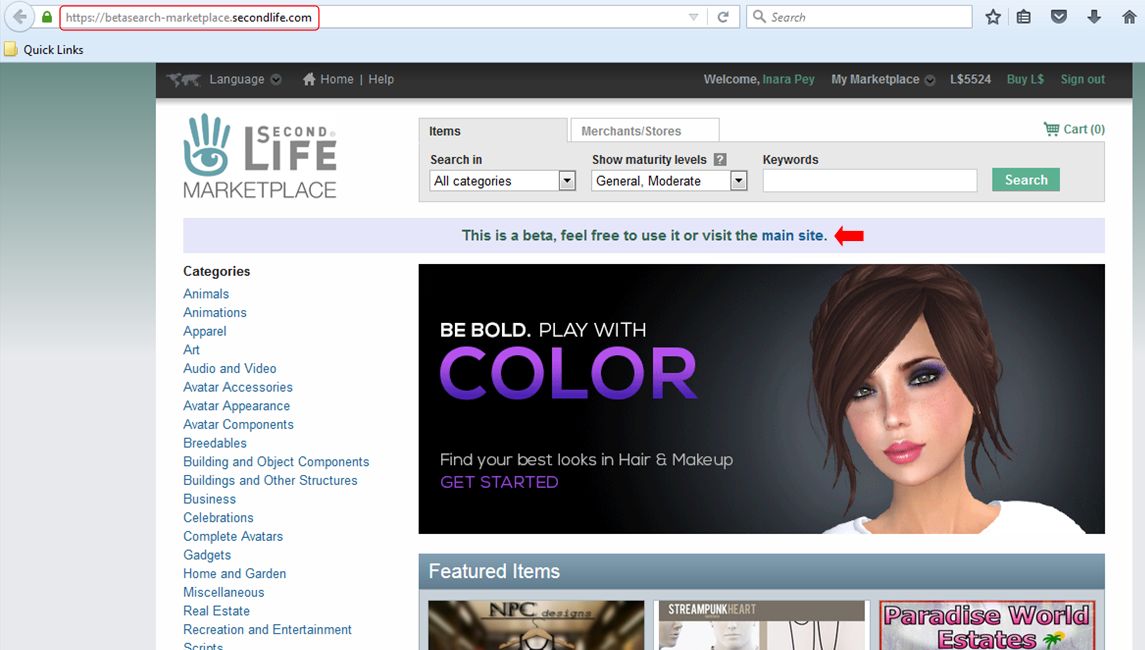
On Monday, March 6th, Linden Lab has published a blog post on faster credit processing and pay-out, together with changes to fee structure for processing credit and paying real money to users’ PayPal and Skrill accounts, and on the fees charged for purchasing L$ on the LindeX. both of these fee changes coming into effect as from Tuesday, April 5th, 2016.
This is an important notification, and one which should be read in full. However, the core changes the Lab are making are quoted below:
Faster Credit Processing
We’re happy to announce that we will significantly improve how quickly we’re able to process a majority of credit requests.
Based on current data, we estimate that the upgrades we’ve made will allow approximately 75% of process credit requests to be completed within 2 business days.
For a minority of requests, the process may still take 5 business days. Because we’re dealing with sending real money to users around the world, we may require additional information and perform other processes that could impact the time needed. A good rule of thumb is that the better we know you as a customer, the more likely it is we’ll be able to quickly process your credit requests.
Changes to the Fee Structure
In addition to taking time, processing credit and paying real money to users’ PayPal and Skrill accounts incurs costs to Linden Lab. Each transaction actually costs us more than the $1 (USD) fee we have been charging. To address that and in light of the significant investments we’ve made to improve the related systems and processes, we will be making some adjustments to the fee structure, beginning next month.
As of April 5, 2016, instead of charging a flat fee of $1 (USD) per transaction, we will charge a fee of 1.5% of the transaction value, with a minimum fee of $3 (USD) and a maximum of $15 (USD). Additionally, the fee for purchasing L$ on the LindeX will increase 10¢, from $0.30 (USD) to $0.40 (USD) per transaction.
Compliance and improved processing has been one of the core focus areas for Linden Lab over the course of that past 12+ months. Work which has involved, among other things, the formation of a subsidiary company, and which is intended to support both Second Life and Project Sansar. As such, the post from the Lab would seem to indicate the major part of this effort is now complete, and that, as promised through various discussions such as Lab Chat, users will be able to enjoy faster payouts, albeit it with increased fees.
Latif’s profile, March 4th, 2016, as updated by his SL partner Krintina Deschanel
I’ve received word through Thoys Pan and Dahlia Trimble that Latif Khalifa has passed away after losing his battle against a long illness.
A software engineer by profession and known in Second Life and OpenSimulator as an enthusiastic technologist, content creator, and viewer developer, he was responsible for the popular Radegast open metaverse lightweight client, as well as contributing to third-party viewer development, notably through Singularity, from which he forked his own viewer, Replex, in 2014.
I first got to know Latif as a result of my growing interest in the viewer ecosystem within Second Life. In fact, it was partially through his encouragement and the conversations we had, that I started blogging about viewers in greater and more informed detail. We became better acquainted in 2011 as he was enhancing Radegast and preparing for the release of Radegast 2.0, and I was privileged to be able to preview the work on several occasions. We also enjoyed many discussions on a range of subjects inside and outside of Second Life, something which led Latif into inviting me to join his Advanced Worlds Group in SL.
Occasionally irascible in the heat of impassioned discussion, Latif more than compensated for this with a generous heart and supporting nature, always willing to offer a helping hand, words of encouragement and friendship.
Commenting on Google+ after hearing the news, Dahlia Trimble said:
I’m very sad to hear that we lost Latif Kalifa
Latif was a good friend and collaborator. He was very helpful when I was implementing mesh physics, materials support, and particle system enhancements in OpenSimulator and also contributed many other fixes and enhancements He was the primary maintainer for libopenmetaverse for the last several years. He was the primary developer of the Radegast viewer which, among other features, had many features for the visually impaired. He was also a major contributor to PHP. His passing is a huge loss to me and I’m sure it is for the field of virtual worlds as well.
Doubtless, many within the metaverse community, including myself, will feel the same way on hearing the news. My condolences to his family, Kristina and all those closest to him at this time.
Tony Dyson, the creator of R2-D2 and Emmy-nominated film SFx supervisor who worked on films such as Superman 2 and Moonraker, Dragon Slayer, Saturn 3 and The Empire Strikes Back, has passed away.
Professor, author, educator, and more, Tony Dyson was also keenly interested in Second Life.
He first became involved with the platform, as Azar Shelman, while investigating distance learning mediums, and recognised the Second Life’s potential as a means of creating real-time animation, something he had tried to do outside of the platform without much success.
As a result of getting involved in SL, he was introduced to machinima producer and publisher Chantal Harvey, (via Phalen Fairchild), and they found they had much in common. Chantal invited Tony to head the jury in the 2012 48 Hour Film Project for machinima, and thus a working collaboration between the two of them was born.
As well as investigating ways and means to produce better machinima, this collaboration led to the development of Bobbekins, interactive e-books for children which would utilised advanced animation, music, and machinima shot in Second Life, and illustrated by another SL resident, Dawny Daviau.
Bobbekins was developed on the idea that children expect to engage all their senses when involved in a story or learning exercise – something to which educators can attest. Filming took place in Toy City, created by Tony as a constantly changing place discovered by the alien Bobbekins, who claimed it as their home. The books were developed under the Netdreamer Publications banner authored by Tony, illustrated by Dawny and edited by Chantal, and the first book in the series, Medieval Farm, is still available through Amazon (and you can read more on the project here).
Bobbekins
However, it is the builder of R2-D2 that he will be most clearly remembered. A regular guest at science-fiction conventions around the world, he never lost his love of the cylindrical little robot, and used the fame he gained through his involvement in star Wars to talk about creativity and learning and give ene[encouragement to young people to pursue their creative endeavours.
As well as building the original eight R2-D2 units, Tony Dyson was responsible for the design of Hector, the robotic antagonist in Saturn 3, and developed a robotic character modelled on (and voiced by) John Cleese for a series of television adverts aired in the 1980s for Sony. He also designed robots for Philips and Toshiba.
Tony Dyson had a wonderful view on creativity “Be playful,” he told the The Times of Malta newspaper in 2015. “Never stop playing. If you look at life the way it really should be – enjoyed – then you become very creative”. It’s a view he shared with Shad Engkilterra at the Malta Comic Con in 2015.
Tony Dyson passed away at his home on the island of Gozo, Malta. My condolences to his family, and to Chantal and Dawny, and those who knew him.
Writing in Readwrite on March 2nd, Ryan Matthew Pierson looks at Linden Lab’s Project Sansar and the Future of Virtual Reality. It’s an interesting article in that Mr. Pierson is a journalist who likes to research his subject, rather than relying on cliché or the input of jaded pundits.
As such, what is presented is a brief, but fair potted history of Second Life, charting the highs and lows, and pointing out that while it can be “dark” it’s simply not all about the adult naughties and nasties. So it is that Mr. Pierson charts the highs and lows of Second Life, with input from someone who know it well: Gary Wisniewski (Wiz Nordberg in SL) the founder of Treet.TV.
Starting with the rise in SL’s popularity in 2006/7, thanks to the attention of the media, the reader who might be unfamiliar with Second Life is given glimpses into the platform’s magic which are painted as effectively with words as they might be illustrated by an image:
You could travel quickly from island to island, experiencing a fantasy world filled with a lush forest one minute and a sprawling post-apocalyptic CyberPunk-style city the next. Just about everywhere you went, there were crowds of people taking in the sights, chatting about their experiences, or dancing the night away in one of Second Life’s many nightclubs.
He also touches on the broad appeal of the platform:
This appeal extended well beyond tech-savvy early adopters. Many residents found that you could do things in Second Life that transcended physical disadvantages. For example, someone bound to a wheelchair could dance the night away in Second Life’s nightclubs, or even fly through a mountain range like a superhero.
Ryan Matthew Pierson
The darker side of SL isn’t shirked, as noted, with Mr. Pierson pointing out the platform did suffer from a reputation for seediness – and that the Lab sought to try to address it as best they could through maturity ratings and safeguards, and without impinging unnecessarily on people’s freedom of choice.
From here, and via an all-too-brief mention of Relay for Life (when, oh when will journalists realise the sheer depths of human interest these is to be found within Second Life’s ability to support global fund-raising events in what is – when compared to the physical world costs involved in trying anything nearly so large – so utterly cost-effective? But I digress, as charity isn’t the focus of this article), the piece gently segues into an overview of Project Sansar.
In this, nothing exceptionally new is mentioned regarding the Lab’s new platform, although the parallels with the likes of WordPress and YouTube are avoided. The familiar comments on the VR tech support, the shift in revenue model away from land, and the desire to make it easer for “creators” all get the usual mention, as do the plans to make Sansar more broadly accessible to consumers:
Linden Lab also wants to make Project Sansar more cross-platform accessible. Where Second Life is largely tied to a desktop-only experience, Project Sansar’s users will be able to log in and enjoy the virtual world from various other platforms including mobile devices as well as HMDs.
It’s likely that SL users will find the Readwrite article frustrating for its lack of new information on Project Sansar. However, that more information isn’t provided stems not only from the fact that the Lab isn’t as yet ready to divulge more details – assuming they keep to their desired time scales, I’d expect this to start happening from about the middle of 2016 onwards – but from the fact that Mr. Pierson isn’t actually writing for Second Life users. He’s addressing the audience the Lab is primarily trying to reach: those ready to invest themselves in opportunities presented by the emerging wave of new VR technology.
That said, it’s fair to say the Readwrite piece isn’t perhaps as engaging as Sophie Charara’s recent piece in Wearable, but as an attempt to encapsulate both Second Life and Project Sansar, it’s a pretty good overview of the past and the present – and the Lab’s hoped-for future.
Avatars representing the Dalai Lama and TV Radio personality Cathy Wurzer in Second Life during the Dalai Lama’s address to Mayo Clinic staff, Monday, February 29th
Monday, February 29th saw a special event take place at the chapel of Saint Marys Hospital in down town Rochester, Minnesota, when the Dalai Lama addressed Mayo Clinic staff in a special event which was livestreamed on the Internet and into Second Life, using the Mayo clinic’s in-world facilities.
The address, entitled Compassion in Healthcare, followed on from the 80-year old spiritual leader, who has been undergoing period treatment for prostate cancer at the clinic, speaking for 3 hours – twice what had been planned – before a crowd of 3,000 people in Minneapolis on Sunday, February 21st. That event was to mark the Tibetan New Year, and his Holiness’ address, delivered in English and Tibetan, focused on valuing education and compassion.
The Dalai Lama at the chapel of Saint Marys Hospital, Rochester, Minnesota, where he addressed Mayo Clinic staff, with his words streamed to an audience in Second Life (image credit: event livestream)
The February 29th address was introduced by Mayo Clinic President and CEO John Noseworthy, and moderated by Minnesota TV and radio host Cathy Wurzer. As the address began, both Ms. Wurzer and the Dalai Lama were represented in-world by avatars at the Mayo clinic’s Second Life conference centre. In both cases, care had been taken to ensure the avatars resembled their flesh-and-blood counterparts.
While I missed the first part of the session, when I did arrive, some 80 people from across Second Life were in attendance, and the Dalai Lama himself sounded energised and related stories with good humour and aplomb through his address, and responded to questions from the audience at the venue, it was not clear to me if any questions were taken from the in-world audience.
The Dalai Lama “addresses” the audience in Second Life
While some be tempted to critique the event on the basis that the avatar in-world was not actually operated by the Dalai Lama, they would actually be missing the point. While his holiness may not have been operating the avatar, being seated in the chapel of Saint Marys Hospital, the thoughts and words steaming into Second Life were his, and as such, the event offered a means for people who might never otherwise get to hear him speak, listen to and appreciate his wisdom in an almost first-hand way.
The address, with a question and answer session, lasted a little over 90 minutes. The livestream is currently being archived by the Mayo Clinic, and the event was also filmed in-world. I’ll update this article when either video is publicly available.
Note: Linden Lab has provided the Better Business Bureau with a breakdown of the permanent ban process, which is available for public viewing.
On Sunday, February 21st, I posted an article concerning SL content creator Teager (Breeder’s Choice and Teegle brands). In it I covered the news that Teager was asking people not to buy from her Marketplace store, on account of her accounts having been banned from Second Life.
Some 24 hours after posting that article – and approaching a week after she first started encountering problems, Teager had her accounted released. As I noted in my update to my original post on the situation, the news first came in a * Breeder’s Choice * group announcement, via Teager’s husband, AgentEightySix in SL:
There is news regarding Teager. She has been unbanned. She’s not home right now, she got the email on her phone, but I’m sure she’ll be on a little later. For everyone who donated at the donation box, thank you. No need to do any more. We’ll take it down tonight, and everything can get back to normal around here.
The following day, Tuesday February 23rd, it was confirmed another creator initially banned under similar circumstances, WarmAnimations Lisa, had also had her ban rescinded. In both cases, warnings were given about the risk of further banishment in the event of a re-offence.
The notifications that their bans had been lifted was also the first time both Teager and WarmAnimations Lisa were actually told why they had been banned: they had used images within one or more Marketplace listings which were deemed to be “not acceptable” – the actual items specified in the listings did not appear to be in question.
While objecting to an image in a listing, even one rated as Adult, may sound odd, it is worth remembering that there are subjects which can still be deemed as offensive or disturbing even among those who have consciously opted to enable the Adult content rating when browsing the Marketplace. This is something content creators should keep in mind when preparing their listings; the Adult rating isn’t necessarily a carte blanche allowance to post absolutely anything.
But that said, for the Lab to immediately respond with an outright ban, as was the case with Teager and WarmAnimations Lisa (and possibly others) without warning nor explanation, is, in five words: excessive and completely heavy-handed.
Even with the best will in the world people make mistakes. They’re not wilfully breaking the policy; they’re not attempting any kind of subversion, they have simply erred. This can happen even when they’ve read all the standards, requirements and policies related to something. As such, there are cases where people should be given – for want of a better term – the benefit of the doubt before a hand starts reaching for the ban hammer.
As it is, Linden Lab can remove any content at any time from both the Marketplace and / or in-world at any time, might it not have been better to go that route first with these situations? That is, remove the content causing the problem; communicate with the affected content creators and explain what has been done, why it has been done, and issue any appropriate warning (if necessary) on the possible consequences of future transgressions.
Such an approach achieves a number of beneficial goals for the Lab:
It allows the offending images to be removed without fuss
It offers a clear explanation of what has been done and why
It allows said content creators to consider any other items they have listed with images which might be considered “not acceptable”, and thus replace said images
It may allow word to spread through the content creation community without undue rancour or drama, so that others with possibly questionable images in their listings might also replace them, removing the need for future actions on the Lab’s part
It demonstrates that Linden Lab recognises that people can, and do, make mistakes, and that most are prepared to accept their error if it is properly explained to them
It demonstrates consideration without removing the explicit understanding that there are policies which must be adhered to, and that repeated violations won’t be tolerated.
Obviously, there are times when it is appropriate / necessary for the ban hammer to be wielded within Second Life. no-one is denying that. But equally, there are times when it should not be seen as the immediate and preferred tool of action when there are other means to initially handle a situation. This is a balance those at the Lab with access to the ban tool seem to have problems in understanding.
Over the past couple of years, the Lab has been investing time and effort in rebuilding users’ confidence in itself on several fronts. If nothing else, an over-reliance on bans as first response to policy transgressions when there are potentially other ways to deal with matters, risks unravelling at least some of that restored confidence.
As it is, when looking specifically at both Teager’s and WarmAnimations Lisa’s situation, it’s very hard not to reach the conclusion they were handled in a manner akin to the image at the top of this article.