The Machinima effect take two and adding some Steam to the mix

In launching The Drax Files recently, Draxtor Despres has caused some bloggers to re-open the question of promoting of Second Life through the use of machinima, with Ciaran Laval in particular asking could LL follow Draxtor’s lead and can resident-made machinima be used to promote Second Life?

These questions were actually the focus of some thought on my part back in 2011, when – having been prompted by a tweet from Crap Mariner, I mused on advertising SL: the machinima effect, and it seems worthwhile both revisiting those thoughts and updating them with a few further ideas and thoughts.

The video that prompted my original post on the subject may not be focused on Second Life, but it is ample proof of how machinima can be used to promote a product. What’s more it is fun.

Back in 2011, it prompted Crap to tweet: Linden Lab needs to make some ads like this for Second Life – something which caused me to reply: Or #LL should work with the machinima folk for suitable ads: say a competition; top 3 promoted on YT, SL.com, etc., which inturn prompted my original post on this idea,

Today, as Ciaran points out, and as I’ve covered for the last few years in this blog (albeit haphazardly), the University of Western Australia holds an annual MachinimUWA Challenge, which this year sees a prize pool of L$1.1 million for machinima makers submitting entries on the theme of “Reflections”.

MachinimUWA VI: showing the potential for machinima as a promotional tool

What makes MachinimUWA particularly relevant to this discussion is that not only does it showcase machinima as an art form, it actually promotes the University of Western Australia. The promotion may actually be very low-key, and a somewhat secondary consideration in terms of storytelling for those entering the competition, but it is there. This year, for example, entrants are required to film in “At least one of the 3 major spaces of Reflection at UWA … (The Reflection Pond, The Sunken Gardens, The Somerville Auditorium).” With the rules going on to note that entrants “may choose to film in any other area of the campus …  or … include all 3 locations.” Thus, the UWA’s in-world facilities form the nucleus of the competition in terms of providing the backdrop for whatever stories entrants opt to tell.

Continue reading “The Machinima effect take two and adding some Steam to the mix”

Sliding, but not yet dead

A little while ago, Nalates Urriah pulled together a set of statistics from diverse sources (all of which are duly credited) which help to paint a decent picture of where SL stands away from all the hype over falling region numbers, etc.

When taken together, the stats – which cover daily sign-ups, concurrency (daily / monthly), region numbers and even forum usage, all for periods of at least a year – present an interesting picture of Second Life which Nalates interprets in her own inimitable way. While they show that Second Life has in many respects been on a steady downward slide (particularly in terms of overall usage), the situation is far from unrecoverable. Indeed, some of the figures are, at least for a moment, trending upwards again – although without more detailed data and a wider breakdown, it is impossible to draw any conclusions as to what this might signify in the short-term and thus how it might be projected in the medium-, or long-term.

There are significant gaps in the data (through no fault of those who gathered / present it – the information simply isn’t available). For example, while sign-ups can be shown to have been at least constant (or have increased slightly) through the 2-year period, there is no practical context to the figures in terms of users actually being retained. A further problem with the figures is that there is no indicator as to the percent / proportion of these sign-ups actually being alternate accounts, rather than actual new users (although LL does apparently have a mechanism in place for distinguishing between the two).

Daily sign-ups, as reported by Tateru Nino and extrapolated and presented by Nalates Urriah, with monthly concurrency for 2012 inset  – click

Certainly, Rod Humble did state at in his first (and last) SLCC address in August 2011 the rise of user sign-ups did coincide with an upswing in identifiable uniques (i.e. genuine new users, rather than alternate accounts), which he clearly defined as people signing-up, downloading the viewer and logging in to SL.

The user concurrency chart is somewhat more meaningful, in that it charts concurrency for a more extended period from December 2009 through to the present day. As such, any trend shown is liable to be somewhat more reliable, although there are still problems in interpreting the data as a whole. For example, it does show a consistent downward trend in concurrency since the late “boom” period when SL was at the height of its own Hype Cycle “peak of over-inflated expectations”; but precisely what this means is still somewhat open to interpretation.

Daily concurrency, Dec 09 through Jan 2013, from Tateru Nino, as extrapolated by Nalates Urriah

Less Doesn’t Automatically Mean Fewer

A decline in concurrency doesn’t automatically mean a substantial drop in overall user numbers (although it is hard to completely divorce the two). There have been a number of factors which have contributed to some aspects of the decline outside of falling user numbers. Linden Lab caused something of a decline when they clamped-down on the use of bots. More recently, factors such as changing demographics and changing user habits appear to have also contributed to falls in concurrency.

These latter points were indicated again indicated by Rod Humble in his SLCC 2011 address, when he drew attention to the fact that the overall demographic of SL users was shifting, age-wise, more toward people in the mid-to-late 20s, and that they were collectively logging-on to SL for shorter periods. He also indicated that LL had charted a noticeable increase in the way SL users were interacting without actually going in-world – through the mechanism of profile feeds, for example.

Continue reading “Sliding, but not yet dead”

Commerce Team announces Magic Box retirement

The Commerce Team have announced the retirement of Magic Boxes is to commence in April. The news, made via Commerce Team Linden, is being circulated to merchants via e-mail as well as having been posted to the Commerce Forum,. It reads in full:

As you already know, about a year ago, we introduced Direct Delivery, a more reliable and faster method to deliver merchandise to your Second Life Marketplace customers. To complete the migration from Magic Boxes to Direct Delivery, we’re starting a phased shutdown of Magic Boxes. In order to keep listings that are currently using the Magic Boxes active, you will need to convert them to the Direct Delivery system. We will be sending email to all Merchants who have active listings that are still using Magic Boxes.

Important dates for this plan:

  • April 2, 2013:
    • Merchants will no longer be able to list unlimited-quantity items for L$10 or less using Magic Boxes.
    • Any active, unlimited-quantity listings for L$10 or less using Magic Boxes will be unlisted.
  • April 16, 2013:
    • Merchants will no longer be able to list unlimited-quantity items using Magic Boxes, regardless of price.
    • Any remaining active, unlimited-quantity listings using Magic Boxes will be unlisted, regardless of price.

For the time being, limited-quantity items can continue to use Magic Boxes and will not be affected. “Limited-quantity” refers to items that the Merchant does not have rights to copy (such as breedable animals which are “no copy” for the seller).

We do not have a Magic Box shutdown date for the migration of limited-quantity listings at this time. After we designate that date, we will give 30 days’ notice so that Merchants will have time to migrate those items. However, to avoid disruption of your listings by the Magic Box phase-out, we strongly encourage you to convert all of your listings to Direct Delivery as soon as possible.

For more information on Direct Delivery and migrating to Direct Delivery, please see the Knowledge Base. If you have questions or problems, please contact customer support for help.

SL Marketplace: Magic Box "retirement" commences in April.
SL Marketplace: Magic Box “retirement” commences in April.

Direct Delivery launched on March 21st 2011, I was perhaps one of the first to dive in a give it a go, and my own experience was – and remains – broadly positive. However, it is fair to say that it wasn’t long before issues started to occur – and to grow in significance. So much so, and despite attempts by the Commerce Team to drive merchants into using Direst Delivery, the date by which Magic Boxes have been due to start being retired has been repeatedly pushed back over the course of the past twelve months as issues with both Direct Delivery and matters such a listing errors, repeated errors in listing enhancements billing and other upsets, served to erode merchants’ trust in both the Marketplace and LL’s own Commerce Team.

This latter point was not helped by the Commerce Team themselves, who rather than engage with merchants, opted to withdraw from communications (despite Rod Humble stepping into the fray – twice), and in obfuscating matters further by simply ceasing to publish updates on progress made in fixing issues (the last update being around November 2012, prior to all updates being quietly removed from the Merchants’ sub-forum within the Commerce Forum.

The current situation regarding outstanding issues with the Marketplace and Direct Delivery remains unclear. While reports of issues and problems seem to have decreased somewhat, it is unclear whether this is due to the Commerce Team making progress in resolving issues or perhaps merchants have simply given up trying to raise the same concerns over and again. As such, it is possible that this announcement may be met with some trepidation, even though no final date for shutting down all Magic Box capabilities has been given.

LL introduce ads on the SL webpages

secondlifeNot too long ago, I discussed the matter of tier and revenue. The main thrust of the piece was an attempt to point out why tier cuts, rather than being the magic bullet which will solve all of SL’s perceived woes, are actually likely to inflict a mortal wound.

As a part of that piece, I scratched the surface of other options open to LL for revenue generation – including the use of advertising. Now, to be fair, the idea wasn’t mine – it is something my dearest Lord of Dee, Ciaran Laval suggested in his blog (which, if not on your reading list, should be).

Indeed, outside of SL, the Lab have already dipped a toe into the use of web advertising as a potential source of revenue in launching dio – which is specifically geared towards revenue-through-ads.

dio: LL dipping a toe into the waters of revenue-through ads

Well, now it seems as though LL are taking Ciaran’s advice on board: advertising using Google AdSense / AdChoice is starting to filter into the SL webpages.

Again, Ciaran reported on this ahead of me, and a thread is up on the forums concerning the move – and the negativity is strong, sadly. The ads themselves comprise a banner at the top of some pages, together with a vertical ad space down the right side of a page. As such, they are not overly obtrusive, but they are noticeable.

Google AdSensse / AdChoice ads starting to filter through the SL website
Google AdSense / AdChoice ads starting to filter through the SL website

I could have sworn I actually had an ad appear on my dashboard earlier, but I was scootling around so much, I’m not sure – and repeated clicks on my browser’s BACK button failed to turn up anything.

As mentioned above, the reactions on the forum thread haven’t been overly positive to this move – but it is hard to fault it. Advertising is a fact of life on the web, and if LL can use it to generate a modest additional flow of revenue to their coffers, then all power to them – it’s not as if we can’t avoid the ads if we so wish; there are plenty of browser plug-ins available for those wo don’t wish to see ads popping-up hither and thither.

Currently, the ads have yet to hit the SL Marketplace, which would appear to be an ideal target for advertising, given the volume of traffic it receives, providing the page layout can be tweaked sufficiently enough so that real world ads aren’t getting confused for SL product ads. As I mentioned back in January, when discussing tier, the Marketplace would potentially be the ideal spot for LL to try-out Ciaran’s idea for strategic partnerships with other companies.

It has been suggested that perhaps the system could be extended to provide in-world businesses the opportunity to use the advertising space as well. I’m actually not convinced this would actually work, for a number of reasons. Which is not to say it shouldn’t be tried, is the software would allow for it in a meaningful way (i.e. links to in-world stores and / or SLMP listings. Certainly, it wouldn’t be the first time LL had offered direct advertising opportunities to users, as those of us who remember the MOTD promotional “opportunity” from 2010. However, were LL able to walk a similar path again, I would hope they’d avoid trying to charge people between $1,500 and $4,500 USD, as they did with that offer …

Overall, there is no real harm in LL seeking to generate money in this way – and it really shouldn’t be taken to mean the company is in “dire straits” financially. It may not generate a significantly large amount of revenue when compared to land, but that doesn’t invalidate the move as a means of removing at least a further small portion of reliance on tier as the company’s sole means of revenue generation.

Marketplace e-mail preference updates

While checking to see if there have been any further updates on resolving the various issues affecting the Marketplace and merchants (the last update having been in November 2012, and the progress sticky has bow been removed), I came across the following.

On February 5th, Commerce Team Linden posted an announcement that user’s e-mail preferences for the Marketplace have finally been updated and expanded. The announcement itself is brief, reading:

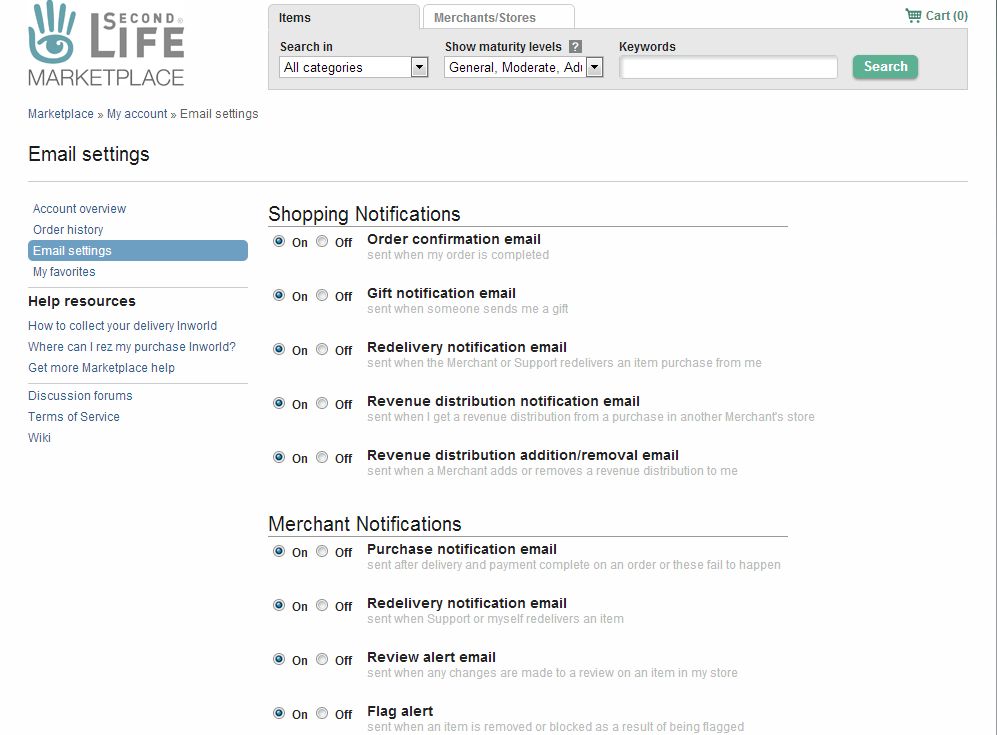
Marketplace now supports the ability to set email preferences. You will now be able to turn emails on or off. In addition, new emails have been added and work has been done on stability to prevent delays in email delivery. Please see the Release Notes or the Knowledge Base articles for Merchants or Shoppers for more information.

The new e-mail notification options can be found by logging-in to the Marketplace and going to My Marketplace (menu bar, top right of the page) > My Account > E-mail Settings (options on the left side of the page). The updated settings allow both shoppers and merchants define when they receive e-mail notifications, as follows (note that all options are “on” by default):

Merchants:

  • Purchase notification email – sent after delivery and payment complete on an order or these fail to happen
  • Redelivery notification email – sent when Support or the merchant redelivers an item
  • Review alert email – sent when any changes are made to a review on an item in the merchant’s store
  • Flag alert – sent when an item is removed or blocked as a result of being flagged

Shoppers:

  • Order confirmation email – sent when an order is completed
  • Gift notification email – sent when someone received a gift from someone else
  • Redelivery notification email – sent when the Merchant or Support redelivers a purchased item
  • Revenue distribution notification email – sent when a shopper get a revenue distribution from a purchase in another Merchant’s store
  • Revenue distribution addition/removal email – sent when a Merchant adds or removes a revenue distribution to the shopper.
New SL Marketplace e-mail notification options

The review and flag e-mail notifications are liable to find particular favour with merchants (indeed, they are already, given some of the comments in the thread), as these have been oft-requested by merchants.

Related Links

Taking a Leap (Motion) into Second Life

While I’ve been buried in dio, working on an interactive guide to … something … Linden Lab slipped out another little surprise this week via the blog.

Reaching Out into Second Life looks at the use of Leap Motion for interacting with SL. The work is being carried out by Simon Linden, and is clearly tagged as experimental, but it shows the potential of Second Life as a platform for exploring gesture-based interactions with controllers like Leap Motion.

Nor are the Lab keeping matters to themselves. The blog post states:

If you have a Leap Motion controller and would like to experiment with the Second Life Viewer, you can find the source code for these experiments at http://bitbucket.org/simon_linden/viewer-rabbit. The indra/newview/llleapmotioncontroller.cpp file contains most new functionality. The Viewer is built to work in several different modes. These modes can be used to control the avatar while flying, send data into Second Life for scripts to intercept, detect hand motions that trigger avatar gestures, or control the camera and avatar movement. To switch between these modes use the “LeapMotionTestMode” value in the Debug Settings, accessible from the Advanced menu.

Commenting on his work, Simon Linden re-emphasised the experimental nature of the work and it’s possibilities, “It’s nowhere near a real feature. But it’s certainly fun to make things happen waving your hand around … I think we’ll see some very interesting stuff in the future.” He went on, “I think there’s potential there, along with touch screens, but it’s going to take a lot of work and experiments to see what really is good or not.”

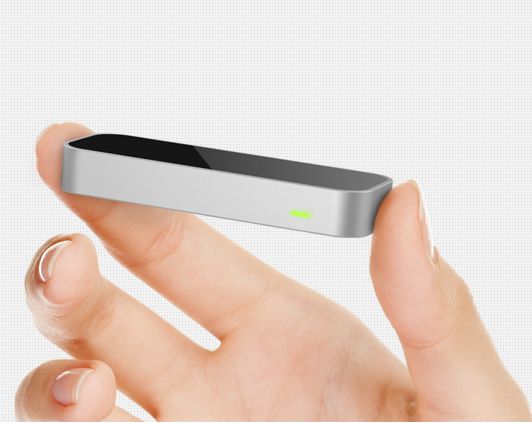
The Leap Motion device (image courtesy of leapmotion.com)
The Leap Motion device for Windows / Mac (image courtesy of leapmotion.com)

If you’re wondering why Simon has his hand cocked sideways when firing the pop-gun in the video, he’s not trying to emulate any cool Hollywood or gangster-style of shooting, the Leap Motion device sensors demonstrated a blind spot when he was testing the unit, and would not register his thumb motion if he had his thumb pointing upwards.

For those wishing to try things out for themselves, Leap Motion can be ordered from the Leap Motion website, with prices starting from $69.99 + shipping (for the USA), which does not make it prohibitively expensive. It’s also capable of being put to a wide variety of uses as Leap Motion’s own promo video demonstrates.

Related Links