I don’t know Misty Mole (aka Caliandris Pendragon), but I can say I know her work, and have enjoed exploring some of it, and blogging about it here.
As a member of the Linden Department of Public Works from 2008, Misty had worked on a range of high-profile projects, including Nautilus, the Linden Realms game, Linden Homes, Cape Ekim (and the oft-forgotten Professor Linden) and Pyri Peaks. I’ve had great fun exploring the latter two, and admit I enjoyed Linden Realms when it first appeared, and still sometimes drop back there simply because I’m feeling a tad silly, while my Linden Home has been more than comfortable for me. I’ve also spent time sailing on (and diving under) the Sea of Fables. Misty had a hand (or hands) in all of these, and a whole lot more.
Sadly, Misty Mole is no more. She has left the ranks of the Moles in what appears to be less-than-happy circumstances. As a farewell, she has produced a video highlighting her work – and her skill as a composer and musician (she’s often provide music for the Lab to use within LDPW builds). It’s a celebration of her work – and rightly so. It’s also a fitting reminder of the amount of work carried out by the unsung heroes of the Moles.
It’s also something which has me itching to don my hiking boots and go out and explore other Moley places around SL.
Thanks, Misty for all your work – and thanks to the Moles as well.
Following-on from the announcement made in week 25 that the SL Marketplace payment system would be “moving” to the Second Life payment system, a further brief Commerce forum post has been issued confirming the move has now been completed.
The forum post indicates that users will be able to pay for goods with Linden Dollars (as has always been the case), or select a new payment method. and includes links to the following resources:
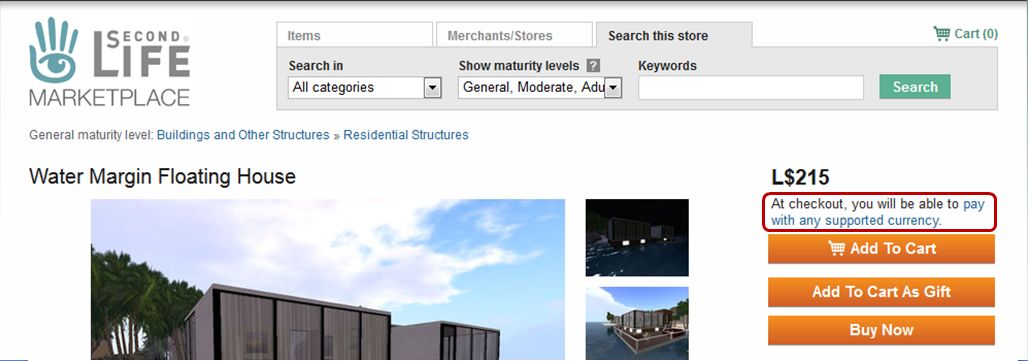
SL Marketplace: no more USD prices for goods on item pages, but a new notice about payment methods and currencies.
There are some changes to the SL Marketplace as a result of this update:
When viewing items in the Marketplace, only the LS price is displayed by default. There is no longer any USD price
All items now include a note that “At checkout, you will be able to pay with any supported currency“, directly under the L$ price. The link will display the Accepted currencies and payment methods section of the Billing page in the Knowledge Base, which lists the credit / debit / charge cars recognised by Linden Lab and the currencies in which payments can be accepted using them.
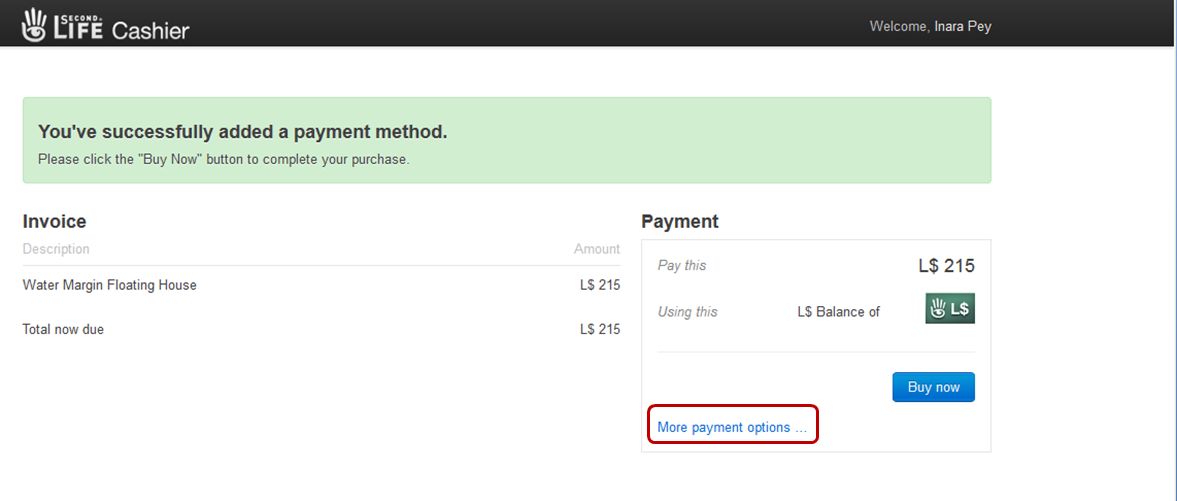
The other major change can be seen when clicking on the Checkout button from your shopping cart. This takes you to the Second Life Cashier Page, which lists the items you are purchasing, unit price for each and the total payable.
The revised SL Cashier payments page for the SL Marketplace
To the right of this is the amount payable and your current payment method, and a link allowing you to add more payment options.
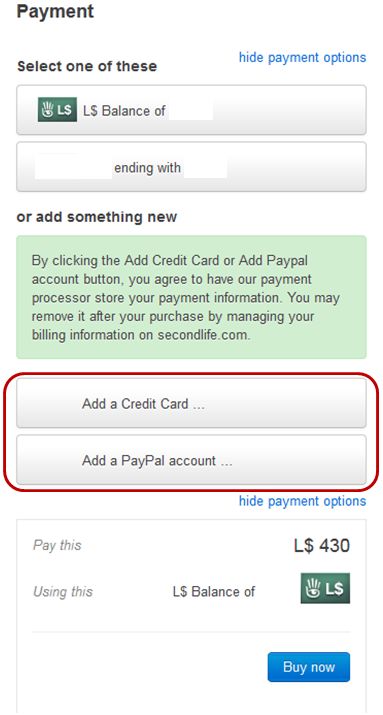
The expanded Payment section showing all recorded payment methods and button to add further methods to your account
Clicking on this link expands the Payment section to display:
Your current payment options
Buttons for adding additional payment methods (credit card, etc., or PayPal).
If you wish you use an existing alternate payment method, simply click on the required button in the upper section of the expanded screen.
To add an additional payment method, click on the required method (note the green-background text above the payment option buttons) and follow the on-screen instructions.
When you are ready to complete the transaction, click the Buy Now button.
Note: I’m not sure if, after selecting and using an alternative payment option, this becomes your default option for all future payments (and thus appearing the “Using this” section of the Payment box of the Cashier Page. This is because I use L$ for all my Marketplace purchases, and have no wish to use an alternate payment method I have registered with the Lab.
At that time, the Beeb looked at SL form a largely corporate perspective, highlighting some of the pitfalls of the platform (not all of which were of LL’s making; there is a certain amount of blame to be placed with the media for spinning the hype to such an extent that corporations were foolish enough to all leaping without looking).
In the latest piece, which takes the form of a video cast, the Beeb again largely retreads the same theme, seeing SL purely in terms of being a corporate tool. While the piece starts off somewhat positively, looking at the in-world music group, Redzone, and highlighting how they can reach a global audience at minimal cost, it quickly ramps down to kind of narrow-focus piece which tends to typify the fact that, as Draxtor Depres has commented in our Drax Files conversations, much of the media is actually too lazy to make the effort to actually report on SL, and is far more content to retread old themes.
In the BBC’s case, this takes the form of once more banging the corporate drum as to how companies poured into SL, “spent millions”, only to subsequently pull-out and raised the idea that “everyone” who used SL has “moved on” to other social media platforms (as if it is a case of one or the other).
The general observation that corporations are somewhat more cautious nowadays when investing in social media is actually a fair point to make. However, as an attempt to address the question of “whatever happened to Second Life”, it is at best lopsided, once again generating the impression that simply because “big business” failed to understand and exploit Second Life, the platform itself has passed its sell-by date.
LL’s infographic on SL’s 10th anniversary (click to enlarge)
It’s an unfortunate angle to take, one which suggests that the BBC consider Second Life to be something barely worth the effort of addressing beyond the scope of past reports, despite this weekend marking the platform’s tenth anniversary. And it is hardly likely that the Beeb weren’t aware of this, given the press release and infographic (rright) the Lab issued earlier in the week on the subject.
In fact it’s fair to say that rather than managing to answer the very question they ask in the title of the piece, the BBC seem content to raise several more questions about SL – and then leave them hanging. Which is a shame, because had they bothered to make something of an effort instead of opting the “rinse / repeat” route, they may have discovered some surprising answers.
Making something of an effort is exactly what Benny Evangelista, a tech and business writer at the San Francisco Chronicle did. No doubt spurred-on by the Lab’s press release and infographic, Evangelista interviews the Lab’s CEO, Rod Humble. In doing so, he is able to present a piece which is informative, providing some interesting insight into goings-on at the Lab and Humble’s own thinking on the future. In doing so, it goes a heck of a lot further in answering the question marks left in the BBC’s piece.
Take, for example the issue of corporations and business in SL. The BBC point to IBM and others with the attitude, “they came, they failed, they left – game over”. However, when raising much the same point with Humble, Evangelista gets a very different answer which presents a much broader and fairer perspective:
Evangelista: There was once great talk about companies coming in and setting up virtual shops, and it being a potential source of revenue for them. And then they pulled back.
Humble: And it was taken up by amateurs or people who specialized in it. So (of) the people who make money now within Second Life, there are people who sublet land, and they help maintain the land.
Humble: providing some insight and answering some of the critics (image courtesy of Bloomberg)
And there are people who make good money – and by good money, I mean hundreds of thousands of dollars a year – making hair, making virtual pets and animals. So it’s those people who are used to the virtual world, rather than big, established companies who are like, “OK, we’ll have a showroom within the world.” So I think (the promise of virtual commerce) was realized, it was just in a very different way.
I always hate waxing pretentious, but indulge me for a moment. I do think there’s a shift within the worldwide economy of people making money in more diverse ways. The nature of work itself is changing. In the same way that people make a good livelihood making objects in Second Life, you’re starting to see people generate significant revenue from posting their cat pictures on YouTube. Now you get an ad-sharing thing. That’s a trend that’s going to continue, and it’s certainly helped propel Second Life.
Humble also offers an alternative view to the idea that SL has perhaps failed because it is not as easy to navigate and understand as the Internet, and hence not as popular as social networking sites:
It’s different for sure. I think there is something (about) being within a 3-D space that’s entirely user-created that is more magical than looking at an image on a Web browser.
Usually it’s around that sense of place. But also there’s a sense of intimacy when you’re talking with someone in a virtual world, and at any time you can walk around, and you get to see what they’ve chosen to represent themselves, that I think is different from pushing a text message somewhere. I don’t know why it’s different, but it is.
Elsewhere in the article, Humble touches on the future and the fact that LL are still investing in Second Life and “virtual worlds”, although – and as he stated a while back in this blog – whatever they’re working on is still a few years down the road. We also know they are investing in at least one other virtual world development: Philip Rosedale’s High Fidelity (scroll down the page of the list of investors).
The Lab has launched the latest step in their campaign to celebrate SL’s tenth anniversary – and it is an offer certain to delight and frustrate.
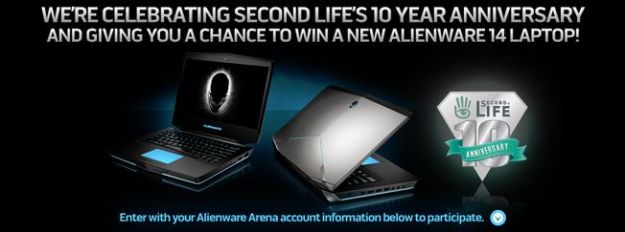
“Celebrate SL10B With a Chance to Win a New Alienware 14 Laptop!” reads the headline of a new blog post, which goes on to read in part:
To help celebrate Second Life’s tenth birthday, we’re running a co-promotion with Alienware , the pioneer in specialty high-performance PC gaming systems!
From now until July 17, 2013, Second Life users can enter to win a brand new Alienware 14 laptop! For contest details and to enter today, visit here.
The Alienware 14 has some impressive specs: Intel i7QM processor, 8 or 16Gb of memory, either an NVIDIA® GeForce® GT 750M with 1GB GDDR5 or NVIDIA® GeForce® GTX 765M with 2GB GDDR5, Windows 7 or 8 64-bit, etc. Exactly which model is up for grabs as a prize is unclear from the promotion, but I’d suspect the entry-level model might be a safe bet.
HOWEVER, before you start rubbing your hands in glee at the prospect of winning a new laptop, be advised that if you’re outside the US, you’re stuffed. You’re not eligible to enter.
There are potentially some very good reasons why the offer is limited to US residents only. For one thing, running a truly international competition with such an attractive prize with a third-party is going to be something of a logistical load to carry, even allowing for any legal / technical issues involved. It’s also likely that Alienware / Dell themselves limited the scope of the competition so that they are not hit with and headache in running it (and lets face it, “country specific” competitions aren’t actually that unusual for multi-nationals to run). But, the fact remains that in going this route, rather than attempting to develop a competition which is inclusive of all their users, the Lab is again going to be perceived as thumbing its nose at its overseas users.
Even so, the fact remains that, with the number of recent “US-only” promotions the Lab has run in recent months (and remembering that ant “US-only” limitations placed on them may not be LL’s fault, but rather stipulations placed on the offers due to technical or other reasons), it would be nice to see if the Lab could come up with opportunities to win “valuable” prizes and participate promotional offers which are both reflective of and inclusive of their international user base.
Update June 24th: The billing system “move” has now been completed, see my update here.
A new post appeared in the Commerce forum on Tuesday June 18th, announcing that the Marketplace is to “move” to the Second Life billing engine, generating some confusion along the way as to how Marketplace payments are currently processed with regards to Second Life.
The intimation appears to be that although the Marketplace allows for payments for goods to be taken directly from your L$ account, the finances themselves are handled through two different channels, with the Marketplace perhaps still, underneath it all, using elements dating back to the XSL / SLX days. With the upcoming “move”, everything will be handled by the one system, the Second Life billing engine – hence the reference that Commerce Linden will be replaced by Currency Linden as the escrow account for Linden dollar purchases via the Marketplace.
One aspect which appears to have gone largely without comment is that international users will, with the switch-over, apparently see more international payment options offered (one assumes alongside the US dollar payment option). How advantageous this is seen as being is perhaps open to question (the US dollar prices for items on the marketplace are hardly favourable when compared to the straight L$ prices, which already tends to encourage people to use L$ rather than USD for purchasing goods).
The switch-over is due to take place in the week commencing Monday June 24th. no action is required on the part of users or merchants, although the blog post does warn that:
We will be failing any old orders that have not completed in preparation for the switch over, so you may see a refund appear from a stuck order over the next week prior to the release.
If you do start experiencing issue with Marketplace transactions, please ensure you submit a Support ticket. All issues related to billing are fully supported by Customer Support and will be addressed with appropriate priority.
Coming on top of the limited-time offer of the SL10B bear avatar launched last week, the Lab has offered-up more freebies for folk to celebrate SL10B, comprising:
The blog post also reiterates the SL10B Destination Guide category. Anyone organising an event to celebrate SL’s tenth anniversary can submit details of their activity for consideration for inclusion in the special DG category.
Sl10B mesh t-shirts from LL
The post also includes a reminder of the Lab’s SL10B Photo Contest, which could see the lucky winners obtain a homestead region for up to four months.




 Inara Pey: Living in a Modemworld