Skill Gaming enforcement in play; CapEx suspends activities

Saturday, November 1st saw the Skill Gaming Policy from the Lab coming into full effect. Notice of the enforcement was given in a blog post issued by the Lab on Monday, September 29th, which in part read:

As our FAQs explained, applicants to the program who submitted their applications prior to the September 1 deadline have been permitted to continue their skill gaming activity while their applications are reviewed.

Beginning November 1, 2014, the enforcement of our Policy will apply to all Residents, including those with pending Skill Gaming applications that await Linden Lab review and approval. As of that date, any objects or regions found in violation of our Policy will be taken down. We strongly encourage all applicants to submit any outstanding materials for our review as soon as possible so that their applications may be processed before the deadline.

At that time, there had already been a delay in the introduction of the new policy (from August 1st through until September 1st) to allow additional time for applications and applications processing.

The end of October saw further additions to the list of Approved Participants, such that some 94 regions have been reclassified at Skill Gaming regions, each of them offering a mix of games from a pool of 56 games from five approved Skill Gaming Creators. Please refer to the Approved Participants list for an idea of the spread of actual Skill Gaming Operators.

However, the enforcement deadline has brought with it one casuality, although hopefully only temporarily.

Capital Exchange (CapEx) is a fictional stock market simulation game, and although it does not offer any opportunity for direct real-world investment or profit, it does operate on what amounts to a “pay to play basis” through the trading of L$-valued “securities” in the SL-based companies listed with the exchange. As such, it falls under the remit of the Skill Gaming Policy.

Capital Exchange’s application to become a Skill Gaming activity lodged with Linden Lab since just after the new policy was originally announced July 2014, including a reasoned legal opinion from their legal counsel outlining why CapEx is a game of skill under federal and New York State laws. However, at the time the deadline was reached, they had not received formal approval as a Skilled Gaming Operator from the Lab, which has forced CapEx to suspend market activities activity until further notice.

The suspension was announced via statement from CapEx’s CEO Skip Oceanlane published on the CapEx website and via in-world note card givers at the CapEx headquarters. This announcement reads in part:

On July 16, 2014, I filled out the first form for the Skill Gaming Application for Capital Exchange Stock Market Simulation Game. From that point until today, there have been numerous correspondences between me, my law firm, and Linden Lab. As of today we still do not have an official determination, positive or negative, on our application.

I was hoping that because much of the delay has been on the part of Linden Lab, that we would be allowed to operate past the November 1, 2014 deadline set forth in a recent post by Linden Lab. Unfortunately I was informed by Rowan Linden that we cannot. So therefore effective immediately, I am suspending all trading at Capital Exchange until our application is approved or denied by Linden Lab.

Capital Exchange has been hit - hopefully temporarily - by the November 1sr, 2014 enforcement of the new Skill Gaming Policy
Capital Exchange has been hit – hopefully temporarily – by the November 1st, 2014 enforcement of the new Skill Gaming Policy

As a result of this move, as the blog post goes on to state, all trading, including person-to-person transfers (unless they were authorised before the trading halt), payment of dividends is suspended, as is any other activity carried out through Capital Exchange which would violate the Lab’s Skill Gaming policy. However, all other aspects of CapEx, such as posting to the forums (including company news etc.), continues. The announcement also notes that CapEx ATMs will still be in operation for those wishing to deposit / withdraw L$, as the Lab has not indicated that doing so would be violating the new policy.

Please refer to the CapEx blog post for detailed information on the suspension and planned steps, and to the CapEx website for further updates on the situation.

It is not currently clear if other gaming operators within Second Life have been similarly hit by the deadline being reached prior to their application being approved or turned down. It is also not clear whether the deadline for enforcement was set as a result of external pressure to comply with legal requirements, or as a result of an arbitrary decision on the part of the Lab.

If it is the latter, it is hard to fathom why the Lab opted for a blanket enforcement of the policy, rather than allowing further dispensation for those operators / creators who have submitted applications, particularly where the delays in approval appears to lie with the Lab’s own handling of applications (as seems to be the case with CapEx).

Related Links

With thanks to Nalates Urriah for the pointer to the CapEx blog post.

CDN – Lab issues data on improvements

On top of their feature blog post on recent improvements to SL, on which I also blogged, the Lab has also issued a Tools and Technology update with data on the initial deployment of the CDN.

Entitled CDN Unleashed, the post specifically examines the percentage of simulator servers experiencing high load conditions (and therefore potentially a drop in performance) on the (presumably) BlueSteel RC both before and after deployment of the CDN service to that channel – and the difference even caught the Lab off-guard.

ss
Charting servers on a production release candidate channel with high HTTP load conditions before and after we rolled the CDN code onto them (image via Linden Lab)

While a drop in load had been expected prior to the deployment, no-one at the Lab had apparently expected it to be so dramatic that it almost vanishes. Such were the figures that, as the blog post notes, at first those looking at them thought there was something wrong, spending two days investigating and checking and trying to figure out where the error in data came from – only it wasn’t an error; the loads really have been dramatically reduced.

Elsewhere, the blog post notes:

Second Life was originally designed for nearly all data and Viewer interactions to go through the Simulator server. That is, the Viewer would talk almost exclusively to the specific server hosting the region the Resident was in. This architecture had the advantage of giving a single point of control for any session. It also had the disadvantage of making it difficult to address region resource problems or otherwise scale out busy areas.

Over the years we’ve implemented techniques to get around these problems, but one pain point proved difficult to fix: asset delivery, specifically textures and meshes. Recently we implemented the ability to move texture and mesh traffic off the simulator server onto a Content Delivery Network (CDN), dramatically improving download times for Residents while significantly reducing the load on busy servers.

Download times for textures and meshes have been reduced by more than 50% on average, but outside of North America those the improvements are even more dramatic.

Quite how dramatic for those outside North America isn’t clear, quite possibly because the Lab is still gathering data and monitoring things. However, the post does go on to note that in combination with the HTTP pipelining updates now available in the current release viewer (version 3.7.19.295700 at the time of writing), the CDN deployment is leading to as much as an 80% reduction in download times for mesh and texture data. Hence why the Lab is keen to see TPVs adopt the HTTP code as soon as their release cycles permit, so that their users can enjoy the additional boost providing the code on top of enjoying the benefits offered by the CDN.

Again, at the time of writing, the following TPVs already have the HTTP pipelining code updates:

As per the Performance, Performance, Performance blog post, the Lab want to hear back from users on the improvements. Comments can be left on the Performance Improvements forum thread, where Ebbe and Oz has been responding to questions and misconceptions, and Whirly Fizzle has been providing valuable additional information.

Lab asks: how is SL for you?

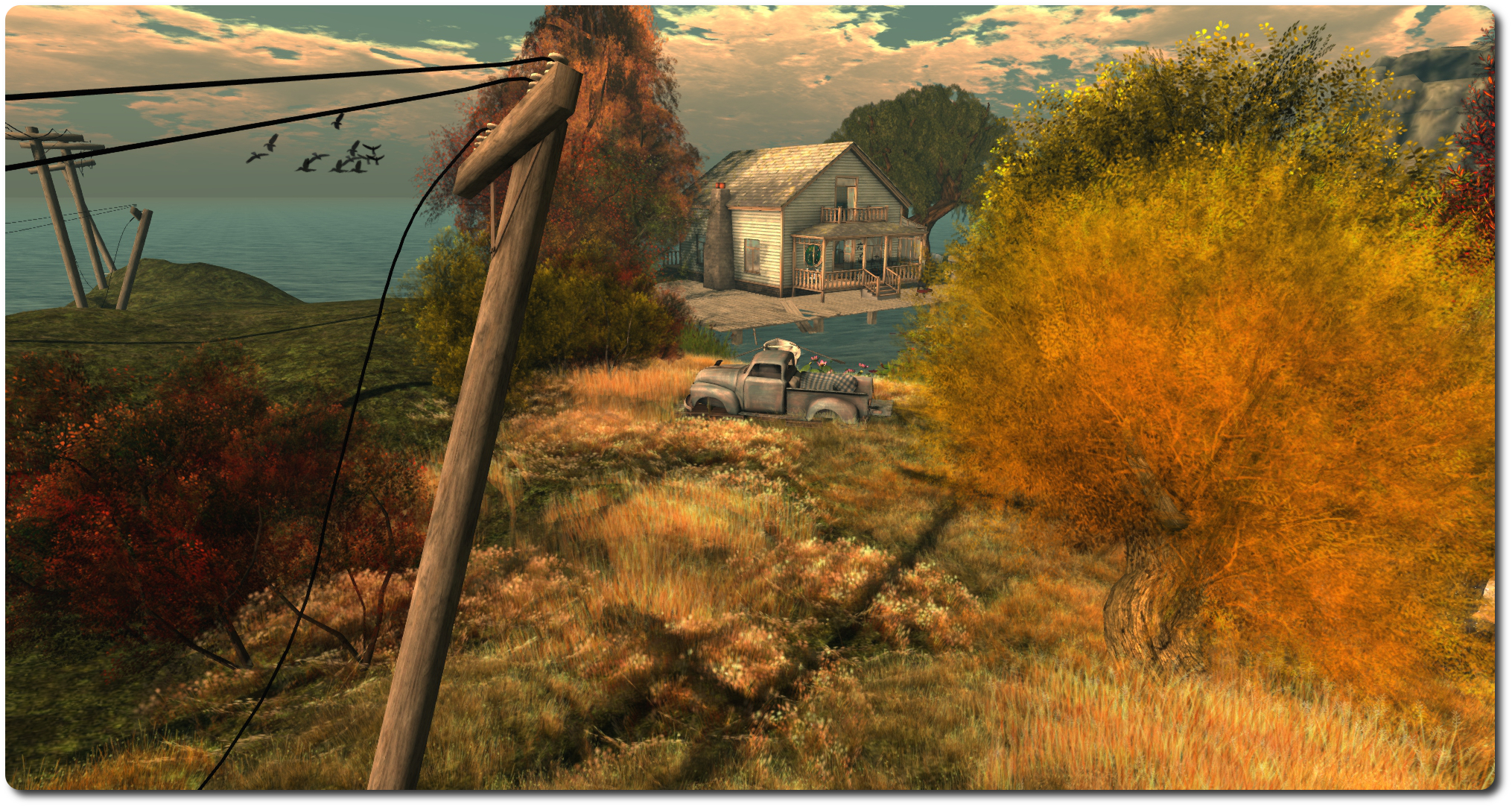
Just Another Tequilla Sunrise, Isle of Love; Inara Pey, October 2014, on FlickrSL should be looking and feeling a lot better for many of us as a result of recent work by the Lab – how’s it going for you? The Lab asks you drop them a line in the forums or via Twitter (image: Just Another Tequilla Sunrise, Isle of Love (Flickr) – blog post)

Following-on from the grid-wide deployment of CDN support and the promotion of the HTTP pipelining viewer as the de facto release viewer, the Lab has blogged about recent improvements to Second Life, finishing with the question “how is it for you?”

The blog post, entitled, Performance, Performance, Performance, opens thus:

Has Second Life seemed a bit faster for you lately? Improving performance for all Second Life users has been an important focus for us at Linden Lab, and we’ve recently seen some great results from several projects that should make your Second Life experiences faster, smoother, and more reliable.

It goes on to make fair mention of the CDN / HTTP work, noting:

Faster Texture & Mesh Loading
The entire grid is now using a CDN service for textures and meshes. This change means that textures and meshes should load more quickly, particularly for those who login to Second Life from places that are far from our US data centers. Our testing showed dramatic improvements: average download times for textures and meshes have been reduced by more than 50% on average, and the improvement is even more dramatic outside of North America.

Quicker Viewer-Server Communications
Another way we’re enhancing Second Life performance is through our HTTP project, which improves the way your Viewer communicates with grid services. With the HTTP Project Viewer out now, the faster content download times you’ll see thanks to the CDN change get even better – we’re talking 80% faster!

For those who may have missed news on the HTTP pipelining viewer and the CDN support, you can catch-up with things via a couple of posts on this blog: SL project updates week 42/2: Monty’s HTTP update and the HTTP pipelining viewer, and HTTP pipelining viewer reaches release status as CDN support is grid-wide.

Mention is also made of the recent Group Chat updates (work is still continuing on this, and you can get updates via the Group Chat tag in this blog).

However, perhaps the most interesting aspect of the blog post is the news that there have been some significant infrastructure updates with the SL Marketplace, which appear to have slipped mention through other mediums such as the var UG meetings. Here the blog post notes:

Speeding Up the Marketplace
If you visit the Marketplace today, you should be seeing a much snappier experience than in the past. We recently deployed infrastructure upgrades for the Marketplace, and the site has since shown some of the best performance we’ve ever seen from it. Even during peak usage periods over the weekend, when in the past performance would degrade, we’re seeing response times that average 70% faster and page load times that are 30% faster than before the changes.

I’ve not used the Marketplace of late – although I have been covering the upcoming Viewer-managed Marketplace (VMM) changes that will be occurring in 2015, and which the Lab is currently gearing-up for, along with merchants and TPVs.

So have you noticed changes and improvement in your Second Life experience? If so, then why not follow the Lab’s request:

So, How’s Second Life Performing for You?
Performance improvements are generally behind-the-scenes work, and we know it’s not always as exciting as rolling out a new feature, but these changes directly impact all our Second Life experiences and our daily lives in-world. We hope you’re starting to notice the effects of these improvements – if you are, please let us know in the Forums, on Twitter, or however you prefer.

Note that is let the Lab know – not me (although general views are always welcome here, they might not be picked-up by the Lab)!

HTTP pipelining viewer reaches release status as CDN support is grid-wide

On Wednesday, October 29th, the Lab promoted the HTTP pipelining viewer to the de facto release viewer, a move that came just after the grid-wide deployment of CDN support on Tuesday, October 28th. While the two are complementary rather than reliant upon one another, both should help improve the majority of users’ Second Life experience to some degree.

Monty Linden: the HTTP pipelining viewer marks the culmination of over 2 years of work inproving SL's HTTP capabilities
Monty Linden: the HTTP pipelining viewer marks the culmination of over 2 years of work improving SL’s HTTP capabilities

The HTTP pipelining viewer is the latest phase of over two years of work on Second Life by Monty Linden, and which has involved both the viewer and the servers and back-end services which support SL.

The work, originally a part of Project Shining, which was itself heralded as complete in June 2014, initially focused on texture handling between the servers and the viewer. Since then, Monty has gone on to tackle a number aspects of improving the use of HTTP in Second Life, such as making connections more robust and reliable, improving throughout to the viewer via HTTP, and so on.

The HTTP pipelining viewer, as the name suggests, leverages HTTP pipelining, a technique in which multiple HTTP requests are sent on a single TCP connection without waiting for the corresponding responses, which significantly improves the download of data (currently avatar baking information, texture data, and mesh data) to the viewer. The upshot of this is that the impact of a user’s physical location on scene loading is reduced, improving their overall experience.

As well as this, the HTTP viewer includes significant improvements to inventory folder and item fetches, which can markedly decrease the time taken for inventory to load, particularly if a user’s local inventory files have been flushed as a part of a cache clearing (or similar) exercise.

These inventory updates alone are liable to be appreciated by users as the viewer-side HTTP code gains wider adoption by TPVs. Tests have shown that a decently structured inventory (e.g. one that uses a folder hierarchy, rather than everything dumped into just a handful of top-level folders) of 100K can have a “clean” load time of 16-18 minutes reduced to around 3 minutes.

Earlier in October 2014, Monty blogged on his work, showing how both the CDN and the HTTP pipelining viewer, coupled with his earlier HTTP improvements have benefited texture and mesh fetching in SL. If you’ve not read that blog post, I recommend that you do.

Monty Linden's recent blog post shows how the HTTP work has improved texture and mesh fexture within SL
Monty Linden’s recent blog post shows how the HTTP work has improved texture and mesh texture fetching within SL

As well as working on HTTP, Monty has also been engaged on rebuilding and cleaning-up many of the third-party libraries used in the building of the viewer. This work should not only improve the viewer build process and such third-party libraries are consistently used in the build process, it may also help pave the way toward the Lab producing 64-bit versions of their viewer in the future.

Continue reading “HTTP pipelining viewer reaches release status as CDN support is grid-wide” →

Poodle vulnerability: Lab issue RC viewer with browser fix

On Wednesday October 15th I blogged about the Lab having issued a Grid Status update warning, those who use the viewer’s built-in browser may not be able to access certain websites. The notice was issued by the Lab as a result of the Padding Oracle On Downgraded Legacy Encryption (Poodle) vulnerability reported by Google.

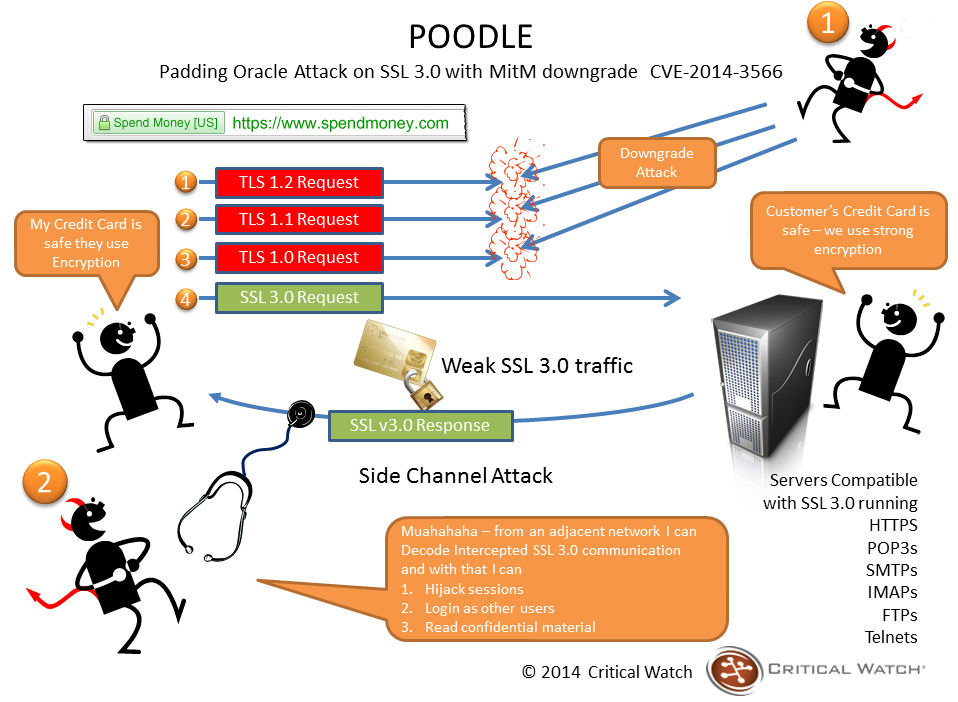
As noted in my original article, the Poodle vulnerability exploits a flaw in the design of the SSL 3.0 protocol, which despite being 18 years old, is used as a fallback security protocol within most browsers. By using a series of connection failures between a browser and website, an attacker can trigger what is called a “downgrade dance” where the browser eventually falls back to using the SSL 3.0 protocol to maintain communications. When this happens, the attacker can use the exploit within SSL 3.0 to grab sensitive data.

How a Poodle attack works (image courtesy of Critical Watch)

There are a couple of caveats to the vulnerability; for the attack to work, the attacker must be on the same wireless network as you or in the path of your communications (as shown above), and your client must be running JavaScript. However, it caused Google to issue an advisory that SSL 3.0 support is disabled or that tools that support TLS_FALLBACK_SCSV (Transport Layer Security Signalling Cipher Suite Value) are used be websites, which prevent the “downgrade dance” attacks. This prompted some websites to remove / disable SSL 3.0 support, which in turn resulted in some websites becoming inaccessible when using the viewer’s internal browser or browser-related services.

At the time the Grid Status update was issued, the Lab indicated they are working to fix the problem within the viewer’s browser capability. This has now been done, and release candidate version 3.7.18.295539 of the viewer, referred to as the “Browser Fix” viewer, removes SSL 3.0 usage from the viewer’s internal browser, allowing it to connect to sites which have disabled SSL 3.0 support.

If you do use the official viewer and prefer accessing websites using the internal browser, you may want to download this RC. For those not using the official viewer and who have experienced issues accessing websites through the viewer’s internal web browser, try switching to using an external browser to open web links (set via Preferences), as per the advice on the original Grid Status update from the Lab.

Related Links

“I believe I can fly”: the empowering freedom of virtual worlds

The single image Jay Jay
The single image Jay Jay Jegathesan used in his 3-minute presentation on his PhD research on community and collaboration through virtual worlds

I’ve frequently blogged about the work of the University of Western Australia in Second Life; with an active presence in SL since 2009, the University has gained a first-class reputation for sponsoring and promoting art in virtual worlds through initiatives such as the MachinimUWA competitions, and activities such as their current Transcending Borders challenge, the Freedom Project, and Project Homeless, as well as supporting the LEA’s Full Sim Art series, all of which I’ve had the privilege of covering in this pages.

The Freedom Project, one of many community-focused activities undertaken by the UWA within Second Life

The UWA’s involvement in Second Life came about as a result of PhD student Jay Jay Jegathesan (), who founded the University’s virtual campus in Second Life, which has grown to include academic teaching activities across Business, Law (including the use of SL machinima in a post-graduate degree course), the Arts, Anatomy, Physiology & Human Biology, and Education (including providing resources essential it helping educators and new users get started with SL).

In particular, as a result of Jay Jay’s work the University has become recognised as a world leader in global community development through virtual worlds technology. This in turn has encouraged Jay Jay to make the topic of global community development and collaboration through virtual worlds, particularly in reference to people with disabilities, the focus of his PhD thesis.

Currently, Jay Jay is participating in the UWA’s 2014 3-Minute Thesis competition, in which students were asked to speak for 3 minutes on their PhD research using no technology or props aside from a single image. His presentation, directly referencing the power of virtual worlds to help those with disabilities – indeed, all of us -, is both beautiful and direct; so why not take a moment to listen to his impassioned explanation of the empowering freedom virtual worlds offer?

I’d also like to take this opportunity of thanking Jay Jay for his generosity and kindness in sending me a copy of the Freedom Project book, which is a fabulous publication, lavishly illustrated with pictures of the works submitted to the project, biographies of the artists, and much more besides. It is very much a must-have for anyone with and appreciation of virtual world art. Copies can be obtained for L$5000 (around $20.00 US), shipped anywhere in the world. Those wishing to purchase a copy should contact Jayjay Zifanwe in-world for ordering information.