Playing in a Winter Wonderland

Winter Wonderland - race track, rinks and Ferris Wheel
Winter Wonderland:  race track, rinks and Ferris Wheel

On Thursday, January 29th, Linden Lab announced the opening of the Second Life Winter Wonderland theme park. Encompassing four regions, the park offers a range of activities for regular and premium members to enjoy – and having popped over, I have to say, it’s a lot of fun.

Those with a keen eye may well have noticed that something called “Winter Wonderland” was coming – there has been a gateway under construction at the Portal Parks since before Christmas. These gateways are now open as well, and form an alternative to reaching the Winter Wonderland to the main SLurl provided in the official blog post.

The four regions of the park offer a range of attractions, comprising (taken from the blog post):

  • Village of lights: “Pay a visit to this fantasy styled icy village and enjoy company, calm, and the wonderful winter feel! In the heart of the village you will find a variety of celebratory gifts await you. Be sure to stick around for the fireworks that light up the sky at the top of every hour!”
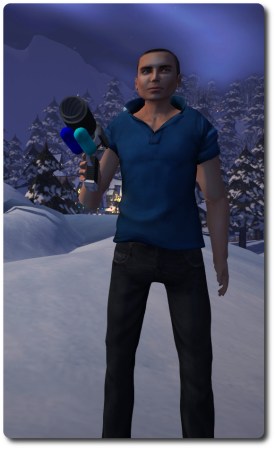
  • Ebbe, Get Your Gun! - my first encounter at the park was a snowball gun toting Ebbe Linden!
    Ebbe, Get Your Gun! – my first encounter at the park was a snowball gun toting Ebbe Linden!

    Snowball Warzone: “Atop the hill outside the village awaits a great cold wasteland where you and others will buckle down in the trenches of warfare: SNOWBALL FIGHTS! Claim the top of the towers for great vantage, or rule the castle walls with friends. Choose from two weapons, or if you are a Premium member, equip your Premium token for access to the ultimate snowball fight arsenal! You may even catch a Linden or two participating in the snowball shenanigans.”

  • Icy Race Course: “Strap on your helmet, hold tight, and rev those engines! On the outskirts of the Village of Lights are free vendors where you can pick up a snowboard or a mighty snowmobile. Premium members can access upgraded vehicles by equipping their token. Hop aboard and race around the four-region wide race track full of bumps, hills, jumps, and more! Grab a friend and see who can best the turns and cross the lines first. Be sure to turn on Advanced Lighting to see the track nicely lit up as you cruise the snow!”
  • Skatetown Area: “In the heart of this region are two skate arenas for the enjoyment of everyone. Grab a pair of skates from the free vendor, strap them on, and give them a spin! Execute athletic jumps and twirls, and glide your way around the ring. In the front vendors here, Premium members will find an extra prize full of customization options to fit your style and avatar.”
  • Winter Ferris Wheel: “What better way to see the region than to sit, relax, and rotate your way to the top of the view.  The Ferris wheel will give you one of the best – and most romantic – views in the region.”

Both the SLurl provided in the blog post and the Portal Park gateways deliver you to the Village of Lights. Here you’ll find gifts to collect in the village square (check the official blog post for details). Two main paths lead from the village to the major attractions.

Winter Wonderland Village of Lights
Winter Wonderland: Village of Lights

Of course, me being me, I took a short cut and found my way to the snowball fight arena somewhat unarmed. As a result, I promptly got shot by the decidedly well-armed Ebbe Linden and Marianne McCann! Of course, as Ebbe pointed out, arriving in the arena unarmed really is “not the way to show up for a fight!” Snowball fight guns can be obtained from the giver at the foot of the stairs leading up to the arena from the village, and as everything in the Wonderland is Experience Keys based, the gun will auto-detach on leaving the arena area.

Head westward from the Village, and you’ll come to the race course. Here you can pick-up a snowmobile or snowboard and zip around the course on your own or race others – but be warned, both are pretty zippy (the snowboard has a turbofan engine mounted on the back, and the animations include the ability to jump and perform a trick. Trying either of them in Mouselook is quite a challenge! Within the loops of the racing circuit, which crosses the regions of the park, sit the ice skating rinks and the Ferris wheel.

The Snowball Warzone arena
Winter Wonderland: the Snowball Warzone arena

Materials have been used to good effect within the builds, and allowing for the fact i got there relatively early, and possibly before many have read the official blog post, lag was barely noticeable, although the Ferris wheel is a little juddery and possibly a tad slow for most people’s tastes.

If you’re a Premium member, you can hop over the any of the Premium Gift kiosks and grab your tie-in gift, which opens up “upgrades” to the Winter Wonderland activities and gifts. Just wear your ribbon with pride prior to returning to the Wonderland regions!

All told, Winter Wonderland is very well put together, and offers some good fun to be enjoyed with friends  – so why not drop in and see for yourself? My thanks to Alexa, Ebbe and Vitae Linden for the added fun 🙂 .

Winter Wonderland
Winter Wonderland

Note that the opening of the Winter Wonderland coincides with the Lab’s latest Premium Membership special offer (50% off the first quarter’s payment if you sign-up to the Quarterly payment plan for Premium membership. This run through until  08:00 SLT on Monday, February 16th, 2015.

Related Links

Lights! Camera! Headset! – Oculus VR opens movie studio

Image: Oculus VR / Story Studio

Oculus VR came, in a manner of speaking, a full circle with this Year’s Sundance Film Festival, which is currently taking place in Park City, Utah, and ends on February 1st, 2015.

In 2012, journalist Nonny de la Peña showed (what was then) her latest journey in what she calls “immersive journalism”, Hunger in Los Angeles. The film utilised a head-mounted display unit developed by a 19-year-old student. So convinced was that student of the potential for VR, he started putting together ideas for a commercial, low-cost headset. A kickstarter campaign followed  and … yes, you’ve guessed it, I’m talking about Palmer Luckey.

This year, Oculus VR are back at Sundance, in the form of their new in-house film studio, Story Studio, which is showcasing the first of five animated short films the company plans to make under the Story Studio banner over the course of the next year.

Located in San Francisco, Story Studio numbers around dozen film industry veterans from the likes of Pixar and Industrial Light & Magic under the leadership of Saschka Unseld, formally of Pixar. The company started to come together around a year ago, although as Josh Constine notes over at Techcrunch, the idea for the studio was already on the Oculus VR roadmap from the earliest days. Indeed, the very potential for VR in films as indicated by Oculus VR in their plans, many have been one of the added attractions for Zuckerberg in acquiring the company.

Certainly, Oculus VR’s CEO, Brendan Iribe is in no doubt that Facebook has been crucial in accelerating the film plans, noting to Constine, “this is another example where as a smaller, independent start-up it would have been hard to spin up an effort like this.”

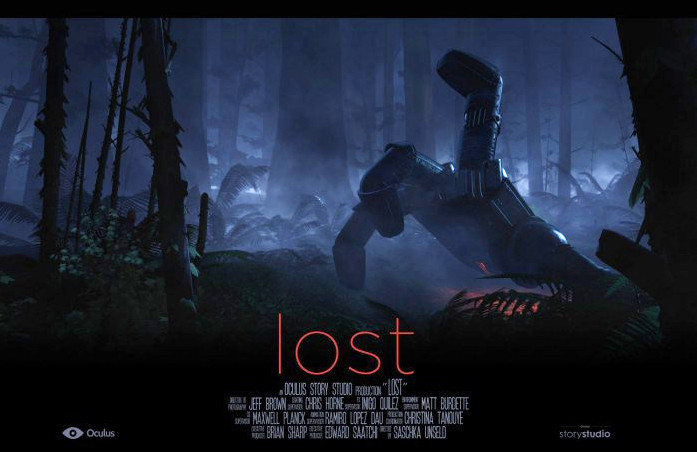
Lost, showcased at the 2015 Sundance Film Festival, is the first in a series of films from Oculus VR's new in-house film studio: Story Studio
Lost, showcased at the 2015 Sundance Film Festival, is the first in a series of films from Oculus VR’s new in-house film studio: Story Studio (image: Oculus VR / Story Studio)

Lost, the title of Story Studio’s short, runs at between 4 and 10 minutes, the length being determined by the level of engagement in the film and what the decide to explore within it. As such, it is said to be a powerful demonstration of the added depth that VR can bring to a film. It is being shown in the Festival’s New Frontier programme, which this years see no fewer than 11 of the 14 submissions attempt to utilise VR.

Not all of them succeed, as Casey Newton and Bryan Bishop, writing in The Verge note. Some mange to do exactly the reverse, and demonstrate the inherent weaknesses in VR if not used correctly, and the need to learn entirely new approach to filming, interaction and editing in order to properly create and maintain the desired level of immersion needed to make the use VR worthwhile.

It is because VR as a medium is so difficult a concept to grasp and successfully integrate into film-making that drove Oculus VR to create and develop Story Studio, as Iribe notes in a conversation with The Road to VR’s Ben Lang.

“When we started to show people [the Oculus Rift] in Hollywood, their question was ‘how do we get started?’… We said ‘you pick up these gaming tools like Unity or Unreal and you start making something’ but that’s not natural for [cinema creatives],” Iribe said. “Right now the focus is to support and inspire the community—share with them everything we’re doing, opening it all up. Over the next two months, we’re hoping to educate the community on how we did this and how we got started. We still have a ways to go before people are making longer film experiences.”

Saschka Unseld (image coutesy of skwigly.com)

Unseld picks-up on this line while talking to Techcrunch’s Constine alongside of Iribe.

“Everyone who starts a project in VR encounters the same things in the beginning,” he states. “They try to figure out ‘How do I make these things I know from film work in VR? How do I do a cut in VR?’ The resounding answer is that porting film concepts straight to VR just doesn’t work.”

Thus, Story Studio will be a studio in both senses of the word. Not only will it be a engine for producing a series of short animated stories over the courses of the next year, it will also be something of a “open-source” VR cinematography “school” presenting and sharing insights into the use of VR in films, offering examples of how the technology works or doesn’t work within the framework of a film, and so on.

This is actually a clever move, as it allows Story Studio to both offer a roadmap on how other studios might involve themselves in VR and present them with the kind of finished product which can be seen to work, both technically and with audiences, thus giving them something they can understand, replicate and even enhance as the technology matures.

Of course, all this will also be helped by actually having the technology – the headset itself – actually available to use by more than a few thousand people world-wide. And even here Story Studio may offer a small clue as to when the consumer version of the Oculus Rift might appear.

According to Reuters, via Fortune On-line, Lost is the first of five animated shorts Story Studio plan to produce over the next year. Furthermore, The Guardian suggests that all five will be released “in the run-up” to the release of the commercial version of the headset – which Iribe refers to as “Oculus Rift CV1”, while Iribe himself, when talking to Ben Lang, says all five films will be available for the CV1 product.So perhaps one way of counting down the time to the release of the commercial headset is to count off the Story Studio films as they appear…

Related Links

The majesty of creation in Second Life

Angel Manor: the subject of a beautiful new video by its creator, Kaya Angel

Kaya Angel is one of Second Life’s most respected builders, and his Angel Manor estate is rightly admired across the grid both as a build in its own right and as a venue for art, fund raising events and a more. I

As a designer / builder, Kaya naturally turned to emerging capabilities to further enhance his commercial and commissioned work, and to enhance Angel Manor itself – so much so, that I keep reminding myself I’m overdue for a visit in order to write an update to my March 2013 piece on the manor, as so much has changed since then.

In celebration of the manor, and to demonstrate just how immersive Second Life can look and feel, Kaya has produced a new 6-minute video entitled Second Life: A different perception, which has been drawing widespread praise from all who have seen it and is without a doubt, simply superb.

Marvellously edited, matched to an excellent soundtrack, this is a film which can hardly fail to evoke a feeling of wonder, joy and pride in the heart of anyone who has invested time and energy into Second Life. If ever there was a banner by which we can proclaim to the world just what is possible within SL for the creative mind, then this film is it.

Kudos, Kaya, and thank you.

with thanks to the G+ pointer from Whirly Fizzle.

OSVR: the Swiss Army Knife for VR?

OSVR logo-2January always bring with it the International Consumer Electronics Show (CES). At the time the show was running, I looked at the “public début” (as Brendan Iribe, the Oculus VR CEO called it) of the company’s latest prototype headset, Crescent Bay, and some of the recent news coming out of Oculus VR.

However, while Oculus were getting a lot of air-time at CES, perhaps the most interesting announcement regarding VR came not from Oculus VR, but from gaming equipment manufacturer Razer and high-end VR specialist firm Sensics. who together announced a new development ecosystem for VR: the Open Source Virtual Reality (OSVR).

OSVR aims to create an infrastructure for common VR development work
OSVR aims to create an infrastructure for common VR development work (image: osvr.com)

While many companies are developing VR capabilities – head tracking systems, camera systems, gesture-based and other controllers, games and entertainment packages around the Oculus Rift, the fact is that the consumer market is liable to see a lot of HMDs and peripherals with a VR focus emerging over the next few years, to say nothing of applications and suchlike.

In terms of HMDs Zeiss have already launchedHMDs for various purposes, notably and most recently their sub- US$100 Zeiss VR One for smartphones at the same time Samsung launched their “Oculus inside” Gear VR, both of which I wrote about in December. Sony is working on the Morpheus, Sensics is working on its own consumer-focused headset for the Playstation, while Vrvana and GameFace are working on HMDs while ANTVR used CS to announce their forthcoming headset will be compatible with the PlayStation 4  in addition to PCs, the Xbox 360 and other devices.

With so many different systems on the horizon, the creation of content and peripherals is becoming something of a minefield for developers in terms of ensuring their games, experiences and hardware has the largest possible reach within the new marketplace.

The intention behind OSVR, therefore, is to provide an environment for cross-platform / hardware development for VR, with different development engine plug-ins anyone can use  covering different headset, controller, tracking systems and so on. All of which is aimed at helping developers ensure their game or experience or controller or whatever works with the widest possible choice of VR options.

In this, it’s important to recognise that OSVR is not some kind of rival to Oculus Rift, although the acronym is emblazoned across the front of Razer’s own forthcoming VR headset, previewed as a part of the OSVR announcement, and may have given some the impression that it is; something Razer’s Min-Liang Tan has been keen to clarify.

Razer CEO Min-Liang Tan: leading the OSVR charge. His company is often seen as the Apple of the gaming world, with Min himself as a latter-day Steve Jobs (image: ubergizmo.com)
Razer CEO Min-Liang Tan: leading the OSVR charge (image: ubergizmo.com)

“It’s not a competitor to guys like Oculus,” Tan said in an interview with the International Business Times. “This works with Oculus. The software is completely open-sourced. This is a set of standards. A couple of knee-jerk reactions is that people think this is competing with Oculus. Absolutely not. It’s an open platform.”

In the original OSVR announcement, Sensics CEO Yuval Boger also referenced OSVR being he development environment, saying, “OSVR’s open-platform approach accelerates innovation and provides consumers the freedom of choosing the best combination of hardware and software components. We are excited to partner with Razer and other industry leaders to build OSVR together.”

The list of companies on-board with OSVR is small but growing. In terms of HMD makers, the aforementioned Sensics, Vrnana and GameFace. It is also gaining a lot of support from input device manufacturers including Sixense STEM, Virtuix Omni, PrioVR and Leap Motion.

And what of Oculus VR? When asked about the move by journalist Matthew Terndrup, Oculus VR founder Palmer Luckey referred to it as a “good thing“, pointing to the fact that the Oculus Rift DK1 was also open-source. That’s as maybe, but Oculus VR were the first company to walk away from earlier discussions on VR standards shortly before it was announced they’d be acquired by Facebook. Not that they perhaps need to be directly involved in something like OSVR – as the tech media note, most companies are developing with Oculus in mind already, so it might be argued standards for development are more about allowing everyone else a better slice of the pie.

The OSVR website places great emphasis on games being its primary focus, and Tan himself points to games developer Gearbox Software being one of the founder partners in OSVR. However, the wider potential for VR across vertical markets is perhaps reflected in the fact that “OSVR supporters” are being sought from both from both industry and academia, with no apparent preference towards games development. Successful applicants being offered a prototype Razer Hacker Kit.

The Razer Hacker Development Kit - US$199.00 from June 2015
The Razer Hacker Development Kit – US$199.00 from June 2015 (image: razer.com)

It is this Hacker Development Kit (HDK) that perhaps gave rise to initial confusion about OSVR being a “competitor” to Oculus Rift in some quarters, having been announced at the same time as OSVR.

However, the HDK is actually intended as a low-cost development test rig for VR developers (although it is probable that Razer will eventually market their own HMD), designed to meet current VR standards and to be somewhat modular, offering hardware developers the ability to more readily use it in the development of their own hardware (e.g.tracking systems, cameras, etc.). It will be available from June 2015 at a price of US$199.00.

Developers can already register their interest in the headset (see the HDK link above), and in keeping with the open source nature of the project, the full specifications for the headset, together with a set of schematics for the major components suitable for 3D printing, can also be downloaded from the site for those wishing to DIY their own HMD.

Basic specifications for the HDK (source: razer.com)

In discussing the HDK and OSVR with International business Times, Tan suggested people think of the two like this,”Think about it like Android for VR. It’s not the kit. It’s a platform, completely open-sourced. All the software is on Android, it’s on Apache 2.0. All the hardware, we’ve uploaded it on the Internet, anyone can print it out at home.”

All told, and in terms of it being intended as a development ecosystem, OSVR + the HDK almost sound like consumer focused VR’s very own Swiss Army knife. It’ll be interesting to see how it fares.

Sources

OSVR will be participating in a Reddit Ask Me Anything (AMA) session on Thursday, January 15th, at 15:00 PST URL: reddit.com/r/virtualreality.

Lab brings a little Skrill to provide additional payment options

secondlifeOn Tuesday, January 12th, the Lab announced the provision of new payment options for Second Life users, through a partnership with Skrill, the UK-based e-commerce business that allows payments and money transfers to be made through the Internet.

Under the new arrangement, Second Life users have further options for their payment activities, including like buying L$ and paying account fees, as well as additional local currency options for Residents outside the United States.

The service actually soft-launched a few weeks ago, and according to the Lab, has seen some very positive results to date, hence the announcement. However, some users outside of those trying the service may have additionally noticed that Skrill themselves announced their partnership with the Lab earlier in January 8th, when they issued a press release on the matter, which reads in part:

New York, NY – 8 January 2015: Leading digital payments company, Skrill, today announces a collaboration with Linden Lab to integrate the Skrill Digital Wallet as a payment option for users of Second Life, the Internet’s largest user-created virtual world.

Skrill’s Digital Wallet provides users with a secure and easy method to send and receive Linden Dollars. Skrill 1-Tap, Skrill’s recurring payment solution, allows users to enter their information only once to enable continuous payments thereafter with just one tap or click.

As noted in the Lab’s blog post, any Second Life users with a Skrill account can now add it to their payment options under the Billing option on their secondlife.com dashboard.

SL users with Skrill accounts can add them to their SL billing options

While the service can currently only be used for any payment transactions (operating just as a credit card would), the Lab note that they hope to extend the service to encompass the processing credits (redemptions) to Skrill accounts in the future.

Given that many SL users have problems in using Credit Cards with the platform, or are unable to use PayPal, the arrangement with Skrill potentially offers a method by which they can better carry out payments and L$ purchases.

If you wish to find out more about Skrill, please visit their website.

Related Links

Sundry thoughts on regions, revenue, tier and platforms

A quiet afternoon at Hollywood Airport

The year-end brought with it a round-up of Second Life in terms of region numbers, courtesy of Tyche Shepherd and her excellent Grid Survey. 2014 continued to see the downward count in the number of private regions in SL, with some 673 regions vanishing through the course of the year (from 19,273 at the start of the year to 18,600 at the end of the year).

Expressed as a percentage, this means that the main grid has shrunk by 3.5%. That compares to an 8.2% shrinkage in 2013 (from 20,992 to 19,273 regions, a loss of 1719) and a 12% reduction in 2012 (23,857 to 20,992, a loss of 2865 regions).

There are likely to be a number of reasons for the slow down in losses, all interacting with one another. While  one ideologue opted to pooh-pooh it, in September 2011 I pointed to one contributing factor to the then increasing rate of decline in region numbers as likely being due to physical world economic issues. With their disposable income diminishing, people were finding an outlay of $125 a month for virtual land increasingly hard to justify, and so were divesting themselves of it; something which likely continued through 2012 and early 2013.

Private regions numbers through 2014 (source: Tyche Shepherd, SLU forums)
Private region numbers decline through 2014 (source: Tyche Shepherd, SLU forums)

While I’m not about to say we’ve turned the corner where the physical world economic situation is concerned, it is probable that by late 2013 we’d reached a point where those still with a residential homestead of their own were more willing to grit their teeth and pay for the land they hold, thus contributing to the slowing of shrinkage.

So what does that mean for the year ahead? While nothing is guaranteed, I tend to sway towards the view that the decline in region numbers will continue to slow, but at less than the rate we’ve seen in from late 2013 through 2014. I’m also inclined to think we won’t see any significant rise in region numbers through 2015 (unless some kind of external factor comes into play or the Lab does opt to do something quite unexpected to cause people to suddenly want lots of land).

One thing the slow-down will hopefully do is decrease future calls for tier cuts. As I explained back in January 2013, unless the Lab have a substantive means of compensating for the revenue loss resulting from any “reasonable” tier, any such cut will likely hurt the company (and SL) more than help. Nor is the Lab’s profit margin anywhere near the levels sometimes mentioned (e.g. the 200% recently claimed in this blog), such that they could simply “absorb” any tier cut without feeling the impact.

The decline in private regions, January 2012 through December 2013 (source: Tyche Shepherd, SLU forums)

In 2008, estimates put the Lab’s earnings at around $90-95 million, and their possible profit margin at between $40-$50 million (48-50%) – see the articles here and here. I assume these estimates are for gross profits, as neither makes allowances for tax.

More to the point, there seems to be a slight flaw in both estimates: they only appear to reference the costs involved in running simulator servers. No mention is made of the various back-end services such as group chat, group management, asset management, login, transaction management and payment, (and today, the avatar baking service), the various web services (Marketplace), and so on. While the costs associated with all of these are obviously going to be a lot lower than those for the simulator hosts, they shouldn’t be entirely discounted. There’s also third-party support costs (in 2008-2010, for example, the Lab was paying Rivers Run Red and 80/20 Studio; today there’s the costs involved in using the Highwinds CDN service).

Continue reading “Sundry thoughts on regions, revenue, tier and platforms”