Linden Lab and Tilia Inc. – speculations on the Lab’s new subsidiary

Logos © and ™ Linden Lab and Tilia Inc.

Friend and fellow blogger, Vick Forcella contacted me at the end of October concerning some interesting items related to Linden Lab he’d uncovered in digging around a few places.

The first comes in the form of documents relating to a relatively new Linden Lab subsidiary company, and the second in a partially filed trademark.

The subsidiary company is called Tilia Inc., and at first glance it seems to be completely unrelated to the Lab, being referred to as being involved with ” Packaging Machinery”. However, an examination of the company’s papers will reveal it is registered at 945 Battery Street – the Lab’s headquarters, as a check on Buzzfile confirmed to me.

Tilia Inc appears to be a defunct corporate entity, first registered in 2002, which has been acquired by the Lab. This, and the further registrations of the name across several US states  as a “foreign” entity (meaning the filing is by an existing corporate entity registered in another US state), tended to suggest the Lab might be using the company to leverage certain tax advantages – a common practice among corporations around the world. Further support for this appeared to come from the names of the directors: the Lab’s CFO, Malcolm Dunne, their Legal Counsel, Kelly Conway and, from outside of the Lab, Benjamin Duranske, founder of PayCom Consulting, and LeAnne Hoang, the Lab’s former Chief Compliance and AML Officer.

Companies registered at 945 Battery Street, the Lab's HQ, via Buzzfile. Note Philip Rosedale's "Coffee and Power" sitting in the middle - and its associated industry description!
Companies registered at 945 Battery Street, the Lab’s HQ, via Buzzfile. Note Philip Rosedale’s “Coffee and Power” sitting in the middle – and its associated industry description!

Obviously one way to get more of a clue was to ask the Lab directly. So I did.

Tilia is a subsidiary of Linden Lab, focused on payments and the compliance work associated with operating virtual economies, and it will provide services for both Second Life and Project Sansar.

Peter Gray, Director of Global Communications, Linden Lab

Following my initial enquiry (which is not to say it is related to it), the list of senior personal at Tilia Inc., dramatically increased. The additional appointees  comprise: Bjorn Laurin (Bjorn Linden), Vice President of Product (Blocksworld, Second Life and Sansar), Landon McDowell (Brandon Linden), Vice President of Operations and Platform Engineering, Jeff Peterson (Bagman Linden), Vice President of Engineering, Pam Beyazit, Senior Director of HR, and Peter Gray.

"Tailia" and Tilia Inc appear to be geared to providing virtual currency and related services to both "Project Sansar" and Second Life
Tilia Inc is said by the Lab to be focused on the compliance work associated with operating virtual economies, and will provide services to “Project Sansar” and Second Life

The trademark, USTPO document 86374264, originally filed on August 22nd 2014, relates to the name of “Tilia”, which is described as, “Computer software, namely, electronic financial platform that accommodates multiple types of payment and debit transactions and the transfer of funds to and from others, in an integrated mobile phone, PDA, and web-based environment.” A further document located by Vick pertaining to the trademark application reveals even more information, and makes for interesting reading on its own.

What this all adds up to is still hard to determine. “Tilia” and Tilia Inc., might be totally coincidental; as such what follows might be pure unfounded speculation; then again, a lot of it also seems to hang together. complaince quote

As indicated in June 2015 by Ebbe Altberg, the Lab has been focused on four areas of activity, one of which has been that of compliance (see the quote on the right).

This work appears to have been overseen by LeAnne Hoang, prior to her departure from the Lab in July 2015. More recently, the Lab has also transitioned to a new payment processor for credit and debit card payments, which may be related to this work.

Again the two – the compliance work and the new payment processor – could be entirely unrelated. However, given that “Project Sansar” and SL will both operate virtual economies possibly based on the same virtual currency, it would make sense for the Lab to develop a central transaction and payment system capable of supporting both. Doing so could reduce the complexities of managing two payment / transaction systems (or any least manage any exchange mechanisms between two separate currencies) and in managing updates to match evolving compliance and anti-fraud regulations and requirements. If so, could “Tilia” be the proposed name for this new service? But why run it under a separate entity? Why not simply run it under the “Linden Lab” umbrella? Is it a matter of compliance, as stated be Peter Gray in his response to my initial questions? Perhaps so.

Another option might be that the Lab be considering making the Linden Dollar and all its attendant services a pre-packaged solution / service they can offer to other companies wishing to operate a virtual currency, with Tilia Inc., as the nominal operating company for that service. After all, they have made much of their leadership in matters of virtual economies and compliance, so spinning it out and offering it to others might be a means of generating additional revenue, although admittedly, given the complexities potentially involved, this might be seen as a bit of a stretch.

As a believer in Occam’s Razor, and moving away from idle speculation, I can’t entirely let go of the idea that Tilia Inc., might be wrapped in matters of compliance and potentially a means of leveraging tax advantages.

After all, The Lab have made it clear that “Project Sansar” in particular will rely on generating  the majority of its revenue through the sales of virtual goods and services. So, spinning out the systems and services that make this possible into a subsidiary registered in states with advantageous tax regulations might be a way for the Lab to reduce its tax exposure on those revenues.

The "Project Sansar" log-in screen: said to use

Following Peter Gray’s reply to my original enquiry of a week ago, I have placed follow-up questions with the Lab, but have yet to receive a response. Updates will be forthcoming if a reply is received or should the Lab reveal more themselves.

And why “Tilia”? I would guess it’s to do with the fact that tilia is genus of trees also referred to as linden trees.

My thanks to Vick Forcella for doing much of the digging into Tilia Inc and “Tilia”, for passing the information to me, trusting me to blog about it, and for his patience as I chased down various information myself, sought answers to questions. Thanks also to Johannes1997 Resident for his input on US corporate tax activities.

Con-Fusion about education in Second Life

Incorrect thinking: just because a campus region is empty of other avatars doesn't necessarily mean it is "abandoned" (image: UWA campus, Second Life)
Incorrect thinking: just because a campus region in Second Life is empty of other avatars doesn’t necessarily mean it is “abandoned” (image: part of the UWA campus, Second Life)

Second Life (with a nod to the Lab’s Project Sansar) has enjoyed some reasonably good press of late. We’ve seen articles in the likes of Xconomy.com. Variety Online, Re/code, Gamasutra – good golly, Miss Molly, even Moviepilot is getting in on the act.

However, there will still be pieces out there which reflect poorly on matters. Not so much where Second Life is concerned, but on their authors. Such is the case with

We took a tour of the abandoned college campuses of Second Life.

Patrick Hogan: writing to underline a preconception
Patrick Hogan: writing to underline a preconception?

As one might expect from such a title, this isn’t a reasoned discussion of the whys and wherefores, both good and bad, on the use of Second Life for educational purposes. There is no mention of the work of universities such as Texas A&M, as featured in episode #19 of The Drax Files World Makers, or that of the University of Western Australia. There is no highlighting of the struggle schools, colleges and universities faced as a result of the axing of the education discount or the resurgence of interest following its re-introduction; indeed Mr. Hogan demonstrates he’s not even aware there is an educational discount.

Similarly, no insights are given into how the platform has been used to assist with medical training among nurses and surgeons alike.  There is no pointer to the Massive Open Online Course (MOOC) run by the  Universidad de San Martín de Porres (USMP) in Perú, now in its third year, which helps Spanish-speaking educators get started with Second Life simply because it is in demand as a platform for education, and so on.

Nor, frankly should we expect there to be any such discussion, because Mr. Hogan doesn’t appear to be so much interested in Second Life as he does about underlining his own misconceptions about the platform which, like his opening comments, seem to be firmly rooted in 2007.

So does this mean we should ignore what he has to say? No, not at all. Looking through his other articles, Mr. Hogan seems to prefer to skim his subjects with the aim of offering something of a lighter look. As such, he may well be open to gaining a little more educated about this particular topic.

Certainly, and with a view to addressing the readership of the piece, its subjective nature and the misconceptions evident within it should be corrected, starting with the false premise of the piece itself (an “empty” region is in no way indicative of it having been “abandoned”).

These arre not the educational uses of virtual worlds Mr. hogan was looking for...
These are not the educational uses of virtual worlds Mr. Hogan was looking for…

Of course, had he really been interested in his subject, Mr. Hogan could have contacted the Lab, asked a few questions, received some pointers towards various education-related organisations and communities, and been on his way and filling his little corner of Fusion with relevant observations, positive or negative.

But he didn’t. He preferred the lazy route, walking the same, tired furrow that’s all too familiar and boring. His article even manages the obligatory reference to porn that is considered de rigueur for such pieces (check the title byline).

That he does opt to walk this line is really to his detriment, rather than it being any reflection on those who use Second Life or the platform itself.

A look at Dr. Phil’s show “featuring” Second Life

Dr. Phil McGraw is a psychologist turned television talk show host who first rose to prominence in The Oprah Winfrey Show in the 1990s prior to migrating to his own show in 2002, simply entitled Dr Phil. In it, he deals with a wide range of topics, offering advice in the form of “life strategies” based on his experiences as a psychologist.

Dr. Phil McGraw (courtesy CBS Television)

The show is a staple in the diet of US weekday television, and in the run-up to the July 14th show, Won’t Work, Won’t Go to School: “My Son Just Wants to Game All Day”, there was much brouhaha about the announcement that Second Life would be featured in the segment.

“Featured” tends to suggest a major role; as such, there were many efforts to promote the platform’s inclusion in the show through social media. There were also a number of blog posts expressing some concern as to how SL would be represented in the show.

Such reactions are understandable. This is our platform after all, so promoting it when the mainstream media will result in a natural reaction of anticipation. However, given the focus of this segment was advertised as being about  computer game addiction, the anticipation was countered by a degree of concern as to how the platform might be portrayed.

In the event, any concerns regarding just how Second Life might be portrayed proved to be without cause. Not so much because SL is shown fairly positively within the programme, but rather because, quite frankly, its role in the show was pretty minor; the overall focus for the programme was  squarely on the stated subject of computer game addiction.

Yes, Dr Phil is shown in-world at places like Creations Park and Mont Saint-Michel, but really, SL is completely secondary to the show's focus
Yes, Dr Phil is shown in-world at places like Creations Park and Mont Saint-Michel, but really, SL is completely secondary to the show’s focus

We often joke about being “addicted” to this or that – including computer games; but the truth is that in extreme cases, “addiction” is precisely the correct term. Those suffering from it demonstrate the same responses and reasoning as those caught in more “traditional” forms of addiction such as drugs or alcohol; so much so that it is now beginning to be treated as a clinical condition by healthcare specialists.

Such is the case with the focus of the show: 23-year-old Justin, who is in every sense of the word, an addict. He is almost completely dependent upon playing computer games to the exclusion of all else (other than marijuana), including caring for his own body.

To be honest, it was this aspect of the show which caused me more concern than how Second Life might be presented.

Justin - the young man at the centre of the show
Justin – the young man at the centre of the show

Addiction of any sort can be a traumatic situation for all parties caught within it; be it the person with the addiction or their family or loved ones. As such, I couldn’t help but wonder just how Dr Phil  –  a programme I’ve admittedly never seen before, but which has oft been accused of taking a “simplistic” approach to the topics covered – would handle the issue. Would it sensationalising the issue and Justin’s situation, or would it reduce the issue  to platitudes and sound bites for the sake of daytime television?

However, what we actually get is a reasonable study of Justin’s life and the factors which have contributed to his situation. These include long-standing family history (suicides, mental illness, alcohol and drug abuse); his mother’s own reticence to constructively deal with his childhood obsession with video games; his own personal trauma of being hit by a car at age 15, with a possible undiagnosed closed head injury that brought about a subsequent change in his nature. All of these are covered in a manner which is neither accusatory nor gratuitous, with Dr. Kenneth Woog of the Computer Addiction Treatment Program, providing context for the similarities between computer gaming addiction and more recognised forms of addiction.

There are the inevitable elements of drama in the show – notably around Justin’s examination by Dr. Rachael Ross and the clips of his home lifestyle; but on the whole what is presented here is a balanced look at a young man’s addiction, although it has to be said that given the segment is just 38 minutes in length, some matters are only lightly touched upon; at several points I found myself wanting Phil McGraw to follow-up more closely on comments passed by both Justin and his mother.

However, for a show that does get critiqued at times for its manner in addressing some issues, as noted above, this one did seem to offer a solid means by which Justin could obtain further help, both through the Lawlis Peavey PNP Centre (often used as a referral centre in the show) to further evaluate Justin’s condition, and the offer of a stay at a dual diagnosis treatment centre to help Justin deal with his addiction, depression and anxiety. I’d also hope that some measure of support was also extended to his mother and step-father, both of whom could perhaps use some counselling in how to more positively support Justin in handling his addiction.

I’m still not overly convinced as to the amount of clinical good that comes out of programmes like this, and there is certainly a good deal that could be debated about their merits or otherwise. As it is, and strictly in terms of this particular segment, it would be interesting to see a follow-up, say a year or so hence, so that we might learn how Justin has managed with his addiction and the results of the assistance offered to him.

As far as Second Life is concerned, the show references it twice. The first time is just after the opening titles, when there is around 90 second of footage showing McGraw’s avatar in-world (and McGraw initially manipulating it). Then, around two-thirds of the way through the show, Lab CEO Ebbe Altberg gets to talk about the more positive influences of virtual environments, overlaid with further clips from in-world, for about 60 seconds. In both instances, the platform is used to underline the fact that engaging in computer games and virtual environments is not in itself necessarily toxic, and to counterpoint any generalisations that might be drawn that this is the case. As such, I’d say the platform stood up well in the show.

Second Life new user experience now with Experience Keys

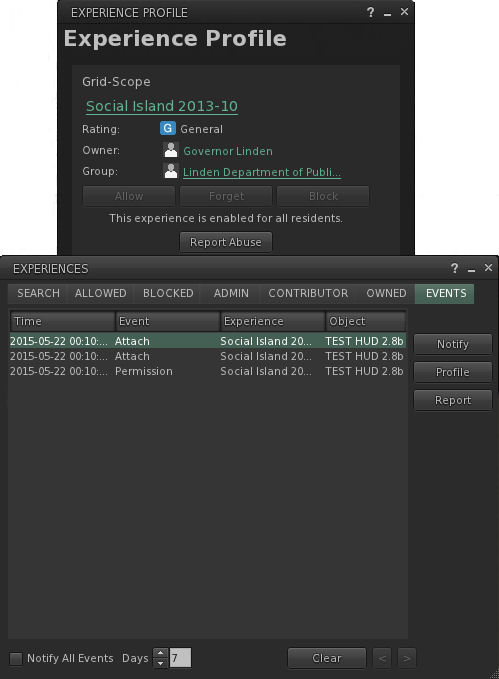
Experience Keys are being used as a part of the new user experience
Experience Keys are being used as a part of the new user experience – click for full size (note viewer UI is intentionally turned off)

update, April 2016: The Lab is apparently A/B testing the use of Experience Keys with task-oriented learning at a set the Social Islands. See my article on this for further details.

As a part of my periodic poking at things in Second Life, I recently logged-in using the avatar I keep “parked” at one of the Learning Islands which are the initial arrival points for new users, and  noticed that the Lab has added Experience Keys capabilities to the first-time log-in experience for new users as part of continuing efforts to improve the experience new arrivals have when arriving in-world for the first time.

For those not already in the know, and keeping things to their briefest, Experience Key (also referred to as Experience Tools) are a relatively new (and at the time of writing, yet to be fully deployed) feature that allow users to opt-in to an “experience”  – which could be a game, a tour, an educational activity, and so on – just once, rather than having to repeatedly grant specific permission each time something wants to act upon their avatar – such as a teleport offer, attaching an object, etc.  This means that the experience can be enjoyed much more fluidly and without the distraction of multiple dialogue boxes constantly popping-up. when the user leaves the experience area, their status in the experience is saved (e.g. their progress and items collected), all permissions are revoked, and all attachments removed.

Experience Keys in use as a part of the New User Experience

Within the first-time log-in environment, Experience Keys are being used to help guide new users through the basic steps of using the viewer. The focus (at least at the time when i noticed the use of Experience Keys) is specifically on avatar movement. However, there is no reason why the approach couldn’t be expanded in the future to cover other aspects of viewer use, and other aspects of gaining familiarity with SL.

A key difference between the use of Experience Keys in the new user experience is that the HUD system is attached seamlessly when logging-in for the first time; there’s no initial pop-up dialogue box for the users to accept as they log in.

This is a good idea, as it avoids potential concern which might otherwise occur for a new user in having a potentially confusing / worrying dialogue box displayed as soon as they log-in, stating it wants to take control of this and that. Instead, the HUD attaches, and a couple of seconds later, the first pop-up displayed, providing a brief, basic overview of walking and turning.

In all, there are four pop-up hints given as the user progresses around Social island, each one appearing at an appropriate point in their travels. The hint on flying, for example, comes just ahead of the user reaching a broken bridge which should otherwise span a chasm.

The four pop-up helpers which appear as a part of the experience as the new user progresses around Social Island
The four pop-up helpers which appear as a part of the experience as the new user progresses around Learning Island – click for full size

The process stops when the user passes through the portal leading to one of the Social Islands, with the experience HUD detaching automatically as they do. Once at the latter, things become more of the familiar mix (to those of us familiar with the new user experience, at least!) of potential confusion, wandering and poking at things in order to work out what to do, even with the help from established users, who have for a while now been able to access the Social Islands (and some of whom can themselves be somewhat unhelpful, and do act as an illustration of the Lab’s misgivings on this area).

However, to stick with the use of Experience Keys, the current deployment is pretty basic, but it does offer a rough foundation on which more might be built. As such, I asked Peter Gray, the Lab’s Director of Global Communications about the use of the Experience Keys capability, and whether it might be extended within the new user experience.

“We’ve been using Experience Keys for some time with the new user experience,” Peter confirmed, before continuing, “We plan to continue to test and improve the new user experience, but at this time, we’re not able to share a pipeline for planned changes.”

The How To guide provide a range of information on movement, communications and other basic aspects of using the viewer - yet seems oddly overlooked; it is not opened by default on a first time log-in, nor are new users directed to it
The How To guide provide a range of information on movement, communications and other basic aspects of using the viewer – yet seems oddly overlooked; it is not opened by default on a first time log-in, nor are new users directed to it

How this might be done is a matter of speculation; Experience Keys certainly offer a raft of opportunities for easy learning activities along the lines of the old Orientation Islands of yesteryear, but with a potentially greater level of engagement and interaction.

As it is, the viewer does have a reasonably good introduction to the basics of using the viewer in the form of the How To guide (which has never seemed to really form a part of the various attempts to tweak the on-boarding process). It would be interesting to see the information this contains put to far better use, possibly as part and parcel of a more immersive, interactive means of guiding new users through the basics of the viewer utilising Experience Keys.

Getting to grips with the viewer is, of course, only one aspect of bringing new users into SL and getting them to stick – and it is one perhaps we focus on a little too much. The key to getting people to stay is to get them engaged in the platform – and that comes through positive interaction with others, preferably by helping them to find people within environments and activities which interest the incoming users.

This is perhaps a harder aspect of the problem to solve. However, as write Beau Hindman demonstrates in his recent video on the new user experience; there are options which might be considered. One in particular could be to direct incoming users more towards Experience Keys-led activities within SL, as more and more come on-stream, as it is likely these will tend to be something of a focus of established users as well, thus providing a potential mix of activity and interaction with others. It also fits with the Lab’s vision for on-boarding people in their Next Generation Platform.

As noted above, what is currently employed at the Leaning Islands is rudimentary; but it is also a start. Experience Keys will hopefully be fully deployed across the grid in the near future. Once that’s the case, it’ll also be interesting to see how the various mentor groups might leverage them to help new users as well.

A skewed perspective on Second Life

There are probably very few of us active within the blogsphere, either as writers or readers, who are not aware of the brouhaha which boiled-up over the course of the last week in response to Hamlet Au’s take on a recent article published in Atlas Obscura.

Wagner James
Wagner James “Hamlet” Au: a biased stereotypical view of the SL outsider

The latter offers a broadly positive look at Second Life, and drew praise from many SL users, including myself. However, Mr. Au’s take on the matter was to largely dismiss the Atlas Obscura piece as a “distorted” piece of journalism because it didn’t delve into the more pornographic aspects of Second Life sufficiently enough to be to his liking. Understandably, his view drew a considerable amount of flak by those actively engaged with the platform.

As a consequence of this, Mr. Au was invited to participate in an interview on show #68 of The Drax Files Radio Hour, to discuss his point of view. What’s interesting about his original article and the subsequent Radio Hour podcast is the way in which Mr. Au appears content to perpetuate a number of misconceptions about Second Life.

The first of these misconceptions is that the Adult rating equates to a region having “pornographic” content – a wildly false proposition, as Honour McMillan has oft and correctly noted:

If you do have Adult content, it does not automatically mean it’s pornographic. Sex exists in Second Life. Fact. Having a popular Adult sim does not make it pornographic. That is also a fact.

The second fallacy evident in Mr. Au’s argument comes at the 14:27 mark in the Drax Files Interview, in his suggestion that anyone can be unwittingly re-directed to an Adult environment and encounter avatars engaged in sex – and thus, the world needs to be told this is the case.

Yet by default, the viewer is set to display / allow access only to material that is rated General or Moderate in nature. Therefore, the only way for anyone to access an Adult rated region under any circumstance whatsoever, would be because they took the conscious decision to set their viewer to access Adult material. And let’s be honest here; while all Adult rated regions may not be pornographic in nature, the label on the setting itself makes it fairly obvious as to the type of content one might encounter as a result of enabling it.

Therefore, it’s fair to say that Mr. Au’s presentation that anyone can somehow inadvertently finish-up in an Adult rated area and catch people in flagrante delicto, as a matter of pure happenstance and through no direct action of their own, borders on the nonsensical, and he does himself a disservice in presenting the matter in this way. True, you can happen into a private residence on regions other than Adult and witness adult activities – but again, they requires a pre-determine at of seeking green dots out on the Map and then trying to teleport to them – it is not a random event.

Contrary to believe in some quarters, one can only inadvertently wind-up at an Adult hub (or other Adult location in SL) if one has consciously decided to enable their viewer to access Adult content - the default is General and Moderate only
Contrary to belief in some quarters, one can only inadvertently wind-up at an Adult hub (or other Adult location in SL) if one has consciously decided to enable their viewer to access Adult content – the default is General and Moderate only

A further fallacy voiced is the idea that because the “main assumption” among people at large is that Second Life is all about “weird sex”, then articles providing insight into Second Life must include an exploration of that “weird sex”.

However, while many who have heard about SL do perhaps think of it as a place for “weird sex”, the huge volume and diversity of content, pursuits, interests, activities and events available in Second Life would suggest that it is in fact a misconception.

Misconceptions aren’t dealt with through reinforcement – which is essentially what Mr. Au is advocating. Rather, they are dealt with by presenting reasoned counterpoints which encourage those holding them to re-evaluate their position / attitude. This is precisely what the Atlas Obscura article does, intentionally or otherwise; while acknowledging there are sexual activities and content in SL, it seeks to offer a broader view of Second Life that doesn’t play to, or reinforce, the stereotypical view.

This isn’t in any way being “dishonest” or “misleading” as Mr. Au states – and again, he does himself a disservice by suggesting it is.

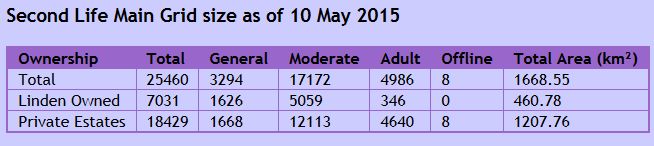
Tyche Shepherds Grid survey summary for May 10th, 2015, from which the figures in this piece are taken
Tyche Shepherd’s Grid survey summary for May 10th, 2015, from which the figures below are taken

And just how prevalent is all this “weird sex” anyway? On May 10th, 2015, there were 7,031 Mainland regions in SL, of which 346 were rated Adult. Given these are all located on the Adult continent of Zindra, it’s not unreasonable to assume that the larger portion of them is devoted to sexual content to one degree or another. Even so, that still amounts to less than 5% of the total Mainland content; hardly a preponderance. When the grid as a whole is considered, the figures are 25,460 region, of which 4986 are rated adult – that’s just 19.6%  – or to put it in Mr. Au’s parlance: “less than one-fifth”.

And (again) leave us not forget Honour McMillan’s sage words quoted above. Therefore, the actual number of pornographic regions accessible to those who have chosen to view adult content is liable to be somewhat lower than that “one-fifth”.

So where, really, does all this leave us?

The bottom line is actually pretty straightforward:  yes, there is a fair degree of sexual content and activity in Second Life. Just as there is on the Internet as a whole and in the physical world. However, the degree to which anyone coming into Second Life might be exposed to it is really hard to judge; unlike a wander through the streets of San Francisco (a parallel Mr. Au draws), where it is possible to accidentally and unwittingly stumble upon the seedier side of life, the degree to which one chooses to be exposed to the more sexual side of Second Life can be controlled, greatly reducing the risk of any accidental or unwanted exposure to it.

This being the case, the suggestion that an article such as Eric Grundhauser’s piece in Atlas Obscura is either “distorted” in its presentation of Second Life or somehow “misleading” simply because it doesn’t delve into the sexual side of SL or play to the stereotype that SL is “all about the sex”, is itself a skewed perspective on Second Life.

With due respect to Hamlet Au, the approach he advocates is not good journalistic practice – but it could easily be interpreted as encouraging continued salacious titillation.

Related Reading

I’ve added the two links above, as they also had an impact on my thinking during the gestation of this article.

Altas Obscura offers a clear-eyed image of Second Life

Second Life has been enjoying something of a positive resurgence in the media in recent months, and with May now passing us by, and June and SL’s 12th anniversary  sitting just over the horizon, it is inevitable that there will be more media coverage forthcoming on SL as the Lab’s media team crank things up.

Eric Grundhauser: touring Second Life with Ziki Questi

One of the first out of the gate in this regard is an article in Altas Obscura, which describes itself as the definitive guide to the world’s wondrous and curious places. Penned by Eric Grundhauser, Forgotten Wonders of the Digital World offers a positive insight on SL with a novel twist.

Rather than asking a few questions of the Lab or relying on images grabbed from Flickr and cobbled together with a little staggering around in-world, Eric Grundhauser is, with the assistance of the Lab, able to gain none other than Ziki Questi, photographer and blogger (together with her partner Kinn), to act as his guide to all that is, and can be found, in-world.

The result is an engaging and informed piece which neatly encapsulates SL’s history, presents an assured view of the platform devoid of the usual clichés and asides, and which focuses on the rich tapestry of content which can be found in-world – role-play, art, personal spaces, with even the broader uses of the platform touched upon, such as the US Army’s use of SL (and OpenSim) to help service personnel deal with PTSD. What’s more, with some of the images supplied by Ziki, the article looks good as well (Mr. Grundhauser’s own snaps aren’t too bad, and kudos to him for taking them, rather than seeking to raid an archive from 2008 or so!).

Ziki and I are a lot alike in terms of taste, so for me it was good to see RocheA Petrovsky Flux and Haveit Neox’s City Inside Out referenced in the article, with Insilico, Kowloon and The Far Away – which Ziki herself rescued from oblivion and now curates – also getting a mention (and photographs).

Roche, a favourite of mine, and featured in the Atlas Obscura article

Such is the impact of his time in Second Life exploring with Ziki and Kinn, Mr. Grundhauser willingly re-evaluates his thinking about the world, while remaining open and honest:

To be honest, when I decided to delve into Second Life, I half-expected to find a dying world of outsiders and bronies gleefully recreating pornographic impossibilities. But that simply doesn’t seem to be true. What I found, and mind you, I was only able to visit a strikingly miniscule portion of the available spaces, was that Second Life is still a fascinating and vital world that is constantly changing and pushing the boundaries of what a virtual space can be…

More telling I think, is the somewhat widespread perception that Second Life is no longer an active digital playground. The Grid is still a vital and evolving space that hundreds of thousands of users create and evolve each day.

Nor is “the sex thing” shied away from – kudos again to Ziki for being open on that subject as well, and the fact that – just as in the physical world and the Internet as a whole – there is an awful lot of it in SL. But as Eric Grundhauser demonstrates very ably – with or without established guides – just because there is a lot of sex in-world, it doesn’t bean it’s the be-all and end-all of the platform. As he notes when describing the diversity of activities and those using SL:

Doctors, universities, hobbyists, sci-fi fans, artists, and inexplicable curiosities can all be found operating in SL, by those willing to look.

Well done to him for making the effort to delve into SL and spend time exploring and getting to know at least a couple of residents, rather than simply taking the hoary old trail of slapping a few outdated headlines (and images) together in an attempt to underline a preconception.

All told, a good, light read.

Related Links

With thanks to Ziki Questi for the advanced notification that this article was upcoming.