I’ve been a user of the Firestorm third-party viewer (TPV) since its inception (and was a user of its precursor, Phoenix). It’s a viewer which offers a comprehensive set of capabilities – those also available in the Official Viewer; those otherwise tucked away in the debug settings and brought to light through the building of UI elements; and those developed by members of the Firestorm team and those contributing to it down the years.
True, it may not run well on all systems – indeed, it may not run as well as other viewers on the same computer; but it offers such a range of capabilities that it is practical for anything a person might want to turn their hand to in SL, from simply pootling around and having fun, to photography, building, scripting, and content creation. Hence why it has become the most widely used TPV in Second life (and, quite likely, Open Simulator worlds).
Given the large percentage of users engaged with SL through Firestorm can clearly present LL with some major headaches, particularly when it comes to matters of support and the deployment and adoption of new capabilities within Second Life. For example, in the six months or so prior to this article one of the main hold-ups in allowing LL to completely switch Second Life over to the WebRTC Voice service and finally turn-off the outdated, troublesome (and potentially costly?) Vivox service, has been the fact that many Firestorm users still use versions of the viewer without the necessary WebRTC support (although that number has been declining).
As it does have such a large percentage of the the total SL user base means it cannot simply be ignored by LL on any level. In this, I do applaud recent moves on the part of the Lab to allow staff to become more au fait with Firestorm and its capabilities, and in publicly recognising the sheer weight of user numbers Firestorm has. Not only does this potentially assist in terms of support issues, it allows Lab personnel more readily understand where people like content creators are coming from when discussing options and capabilities that may have been exposed within Firestorm but may not be so readily apparent in the Official Viewer.
However, what I don’t think is particularly fair is the for Lab to promote Firestorm to the exclusion of all other TPVs. At the June Web User Group it was stated that Firestorm would be added to the Official Viewer download page, and this was due shortly thereafter.
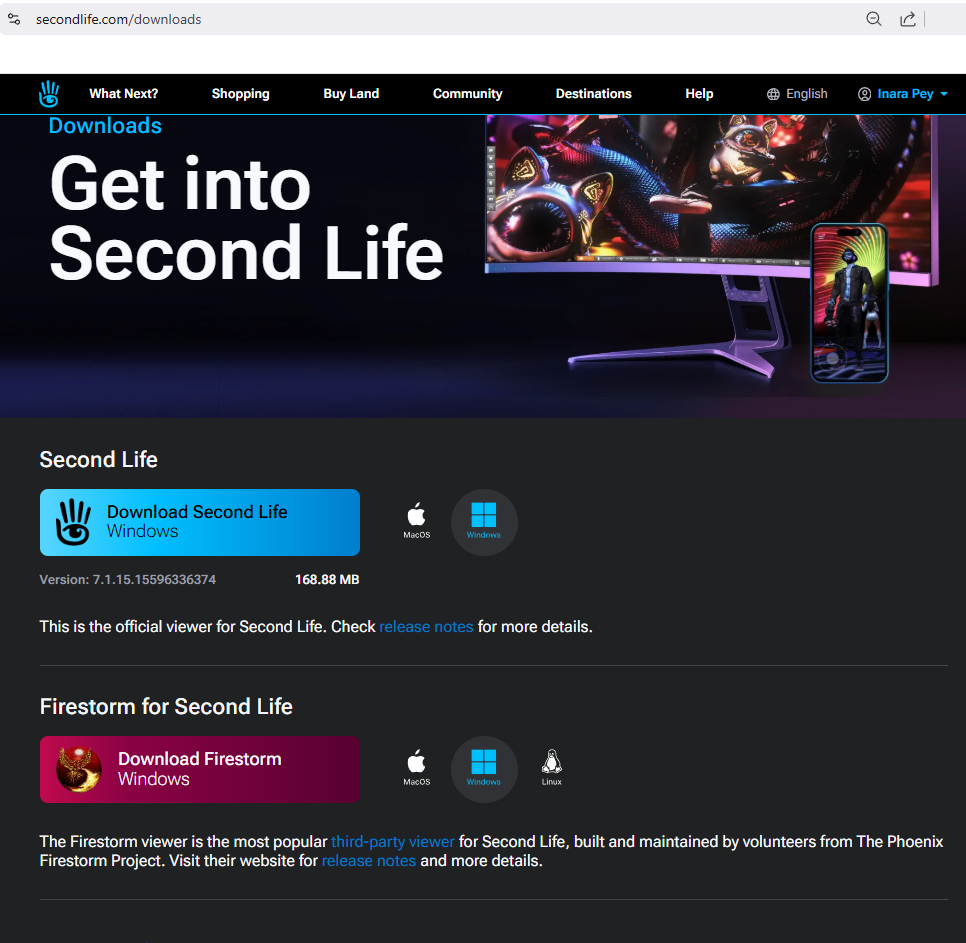
What I find unfair in this move is not the inclusion of Firestorm on the Official Viewer download page per se. As noted, there are good reasons for LL to acknowledge it. Rather it is in the fact that in doing so, all other TPVs are completely ignored to the point where they might as well not exist. Even the one link referencing third-party viewers goes to the Firestorm Viewer download page, not the Third Party Viewer Directory. There’s not even a statement as to what a TPV actually is.
Worse, the appearance of Firestorm alone on the Official Viewer download page can so easily be interpreted as meaning Firestorm is now “officially endorsed” by Linden Lab as “the” alternate viewer for accessing Second Life; or for those relatively new to SL, that Firestorm is the only TPV on offer.
As such, I cannot help but find this move to be demeaning towards the developers of other third-party viewers. Yes, they may well have a smaller overall percentage of users when compared to Firestorm, but this doesn’t invalidate them. What’s more – and as I’m sure the Firestorm developers will agree – many of the people behind those other viewers have contributed to the success of Firestorm and the Official Viewer through code contributions (direct and indirect). Thus, to ignore them entirely is to do them a disservice, however unintended.
The point here is that all of the above could have been easily addressed from the outset by including a section on the Official Viewer download page below the one for Firestorm, outlining what third-party viewers are, and which provides links to the TPV Directory and the TPV Policy. Nor does such a statement have to be complicated. For example:
Third-party viewers are developed by users of Second Life. They are based on the core code from the official viewer but offer additional options and capabilities to users. Third-party viewers (including Firestorm) are not endorsed or supported by Linden Lab. However, those recorded on our Third Party Directory have been self-certified for their compliance with our Third Party Viewer Policy to provide a positive and predictable experience for all Second Life Residents.
Such an inclusion would only be fair an appropriate – as I hope that if anyone from the Lab who might read this piece would agree. All TPV developers put in considerable amounts of their own time and effort into developing viewers to offer users a broader choice in the software they might opt to use. As noted, numbers of active users employing them might pale in comparison to Firestorm, but this does not make them any less deserving of a similar degree of recognition by LL.





 Inara Pey: Living in a Modemworld