In the run-up to the festive season, the Lab are using social media (though not, it seems their own forum) to ask residents a question.
In the Tell Us What You Want campaign, the Lab is enquiring:
We’re working on a holiday gift item for everyone and want to know: What item would be on your Second Life wishlist?
The question is being asked via Facebook and Twitter, Second Life enjoying a high level of visibility on both (although I’ve little doubt the use of Facebook will draw some humbugging grumbles!).
In terms of the responses so far, I’m actually not sure people are perhaps giving the kind of response the Lab has in mind. Requests range from from a couple of thousand Linden dollars a head through 24-hour day cycles on regions, volumetric Linden water, functional search, to lower tier (inevitably, even though not currently possible) and the return of gambling to the grid (not possible) – as well as a whole lot more in between, including, in so cases, what appear to be entire wish lists!
At the time of writing, only one person appears to have entered into the spirit of the direction the Lab would probably like the conversation to take:
Dean Takahashi has a new article up at VentureBeat’s GamesBeat column, featuring a conversation with CEO Ebbe Altberg.
I admit to finding the title of the article, Linden Lab explores VR for its next-generation virtual world (interview), a little bit of a misnomer, given the article actually covers more ground than just the Lab’s new platform and VR. In fact, it’s fair to say that much of the focus of the piece is on Blocksworld, and not the new VW platform – which doesn’t make the piece any less interesting a read.
Ebbe Altberg discusses the Lab’s next gen platform, Blocksworld and SL with VentureBeat
The article starts out by noting the company’s longevity and the fact that it has been in something of a transitional state (as we all know), divesting itself of almost all its existing products save Blocksworld and SL, while at the same time announcing it is heading down the road of building a new virtual world platform.
Takahashi suggests the reason for the Lab divesting itself of products is down to some of the products failing to have the right mix of talent, traction and resources to make their mark.
This is perhaps debatable; while Creatorverse and dio were perhaps lame ducks in terms of appeal, it has to be pointed out that both Versu and Patterns had potential – the former has since gone on to stand on its own two feet, and the latter already had a reasonable user-base even whilst still in a pre-release status (and its termination drew no small amount of upset from Patterns user on Steam).
In fairness to Ebbe Altberg, he does acknowledge the fact that some of the Lab’s nascent products didn’t really get a chance to grown their own legs, and that some of them might well have worked out for the good of the company. However, hard choices were required, the Lab really being too small to handle everything at once (and we know what happens when it grows beyond its means: remember, the June 2010 layoffs came after a sustained 18 months of recruiting that saw staffing numbers increase by 50% for no demonstrable increase in revenue).
Turning to the meat of the article, it has to be said the the recent sale of Desura had led to some questions over Blocksworld’s future. However, Altberg’s replies to Takahashi about that product should put paid to speculation:
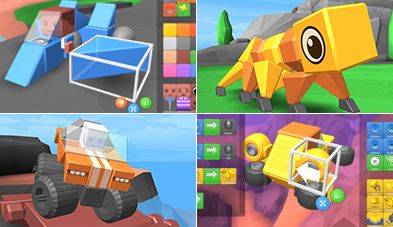
We’re also very excited about Blocksworld. I don’t know if you’ve had a chance to check that out before, but it’s a small up-and-comer. It’s one of the portfolio of non-Second Life products that we decided to stick with. We liked the user experience, the ease of creation, and the audience it targets: a much younger demographic than Second Life. Also, right now, it’s iPad only. It gets us into a lot of experience dealing with a younger audience. … You need to think about ease of use and simplicity but still enable them to create really powerful things, as well as working with the new medium of mobile. We’ve had good progress with this product. It’s still early, but we have good traction. The kids love it.
Linden Lab are said to be “very pleased” with Blocksworld’s performance
In addition, and further into the interview, Altberg indicates that the game has around 400,000 monthly users. How this translates to revenue flow beyond the actual purchase of the game is hard to judge. While additional building sets and expansion packs are available as in-game “purchases”, these are paid for through “coins” which users can earn, rather than having to necessarily buy. Even so, buying coins is the easier option, particularly where the expansion packs are concerned (see the video below), so there’s a reasonable chance that Blocksworld is proving a “nice little earner” for the Lab, even if it is nowhere on the scale of SL.
Beyond this, it would seem clear that the Lab have further plans to enhance Blocksworld, including the development of an in-game user-to-user economy, which will allow the sale of creations and builds between users, somewhat a-la SL. Also, Altberg’s statement that, “right now it’s iPad only”, suggests that an Android version of the game is still under consideration.
Don’t forget that the coming week (commencing Monday, November 17th, 2014) will see all regions on the main SL grid undergoing daily restarts – which may occur more than once for each region.
The restarts are a part of grid-wide maintenance which requires all of the sim host servers to be inspected, with work commencing at 07:00 SLT every morning from Monday through Friday.
[Posted 10:00 AM PST, 14 November 2014] Beginning Monday, November 17, we will be undertaking a full week of scheduled maintenance. This maintenance will take place at approximately 7:00 AM each day next week. Each region will be subject to one or more restarts, as its host takes its turn for inspection. A five-minute warning will be broadcast for each restarting region. Additional warnings will be broadcast to regions where multiple restarts are necessary. Please be cautious about going AFK for extended periods in the middle of build sessions or handling no-copy objects, as you may miss the shutdown warnings. Please keep an eye on this blog for further updates.
@Second Life, the Lab’s official Twitter feed, has announced a public meet-up with users to explore Meauxle Bureaux. The gathering will take place at 12:00 noon PST on Friday, November 14th, 2014.
The announcement via twitter
Meauxle Bureaux is the new “Mole Town” which utilises (with the creator’s permission) Kayle Matzerath’s Lumenaria build from Fantasy Faire 2013 as a home for the Linden Department of Public Works (LDPW) moles.
Following a lead from Ciaran Laval, I flew over to the town to have a look around myself at the start of November, having delighted in the Lumenaria build back at the time of Fantasy Faire. It’s a great place to visit.
Meauxle Bureaux – join the Lab there on Friday, November 14th at 12:00 noon for a tour
So, if you fancy a look around the town, and fancy meeting a Linden or two (or three or four …) why not see if you can hop over to Meauxle Bureaux this coming Friday?
The Oculus Crescent Bay prototype showing the Samsung Gear-type head harness with motion tracking sensors on the back and the integrated headphones (image via Oculus VR)
Brendan Iribe, CEO of Oculus VR was at the Web Summit event in Dublin Ireland at the start of November, where he sat down for a conversation with Wired’s Peter Rubin to discuss the latest state of play about the Oculus Rift, VR in general – and to deliver a small warning to others also involved in the headset market. He also indicated that the consumer version of Oculus Rift isn’t necessarily as close to reaching the market as some might think.
In terms of the Oculus Rift, he was upbeat about the latest prototype version, Crescent Bay, which appeared in September and which is said to be a “massive leap” forward in comparison to the Oculus DK2 hardware that shipped to developers in June and July.
Crescent Bay incorporates 360-degree positional head tracking through the inclusion of sensors on the back of the redesigned and improved head harness, higher resolution, wider field of view, a lighter body, and integrated audio (via Realspace 3D). Iribe said of the new prototype, “Crescent Bay is where it all begins: that quality level.”
Oculus Rift CEO Brendan Iribe (left), in conversation with Peter Rubin from Wird Magazine at the 2014 Web Summit in Dublin, Ireland, November 4th (image via VentureBeat)
However, he also cautioned against people getting too excited over thought that the Rift is just around the corner. “What can I say on that?” he replied to Peter Rubin’s enquiry as to when a consumer version might appear. He went on:
We want to get it right. We really do. We’ve gone out there and we’ve set this bar and said, “we are going to get it right, and we’re not going to ship until we get it right” … We’re getting very close … We want it to be a beautiful product; there’s no reason it can’t be a beautiful product … so we still have a way to go, and we’re still working on a number of things, but we’re getting much closer. We like to say it’s months, not necessarily years, away [but] it’s many months, not a few months.
He then continued, “Crescent Bay, I’ll go on the record as saying that hardware-wise for the headset, it’s arguably almost there for the consumer product, and now there’s a few other parts. So we are finalising the specifications for that consumer version, and the headset is largely finalised.”
Michael Bormann of Engadget tires-out the Crescent Bay Oculus Rift prototype
One of the issues remaining in the way of a launch doesn’t lie with the headset – it is squarely down to the suitability of input devices. Iribe notes that keyboard, game pads and even gesture devices aren’t ideal; there needs to be some form of visual element (e.g. seeing your hands), and there needs to be a tactile element as well. People need to be able to touch, feel, and sense a button reacting to being pressed.He went on to say:
We’re trying to focus now on is, what is that VR input? Where does VR input begin? We don’t know the final Holy Grail of VR input; we have kind-of any idea of VR vision being a pair of sunglasses, which we’d like to get to [but] VR input, we’re still R&Ding, we’re still looking at. But that’s definitely a big focus for us.
The implication of his comments, and those that follow an observation made somewhat in jest by Rubin suggest that Oculus VR may be looking to develop their own input device, or perhaps work in close partnership with another company in the development of an “Oculus ready” (my term, not Iribe’s) device. Certianly, having grown from employing just 50 people prior to Facebook acquiring them, to almost 250 personnel today, it is not inconceivable that Oculus VR may be poking at ideas for its own inpute device.
What is the best VR imput tool… and are Oculus VR lloking to produce their own?
The subject of VR’s “killer application” also comes up in the conversation, and Iribe states he feels it is too early to really say, although he acknowledges it will initially have a big rooting in games and entertainment – hardly surprising, given the Rift’s pedigree. “There’ll be a market of a lot of really fun entertainment experiences in VR where you’ll feel like you’re in the game or in the movie, and it’s going to be awesome,” he said.
But in terms of going mainstream, he very much sees VR’s future hinging on communications:
For me, the real media where this is going to really transform the world long-term, is when we can have face-to-face communications…. Most people travel, and we get on airplanes and cars to go have face-to-face communications… If you could, in the future throw on a pair of sunglasses, and we can have that same conversation with people around the world, all feeling like you’re in the same place, face-to-face, looking at each other, looking at each other’s eyes, looking in each other’s mouths; we may look like funny little avatars, we may look a little more human… that’s really transformative.
Could VR be as transformative in how we communicate and access information as the mobile ‘phone has been?
Were this to happen, and VR offer the same ease of use and access to communications and information as the smartphone, Iribe is convinced it could have as deep an impact on the way we communicate as the mobile ‘phone itself. “To have virtual reality where you can have these face-to-face communications, that’s going to appeal to billions of people,” he said.
However, he also had a warning for other companies also trying to bring VR headsets to the market – there have already been at least two Oculus clones making waves (the ANTVR being one), with Sony also working on its Morpheus headset for the PS4. And that warning is: don’t launch until you’ve solved the problem of motion sickness. In giving the warning, Iribe seemed to be particularly focused on Sony.
We’re really looking forward to this as an industry, and looking forward to it being an industry that takes off… We’re really looking forward to more people jumping into the VR space, and we’re doing our best to be very open, supporting others. At the same time we’re a little worried about some of the bigger companies putting out product that isn’t quite ready. That elephant in the room is disorientation and motion sickness. That’s something I view as, two or three years from now, will really be behind us… We feel pretty confident that our consumer product will have solved that; and we’re really encouraging other companies, especially big companies, “don’t put out a product until you have solved that!”
Iribe’s warning to Sony, “Don’t launch until you’ve solved the problems of motion sickness” (image via Sony)
To this end, Oculus VR’s openness on matter has been such that they’ve invited senior representatives from Sony to come and learn from the lessons the company gained from users’ experiences with the DK1 and the DK2 and to see the Crescent Bay prototype ahead of its launch, offering them the advice that they should “make sure your product is as good or close!”
Elsewhere in the interview, Iribe gives some fascinating insight into a number of topics, including his role as CEO of Oculus VR, the impact of being acquired by Facebook, the company’s relationship with the VR community, the worries those within the company had (rightly so as it turned out) over the potential backlash they’d face if they accepted Facebook’s offer, and more. All of which makes for a fascinating 19-and-a-half minutes viewing.
Linden Lab CEO Ebbe Altberg was in New York recently, attending the Engadget Expand NY 2014 event, which took place on November 7th and 8th. While there, he participated in a panel discussion hosted by Engadget’s Ben Gilbert, exploring the subject of Back to Reality: VR Beyond Gaming. Also appearing on the panel were:
Marte Roel, co-founder, BeAnotherLab and the open-source project called The Machine To Be Another, which is designed to explore the relationship of identity and empathy through VR immersion. The approach is particularly seen as a means of helping in conflict resolution (by allowing a person to experience a situation from another’s perspective). The group is perhaps most widely known for the Gender Swap Experiment, in which participants experience the illusion of being in one another’s body
Matt Bell, co-founder and Chief Strategy Officer at Matterport, a company providing a means to imaging interior spaces and reproducing them as 3D models which have the potential to be utilised in a number of ways.
At just over 34 minutes in length, the panel isn’t long, and the opportunity for discussion of questions and views is further reduced by the first ten minutes being devoted to each of the panelists giving an overview of their particular platform / interest. However, once past this, there are some interesting observations made on the status of virtual reality outside of the games environment, some of which tend to echo commentary from elsewhere.
For example, discussion is held around the idea that immersive VR is more than simply seeing and hearing; we rely on other senses as well – smell and touch in particular. The latter is perhaps particularly relevant as the ability to generate a natural sense of feedback through touch, say through a haptic glove – is in many ways essential to move one beyond being something of an observer of a digital 3D environment to being a participant within it.
The Engadget Expand NY panel for Back to Reality: VR Beyond Gaming. For left to right: Ebbe Altberg, Matt Bell, Marte Roel and host Ben Gilbert
Marte Roel particularly notes this being the case with The Machine To Be Another, where users can use haptic capabilities to interact with the characters they meet by shaking hands and so on. Ebbe Altberg also observes a little later than haptics can help one enter more deeply into the illusion created by VR, noting that while it is possible to see the texture of a surface in a digital environment, the brain knows it is simply seeing an image, but if you can also feel the texture of that surface, the brain is further tricked into a deeper level of immersiveness and engagement – and move it beyond what James Cameron recently referred to as the “I can stand and look around” situation we currently have.
The flip side to this, as Ebbe Altberg also points out, is that the fidelity of the “real” experience – sight, sound, smell, touch, isn’t necessary in every potential use case for VR. There will be situations (indeed, there all ready are) where the full sense of immersiveness isn’t required; as such, over-emphasising things one way or another in terms of requirements or prerequisites would be a mistake, as there is liable to be a broad middle ground.
Even so, it cannot be denied that the technology is – for the time being, at least – one of the more obvious problems facing VR when it comes to mass adoption. There’s no denying ht Oculus Rift and its imitators and competition are still cumbersome, awkward and unappealing, lacking both convenience of use and portability. This is going to have to change – as the panel acknowledges. Indeed, we are already seeing attempts to improve the overall form factor – take the Zeiss cinemizer for example, or the Vuzix Wrap headsets. The problem here is that of price; even at $599, the Vuzix Wrap 1200DX VR is liable to be around $300 more than the Oculus, a pice point liable to keep people thinking VR more a “geeky” adjunct to activities than central part of them.
The Vuzix Wrap 1200DX VR “VR in a pair of sunglasses” – offering the kind of lightweight, non-nerdy approach that will help further acceptance of VR, but currently at a price.
Ebbe Altberg appears confident this could occur within a couple of years. He’s potentially a lot more optimistic than Oculus VR CEO Brendan Iribe, who, when talking to Techcrunch in May 2014, suggested it could be another five years before people will be pulling compact (and presumably low-cost) VR glasses from their pocket and using them with the same ease they do with a part of sunglasses today.
Nor is it necessarily just the headsets; it’s the other accoutrements as well – haptic gloves, controllers, sensors systems, recognition systems. As the panel again acknowledge, these all need to mature and become more widely accepted. They also, frankly, need to become a lot cheaper. High Fidelity may well sign the praises of the STEM system, but it still dumps a minimum $300 extra on the cost of entry into some VR environments. Perhaps the answer lies in the improved integration and capabilities with existing hardware, as has been the case with mobile technologies: the more integrated things have become within the mobile ‘phone, the more central it has become to our everyday lives, something Matt Bell indirectly touches upon.
Matt Bell (holding the Galaxy Note 4), Marte Roel and Ben Gilbert (far right) during the Engadget Expand NY panel. Ebbe Altberg is slightly off-camera to the left (image via Bryan Bedder/Getty Images on Zimbio)
For a discussion on the future of VR outside of gaming, the conversation is surprisingly light; familiar verticals are pointed to as being very well suited to VR – education, health, virtual tourism, etc – but there’s no real probing of potentials. This is in some ways a shame; however, as Ebbe Altberg points out, predicting the overall future for VR isn’t that straightforward, given it could well cut through everything in its applicability:
It’s like an infinite number of potential use-cases for it… When people ask what’s the killer app, there’s going to be lots of killer apps, just like it is on the Internet in general or in the world in general. So I think of VR as a horizontal thing, something that you can able to apply to almost anything you’re trying to do.
Even so, it would have been interesting to hear thoughts on just how VR will be leveraged to a position of being not just an ancillary aspect of how we do certain things, but a piece of technology people see as vital to their every day lives as their mobile ‘phone. Will the catalyst simply because the hardware is available? Might it be come about as a result of multiple independent uses of VR which infiltrate our lives until it becomes an accepted part of everyday life – a quiet revolution, if you will, rather than the kind of sudden “whiz-bang, here it is!” that seems to be anticipated?
When limited to a 24 minute time frame, there’s obviously only so much that can be discussed in such a forum; as such, I couldn’t help be feel the topic might have been done more justice had it been given more time and a broader panel of participants. Nevertheless, what is there is worth listening to, and it has to be said the Ebbe Altberg does a respectable job to hoisting SL’s and the Lab’s flag and profile.




 Inara Pey: Living in a Modemworld