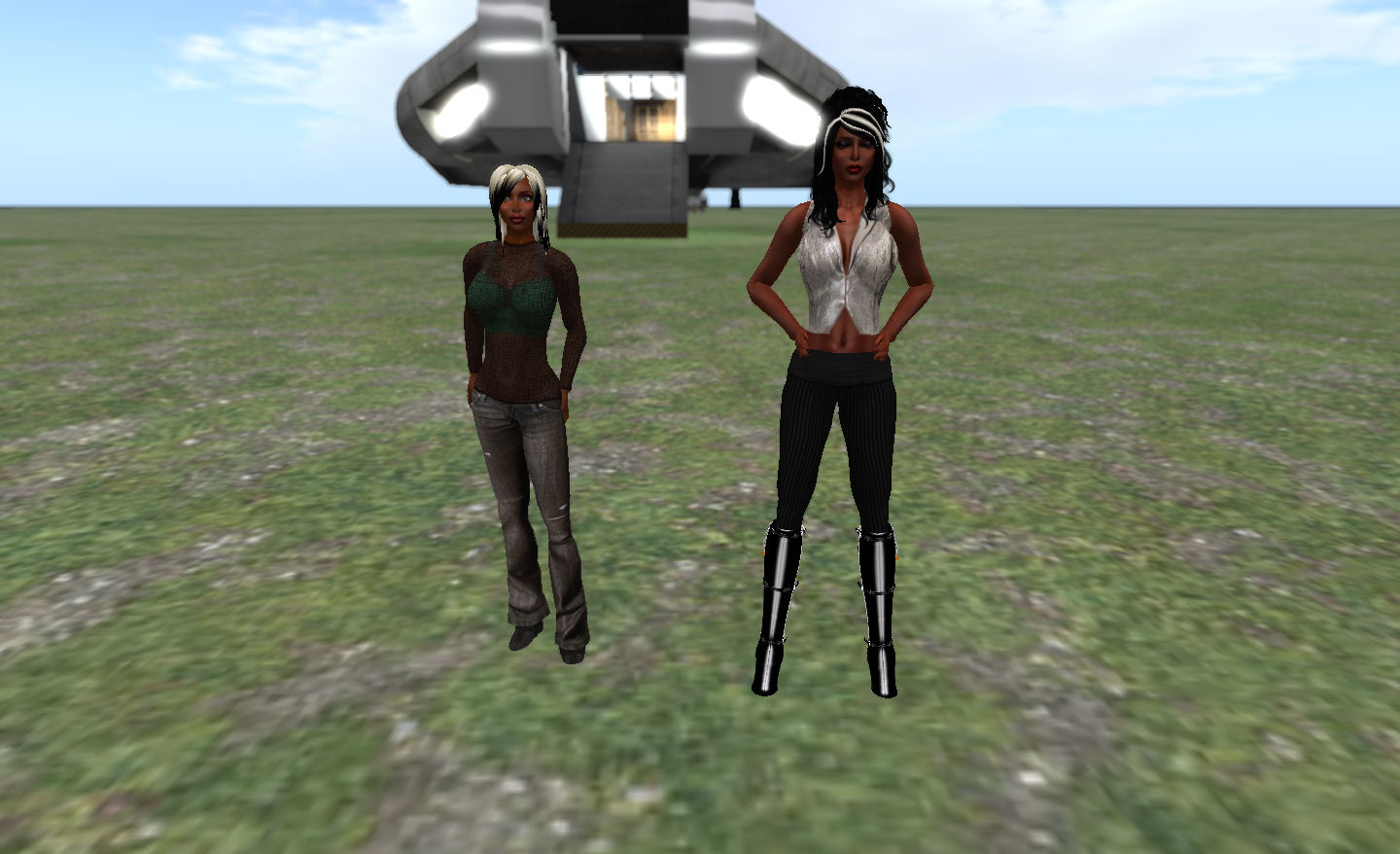
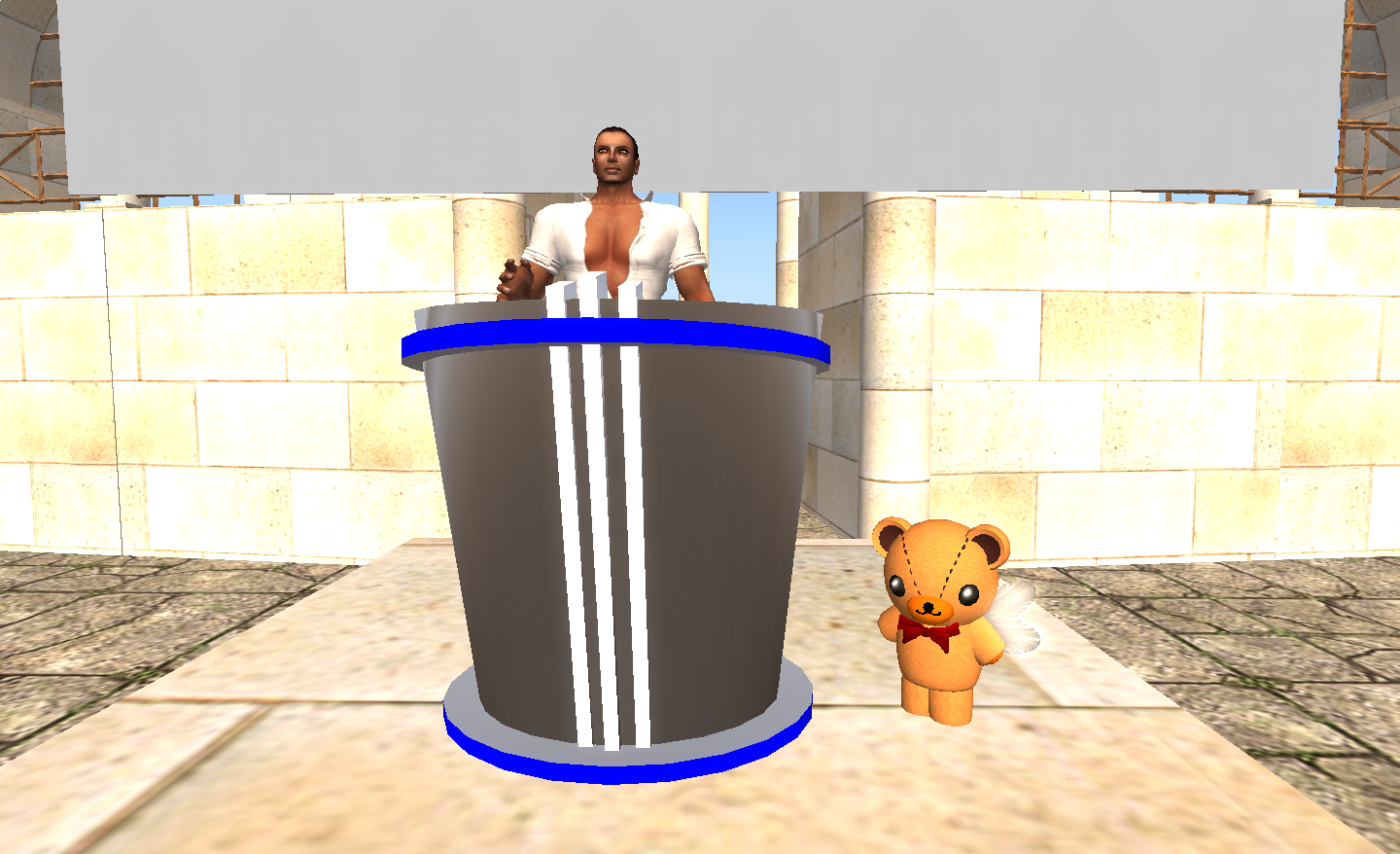
Standing outside the “Hidden Avatars Enabled” parcel
Privacy in SL is a nebulous thing.
We can employ banlines, security orbs and other systems; we can restrict parcel access to those without our own Group, or by access list; we can even resort to ban lists and systems that support them.
Whatever option we take, the fact remains that, unless we have our own private sim (Homestead or full), our privacy lasts only so long as someone who is so minded opts to step up their draw distance and use their camera to zoom-in and watch us.
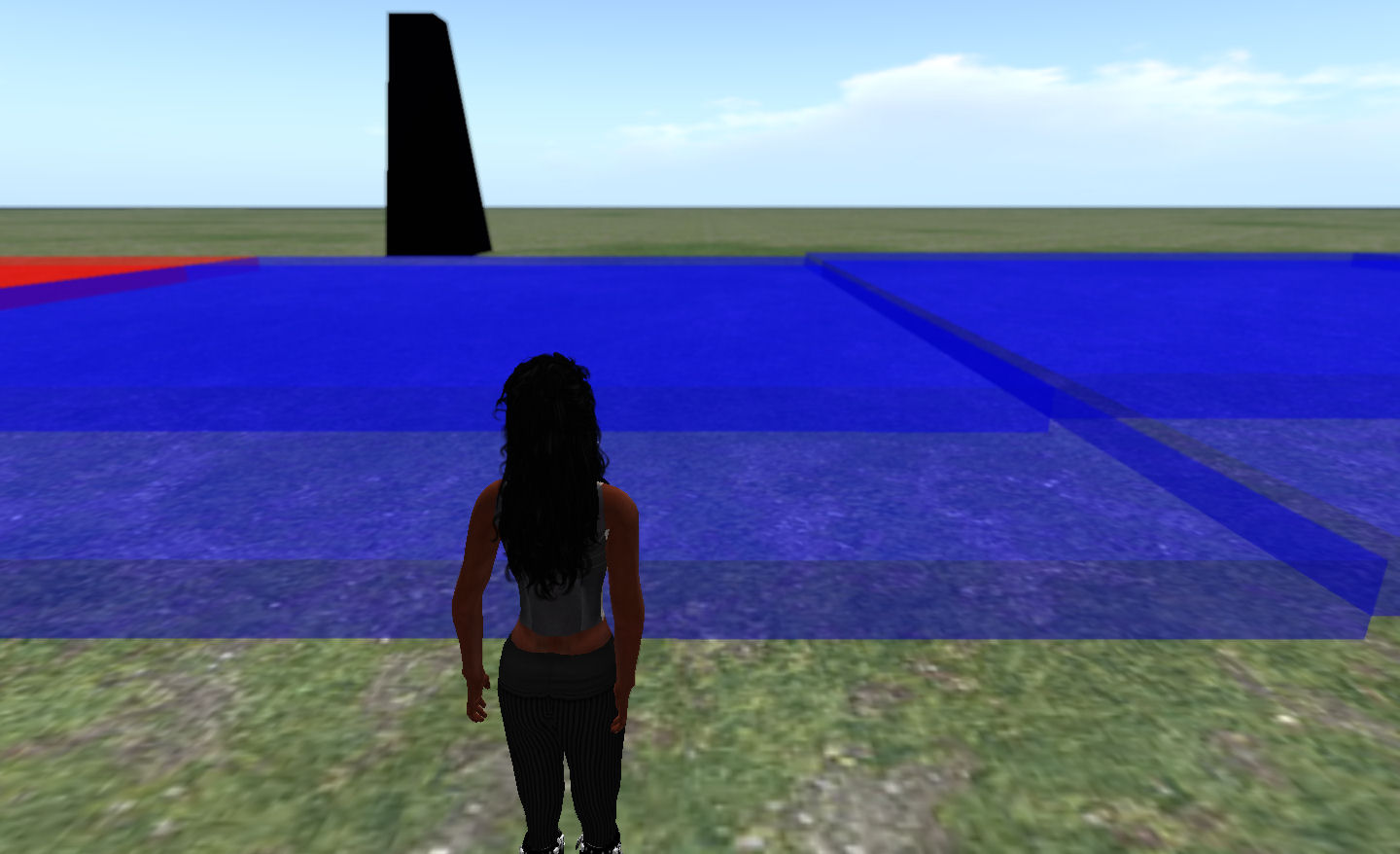
The view from outside the “Hidden Avatars” parcel when someone is occupying it
The ability to “camera-perve” has long been an issue in SL. Indeed, it was one of the worries people had when the grid merger took place: while those under 18 may well be restricted to G sims, if they are on mainland, there is nothing to stop them from camming out of a G sim and into a neighbouring M sim and seeing something they shouldn’t.
Now even that might be about to change in the near future.
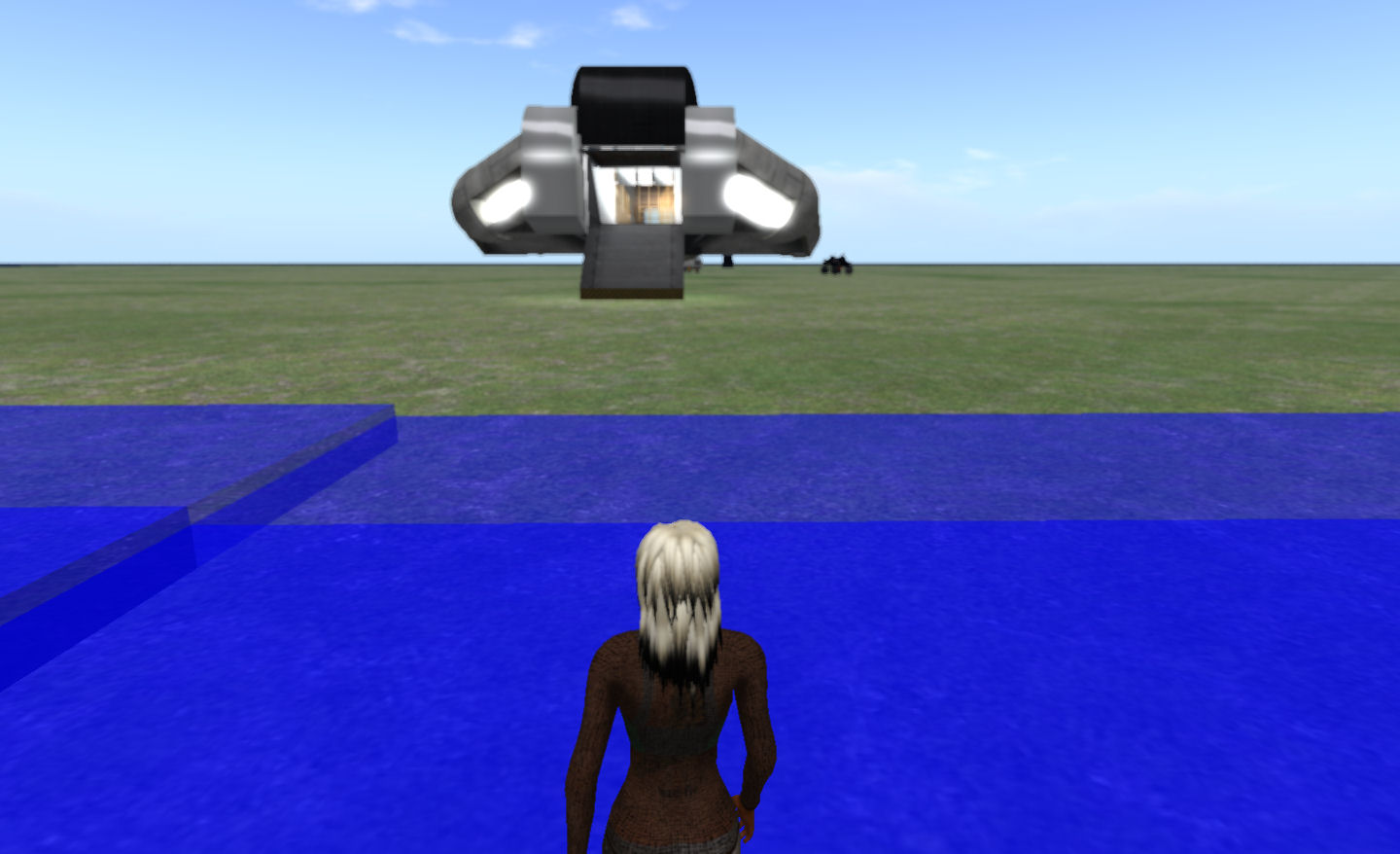
Standing inside the parcel, looking out – I’ve vanished as well!
A new parcel-level permissioning flag is currently being tested on the beta Grid, and could soon be rolled out to the main grid with a number of other new parcel capabilities. This is the Hidden Avatars flag, and when set against a parcel, it will have the following impact:
All avatars inside the parcel will not be rendered in the Viewers of those outside the parcel, however avatars inside the parcel will be able to see one another
Avatars outside the parcel will not be rendered in the Viewers of those inside the parcel
In either case, avatars will still show up on the map and mini-map as dots/icons as usual.
This isn’t an ideal solution to all matters of privacy; objects within the parcel will be visible and touchable by those outside the parcel, for example, and it may even lead to confusion for some (open chat conversations apparently popping out of thin air – the SL equivalent of hearing voices). However, this is a step in the right direction when it comes to increasing people’s personal privacy when combined with other privacy features such as the aforementioned security options.
It’s not clear when (or indeed if) this new option will appear on the main Grid; not everything tested by the Lab in the beta Grid winds up as being rolled out to the main Grid, but looking at it now, and limitations notwithstanding, there doesn’t appear to be any major reason why it shouldn’t find its way onto the main Grid in the near future. Indeed, one has to wonder why LL have been resistant to implementing it in the past, given it has oft-been requested by users over the years.
If you want to test Hidden Avatars for yourself, you’ll need to log-in to the beta Grid using the SL Viewer 2 (I found things didn’t actually work that well when I was running Firestorm, which is based on the 2.4 or 2.5 Viewer 2 code). Instructions for doing this can be found in the SL wiki.
Rod Humble once again demonstrates an adept hand and tongue when dealing with the media – this time the e-zine The Mark. It’s a fascinating piece that further demonstrates Rodvik not only grasps Second Life as a platform, he understands the importance of virtual identity. Take this extract:
The Mark: Do you think people existing in virtual worlds get closer to, or further away from, their true selves?
Rod Humble: I don’t have a clear answer on that, but I do have an opinion. There have been a series of high-profile people, from the head of Facebook to the Pope, talking about how social media should be about centering the individual – that it is all about your real life and ensuring that you don’t become a fractured person. I respectfully disagree with that.
I think that one of the healthiest things that technology can do is actually help us develop the different dimensions of ourselves that we portray in different situations. For example, the “me” at church is very different from the “me” who plays an online shooter game. The “me” talking to you now is very different from the one who will be at my parent-teacher-association meeting later tonight. We’ve always had that. I actually like the idea of enabling people to say, “In this community, I’m a completely different person, and I can hold views that aren’t going to seep into this other part of my life.” It’s a slightly heretical position, but that’s the one I take.
It may be a heretical position among his peers, but Rodvik hits the nail squarely on the head. No one in the world is ever “one” individual per se. Yes we may constantly present the same physical face to the world (although for those that wish to make use of cosmetic surgery, even that isn’t a given) – but the individual we present to different social aspects of our lives vary enormously. I am simply not the same person when among my family as I am when in the office environment of a major publishing house.
Of course, the “identity purists” will argue that this is not a matter of identity but rather of behaviour and personality; that while I may behave differently according to circumstances, my identity remains constant, as demonstrated by my having the same name on my office ID (when I have one!) as I do on my driving license. And in terms of ID cards and driving licenses they’d be right.
But they’d also be missing the point entirely. Identity is not distinct from either behaviour or personality. Rather it is intimately bound up with both, and that who were are and how we present ourselves to the world goes far beyond the a photo on a piece of paper or laminated card.
Facebook and, it now seems, Google Plus, would rather narrow the definition of identity to the two-dimensional aspects of name and photo, coupled with a verifiable address, as that better suits their marketing engines and their ability to generate revenues. I say “it seems” where Google Plus is concerned, because that situation is an unholy mess right now as regards “identity”, and it’s unclear how Google’s own tools may or may not be hooked-into Plus to reap data for their own use.
In taking this approach, the likes of Facebook are trying to enforce a form of conformity on their terms while remaining blind to the potential offered by virtual identities simply because the virtual does fit with the corporate modus operandi or world-view.
The fact is, “Inara Pey” is as much me as the person I present to business or to family and friends. In some ways she’s more “me” than the “real me” I am myself. Through her, I can integrate and publicly express facets of my personality that “real world” society would still deeply frown upon. I can, for example, mix my interests with fetish, D/s, etc., with my interests in business, psychology, politics, history, sport, etc., without (for the most part) being judged solely on the one aspect (fetish / D/s) some have determined to be “objectionable”.
She’s also a part of my psyche in other ways: she is an outlet for my writing on a variety of subjects; she represents me through Twitter and the like. In fact, I find it impossible – even discomfiting – to enter other virtual worlds without her, and so she existed in Blue Mars (as was) and exists in InWorldz, OSGrid, New World Grid, and Avination.
She only really differs in looks (although I’ve tried to mod her shape to be reasonably reflective of the “meat me”): I’m Caucasian in real life, whereas she is dark-skinnned. But even this is perhaps a subconscious reflection of elements of my “real” personality.
I say this because one side of my family’s history goes back to New Zealand, which has generated a deep interest in all things Maori in my in adult life. At the same time, I’ve been fortunate to spend a fair amount of time as an adult in Sri Lanka, and have developed a deep love for that country and its people. The fascination with both New Zealand’s Maori and the Sri Lanka people (Sinhalese and Tamil) seems to have influenced how Inara herself looks.
This genuinely wasn’t a conscious act on my part when I decided to give her a virtual make-over last year. However, the look evolved somewhat subconsciously over a period of several months, and has left me feeling that her appearance is a result of these various inner voices and aspects of who I am coming together to give her form. so to me, physical and virtual self, are deeply intertwined emotionally and psychologically; and I doubt I’m alone in feeling this.
And while she may not have a credit card or a driver’s license or a passport, it’s about time that big business caught on to the fact that she can still be a consumer (and again, that’s really what a lot of the kerfuffle about “real identities” is about: the ability to connect producer with consumer). This is because advertising, promotions, and the like that are directed at her still reach me. Certainly, they do screw with FB’s (and the likes) abilities to carry out wider data-gathering and limit their ability to gain “real” influence (in their eyes) over people – but the fact is, *if* I end up purchasing something, getting involved in something (either directly, or through my digital persona, and accept the receipt of on-going communications, etc., from a service, company or group – does it really matter if it came about through contact with my digital self rather than the “real” (in their eyes) me?
Blimey, and I haven’t even started on privacy concerns and handing over my “real” identity over to the suits and shirts of FB et al is akin to handing them power over me…
But to return to the interview with Rodvik: as well as identity, he dives into the many creative facets of Second Life and the myriad ways in which it brings people together and how they interact once brought together. As such, it not only shows (again) that he gets the value of Second Life on just about all levels, it provides interesting thought for consideration, both by those of us involved in this frontier – and, dare I say, by those who would seek to limit our ability to explore it by forcing us to restrict ourselves to their interpretation of what can be classified as a “real identity”. Not that I can see it causing them to re-think their position, sadly.
If I were to take issue with Rodvik, it would in his answer to a question concerning the future of virtual worlds and how people come together, when he replies:
“Good question. I think that something big is going to happen when it comes to online associations, which are going to run headlong into conflict – probably with some totalitarian country somewhere. It’s a broader thing than just Second Life.”
My take on this – while it is slightly out-of-context to the question asked, which set commercial aspects of virtual interaction to one side – is on the one hand he is more than likely right right in his assessment vis “totalitarian countries”. However, on the other, for those of us already living on the edge of the “new digital divide”, the conflict is clearly already here, with the totalitarian drive is coming out of “big business”. How that is resolved may actually render anything else moot for us.
I would, however, end this piece on a lighter note, and wag a teasing finger. My 40th birthday is rushing towards me fast enough as it is, Rodvik, so did you really have to go and push me into my “mid-40s” in the interview?! That’s two dances you owe me! 😉
Given recent losses within the Lab – Amanda, Courtney, Blondin – it’s not surprising that the communications team are perhaps a little short-handed, even if news and announcements coming out of Linden Lab have been in short supply for a good while now.
So it is interesting to see that Featured News on the official blog appears to have moved to a monthly round-up / announcement, as exemplified by the “July Update” which popped up earlier today.
It is a fairly comprehensive piece, covering the implementation of new default avatar types – something Rodvik alluded to last month on Twitter; progress on fixing Group chat and the upcoming changes to web profiles I’ve given something of an overview to here, as well as news on changes to promotional e-mail and an update on the new Search system.
The new default avatars cover animals, robots and vehicles – all of which LL have received criticism for having previously “ignored”, and which will hopefully prove to be welcome additions.
I’m not entirely sure the comments on Group chat lag being a thing of the past are not going to come back and haunt LL; I’ve been in Group chats as recently as yesterday and witnessed the kind of issues referred to in the piece, and I’ve seen similar comments from others on the subject. So while things have undoubtedly improved, I’m not entirely sure its a matter of “case closed” just yet.
As to the web profiles, it is interesting to read the formal announcement of what is coming and see what appears to be the “smaller more integrated” in-viewer web profile window (see below).
New Web profile window? (with thanks to Linden Lab)
While the window does appear smaller and less intrusive, I’m not sure that “more integrated” is the right description. As I’ve said elsewhere, “integration”, to me, suggests something that blends-in with the rest of the Viewer in terms of layout, skin, etc. This isn’t really the case with the in-viewer web profile view.
Possibly the most controversial item reported on in the update is the SL Marketplace, which has seen a series of on-going changes that have been met with frustration in some quarters and concern in others. Of these, the upcoming Direct Delivery system, which is currently in its “Alpha phase” and which will eventually replace magic boxes, is perhaps the focus of the majority of concern when it comes to the Marketplace. As I’m not participating in the Alpha phase of this system, I’m not in a position to comment (and probably wouldn’t be able to comment even if I were, given the NDA requirements around the project); suffice it to say others have passed comment on the new system, and their concerns do seem justified.
Stepping back from the details of the post, I have to say that I hope that this “monthly update” approach is not going to become the trend for all of LL’s blog posts. We get little enough communication from them through “official channels” as it is, and I’d personally rather get fed the news “as it happens” rather than getting it almost in retrospect (as is the case with some of the content of this update – the new avatars have been reported on elsewhere already, and the updates to web profiles have been the subject to a lot of chatter for over a week now).
It’s also a shame that LL are (again) pushing people out to Twitter in order to discuss news. For crying out loud, Rodvik et al – you’ve clearly spent time and money developing and rolling-out a “community communications platform” so why the hell are you guys not using it effectively?
OK, so fair enough, you also point people to the Technology Forum – but the fact is, this is also hardly ideal unless you start specific topic threads for each update that comes out – and even then, it’s hardly convenient. If you really want feedback and comments on what is happening, then give us the means to do so in as quick and convenient manner as possible.
By that I mean letting us us comment on your blog posts directly. It’s the way almost every other blog in the world operates when comments and feedback are allowed – so why not you? You used to at one time, but then you moved away from this approach, almost as if you were either afraid of what we might say, or didn’t want to hear what we were saying.
But the fact is, if you really want our feedback, you really should consider making it as easy as possible for us to do so, even if it does mean opening up your blog entries for comment once more.
I actually started writing this post back last week, but abandoned it for lack of in-depth information as to whether we were seeing something new or something abandoned that had accidentally resurfaced. However, after attending today’s mysecondlife.com User Group meeting, I’m now more confident in going to press – even if the news is now rather old!
Essentially, in the next few weeks our web profiles will be turning a lot more “social” in their look, feel and capabilities. With the “new” Profiles, people will be able to:
Link more closely to any other social networking identities they may have & which they wish to connect to their SL identity (e.g. Twitter, Plurk, Facebook, etc.)
Allow people to comment on their own and other profiles (subject to permissions being set) in a Twitter-like manner
Manage their Friends and Group lists through the web profile as well as in-world
Upload snapshots directly to their web profile.
Some of these changes can already be seen on my-demo.secondlife.com, although the more recent code updates appear to be only available if you actually physically log-in to the Beta grid and use the new profiles through the in-viewer browser.
Several of the new features look to be well-considered and have been much-requested: the ability to manage Friends lists for example. Others are likely to prove more questionable among the masses – and indeed are already generating concerns.
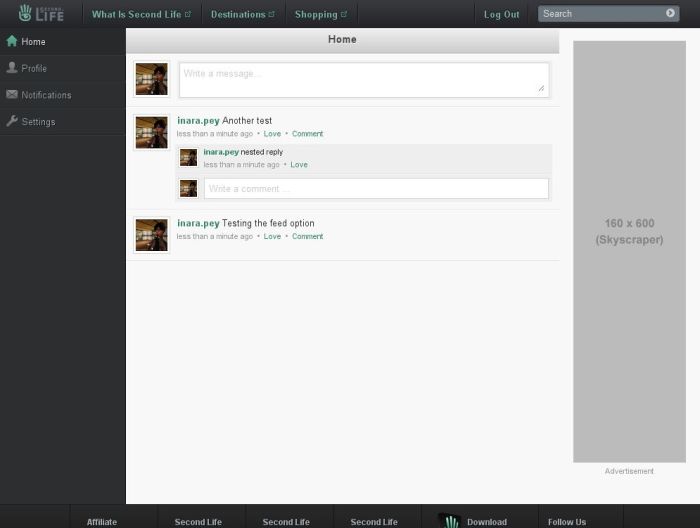
Feed option
The Feed Option
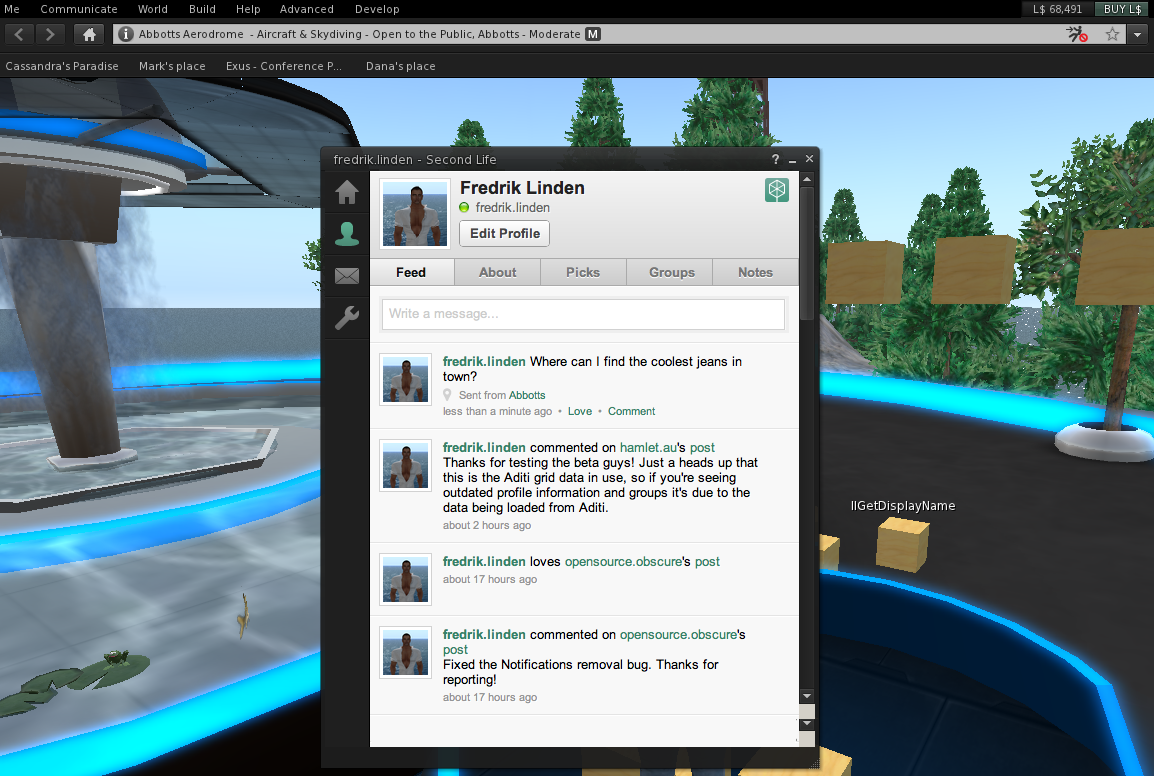
The Feed option is most analogous to Twitter in many respects. Essentially it allows those to whom you give permission (defined as a Friends only, or anyone in SL or anyone coming across your profile while browsing the web) to leave a comment on your profile. Replies to comments can also be made – as shown in the example above.
This has already given rise to concerns about spammers abusing the system and people finding their feeds filled up with ads for tat, tosh and trinkets. However, this can be mitigated against by adjusting the privacy settings for the Feed option (setting it to just “Friends” – which really, it should be by default).
Another concern with the Feed is that if it is used via the in-viewer browser and Viewer 2 / a V2 TPV, your in-world location is automatically appended to the message you send out. This is something that did not prove to be popular among those attending the my.secondlife.com user group meeting today, doubly so when it became apparent that the option to transmit your location is opt-out, rather than opt-in, and that there is currently no blanket opt-out option: you must do so message by message. However, Fredrik and Teddy Linden, attending the meeting on LL’s behalf, appeared to take concerns about the opt-out rather than opt-in situation on-board, with Fredrik commenting:
[11:41] Frederico (fredrik.linden): again, we want to help people socialize and stay up to date with what’s happening in Second Life. Location does that, and we want to push it. we’ll be sure to tweak the opt in/out before we go live to agni
Given that people will be able to comment on your profile, the new system includes options to notify you when someone does so – you can elect to be notified in-world and/or via e-mail and these options can also be set should someone comment after you or comments on a message you leave on another person’s profile.
Faster, smaller, neater
Fredrik (left) and Teddy Linden at the my.secondlife.com User Group meeting
A repeated complaint about the web profiles, and I’m as responsible as anyone here, is that they a) take far too much time to load when using the in-world browser (4 seconds on average for me – others have reported up to 10 seconds on busy regions) and b) they take up far too much screen real estate. Again, LL appear to be listening to these concerns, with both Teddy and Fredrik giving assurances that the “new” profiles will be faster on loading and “more integrated” into the Viewer.
The new profiles are not ready for prime-time as yet: the data used at my-demo.secondlife.com is from the Beta grid, and thus is very stale for many users (other than those who routinely spend a good deal of time logged-in to it). More work is required on various aspects of the new look – and both Fredrik and Teddy seemed keen to take on board as much feedback from the UG meeting as they could – presumably so that it could be fed-in to the development process in the lead-up to the release some time in the next few weeks.
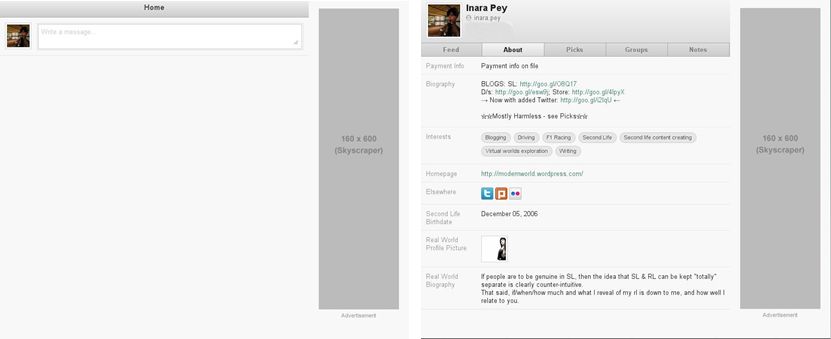
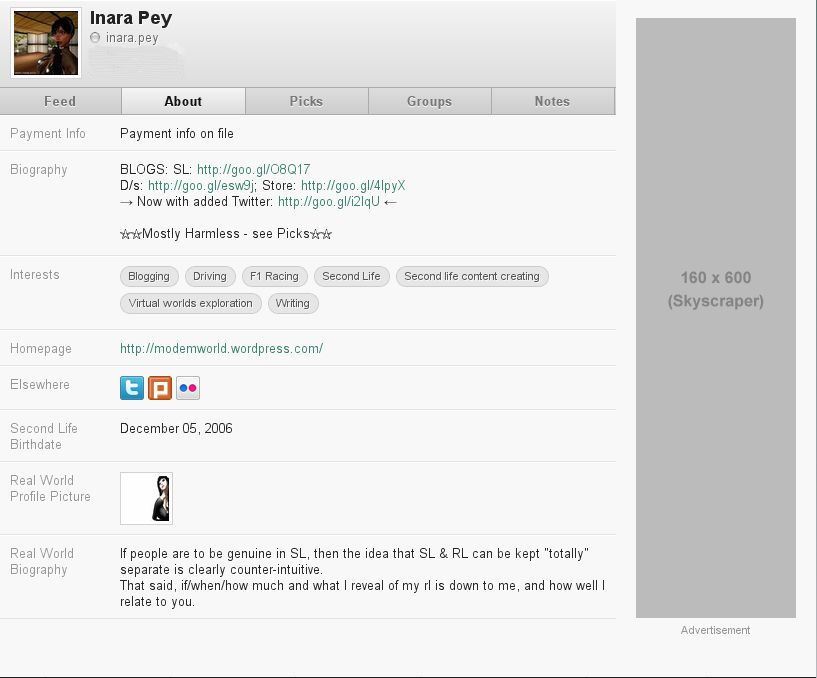
Right now it is unclear (at least to me) as to which page / tab will be the item others see when looking at your profile; “Home” would appear to be the obvious choice, but given this is essentially a blank page with a feed box in it, it would appear somewhat redundant. The ABOUT tab appears more informative – and it is actually hard to understand why this isn’t, by default, the “home” page for a profile.
Home page (l) and About tab
Overall, the new-look profiles offer much of promise and provide a set of potentially useful social networking options. A part of me wonders as to how effectively they will be used, however – those that want to extend some of their SL contacts and activities into the “pure” social networking space are probably already at home with the likes of Plurk and Twitter, and may not be overly attracted to the new profiles unless deeper integration with their preferred communications medium are available, or all their existing contacts can be persuaded to swap over or get involved. For many SL users however, there is a risk that these additional bits and pieces will be at best ignored, as they don’t have any place in their in-world lives, or at worst seen as a complete distraction.
For my part, I do find it hard to believe that things like the Feed will do much to pull me away from Twitter (and to a lesser extent, as I don’t use it so much, Plurk) – it simply isn’t as convenient a tool to use. However, I do like other aspects of the new profiles; overall the new tabbed approach is a lot cleaner and easier to grasp. I also look forward to seeing just how LL tweak the profiles for “better integration” with the Viewer as a whole.
I’m also curious as to how the Firestorm team will respond to these changes – if at all. Currently, Firestorm takes profile information and displays it in a Viewer 1-style window within the browser. This actually works a lot better than the in-browser approach – but will it be able to display all the new widgets and options, or will Jessica and the team opt to leave that to using web profiles through the in-viewer browser.
Update, July 2012: This article is now out-of-date following a further change to the Age Verification process. See this post for details.
It appears that Linden Lab has launched a new Age Verification process. This is causing more than a few waves, as Tateru and Ciaran report.
While I don’t wish to blow my own horn, I’m not actually surprised that there has been a change; this is actually something Rodvik took the time to Private Message me about via Twitter earlier in June in order to obtain some perspective on changing the system (presumably because I’m involved in the Adult Community within SL) – and I’ve little doubt he PM’d others as well to get some feedback. While he didn’t specify how the system was to be changed, it was clear from the exchange that something would be changing.
The problem with the old verification process – really – was that it was completely misrepresented through rumour, ignorance and assumption. It was also somewhat invasive (although to be honest, I had little issue with Aristotle Integrity and providing my passport details because I made myself go read-up on the system itself and understand what it was actually about).
Among the wild (and incorrect) claims made at the time the system was introduced were the following:
It was used to track US citizen’s voting habits / to target US citizen for political mailshots, etc. (a rumour generated because the software came from the same company that provides political trending software to the major US political parties)
The software was “against European law” (and yet 12 out of the twenty top users of the software were European Union countries, including Germany, France and the UK – three countries where the “against European law” cries were the loudest)
That the software stored personal information on-file and made it available to third parties for a fee (yet the software does no such thing: it operates on a look-up basis with nationally-held databases and simply acts a a “tick box” confirmation service)
That the software supplied personal information to Linden Lab (in fact the only information passed to Linden Lab was either a tick to say a person had been successfully Age Verified or a cross to say they hadn’t).
If genuine fault were to be placed with Aristotle Integrity, it was in the fact that it could easily be fooled. The system appeared to compare supplied data with a variety of databases with no actual cross-referencing. This resulted in people being able to fool the system by giving (for example) a valid Social Security number against the name Elvis Presley and end up being verified. In the UK and Europe people were able to give “old” data relating to themselves (such as a former home address and expired passport number) and get verified. Some even claimed to be able to give completely fictitious information together with a real name (say, Donald Duck) and get verified. There was also a problem for some in that even when genuine information was given, verification would fail, or the Age Verified flag would have to be periodically re-set (I myself have had to re-verify twice since my original verification after suddenly finding myself blocked once again from land with the Age Verified flag set (rather than the PIOF flag)).
Part of the fault here was clearly with the Artistotle Integrity software, although equally, much of the blame lay with the various government databases being checked, simply because they are not cross-referenced (and we probably all breathe easier as they are not).
However, all this aside, the fact that the system required the submission of passport numbers, Social Security numbers, etc., whether or not they were stored somewhere was extremely off-putting to many – and it was this evasiveness that gave Rodvik cause to PM on the subject, and indicate privately that he felt the matter needed addressing.
The result is a completely new system that simply requires you supply a date of birth and confirm the information supplied is true.
That’s it.
New Age Verification Process (with thanks to Tateru Nino)
Doubtless the new system is going to get people up in arms once it becomes widely known, and some people are going to rail against the whole thing being a “joke” and so on simply because the system is now so “easy”. Others will doubtless cry “foul” because of the information (SSN, driver’s license, etc) they have “given” to LL in the past (even though, as stated, no information supplied is actually retained by Aristotle Integrity or LL).
However, the fault here is not LL’s: they are simply conforming to the requirements set forth by the US Federal Trade Commission’s best-practices for age-verified access to adult content on-line. It may not be the best method in the world (but can anyone point to a system that does work without falling flat on its face at the first presentation of false data that doesn’t require invasive “background checks”?). It is however what the US government considers adequate in lieu of anything better.
If nothing else, it should put an end to the more ludicrous claims made around Aristotle Integrity and take away the very genuine headaches some people did have when trying to verify using it.
We’ve yet to see any formal announcement about the new system – the news has been “leaked” via SLU, where it appears some were given a heads-up that the new system was now available for testing and opted the break the news themselves on Friday. Whether they received word from LL or perhaps from Rodvik having also been a part of the batting of ideas I had been loosely involved in via Twitter, is unclear. Given that so much of late seems to be coming to light as a result of word-of-mouth rather than any official announcement, it would be nice to see something show up on the official blog about this come Monday.
I’ve not had time to flick around SL8B today – real life has kept me occupied. However, Massively did get a superb interview with Rodvik Linden, and posted it to You Tube. So, to make up for my own lack of effort, here’s the piece for your enjoyment:



 Inara Pey: Living in a Modemworld