Desura – grand ambitions

Update: Linden Lab sold Desura to Bad Juju Games on November 5th, 2014.

Kris Ligman over at Gamasutra had an interesting chat with Rod Humble recently, in which the Lab’s CEO discussed the acquisition of Desura earlier in July, providing more of an insight into why it was done and – perhaps – some of the longer-term thinking going on at the Lab.

I’ve been intrigued by the acquisition since first reading the press release. Of all of the Lab’s moves to establish itself beyond SL, this is perhaps the one which could stick, and stick well – if they can follow-through on it. For one thing, Desura isn’t a start-up facing an uphill fight to gain a marketshare. It’s already established and, despite being a minnow to Steam’s whale, has nevertheless carved out a niche for itself in a sector which offers the potential for growth.

I’m not a gamer by any stretch of the imagination, but in digging around Gamasutra, Desura et al, I tend to agree with Iris Ophelia on the positives around the move.

Desura: have LL boxed clever on their latest acqusition

There would also appear to be attractions beyond those Iris states. For a start, there could be the opportunity for something of a symbiotic relationship between the Lab and game developers which grows out of the acquisition.

The Lab is looking around and trying to establish a broader portfolio of products and hopefully develop them into revenue streams. At the same time, it is possible that some game developers are looking at Desura as a means of honing skills and perhaps getting noticed “out there” by a games house. Thus, through Desura, the Lab potentially gains a platform through which they can scout talent they may wish to recruit at some point, and game developers have a service they can use to promote their offerings without jumping through hoops or fighting for attention, as Iris points to being the case with Steam’s Greenlight, and be aware that the Lab might just see something they like and snap them up.

While it is unlikely to have been a consideration in the acquisition, Desura does now mean the Lab has a direct channel-to-market for any PC / Mac  / Linux games and software they produce – such as Patterns, which is already offered through Steam, but which would appear to be a good fit for Desura as well. Might we yet see the hinted-at versions of Creatorverse for PC and Mac popping-up on Desura at some point in the future (assuming Creatorverse is actually still under active development)?

Patterns: an additional channel-to-market via Desura?

However, Humble’s comments in the article make it clear that the Lab is looking at Desura in far broader and more ambitious terms. In framing the reason for acquisition to Ligman, Humble states (emphasis mine):

[We want] to make it the most open, developer- and user-friendly distribution service for all kinds of digital goods, starting out with games and mods and going from there. For us it’s a natural step… We’re about user-to-user transactions and empowering people’s creativity.

This is a pretty hefty ambition, and suggests that the Lab might be willing to take Desura into more open competition with Steam, which started offering “other” digital goods in the form of non-games software last year. And while this is pure speculation on my part, could it perhaps also be that LL have their eye on content creators interested in being able to sell their mesh creations to users of virtual worlds – not just SL, but OpenSim (and perhaps even Cloud Party)?

This may not happen immediately (if at all), but the idea needn’t be that much of a stretch. Desura is already geared to handle payments in the user’s local currency, so it would be relatively easy – and attractive to content creators – to provide a means by which they could potentially reach multiple grids without having to fiddle-fart with local on-line markets or deal with different virtual currencies. Sure, users would mostly likely have to upload whatever they buy to their chosen grid (and pay any associated upload costs), but this needn’t necessarily be a huge blocker to the idea.

Pushing my own speculations to one side, that the Lab does have ambitions for Desura inevitably raises a couple of questions: can the Lab actually live-up to its own ambitions. and will it actually be allowed to do so?

In terms of the first question, the concerns are twofold. Desura is community-oriented, and the Lab’s track record of community relations within SL hasn’t exactly been stellar. Can they fare better with the Desura user community? The other, perhaps more vital, point is that while it is already up and running and has its own community, Desura is still pretty small and needs a lot of commitment and nurturing in order to grow. This will require time and effort on the Lab’s part – do they actually have the patience and willingness to run the course (as well as the expertise to run it well), particularly among the board, who are liable to have one eye firmly on ROI? In this, it is interesting that the Lab may not actually be looking to go it alone, with Humble admitting they could well be looking to bring-in partners.

The answer to the second question  – will the Lab be allowed to develop Desura in keeping with their ambitions – in a way comes down to Valve and Steam. Currently, Steam’s focus is slewed towards the bigger names in games development, and Steam Greenlight currently appears to have a number of barriers standing in the way of the smaller developers. However, should Valve sense that Desura is getting a little too big, there would be nothing stopping them from making their own offering far more appealing to game devs across the board, undermining Desura’s appeal, and leaving it starved for growth.

The interview with Ligman is perhaps one of the more forthcoming Humble has given – in some respects, would that he’d be as candid when talking SL. It’s fair to say that in the piece he’s gone a good way to answering the question of “why?” regarding the acquisition, and which has been on a lot of lips since the move was announced. As to the additional questions as to whether they can bring their ambitions for the service to fruition – well that, as they say, will be determined in time.

Related Links

Fastcompany: grokking SL

Jo Yardley indirectly pointed me towards another article on Second Life and its past / future and what is going on at the Lab. Written by Susan Karlin, the piece again covers some familiar territory, but also offers-up a light analysis of the platform as well as taking a look at the road ahead.

The first thing to be noted about the piece is that Karlin gets the creative opportunities offered by SL and its the ability to bridge the digital / real-life divide in many unique ways for those who wish to do so.

A slide show at the top of the piece gives a more than fair representation of the platform’s breadth of appeal / promise ability and also its ability to reach through into real life and have real and lasting impact for people – be it the real life relationship which blossomed between Anglo-American couple Damien Fate and Washu Zebrastripe (both now well-known in content creation circles) which led to their eventual marriage and the birth of their son, or the story of Holocaust survivor Fanny Starr, or the work of Beth Noveck, a law professor who served as President Obama’s deputy chief technology officer for open government until 2011 and who used Second Life as an educational platform through her avatar Lawlita Fassbinder.

Anglo-American couple Damien
Anglo-American couple Damien Fate and Washu Zebrastripe (left) saw their relationship blossom in SL to the point where they married in RL, and in 2009 saw their son – called Linden, appropriately enough – enter the world.

Within the article, Karlin highlights some of the weaknesses of the platform without feeling the need to dismiss SL in the process. While she rides the wave of LL’s infographic, which highlights the one-million log-ins per month and the 400,000 new sign-ups, she also points out the former has remained on a plateau (“stable”) despite the 400,000 apparently arriving on SL’s doorstep each month, only for around some 80% to turn around and walk away again.

Her quotes from Rod Humble also help provide more of a framework as to why he’s been pushing the Lab in the direction he has over the last two years.

The Lab is constantly chastised not “dealing with lag” or not “improving performance”.  But the reality is, that issues of performance have been a core focus for Humble since the day he arrived at the Lab – and has been so, purely as a result of the feedback from the many who try SL only to leave, a good portion of whom cited “performance” as being a major issue in their exit feedback. In this, Karlin’s piece is timely, as many of the various threads of this ongoing work – interest list updates, HTTP work, SSB/A, and so forth – are just coming out into the open, with the promise of more work to come.

Karlin’s article makes it clear this strategy runs deep. I recently pointed to a comment made by Humble to Benny Evangelista of the San Franscisco Chronicle in which Humble talks in terms of winning back the 30+ million people who tried SL and gave up. In that piece, the comment was couched in the framework of the Lab’s plans for their future endeavours. However, Karlin’s article makes it pretty clear that those 30+ million have been on his mind for a good while now and have been one of the influences which has shaped LL’s strategy and approach to SL.

An SL fashion design: Karlin's piece does much to present the rich diveristy of the Second Life community, offering-up many examples of the creative nature of the platform as well as its power to cross the virtual / RL divide in many different ways. It's a refreshing chang from the usual media angle, which frequently relies upon sterotypical references and images at least 5 years old
An SL fashion design: Karlin’s piece does much to present the rich diversity of the Second Life community, offering-up many examples of the creative nature of the platform as well as its power to cross the virtual / RL divide in many different ways. It’s a refreshing chang from the usual media angle, which frequently relies upon stereotypical references and images at least 5 years old

She also touches on the fact that LL are still committed to the platform despite their move to try to diversify their products portfolio, noting:

The goal is to strengthen Second Life’s core infrastructure, while expanding Linden’s offerings in other types of shared communities … What has always worked–and what Linden seeks to tap into with its other products–is a virtual community that can have as much resonance as in real life … Hoping to tap that enthusiasm, Humble is developing a Linden Lab product line of cloud-sharing interactive community building apps unrelated to Second Life.

Diversifying is, as I’ve said in the past, generally considered a positive move for any company occupying a single-product market space. Yet even before any product had been announced, many in SL immediately denounced the Lab’s planned move to diversify as indicative the company had “given up” on SL or were merely using it as a “cash cow” to serve their new products. Not even strong evidence to the contrary, with the Lab continuing to refine and enhance the platform or the fact it has continued to invest heavily in infrastructure improvements aimed solely at the platform or that it has recruited  / acquired talent outside of the pool of resources working on SL with which to develop their new products, would sway naysayers from this view.

Of course, there is a broader discussion on how actually effective LL’s new products are in terms of promotion and market penetration, but that falls outside of a piece such as Karlin’s.

LL's new products: wrongly pointed to as indicating the "end" of SL
LL’s new products: wrongly pointed to as indicating the “end” of SL by many involved in the platform

Some might dismiss this as a “light ” piece, albeit one which attempts to take a step back from the line of the Lab’s message and apply a little more thinking to its coverage of SL True, it doesn’t plumb the depths some of us, as SL users would perhaps like to see, such as issues around revenue and tier. But then, mainstream media probably isn’t any more interested in plumbing those depths than LL is in seeing them explored, so to dismiss the piece purely on these grounds might be a tad unfair.

What is particularly refreshing about Karlin’s article is that it is one in which the writer actually groks the broad creative opportunities it provides and who understands the sheer power of the platform to connect lives. That alone makes it a refreshing read when compared to the tired retreads of “where SL went wrong” and “whatever happened to” pieces all too often rolled out by those is the media unwilling to give the platform a second look.

It’s also good to see someone in the media picking-up on The Drax Files, which makes no fewer than two appearances in the article.

Related Links

Rod Humble on living the Second Life

Rod Humble is very much a Q&A man, something I can personally attest to, and which was shown back in June with his Q&A session with Best of Second Life magazine. There are pros and cons to this approach.

On the one hand, and particularly when working across large distances and different time zones, it means that neither side is tied to trying to commit to a day / time (at possibly an ungodly hour) in order to try to hook-up either in-world or by ‘phone or via Skype.

The downside to this is that it prevents a spontaneous conversation from developing, which stifles rapport, perhaps of greater impact from the reporting side of things, it gives the Lab the freedom to dictate the direction of questions / cherry-pick which questions they are willing to answer.

Rod Humble: master of the Q&A session

Much has been made of this second point, although from my own experience I can say LL are not the first to “vet” or pick questions to answer within an interview, and I doubt they’ll be the last.

However, perhaps what frustrates me more about the whole Q&A style approach is that can isolate questions from their broader context (unless submitted with reams of explanatory text), which can further dissuade the Lab from responding, when a more face-to-face contact might enable the aforementioned rapport to be established, resulting in a more relaxed exchange in which some answers might be a little more forthcoming.

I’ve no idea how much time Eric Johnson of All Things D got with Rod Humble recently, or how many questions were vetoed ahead of the fifteen that were answered. However, while the resultant interview, which appeared on July 5th, may initially appear to be much the usual mix of things we’ve been hearing about in interviews with the Lab’s CEO in general of late, it is a worthwhile read.

For those eager for Oculus Rift, for example, we find that the Lab is potentially looking at a “late summer” public debut for their support of the headset, and that Humble himself has been able to experience the capabilities.

I’m not actually that intrigued by the arrival of Oculus Rift in SL – although I can fully see the potential in integrating it into SL and the opportunities it may well open for the platform across a range of uses, and am thus fully supportive of the work being done. However, what does intrigue me is how the Lab are going to integrate Oculus Rift with the UI. Are we perhaps going to see the iteration of an entirely new form of viewer to cater for it?

Oculus Rift and Second Life: a "late summer" public release?
Oculus Rift and Second Life: a “late summer” public release?

More interesting from my perspective are Humble’s comments around new users. I recently had the opportunity to fire my own questions at Mr. Humble in June, and the issue of new user retention was on my list.

Sadly, it was something he sidestepped somewhat (which is perhaps as much down to the way I asked certain questions as anything else); so it was interesting to read in the All Things D article that of the approximate 400,000 sign-ups a month SL receives, some 80,000 are still logging-in to the platform after about a month (some 20%). As Humble himself notes, that’s a massive drop-off; however it might also be said to be sufficient to ensure the churn is enough to stop the platform hemorrhaging users in quite the way some of the more dour commentators like to present.

We also get to see more of Humble’s thinking behind the direction in which he’s taking the company:

Game makers are always trying to stay one step ahead of content creation, so you get these bigger and bigger budgets, trying to make more and more polished content. Second Life and YouTube are both rewarding their users for what they create. I believe there will be a day when you’ll log in to your social network and see, “Oh, I got five bucks because I posted my silly cat picture.” What I’m trying to do is position our company to take advantage of that and facilitate people being rewarded for the time they put in.

Whether this positioning involves SL in the longer term, particularly as the company does appear to be involved in both investing in new virtual environments (such as High Fidelity, wherever that leads) and perhaps creating a direct successor to Second Life itself, remains to be seen.

For those curious as to why the Lab hasn’t itself pushed SL to the mobile / tablet environment, Humble also provides food for thought, both pointing to TPV work in the area and why the Lab has tended to avoid getting too involved.

Overall, this is another Q&A session which can easily be lambasted for being one-sided and only talking about the things the Lab wants to talk about; however, that’s actually what PR is about – promoting the things you want to promote and generating the interest you want to generate. While the All Things D does at times cover ground ploughed in earlier interviews, it also covers some fresh territory and provides further insight into some of the thinking at the Lab, and that alone makes it worth the time taken to hop over and take a gander for yourself.

Related Links

Evans et al vs. Linden Lab – L$43 million settlement

secondlifeIn April 2010, and following Tateru Nino’s lead, I reported on a class action lawsuit brought against Linden Lab by plaintiffs Carl Evans, Donald Spencer, Valerie Spencer and Cindy Carter  on behalf of Second Life users, citing misrepresentation and fraud on property ownership, misrepresentation and fraud.

The action was brought by the plaintiffs after having their accounts terminated and their assets (land, content, Linden dollars) seized. What made the case particularly interesting at the time was that the plaintiffs had retained Jason Archinaco as their legal representative. Archinaco was himself no newcomer to the legal complexities of virtual worlds – he had represented Marc Bragg in a similar lawsuit brought against Linden Lab in 2007 which resulted in an eventual settlement between the two parties.

Judge Eduardo Robreno

Nor did the similarities end there: the Evans et al case was initially set to be heard by Judge Eduardo Robreno, who presided over the Bragg case.

Given this, it is no surprise that the papers filed by Archinaco on behalf of his clients pursued a similar line of argument as had been put to Robreno in 2007, when  – and despite the confidential nature of the final settlement – Robreno appeared somewhat sympathetic towards the plaintiff at that time. Indeed, in a further twist, it was Robreno’s published holding on the matter of Bragg vs. Linden Lab which may have resulted in alterations to the SL Terms of Service which may in turn have contributed to the case involving Evans et al.

Even without this, Archinaco had a strong case to put before the court. Despite ToS changes, etc., Archinarco argued that the Lab continued to systematically represent that virtual items and land were owned by users and that the Linden Dollar constituted a valid currency. At the same time he outlined the Lab’s moves to withdraw such representations and present virtual goods and the Linden Dollar as ‘limited licenses’ and “tokens”, thus presenting Linden Lab as the owner of all as effectively altering users’ title “without consideration, the consumer’s knowledge or consent” through ToS, which Robreno himself had previously held as a Contract of Adhension.

The papers filed by Archinaco set out two potential class actions:

  • The Main Class, comprising: US residents “who are or were owners, possessors, purchasers, creators or sellers of virtual land or any other items of virtual property or items as participants [of Second Life] at any point between November 14, 2003 and the date of class certification”
  • A subclass of plaintiffs who found their Second Life assets “deliberately and intentionally converted, taken, ‘frozen’, or otherwise rendered unusable by Linden Lab” (SubClass A).

The case ran on through 2010, with the Lab moving for the case to be dismissed in July of that year, citing grounds which – and while I stress I’m certainly not a lawyer, I didn’t think at the time would carry much weight. After that, the case tended to fade from public thought – although it clearly continued with further papers being subsequently filed by both parties, including Amended Complaints on behalf of the plaintiffs, which included the names of further SL users who had seen their accounts suspended.

Judge Donna M. Ryu
Judge Donna M. Ryu

Move ahead to 2012, when Magistrate Judge Donna M. Ryu, of the United States District Court, N.D. California, published holdings on the case, which granted Subclass A of the motion, which was defined by the court as:

All persons whose assets, including virtual items, virtual land, and/or currency in lindens and/or U.S. dollars, have been deliberately and intentionally converted by Defendant Linden’s suspension or closure of their Second Life accounts.

The Main Class of the action, which involved claims of violation of a number of Californian Laws, was denied.

It now appears that a settlement in the matter has been reached between Linden Lab and some 57,000 plaintiffs who met the criteria of subclass A before the matter came to court. This has apparently resulted in an agreement for a payout of some $172,000 by the Lab – which is to made in Linden Dollars (and so presumably to active SL accounts), amounting to approximately L$43,000,000.

Given settlement has been reached, and as Peter S. Vogel of Gardere Wynne Sewell LLP notes, we will “need to watch for other lawsuits to see how virtual property ownership will ultimately established.”

Related Links

With thanks to Aimee Weber, NWN

Goodbye, Misty Mole, though I never knew you at all…

I don’t know Misty Mole (aka Caliandris Pendragon), but I can say I know her work, and have enjoed exploring some of it, and blogging about it here.

As a member of the Linden Department of Public Works from 2008, Misty had worked on a range of high-profile projects, including Nautilus, the Linden Realms game, Linden Homes, Cape Ekim (and the oft-forgotten Professor Linden) and Pyri Peaks. I’ve had great fun exploring the latter two, and admit I enjoyed Linden Realms when it first appeared, and still sometimes drop back there simply because I’m feeling a tad silly, while my Linden Home has been more than comfortable for me. I’ve also spent time sailing on (and diving under) the Sea of Fables. Misty had a hand (or hands) in all of these, and a whole lot more.

Sadly, Misty Mole is no more. She has left the ranks of the Moles in what appears to be less-than-happy circumstances. As a farewell, she has produced a video highlighting her work – and her skill as a composer and musician (she’s often provide music for the Lab to use within LDPW builds). It’s a celebration of her work – and rightly so. It’s also a fitting reminder of the amount of work carried out by the unsung heroes of the Moles.

It’s also something which has me itching to don my hiking boots and go out and explore other Moley places around SL.

Thanks, Misty for all your work – and thanks to the Moles as well.

Related Links

With thanks to Indigo Mertel for circulating the video via Google+

Marketplace completes “move” to SL payment system & offers new payment options

Following-on from the announcement made in week 25 that the SL Marketplace payment system would be “moving” to the Second Life payment system, a further brief Commerce forum post has been issued confirming the move has now been completed.

The forum post indicates that users will be able to pay for goods with Linden Dollars (as has always been the case), or select a new payment method. and includes links to the following resources:

What Has Changed

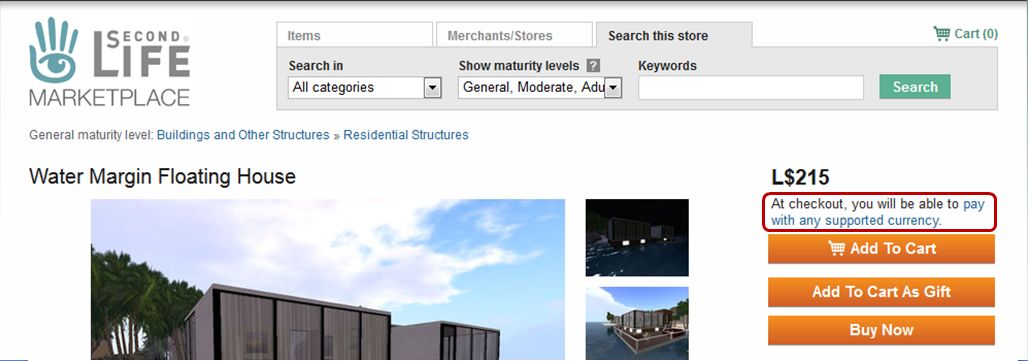
SL Marketplace: no more USD prices for goods on item pages, but a new notice about payment methods and currencies.

There are some changes to the SL Marketplace as a result of this update:

  • When viewing items in the Marketplace, only the LS price is displayed by default. There is no longer any USD price
  • All items now include a note that “At checkout, you will be able to pay with any supported currency“, directly under the L$ price. The link will display the Accepted currencies and payment methods section of the Billing page in the Knowledge Base, which lists the credit / debit / charge cars recognised by Linden Lab and the currencies in which payments can be accepted using them.

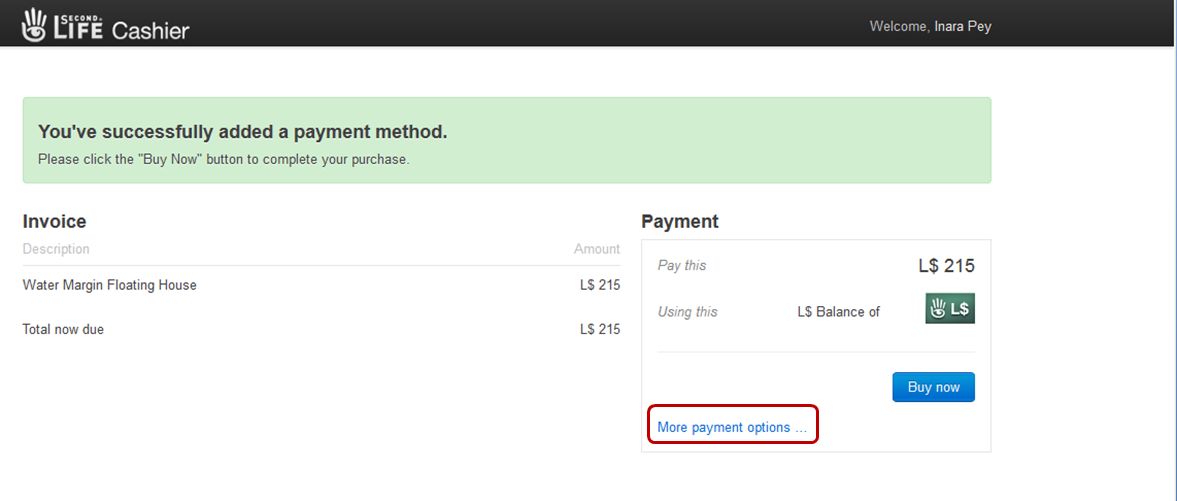
The other major change can be seen when clicking on the Checkout button from your shopping cart. This takes you to the Second Life Cashier Page, which lists the items you are purchasing, unit price for each and the total payable.

The revised SL Cashier payments page for the SL Marketplace

To the right of this is the amount payable and your current payment method, and a link allowing you to add more payment options.

The expanded payment section showing all recorded payment methods and button to add further methods to your account
The expanded Payment section showing all recorded payment methods and button to add further methods to your account

Clicking on this link expands the Payment section  to display:

  • Your current payment options
  • Buttons for adding additional payment methods (credit card, etc., or PayPal).

If you wish you use an existing alternate payment method, simply click on the required button in the upper section of the expanded screen.

To add an additional payment method, click on the required method (note the green-background text above the payment option buttons) and follow the on-screen instructions.

When you are ready to complete the transaction, click the Buy Now button.

Note: I’m not sure if, after selecting and using an alternative payment option, this becomes your default option for all future payments (and thus  appearing the “Using this” section of the Payment box of the Cashier Page. This is because I use L$ for all my Marketplace purchases, and have no wish to use an alternate payment method I have registered with the Lab.

Related Links

With thanks to CS Pfeffer for the nudge about the forum update.