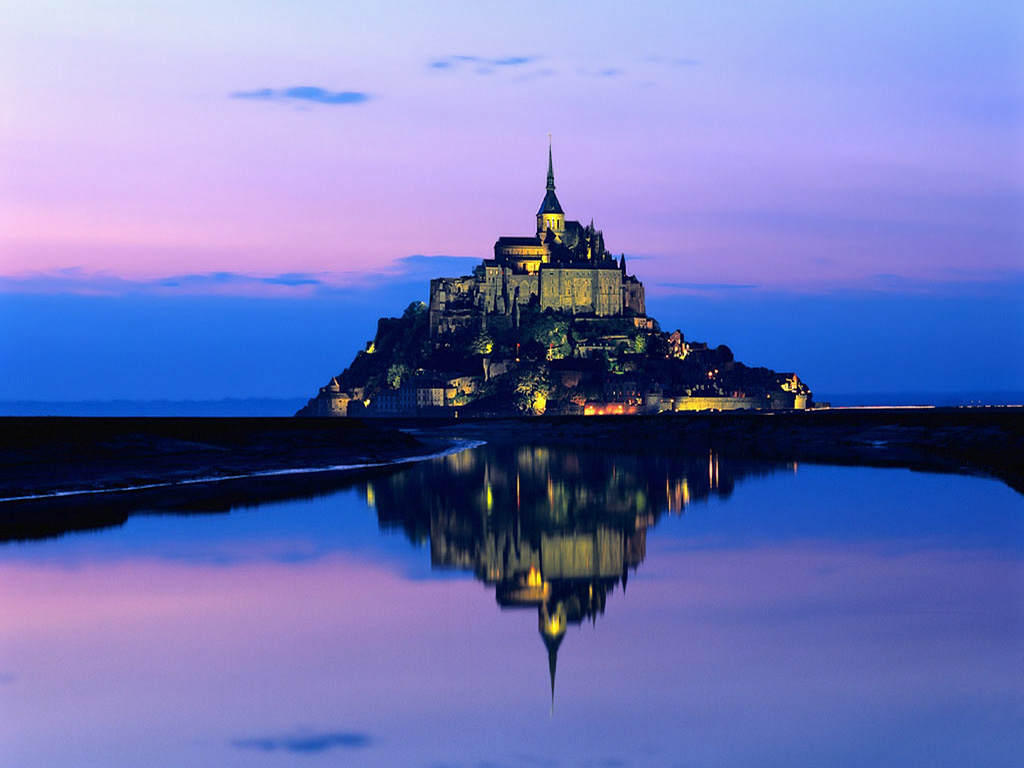
 Sitting in the mouth of the Couesnon River roughly a kilometre offshore from the mainland, and connected to it by a causeway, lays the magnificent Mont Saint-Michel. Occupied since before the Roman times, the islet (less than a kilometre square) rose to prominence in the middle ages as a religious centre, gaining strategic significance when it was annexed by William Longsword, Duke of Normandy in 933, and 100 years later when it supported William, Duke of Normandy’s claim to the English throne.
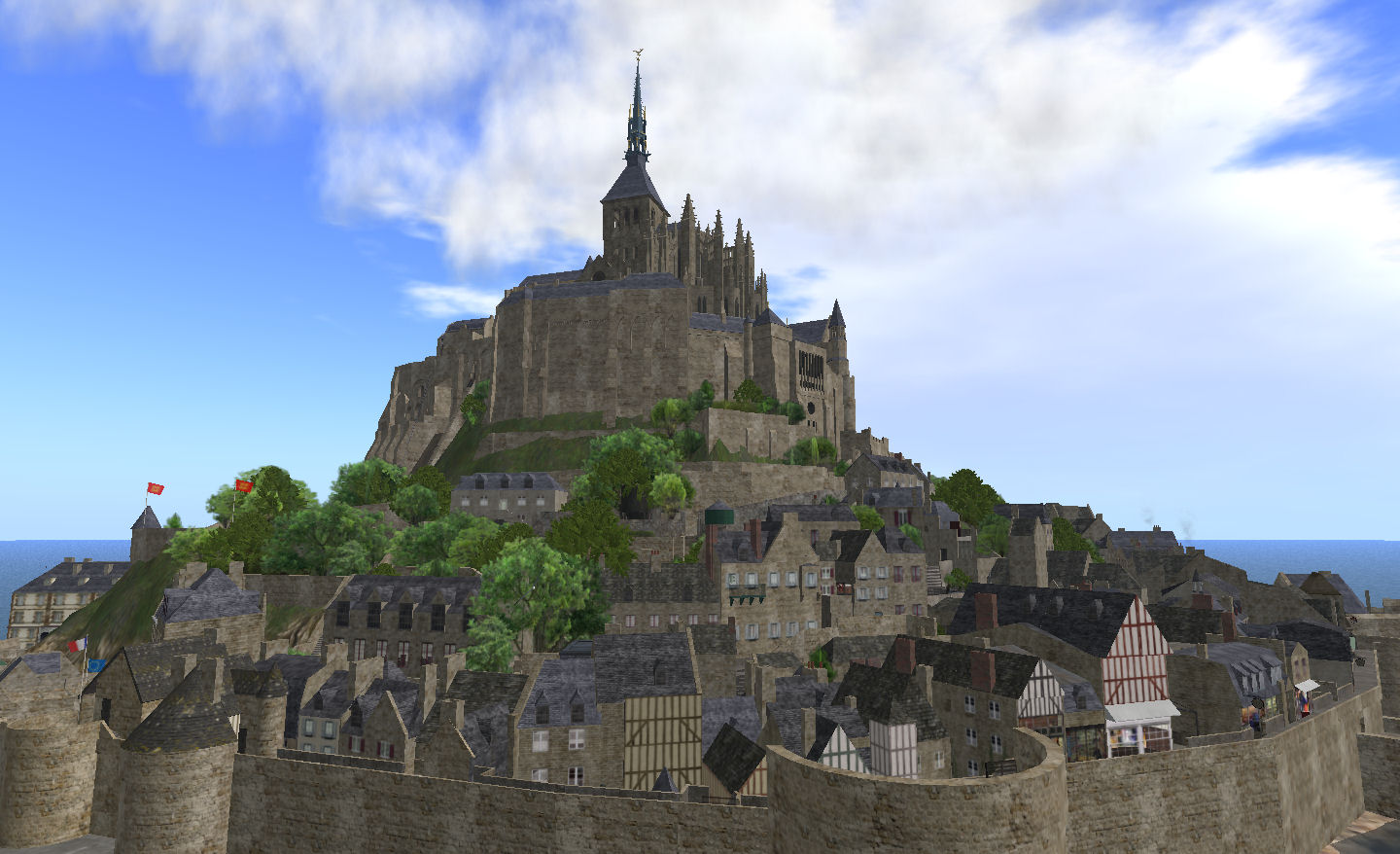
It’s also famous for being painstakingly reproduced to careful scale within Second Life by Moeka Kohime. Featured on the French version of the Second Life homepage, the sim is a magnificent testament as to what can be achieved when building in Second Life with the humble prim – or in this case, 14,328 humble prims.

The Mont faithfully reproduces the original in almost every visual aspect; no mean feat given it occupies an area a quarter of the size of the original. Yet it is not just a mere “look but don’t touch” showpiece: it is also scaled to allow avatar access, providing a fully immersive experience for visitors who can walk through the narrow streets, browse shops and wend their way up to the magnificent monastery that crowns the island.
I’ve known about the Mont in Second Life for years – yet I’ve never visited it until this week; I now regret not having done so sooner. Arriving (via a friend’s Tp) in the causeway car park (something that will hopefully vanish in the near future, to reflect the fact that it is being replaced at the real Mont as a part of the project to return it to its original island status), which sits on an adjacent sim, I carefully crossed into *Edelweiss* and followed the walkway to the entrance.
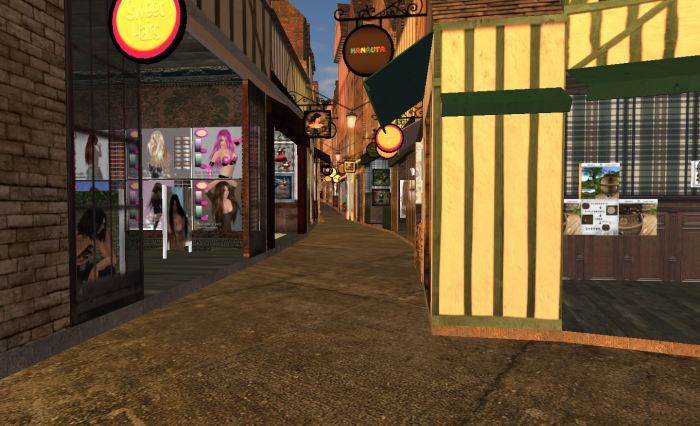
On entering the citadel, the attention to detail is immediately apparent – two massive wrought-iron bombard canon, left by the English after they failed to capture the island during the great siege of 1423-24, lay in the entranceway, just as they do in the original. Beyond these, past the information bureau is a small wooden bridge leading you into Le Grand Rue, and the sim’s shopping mall filled with boutique-style shops that fit the look and feel of the original Mont.

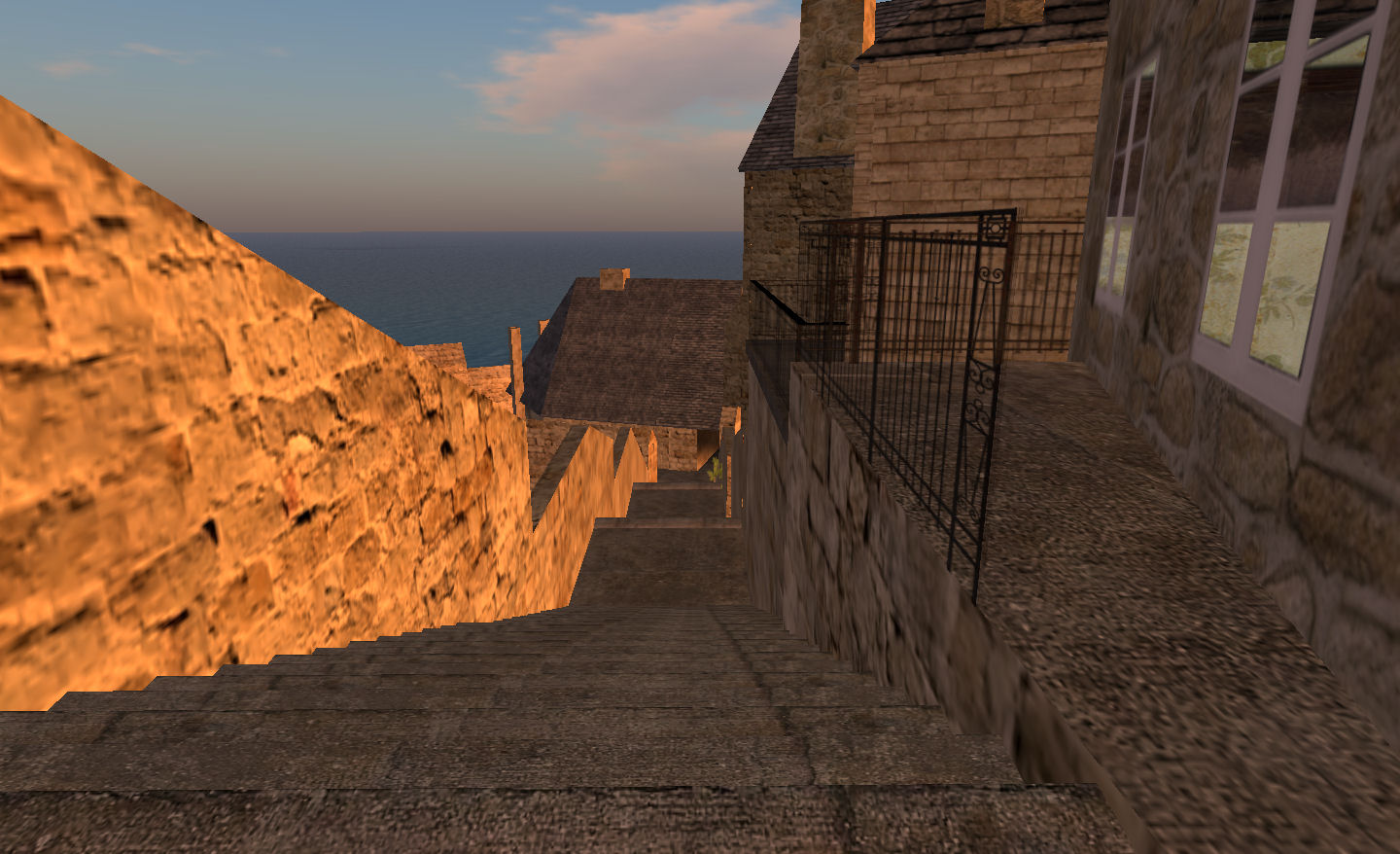
From here you can choose to either wander the Grand Rue, browsing the boutiques, or you can take one of the many stairways leading further up onto the island and towards the towering edifice of the abbey. This is one of the joys of the Mont is Second Life – it is a charming warren of walkways and passages that – as with the actual Mont – make exploring it full of anticipation: what lies under the next arch, at the top of the next stairway, around the next stone-walled corner? As you wander, you can peek through windows into the homes of the “locals” (none of the houses are actually occupied, but the detail again adds to the charm and realism of the place), or pause for a breather along the way at one of the many vantage-points and simply enjoy the view.
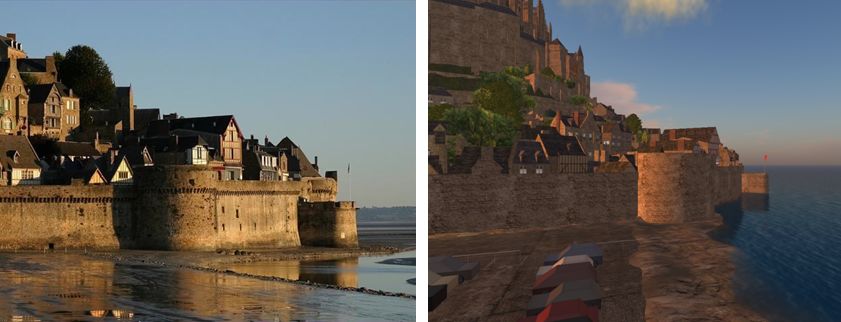
The monastery itself is beautifully reproduced in some detail, from the stepped entranceway through to the high cloister and its covered walkways and garden, suitable for quiet contemplation. The interior captures the magnificence of a medieval abbey, and one can almost imagine the monks chanting prayer, or quietly going about their business, conversing in hushed tones as they walk around the cloister. I have to admit that the mood for me was heightened as I was listening to Christopher Franke’s The Celestine Prophecy while exploring – but even without it, it’s hard not to fall into the atmosphere of the place.
There are a few things to be wary of: in a couple of places, the build exceeds the sim boundaries, and if you try to follow the outer sea wall all the way around the island, you’re going to find yourself inexplicably bouncing against empty air in a couple of places (and may get bounced right through a wall and down to the sim-edge below). Keep an eye on your bearings, and use the provided covered walkways to avoid this. The Mont was also constructed with the default camera angle in mind. As such, if you use adjusted camera positioning, either through a HUD or Penny Patton’s super Camera Offsets, you may experience the odd camera movement stutter or find your camera swinging unexpectedly through a house wall to give you a view of the interior. This is worth it however, as overall, you get a much more “involved” feel for the place with a decent set of offsets.
Of course, if you are good with navigation, the most immersive way of experiencing the island is through Mouselook – and I really recommend you try; the Mont comes alive in so many ways, and you really do not know what awaits you around the next corner. It is certainly worth keeping to Mouselook when walking around the monastery itself.

When you’ve done with your wandering, make sure you seek out the Café Poulard and have a well-deserved rest, either in the café itself, or out on the upper floor balcony with its sea view. It’s also a great place from which to camera around the island and make sure there is nothing you’ve missed in your wanderings, and which might be worth a Mouselook attempt to find when you leave the café.
If there is one thing perhaps missing from the build, it is the opportunity to learn about the history of the real Mont Saint-Michel; the museum is devoid of displays, information plaques are minimal, and so on. This is a shame, as the sim represents a superb place to enthral, educate and promote. Of course, no-one wants to be bashed over the head with facts and figures and historical diatribes, but it would be nice to see some context around the build and its real life counterpart.
Mont Saint-Michel is – to use the superlative yet again – a truly magnificent build. If you haven’t done so already, I’d recommend you do; you will not be disappointed, and you’ll be capturing a slice of history from two worlds in the process.

Addendum
When someone says to me, when I mention Mont Saint-Michel, “Did you find the hanger and the spaceship under it?” I tend to think they are trying to tug on my leg in the hope that bells ring. When three people independently raise the same subject (one of whom swears they’ve never read my blog), I get the feeling that either there is something to the comments, or the world is out to get me.

Given the second reaction is pretty much my everyday state of being at the moment (you’d be the same if you’d had the same issue with technology this last week, believe me), I opted to go with “there is something to the comments. So off I zoomed to have a nose around. And guess what? There is a hanger hidden under the Mont – although I’m not sure if what is inside is a spaceship or so kind of futuristic aircraft.
The Edelweiss sits in a bunker under the Mont, apparently fuelled and ready for flight (although you don’t appear to be able to board her), lit from above by powerful spotlights.
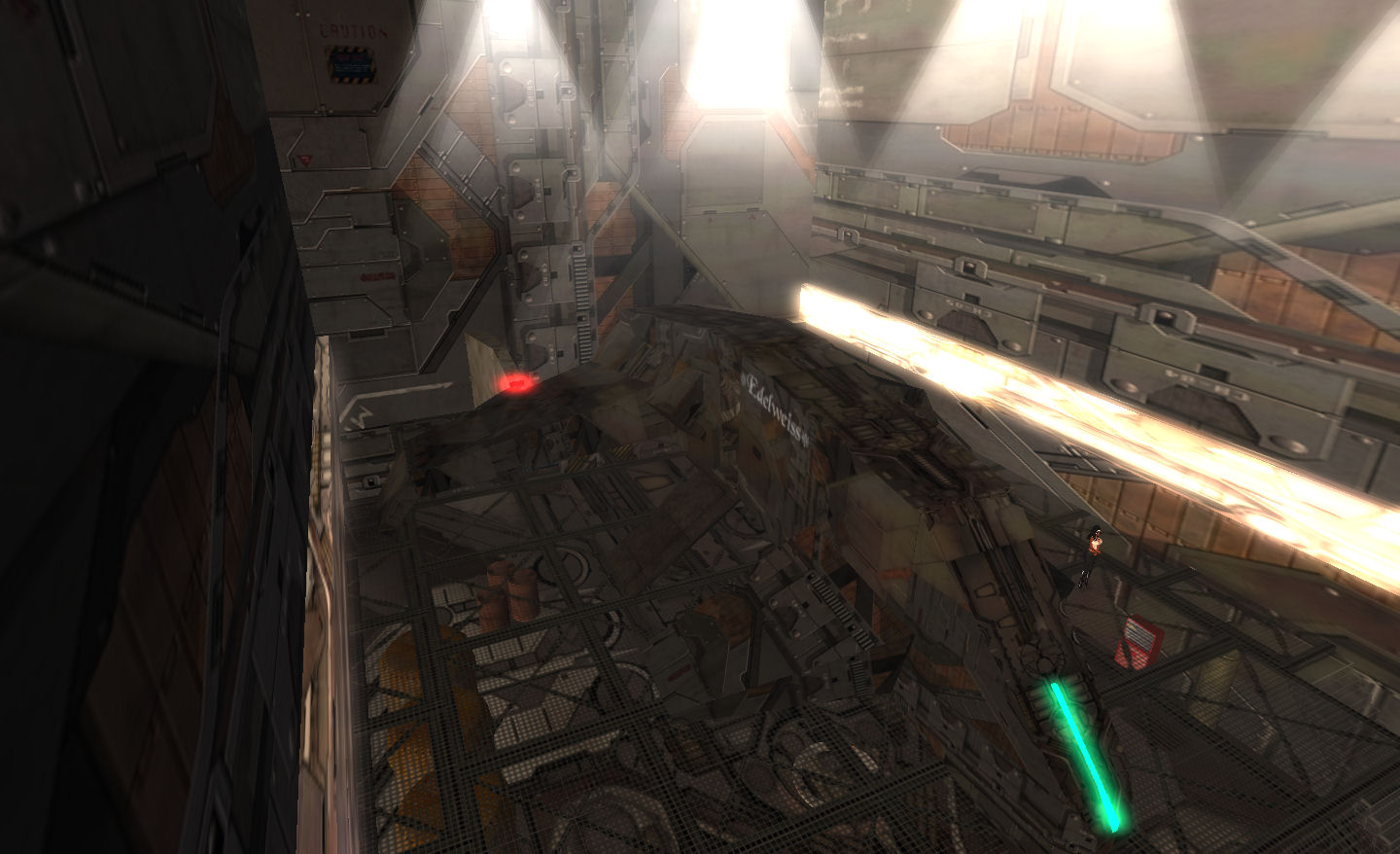 It’s a strange thing to have under an abbey atop a small islet, and certainly well-hidden from casual eyes; had I not received three separate prompts on the matter, I’d have remained in ignorance of it being there. But it does raise an interesting question…given the accuracy of the rest of the build…is there yet something extraordinary to be found under the crypts of the real Mont Saint-Michel? Could it be that those 11th and 12th century monks who built the original abbey actually knew more than they were letting on?! The mind boggles! ;-).
That said, I’m not telling you where it is. Go and find it for yourself! ;).


 Inara Pey: Living in a Modemworld