June 2024 will mark the 21st anniversary of Second Life opening to public access – and to mark it, Linden Lab has announced the 2024 Birthday celebrations as being marked across an entire month – from Friday, June 21st through until Sunday July 21st, 2024.
Theme
This theme for Second Life’s 21st birthday (SL21B) has been given as Elements, which the Lab describes thus:
This theme invites us to explore the fundamental components that make up our vast virtual landscape and the diverse communities within it. From the fiery passion of creators and artists to the fluid adaptability of our social environments, from the solid bonds within our communities to the fresh breezes of innovation that propel us forward, “Elements” is a celebration of the core forces that shape our experiences in Second Life.
For the last several years, the birthday celebrations have included a series of sessions called Meet the Lindens: opportunities for people to hear from and put questions to Linden Lab personnel, generally with questions submitted beforehand. In 2023, these Meet The Linden sessions morphed into Lab Gab sessions, and this year they are being referred to as Town Hall meetings, all to be held live at the SL21B event, and which will include the second of the Community Round Table events, at which questions can be specifically put to members of the Linden Lab leadership team.
It is not clear as to who will be representing the Lab at each of these sessions, or when the sessions will be held. In the announcement that they would be taking place, the Lab only promise details to come and indicate:
The founder of Second Life Philip Linden and Executive Chairman Oberwolf Linden will be among the participants, which also include many leading executives and team leads from Second Life’s Product, Engineering, and Product Operations departments.
However, the blog post does include a link to a form those wishing to ask questions of the Lab can complete and submit, which includes the opportunity to indicate to whom the question should be addressed, if required (although a little difficult outside of the usual suspects for these events given that, as noted, exactly who will be attending them has yet to be announced).
BUT – if you do wish to submit a question, then hop over to the form and do so, and note that it will remain available until Thursday, June 20th, 2024.
June 2024 will mark the 21st anniversary of Second Life opening to public access – and to mark it, Linden Lab has announced the 2024 Birthday celebrations as being marked across an entire month – from Friday, June 21st through until Sunday July 21st, 2024.
Theme
This theme for Second Life’s 21st birthday (SL21B) has been given as Elements, which the Lab describes thus:
This theme invites us to explore the fundamental components that make up our vast virtual landscape and the diverse communities within it. From the fiery passion of creators and artists to the fluid adaptability of our social environments, from the solid bonds within our communities to the fresh breezes of innovation that propel us forward, “Elements” is a celebration of the core forces that shape our experiences in Second Life.
Applications for SL21B performers were officially opened on April 29th, 2024. Key points:
Applications will be accepted through until Friday, May 31st, 2024.
There will be three stages for performers within the General rated SL21B estate.
New for 2024 will be an official performance stage in the Adult rated SL21B estate, and explicit lyrics and more adult attire will be permitted on this stage.
DJs, live artists and people performing on the designated events stages are permitted to rez ONE low-prim tip jar. Donation kiosks are not allowed.
There is a 350LI allowance for props and rezzable items for DJ and live music shows. A DJ set-up is allowed (spin table, speakers, small light emitters/effects) – but performers are asked not to design a giant framed set that covers the stage, its floor or the backdrop.
A call for event volunteers was made on April 15th, 2024. Key points:
Applications will be accepted through until Sunday, May 12th, 2024.
Volunteers are asked to commit to at least two hour shifts at a time, and to note that as a week long event. SL21B requires volunteers who will be available for more than just one or two days.
Training sessions will be provided across multiple times. All volunteers are expected to complete a training session, regardless of whether they have been volunteers at previous Birthday events. Those failing to complete the required training will be removed from the Volunteer group.
These are volunteer positions, and as such, volunteers will not be paid. Additionally, volunteers cannot rez/wear tip jars or solicit for tips.
Full rules and requirements for volunteers can be found in the application form.
As I’ve previously reported, Exhibitor applications opened on April 4th, 2024.Again, key points:
Applications will be accepted through until Sunday, May 12th, 2024.
There will be both General and Adult rated regions available to exhibitors.
Exhibits do not have to be in keeping with the Elements theme – LL are keen to showcase the passions, interests and creativity of the platform’s users and many groups and communities.
June 2024 will mark the 21st anniversary of Second Life opening to public access – and to mark it, Linden Lab has announced the 2024 Birthday celebrations as being marked across an entire month – from Friday, June 21st through until Sunday July 21st, 2024.
Theme
This theme for Second Life’s 21st birthday (SL21B) has been given as Elements, which the Lab describes thus:
This theme invites us to explore the fundamental components that make up our vast virtual landscape and the diverse communities within it. From the fiery passion of creators and artists to the fluid adaptability of our social environments, from the solid bonds within our communities to the fresh breezes of innovation that propel us forward, “Elements” is a celebration of the core forces that shape our experiences in Second Life.
The announcement also notes that applications for those wishing to host exhibits within the Birthday regions are now open, with the following notes:
Applications will be accepted through until Sunday, May 12th, 2024.
There will be both General and Adult rated regions available to exhibitors.
Exhibits do not have to be in keeping with the Elements theme – LL are keen to showcase the passions, interests and creativity of the platform’s users and many groups and communities.
In 2023, Exhibitor parcels were expressly stated as being 4096 sq m in size, with a Land Capacity of 1872 LI. While this is not stated in this year’s application form, there is no direct reason to suppose this will not be the case this year as well – although clarification from LL would be welcome.
With the parties for SL’s 20th birthday now over and the celebration regions sitting a little quieter, those who have perhaps been put off by the idea of fighting the crowds and all they can bring with them (aka “lag”), might feel that now is the time to explore some of the exhibits presented by the residents and communities of Second Life. This being the case, I thought I’d offer a list of some of the exhibits I’ve particularly enjoyed dropping in to see.
Notes: this is not an exhaustive list of the exhibits I’ve visited or the only ones I enjoyed, and should not be taken as such – there is a lot to see and appreciated at SL20B, and time allowing I might produce a further list of those I’ve enjoyed. Also, the order in which they are given should not be seen as indicative of any kind of preference on my part; it simply reflects the alphabetical ordering of the regions in which the exhibits are located.
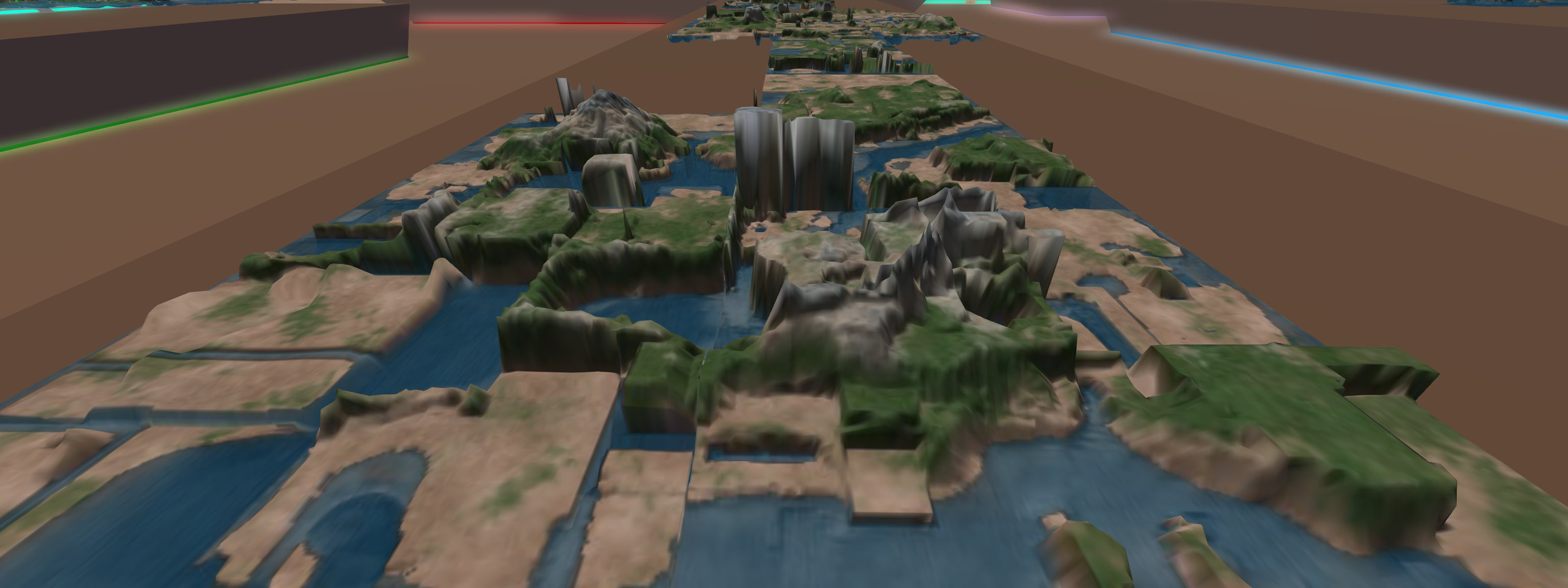
Occupying a 1024 sq m parcel, Erik’s exhibit is perhaps a little easy to overlook, it is so understated. However to do so would be a shame, as it features the results of a fascinating – and ongoing – experiment / project in presenting Second Life as a series of three-dimensional terrain maps which offer an entirely new perspective (no pun intended) on the regions and continents, presenting scaled models of groups of regions, giving a powerful visual representation of how the terrain has been terraformed, some of which have been overlaid with textures representing the structures and infrastructure found within the regions represented.
Producing these models is a process as fascinating as the models themselves, as Erik explains:
I gather each region’s elevation data, at half-metre XY intervals using an LSL script, feeding that data to my computer via a series of HTTP responses. [I] then (re)constructed and textured the terrain model(s) in Blender using its incredibly powerful Python API. The World Map textures [are] downloaded individually from Second Life’s official map servers [and] the terrain layer textures are available thanks to Tyche Shepherd and her indispensable Grid Survey database.
– Erik Mondrian
SL20B: Second Life Terrain Models
Depending on the complexity of the maps being produced in terms of elevation, and the the overall size of the map being produced, Erik’s script might take time to run; in the case of his more recent map of the entire Heterocera continent (433 regions), the scripts took some 32 hours to run.
Within his exhibit at SL20B, Erik presents pairs of models representing five areas of Second Life: Sakurasseria (the Japanese / oriental themed regions of Bellisseria), the “First 16” – the original regions of Second Life; Bay City; The Wastelands role-play estate, and the regions of the Vehicle Sandbox. Each pair presents a model of the terrain, as produced by Erik’s process, and a second overlaid with the World Map textures. For uploading to Second Life, some compromises have to be made – as Erik notes with the model of Heterocera (which is not a part of the set at SL20B, but which you can see in Erick’s video below), the original blender model initially amounted to 227 million triangles, and thus had to reduced to 2.3 million for the purposes of the video. As it is, the models at SL20B range from 31K through more than 220K triangles whilst varying between 12,ooo and almost 99,000 vertices, offering a reasonable compromise between complexity(/detail) and Land Impact.
Models like this help to further bring SL to life, literally adding a further dimension to how we can look on our digital world; and while they may provide a view of regions are they are today, they nevertheless of historical import as well. Take the models of the “First 16” for example; they give a view of those regions which perfectly complements the familiar historical 2D maps of those regions. As such, it could sit well within exhibitions such as the Maps of Second Life at New Kadath Lighthouse Art Gallery (see: The maps (and more!) of Second Life). Not that I’m suggesting anything, mark you 😀 .
Get the Freight Out (GTFO) is a popular in-world game among many vehicle users. HUD-based, it allows players to “haul” cargo from by land, sea or air, point-to-point across the mainland continents of Second life, and over their connected waterways and seas (e.g. Blake Sea), earning in-game (and non-redeemable) “Goal dollars” – G$ and game experience points which allow them to “level up”. Since its inception, GTFO has grown into one of the most popular activities among vehicle users in SL, and many types of land, sea, air and space craft are capable of supporting the game, or come with support built-in (when I wrote about GTFO five years ago in July 2018 – see An inside look at Get the Freight Out in Second Life – over 280 individual vehicle types were supported, and the game featured over 300 “hubs” to / from which freight is delivered / collected across the grid.
At SL20B GTFO combine with the Drivers of SL (on the neighbouring SL20B region) to allow people to learn not about both, visit the GTFO headquarters, race a go kart around a track, visit the local GTFO space station and – if you’re new to SL or the world of physical transportation in-world – see a range of the drivable vehicles available within the platform.
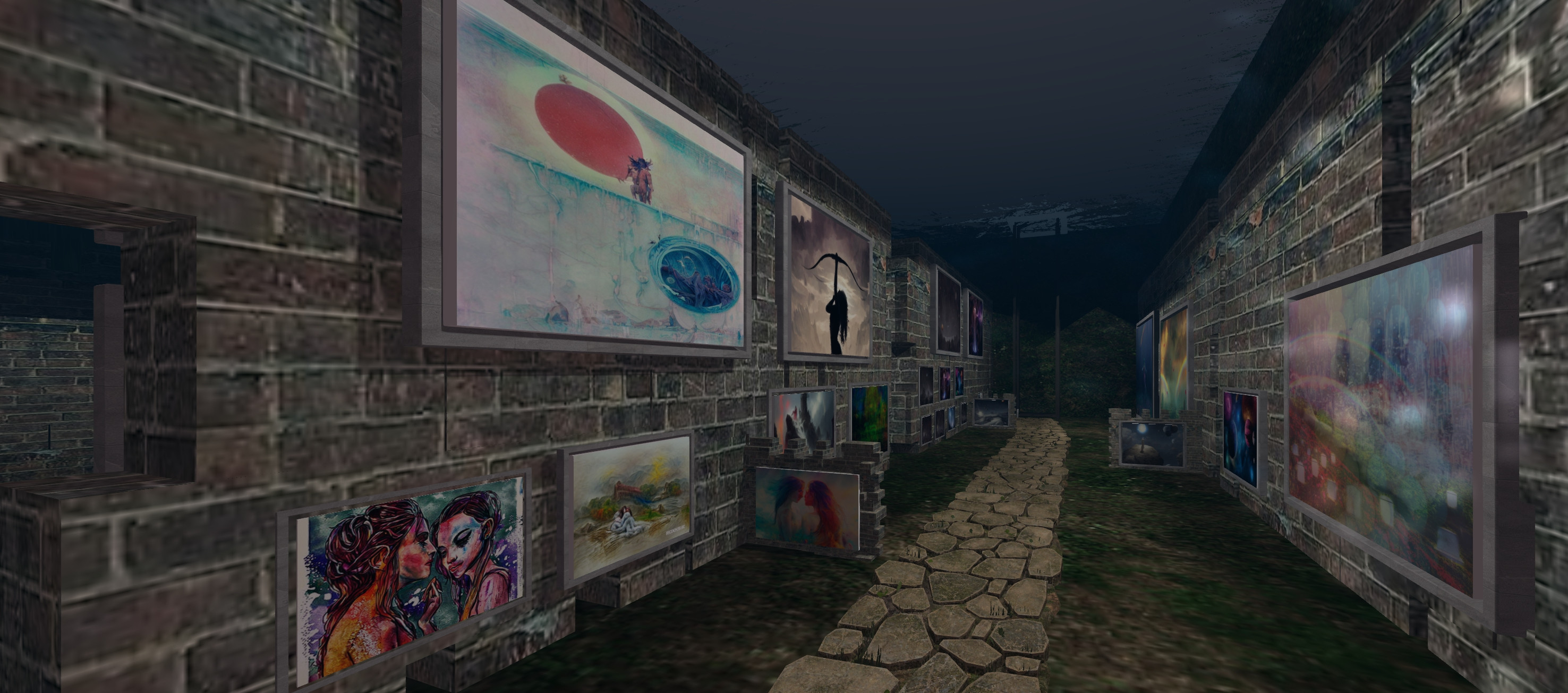
Second Life has a rich history and culture of art art – 2D, 3D, performance, interactive, and so on. It’s one of the aspects of the platform I find the most fascinating (hence devoting a good portion of this blog to the subject!). SLB has traditionally drawn artists to it over the years – to the extent that for some events, I’ve included an article devoted to the art exhibits awaiting discovery.
The diversity of art on offer at SL20B is as rich as previous years; however, I wanted to highlight The Water Slide here, given the way it combines art and interactive fun.
SL20B: the Water Slide
The work of the SL Random Art Crew (founded by Roxksie Logan) and the Tigerpaw Sanctuary, this is multi-faceted installation. Built around a central tower containing the water slide of the title, the installation offers a series of rides and activities – and an underwater art exhibition. How you get to the top of the tower is up to you – will you take the easy route and use the teleport elevator, or will you trey the harder way – up the animated wooden steps (you might want to try running!). Similarly, how you get down is a matter of choice – by rope, by slide, take the ladder or … the fast way. Similarly, getting down to the underwater gallery offers a choice of routes.
Founded by Emm Evergarden (herself the creator of a number of immersive, natural environments in SL, as witnessed within my Exploring Second Life articles), the Nature Collective is a group intended to cultivate a community around regions, spaces and projects which share a common focus on nature. To assist in this, the group provides both an Explorer HUD, featuring all in-world locations linked to the Collective (and available in-world here), and a list of locations available through the Nature Collective website.
In addition, the Collective runs the Shutterbug Club, a monthly event (advertised through the in-world group and the Collective’s Discord Server), in which members visit a Nature Collective location in-world and spend and hour or so exploring it and taken photos which can be submitted – without post-processing, and created only using the tools available in the viewer – to the group’s Shutterbug Flickr photo stream.
SL20b: The Nature Collective
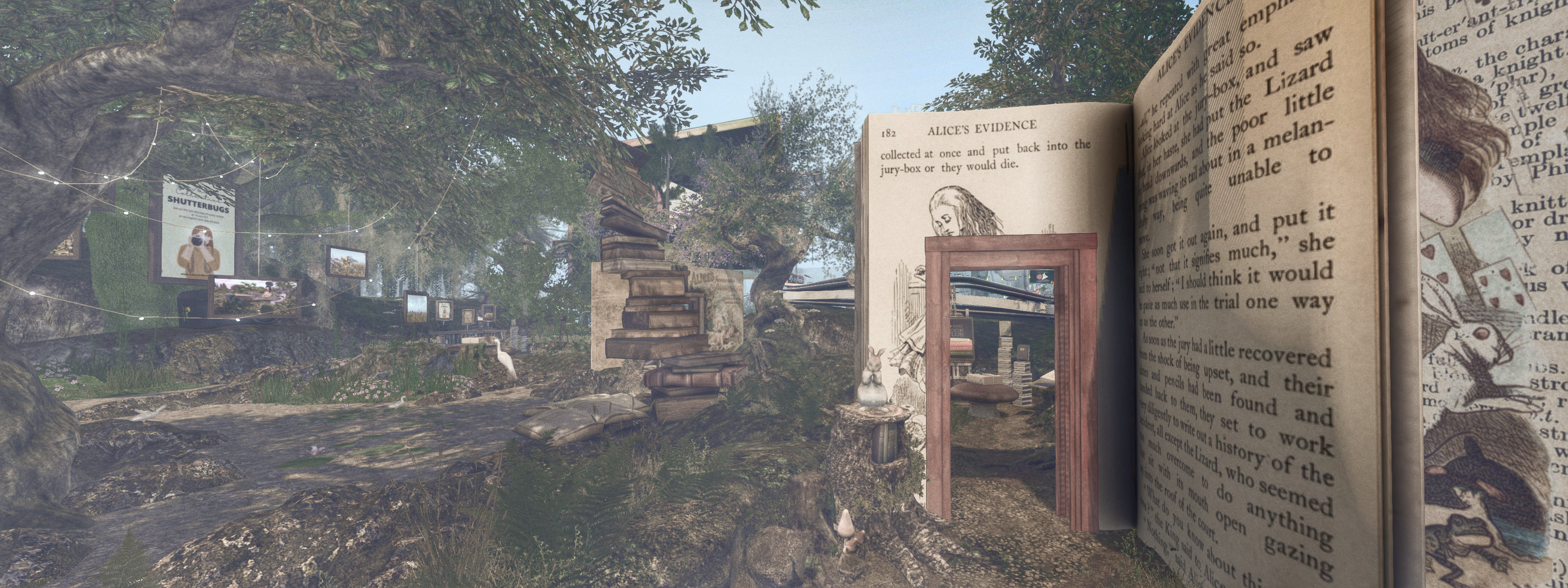
I’ve always enjoyed and appreciated the work the Collective does – and they have led me to a number of engaging locations in SL, large and small. for SL20B they present a walk through a woodland glade coupled with an Alice’s Adventures In Wonderland & Through the Looking Glass theme while is entirely appropriate for a celebration of Second Life, given the platform is a wonderland of experiences and adventures. When visiting, people can also collect a copy of the group’s Explorer HUD and pick up a gift.
Generative AI systems are one of the current focuses of technology discussion and hype (notably around matters around copyright when it comes to AI tools like Midjourney), with considerable interest also being directed towards systems and their potential within games and similar environments. With this installation, Nadir Taov presents a practical demonstration on the used of Chat GPT3-powered NPCs to add depth and flow to interactions with NPCs within role-play (and other – such NPCs could have a range of uses – environments).
SL20B: Unscripted Future – AI NPCs in Roleplay
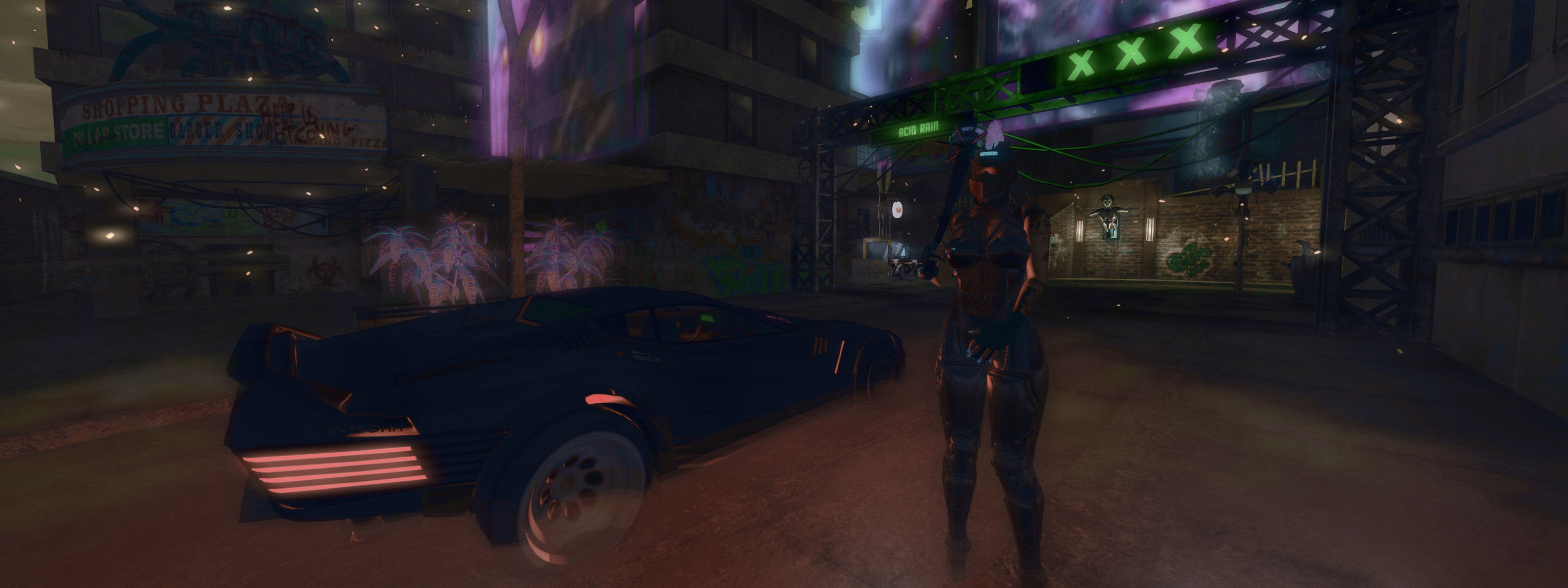
Presented in cyberpunk-esque urban setting, the installation allows visitors to interact with “Alexa”, a club-carrying, bemasked female, by means of emotive exchanges. Depending on induvial skills with emoting (and mixing descriptive actions with spoken words within those emotes), so interesting exchanges can be had – although those who find para-roleplay annoying are liable to find themselves getting irritated at the length of Alexa’s responses. But that said, this is an impressive demonstration of the potential in combining NPCs and AI.
Sniper Siemens is perhaps Second Life’s most dogged historian, over the years presenting us with a unique look into the platform’s long history using immersive installations. First seen in 2014, with the assistance of the former Linden Endowment for the Arts, they have been outstanding in their curation of information, facts, figures, images and trivia about Second Life. Over the years, these installations have grown ever more engaging, presenting a wealth of information about SL’s long history in easy-to-follow (and digest) summaries visits can walk through and appreciate at their leisure.
SL20B – Second Life: The Past, The Present, The FUTURE
I’ve always enjoyed Sniper’s visual approach to presenting key and perhaps not so well-known points in the platform’s history, and have covered these installations on numerous occasions in these pages; they are the gold standard for such installations. As such, I make no apologies for including Sniper’s build at SL20B in this list.
Three To Close
Society for Preservation and Archeology of the Metaverse (SPAM)Region SLurl (SLB Electrify) – Penny Patton presents a slightly tongue-in-cheek look at defining moments of Second Life’s history. complete with an undertow of serious commentary in places.
Piano Roll RegionRegion SLurl (SLB Fantasy) – Bryn Oh’s reflective installation on the AI and its impact on presence and human interaction.
On Friday, June 30th, 2023 saw the fourth in a series of Lab Gab special events take place for the SL20 Birthday celebrations, featuring featuring Patch Linden and the Moles of the Linden Department of Public Works (LDPW).
Unlike the other summaries in this series, this article focuses on the work of the Moles and the projects they are currently working on and which have recently been launched or will be launched in the near future. Broader questions on individual interests, hopes for the future of SL, subjects (such as the SL20B Sweepstakes) covered in more depth in other Sl20B Lab Gab sessions are not included below. As always, timestamps to the video are included within each topic / sub-topic, allowing comments made to be heard in full.
Short interviews with a number of the Moles covering what they do and how they became members of the LDPW team. These discussions fold-in to them some of the points below.
Who or What are the Moles?
Officially called the Linden Department of Public Works (LDPW), originally formed in 2008, Moles are residents from all over the world hired by Linden Lab as independent resident-contractors to undertake Lab-led projects.
Their work was originally focused on the Mainland, adding the infrastructure – road, bridges, etc., and the landscaping, as noted in the official LDPW wiki page, although they actually do a lot more than this.
Notable major projects carried out by the Moles include:
Development of residential centres such as Nautilus City and Bay City and Bellisseria; development of the Lab’s various games accessible through the Portal Parks.
Involvement in special development projects for both Second Life (e.g. Bento, Animesh, EEP, PBR), and partnership developments (e.g. Zenescope and Motown Experience), that latter under the banner of Second Life Studios.
In keeping with their name, Moles were originally given a mole avatar, complete with hard hat. However, over the years, most have moved to having a more individual and personal look, although some say with their Mole look.
As well as being paid for the work they do, Moles also receive and allowance from the Lab, which is primarily intended to go towards the cost of uploads (texture, animations, mesh objects, etc)., but which can also be put towards developing their individual looks.
How to Become a Mole
Positions in the LDPW are open to application by residents who believe they are qualified to work in the team, and the team may also approach specific residents and ask if they would consider joining them.
Applications are made by dropping a résumé (note card or email) of qualifications / experience (including links SLurls, Flickr, You Tube, etc.) to Derrick Linden (derrick.linden-at-lindenlab.com) or to Patch Linden (patch.linden-at-lindenlab.com).
Applicants have to go through a former interview process.
Successful applicants get to pretty much choose their hours of work – providing agreed tasks are completed on time.
As they are from around the world, this can allow some projects to move forward on almost a round-the-clock basis.
Those who are more fully-rounded in skill sets – content creation, scripting, etc., – are encouraged to apply, but LL will also take on specialists.
Motivated, outgoing, communicative people with a passion for SL and willing to self-teach themselves new skill sets are particularly considered.
Planning for SL20B started during SL19B, commencing with a review of what worked / didn’t work at SL19B, and initial discussions on the 20th anniversary theme.
The initial planning process for the theme (/build aesthetic) and size of the event took around 3-4 months.
The size of the event means there are 321 exhibits – many of them interactive -, compared to 150 just five years ago. The increase in event space has meant some exhibit parcels (around 100) could be offered at 4096 sq m.
The focus for the last few SLB events has been not only to encourage people to share in the theme, but to present exhibits that reflect their passions / interests: art, music, community activities, etc.
SL20B is also the first SLB event to include the Adult community (also at the Shop and Hop as well). To achieve this, there was a lot of direct canvassing / encouraging of Adult communities to come and participate, rather than just leaving it to people to apply. As well as the Adult region exhibits, there have also been events hosted on them.
Discussions within the LDPW team are already in progress to discuss how the Adult presence can be grown in future SLB events, including the possibility of having an “official” event stage within the Adult regions.
Patch Linden:
Given it is the 20th anniversary, the decision was decided to refresh some of the “core” SLB builds (such as the Tapestry of Time) and also the Shop and Hop regions to be more in keeping with the event theme and also to offer fresher designs for future events.
The New Shop and Hop region design will be retained and “themed up” for future events.
Dreaming Mole:
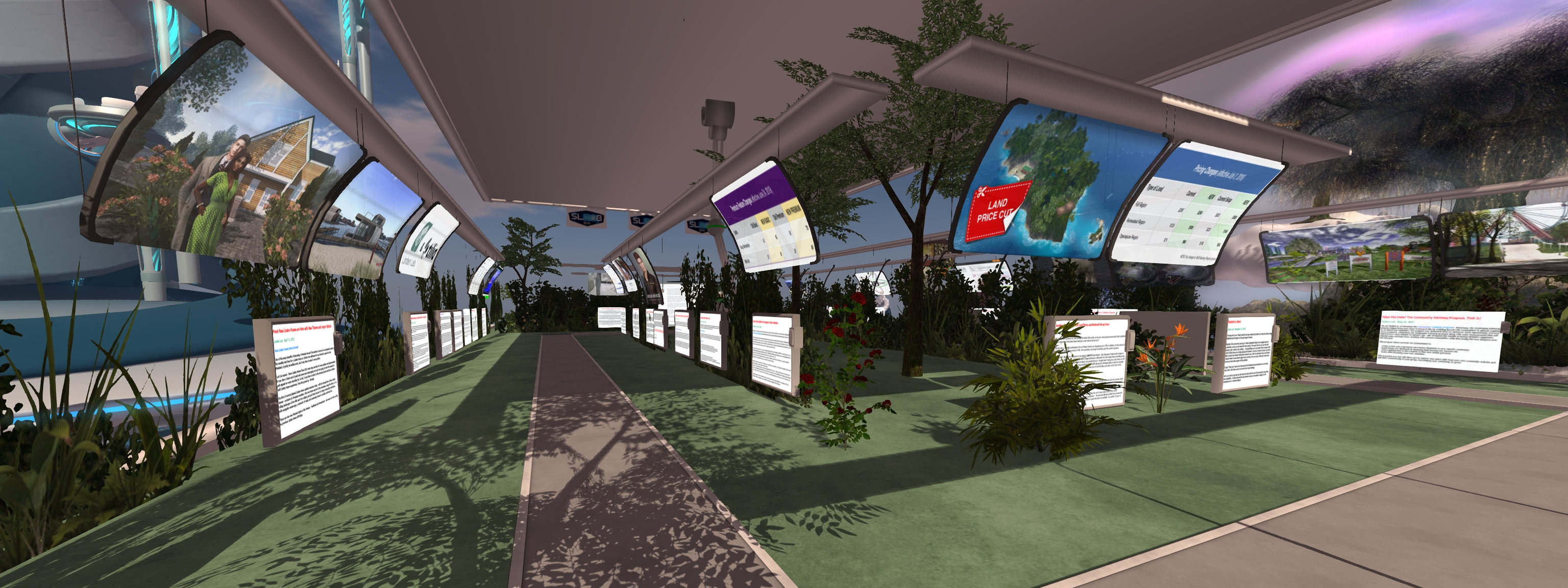
The concept of the Welcome Area was to present a setting which reflects both the theme of the event and suggests important factors for the future – sustainability, etc., whilst also acting as a natural information hub and viewing area.
The landing point was placed so that people would see the structure before them and be encouraged to walk towards it, along the Community Gallery Walkway.
The overall inspiration for the build was modern architecture and the work of architects such as Oscar Niemeyer.
Senra is the brand name giving to the upcoming new Bento / Bakes on Mesh complaint starter / new avatar series specifically developed via the Moles as a Lab project, and which were initially previewed at SL19B in 2022.
Come with a complete set of accessories: hair, skins, clothing, attachments, shoes, etc. All of which will be presented as a full library of content within the viewer (as a part of the overall Library).
The first phase of the release will feature two human avatars + accessories, etc., referred to as Jamie (female) and Blake (male).
The second phase of work has already started and will include anthro, allowing Senra to cross over into “other areas.”
The launch is provisionally targeting middle-to-late-July.
Prior to the launch, effort will be made to get the developer’s kit (devkit – covering clothing, accessories, skins, etc.) and licensing agreement made available to SL content creators who wish to develop content and sell it into the Senra ecosystem.
Screen caps of the Senra Jamie and Blake avatars. Note: as these are screen caps (as I was unable to be in-world for the session), noassumption as to the overall quality / looks of the Senra avatars should be assumed on the basis of these images
Initially grew out of a need to have somewhere to demo the Liden Home themes and styles for those wishing to “try before they buy” a Premium / Premium Plus account.
The grew into an idea to also provide further information on Bellisseria and from there grew into a complete Welcome Hub for new users.
However, the primary focus is to provide information on Bellisseria for existing resident and give insight into Premium Subscriptions via an in-world means.
BelliHub: Linden Homes demo area at the BelliHub
As they were in development at the same time, some of the work put into the BelliHub Welcome Area was used to inform the design within the the Welcome Centre at the new Welcome Hub.
The Welcome Hub with its nine regions is designed to provide a more complete experience for incoming new users, which in part came off the back of the fact that many people coming into SL will go through the older Welcome and Social islands and think that that was all there is to SL, and leave.
So the Hub is intended to both introduce new users to both the viewer and using an avatar and to encourage them to understand there is much more to discover about Second Life and the events and activities which take place in SL, while at the same time not locking them into a specific path or hierarchy of things they have to go through in order to better understand SL.
The above is very much assisted through the presence of mentors and the video and general info boards they can opt to use or skip over, depending on their knowledge and abilities.
The only really “key lessons” within the Welcome Centre of the Hub are moving, talking, and interacting with objects. The rest is intentionally free-form.
[Video: 50:23-51:00] The overall design of the Welcome Hub is intended to be modular in that options, features, areas, can be swapped in / out with others, and the overdesign expanded, etc., as required.
A question was asked about refreshing Mainland terrain textures. There is an off-shot of the current PBR Materials project to allow such materials to be applied to SL, and – with noted caution about ensuring consistency of appearance, etc., – this will include Mainland. Details of the PBT project and the terrain project can be found in my CCUG summaries; also see this official sneak peek. Image credit: Linden Lab
Who is Magellan Linden?
Magellan Linden is The Great Explorer of Second Life (who was once said to have vanished during his explorations, but does pop-up from time-to-time) is a construct, rather than an individual, but as revealed in the session, Abnor Mole loans his voice to Magellan!
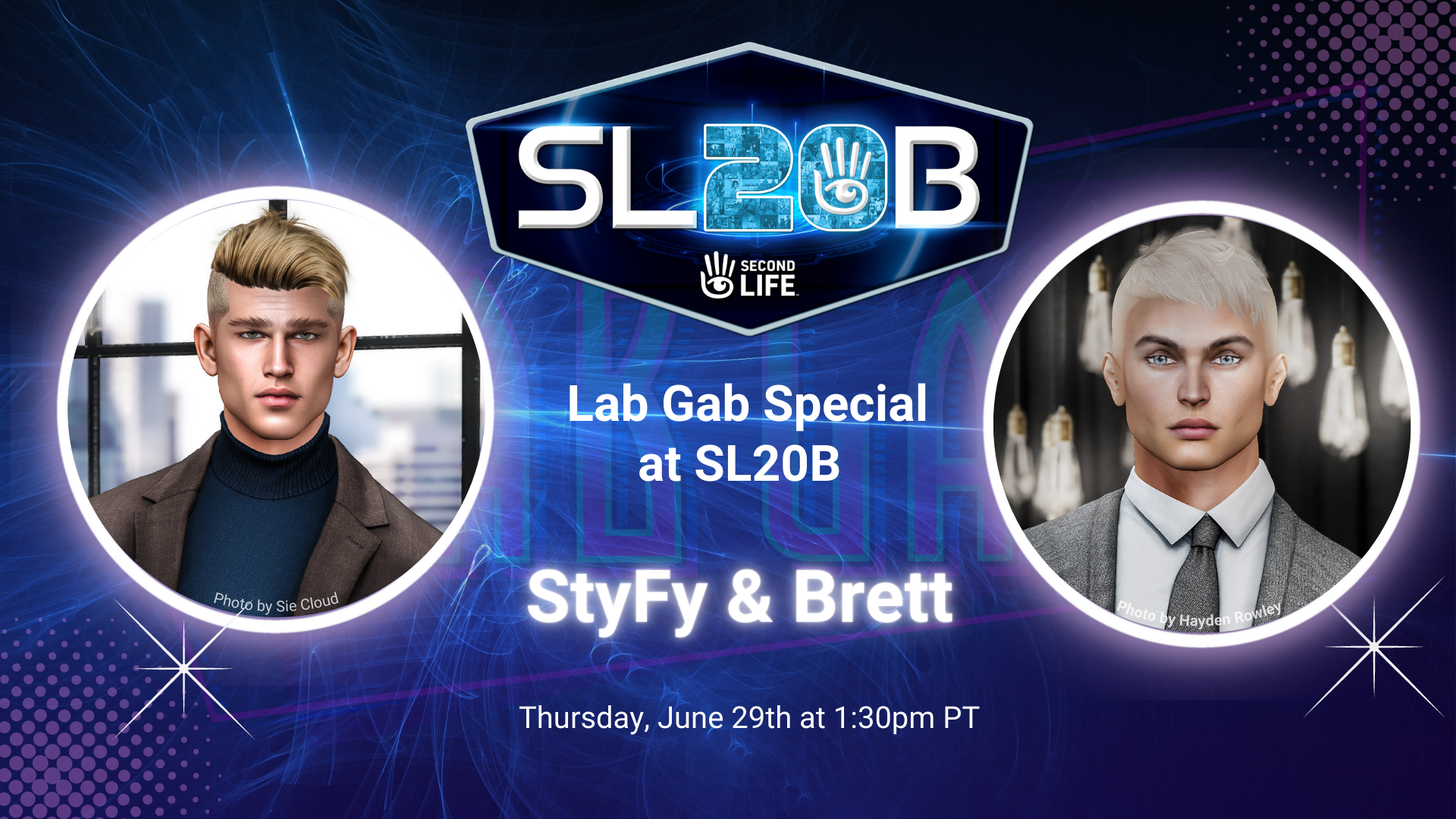
Thursday, June 29th, 2023 saw the fourth in a series of Lab Gab special events take place for the SL20 Birthday celebrations, featuring Brett Linden, the Lab’s Vice President of Marketing, and the company’s Chief Marketing Officer, StyFy Linden.
The following is a summary of the session covering the core topics raised. The full video is located at the end of this article.
Please note:
The session was built around questions submitted in advance of the session.
This is a summary, not a full transcript, and the focus is on those questions which offer insight into the world of the Marketing Team.
Timestamps are included against the topics discussed, so that those who wish can listen to the responses in full.
A Little Background
Brett Linden
As VP of marketing, Brett Linden manages the team responsible for developing media campaigns and strategic content partnerships for Second Life.
Has more then 2 decades of marketing and journalism experience, and has been at the Lab for 16 years.
In the past decade, he has produced numerous virtual and “mixed reality” events and panels on various academic topics with an emphasis on legitimising and better surfacing the many cultures and communities within virtual environments.
From Rolling Stone to Billboard, Brett has also written for major publications and managed multimedia initiatives for Amazon.com and RealNetworks. As a co-founding editor at Billboard.com, he interviewed Stevie Wonder, David Bowie, Peter Gabriel, Shania Twain, and Bjork.
Was drawn to Second Life after trying the platform during its first burst of media exposure in 2006 – specifically trying to find the CNN and Reuters bureaux that were active in SL at that time.
At the same time, he received a grant from the McCormick Foundation to run the Virtual Journalism Summit, some of which took place in-world, allowing him to meet Philip Rosedale.
He moved from being a resident to being a Linden in 2007.
He is as fascinated and intrigued – and sometimes frustrated – but always illuminated by the platform, the residents, the diversity of use and creativity, etc., today, as he was when he started.
StyFy Linden
Has been with Linden Lab for 18 months.
Has a broad background in marketing, including client marketing, retail marketing and running marketing agencies, and has also working within some major technology companies.
States that throughout his career, he’s never had as much fun as he is having at Linden Lab.
It has benefitted SL. In 2022,there were some major corporations sucking up a lot of the media’s interest in the “metaverse”.
However, the fact that SL has hit 20 years of open public access at a time when others have really been “flash in the pan” announcements around the “metaverse”, allowing SL to be positioned at the “gold standard” of virtual worlds.
Believes this is being reflected in the kind of press coverage the platform has recently received, and the fact that LL is no longer one “of six” calls reporters might make when writing about virtual worlds – they are the “only” call being made.
Work is understand to update / refresh the SL web properties; thew Destination Guide has received a major refresh, with more work to come [see below].
Notes that the community within Second Life does a lot to help keep SL fresh through content creation, building destinations and experiences, etc., and with their on photography.
The Marketing Team as a whole is expanding with new talent.
All of this is feeding back into the overall media / press interest in Second Life.
Believes that SL Mobile, once available, will offer further interest in SL.
StyFy Linden:
Time has been put into formalising they way in which feedback can be obtained from existing and new Second life users and communities within SL, and even potential SL users.
This is being used to help drive some of the ideas the Marketing Team and others within LL have in moving the platform forward, developing new initiatives, etc.
Marketing is being looked at more broadly; not just as a pipeline to draw new users into Second life, but also how it can be used to assist users during their journey through Second Life: how can Marketing help new users get acclimated to SL; how can Marketing help users to connect with one another; etc.
So the thinking is not longer siloed towards a single goal, but more broadly spread to benefit both the platform and users as a whole.
Brett Linden:
People thinking of Marketing in terms of acquisition only, but the involvement can be broader, as demonstrated with the new Welcome Hub, in which Marketing have played a significant role in helping define how they can help users beyond the pure acquisition stage of their experience with SL.
Very much sees helping to get users to “stick” with Second Life, from having a very good, comfortable initial exposure to the platform onwards, is something in which Marketing can offer considerable expertise.
Can understand why there are misconceptions, as users are not sitting side-by-side with the Marketing team.
Many misconceptions tend to be the result of people’s focus. For example, if they see SL paid ads, they assume the Marketing Team only does paid ads.
The overall strategy is far broader – wrapping into the Public Relations (including the use of an external company), the involvement in user acquisition and retention, etc.
Would also point out that Marketing is only one team within SL. They work extremely closely with Product and Product operations in particular, but this is sometimes misconstrued by users as to which team is doing what; sometimes Marketing will be operating in support of initiatives led by the other teams, sometimes they will actually be leading initiatives which may be perceived as being run by other teams.
StyFy Linden:
Would say the biggest misconception about Marketing is that “all” they do is form pipeline to acquire new users through mechanisms like paid ads, etc.
Marketing touches on many parts of Second life and LL in many different ways, from providing imput through to actively providing solutions for given requirements, and involved across the “entire resident journey”.
Strawberry Linden (as Social Media Manager at LL):
Main goal is to feature as much of the community as possible.
Spreading SL’s presence to multiple social media platforms, as has been the case with TikTok.
StyFy Linden:
Looking to add depth to SL’s current social media presence, particularly where new channels are opening up (as with TikTok, seen as particularly important due to the broadness of its user base).
Brett Linden:
Feels that the social media strategy is an excellent means to celebrate and promotion what the Second Life user community is doing.
Appreciates the ways in which users themselves are using social media to tell their own stories vis Second Life.
In terms of the future, feels video will play more of an important role for SL, giving the growth of platforms like TikTok and Kik.
User Created Content and Its Use in Marketing Campaigns
User created content is one of the biggest opportunities Market has thanks to its richness.
Sees the content available within SL as a cornerstone of those aspects of Marketing’s work geared towards user acquisition.
Would like to have specific feedback / ideas from the community on what Marketing can do to leverage the diversity of content within Second Life to help bring users into the platform / help communities within SL attract new users from beyond the platform.
Brett Linden:
There is a general e-mail address at the Lab which is monitored by Marketing and others to which users can submit general feedback and ideas [not feature request or bug reports – please use the Jira for those!] – feedback-at-lindenlab.com.
Would emphasise that the community is “at the core and heart of all that we do”.
The New Welcome / Community Hub: Goal and Continuing Development
The new hub is very much a “version 1” of the concept. As such it is an experiment, and the Lab is learning from it. As such it will be improved and iterated upon.
It particularly presents an opportunity to observe new users throughout their on-boarding to the platform and through their initial exposure to the world and other users, and take lessons from what is seen over time.
The work is critically important to the overall idea of bringing people into SL and to helping them engage with the platform and thus help ensure its continued longevity.
Notes that there are already community gateways which tackle the new user experience, and sees the Welcome Hub idea as augmenting the work they do.
In terms of strategy, the use of mentors and leaders within the Hub environment is as important as the environment itself, given they provide a friendly, helpful face to SL as new users come it.
StyFy Linden:
Would note that a lot of what is available within the Hub’s regions really flowed out from talking with incoming users about their experience, why / how they are encouraged to stay engaged with SL, who helped them and how, etc.
As with the press, SL was one of a number of “metaverse” platforms brands were looking to engage with in 2022. Now SL is part of a “much, much shorter list” of platforms brands are interested in.
This means SL is attracting a lot of interest; however, LL do not engage with entities simply for the same of creating a partnership; the focus is on partnerships that will add to Second Life and the in-world experience of users.
Because of this, it is likely there will be more partnerships similar to Motown – which itself will be expanded upon – in the future.
Elements of the refresh – such as the additional of search capabilities on the web version – are the direct result of feedback from users on the older Destination Guide look.
Future updates will include “population counts” (i.e. avatars actually within a location); the ability to bookmark / favourite locations, etc.
The architecture for the Destination Guide is actually complex: the version in the viewer isn’t simply the web version presented through the viewer, it is its own entity, driven by the same engine, and DG data touches on things like the official viewer message of the day, the map system, etc.
No timeline on when additional features will be surfaced, but the Destination Guide is “on our roadmap for the next 6 months, let’s say”.
Strategies for Attracting New Users and Content Creators / Artists
Content creation is such a core part of SL, that considering how to engage with the next generation of content creators and bring them in to SL is very much part of the Marketing focus.
Some of the ideas being discussed are “in-world apprenticeships” and partnerships with colleges and universities to help guide students into SL [through, presumably, art and content creation].
Hopefully more of these ideas will be fleshed out throughout the rest of 2023.
Great for 30+ age range. The challenge is 18-29-year-olds.
Feels that reaching this 18-29 demographic is not unique to SL; virtual worlds in general appear to have the same problem.
Time has been spent exploring the challenges involved in reaching this demographic and in looking at the channels through which they can be reached (e.g. TikTok).
There is also a working group “within SL” focus on the subject of growing the user base.
Hopes the platform continues to innovate and expand.
Would love the see SL continue to foster the development and evolution of on-line cultures whilst also scaling to greater numbers of concurrent users and also becoming more broadly available through Mobile.
Most of all hopes SL will continue to be known as a welcoming, creative space that is really honouring and respectful of freedom of expression and people’s individuality.
StyFy Linden:
The power of SL is its users and their creativity, and hopes that remains the cornerstone of what the platform is.
Hope people engage with the platform and how LL will engage with them will obviously change as technology changes, but does not believe what SL is known for is going to change.




 Inara Pey: Living in a Modemworld