VWBPE 2020: keynote speakers and recent updates

via vwbpe.org

The 2020  Virtual Worlds Best Practice in Education (VWBPE) conference will be taking place between , Thursday, March 26th and Saturday March 28th, 2019 inclusive. A grass-roots community event focusing on education in immersive virtual environments, VWBPE attracts 2200-3500 educational professionals from around the world each year.

Carrying the theme of Stellar, the conference will, as usual, take place in a group of dedicated regions which this year will see them designed in a matter to reflect the conference theme, and will comprise its usual engaging programme of events and activities. I’ll be offering more of a preview of the conference’s facilities in due course. In the meantime here is a round-up of the latest news from the organisers on the event programme.

Keynote Speakers

The keynote speakers for this year’s event comprise:

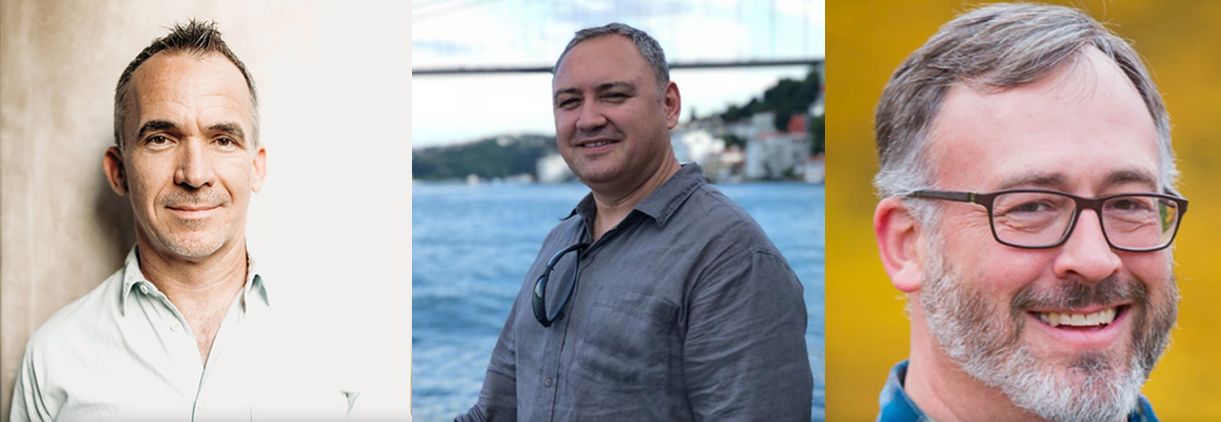
Thursday, March 26th – Dr. L. Robert Furman:  Dr. Furman is an educator, leader, scholar, speaker and author; but most notably, Dr. Rob is a true champion for education in the 21st century. Beyond speaking at venues across the country, Dr. Rob is also a contributing Educational blogger for The Huffington Post as well as Ed Tech Review. He has received numerous prestigious awards, such as being named in the National School Board Association’s 20 To Watch in technology education and an ISTE Best Selling Author.

Friday, March 27th – Dr. Michael Thomas: a Professor of Education with a focus on digital learning, social justice, social mobility and the student experience. Dr. Thomas is a Principal Fellow of the HEA and hold two PhDs, one from the Newcastle University, UK and a second from Lancaster University, UK. He has studied for an MBA in Educational Management at the University of Leicester, M.Ed at Manchester University, an MA at Newcastle University and change leadership at Cornell University, USA. He has worked at eight universities in Germany, Japan and the UK, from ancient, to Russell Group to modern, and led large, multinational research groups and project teams.

  • Address time: 08:50 SLT.
  • Address title: Virtual Worlds and Social Justice: An Impact and Civic Engagement Agenda
  • Biography at VWBPE.
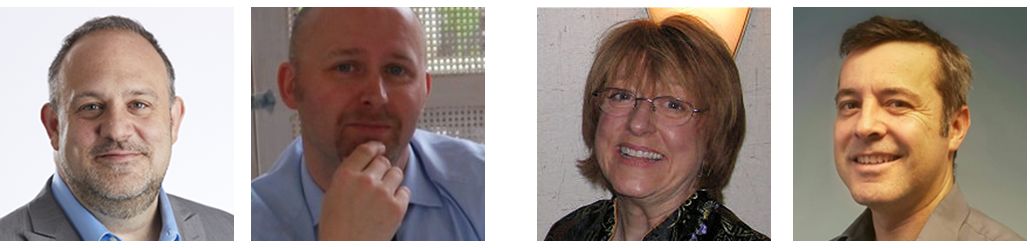
Keynote speakers (l to r): Dr.Robert Furman, Dr. Michael Thomas, Lorelle VanFossen and Daniel Dyboski-Bryant

Saturday, March 28th – Lorelle VanFossen and Daniel Dyboski-Bryant : Lorelle VanFossen is a keynote, trainer, writer, and consultant on web writing, digital storytelling, content curation, social media, and blogging, especially working with WordPress and virtual reality. Called a digital evangelist, on Lorelle on WordPress she writes and teaches more than you may want to know about how all this social publishing business stuff works.

Daniel Dyboski-Bryant is a lifelong educator from a family of educators and speaks 5 languages. He is a trainer, speaker and consultant of VR in Education with clients including schools, colleges, universities, design teams, training companies, councils and private individuals. In his daytime job Daniel is the Project Lead for Exploring VR in Further Education, Remote Learning and Language, ESOL (English for Speakers of Other Languages) Lecturer, and Trainer at Coleg Llandrillo, Grwp Llandrillo-Menaia in North Wales UK.

Note that all keynote addresses will by at the VWBPE main auditorium, SLurl to be made available closer to the conference opening.

VWBPE Programme

The VWBPE programme offers full range of presentation, social events, workshops, discussions and more. There is also a series of special Immersive Experiences that commence on March 15th and run through until April 5th.

Running to around 60 to 90 minutes each, these Immersive Experiences offer the chance to see what others are doing in virtual learning environments from Kitely to World of Warcraft.  Check the VWBPE 2020 Immersive Experiences page for more.

For full details of all events and activities so you can start planning your time at VWBPE, visit the VWBPE 2020 Programme page.

Volunteers

VWBPE would not be possible without the dedicated service and support of its volunteers. Roles are still available to be filled – if you are interested, please visit the VWBPE 2020 Volunteer Roles / Sign-Up page.

About VWBPE

VWBPE is a global grass-roots community event focusing on education in immersive virtual environments which attracts over 2,000 educational professionals from around the world each year, who participate in 150-200 online presentations including theoretical research, application of best practices, virtual world tours, hands-on workshops, discussion panels, machinima presentations, and poster exhibits.

In the context of the conference, a “virtual world” is an on-line community through which users can interact with one another and use and create ideas irrespective of time and space. As such, typical examples include Second Life, OpenSimulator, Unity, World of Warcraft, Eve Online, and so on, as well as Facebook, LinkedIn, Twitter, Pinterest or any virtual environments characterised by an open social presence and in which the direction of the platform’s evolution is manifest in the community.

Read more here.

Additional Links

VWBPE 2020: call for proposals

via vwbpe.org

The 13th annual  Virtual Worlds Best Practice in Education (VWBPE) conference was recently announced, together with a call for proposals, which combines calls for presentation proposals, proposals for exhibits, and proposals for and immersive experiences.

The conference will take place between Thursday, March 26th through Saturday 28th, 2020 inclusive, and has the theme Stellar, with the organisers noting:

When we look up into the night sky, almost every one of us is filled with awe as to the immense possibilities of what could be out there. New stars, galaxies, planets … even the very real possibility of life. There are a billion, billion opportunities, so rich in ways in which it can influence our understanding of everything around us.

Education is no different. We are surrounded by hundreds of millions of people teaching and learning from each other, all filled with possibilities … Instructors hold a special place in that cosmos. They are the guiding stars that help fuel the imagination to create, to build, to communicate, to partner. It is little wonder that instructors are innovators themselves, seeking out new worlds, new frontiers, and new opportunities for learning, as well as teaching.

On November 13th, 2019, VWBPE opened its call for proposals for the 2020 conference. This year the conference will include four conference presentation formats: in addition to the Spotlight Presentations, Hands on Technology Workshops, and Compass Points Round Table Discussions, the 2020 conference will include an additional track, Micro Burst Clusters for presentations no longer than 15 minutes.

Full details on the tracks and formats can be found on the VWBPE 2020 Call for Proposals page. In addition, those considering participating in the conference as presenters are asked to read the Presentation Paper Submission Guidelines for additional and supporting information.

The closing dates for submissions are as follows:

  • Presentations: Monday, January 13th, 2020.
  • Immersive Experiences: Monday, February 10th, 2020.
  • Exhibits: Sunday, February 16th, 2020.
VWBPE 2019: Lecture Area B

Sponsorship Opportunities

The VWBPE organiser are currently seeking sponsors for this year’s conference to help to keep this open source conference free for all to participate and to help with the conference’s informational systems, live streams, and archives active.

Your generous support will help raise your organization’s profile to gain the attention of over 1000 conference participants, including K-12 instructors, post-secondary instructors, researchers, non-profits, creative designers, education business leaders, and social media influencers in the field of education.

– From the VWBPE sponsorship page

Sponsorship opportunities start at US $250 for organisations and groups. Those interested are referred to the official VWBPE Sponsorship Opportunities pack, or sign-up directly / contact the organisers via the conference sponsorship page.

About VWBPE

VWBPE is a global grass-roots community event focusing on education in immersive virtual environments which attracts over 2,000  educational professionals from around the world each year, who participate in 150-200 online presentations including theoretical research, application of best practices, virtual world tours, hands-on workshops, discussion panels, machinima presentations, and poster exhibits.

In the context of the conference, a “virtual world” is an on-line community through which users can interact with one another and use and create ideas irrespective of time and space. As such, typical examples include Second Life, OpenSimulator, Unity, World of Warcraft, Eve Online, and so on, as well as Facebook, LinkedIn, Twitter, Pinterest or any virtual environments characterised by an open social presence and in which the direction of the platform’s evolution is manifest in the community.
Read more here.

Additional Links

VWBPE 2019: Patch and Grumpity Linden

via vwbpe.org

On Thursday, April 4th, 2019, a public Above the Book events was held at the VWBPE 2019 event featuring Grumpity and Patch Linden, who answered questions about the platform and Linden Lab. The following is a summary of the broader points raised during the session, with the full video also embedded at the end.

A general Q&A session from the audience was held

Grumpity Linden

Grumpity Linden – Director of Product for Second Life

Grumpity originally came to Linden Lab while working for The Product Engine, a company providing end-to-end consulting and software development services, and which supports viewer development at the Lab, and she was initially involved in the development and viewer 2 (as designed by 80/20 Studio).

She became a “full-time Linden” in 2014. Her current position involves coordinating the various teams involved in bringing features and updates to Second Life (e.g. Engineering and QA), liaising with legal, financial and compliance to ensure features and capabilities meet any specific requirements in those areas, etc. This work can involve looking at specifics within various elements of the overall SL product, such as UI design and layout, etc.

Patch Linden –  Senior Director of Product Operations at Linden Lab

Patch Linden

Patch originally a Second Life resident, he joined linden Lab in 2007, after being invited to apply to the company as a result of his work as a community leader and mentor from 2004 through until the invitation was extended.

His role also encompasses Sansar, as he manages the respective support teams for both platforms. In this regard, he recently established a support centre in Atlanta, Georgia. For Second Life, his work also involves overseeing the content development teams, the Mainland Land Team, the Linden Department of Public Works – LDPW, aka The Moles, and managing the account support team.

Status Update

  • A lot of focus is on infrastructure work; making SL more performant for those in-world, and on moving Second Life services to the cloud.
    • The latter is especially time-consuming and difficult, as it requires moving services over without disturbing the way things are currently set-up.
    • As has been previously stated in public forums, there are currently no projections on whether this will lead to any reduction in region costs.
    • Currently, this work is taking a lot of resources in terms of staff, time and effort.
    • Overall, it is hoped the move will result in LL being more operationally streamlined and cost-effective, however, this could take time (a few years?) to achieve.
  • Feature work has obviously included:
    • The recent release of Animesh.
    • The continuing work to fully deploy the Environment Enhancement Project (EEP) that will replace the current windlight settings for controlling the appearance of the environment.
    • The continuing work to deploy Bakes On Mesh (BoM), that will allow system layers (skins / clothing) to be directly applied to worn mesh items.
    • The new Estate Access Management (EAM) capabilities (see the Alternate Viewers wiki page for the latest EAM RC viewer).
    • See my Content Creation User Group summaries for information on Animesh, EEP and BoM.
The Estate Access Management update sees significant changes to the region access controls in the viewer
  • The work on a mobile solution (iOS) for accessing Second Life is continuing.
    • This will initially be text-based.
    • Should be able to take advantage of the naked accessibility options available in iOS.
    • Won’t be available for some time yet.
    • iOS was selected because there are already popular Android solutions (notably Lumiya and Mobile Grid Client – there is also MetaChat for iOS).
    • An official Android client will follow, however.
  • Linden Homes are progressing (there will likely be another preview at SL16B).
    • Work is progressing on the new continent; this will be more organic and natural than the old Linden Homes mini-continents, and will be water / air navigable.
  • There has been the re-vamp and re-launch of Linden Realms.

What Audience Does Linden Lab Try to Address with Features?

  • Everyone who uses the platform.
  • The roadmap is designed so the Lab spends time on features for home / land owners, features for content creators, features for new users, features for consumers, features for Premium members, etc.
  • Communities in SL tend to use the platform in a wide variety of ways and continue to surprise LL in how they use the platform. Thus, the Lab try to plan development of SL with as many communities as possible in mind.
  • For the education sector, a lot of work has been put into the RegAPI / Gateway programme to allow educational institutions to bring students directly into their in-world environments, and even brand user accounts specifically to their own institution.
  • Accessibility is always foremost in the Lab’s thoughts.
    • This can in part be addressed by communities themselves in how they take the RegAPI to build their registration process, and gear their gateways.
    • Accessibility options within the viewer are harder to build, due to the nature of the viewer, although some capabilities are presented through third-party viewers  – Radegast being the most obvious (although currently stalled in development).
  • When considering features and updates, backwards compatibility is also foremost in the Lab’s thinking, both because of content available in-world that may be in use, but no longer actively maintained / updated, and because users have become reliant on specific capabilities / content.
    • This isn’t always possible, simply due to the age of SL.

In Brief

  • SL Search: there is a project on the roadmap (yet to be started) to overhaul SL search. It’s too early to discuss specific changes, but Search is complex, and a similar project performed with Marketplace Search took far longer than anticipated, although it yielded positive results.
  • Age Restrictions and Mobile: it is not anticipated that the arrival of an official mobile app for SL will change the current age range access restrictions (just as it hasn’t for the current mobile apps). Any changes in age related access will be a policy change, not the result of any specific technology change.
  • LEA and Art: the LEA is on hiatus and being restructured, and LL are in conversation with the LEA committee and others for the arts community about ideas for moving things forward.


VWBPE 2019: overview

via vwbpe.org

The 2018 Virtual Worlds Best Practice in Education (VWBPE) conference takes place between Thursday, April 4th and Saturday April 6th, 2018 inclusive. A grass-roots community event focusing on education in immersive virtual environments, VWBPE attracts 2200-3500 educational professionals from around the world each year.

As with recent years, the conference is focused on the 8 core VWBPE regions in Second Life, centred on the VWBPE Gateway.

VWBPE 2019: Main auditorium

Event Calendar

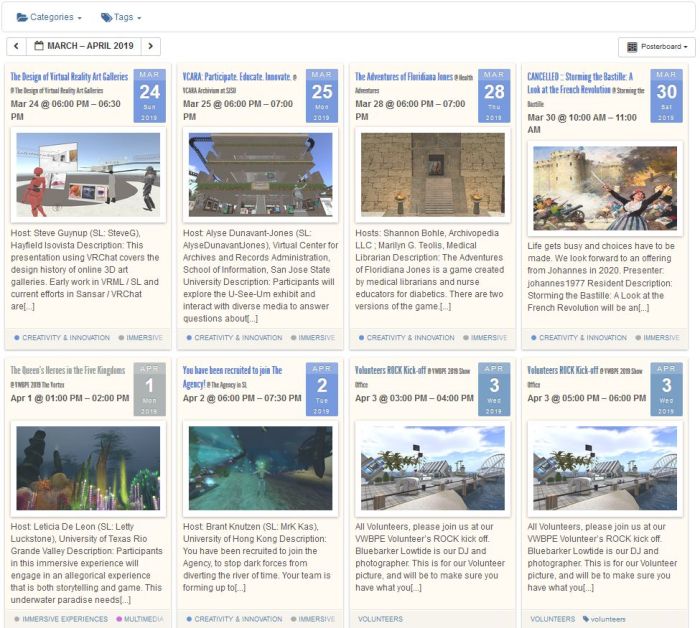
The best way to keep abreast of the full schedule is via the VWBPE 2019 event calendar. By default, this displayed in posterboard (shown below), but can easily be switched to agenda, month or stream views via the drop-down menu in the top right corner. Individual events can also be added to a number of personal calendars – Google, Outlook, Apple – making it even easier for attendees to track the events and activities they particularly want to attend at this year’s conference.

VWBPE 2019 calendar

Event Selection

The following is a (personal) selection of events those curious about VWBPE 2018 might want to attend. All times SLT:

Thursday, April 4th

  • 14:00-14:50 – What’s New At the Lab with Patch and Grumpity Linden in the Main Auditorium.
  • 16:00-17:00 – The Making of Our Digital Selves: My Avatar and Me: at the VWBPE social plaza.

Friday, April 5th

  • 09::00-09:50 – Keynote: Teacher Training with Virtual WorldsMain Auditorium: Dr. Tuncer Can, Istanbul University looks at how training teachers within Virtual Worlds could enhance innovation in the class and change the lives of real people by ensuring them.
  • 10:00-10:50 – Non-Profit Commons Past Reflections, Future DirectionsVWBPE 2019 Quadrivium.
  • 11:00-11:50 – Perspectives on virtual professional learning communitiesVWBPE 2019 Lecture Area A.

Saturday, April 6th

  • 11:00-11:50: Keynote: Crossing the Horizon together: Scanning, transforming, and sharing “What Works” in Immersive XR Main Auditorium: Dr. Jonathon Richter, Salish Kootenai College and Executive Director discusses the Immersive Learning Research Network facilitates collaboration between computer scientists, game developers, educators, learning scientists, and others.
  • 12:00 noon-12:50: Blue Mars on Virtual Harmony for agile mindsets –  VWBPE 2019 Lecture Area B.
  • 12:00-12:50: Re/visioning virtual educationVWBPE 2019 Quadrivium.
  • 14:00-14:50: Catching up with ThinkererMain Auditorium.
VWBPE 2019: Lecture Area B

Getting About

VWBPE takes place across 8 regions (including the exhibitors spaces). While exploring on foot is fun, the quickest way to get to event / activity venues is via the VWBPE Gateway and using the teleport boards there, and similar boards at each of the primary VWBPE events areas.

Additional Links

VWBPE 2019: keynote speakers announced

via: VWBPE

The 2019  Virtual Worlds Best Practice in Education (VWBPE) conference will be taking place between Thursday, April 4th and Saturday April 6th, 2019 inclusive. A grass-roots community event focusing on education in immersive virtual environments, VWBPE attracts 2200-3500 educational professionals from around the world each year.

On Saturday, March 2nd, 2019, the organisers of the event announced their list of keynote speakers – one for each day of the event.

Thursday, April 4th Tom Boellstorff: (Tom Bukowski in SL), a professor of anthropology at the University of California, Irvine. His interests have included the anthropology of sexuality, the anthropology of globalization, the anthropology of virtual worlds, Southeast Asian studies, the anthropology of HIV/AIDS, and linguistic anthropology.

The winner of the 2009 Dorothy Lee Award for Outstanding Scholarship in Ecology of Culture, Media Ecology Association, his has authored several books, including Coming of Age in Second Life: An Anthropologist Explores the Virtually Human, (Princeton University Press, 2008), the result of two years fieldwork in Second Life, living among and observing its residents in exactly the same way anthropologists traditionally have done to learn about cultures and social groups in the so-called real world. He has also co-authored Ethnography and Virtual Worlds: A Handbook of Method (Princeton University Press, 2012) a concise, comprehensive, and practical guide for students, teachers, designers, and scholars interested in using ethnographic methods to study on-line virtual worlds, including both game and non-game environments.

Tom is perhaps best known for his joint study with Donna Z. Davis, Disability and Virtual Worlds: New Frontiers of Appropriation, which I first wrote about in 2016, and which is the subject of the film Our Digital Selves: My Avatar is me!

VWBPE 2019 keynote speakers: Tom Boellstorff, Tuncer Can and Jonathon Richter

Friday, April 5th Tuncer Can: Tuncer is no stranger to the vLanguages community, a VWBPE 2019 partner. His most recent collaboration with vLanguages is GUINEVERE, an EU Commission funded language learning project. An exploration of the GUINEVERE project in OpenSim will be offered as an Immersive Experience after the conference.

Saturday, April 6th Dr. Jonathon Richter: a long-time friend of virtual and immersive environments, Jonathon Richter is the co-founder and Executive Director of the Immersive Learning Research Network (iLRN). Jonathon will explore with us what works in immersive XR (VR/AR/MR).

Call for Volunteers

VWBPE would not be possible without the dedicated service and support of its volunteers. If you would like to help at the upcoming conference, please sign up today!

Ebbe Altberg at VWBPE 2018: video, transcript and audio

VWBPE 2018 banner. Courtesy of VWBPE

On Thursday, March 15th, 2018, Linden Lab CEO met with a group of invited participant for the Above the Book events at VWBPE 2018. Lasting some 80 minutes, the conversational  Q&A session was livestreamed for its first hour to the main auditorium at the conference. Also in attendance at the event was  Brett Atwood (Brett Linden), Senior Manager for Marketing at Linden Lab, was also in attendance.

The full transcript of the session, including a number of “after stream” questions not in the official video is available here. When reading, please note:

  • The transcript notes don’t follow the chronological flow of the session, as I’ve attempted to group subjects by topic for more concise reference.
  • Audio of responses to questions are provided for each section of the transcript.
  • Questions are given in bold.
  • Comments from Ebbe Altberg are prefixed EA; comments from Brett Atwood are prefixed BA.

The video of the session is embedded at the end of this piece for reference and for those who would prefer to watch it. My thanks to the VWBPE stream team for providing it.

The Short Form

For those who prefer,the following is a bullet-point list of the core questions asked, gathered into the same topic headings as the transcript notes. Links are given to the relevant part of the full transcript for those who would prefer to read / listen to the complete answers / comments.

Note: due to the nature of WordPress internal text anchors and scrolling, you may have to scroll up a little after jumping to a specific topic, in order to see the question.

The Lab and Education

  • Education is, and remains, an important element of the lab’s thinking, both with Second Life and with Sansar. Jump to topic.
  • For educators interested in engaging with the Lab, the best way to do so is by reaching out to Brett Linden, who himself is an educator with 15 years experience (and who currently teaches a course as Washington State University) and who sees himself as a advocate for virtual worlds in education.
  • To help educators promote their endeavours, Brett suggests looking at SL Place Pages as a means to self-curate a web presence for in-world activities. Jump to topic.
  • The Lab is willing to work with educators on putting together documents / information addressing the value proposition, safety, security, etc., of using virtual space in education which can be used by educators to help inform their administrators and IT experts. Jump to topic.
  • The Lab is also willing to consider ways to make SL more attractive to the education market, preferably with a list of prioritised ideas from the education community, which can be compared with other requests for features / improvements, evaluated (technically and in terms of value / ROI, etc). Jump to topic.
  • It’s unlikely that LL will, in the near future, provide a dedicated resource to the educational / non-profile community. However, the recent re-alignment of the Second Life and Sansar team structures means there is now a dedicated SL marketing resource, lead by Brett, to help and support SL communities such as the educational / non-profit community. Jump to topic.
  • What has been the educational uptake with Sansar?

Product Accessibility and Ease-of-Use

  • Access for the disabled:
    • Sansar is too early in its development to offer much in the way of ease-of-access for the disabled.
    • The Lab would like to hear of specific instances where more could be done to help with accessing Second Life by those with disabilities.
    • Jump to topic.
  • What is the Lab’s position on speech-to-text, text-to-speech?
    • There are 3rd party tool already available, which the Lab might not look to directly integrate into their platforms.
    • However, major players like Microsoft, Google and apple are developing capabilities which the Lab might look towards integrating in the future.
    • Jump to topic.
  • Providing a plug-in architecture for SL / Sansar to allow third-party extensions (text-to-speech, etc.), has been suggested.
    • Not n the current roadmap, as SL client already provides a lot of open-source extensibility.
    • Possibly something TPVs could implement / contribute.
    • For some services, would have an associated cost involved, adding complexity, simply because third-parties charge for their services.
    • Jump to topic.
  • More broadly, Sansar has offered accessibility for people to be able to create and publish their own VR experience to the world without the need to develop their own platforms on which to run them. Jump to topic.
  • Will Sansar have easier access to content tools? Jump to topic.

Second Life: Development, Land Cost and Fees

  • The Second Life team numbers just under 100 people (engineering, support, operations, customer services, and not including finance, compliance, etc.). Jump to topic.
  • Key focuses for SL are: enhancing the platform, growing  the user base and trying to re-balance the economic model away from a reliance on land fees.
    • Costs of involvement in Second Life remain a concern for the Lab, which is taking a high-level look at trying to pivot revenues away from the land model potentially towards more of a transaction-based model, while at the same time trying to reduce at least some of the burden of land costs (e.g. the 2016 private region buy-down offer and more recently, the Mainland price restructuring).
    • Jump to topic
  • In time it is hoped that transitioning revenue away from land might lead to a further reduction in land costs to educators. Jump to topic.
  • Other areas of focus include making SL more scalable, secure and performant. Jump to topic.
  • The Lab will soon be publishing a roadmap announcement of improvements / enhancements to Second Life. Jump to topic.

Developing Second Life and Sansar

  • Linden Lab has more clearly split the Sansar and Second Life teams; there are no longer people “floating” between the two and working on both.
  • The Lab see a lot of overlap between the two products, with customers potential using both for different purposes.
  • However, each has its own potential markets / its own selling points for those markets, allowing them to co-exist.
  • The Lab believes that with 15 years of SL notwithstanding, the potential of virtual spaces has only been scratched, and both second Life and Sansar can do so much more.
  • Jump to Topic.

Second Life and the Cloud

  • Huge engineering effort, still in early stages, which will take “all of this year and then some” just to get transitioned and working.
  • Benefits to the Lab:
    • Reduced capital investment and maintenance costs.
    • Potential to dynamically scale consumption, rather than having simulator servers always on.
  • Potential benefits to users:
    • Potentially more flexibility in products and tiers, possibly defined by a mix of region use and use-case (e.g. high-powered, high capacity servers for popular events; more moderate, lower-cost servers for residential use).
    • Might add the ability to geographically locate simulators closer to dedicated audiences (e.g. regions serving South American communities could have their simulators running out of cloud locations in South America, reducing issues like latency for customers).
    • Not something that will happen immediately, as the Lab will need to transition services and then refine operations and investigate option.
  • Jump to topic.

Second Life and VR / Browsers

  • VR remains a challenge to implement in Second Life due to the high run-time frame rates required. As such, it is not something the Lab plans to pursue or re-deploy.
  • Streaming Second Life to a browser / mobile devices has been tried by third-parties (OnLive with SL Go and Bright Canopy from FRAME).
    • It’s not something the Lab is actively pursuing at present, so they are leaving it to third parties.
    • As the cost of cloud-base GPU technologies come down it might be something the Lab re-examines in the future.
  • Jump to topic.

“After Livestream” Questions

Note some !after stream” questions and comments are also addressed in the sections above.

  • Will the Lab bring back the Teen Grid as “the Education Grid”?
    • Not at this time, as it doesn’t fit with current plans to move away from dedicated infrastructure and to the cloud.
    • Might be something to be considered after the move to the cloud: presenting grids for unique audiences.
    • Jump to topic.
  • Can educators be given more control over their regions?
    • This would need indication from educators as to what is required (prioritised list again).
    • Jump to topic.