Sansar Product Meetings week #8: communication

Sansar: Treehouse Overlook

The following notes are taken from the Sansar Product Meetings for 2018 week #8,  held at 14:00 PST on Tuesday, February 20th. Unfortunately, illness kept me from attending the second meeting on socialisation, held on Thursday, February 22nd.

These weekly Product Meetings are open to anyone to attend, are a mix of voice (primarily) and text chat. Dates and times are currently floating, so check the Meet-up Announcements and the Sansar Atlas events sections each week. Official notes, when published can be found here.

Communications – Ideas from the Lab

The following is a list of some of the communications elements the Lab is actively investigating for Sansar. Note none of the following currently has a delivery time frame associated with it.

  • Group chat: somewhat similar in nature of SL conference calls: starting an IM with someone and then inviting others into it, to allow a select number of people to jointly converse together privately in Sansar as a whole (e.g. when in an experience or browsing the Atlas or working in LookBook).
  • Multiple instance communications: currently, users can only converse with one another in open chat if they are all in the same instance of an experience. The Lab would like to broaden this to allow some form of open chat between users in different instances of the same experience.
  • Broadcasting: the ability of nominated people in one instance of an experience to “broadcast” out to all other instances of that experience. This is being developed specifically for events such as presentations, concerts, etc.
  • Chat App improvements: including time stamps, and hopefully copy / paste – the problem being here that at the moment, the Chat App UI can break if trying to copy a large swathe of text. Hence why the option was disabled.

Ideas that are not currently being pursued, but may be considered in time include:

  • The ability to see where friends are in Sansar and teleport to them.
  • The ability to send a teleport invitation to friends to have them join you in an experience.
  • The ability for users to engage in private, one-to-one Voice conversations (Voice IMs, so to speak).

Voice Chat

A number of issues have been identified with Voice chat:

  • Audio occlusion: this does not always work as expected, allowing shows from part of an experience to bleed into a neighbouring part, even if the two are separated by a solid wall.
  • Voice roll-off: it’s been noticed that recent changes mean that where there was a clear break between different voice chat sessions scattered over an experience, there can now be times when multiple conversation overlap, potentially confusing the listener as they move around.
  • There needs to be a quick, effective means to focus in on someone talking in a group, which can be applied to both Desktop and VR modes.
  • there needs to be a more granular approach to being able to adjust the volume at which a users hears those around them talking.

Text Chat in VR

The Lab is looking at ways to surface text chat in VR mode, so that VR users can read what is going on in text and respond to it via Voice. This alone would be a huge improvement, given that in groups are VR dominant, anyone using Desktop text chat is essentially ostracised, as one of the VR users can see what they have typed.

User Profiles

Spanning both communication and socialisation is the user profile. Familiar to everyone in Second Life, it has been lacking any kind of implementation in Sansar. However, this is now changing.  Being prepared for a future release is the first iteration of a Sansar user profile. This will initially include:

  • The user name and an avatar head shot (obtained via the LookBook).
  • A field in which a short biography can be added.
  • And option to friend others through their profiles.

Additional options such as instant messaging, recording an avatar’s rez date and having a field in which notes on an avatar can be recorded.

2018 Sansar Product Meetings week #7: on-boarding and audience

Mario2 Helstein’s M2D City, location for the Thursday, February 15th, 2018

The following notes are taken from the Sansar Product Meeting held at 16:00 PST on Thursday, February 15th, 2018. are open to anyone to attend, are a mix of voice (primarily) and text chat, and there is currently no set agenda.Dates and times are currently floating, so check the Meet-up Announcements and the Sansar Atlas events sections each week. Official notes, when published can be found here.

Unfortunately, I was unable to attend the Tuesday, February 13th Product Meeting for week #7.

New User / On-Boarding Process

As noted in recent Sansar project updates (see 2018 week #3 for example), this is a priority for the Lab: making the new user sign-up and on-boarding smoother, possibly with fewer steps and hopefully (in the future) providing the means for experience owners to engage directly with their own audience through the events listing, their own web page with a URL to their experience and bring that audience of new users directly into their own experiences.  The Lab has been looking at a number of possible options for direct on-boarding, including something akin to Second Life’s Social and Learning islands.

Introducing Sansar to an Audience

Related to on-boarding is the idea of how to introduce Sansar to a new audience. Like Second Life, Sansar isn’t a game; there are no goals to work towards, no achievements to gain, no quests to be completed per se (although individual experiences can obviously include these). Therefore, providing videos, live streams, etc., which might help newcomers understand Sansar is a difficult topic to encompass.

  • One suggestion is to focus on the common elements within Sansar – such as the form-form ability to create environments, or the ability to participate in the economy either as a creator or a consumer (or indeed, a consumer-creator), and make “let’s play” style videos.
    • This could would well for the consumer-creator especially: showing how someone not versed in Maya, Blender, ZPaint, etc., can enter Sansar, come up with an experience idea, purchase items through the store and then create an experience and using the Edit Mode to lay things out and then set-up an Atlas presence and bring people into that space.
  • A problem with a “creation” perspective videos is that they might only appeal to a small percentage of a potential audience – simply because a) creation is complex in Sansar (even for the consumer-creator) in using the Edit Mode; and b) many people are looking for more-or-less for instant gratification. So having a focus on what people might find and do could be more effective.
  • Another suggestion is to have videos of the community meet-ups and the Top Five videos better promoted.

Audience Identification and Outreach

Part of the problem with encouraging an audience into Sansar is actually identifying that audience. Again, this is not a “one stop shop” like a conventional game. Those running a social environment for discussions and conversation in Sansar aren’t necessarily seeking the same audience as those making a learning or historical experience, who in turn aren’t necessarily going to be looking to the same audience as a sci-fi role-play experience. Thus, consideration must be given to experience creators finding their own channels to reach their preferred audience – be it YouTube or some other video outlet, forums, etc.

Is Sansar Ready for a Bigger Audience?

This is a chicken-and-egg question: users are need to drive adoption and grow content. Content is needed to attract users and engagement – content here not only being experiences and mesh models etc., but the platform’s capabilities: users being able to interact with one another and with the environment, etc. Right now, and in many respects, Sansar isn’t ready for a broader audience, simply because it isn’t capable of supporting these broader / deeper levels of activity. Focused communities cannot easily be managed, for example, because there is no mechanism (platform content / capability) to be able to do so.

This is already potentially leading to people visiting Sansar and walking away with the impression it is just a pretty place with nothing to do – so how to engage with these people and encourage them back needs to be considered and made a part of thinking, rather than – for the time being at least – simply looking to try to attract people in from elsewhere in greater numbers, by it from the world at large or SL or other platforms.

Social aspect of Sansar are picking up – look at the events listings during the week (not so much at weekends as yet). However, these can be very close-knit (for example, the preference is for voice chat, not text – which can be off-putting for those who do not wish to use – and equally importantly, if often overlooked – people who do not wish to hear chatter. Voice, frankly can be off-putting socially, simply because so many people don’t have the wherewithal to toggle their microphones off when not speaking, often leaving disconcerting background noise, conversations with other in the physical world with them, and so on.

On-Boarding / New Users Focus Group Discussion

On-boarding is liable to be the subject of a focus group meeting in the near future.

In Brief

  • Experience access control: currently, access to an experience can be limited to those on the creator’s Friends list. The next element – possibly to be rolled-out in the March update (ish) will be the ability to govern access via a white list of names. Anyone not listed for access won’t see the experience on their Atlas.
  • Sansar roadmap: this will likely be a focus for the Product Meet-ups in week #8 (commencing Monday, February 19th, 2018).
  • Improved object interactions: the ability to touch-interact with objects (e,g, touch a book and it opens, click a switch and a lights come on, etc)., are being worked on – but the Lab is sensitive to developing these capabilities so that such capabilities can be scaled and grow to meet a broad a range of needs as possible, rather than pushing the capabilities out quickly “to give people something to do”, and then having to revise them, possibly breaking content.
  • Windows Mix Reality Headsets: some people have been trying Windows Mixed Reality headsets with Sansar. While Sansar doesn’t officially support these headsets, people are finding the work, but the avatar arms don’t respond to the user’s hand / arm movements, even those the available VR interaction (picking up objects, etc), does work.

2018 Sansar Product Meetings week #6: Find and Connect 2

Eternity by C3rb3rus

The following notes are taken from the Sansar Product Meeting held at 9:30am PST on Friday, February 9th, 2018 – unfortunately, I was unable to attend the afternoon meeting, so have not notes from that.

These Product Meetings are open to anyone to attend, are a mix of voice (primarily) and text chat, and there is currently no set agenda. The official meeting notes are published in the week following each pair of meetings, while venues change each week, and are listed in the Meet-up Announcements and the Sansar Atlas events sections.

Product Meeting Changes

The “new format” for the Product Meetings, featuring specific subject matter experts from the Lab making themselves available to answer questions from users will now likely start in the week commencing Monday, February 12th.

  • The meetings are liable to be held on different days of the week relative to one another, rather than both on a Friday.
  • Dates and topics will be announced via the usual channels (Sansar Discord channel, meeting announcements, Atlas Events).

Find And Connect Update

The Find and Connect release (see my previous Product Meeting report) was updated on Wednesday, February 7th, 2018, comprising fixes for some known issues.  A list of changes / remaining known issues is available in the release notes. The following provide a little more context on the update.

Character Editor

A couple of avatar issues have been fixed, forcing users logging-on for the first time after the update to go to the LookBook (avatar app). These are:

  • The avatar’s head only having limited movement (particularly noticeable in VR).
  • Switching between avatar genders could merge female and male avatars together.

Experience Loading  and Progress Indicators

This was noted in my previous meeting notes, the progress bar seen on an experience splash screen is still in its first iteration, and can appear to “hang” while loading content for uncached scenes.

  • It’s been suggested a count of assets loaded (e.g. 23 out of 96 or something) could help prevent feelings that the load process has hung.
  • It’s been noticed that on occasion, an experience can hang on loading, then quiting and restarting the client / reloading the experience can cause it to load and start OK.
    • This was noted before the progress bar was added, and has been more noticed since the addition of the progress bar, which might be indicative of a load problem / connection issue upsetting the load process.

Experience Concurrency Indicator

The experience concurrency indicator (green icon in the top left of the experience Atlas thumbnail / description image) is reporting avatars as being present in experiences when no-one is in fact visiting.

  • This is a known issue, caused in part by a degree of latency which can occur between people entering and leaving an experience, and the Atlas being updated, and the Lab is looking to improve this.
  • If the Atlas has been left open for an extended period, refreshing it (e.g. reloading the page in the case of the web Atlas) might force an update of the concurrency indicators for experiences that have seen a change in the number of people visiting.
  • Note that this indicator only applies to visitors in a published experience, it doesn’t count people actively editing the scene associated with the experience.

General Feedback

Outside of the points raised above, general feedback for the Find and Connect update is:

  • Load times have (in general) improved.
  • Performance has improved within experiences, probably as a result of the update optimisations included in the release.
  • LookBook is a lot more responsive and gives a smoother experience.
  • Issues of names not showing in Desktop Mode when hovering the mouse over an avatar seem to have increased, and dropping into / out of LookBook and re-spawning in an experience no longer consistently fixes the issue. This is a known to the Lab and is being investigated.

Voice and Text

Voice Indicators

The debate on how to more easily identify who is speaking continues both at the Lab and among users. Ideas put forward include:

  • A over-the-head indicator of some kind (a-la Second Life) – perhaps a an illuminated dot only seen when speaking. There is some resistance at the Lab to this approach as it “breaks immersion”
  • A voice indicator in Sansar’s people floater. Potential problems here:
    • It requires people to always have the people floater open, which could be intrusive and “immersion breaking” for some (possibly more so than a dot that only illuminates when someone is speaking).
    • It currently wouldn’t work for people in VR, who cannot see the chat / people floaters.
  • An auto-rezzing “speaker’s stick” indicator that automatically rezzes in front of the avatar of someone speaking, and vanishes when they are silent.
  • An avatar animation (again a-la Second Life “speaking” animation gestures); but again, this might be a problem for users in VR using hand controllers.

Currently, this issue s not on the immediate road map to be addressed.

Text Chat  / People Floater in VR Mode

  • This is still being considered at the Lab and not currently on the implementation road map.
  • It is possible that the first iteration will allow VR to see text chat, but not necessarily have the means to type text.
    • Users may have the option to toggle this on or off.
    • Some form of indicator that messages have been left in text chat, even if the text panel isn’t visible is also seen as advantageous.
  • The ability for VR users to respond in text is seen as a longer-term issue to resolve.

Voice vs. Text Debate

There is an ongoing debate about preferred communications in Sansar.

  • The platform is a lot more geared towards voice use; so there is a concern that encouraging text chat (as with making text visible to VR users) could shift the bias away from voice to text.
  • There are situations where text chat is the better means of communication, e.g:
    • As a means of saving a transcript of a business discussion / arrangement.
    • To assist with character role-play (e.g. no issues of a voice failing to match a character  – orc, dragon, elephant, etc), or a male user having a female character or vice versa, etc.

Discord has been pointed to as a “solution” to group chat, etc., with Sansar. However, while there are advantages to this (e.g. Linden Lab do not have to develop a Discord-like environment within Sansar) there are also disadvantages (e.g. Discord is not particularly intuitive for a new user; it actually means time in Discord is time potentially away from Sansar; it means placing data and information in the hands of yet another third-party, etc.).

  • There is potentially a bias towards Discord at present, as it does only have a very small community of Sansar users involved within it. There are questions as to how well it scale should Sansar reach tens of thousands of active users trying to engage in group conversations, locate groups, etc.
  • Conversely, can Linden Lab realistically encompass everything users need directly within Sansar without overwhelming the ease-of-use aspects the platform is supposed to have, and are approaches used in Second Life (e.g. full group integration) the most optimal solution?

The Voice / chat debate and options for text chat and voice indicators may form a part of one of the new focused Product Meetings in the future.

2018 Sansar Product Meetings week #5: Find and Connect

David Hall’s Dwarven Fortress – setting for the Friday afternoon Product Meeting

The following notes are taken from the Sansar Product Meetings held at 9:30am and 4:00pm PST on Friday, February 2nd, 2018. These Product Meetings are open to anyone to attend, are a mix of voice (primarily) and text chat, and there is currently no set agenda. The official meeting notes are published in the week following each pair of meetings, while venues change each week, and are listed in the Meet-up Announcements and the Sansar Atlas events sections.

Meeting Changes

Up until now, the Product Meetings have been free-form, general Q&A sessions, largely guided by whoever from the Lab’s Sansar team has been able to join each meeting. In the future, there is liable to be more of a roadmap to meetings, with advanced notice being given on specific subject matter experts from the Lab who will be attending each meeting, to allow for more focused discussions on topics, with Q&A on the specific subjects being covered. These changes may start with week #6 (commencing Monday, February 5th, 2018), or shortly thereafter.

Free Creator Subscription Period Ends

On Thursday, February 1st, 2018, the “Free Creator Preview” period closed for Sansar users. The announcement was made via e-mail, and means those not on a subscription plan have been downgraded to the Free account status, and limited to just three experiences.

Those who have created more experiences under the Preview period are able to save the scenes for all there experiences, allowing them to swap between published experiences, but can only have three published for public access at any one time. Specific issues with changes required by the ending of the Preview period should be raised with support. Details on Sansar subscription packages for those wanting to have more than three active experiences can be found here.

Find and Connect Release

The January 2018 Sansar release, previously referred to as”Release 17″, now called Find and Connect, was deployed on Friday, February 2nd, 2018. The release notes are available on the Sansar website – please refer to these for a complete breakdown of the release contents, particularly fixes and known issues. The following is a summary of the major updates and initial feeback.

Atlas

The Client Atlas now includes a popularity search option and a concurrency indicator for experiences.

  • When selected from the sort drop-down menu (see below), the Popularity option orders the listed experiences in a tab by current real-time use, so those with avatars actually visiting them will be listed first.
  • Experiences with avatars in them have a concurrency indicator in the top left corner of their thumbnail image. This is a near real-time indicator that the experience is in use at the time it is seen in the Atlas.
Client Atlas: popularity in sort drop-down (circled, right), and the concurrency indicators (highlighted in the top three thumbnails) available for all experiences with avatars in them on all tabs

Note: while listed in the Find and Connect release notes, these two updates were actually released on January 22nd, 2018.

Event times in the Atlas (client and web) are now displayed in local time, and no longer only in PST. So if you are on the East Coast, the time will be displayed in EST / EDT; in the UK the time will display in BST or GMT, etc.

Experience Loading Progress Indicators

Indirectly linked to the Atlas, and in response to numerous requests, the splash screens for experiences now display a progress bar and status notices on the condition of the loading process (e.g.  “loading scene resources”, “loading avatar”, etc.).

This is a first pass at offering a progress bar, and the hope is it can be further refined to be more informative, particularly as the load process can seem to pause whilst loading an uncached experience. Ideas being considered are a percentage count, a count of assets loaded (e.g. 23 out of 96 or something), but no decisions at this time, as any count – percent, assets, etc., can still be subject to pauses which can give the appearance that the load has stalled.

Experience splash screen with progress bar and status notices

Audio

  • Live Streaming: live video streaming from Twitch and YouTube.
  • Multiple sound streams: multiple sound streams can be attached to a scene with easy changing between channels, and labels can be assigned to each.
  • Multiple audio emitters: sound streams or a media stream’s sound can be played across multiple emitters in your scene.
  • Play media stream sounds in the background: audio output of media streams can be channelled to play globally in an experience.

Avatar And Clothing

  • The avatar rest pose in Desktop Mode has been revised, as the “looking over each shoulder” action recently introduced didn’t find favour. Instead, the avatar moves in a more subtle and natural manner.
  • The underwear skinning for the female avatar has been revised to reduce the areas covered by the bra and (hopefully) make it easier for clothing creators to produce designs such as backless gowns, etc. This should not affect already uploaded clothing.
  • The knowledge base documentation previously stated that hair should not be more than 5,000 triangles. This should have been 8,000 triangles and has now been amended.
  • The Lookbook has received a lot of optimisation and intelligent caching to reduce load times.
  • Marvelous Design updates:
    • Marvelous Designer creator resources updated, and creators are encouraged to update to the latest skeleton to ensure all new clothing will upload to Sansar. This should not affect existing clothing in Sansar / the Sansar Store.
    • Cloth simulation is a lot smoother in the Lookbook.
    • The latest MD update allows users to use UV maps on the UV guide and fixes issues with exporting clothing to .SAMD. See here for more.
  • Known Issue: following the update, all “ear” attachments vanished from Lookbook (avatar app). This is being looked into.
  • Known issue: avatar head movement in VR mode is constrained (e.g. the head will turn more in one direction than the other). There is a fix for this that didn’t make the cut for this release.

Continue reading “2018 Sansar Product Meetings week #5: Find and Connect”

2018 Sansar Product Meetings week #4

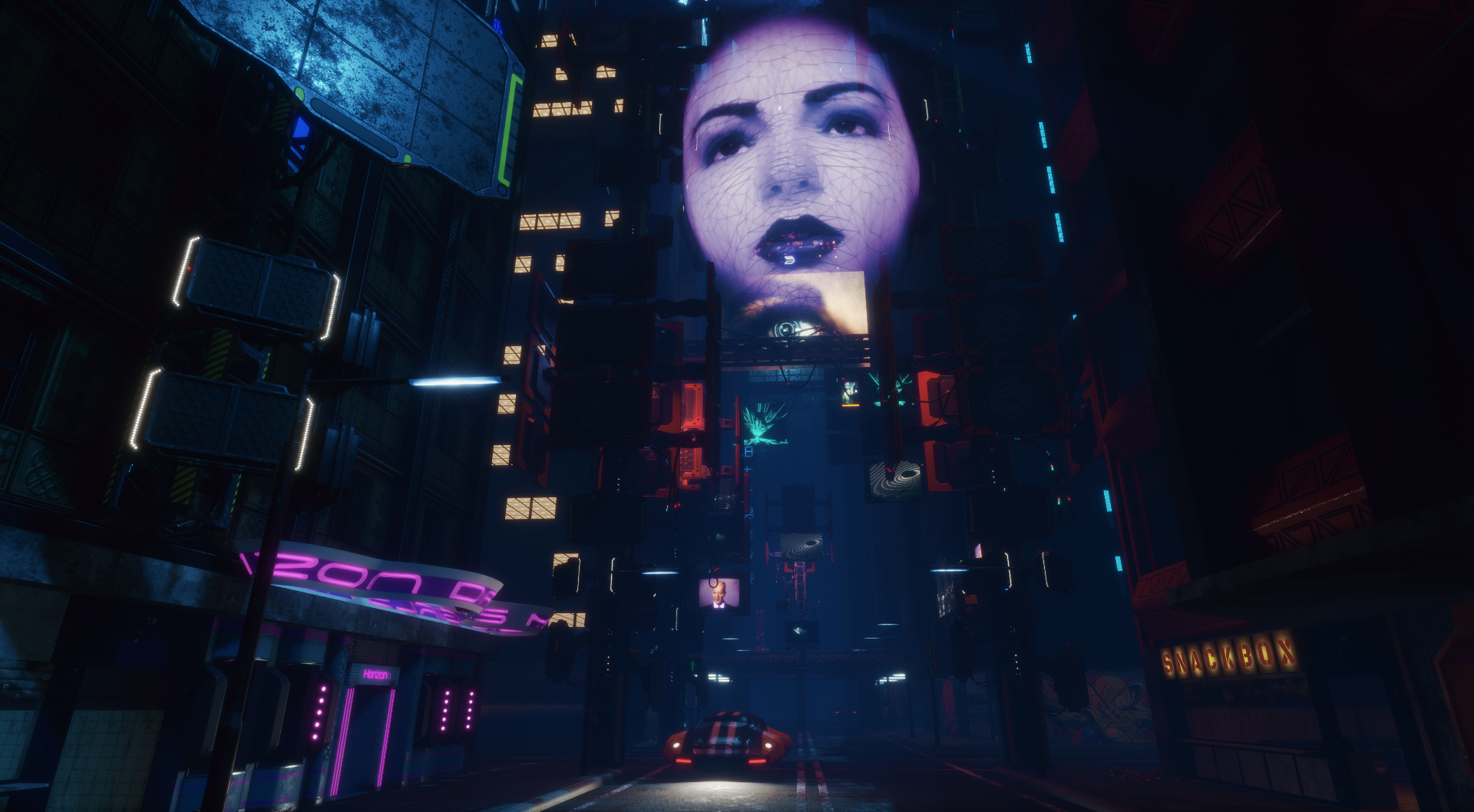
2077, Sansar; Inara Pey, January 2018, on FlickrSansar: 2077blog post

The following notes are taken from the Sansar Product Meetings held at 9:30am and 4:00pm PST on Friday, January 26th, 2018. These Product Meetings are open to anyone to attend, are a mix of voice (primarily) and text chat, and there is currently no set agenda. The official meeting notes are published in the week following each pair of meetings, while venues change each week, and are listed in the Meet-up Announcements and the Sansar Atlas events sections.

Nyx, Cara and Carolyn from the product team joined Jennifer for the meetings.

Inventory Updates

  • Filter / sort / search: the Lab is trying to fine-tune inventory to allow better sorting and filtering. This will hopefully include a search by item name function. This is seen as the first improvement to inventory for 2018, and at the time of writing was still being worked on, so it is not clear if tit will make the January release (Release 17 – see below for a re-cap on this).
  • Folders: inventory folders are frequently requested. These are now something the Lab hopes to start working on “soon”.
  • Scene Templates: the scene templates (currently available from the Scene Template drop-down list to the System Object menu to allow for easier drag-and-drop of scene templates at any time.
An update to the WEB Atlas means that events are now shown in your local times zone – not PST. A similar update will be deployed to the Client Atlas soon

Release 17

As note on my 2018 week #3 notes, the January release is simply called “Release 17” by the Lab, and focuses on:

  • Bug fixes.
  • Performance improvements – for example, the amount of data sent to the client for avatar and dynamic object animations has been reduced by some 60%, which will hopefully make things more fluid for users in busy experiences.
  • An experience loading progress bar has been coded, although the scene loading page has yet to be revised to show it, and it is hoped this will be in Release 17, or deployed shortly thereafter.

At the time of writing, the Lab is aiming to deploy the release around mid-week in week #5 (commencing Monday, January 29th, 2018).

Valentine’s Day Store “Express Your Love” Event

Jennifer has blogged about a special Valentine’s Day store event called Express Your Love. It has a very short lead-time (official closing date January 31st, 2018, although submissions may still be accepted beyond that), and creators are invited to submit wearables / clothing with a strong Valentine’s Day theme (e.g. chocolates, roses, jewellery in the case of wearables, gowns or suits for a romantic evening out for clothing) for inclusion in a special Sansar Store Valentine’s Day collection, which will be available from February 1st through February 14th.

Attachment Poly Counts / MD Issues

Currently the poly count for individual avatar attachment is restricted to 15K triangles. As the Lab is looking at various optimisations to help improve Sansar’s performance, this is unlikely to change in the immediate future. Some of the requests to increase the poly count is as a result of issues being encountered in using Marvelous Designer (MD). Cara understands that higher poly counts can be avoided when importing MD clothing if the particle distance is not smaller than 20mm – which matches that of the Sansar avatar. It is acknowledged that this may cause problems in some designs, and so is offered as a suggestion, rather than a hard-and-fast recommendation.

Suggestions have been made on how complex clothing might be better handled, such as splitting a rigged gown into two parts, but having them annotated such that they are handled within Sansar as a single item when worn. In response, Nyx reiterated that what was made available in the Fashion Release was only an initial release, and the Lab are looking at further refinements and improvement options, so final limits on things like poly counts and options for handling clothing and attachments are still being examined and considered.

Functionality over Immersion?

While not ideal, Second Life does have the floating dot over people’s heads, and the visible green sound bars flashing when someone is actually speaking. This eases locating someone talking at a meeting a lot easier (as can having the people floater open and checking for the voice indicator there).

A similar approach in Sansar has been seen by the Lab as “immersion breaking”, but its is now being recognised as there needs to be some easier means to locating who is speaking rather than trying to spot moving avatar lips. Suggests put forward for such a capability include:

  • A voice indicator in Sansar’s people floater.
  • An auto-rezzing “speaker’s stick” indicator that automatically rezzes in front of (or over?) the avatar of someone speaking, and vanishes when they are silent.

Sansar Store

  • Product updates: the Lab is working on a mechanism to allow creators to offer product updates to purchasers.
  • Merchant / customer communications: offering merchants the ability to better communicate with their customers is on the radar and being looked at.
  • Gifts / Gifting: the ability to gift items in the Store to people is “on the radar”, but is seen as lower on the priority list, so no work has started on it as yet.

In Brief

  • Building Gizmo: it’s been noted that the gizmo used to move and position models in a scene is not easy to see and manipulate when handling very large models. The Lab is a ware of this and looking at options for improving the tool.
  • Level of detail: there are plans to add level of detail (LOD) capabilities / optimisations to Sansar, but these are still a little further down the road.
  • Advertising outreach: options for people to be able to better advertise / promote goods, services, activities, etc., are being thought about. These could include user profiles and group options similar to those found in SL; an ability to “follow” others and receive updates and notifications from them, etc.
  • Events promotion: the Lab is working on a mechanism for people to submit their own Sansar events directly to the events calendar without having to e-mail a member of the Community team. This will not be in Release 17, but will hopefully be deployed in a future release update.
  • Improved Desktop Mode interactivity options: the ability to click on buttons, etc., in Desktop Mode, is being looked into, and additional engineering expertise has been brought in to work on interactivity in Sansar in general.
  • Sitting: an initial ability to allow avatars to sit is being investigated. Avatar animations in general are also being considered – please refer to recent Product Meeting notes in these pages for more.
  • Chat: improvements to Sansar’s chat capabilities are being planned, including things like group chat sessions independent of people all being in the same experience, etc., and it is hoped these will start being deployed later in 2018.
    • The Chat App currently does not support copy from the chat history. However, the Lab is looking into trying to offer a text copy capability within the local chat window once more (the “original” ability to do so having been a bug).
  • PayPal support: still on the road map, but no work carried out as yet.
  • Subscription plans & experiences: there are currently no plans to change the current number of experiences per Sansar subscription plan.

Sansar: client Atlas update and Anu’s Copper Valley

Sansar: Copper Valley

As per my 2018 week #3 Product Meeting notes, the Sansar Client Atlas has been updates to include the new Popularity sort option and currency indicator.

When selected from the sort drop-down menu (see below), the Popularity option orders the listed experiences in a tab by current real-time use, so those with avatars actually visiting them will be listed first. In addition, those experiences with avatars in them have a concurrency indicator in the top left corner of their thumbnail image. This is a near real-time indicator that the experience is in use at the time it is seen in the Atlas.

Client Atlas: popularity in sort drop-down (circled), and the concurrency indicators (arrowed) available for all experiences with avatars in them on all tabs

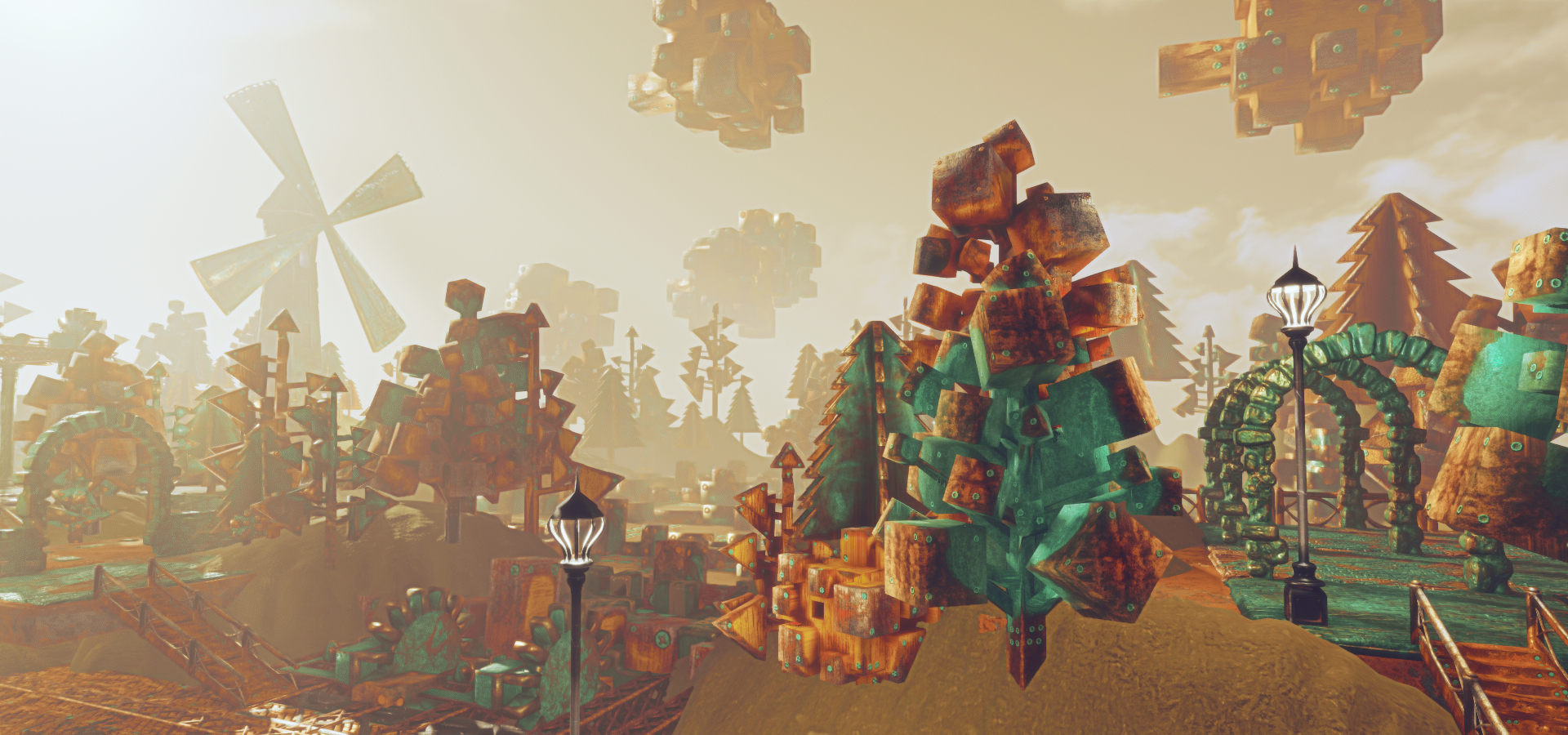
The banner images from that Product Meeting report was an advanced look at a new experience by Anu Amun, which is now publicly listed in the Atlas, by the name Copper Valley. A work-in-progress, it offers a mechanoid landscape inspired by steampunk.

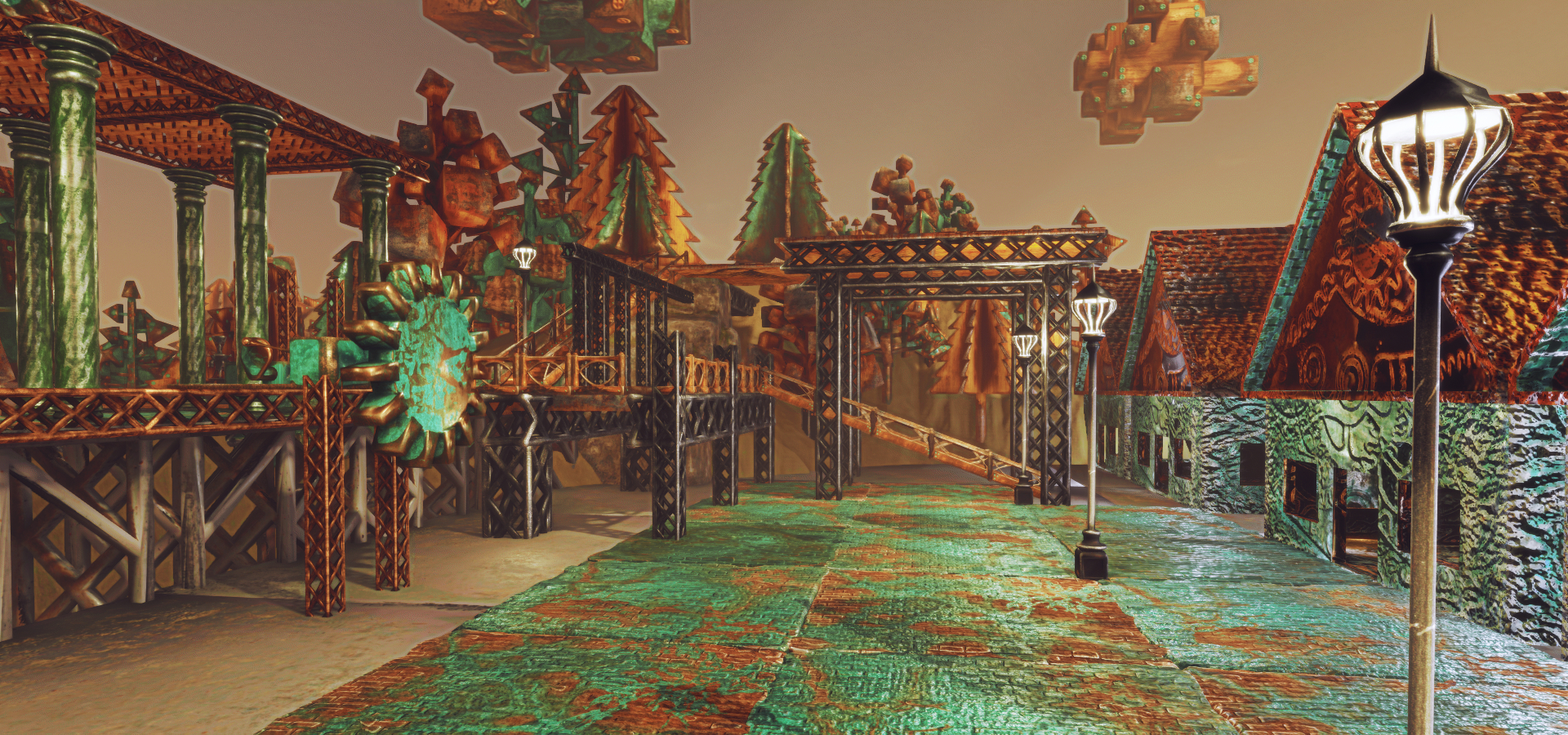
The spawn point for the experience drops visitors onto a platform roughly in the middle of this curious landscape. A raised walkway runs behind the spawn point, linking a tall windmill, sails slowly turning, with stairs leading up to another platform. Steps also offer ways down to the lands below – on one side a row of little houses, their walls and roofs seemingly made of copper – walls green and aged-looking, the roofs pristine.

Sansar: Copper Valley

On the other side, through peculiar trees, looking like they’ve been cut from blocks of metal or cut from heavy sheets, and past Mecano-like seats, to where massive blocks rotate as if on long axles hidden just below ground, rising and falling from flat fields of screwed-down metal plates. Overhead, great bulky clouds drift across a dusty sky with “normal” clouds at much higher altitudes.

It’s a strange environment, complete with it own enchantment; a mechanical place where the sandy hills are gradually giving way to more of the metal plate fields with their rotating axles of blocks. So much so, that in one corner, the “fields” are still under construction.  Exploring this realm is a case of following the elevated paths, climbing the stairs, descending the steps and following your nose – but be warned! Some surfaces aren’t as solid as others.

Sansar: Copper Valley

Having enjoyed Anu’s Anu, I admit to being curious as to where Copper Valley might go. In the meantime, it makes for a most unusual visit.

Experience URL