Sansar : some hints at options for revenue generation

Project Sansar image via Linden Lab

Update, May 5th: As indicated by Pete Linden, the Lab’s Director of Communications, in the comments following this piece, the write of the the TCP project article appears to have got his wires crossed in reference to user-to-user transactions and the Lab’s revenue model for Sansar, which has in turn lead my speculations astray in the possible levels of commissions. I’ve now revised the piece to focus on the elements directly related to Ebbe’s comments on other revenue models under consideration.

One of the areas of interest with Project Sansar is how Linden Lab will generate revenue from the platform, given their intention to pivot strongly away from the and land model which has proven so constraining within Second Life.

During assorted presentations at the Virtual Worlds Best Practice in Education conferences, Lab Chat sessions, and in talking to the media, Ebbe Altberg has made it clear that one of the ways in which the Lab intend to more broadly generate revenue from Project Sansar is through a “sales tax” (commission) on the sale of goods and content within the platform.

While no specifics of the possible commission rate(s) has been given, the idea has caused some concern among original content creators as to how much such charges might be and how they’ll be applied. However, in order to be sustainable, Sansar will need other means of revenue generation, something which has caused some speculation in various circles as to what other means the Lab might use. The Lab itself has, until recently, been quiet on the matter. Then, on April 29th, two items caught my attention, offering as they do further hints on the Lab’s thinking.

The first came through a piece penned by D.J. Pangborn, and which appeared in the April 29th edition of The Creator Project (TCP). Entitled Peek Inside Second Life’s Virtual Reality Successor, ‘Project Sansar’, the article doesn’t really offer much that was new it terms of news about Project Sansar for those who have been tracking things, despite its title; but it does include a little snippet which caused my eyebrow to rise when I read it:

As for the monetization of experiences in Sansar, Linden Lab will collect most of their revenues from charging for virtual services, not from renting land. Altberg says they plan to take very little from the user-to-user economy.

The emphasis is mine, but I found these particular parts of the statement interesting for two reasons. The one on taking “very little” from the user-to-user economy suggests that the Lab are looking to keep any “sales tax” / commission on content sales to a minimum. (See the update note at the top of this article / Pete Linden’s comment below).

The idea of the Lab collecting revenues from charging for virtual services suggests they are considering an approach a little similar to that put forward by High Fidelity – revenue can be drawn from services associated with Project Sansar. Obviously, this would likely include fees for virtual currency handling a-la Second Life, but what else?

Sansar Mars landscape (via Linden Lab)

Speaking to Draxtor Despres for show #114 of The Drax Files Radio Hour, which also appeared on April 29th, the same day, Ebbe Altberg indicated some of the additional ways in which the Lab is thinking of raising revenue through Sansar, starting at the 19:30 mark into the recording. While no fees / percentages were given, the options under consideration (and there could well be more the Lab is thinking about) are defined as:

  • Via fees associated with the resources used, e.g. paying for the experiences published through the platform people can visit
  • Via a commission on in-world sales (currently for Second Life, the Lab only charges a direct commission for Marketplace sales)
  • Through a series of subscription options for users / customers, possibly based on resource usage – capabilities used, size of inventories, hoe many experiences can be published, what kind of privacy controls are provided, etc.

The last idea is based on the view that in order to solve for specific requirements from certain customers, the Lab will likely have to develop very specific tools and capabilities – which those same customers would be willing to pay to access.

While the idea of paying for capabilities might not sit well with those of us using Second Life, given some of the markets the Lab appear to have in mind for Project Sansar, the idea actually isn’t too much of a stretch. Companies and organisations are often willing to pay a little extra for what they feel is a more “tailored” offering.

However, none of the above means that the Lab is abandoning the free-to-play approach entirely. As Ebbe states in the interview, “but at the same time, anyone should be able to come in for free and consume any experience any experience they have access to, whether it’s a private experience or a public experience, that someone has given them access right to. They should be able to come in for free and participate.”

It’ll certainly be interesting to see if / how these ideas develop, precisely what fees / percentages the Lab is considering on the sale of goods, , and what else might emerge as a possible option for revenue generation (price per instance of an experience, for example?).

Maps as metaphors: Second Life and Sansar

The map is Second Life offers a powerful metaphor for the grid being a contiguous whole, even where private reagions may be remote and physically isolated from their neighbours
The map in Second Life is seen as a powerful metaphor for the grid being a contiguous whole, even where private regions may be remote or physically isolated from their immediate neighbours

Just how important a metaphor is the concept of a “world map” to Project Sansar? Given it has been a topic of discussion in both the first and second instalments of LabChat, and has been given by some as a reason for not wanting to be involved at all in Project Sansar, one might say “very important”; and there is no denying it does have its uses. But is it really as intrinsic to our use of Second Life as has been portrayed, and because it may not exist within Project Sansar in the manner we’re accustomed to seeing in SL, is it really a reason to proclaim we’ve no interest in the Lab’s new platform?

Within LabChat, the discussions on the Map have revolved around two ideas: that without the map, there will be “no sense of community”, and that it gives Second Life a greater sense of presence and of being a place when we’re within it.

I admit that in terms of the map being somehow central to the ideal of community, I find myself in agreement with Ebbe Altberg; that when all is said and done, the world map (and mini-map) don’t hugely contribute to a genuine sense of “community”. Yes, they help us find busy places we might want to visit (or avoid!), or see how busy a venue or store is, etc. But really, this doesn’t add to any feeling of “community” within SL. That comes from the people we meet within those spaces and how they interact with one another and us; how we in turn relate to them; what is going on within those spaces in terms of activities and events, etc. These are the things which are going to bring us into a community, and in that regard, the map really places no larger a role than search; it is simply a means to an end.

Is it really the map which gives SL its sense of community - or is it the people themselves. I'd tend to go with the latter (image: Richard Finkelstein (Leko Littlebird), SLCC 2011)
Is it really the map which gives SL its sense of community – or is it the people themselves? I’d tend to go with the latter (image: Richard Finkelstein (Leko Littlebird), SLCC 2011)

However, the idea that the world map presents Second Life as a place, adding to our sense of presence, is harder to deny. In fact, given that Second Life is intended to be a single world of (largely) interconnected spaces, its representation via a map can be a vital aspect of reinforcing this view. In other words, the map is, for many  – but not necessarily all of us – an intrinsic part of how we see Second Life as a connected whole, a place.

When it comes to Project Sansar, however, things are slightly more complicated. For one thing, it is not designed to be a single “world” in the same manner as Second Life. It’s a platform for hosting multiple “worlds” (“experiences”, “spaces”, “environments”, call them what you will), many of which may well have nothing whatsoever in common with one another – and certainly no way of moving directly from one to another in-world as we can in Second Life. Thus, presenting a single, all-encompassing map of “Sansar spaces” actually makes a lot less sense that it does with Second Life.

Within specific spaces, maps do have enormous value for visitors, so providing the means / support by which experience creators in Sansar can produce them could be of enormous benefit to the platform
While having some kind of over-arching map of all Project Sansar experiences might not be either practical or useful, providing the means by which experience creators can represent their spaces in a map which can be accessed by their users / clients / visitors remains both a useful tool and a powerful means of adding to the sense of presence within a space

Which is not to say the map is entirely redundant for Project Sansar. While some kind of all-encompassing map of “every” Sansar experience might not hold much value, the fact remains that as noted, maps do assist in giving one a greater sense of presence in an environment (as well as being useful for things like navigation!). As such, providing the means for experience creators to provide maps of their environments, and those to which they connect, would appear to be something Project Sansar should provide. In fairness, this isn’t something the Lab has ruled out, as Ebbe Altberg noted in the first Lab Chat:

So, that’s where we’ll start, and then it could be that maybe people create continents, or whatever you want to call it, even worlds, and maybe over time we’ll think about ways in which those can figure out how to have a map of that experience, and those could be vast.

The only caveat I’d have here is the idea that “over time” consideration will be given to enabling people to graphically represent their spaces. As noted, a map does provide a powerful metaphor for giving the environment you’re in a sense of greater presence. It’s also often the best means of showing people what is where, allowing them to see what might be of interest to them, and  – most basically – how to navigate from A to B to C.

Given this, and the fact that there may often be circumstances within Project Sansar where direct “in-world” transfer from one experience to another may not be possible, I’d say that having some kind of all-encompassing “world map” of every available experience within Sansar actually isn’t that important or something we should perhaps get too hung up about. Certainly, it doesn’t seem to be as important as perhaps encouraging the Lab to fully appreciate how useful a tool a map can be to visitors within a specific experience  (or connected group of experiences), and thus provide the means by which experience creators can easily create such maps sooner rather than later.

Sansar: of images and reactions

 Project Sansar (image: Linden Lab)
Project Sansar (image: Linden Lab)

There’s been a lot of reaction to recent images release via Twitter of scenes from Project Sansar. The images, one of the surface of Mars, and another an almost alien-looking beach scene, were Tweeted by Ebbe Altberg.

The first came on February 4th, and prompted several Tweets in reply, the second on February 10th. Both were picked-up by various media outlets such as Tom’s Hardware and VR Focus. Each of the images reveal very little, and this has led to a certain amount of negative feedback and potentially incorrect comparisons to Second Life, with some of the criticism reading as attempts to write-off Project Sansar before people have been given the opportunity to look inside it.

The February 4th Tweet by Ebbe Altberg

Some of those critiquing the images point to similar work being possible in Second Life. On the surface, this is a fair comment – such environments are possible in SL; however, they also seem to miss the point.

While Project Sansar isn’t exclusively VR HMD oriented, when discussing its initial use, Ebbe Altberg has made it clear that the Lab is firstly looking to those market verticals which are already demonstrating interest in getting involved with immersive environments through to use of (relatively, when compared to the “traditional” costs of such systems) low-cost era of HMDs and their peripherals. Verticals such as education, training, simulation, healthcare, design, architecture and business have all been mentioned time and again. Hence why,  for example and as I’ve previously pointed out, it was no accident that the first public demonstration for Project Sansar came during month-long Architecture and the City Festival in San Francisco, held in September 2015.

The February 10th Tweet by Ebbe Altberg

The hard reality here is that for the most part, these are sectors which have little or no interest in delving into Second Life to achieve their aims; it is simply too costly and / or too complex to do so (even were it capable of supporting HMDs at things like the recommended frame rates, etc). Thus, comparisons with what is shown in the images and what can be created in Second Life is really irrelevant.

Of course, by the same standard, aiming for specific verticals and opportunities and actually gathering a sufficient audience from those vertical to help grow the platform more broadly isn’t an automatic given. That in itself is a worthwhile debate, but it is one far beyond determining Sansar’s worth based on a couple of in-world snapshots.

Others have critiqued the images on the basis that they are leveraging pre-built models and thus the comment that Sansar environments can be built in “a few hours” is misleading. But is this really the case?

Ebbe Altberg on Sansar's marketplace, January 21st, 2016
Ebbe Altberg on Sansar’s marketplace, January 21st, 2016

The reality is that in this regard, Project Sansar isn’t that different to Second Life, where we leverage existing assets and content, purchased in-world or through the Marketplace, every day to create our environments.

What Project Sansar aims to do is take things further by offering those who wish to simply acquire and use assets up to and including dedicated experiences, the means to do so. This can then be coupled to a much easier means of direct access to those environments, possibly hooked directly into their own  user authentication systems (see the 3rd bullet point here), to provide a direct means of immediate access to that environment for their staff / students / users / clients, thus entirely bypassing the stress of user access which is so much a part of Second Life.

As such, the use of pre-existing content in the Tweeted images isn’t misleading or “cheating” when placed alongside the “few hours” statement of build time. Rather, it’s a reflection of one of the ways the Lab envisages Project Sansar being used.

There is a lot about Project Sansar that has yet to be revealed and / or understood. There’s also much about it that would seem to be a gamble on the part of the Lab. As such, there is a lot worthy of debate about it and platforms like it – High Fidelity, Sinwave.space, AltspaceVR, et al, their potential for success, how they fit with the VR ecosystem, how that ecosystem will fair over time when faced with things like emerging AR capabilities and potential, and so on and so forth. But to dismiss Project Sansar purely on the basis of a handful of screen shot seems, at least to me, a tad bit premature.

Wareable examines Project Sansar

"Project Sansar" promotional image via linden Lab
Project Sansar promotional image via Linden Lab

In Virtual worlds reborn: Can Second Life’s second life democratise VR? Sophie Charara, features editor at Wareable, examines Project Sansar, using in part Ebbe’s comments from an on-stage discussion they had, together with Ken Bretschneider of The Void during the December 2015 Web Summit. I’ve embedded the video of that discussion at the end of this article.

While the piece in Wearable doesn’t offer much that’s new to those who have been following the Lab’s conversations to the press and SL users about their hopes for the new platform, the article does offer some interesting insights to what the Lab is doing and some of their thinking behind Sansar.

Sophie Charara
Sophie Charara

Starting out with what we already know – the Lab is pitching the platform as “WordPress for VR”: an environment where people can come in and create virtual environments without the need to be a software engineer, coder, etc. – the article covers a lot of ground, with comparisons to Second Life, references to other pioneers in VR (Chris Milk, Nonny de la Pena and Jeremy Bailenson) and a further look at hoped-for time frames with “Sansar”.

The Lab has, on numerous occasions, indicated that initially, Sansar is being targeted at some very specific verticals where immersive VR has practical application. Education, healthcare, simulation, business, design and architecture have all be very specifically mentioned in this regard. So a point of interest for me was reading the specific example cited by Ebbe as to how Sansar is already been used, albeit on a test basis, by an architect:

An architect named Diego, who works for a big firm that is completing a major medical centre project, built the entire building in Sansar as an experiment.

“When he experienced it in virtual reality for the first time, he walked into the lobby and said ‘Damn, it’s too big,'” said Altberg. “It took him one second to realise that something was off and he’d been working on this project for a long time. That had value instantly.”

In this instance, the power of virtual realisation is clear, and having a platform which allows companies and individuals easily leverage this kind of visualisation, connect with other and have them shared in such visualisations / experiences / models is clear. In the example above, it is only a short step from Diego witnessing the flaws in his design (and being able to correct them as a result) to him being able to invite his clients into the model, so they can witness first-hand what his company’s vision for the project is. It also potentially allows his company to retain the model as a part of a virtual portfolio of projects they can showcase to future clients.

That the Lab had identified architecture as a suitable environment where Sansar could offer significant value for clients can also be ssen in the fact that the first public demonstration of the new platform took place San Francisco’s month-long Architecture and the City Festival in September 2015.

VR capabilities have a huge potential for various vertical markets, such as architecture and design, and these are markets the Lab have indicated they are targeting (image archvertical.com)
In 2014, Jon Brouchoud demonstrated the potential of architectural visualisation using the Oculus Rift and Unity 3D (image archvertical.com)

Hence why “Sansar” could, potentially, be a very powerful platform with the sectors the Lab has identified, particularly if it really does allow clients the freedom to create environments which can be standalone or interconnected, and / or which can be accessed directly through a closed Intranet, or open to all via direct web portal, according to individual needs.

Picture, for example, a university using Sansar to build a virtual teaching environment, access through its own Intranet and using it’s exiting log-in and authentication process so students and staff can seamlessly move into and out of the virtual space. They could then open a public portal to elements of that space, and / or link-up with other education institutions, enabling students to share in their virtual learning spaces, building-up their own “world” of connected experiences.

Second Life has proven itself and the value of virtual environments in education. "Project Sansar" could present opportunities to significantly build on the foundations laid by SL
Second Life has proven itself and the value of virtual environments in education. “Project Sansar” could present opportunities to significantly build on the foundations laid by SL

Not that Sansar is purely about these niche environments. The potential social power of virtual spaces and virtual opportunities has long been established by Second Life, and the article does make it clear that as things progress, the Lab does see Sansar as potentially being able to replicate a lot of what Second Life can already do and offering it to an audience as a much more accessible medium.

This obviously is something of a worry for those of us deeply rooted in Second Life – much has already been made of the potential for the “cannibalisation effect” Sansar might have on the current Second Life user base. It’s actually a valid concern, and something we should perhaps be prepared for at some point down the road, if Sansar proves to be a success and starts to pull SL users away from this platform. But frankly, it’s not something which should be held up as a reason for the Lab not to press ahead with Project Sansar.

Continue reading “Wareable examines Project Sansar”

“Created Reality”- possible contender for Project Sansar’s name?

Is Porject Sansar to be called Created Reality?
Is there a Link between Project Sansar and “Created Reality”?

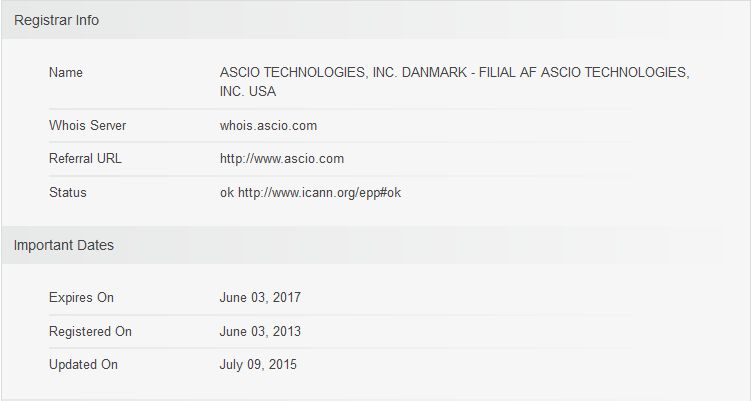
Ciaran Laval and I have been using Twitter to further ponder a domain registration in the name of “createdreality.com”. It was originally taken out in June 2013, which under the usual two-year registration policy means it possibly expired around June 3rd, 2015. However, on July 9th, 2015, it was renewed through Ascio Technologies, the company used to register the projectsansar.com domain.

The domain registration renewal followed a trademark registration submitted to the USPTO by the Lab for the name “Created Reality”. This occurred on May 22nd and is summarised here.

The timing of both is possibly interesting, given the domain name had been allowed to lapse (although this could simply have been admin oversight), and the trademark filing came 2 weeks after Lab had confirmed “Project Sansar” to be the new platform’s code-name, thus ruling out “Created Reality” as simply being an alternative code-name for the platform.

The domain createdreality.com was registered through the same servie used to register the projectsansar.com domain
The domain createdreality.com was registered through the same service used to register the projectsansar.com domain

The trademark application also contains pretty much the same descriptive wording as used within the “Project Sansar” and “Sansar” filings made in April 2015.

So, does this mean “Created Reality” is the new name for the Lab’s Next Generation platform? Well, maybe – but maybe not.

On the one hand, it is interesting that the Trademark filing came after the code-name for the platform had been decided. However, this isn’t necessarily indicative of anything; the Lab could simply be covering the bases as they consider various names for the new platform.

More to the point, while the name “Created Reality” may doubtless describe the platform’s function in presenting spaces where people can create their own virtual realities, it does actually read rather, well, bland.

The createdreality.com domain administrator: Linden Research (Linden Lab)

Countering this, however, is the idea that the new platform is apparently geared towards being a “white label” service in which in which creators can build their own branded spaces, and then promote  / market them directly to their potential audience, complete with sign-up portal, etc.

As such, the users of the environments created on the platform are perhaps more likely to know the environments by their various names, rather than collectively by the name of the platform on which they run. Thus, the platform’s name might be less front-and-centre than is the case with something like Second Life. Although that said, I’d personally like to see something a little more dynamic by which to know the platform.

Right now, the Lab is saying little on the subject of “Sansar” or “Created Reality”, with Peter Gray only informing me that the platform’s name is still “being determined”.

However, if we place the “Created Reality” trademark alongside the one for “Sansar”  – the latter being quite distinct from the trademark filed for “Project Sansar” – it would seem we have a couple of the names the Lab have been ruminating on for the platform’s eventual title. Could there be more lurking out there in the form of trademarks and / or domain names?

Sundry thoughts on regions, revenue, tier and platforms

A quiet afternoon at Hollywood Airport

The year-end brought with it a round-up of Second Life in terms of region numbers, courtesy of Tyche Shepherd and her excellent Grid Survey. 2014 continued to see the downward count in the number of private regions in SL, with some 673 regions vanishing through the course of the year (from 19,273 at the start of the year to 18,600 at the end of the year).

Expressed as a percentage, this means that the main grid has shrunk by 3.5%. That compares to an 8.2% shrinkage in 2013 (from 20,992 to 19,273 regions, a loss of 1719) and a 12% reduction in 2012 (23,857 to 20,992, a loss of 2865 regions).

There are likely to be a number of reasons for the slow down in losses, all interacting with one another. While  one ideologue opted to pooh-pooh it, in September 2011 I pointed to one contributing factor to the then increasing rate of decline in region numbers as likely being due to physical world economic issues. With their disposable income diminishing, people were finding an outlay of $125 a month for virtual land increasingly hard to justify, and so were divesting themselves of it; something which likely continued through 2012 and early 2013.

Private regions numbers through 2014 (source: Tyche Shepherd, SLU forums)
Private region numbers decline through 2014 (source: Tyche Shepherd, SLU forums)

While I’m not about to say we’ve turned the corner where the physical world economic situation is concerned, it is probable that by late 2013 we’d reached a point where those still with a residential homestead of their own were more willing to grit their teeth and pay for the land they hold, thus contributing to the slowing of shrinkage.

So what does that mean for the year ahead? While nothing is guaranteed, I tend to sway towards the view that the decline in region numbers will continue to slow, but at less than the rate we’ve seen in from late 2013 through 2014. I’m also inclined to think we won’t see any significant rise in region numbers through 2015 (unless some kind of external factor comes into play or the Lab does opt to do something quite unexpected to cause people to suddenly want lots of land).

One thing the slow-down will hopefully do is decrease future calls for tier cuts. As I explained back in January 2013, unless the Lab have a substantive means of compensating for the revenue loss resulting from any “reasonable” tier, any such cut will likely hurt the company (and SL) more than help. Nor is the Lab’s profit margin anywhere near the levels sometimes mentioned (e.g. the 200% recently claimed in this blog), such that they could simply “absorb” any tier cut without feeling the impact.

The decline in private regions, January 2012 through December 2013 (source: Tyche Shepherd, SLU forums)

In 2008, estimates put the Lab’s earnings at around $90-95 million, and their possible profit margin at between $40-$50 million (48-50%) – see the articles here and here. I assume these estimates are for gross profits, as neither makes allowances for tax.

More to the point, there seems to be a slight flaw in both estimates: they only appear to reference the costs involved in running simulator servers. No mention is made of the various back-end services such as group chat, group management, asset management, login, transaction management and payment, (and today, the avatar baking service), the various web services (Marketplace), and so on. While the costs associated with all of these are obviously going to be a lot lower than those for the simulator hosts, they shouldn’t be entirely discounted. There’s also third-party support costs (in 2008-2010, for example, the Lab was paying Rivers Run Red and 80/20 Studio; today there’s the costs involved in using the Highwinds CDN service).

Continue reading “Sundry thoughts on regions, revenue, tier and platforms”