Sansar Product Meetings week #29: UGC quests and the XP system

50 years on: recalling Apollo 11 in Sansar – the Apollo Museum in Sansar

Oops! this was drafted on July 19th, then the weekend came, and I forgot to publish it!

The following notes were taken from my recording of the July 18th (week #29) Product Meeting. This meeting focused on the new quest system.

Quest Authoring

  • Week #30 (commencing Monday, July 22nd) should see a point release of the first version of Sansar’s in-client quest editor, together with a new library of scripts designed to enable linking quest elements within the authoring tool with in-scene objects.
  • The editor will be accessible through the Create button on the left-side menu in the Sansar client. It allows quests to be created, objectives named and set within it (and reordered, if required).
  • Ease-of use will allow quests to be associated with scenes, tested with scenes, and iterated without actually having to continually rebuild the scene(s) in which the quest runs.
  • Quests can be experience specific, or – providing all the experiences are owned by the same account setting-up the quest – span multiple experiences.
  • The system supports placing links within objects that can be used to send users to a specific point in the quest.
  • It is acknowledged that the editor’s UI will be a “little rough” in the first release, but the Sansar team have ideas for improving it, and are also open to feedback from creators for improvements.
  • For the initial release, it will not be possible to fully interconnect quests via prerequisites (e.g. quest A must be completed before a user can progress to quest B). However, creators should still be able to create multiple quests which can have a degree of relationship one to the next (e.g. to open door A and access quest B, the user must find key A).
  • The authoring tool is seen by the Lab as a significant step forward from the internal tools that Sansar team have used up until now to create quests such as those seen in the Social Hub. In particular, it was reported that some of the Lab’s quests took around a month to build; the new editor allows that same amount of work to be completed a just a couple of days.

Rewards System

  • Coming at some point after the initial release of the quest system will be a  rewards system.
    • A tab for the rewards system will appear in the quest authoring tool, but will not be available for the first release(s) of the quest system.
  • When available, the rewards system will:
    • Allow creators to specify (initially) up to three objects (not Sansar Dollar amounts) users participating in a quest can win / obtain.
    • The system will allow for user choices within the three (e.g. a reward might offer a user a choice of A or B as one of the rewards).
    • If it is felt the system needs to be expanded to support more rewards per quest, the Sansar team is open to discussing this down the road.
  • Rewards will be collected by users on completion of a given quest, using the Sansar Store mechanism for delivery.
  • The rewards system is not being released with the first pass of the quest system so that creators can have a chance to test the latter, gain familiarity with it and offer feedback and suggestions for improvement before more complex capabilities are layered on to it.
    • However, once the rewards system may not be turned on from day one, the design of the editor means that once it is available, creators can easily go back over their defined quests and add rewards to them.

Experience Points (XP) System

  • The experience points system is still being developed and will be released at some point after the quest authoring tools.
  • The system will follow “traditional” XP system lines – the more a user participates in activities, the more points they can obtain, and thus “level up”.
  • It will be a global system – users can accumulate points right across Sansar, wherever they participate, rather than individual experiences just offering point applicable within that experience.
  • The first iteration of the XP system will be geared towards users gaining points within existing Sansar quests.
    • Those who have already completed the existing Sansar quests will be grandfathered in to the XP system when it is launched.
    • A future expansion will allow creators to award experience points within their own quests / experiences.
    • The system will also support experience creators specifying the level users must be at in order to access their quests.
  • To achieve the broadest range of applications, Sansar experience points will be split into three different  activity groupings:
    • Exploring – people who like visiting and exploring experiences, playing games within experiences and generally interacting in experiences.
    • Socialising – people who like going to events, spending their time making friends and interacting with friends and participating in activities that require more than one person.
    • Creating – anyone who enjoys creating in Sansar, be it experience, accessories, games, etc.
  • These are very broad activity definitions, but LL believe they encompass the major high-level ways in which people use Sansar, and thus have the opportunity to earn experience points. However, there may be more granularity within each.
  • Exactly what the returns will for those achieving a given level is still TBD – ideas mooted range from profile badges / icons / similar, through to ideas like entire avatar looks.
  • The system will initially have a level cap to limit how many experience points a user can earn. This is in part because the system is still being built-out and in part because the Lab would like to evaluate how people respond to and use the XP system. As more activities are supported by the XP system, the cap will be increased.
  • Also to be associated with the XP system is a “milestone” system – as users achieve certain XP levels, so those levels will unlock new rewards. What the levels and the “special” rewards might be will be discussed at a later date, once LL have finalised how they’d like the milestone system to work.

The overall goal in building the questing system, the rewards element, the XP system is to develop a framework for such capabilities that  is consistent across all experiences, making it easier for creators to leverage, and for users to understand, without having to re-learn the basics each time they visit a new experience.

Q&A

  • Who will provide the Avatar 2.0 file for use with Marvelous Designer – Sansar or Marvelous Designer? If Sansar, will it be possible to include the rigged bones? The Sansar team is working with Marvelous Designer on the files, and it is not clear if rigged bones can be included.
  • Would it be possible for LL to give more warning on themed Store events to give creators more time to work on items? Generally speaking, yes.
  • When will the event ticketing system be available for experience creators? Not on the immediate roadmap, as the Lab would like to polish the system a little more before opening it out.
  • Sitting – is there a plan and will sit points work with move objects? Yes to both, but not going to be available in the short-term.
  • How will the disparity in using items in VR and in Desktop Mode be overcome (e.g. allowing Desktop user to swing bats / clubs in the same way as VR users)? The Sansar team are aware of this, and there are currently internal discussions taking place on how best to bring more parity between the two modes of use.
  • Can experience creators have a pop-up warning appear in active versions of an experience they’ve just updated, so visitors can click on it and teleport to the updated version? Will be looked into.
  • Elements of the client UI are intrusive – like the emote system in Desktop Mode (it pops up over the middles of the screen). Are issues like this going to be addressed? Focus at the moment is getting the core capabilities like the quest, rewards and XP systems out and available. However, there are discussions on the subject of improving the UI, and feedback is appreciated.
  • Is it possible to have a feature to change clothes and attachments in the thumbnail pic after the initial upload? Being worked on, and should be out “soon”.
  • Will Sansar have real-time reflections / mirrors? Unlikely, due to the complexity  / performance hit, unless the platform can be shown to perform well at scale.
  • Keybindings / control options: the eventual goal is to allow Sansar users to define their own keyboard key binding / controller options for movement, etc.
  • When will creators be able to limit the number of people able to access an instance of an experience?
    • Not for a while. Before then, it a likely that there will be some form of “instance browser” that will show how many instances of and experience are running and who is in them, and potentially allow users to select which instance they wish to join and also pull their friends into.
    • Low user density per experience instance increases costs. For example: limiting access to a game to 5 people per instance and having 10,000 people playing the game means running 2,000 servers – so who meets the cost of running those servers? Should there be a business model that passes on the cost to the creator and (ultimately) those playing the game?
  • One of the reasons there were a rapid-fire series of updates following the R34 deployment is that one of the updates accidentally caused a memory leak in the client, and the update intended to fix it contained code that actually made it worse.

Note: there is due to be a general internal meeting at the Lab on Sansar and goals / capabilities, so some of the more frequently-asked question things like sitting in Sansar, the opening of the ticketing system, etc., might be clearer in terms of possible time-frames once this meeting has taken place.


Celebrating Apollo 11 in Second Life and Sansar

Recalling Apollo 11 in Sansar and Second Life – the Apollo Museum in Sansar

July 16th 2019 marks the 50th anniversary of the launch of Apollo 11 on its historic voyage to the Moon which saw Neil Alden Armstrong and Edwin Eugene “Buzz” Aldrin Jr. set foot on the lunar surface on July 20th, while Michael Collins orbited some 11 km (69 mi) overhead.

I’m re-tracing the flight of Apollo 11 in my Space Sunday articles – part 1, published to coincide with the launch of Apollo 11 is available now, and part 2, covering the Moon landing and the return to Earth will follow on the weekend of the landing. But you can also celebrate the audacious achievement of Apollo 11 in-world in both Second Life and Sansar (and, I’m sure, in other virtual worlds as well – but I am focusing on SL and Sansar here, as it is in these worlds that I spend my time nowadays).

Second Life

Note: there are likely to be more Apollo 11 celebrations than recorded here. These are simply two I’ve enjoyed visiting.

International Spaceflight Museum

Where better to immerse yourself in all things space than the International Spaceflight Museum? Covering two regions, and with the likes of NASA’s (slightly ageing) Jet Propulsion Laboratory region adjoining or close by, the ISM allows you to take a walk through the history of international space-faring achievements, see the massive launch vehicles, re-visit missions both crewed and automated, travel the solar system, and take a glimpse of things to come.

ISM features several elements related to the Project Apollo and its precursor Project Gemini programme; for example, in the shadow of the Rocket Ring sit models of an Apollo Lunar Module (also known as the Lunar Excursion Module or LEM) and the combined Command and Service Modules (the former the capsule in which most of the Apollo crews flew to the Moon and in which all returned to Earth, the latter the power and propulsion system for the Command Module). These include cutaway schematics and other information.

Commemorating Apollo 11 at the ISM

However, located on the ISM’s Spaceport Bravo region, and in the lee of the mighty Saturn V lunch vehicle that carried every crewed Apollo lunar mission on its way to the Moon, is a display dedicated to Apollo 11 (as also seen at the SL16B celebrations in June 2019). It features a combined model of the Command and Service Module and a model of the Command Module itself that allows visitors a peek inside.

Close the this display is a model of the LRV – the Lunar Roving Vehicle, or “Moon buggy”. While this did not fly to the Moon until the Apollo J-class missions (15 through 17), it still stands as a reminder of the technical abilities of the Apollo programme.

While it didn’t fly to the Moon until Apollo 15, the Lunar Roving Vehicle played an important role in humanity’s first foray to the Moon

And if you want to get a feel for how truly massive the Saturn V rocket really was, then hop up onto the Mobile Launcher behind the Apollo 11 display.

Sitting atop a crawler / transporter the Mobile Launcher comprises the massive slate-grey launch platform base and the massive Launch Umbilical Tower (LUT) that included all of the service arms required to support the rocket (nine in all) with fuel, power, and direct access. The most famous of these arms lay close to the top of the tower as it stood in attendance beside a Saturn V. This arm held the White Room – the room where the astronauts, assisted by pad technicians, boarded their Apollo Command Module. Sadly, the White Room doesn’t form a part of the ISM’s Saturn V Launcher model – but you can climb the stairs all the way up to the swing arm on which it sat, and in doing so gain an appreciation for the size of the rocket next to it.

Headline Apollo Exhibit

Headline Apollo  is a pop-up exhibition by Diamond Marchant taking place at the Beckridge Gallery curated by Emerald Marchant in Bellisseria. It takes as its theme a look at Apollo 11 from the perspective of a north Texas newspaper, the Fort Worth Star Telegram. In doing so, it offers a unique perspective on the mission – which was as we know, managed out of the Manned Spacecraft Centre (later renamed the Johnson Space Centre), located further south, near the Texas state capital, Houston.

Beckridge Gallery: Headline Apollo

Given the size of the Bellisseria Homes, they make for a cosy gallery space, but this actually makes Headline Apollo more of an intimate visit. A guide note card is available both at the entrance to the galley and in the foyer (and which includes copies of some of the images seen in the exhibition). The exhibition itself is broadly split in two: to the left of the entrance foyer the launch and the flight to the Moon, to the right, the surface mission and return to Earth.

What makes this exhibition engaging is that Apollo 11 and the Apollo lunar missions as a whole, tend to be remembered in a way that frame them on their own. There might be some ruminations on major events of the time – such as the Vietnam War -, but by-and-large they are presented in something of a bubble. Headline Apollo, however, with its reproductions of front pages and columns from the Fort Worth Star Telegram frames the story of the mission alongside that of daily life in Forth Worth and America as a whole.

For example, sitting alongside the reports of Apollo 11 are those of a more infamous event that took place in 1969, one that would become known as the Chappaquiddick incident, which involved the death of a young woman in a car driven by Edward Kennedy, the youngest brother of John F. Kennedy, who had started America on its journey to the Moon in 1961.

Beckridge Gallery: Headline Apollo

This story, and the more local ones appearing on the reproduced pages of the newspaper put the Apollo 11 mission is something of a different perspective. We’re reminded that for all its faults and weaknesses, humankind can raise itself up, seek to achieve something better, and the bravery of just three men in a tin can can unite us all in a hope for a better tomorrow.

Complete with archival NASA photos an cover pieces from the likes of Time and Life magazines, Headline Apollo offers a departure from the more usual Apollo retrospectives and will be open to visitors through until July 28th, 2019.

Sansar

Sansar may be anathema to some Second Life users, but if you have the hardware to enjoy it – and remember you can with a suitable PC and without the need for a VR headset – then frankly, there is no better way within a publicly accessible virtual world to celebrate Apollo 11 and the entire Apollo lunar endeavour than by visiting the Apollo Museum ant Tranquillity Base.

The Apollo Museum

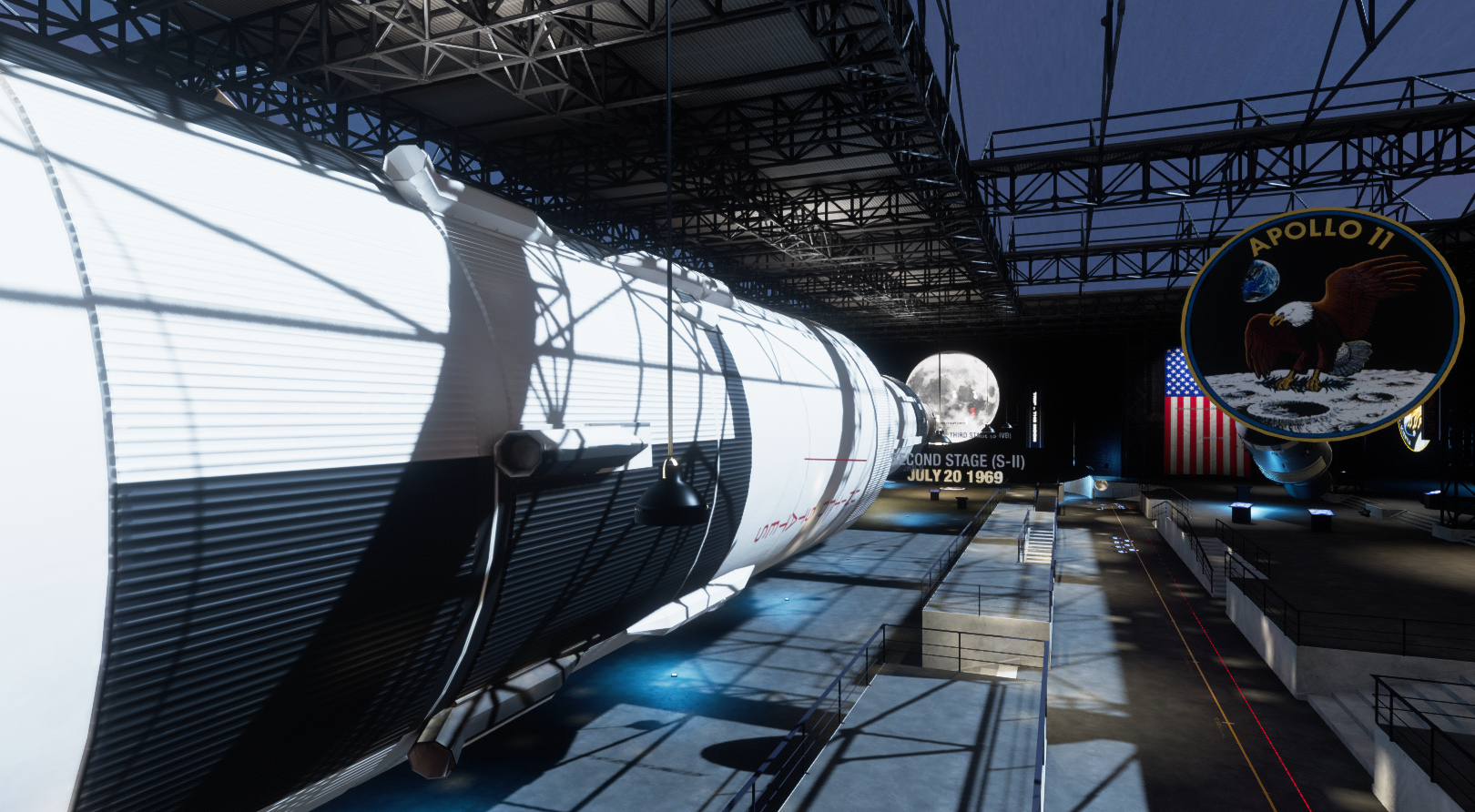
The Apollo Museum remains one of the highlights of Sansar (if first wrote about it back in 2017). Developed by Sansar Studios, Loot Interactive and NASA, it reproduces the main hall of the Apollo/Saturn V Centre at the Kennedy Space Centre, Florida, to offer visitors a fully interactive guide to the Apollo programme.

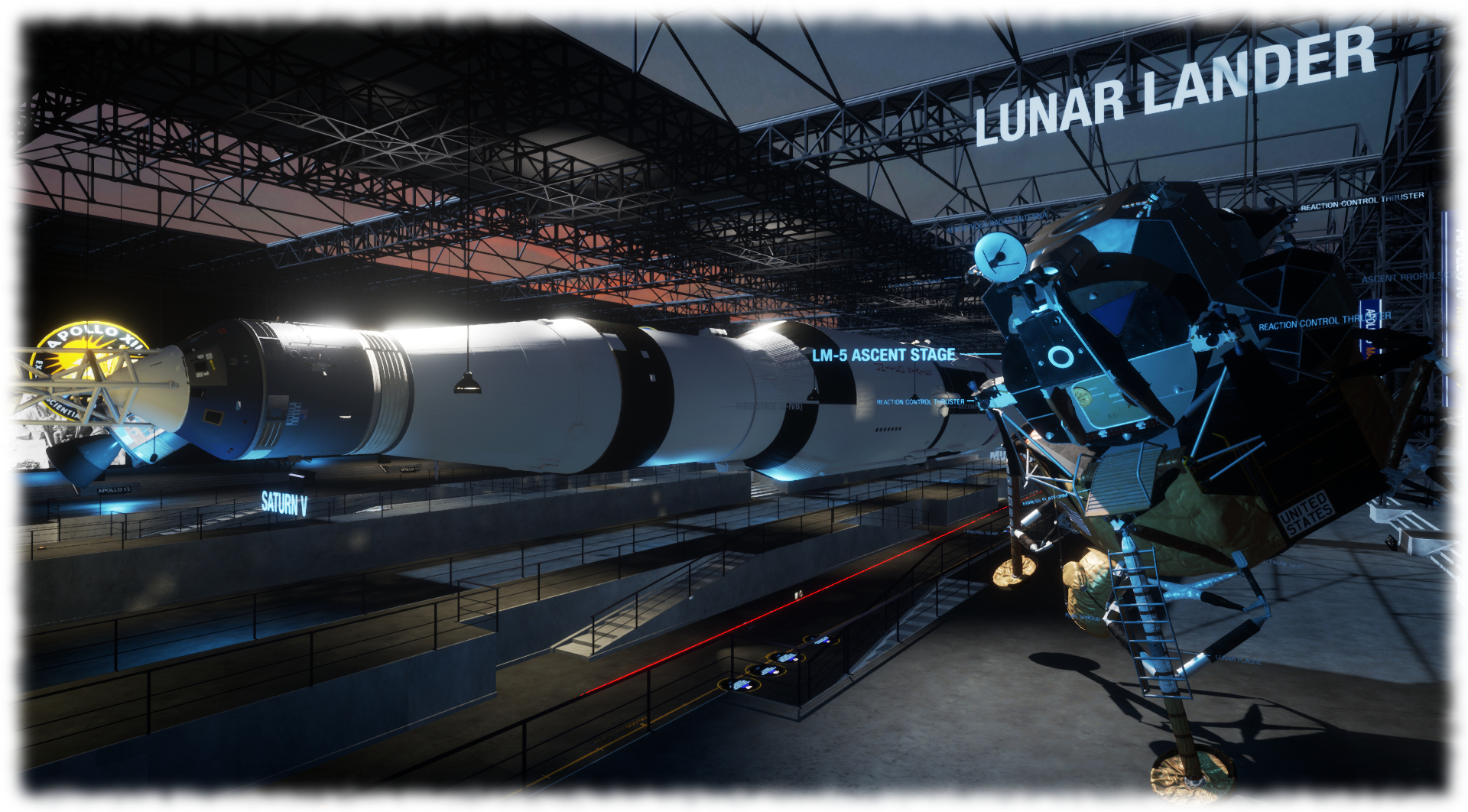
The Apollo Museum: Apollo Lunar Module (r) and Saturn V

Here you can walk the length of a Apollo Saturn V launch vehicle, from the exhaust bells of its five mighty F-1 engines to the tip of the Launch Abort System tower. Along the way, and set out on  time-line, you can re-trace the journey of Aldrin, Armstrong and Collins from the launch of Apollo 11 through to its splashdown 8 days later.

This is done by walking up the left side of the Saturn V, where exquisite models (the Earth and Moon not being to scale admittedly) and photos mark the significant stages of the the mission as they unfolded, culminating in Apollo 11’s arrival at the Moon and Armstrong and Aldrin’s descent to the Moon’s surface. The story then resumes on the other side of the Saturn V’s nose, with the two men ascending back to orbit to link-up with Collins in the Command and Service Module, before charting the trio’s return to Earth and splashdown.

The Apollo Museum: the little models re-creating the flight of Apollo 11, these showing the TDE phase of the mission, when Michael Collins manually flew the Command and Service Module to dock with and extract the Lunar Module from the S-IVB upper stage of the Saturn V

With interactive disks available that play audio relevant audio recordings from the mission, it’s a marvellous way to understand the mission, even if I do have a small quibble with the Lunar Module’s legs being shown unfolded during the flight to the Moon (this was actually only the case with Apollo 13, when the LM was being used as a lifeboat).

Beyond this, on the upper sections of the gallery, are sections devoted to all of the Apollo crewed flights, from the tragedy of Apollo 1 through the triumph of Apollo 11 to the near-disaster of Apollo 13, and thence to the the sounding bell of Apollo 17. These also include interactive panels that will play audio when an avatar stands on them, and are bracketed by a complete model of an Apollo Lunar Module (also referred to as the Lunar Excursion Module, or LEM) and a model of the Apollo 13 Command and Service Module showing the damaged and exposed part of the latter after it had been crippled by an explosion within a liquid oxygen tank.

The Apollo Museum

From a large disk under the Saturn V’s Launch Abort System tower, visitors can jump to Tranquillity Base, the landing area for Apollo 11.

Tranquillity Base

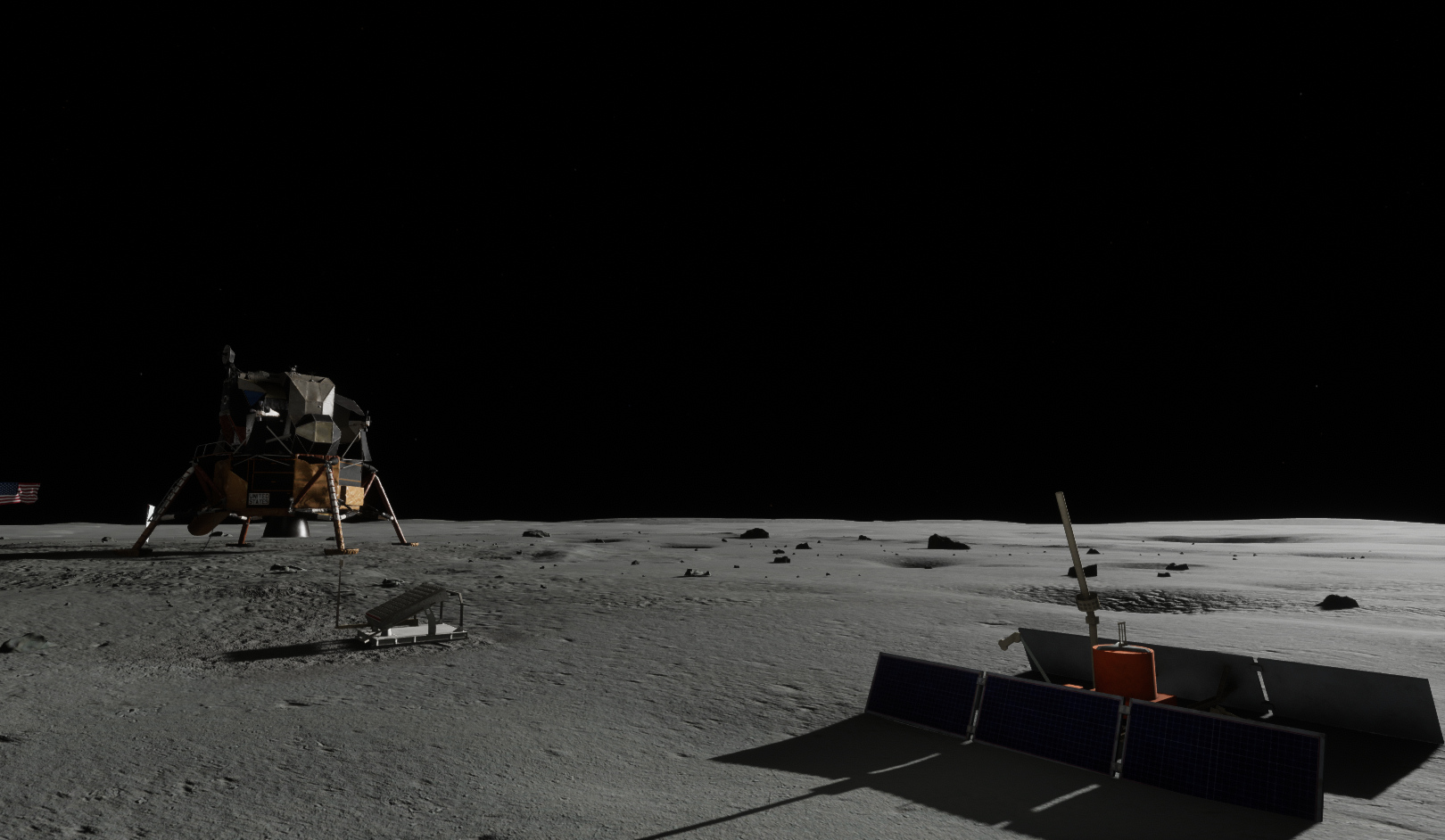
Also by Sansar Studios / Loot Interactive and NASA, Tranquillity Base reproduces the Apollo 11 Lunar Module as it sat on the Moon whilst Armstrong and Aldrin were on the lunar surface. This is a more static display when compared to the Apollo Museum, dominated by the Lunar Module and an overhead display which, when correctly aligned, provides insight into the surface equipment placed out on the lunar surface around the LM.

Visiting the individual elements will trigger playback of audio elements relevant to the science packages, whilst closer to the LM Armstrong’s famous statement on setting foot on the Moon’s surface can be heard.

Tranquillity Base: showing the Apollo 11 lunar Module Eagle in the background. In the middle of the picture is the Laser Ranging Retroreflector (LRRR), designed to gain accurate measurements of the Earth-Moon distance by reflecting lasers shot at it from Earth, and on the right, Passive Seismic Experiment Package designed to record “moonquakes”

And if you want to know how small the Earth looks from the surface of the Moon, be sure to tilt your camera up and around.

In Conclusion

As noted above, there are doubtless numerous other Apollo 11 celebrations – be they exhibits, parties or something else – across SL and other virtual worlds. But these are the ones I wanted to start here during this historic week. I hope you’ll take the time to drop-in and visits them.

SLurl Details

Sansar Product Meetings week #28: more on avatar 2.0 + updates

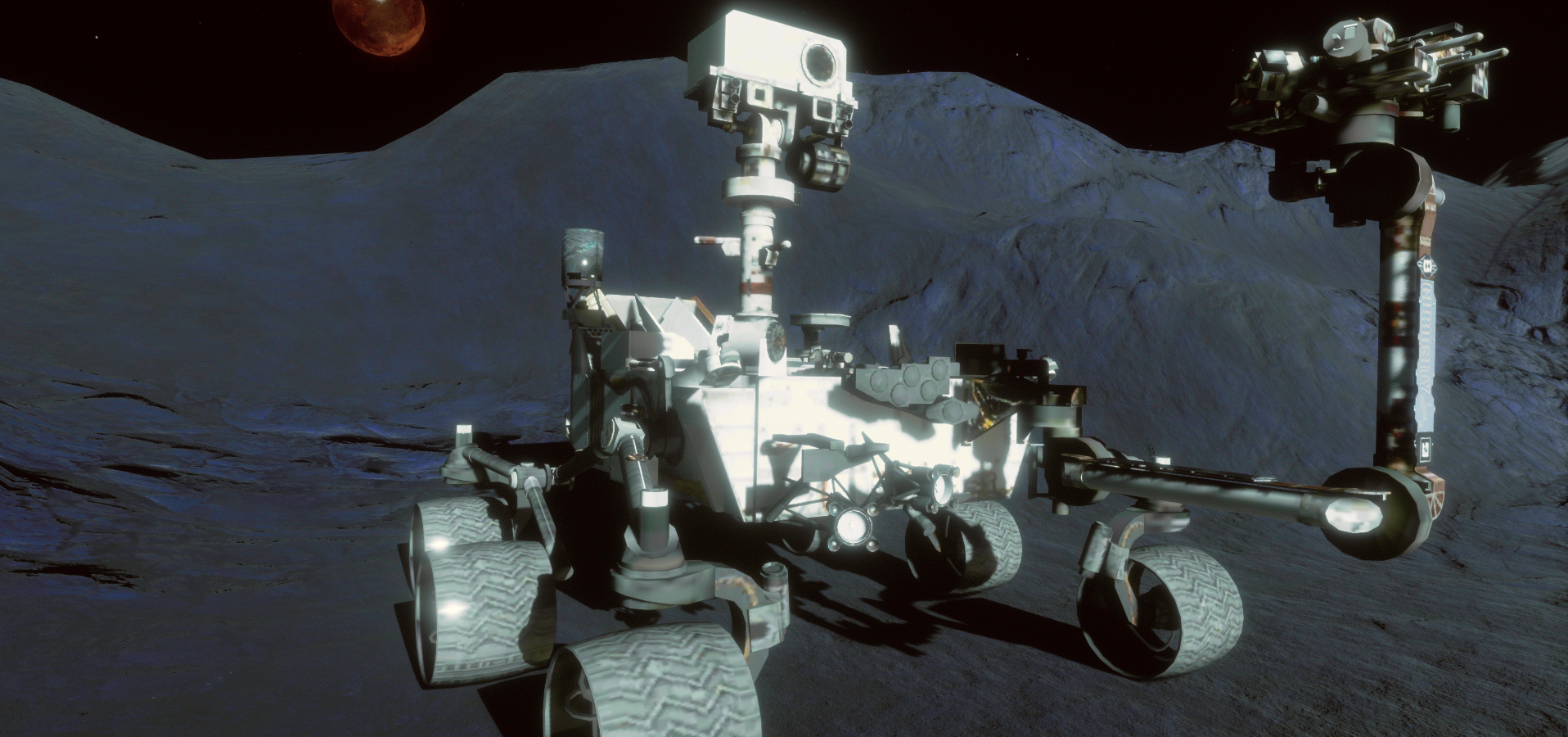
Asteroid Escape – an MSL-class rover

The following notes were taken from my recording of the July 11th (week #28) Product Meeting. Once again, this meeting had a focus on Avatar 2.0 and also on the proposed upgrade path to it for creators.

R34 Release Updates

There have been two further bug fix updates for the R34 A Richer World Release:

(I’m not sure what happened to any Update 4; the numbers jump from 3 to 5).

Official Blog Post on Avatar 2.0

An official blog post outlining the Avatar 2.0 roll-out and its implications was issued on Tuesday, July 9th. This largely repeats what has been indicated in my last few Sansar Product Meeting summaries on Avatar 2.0, and also contains a link to a new Avatar 2.0. FAQ. In particular, this FAQ highlights the following information:

  • What wearable items will not be usable on Avatar 2.0? Any asset (avatars, rigged hair, rigged clothing) created using the avatar 1.0 avatar skeleton will no longer be usable in the new avatar 2.0 system. These items will be removed from inventories, and deprecated on the Store.
  • Why will these items no longer work? Changes to the base avatar’s skeletal structure had to be made in order to support Avatar 2.0 mean they will no longer work as expected.
  • Will it be possible for creators to update broken content? Yes, providing it has been listed on the Store – see below for more. 
  • Which avatar 1.0 assets should still work after the release of Avatar 2.0? All Marvelous Designer clothing, accessories and emotes created against the 1.0 avatar skeleton will have mechanism in place to help ensure they can still be used with Avatar 2.0, and will still be available via inventory and any listed items will still be accessible from the Store for purchase.

Updating Avatar Wearables

Deprecating  Old Content Listings and Updating Them

  • When Avatar 2.0 is deployed. the non-usable wearable defined above that are on the Sansar Store will be deprecated by the Lab, leaving the listings visible, but will not be modifiable.
    • However, items that have been uploaded but never listed will effectively be “hidden”, and will not show up in inventory searches.
  • It will be possible to update deprecated listings by associating them with replacement items in the character editor – but this can only be done once per item. The old item will then be unlisted.
  • Documentation on the update process will be made available around the time of the Avatar 2.0 deployment.

Updating MD Clothing, Accessories, and Emotes

  • Updating these items will follow the same process as deprecated items, except the Store listings are never deprecated.

Single Update Process Explained

  • The reason for the one-time update process on deprecated items is that the licensing system has yet to be properly hooked-up to the avatar system, so this is a temporary solution.
  • The Lab is working in parallel to extend the update system so users can make use of it and not be restricted to the one-time update. It’s not currently clear how long this will take to implement.
  • This  “full” system will also provide the means to update scene content items as well, and items with components from more than one creator, etc. This will likely be rolled out in phases of increasing capability.
  • So the one-time update for Avatar wearables might be considered a stepping stone towards a full update system (although that’s not its primary purpose).

Q&A

The following is a selection of the questions asked in the meeting.

Avatar 2.0 Related

Please also refer to the official blog post (link above), and my previous Sansar Product Meeting summaries for further information on Avatar 2.0, as some of the questions asked during this meeting have been previously covered, and are not repeated here.

  • Will Avatar 2.0 support custom skeletons? Not initially, but longer term, yes.
    • One of the issues in allowing this to happen, is putting in place a mechanism to determine what wearables might be used by different skeletons.
    • Sansar would also like – again, long-term – to support an Animesh-like system where attachments can have their own skeletons that can be used to extend the Avatar 2.0 skeleton (e.g. the hindquarters, body and tail of a centaur that can be added to the Avatar 2.0 skeleton).
  • Will it be possible to create custom avatars using the Avatar 2.0 skeleton? Yes.
  • Will it be possible to create custom heads / faces without having to create complete custom avatars? Yes. face presets should allow this, together with the additional custom texturing capabilities that will follow the initial release of avatar 2.0.
  • When will custom texturing be available? Hopefully, a couple of releases after the initial Avatar 2.0 release. The texturing releases will most likely be:
    • Initial Avatar 2.0 will support skin swapping, using supplied skins.
    • Custom skin texture support (around 2 releases after initial Avatar 2.0 release).
    • At some point thereafter a full texture layering system (make-up, tattoos, etc) for default and custom avatars.
  • Does the phased release of Avatar 2.0 mean there might be further content breakages? No. The breakage caused by the switch from Avatar 1.0 to Avatar 2.0 is a one-time only breakage.
  • Will Avatar 2.0 heavier to render? No, it shouldn’t be: tri count, skinning, etc., should all be about the same, the skeleton has been simplified. If anything, it should be slightly lighter on systems.

General

  • Users working in Sansars Edit Mode are not counted in the currency / user numbers for the platform. Could this be addressed?  Probably something that should be looked at.
  • Can there be a “global” text chat open that allows users in different experiences to chat with one another if they wish, regardless of whether they have friended or not? Being considered, but may not be fully on the roadmap as yet.
  • A.O. Systems: the Lab is looking at providing animators with a means to override the basic Avatar 2.0 animation: walk, run, crouch, idle, etc. This  will not be with the release of Avatar 2.0, but something for the future, as it involves a lot of work.
    • For picking up objects – guns, swords, etc. – the Lab is looking at a means of embedding the required animation in the object rather than having to make them a part of a core AO system.
    • Active feedback from creator on this subject via Discord, etc., is encouraged.
  • When will 3D mouse systems (e.g. SpaceNavigator) be supported? Not on the roadmap. Liable to be more part of any work undertaken to support joysticks and other controllers, rather than focusing purely on 3D mouse systems.
  • When will there be support for vehicles? Still to be developed, but something LL wants with Sansar.
  • Will it be possible to develop simple layouts in Edit Mode with data to allow basic mesh elements to be easily selected and swapped-out for complex (finished) mesh objects as a part of the build process? Recognised use-case, and something the Lab would like to try to address.
  • Could the upload process be de-coupled from the build process, to prevent work being lost on an upload failure? This would require saving builds locally; a better solution would be to make the upload process more robust to overcome losses due to momentary disconnects.
    • LL is already looking at making the client more resilient to prevent crashes should a disconnect occur, so that data on builds isn’t lost should the client disconnect from the server.
  • Would it be possible to preview object materials in Edit mode without having to preview them after each change as the preview option can take time to load and interrupts workflow? Possibly. Request will be relayed to relevant team.

Sansar update: R34 and avatar 2.0

Creator Academy: Hall of Materials

The following notes combine the June 26th R34 release and aspects of the June 27th (week #26) Product Meeting. I’m a little late in getting to both, in part because of work related to SL16B, and in part because I had been waiting to see if a video from the June 27th Product Meeting will be officially posted.

R34: A Richer World Release

The new inventory filters for clothing

The R34 release, issued on June 26th, 2019. As with the majority of Sansar deployments, this update requires the automatic download and installation of a client update. Compared to other release releases, this was somewhat smaller in scope, offering the following:

New features

  • Gifts are now adjustable in increments of 100, amounts can be entered directly. Gifts are capped at a maximum of 9999 Sansar Dollars each.
  • New filters in the avatar editor that enables users to show male, female or all clothing in the inventory. This allows users to wear male clothing on female avatars and vice versa.

Improvements 

  • Chat improvements – less lag when joining an experience with a long backscroll.
  • More stable voice server connections – less disconnects and more reliable reconnects to the voice server.
  • Avatar broadcasting performance improvements – Better broadcasting behaviour for streaming performers and dealing with broadcast instance crashes.

In addition, the release included script updates and stability improvements – these are documented in the official release notes for R34.

Two additional updates to the release have since been issued:

  • The first, issued on June 28th, comprises bug fixes and a new script example, HintText.cs, available in the Scene Script Library. Details are again in the release notes.
  • The second (labelled “updates 2 and 3”), issued on July 3rd, included additional new features:
    • New support for the Valve Index controllers (although note that Sansar does not support the Valve Index headset).
    • A new Memo feature on the My Experience panel allows creators to write and view notes for each of the experiences they own.
    • The People panel has been updated so that the block/unblock and muting features can be more easily accessed. Some inactive buttons have also been removed.
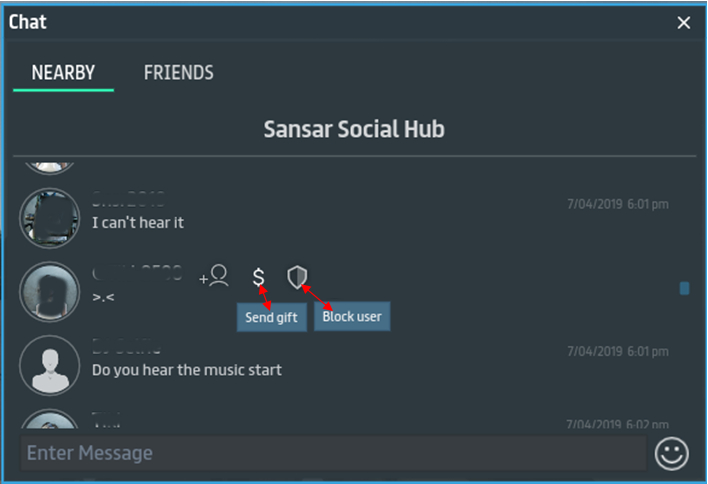
    • The Chat panel has been updated to allow gifts to be send via it, and other users to be blocked/unblocked.
    • New script API for per user gravity factor, which allows scripts to define the gravity factor for individual users.
    • See the update release notes for full details, including fixed issues.
The new chat options for gifting and blocking / unblocking

Avatar 2.0

As I’ve previously reported, the new Sansar Avatar 2.0 is planned for release in September 2019 (see Sansar Product Meetings week #24: more on Avatar 2.0). During the June 27th Product Meeting, the Sansar team unveiled a video showing a “first look” of manipulating the new avatar face using the bone deformation capabilities with the upcoming new avatar system.

The video was (briefly) posted to You Tube, but then taken down while the Lab “decided what to do with it”. I contacted the Sansar Community Manager, Galileo, to ask if a capture from the meeting could be posted, and received a “should be OK” reply.

The video demonstrates the ability to manually adjust the features on the avatar through a touch interface that allows fine tuning of adjustments. For those used to having sliders to adjust features, as with Second Life, the approach taken with Sansar may appear a little odd. However, the full system, when ready for release will also include some sliders to allow for blend morphing.

The overall feedback from those watching the video appeared positive, with Lab staff noting that the approach should allow a highly diverse range of avatars to be created once Avatar 2.0 is released, and the skin texturing / layering system (still being worked on as well, and not shown in the video) should add to this, allows different skin tones, make-up finishes, freckles, wrinkles, tattoos, etc.

Avatar 2.0 Points of Discussion Raised at the Meeting

Please also refer to the week #24 meeting notes, as they bullet-point much of the Avatar 2.0 discussion that formed part of this meeting.

  • Avatar 2.0 will have around 30% less bones that the current avatar, which should simplify skinning to it. The face should have around 50% fewer bones (140 to 70).
  • A more neutral avatar mesh to better support deformation.
  • The skin texturing / layering system may not be part of the initial release, but will follow-on.
  • Bone deformation will only be for the face in the first release of Avatar 2.0, but will be extended in subsequent releases.
  • Avatar expressions available with the current avatar will still work with Avatar 2.0.
  • Mouth movement should also continue to work a seen today, and there is a be a refresh of the mouth / voice animations.
  • There will also be a refresh of the avatar IK system with Avatar 2.0.
  • The system includes a face preset feature that allows users to adjust their avatar’s face using the bone deformation feature and the blend morph sliders and then save the results, allowing them to be used with different avatar bodies.
    • While not in the first release, Avatar 2.0 will include the option for people to create and sell faces on the Sansar Store.
  • It is still planned to release the Avatar 2.0 reference files in August 2019, to allow creators to gain familiarity with the new skeleton ahead of support being deployed to Sansar, and to start updating those items they make / sell that require adjustment / re-rigging to work with Avatar 2.0.
    • As a part of this, the Lab will be running a Creator Programme,  to help creators to develop assets (avatar, rigged items for avatars, etc., and pass them for testing and feedback by the Lab.
    • Details on how to be a part of this programme will be issue by the Lab via e-mail in the near future.
  • Avatar 2.0 may support asymmetric faces. The ability is there, but the Lab hasn’t decided if / when the button to enable it will be toggled. This will in part be governed by feedback from users after Avatar 2.0 has been deployed.

In Brief

  • The Lab is working to extend blend shape support to custom avatars, and the importing of pre-morphed skeletons that can be used with the sliders.
  • The ability to give other avatars items will probably also be released around the time of Avatar 2.0 appearing, and will use the quest system to enable it.
  • Item update mechanism for the Sansar Store  – this is still being working on, and will most likely follow “a couple of releases” after Avatar 2.0.
  • Push-to-talk on the microphone has oft been requested, but not currently on the roadmap.

Sansar Product Meetings week #25: sustainability + feedback

Animal Sanctuary (WIP)

The following notes were taken from the Sansar Product Meeting held on Thursday, June 20th, with the opportunity for creators and users to offer feedback on Sansar (official video here). Note that not all items raised in the meeting are recorded here; I have restricted this summary to questions that drew detailed responses / issues that multiple creators are seeing as pain-points / questions or requests that have come up in other meetings but may not have previously been reflected in my Sansar summaries.

Sansar Sustainability

It’s now almost two years since Sansar opened its doors to the public, and general user concurrency is still only in or around the mid-20s level. This has raised questions of Sansar’s sustainability, and whether the Lab have set any goals for the platform that need to be achieved in order for it to be continued, etc.

Landon McDowell, the Lab’s Chief Product Officer, and the person most directly in charge of Sansar’s development, responded thus to one of these questions (audio also included):

I am not going to put any date on the board. I think we’re taking this day-by-day, week-by-week, month-by-month, release-by-release, and we want to see what is happening and what is resonating and what isn’t … I believe steadfastly in the future of virtual worlds, that what we’re doing here is really important … Are we happy with the result? I’m not happy with the result; I would want a million people in here today, and we’re obviously not there.

But in terms of sustainability, I think we know what our limits are, and we are proceeding accordingly. If we have 50 people in here in a year then yeah, I’m going to be really massively disappointed. I think everybody here is working hard to make this an absolutely monumental success … I feel that everyone that’s here is here because they’re digging something about what we’re doing, and I want that to spread like wildfire quite frankly. So we definitely have hopes and ambitions.

But again, I’m not going to put a dot on the board of, “this date and this time, this number of users”. I think we want many more users in, and we want them relatively quickly, and we go from there.

Experiences

As recorded in some of my previous Sansar Product Meeting summaries, the events system has changed recently so that events are held in copies of a published experience that are spawned when event is created in the events system. This has given rise to a number of issues including:

  • Where the event is being based on a public experience (rather than one built specifically for the event), the experience creator must update and publish the existing experience. This means:
    • People can access the event space ahead of the event itself via the published version of the experience, thus potential spoiling the surprise.
    • Creators often make incremental changes to the scene for a published experience in Edit Mode without necessarily updating the experience itself by publishing them. This allows ideas (such as different lighting, etc) to be experimented with, without them necessarily published. However, to hold an event using a published experience, all such updates must be completed (or removed) ready for the event version of the experience to be spawned, potentially adding to the overhead of running events.
    • As event instances of an experience are separate from the original and effectively locked against “casual” admittance ahead of the event (including, say, a performer at the event), it is not easy for changes requested by a performer (e.g. a change of lighting, repositioning of an item of a stage, etc.), to be made and reviewed by the performer.
    • A lack of “event permissions” can impede event management, as it effectively means that events more-or-less must be organised, managed and run by experience owners, which again can put them off running events.
  • Where an experience is being used to host multiple events during a week / month (as per 114 Harvest), multiple versions of the experience can be spawned without clear differentiation between them within Sansar’s Edit mode. This means it is possible to actually update a clone of the experience in error when preparing for a new event, only to have the updates ignored when the event is created, because the event system, as noted, spawns from the original version of the experience (which will not have the updates).
  • As the event version of an experience is separate to the published version, all traffic generated by the former does not help raise the profile of the latter within the Atlas. Therefore, experience creators often don’t see the advantage in hosting events.
    • This lack of traffic reporting can also influence whether or not people log-in to Sansar. An event might well attract 40-50+ people to it – but as this traffic isn’t reflected in the Atlas, a casual glance at the latter via the web might give the impression “nothing is happening” in Sasar, and so a user doesn’t log-in.
  • The broadcasting system (allowing an avatar in one instance of an experience to be seen and heard across all instances of that experience) can actually result in an event performer feeling they are playing to an “empty house”. The “master” version of the experience is full by the time they arrive, so they get spun-off into an instance that might only have (say) 3 or 4 people in it. Thus, while they may well be performing in front of an audience of dozens who can see them, they are only able to see those few in the same instance with them.

LL have indicated they have experienced these issues for themselves, and are working to try to address most / all of them.

Avatar 2.0

Concern has been raised about the overall impact of the Avatar 2.0 deployment (due in September 2019) on the general Sansar users base (e.g. those who don’t attend in-world meetings, etc.). specifically: reactions should users log-in and find their custom avatars “broken”.

LL are planning an announcement campaign via social media, e-mail, etc., to advise users of the changes ahead of the Avatar 2.0 deployment.

In Brief

  • Valve index controllers / finger tracking support: this is not seen as a major project in terms of integration, but will require some work. As such, the Lab is not currently planning on supporting the index controllers from day one of their release.
  • Oculus Quest support: as has been previously indicated, this is not currently on the cards. The Quest processor and general capabilities are seen as being unable to handle to quality of content LL want to provide without massive amounts of auto-decimation, which can be problematic. However, as the capabilities of emerging VR systems continues to improve and Sansar improves in terms of performance limits, the hope is that the two will converge at some point in the future.
  • Motion sickness: there are reports that Sansar induces higher levels of nausea when turning while moving in VR. Such nausea is generally related not so much to the speed of a turn, but its length – hence why snap-turns are becoming more popular in VR., although the Lab has yet to adopt this approach in Sansar. Dance spotting might help reduce symptoms, although the reverse of this was suggested in the meeting: move the head first, then make the turn (and this might be easier if you can turn your head, then “spot” an object and turn your avatar).
  • Site-to-site teleports between experiences: currently, it is not possible to employ site-to-site teleports between experiences. For example: arrive as a door in one experience and get teleported by it to the interior of a building in another experience, then being retuned to standing outside the door again when you “leave” the building – instead, you will be returned to the spawn point in the first experience. This can be immersion-breaking in something like a quest or adventure game. The Lab has acknowledged this as something that should be addressed.
  • Animation objects: the ability to have in-scene objects proved / control avatar animations (e.g. SL-style dance systems). This is not on the current roadmap for implementation, but it something the Lab want to provide in the future.
  • Snapshot / Machinima policy: currently, Sansar does not have a policy relating to the taking / use of images or film captured in Sansar, other than the permission of the experience creator should be sought – and they have the right to ask LL to remove images of their experiences uploaded to the Lab’s Sansar properties.
    • Given that experiences in Sansar differ from those in SL (an entire experience in Sansar, including all the objects within it is generally built by an individual or perhaps a couple of people working in unison, rather than the content coming from a wide variety of creators, as tend to be the case with SL), putting the onus on the experience creator is in some way understandable / relatively easy to manage – the entire experience is, after all, their IP.
    • However, this will not always be the case, and at some point a more structured policy – such as the one used with SL – is likely to be required.
    • This is obviously seen as a matter for the Lab’s legal team.
  • Sansar website: feedback was given that the Sansar website is perhaps under-utilised. There is no real blog, no news information, etc. Instead, people are directed to Discord which, frankly, is a painful means of disseminating news and information when compared to a website, as was noted in the session.

Sansar Product Meetings week #24: more on Avatar 2.0

Sansar Social Hub

The majority of the following notes were taken from my recording of the Sansar Product Meeting held on Thursday, June 13th, which primarily focused on the upcoming Avatar 2.0 release. The official video of the meeting is embedded at the end of this article.

R33 Update

A third R33 Give More, Get More update was deployed on June 11th. This comprises:

  • A new ability to copy and paste components within the “Object Structure” panel – creators can copy and paste audio, light, and script components in the ‘Object Structure’ panel via the right-click context menu. Components may be pasted within an object, or into another object.
  • A fix to prevent crashing when editing scenes that have objects with joints.

Avatar 2.0

Target Release Periods

  • The target date for the initial Avatar 2.0 update is early September 2019.
  • It is hoped that the Avatar 2.0 reference files will be available for release to creators in early August 2019
    • This is to allow creators to gain familiarity with the new skeleton ahead of support being deployed to Sansar, and to start updating those items they make / sell that require adjustment / re-rigging to work with Avatar 2.0.
    • As a part of this, the Lab will be running a Creator Programme, this will:
      • Allow creators to develop assets (avatar, rigged items for avatars, etc., and pass them to linden Lab for testing in an environment the Lab has that support Avatar 2.0, then allow creators to receive feedback on their assets: did they work, were there problems, did things not fit as expected, do adjustments need to be made, etc.
      • Be open to all interested creators, and details on how to participate will be made available when the avatar reference files are released.
      • It is noted that this may not be as effective as creators testing their items directly; however, as there is no public beta testing environment, there is no real alternative.

General Notes

  • This is both a new avatar skeleton and mesh. As noted in my previous meeting notes, this will support:
    • Bone deformation, allowing the avatar’s face to be directly selected and shaped / contoured / scaled as the user wants (default avatars only with the initial release, but will hopefully be extended to support custom avatars in later releases.
      • Facial presets will be a part of this, allowing users to make adjustments to their avatar’s face from a pre-set look.
      • These presets will extend to allowing creators to make and sell their own facial presets.
    • Blend shapes (initially just for the base avatar, but hopefully to be extended to support custom avatars).
    • Support for uploading and using custom skins for the base avatar.
  • A large part of the reasons behind the update are: to support bone deformation; to make the avatar more expressive, and to allow users to give their avatars more in the way of individuals looks.
  • Avatar 2.0 has:
    • A skeleton with 170 bones (compared to the 230 for Avatar 1.0), which should simplify skinning to it.
    • Bone-based facial deformation (rather than blend shapes) to better support both facial deformation and to support attachments that will correctly move in response to changes to the facial bone structure.
    • A more neutral avatar mesh to better support deformation.
    • A set of skeletons, from “complex” to “simple”, to make it easier to develop custom avatars (if you have an avatar design that doesn’t require all 170 bones, use one of the simpler versions).
  • It is acknowledged Avatar 2.0 represents a substantial change (particularly the male avatar).
  • Both the male and female default avatars will be of the same shoulder height (but obviously this can be adjusted through the uniform scaling option).
  • The overall aims for Avatar 2.0 is to provide an avatar system that:
    • Meets requirements as expressed by creators, and which forms a solid foundation for all future avatar enhancements / updates without having to completely overhaul the entire avatar system again.
    • Can be used to develop avatars using the default avatars which can in turn be solid through the Sansar Store.
    • Can be used to create wholly custom avatars.
  • Avatar 2.0 sees a re-working of the procedural speech animations and some IK reworking, both of which should result in improvements in animations and VR-related movements during body tracking.

Avatar 1.0 and Avatar 2.0

  • The Lab will not continue with supporting Avatar 1.0 when the new avatar is deployed.
  • Rigged objects (hair, clothes) designed for Avatar 1.0 will need to be re-rigged for Avatar 2.0.
  • There will be little in the way of bone matching between Avatar 1.0 and Avatar 2.0 (although creators can obviously do re-mapping through their own tools, if they wish, allowing for the potential of texture stretching).
  • As recorded in my previous meeting notes:
    • The Lab has been working on Marvelous Designer scaling and translation. This, together with a clothing translation tool LL are working on, should allow MD clothing to be more easily updated to fit the new avatar skeleton. However, some of this may be limited due to the fact that MD only support uniform scaling.
    • Run-time re-targeting in being introduced to allow animations and emotes using the core bones should work with Avatar 2.0.
      • Very specific custom animations may require the creator to re-target.
    • Similarly, a re-mapping capability for attachments is being looked at, primarily aimed at allowing attachments to be moved between attach points, but which may also ease some of the transition to the new skeleton.
  • Compensation / redelivery: it has been intimated:
    • Those who have purchased custom avatars / rigged items using the current avatar may receive some form of refund / stipend from the Lab in lieu of no longer being able to use those avatars.
    • Some form of update system will be made available to creators to allow them to make updates to items they’ve made specific to the current avatar to work with Avatar 2.0, and notify customers the update is available.

Capabilities Release Order

  • Lab’s first priority is to get Avatar 2.0 working smoothly enough for an initial release, which will support facial deformation.
  • Open things to allow texture (e.g. skin) uploads that can be applied to the base avatar (providing skin uploads for custom avatars is regarded as a harder option to support, due to the need to support custom UV maps).
  • Then extend support to full body bone deformation etc.

Custom Avatar Skeleton Pre-Morphing

This is a “would like to have” from the Lab. The idea is that for custom avatars with unusual both shapes (e.g. a gorilla with longer arms, shorter legs and a tapered torso), the skeleton can be morphed and skinned through Maya (or other tool), thus avoiding the need to additional UV work to avoid stretched textures when users adjust the avatar. The morphed skeleton (and skin) can then be uploaded into Sansar and run-time animation re-targeting can be used to ensure the default animations / emotes work with it.

Ultimately, the Lab would like to get to the point of supporting fully customised animations / locomotion graphs, but this is still a way off, and this is seen as a good initial step to help better support custom avatars.