An actual look inside Project Sansar

Project Sansar image via Linden Lab

The end of April was a busy time for the Lab, with Ebbe Altberg leading a team to both the  Collision 2016 tech conference (billed as the “anti-CES”) in New Orleans, which ran from April 26th through 28th, quickly followed by the 2016 Silicon Valley Virtual Reality (SVVR) conference, which took place at the San Jose, California, conference centre between April 27th and 29th.

At both events, Ebbe Altberg gave a presentation which included further images and some video shots from within Sansar, and Collision 2016 has now made these available for viewing within a recording of Ebbe’s presentation which can be found on YouTube, and is embedded below.

As the Collision event is more general tech than VR specific, the first part of the video is more about the potential of VR and the possible VR / AR marketplace in the future. A lot that is familiar to SL users is mentioned, such as the use of immersive spaces for social activities and the potential VR has in areas such as education, design, business, healthcare (the use of Second Life in helping PTSD sufferers is touched upon, something I covered back in June 2014).

For those wishing to cut to the chase, the Project Sansar discussion starts at the 8:18 point in the Collision video.

[05:52] The Sorbonne University and the Egyptian Ministry of Antiquities worked with Insight Digital to produce a 3D model of an ancient tomb based on digital photography and laser scanners. The initial 50 million polygon model, which the Lab were able to publish through Sansar as an optimised 40,000 polygon model visitors to the experience could visit and interact with and within
[09:52] The Sorbonne University and Insight Digital supplied a 50 million polygon model of an ancient Egyptian tomb created as a part of a project for the Egyptian Ministry of Antiquities. This was optimised as a 40,000 model in Project Sansar people can enter and explore
In brief, this part of the presentation:

  • Reveals the Lab is now employing around 75 people in RD on Project Sansar (High Fidelity, as a simple comparison, has around 25-30 staff)
  • Indicates the broad base of creators and “content partners” invited into the initial platform testing which started in August 2015 is revealed – such as the Sorbonne University / Insight Digital (see above)
  • We get to see both the editing environment and the runtime environment elements of Project Sansar (remembering that the actual editing / layout mode of Sansar is quite separate from the runtime environment where users actually engage with one another once experiences have been “published” to it)
Jason manipulates assets using the HTC Vive hand controllers within Sansar's edit mode whilst building the Mars scene seen in previous Sansat promotional shots
[11:17] Jason manipulates assets using the HTC Vive hand controllers within Sansar’s edit mode whilst building the Mars scene seen in previous Sansar promotional shots
  • Reiterates that in using the term “creator”, the Lab isn’t necessarily just referring to content creators as might be the case within SL. Rather the term also encompasses those who purchase original content within the platform and use it to create their scenes and spaces. It is ease-of-use for this broader class of creator that the Lab is currently addressing when it comes to ease-of-use within the platform.

I’m actually curious to know more about the edit mode / runtime split. For example, can an experience still be accessed by others while it is being edited, in the same way a WordPress (to use the Lab’s analogy) page can still be viewed and read by others? If so, what happens when an update for an experience is published?

The video show Project Sansar’s runtime environment commences at the 12:38 mark.

In particular, this reveals a number of locations – including the Mars scene, the Golden Gate seen previously in Project Sansar promo shots, and a camera trip into the ancient Egyptian tomb mentioned above.

The Sansar clips open with a reasonable-looking avatar walking across the office / excavation space
The Sansar clips open with a reasonable-looking avatar walking across a complex built around the Villa Ortli excavation in the Crimea – a model selected from on-line, or another joint project?

My own observations from these video clips are that:

  • Project Sansar potentially has a higher level of polish within the runtime environment than High Fidelity has thus far shown
  • In there appearance, Project Sansar avatars are at least as good as the more advanced avatars currently found within High Fidelity and certainly more immersively attractive than the more recent iterations of the Altspace VR avatars
  • It will be interesting to see how dynamic things like day / night cycles and weather are / will be handled be Project Sansar.
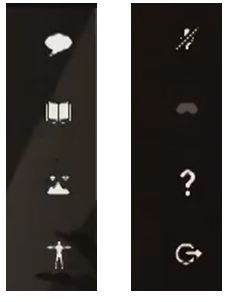
The UI icons in the video clips

The video includes some hints at the client UI – remember it is still very much a work-in-progress, so there are likely to be many changes.

As it stands, the buttons are ranged against the right side of the screen, in two groups of four, top and bottom, and shown on the right.

Some of these appear reasonably obvious: the landform / terraform tool and Avatar tool at the bottom of the first group of icons, and microphone, help and exit  / log-off options in the second group of four.

Doubtless the range of buttons and options available will increase  / grow more sophisticated as the UI continues to develop. The current set would appear to simply address the current level of capabilities within the platform at present.

The Lab is apparently still considering whether or not to make the video footage of Sansar more generally available. I’m tending to assume given the overall tone and presentation of the runtime footage, complete with music, that it was put together as a potential promo piece, rather than just a video to show at presentations. So hopefully it will make a broader appearance when the Lab judge the time to be right.

Sansar : some hints at options for revenue generation

Project Sansar image via Linden Lab

Update, May 5th: As indicated by Pete Linden, the Lab’s Director of Communications, in the comments following this piece, the write of the the TCP project article appears to have got his wires crossed in reference to user-to-user transactions and the Lab’s revenue model for Sansar, which has in turn lead my speculations astray in the possible levels of commissions. I’ve now revised the piece to focus on the elements directly related to Ebbe’s comments on other revenue models under consideration.

One of the areas of interest with Project Sansar is how Linden Lab will generate revenue from the platform, given their intention to pivot strongly away from the and land model which has proven so constraining within Second Life.

During assorted presentations at the Virtual Worlds Best Practice in Education conferences, Lab Chat sessions, and in talking to the media, Ebbe Altberg has made it clear that one of the ways in which the Lab intend to more broadly generate revenue from Project Sansar is through a “sales tax” (commission) on the sale of goods and content within the platform.

While no specifics of the possible commission rate(s) has been given, the idea has caused some concern among original content creators as to how much such charges might be and how they’ll be applied. However, in order to be sustainable, Sansar will need other means of revenue generation, something which has caused some speculation in various circles as to what other means the Lab might use. The Lab itself has, until recently, been quiet on the matter. Then, on April 29th, two items caught my attention, offering as they do further hints on the Lab’s thinking.

The first came through a piece penned by D.J. Pangborn, and which appeared in the April 29th edition of The Creator Project (TCP). Entitled Peek Inside Second Life’s Virtual Reality Successor, ‘Project Sansar’, the article doesn’t really offer much that was new it terms of news about Project Sansar for those who have been tracking things, despite its title; but it does include a little snippet which caused my eyebrow to rise when I read it:

As for the monetization of experiences in Sansar, Linden Lab will collect most of their revenues from charging for virtual services, not from renting land. Altberg says they plan to take very little from the user-to-user economy.

The emphasis is mine, but I found these particular parts of the statement interesting for two reasons. The one on taking “very little” from the user-to-user economy suggests that the Lab are looking to keep any “sales tax” / commission on content sales to a minimum. (See the update note at the top of this article / Pete Linden’s comment below).

The idea of the Lab collecting revenues from charging for virtual services suggests they are considering an approach a little similar to that put forward by High Fidelity – revenue can be drawn from services associated with Project Sansar. Obviously, this would likely include fees for virtual currency handling a-la Second Life, but what else?

Sansar Mars landscape (via Linden Lab)

Speaking to Draxtor Despres for show #114 of The Drax Files Radio Hour, which also appeared on April 29th, the same day, Ebbe Altberg indicated some of the additional ways in which the Lab is thinking of raising revenue through Sansar, starting at the 19:30 mark into the recording. While no fees / percentages were given, the options under consideration (and there could well be more the Lab is thinking about) are defined as:

  • Via fees associated with the resources used, e.g. paying for the experiences published through the platform people can visit
  • Via a commission on in-world sales (currently for Second Life, the Lab only charges a direct commission for Marketplace sales)
  • Through a series of subscription options for users / customers, possibly based on resource usage – capabilities used, size of inventories, hoe many experiences can be published, what kind of privacy controls are provided, etc.

The last idea is based on the view that in order to solve for specific requirements from certain customers, the Lab will likely have to develop very specific tools and capabilities – which those same customers would be willing to pay to access.

While the idea of paying for capabilities might not sit well with those of us using Second Life, given some of the markets the Lab appear to have in mind for Project Sansar, the idea actually isn’t too much of a stretch. Companies and organisations are often willing to pay a little extra for what they feel is a more “tailored” offering.

However, none of the above means that the Lab is abandoning the free-to-play approach entirely. As Ebbe states in the interview, “but at the same time, anyone should be able to come in for free and consume any experience any experience they have access to, whether it’s a private experience or a public experience, that someone has given them access right to. They should be able to come in for free and participate.”

It’ll certainly be interesting to see if / how these ideas develop, precisely what fees / percentages the Lab is considering on the sale of goods, , and what else might emerge as a possible option for revenue generation (price per instance of an experience, for example?).

Project Sansar: applications open for “creator preview”

Project Sansar image via Linden Lab

On Tuesday, April 26th, Linden Lab announced the opening of applications for creators wishing to access their next generation virtual experiences platform, “Project Sansar”.

The press release on the announcement reads in part:

New Platform Enables User-Created Social VR Experiences

SAN FRANCISCO – April 26, 2016 – Linden Lab®, the creators of Second Life®, today announced that applications have opened for an upcoming “Creator Preview” for Project SansarTM, the new platform for user-created social VR experiences. Interested 3D content creators can now apply at ProjectSansar.com and accepted applicants will begin to receive invitations later this summer.

Slated for general availability at the end of 2016, Project Sansar will democratize virtual reality as a creative medium. It will empower people to easily create, share, and ultimately monetize their own interactive social experiences that can be enjoyed in VR with head-mounted displays like the Oculus Rift and HTC Vive, as well as via PCs and, later, mobile devices. The platform enables professional-level quality and performance with exceptional visual fidelity, 3D audio, and physics simulation, while also solving the complex engineering challenges that have previously limited creating and publishing social VR experiences to just sophisticated professionals.

While not entirely VR HMD centric, Project Sansar is being built to leverage the anticipated market for VR HMD-focused social and other experiences

It has been previously indicated by the Lab’s CEO, Ebbe Altberg that access to the new platform will initally be creator-focused, with priority given to those who have ideas / projects which can help Linden Lab further develop and enhance the platform in terms of its initial target audiences, and who are willing to give feedback and provide input to the Lab on exactly how the platform might be improved. This is very much reflected in the on-line application form, not only within its title, but also in the information being sought, focusing on potential market sector reach (e.g. education, commerce, design and architecture, fashion, games, media, health, etc.), and on tools used by applicants for content creation.

Those who are seeking a “sneak peek at Project Sansar will have to continue to wait; however the is an option within the creator sign-up for non-creators to subscribe to receive information updates on the platform by e-mail from the Lab.

Related Links

Additional hat-tip to Whirly Fizzle,

VWBPE 2016: Ebbe Altberg transcript with audio

Ebbe Atlberg, through his alter ego of Ebbe Linden, addresses the VWBPE conference

On Wednesday, March 9th 2016, Linden Lab CEO Ebbe Altberg appeared at the 2016 Virtual Worlds Best Practice in Education conference, where he gave a brief overview of matters pertaining to Second Life and Project Sansar over the course of the year since the last VWBPE conference, and to answer questions about either platform asked by the audience.

The following is a transcript of his session at VWBPE 2016, complete with audio extracts. Note that note all items are given in the order they are discussed in the video of the session. For ease of reference, I’ve split comments and questions between those specific to Second Life and those focused on Project Sansar. Also, where more than one question was asked on a specific topic, I’ve grouped the questions / responses together under a single topic.

The Summary

Click on the links below to go to the relevant section.

Opening Comments

Thank you  so much. Great to be here again; it’s an awesome event, I hope you’ve all have had great sessions and more sessions to come. I will just spend a little bit of time and just talk about what I am and what we here at Linden Lab are really excited about, and what we’re working on a little bit. Then as usual, very happy to spend most of the time actually talking to you with regards to your questions that you may have.

So, first of all, wow! What an incredible year it’s been. The virtual reality market that we’re sort-of been waiting for is actually in the process of happening. We’re now seeing incredible investments from a  very large number of companies, whether it’s hardware, software, platforms tools, that I’m sure many of you are very excited to get your hands on very soon.

We in the Lab have been playing a lot with the latest hardware that’s going to hit the consumer market soon, over the next few months, and doing a lot of work to integrate those into project Sansar, but there’s also work to get some integration of that into Second Life.

So we feel very fortunate to be having all this incredible experience, together with you all, of running Second Life. Having the opportunity to see what works and what doesn’t work, what works really well and what is not working at all, and what it takes to run a platform like Second Life. What makes creators successful, what makes businesses successful, because our primary goal here is to make creators of experiences as successful as they can possibly be, and share their success.

VWBPE 2016
VWBPE 2016

Second Life Overview

Second Life has made a lot of good strides over the last year since we last met. Performance is continually improving, and we have some more performance improvements in the pipeline to come out soon. Quality is improving, stability is improving, and we’ve also managed to roll out some nice improvements. New avatars, and you have the new, better web control or media on prim, that’s now a really modern browser technology, which hopefully will be really helpful for educators.

New Registration API

We also have a lot of interesting things coming in the pipeline. [An] improved registration API, so that it will be easier for institutions to bring on their customers or clients or students in a more pre-configured way: choosing what avatars they can select from, getting them set-up in the proper groups, and taking them through a whole custom on-board experience.

Back to index

Compliance Work

We’ve also done a huge amount of work in what seems boring but is very, very, important to us, and even though you might not realise it, very important to you all as well, which is around compliance, and making sure that all the things we do fiscally within the Second Life virtual economy, and what it takes for people to redeem to fiat currency, US dollars or whichever currency you prefer around the world. We’re doing a huge amount of work to improve all the tools and fraud controls, etc., to make sure we’re running a clean, tight ship where there’s no money laundering or anything of that sort.

We’ve gotten far enough that we’ll be able to soon improve the time it takes for people to redeem money, so we can do that in hopefully just a day or two for most people. We’ve blogged about that, so you might already know about that.

Back to index

The SL Team and Other Things Coming Up

So, I feel really good about the Second Life team. Just a few weeks ago we had the whole team together in Seattle. We keep switching spots; sometimes we do it in Boston and this time we did it near the offices in Seattle. And it’s a very tight group, they are very passionate about Second Life, with Oz heading-up on the engineering side, and just a great, tight crew who really just want the absolute best for Second Life and for you all. So I feel very good with what that team has been able to do over the last year, and what they’ll be able to do in the coming years.

Some cool things coming in addition to the registration API. We have a way for, institutions that have had interruptions of viewer updates when it wasn’t something they were completely prepared for can now sign-up to be on an EDU channel, where we can better manage viewer updates.

We’re working on an update to get the current Oculus viewer working with Second Life, and we’re also working on this Quick Graphics viewer (version 4.0.2.311103 a the time of writing), so that you can manage when people show up in your regions with way too much clothing or too heavy of an avatar and still get good frame rates within your regions if there are avatars that are too heavy.1 Those will all roll out over the next weeks and months.

Back to index

Continue reading “VWBPE 2016: Ebbe Altberg transcript with audio”

Maps as metaphors: Second Life and Sansar

The map is Second Life offers a powerful metaphor for the grid being a contiguous whole, even where private reagions may be remote and physically isolated from their neighbours
The map in Second Life is seen as a powerful metaphor for the grid being a contiguous whole, even where private regions may be remote or physically isolated from their immediate neighbours

Just how important a metaphor is the concept of a “world map” to Project Sansar? Given it has been a topic of discussion in both the first and second instalments of LabChat, and has been given by some as a reason for not wanting to be involved at all in Project Sansar, one might say “very important”; and there is no denying it does have its uses. But is it really as intrinsic to our use of Second Life as has been portrayed, and because it may not exist within Project Sansar in the manner we’re accustomed to seeing in SL, is it really a reason to proclaim we’ve no interest in the Lab’s new platform?

Within LabChat, the discussions on the Map have revolved around two ideas: that without the map, there will be “no sense of community”, and that it gives Second Life a greater sense of presence and of being a place when we’re within it.

I admit that in terms of the map being somehow central to the ideal of community, I find myself in agreement with Ebbe Altberg; that when all is said and done, the world map (and mini-map) don’t hugely contribute to a genuine sense of “community”. Yes, they help us find busy places we might want to visit (or avoid!), or see how busy a venue or store is, etc. But really, this doesn’t add to any feeling of “community” within SL. That comes from the people we meet within those spaces and how they interact with one another and us; how we in turn relate to them; what is going on within those spaces in terms of activities and events, etc. These are the things which are going to bring us into a community, and in that regard, the map really places no larger a role than search; it is simply a means to an end.

Is it really the map which gives SL its sense of community - or is it the people themselves. I'd tend to go with the latter (image: Richard Finkelstein (Leko Littlebird), SLCC 2011)
Is it really the map which gives SL its sense of community – or is it the people themselves? I’d tend to go with the latter (image: Richard Finkelstein (Leko Littlebird), SLCC 2011)

However, the idea that the world map presents Second Life as a place, adding to our sense of presence, is harder to deny. In fact, given that Second Life is intended to be a single world of (largely) interconnected spaces, its representation via a map can be a vital aspect of reinforcing this view. In other words, the map is, for many  – but not necessarily all of us – an intrinsic part of how we see Second Life as a connected whole, a place.

When it comes to Project Sansar, however, things are slightly more complicated. For one thing, it is not designed to be a single “world” in the same manner as Second Life. It’s a platform for hosting multiple “worlds” (“experiences”, “spaces”, “environments”, call them what you will), many of which may well have nothing whatsoever in common with one another – and certainly no way of moving directly from one to another in-world as we can in Second Life. Thus, presenting a single, all-encompassing map of “Sansar spaces” actually makes a lot less sense that it does with Second Life.

Within specific spaces, maps do have enormous value for visitors, so providing the means / support by which experience creators in Sansar can produce them could be of enormous benefit to the platform
While having some kind of over-arching map of all Project Sansar experiences might not be either practical or useful, providing the means by which experience creators can represent their spaces in a map which can be accessed by their users / clients / visitors remains both a useful tool and a powerful means of adding to the sense of presence within a space

Which is not to say the map is entirely redundant for Project Sansar. While some kind of all-encompassing map of “every” Sansar experience might not hold much value, the fact remains that as noted, maps do assist in giving one a greater sense of presence in an environment (as well as being useful for things like navigation!). As such, providing the means for experience creators to provide maps of their environments, and those to which they connect, would appear to be something Project Sansar should provide. In fairness, this isn’t something the Lab has ruled out, as Ebbe Altberg noted in the first Lab Chat:

So, that’s where we’ll start, and then it could be that maybe people create continents, or whatever you want to call it, even worlds, and maybe over time we’ll think about ways in which those can figure out how to have a map of that experience, and those could be vast.

The only caveat I’d have here is the idea that “over time” consideration will be given to enabling people to graphically represent their spaces. As noted, a map does provide a powerful metaphor for giving the environment you’re in a sense of greater presence. It’s also often the best means of showing people what is where, allowing them to see what might be of interest to them, and  – most basically – how to navigate from A to B to C.

Given this, and the fact that there may often be circumstances within Project Sansar where direct “in-world” transfer from one experience to another may not be possible, I’d say that having some kind of all-encompassing “world map” of every available experience within Sansar actually isn’t that important or something we should perhaps get too hung up about. Certainly, it doesn’t seem to be as important as perhaps encouraging the Lab to fully appreciate how useful a tool a map can be to visitors within a specific experience  (or connected group of experiences), and thus provide the means by which experience creators can easily create such maps sooner rather than later.

Sansar: of images and reactions

 Project Sansar (image: Linden Lab)
Project Sansar (image: Linden Lab)

There’s been a lot of reaction to recent images release via Twitter of scenes from Project Sansar. The images, one of the surface of Mars, and another an almost alien-looking beach scene, were Tweeted by Ebbe Altberg.

The first came on February 4th, and prompted several Tweets in reply, the second on February 10th. Both were picked-up by various media outlets such as Tom’s Hardware and VR Focus. Each of the images reveal very little, and this has led to a certain amount of negative feedback and potentially incorrect comparisons to Second Life, with some of the criticism reading as attempts to write-off Project Sansar before people have been given the opportunity to look inside it.

The February 4th Tweet by Ebbe Altberg

Some of those critiquing the images point to similar work being possible in Second Life. On the surface, this is a fair comment – such environments are possible in SL; however, they also seem to miss the point.

While Project Sansar isn’t exclusively VR HMD oriented, when discussing its initial use, Ebbe Altberg has made it clear that the Lab is firstly looking to those market verticals which are already demonstrating interest in getting involved with immersive environments through to use of (relatively, when compared to the “traditional” costs of such systems) low-cost era of HMDs and their peripherals. Verticals such as education, training, simulation, healthcare, design, architecture and business have all been mentioned time and again. Hence why,  for example and as I’ve previously pointed out, it was no accident that the first public demonstration for Project Sansar came during month-long Architecture and the City Festival in San Francisco, held in September 2015.

The February 10th Tweet by Ebbe Altberg

The hard reality here is that for the most part, these are sectors which have little or no interest in delving into Second Life to achieve their aims; it is simply too costly and / or too complex to do so (even were it capable of supporting HMDs at things like the recommended frame rates, etc). Thus, comparisons with what is shown in the images and what can be created in Second Life is really irrelevant.

Of course, by the same standard, aiming for specific verticals and opportunities and actually gathering a sufficient audience from those vertical to help grow the platform more broadly isn’t an automatic given. That in itself is a worthwhile debate, but it is one far beyond determining Sansar’s worth based on a couple of in-world snapshots.

Others have critiqued the images on the basis that they are leveraging pre-built models and thus the comment that Sansar environments can be built in “a few hours” is misleading. But is this really the case?

Ebbe Altberg on Sansar's marketplace, January 21st, 2016
Ebbe Altberg on Sansar’s marketplace, January 21st, 2016

The reality is that in this regard, Project Sansar isn’t that different to Second Life, where we leverage existing assets and content, purchased in-world or through the Marketplace, every day to create our environments.

What Project Sansar aims to do is take things further by offering those who wish to simply acquire and use assets up to and including dedicated experiences, the means to do so. This can then be coupled to a much easier means of direct access to those environments, possibly hooked directly into their own  user authentication systems (see the 3rd bullet point here), to provide a direct means of immediate access to that environment for their staff / students / users / clients, thus entirely bypassing the stress of user access which is so much a part of Second Life.

As such, the use of pre-existing content in the Tweeted images isn’t misleading or “cheating” when placed alongside the “few hours” statement of build time. Rather, it’s a reflection of one of the ways the Lab envisages Project Sansar being used.

There is a lot about Project Sansar that has yet to be revealed and / or understood. There’s also much about it that would seem to be a gamble on the part of the Lab. As such, there is a lot worthy of debate about it and platforms like it – High Fidelity, Sinwave.space, AltspaceVR, et al, their potential for success, how they fit with the VR ecosystem, how that ecosystem will fair over time when faced with things like emerging AR capabilities and potential, and so on and so forth. But to dismiss Project Sansar purely on the basis of a handful of screen shot seems, at least to me, a tad bit premature.