I’ve often commented on Sansar’s potential for historical recreation, and there are number of fledging experiences cultivating this idea: Sansar Studio’s Egyptian Tomb and Ortli Villa, for example or the builds by IDIA Lab’s Mencius Watts. Another example, which approaches things from an imaginative angle, is Seven Wonders, which I visited just before the Creator Beta was launched.
Designed by Ancient (of SL’s Mole fame), Seven Wonders presents the novel idea of a theme park in which have been gathered together the Seven Wonders of the Ancient World. From the spawn point – a little rocky amphitheatre caught under a bright, sunny sky – a brick paved path points the way through an ivy-lined tunnel. Walking through this brings visitors to a coastal walk raised above golden sands. A broad wooden pier runs out over the sand – but this is not what catches the eye. Standing off-shore is the gigantic figure of the Colossus of Rhodes.
As the path reaches the pier, so to does it branch, one arm rising inland, the other forming a gentle incline over a more rocky part of the coast, skirting the unmistakable stepped foot of the Great Pyramid of Giza. At the top of this coastal rise, the path splits again. To one side, the arch of a great bridge spans a small inlet to where the Lighthouse of Alexandria stands on a broad rocky promontory. The bridge itself offers excellent views of the lighthouse, the Colossus and the rising peak of the Great Pyramid.
Beyond the bridge, the path dips through another rocky tunnel before rising and turning inland, passing the lighthouse to lead the way first to the Mausoleum at Halicarnassus then to the Hanging Gardens of Babylon, again by way of the Great Pyramid. The latter sits in a desert-like setting, complete with a small Sphinx and a number of obelisks gathered around it, with palm trees offering shade. It is from this sandy setting that paths may also be found to the remaining two Wonders: the Temple of Artemis and the Statue of Zeus at Olympia.
Set under a bright summer’s sky, Seven Wonders presents each of the Seven Ancient Wonders of the World in its own mini-setting. The walks around and through the park are pleasant and offer a very fair feeling of being in a theme park, with bench seating, balloons, rubbish bins – and even detritus of human passage where the bins have been ignored. However, this is a static experience – at least for those in Desktop mode. This may lead to a temptation to dismiss it as something that could just as easily be built within Second Life (space permitting). It’s also true the structures aren’t all accessible.
Nevertheless, the experience does stand as a demonstration of what might be achieved as Sansar’s capabilities grow and people become more adept at using it and presenting models and information within their scenes and experiences. It’s not that hard to imagine visiting somewhere like this immersively in the future and gaining a virtual tour of each of these ancient monuments, complete with audio tour and visual aids, and the chance to witness what some of them may have looked like from within.
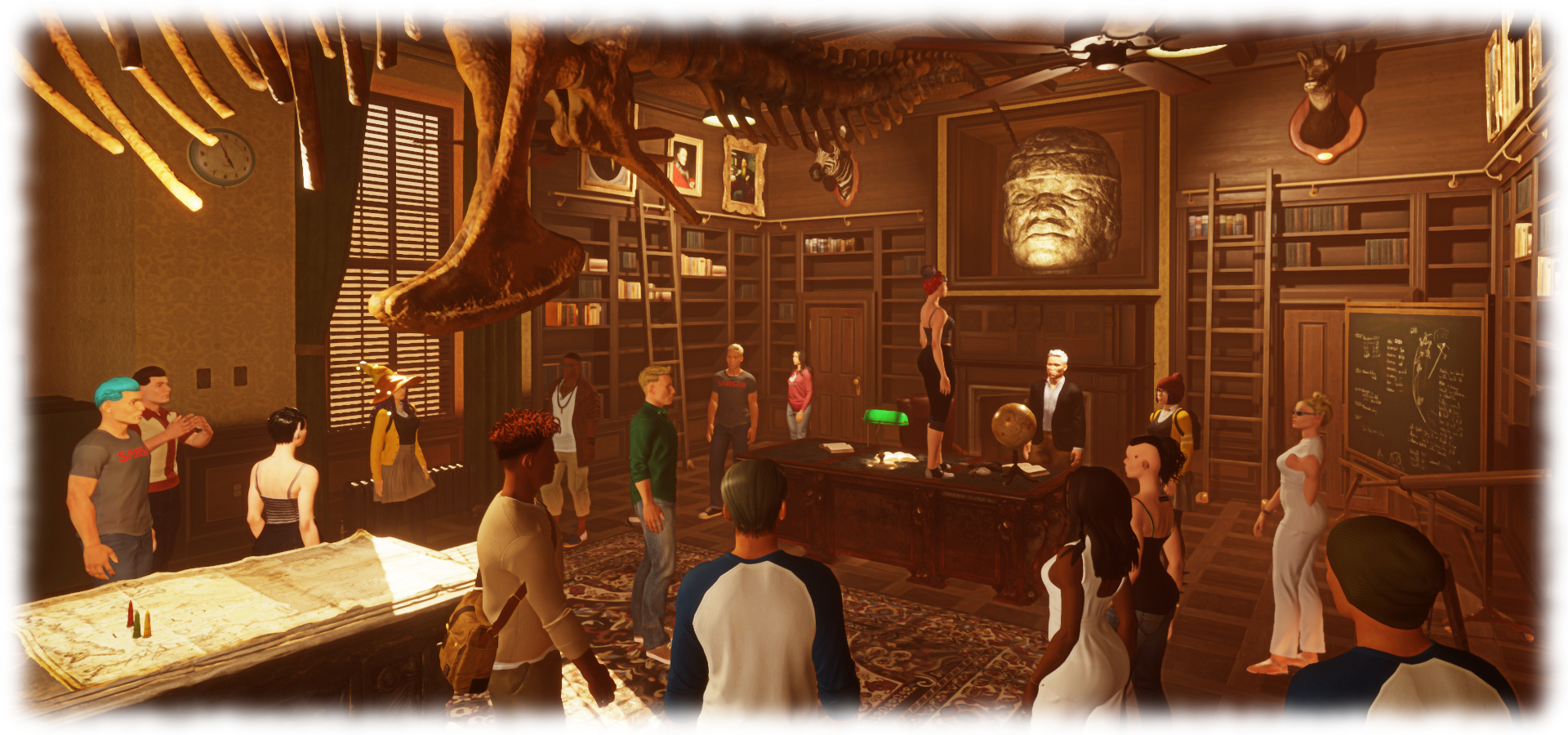
People gather for the morning product meet-up, Friday, August 24th
The following notes are taken from the Sansar Product Meet-ups held on Friday, August 25th. These meetings are held every Friday at 9:30am PDT and 4:00pm PDT, and are open to all. There is no set agenda (currently), and the meetings are a mix of voice and text. Venues change on a weekly basis, and are announced in the Meet-up Announcements; the August 25th meetings took place at Voyage Live: Egypt. The official meeting notes published the week following each pair of meetings.
The meetings are chaired by Jenn (aka Xiola Linden) from the Community Team, and feature various members of the Sansar teams. The August 24th meetings, for example, saw Cara and Caroline from the Product Team in attendance, with Hydro Linden from the Modelling Team, and Brett from the Community Team.
Next Release
The tentative date for the next major Sansar release is Thursday, August 31st. This is in keeping with the Lab’s approach to making major (feature) updates at the end / start of a month, with smaller interim releases focused on bug fixes and patches being rolled out as required between these major releases. There is still some work to be done on the release, so the 31st is not a definite date. Highlights of the upcoming release include:
Terrain Editor
A first implementation of the Sansar Terrain Editor; the ability to upload custom textures to follow. Cara reports there are still some issues with this at present which need to be sorted before it is released.
An initial implementation of AO to allow things like indirect lighting shadows to help objects and avatars look more “rooted” in a scene. This should not require creators to re-visit and update the Global Illumination (GI) bakes for their experiences, as the AO will be a real-time effect.
Other Notable Updates
Avatar Attachments: creators will be able to upload and sell their own avatar attachments through the Sansar Store.
Object Animations: animated objects created in Maya, StudioMax, or Blender can be imported them into Sansar.
Support for custom music and live streaming: e.g. via Shoutcast an similar services, for audio streaming in experiences.
3D Video support: ability to watch 3D movies within experiences.
Bug fixes.
Once the release has been deployed, details of updates, changes, improvements and fixes will be documented in the Release Notes section of the knowledge base, and form an e-mail to users. Specific feature notes will also published through the forums.
Jenn and Cara Linden at the 09:30 PDT meeting, Friday, August 25th.
Beyond the Next Release
The following areas are priority work areas for future releases:
Collaborative Building / Design
While seen as a priority, it may take some time to appear, as it is also reliant on other aspects of the platform, such as the permissions system.
It’s also not clear what form it might take – will creators be able to work together to “block out” a scene collectively, using tools in the editor to construct basic models (walls, floors, door, etc), which can then be positioned, modified and used as a reference for the off-line building of the actual optimised, fully textured items for use in the scene, for example?
Social Aspects Improvements
These include:
Making it easier to find others in Sansar and communicate privately with non-friends (currently, you can only direct message someone you have friended)
Greater avatar-to-avatar interaction when in Desktop mode (e.g. the ability to identify other avatars, ability to directly mute (voice only) other avatars, etc).
Text chat improvements (e.g. clickable support for URLs rather than reliance on the “Go” button function to identify URLs; ability to copy / paste chat, etc.).
Text chat and messaging in particular lack some core functionality (scrolling back through open chat, for example, no time stamps on messages, muting only applies to voice, etc). The current inability to directly contact non-friends came about as a result of muting being limited to voice chat only, and will hopefully be reversed in time.
An attempt will be made to get someone from the UI Team and from the Product Team involved in the UI / chat tools to come to a meeting to discuss their work and priorities.
Other Items In Progress
Inventory management improvements.
User preferences – but no details on what these will be.
Sansar Roadmap
There is a Sansar roadmap for updates and improvements, etc. This is currently being refined, revised and prepared for public release. Once available, the hope is that it will form the basis for more focused discussions on Sansar’s development and for obtaining feedback from Sansar users.
Avatar Improvements
A means to refine the texturing of hair for avatars was discussed several weeks ago, but it’s not clear if this is on general release to creators, or something only available for the Sansar Character team to use in refining the current avatars. If it is generally available, a request as been made for documentation / examples.
There is a longer-term project to refine and improve the Sansar avatars. This includes separating clothing from the avatar bakes to make it easier to support clothing (e.g. clothing making, mixing and matching items, etc.). The time frame for this could be several months.
Given my interest in space exploration, it really shouldn’t come as any surprise that my second Exploring Sansar article focuses on the LOOT Interactive NASA Apollo Museum, based on the Apollo Saturn Centre at the Kennedy Space Centre. However, there is another reason for my doing so: as the Sansar Creator Beta opened, it was – and remains as of the time of writing this piece – one of the most comprehensive demonstrations of Sansar’s potential for creating standalone, easily accessible educational / historical interactive virtual spaces.
As the name states, this experience is a celebration of America’s triumph in sending men to the Moon and returning them safely to the Earth at what was the dawn of the space age. As politically motivated as it may have been, Apollo was – despite the tragedies and near-disasters which marked it – a huge triumph of humankind’s determination and technical prowess.
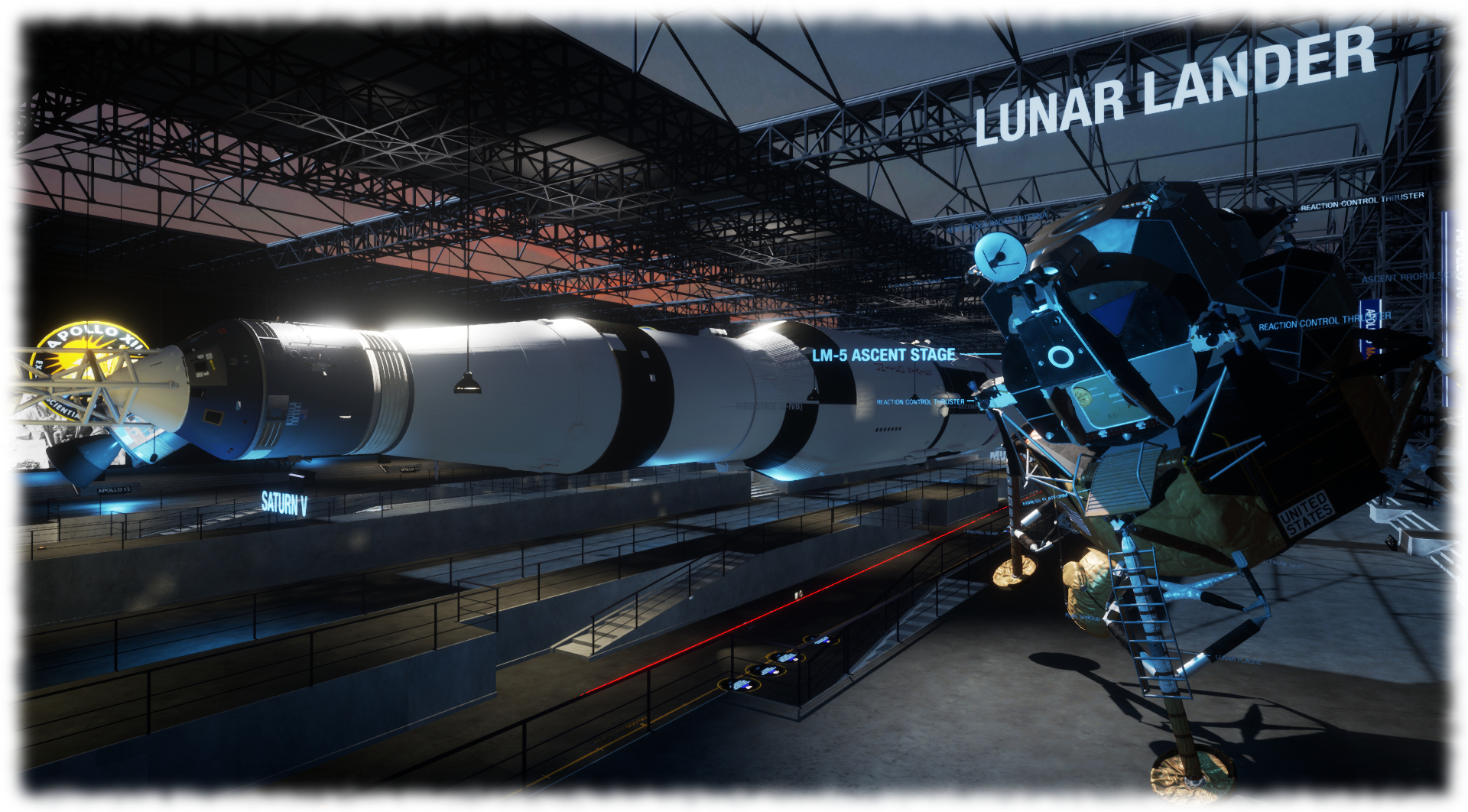
Unsurprisingly, given this *is* a museum, the setting is that of a mammoth hanger-like structure dominated by the huge form of an Apollo Saturn V rocket lain upon its side. Visitors arrive in a presentation area at the “base” of the rocket where, facing the five F1 engine bells of the S-IC first stage of the booster, is a huge video screen, used to present a film on the entire Apollo programme, from birth, through development and the horror of Apollo 1, through to the triumph of Apollo 11, and thence onwards through the remaining six missions to the Moon, together with the recovery of the near-loss of Apollo 13.
Flanking the Saturn V are two raised galleries featuring the Apollo missions with photos, mission logos and information boards. These start with the tragic loss of Apollo 1 and astronauts Grissom, White and Chaffee and run down either side of the rocket, progressing through the preparatory missions leading up to the first manned lunar landing, and thence on through Apollo 17.
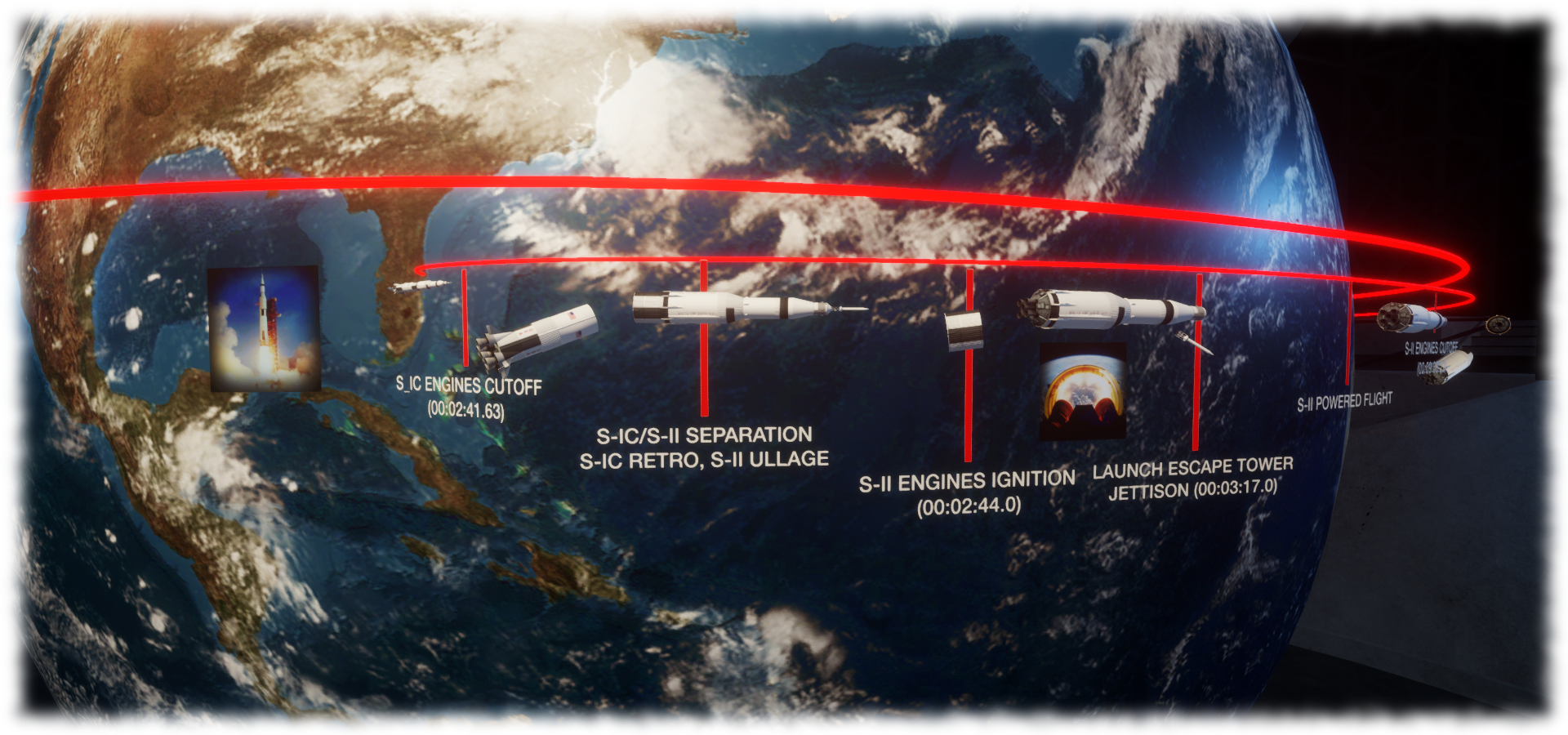
Sitting either side of the nose of the Saturn V are the LEM and the CSM. These and the rocket are neatly labelled, and the Service Module is shown with a cutaway in roughly the area where the liquid oxygen tanks exploded on Apollo 13, crippling it and leading to the rescue flight around the Moon. In the well between these display areas, starting with a model of the Earth, are a pair of time lines for the Apollo 11 mission. The first covers the journey from the Earth to the Moon, with principal events indicated along the way by scale models and annotations / information panels. The other similarly documents Apollo 11’s return to Earth.
Also, on the floor of these time lines are a series of interactive circles. Stepping on these will play audio clips of conversations between Mission Control and Apollo 11, and commentary from NASA on the mission status. There are other audio elements to be discovered as you explore the museum: an extract from Kennedy’s famous speech at Rice University in September 1962, when he uttered those immortal word, “We choose to go to the Moon.” There’s also audio at the Saturn V display.
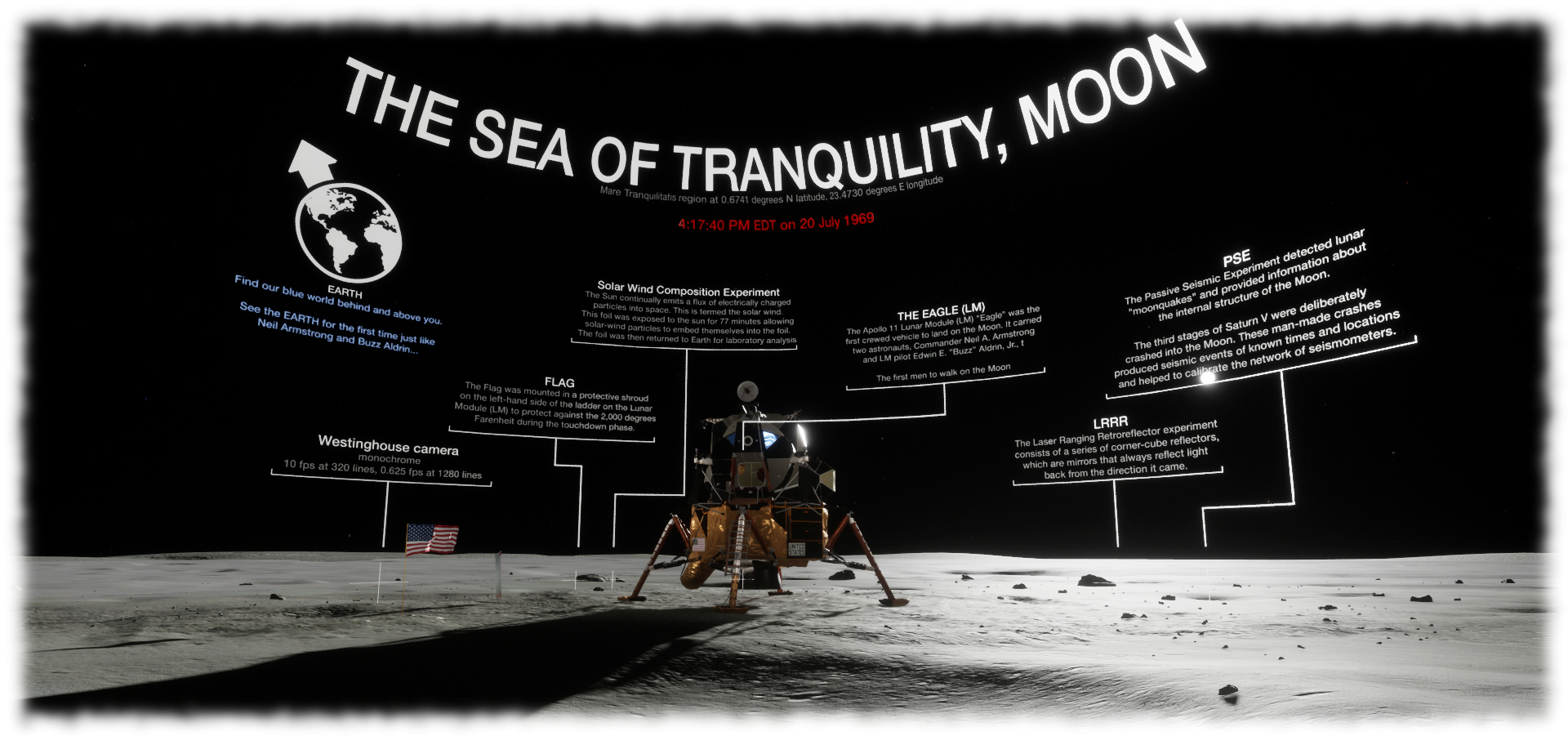
Beneath a model of the Moon which shows the landing areas of the six Apollo missions to reach its surface, sits a teleport disk. Simply step on it to be carried 384,400 km (240,250 mi) to Mare Tranquillitatis – the Sea of Tranquillity – and to where the Apollo LEM Eagle as it sits on the Moon. Pan / look up from here while you’re exploring, and you’ll get to see one of the most heart-catching sights a human can witness: looking back across the blackness of space to the beautiful, fragile marble of Earth.
Sansar’s current status does tend to limit what can be done interactively on the platform, and this in turn limits some of the effectiveness of experiences like this. For example, it would be nice of have a finer level of control over audio; right now, it is possible to end up with different audio elements confusingly overlapping one another (I have to admit I also found the clump-clump of shoes on solid floor is also a little off-putting when walking on the Moon). It would also be nice to have more interactive elements as well; as it is, the hanging information area above the Sea of Tranquillity setting is informative, but alignment with the appropriate elements can be difficult if you move.
Nevertheless, the NASA Apollo Museum is an engaging, informative and immersive experience, offering a promise of just where Sansar might lead us as features and capabilities are added.
I’ve mentioned Secrets of the World Whale several times in my Sansar posts of late, so it seemed to be a good place to launch into my Exploring Sansar series.
Designed by Teager, of Breeder’s Choice and Teagle fame in Second Life, this is one of the more enchanting early Sansar experiences. It is also one of the winners in the Lab’s Creator Challenge, winning Best Sound Design – although in my opinion, it could have just as easily been awarded Best Narrative and / or Best Visual Design.
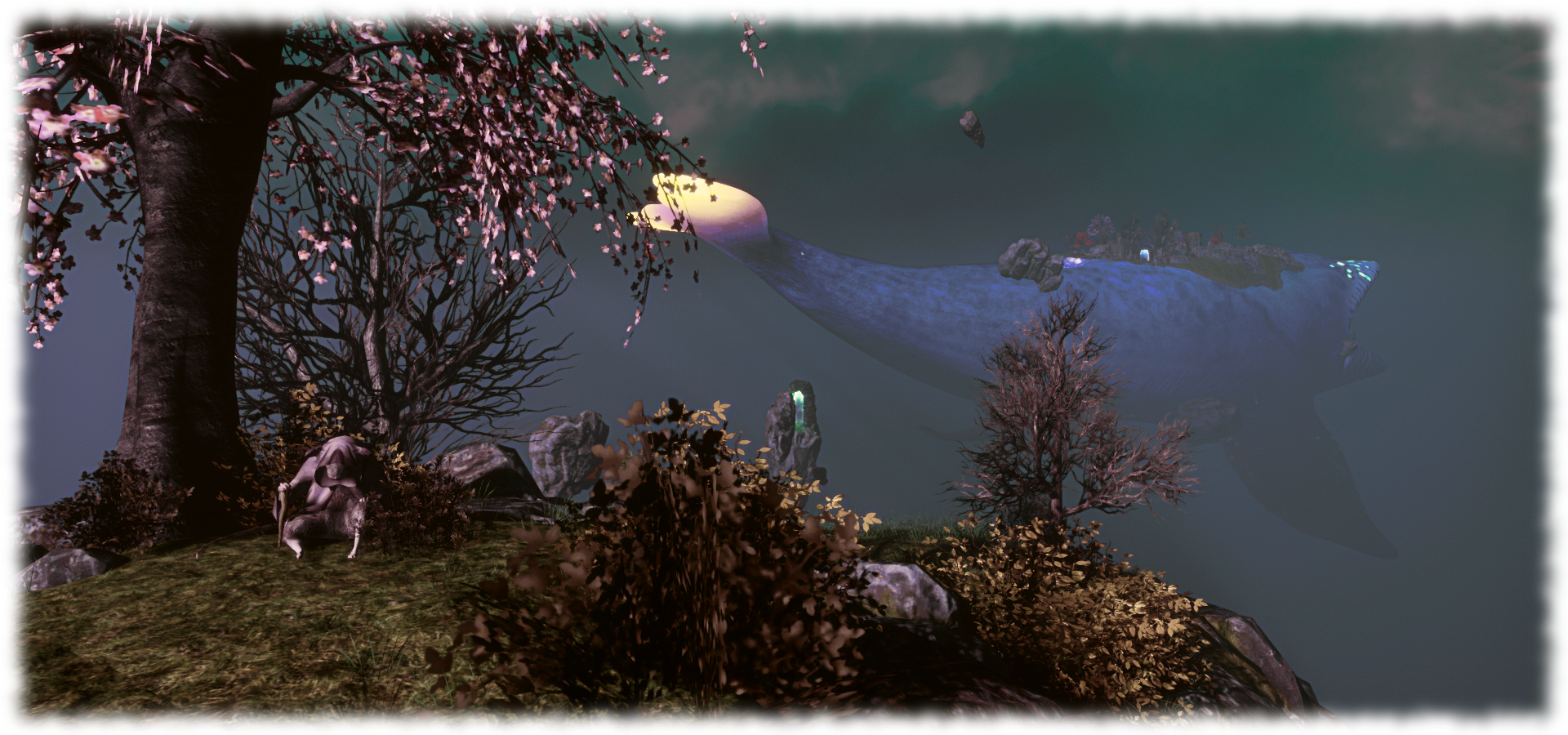
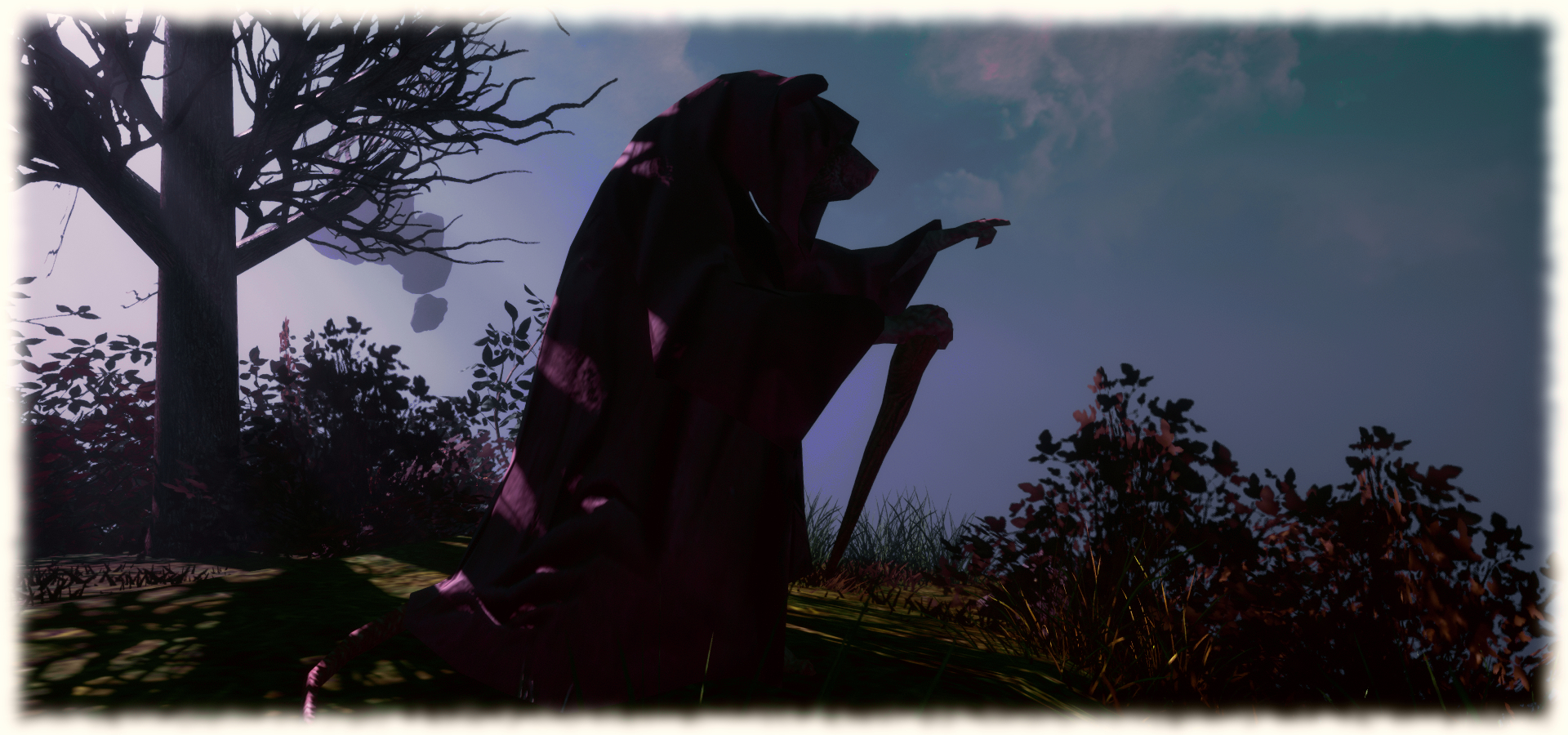
A visit begins on a floating island hanging in a clouded sky, the Sun illuminating the scene as it shines from beyond a very near-looking full Moon. Other islands of rock float in the sky and, beyond them, a great blue-coloured humpback whale swims through the sky. Beneath a tree close to where we stand sits an old rat, wrapped in a cloak and holding a walking stick in one paw.
“Look yonder! The World Whale passes!” he whispers hoarsely at our approach. “A creature as ancient as time itself, it wanders the sky, swallowing civilisations whole, leaving chaos in its wake. It is said that buried deep in the beast’s belly is an untold treasure, lost to man some thousand years. Perhaps, if we act quickly, we might discover it before the whale is lost to us again!”
Just beyond him, a tumble of rocks offer a way down to the island’s lower level as the rat tells us of the whale’s passing, and music drifts through the air. We encounter him again as he stands near the edge of the island, as he points outwards. “There! On that island!” he rat whispers once more, “An ancient doorway! But how to reach it?”
How indeed. There is a gulf of empty air between the island on which we stand and the smaller one on which the glowing portal stands. But, there are other islands as well. Perhaps, by using the personal teleport capability (CTRL+mouse + left click) we can jump one to the next with teleport hops. Take care as you do so, as the wind will howl around you, and a misplaced step could see you fall into the abyss – and back to the start of the experience.
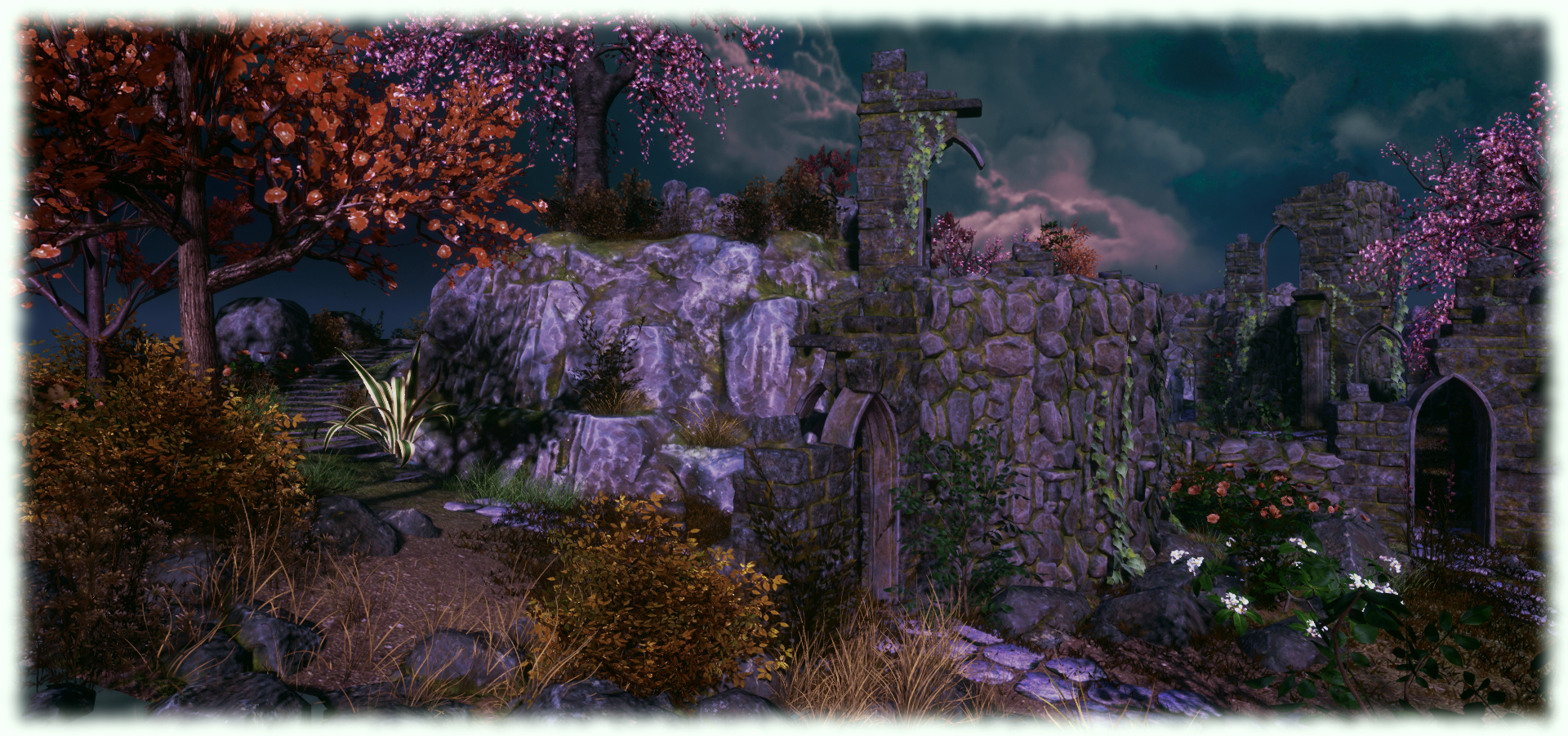
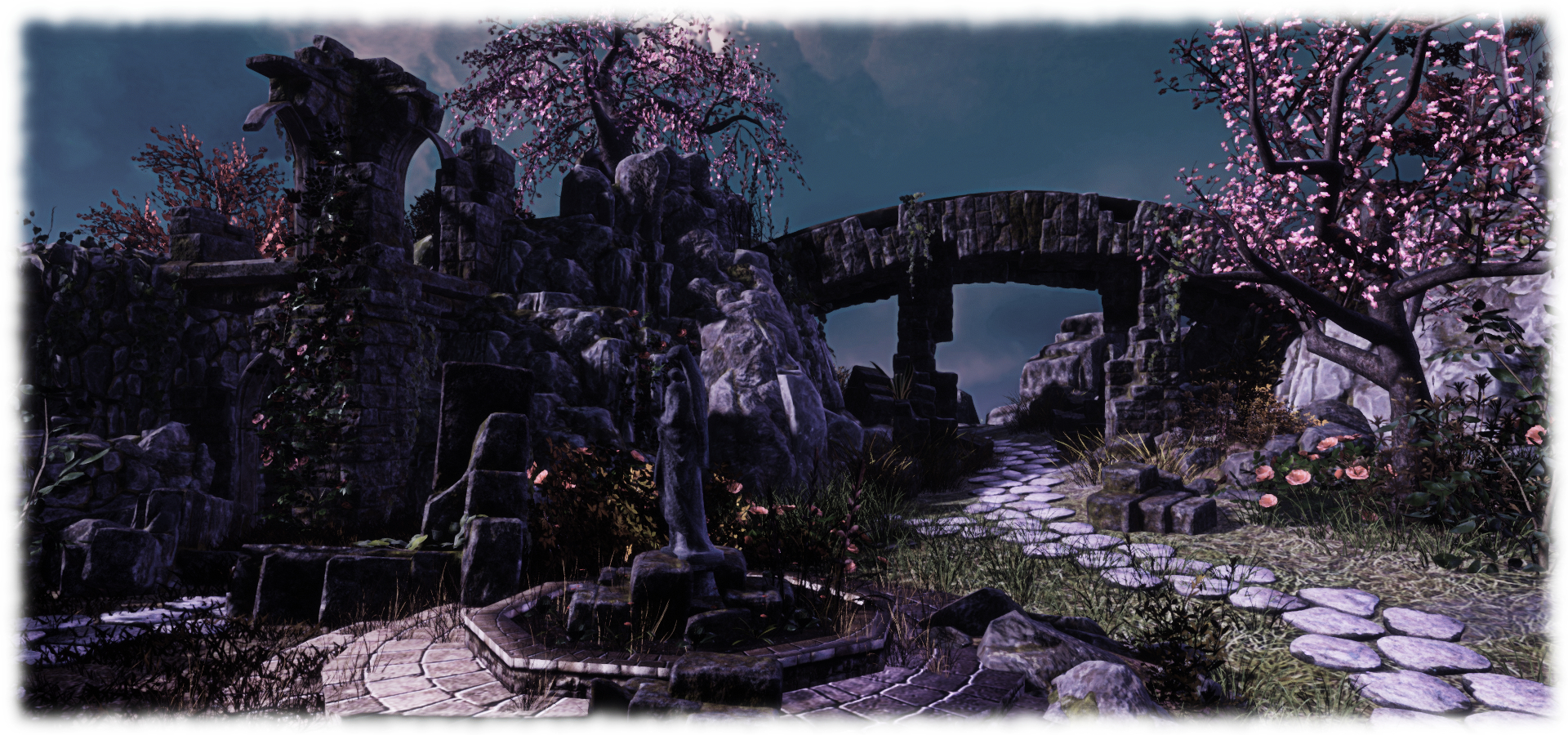
Stepping through the glimmering portal will carry you to the whale, where your companion rat is again waiting to guide you onwards to where a garden and ruins awaits. Paths run around and over the gardens, but it is one in particular you need to seek: the one that leads down inside the whale itself. Once you find it, you’ll find yourself in a cavern-like world, where great stalagmites rise and stalactites descend, and a rough road leads you onwards. It many take a second or two to realise the formations are teeth and the road is the whale’s tongue. Two portals await you – one leads back to the garden above, and the other – well, you’ll have to visit the world whale in its mysterious flight and find out for yourself.
Secrets of the World Whale is an engaging experience, combining strong visuals with a rich ambient sound scape and music, with a narrative track to follow. There are a couple of small hiccups, potentially down to Sansar’s state of play – stay too close to the rat for too long while he’s speaking, for example, and his words can end up in an overlapping series of loops – just keep walking to the edge of the audio fall-off to avoid it. However, none of this detracts from the central attraction of the experience.
AppliedVR: VR support for hospital patients. Credit: AppliedVR (see below)
This month has seen some interesting press pieces popping up concerning VR and Sansar since the opening of the Creator Beta. However, three in particular have so far caught my eye as they appeared, as they offer interesting perspectives and discussion points both on the Lab’s new platform and on VR and AR as a whole.
The first – and most recent, is Barely into Beta, Sansar is making social VR look good, by Alice Bonasio, which appeared in The Next Web on August 18th. The title caused some to question Sansar’s social capabilities, but the article itself was more about Sansar’s overall status and development, rather than zeroing directly into the medium of “social VR” per se. In this respect, it opens by clearly underlining the platform is still in its early days, and there is still much to be done, using a quote from Peter Gray, the Lab’s Director of Global Communications, to do so:
We wanted to make Sansar available to everyone as early as possible, and there are still a lot of features and capabilities that we’re excited to add to the platform soon, as well as many improvements to the current featureset.
Alice Bonasio: looking at Sansar
From here, Ms Bonasio makes the point that despite the lack of features and capabilities which will be needed to fulfil on its promise of being a social hub, it already looks good and offers a lot to see, much of which points to the platform’s potential.
The piece also delves into some of the technical and economic factors which set Sansar apart: such as Linden Lab’s partnerships with IKinema and Speech Graphics. The former is key to the Sansar avatars utilising Inverse Kinematics in an advanced way, and which are and will play a key role in the Sansar avatar’s development. The latter is key to synchronising facial animations automatically to match speech patterns, a capability key to many of the social interactions Linden Lab hope will be occurring within Sansar.
The article also touches on some of the key differences between Sansar and Second Life, the ability Linden Lab has to take fourteen years of running a virtual world to help shape the philosophy and approach it takes with Sansar. Passing – but important – mention is made of the Lab’s ability to self-finance Sansar; given the topsy-turvy situation with Altspace VR (which may have been saved from having to close), this is an important fact to keep in mind.
As noted above, the piece has received some feedback questioning the “social” element of Sansar at it stands at present, which given the broader thrust of the article might be considered a little out-of-context. However, it is fair to say that right now Sansar does currently lack elements which could be regarded as essential to supporting larger-scale social activities. Similarly, while social interactions are possible – as demonstrated through the daily meet-ups held “in-worlds” – it’s also fair to say these can be confusing and limiting for some. For example, undisciplined voice chat can mean that that multiple conversations in a single locale can overlay one another and become confusing to those not used to voice chat.
Hopefully these issues will be addressed, along with the provision of other social elements, and I’ll doubtless have more to say on them myself in the future 🙂 . In the meantime, this article provides a good summation of Sansar for the curious / those wishing to catch-up on things.
Samantha Cole examines VR’s role in conference calls
I’ll say up-front that I’m one of the non-believers that VR will become ubiquitous for business-style conference calls for a number of reasons, and its fair to say that Samantha Cole does a balanced job of presenting both sides of the argument – whilst also offering side pointers to those areas where VR is already showing benefits (and which I’d suggest Sansar could leverage).
Much has been made of VR’s abilities to add body language, hand movements, eye movement and contact – all vital elements in adding subliminal feedback / context to our day-to-day, face-to-face interactions to one another – to give more depth and meaning to tele- and video-style conferencing. In doing so, the likes of the telephone and “traditional” means of this type of conferencing have been somewhat “demonised”. Emphasis is laid on things like network latency, or the extra mental effort involved in reading into people’s words when you can only hear their voice or see their head / shoulders, as “limiting” such interactions.
But the truth is, we’ve been using the telephone for decades as a business tool. It’s fast and convenient, and as adults, we’re all pretty adept on picking-up on vocal nuances. We’re also, in a business context, far more prepared to communicate directly with colleagues; if there is something worrying / irksome within a work environment / business project, most of us are pretty willing to make thought known, be they over the ‘phone, face-to-face or via e-mail. So even with the faster, lighter, better VR technology we’re promised will be coming down the pipe, is it really any kind of “killer app” for business conferencing?
Eric Boyd, a professor of marketing at James Madison University points to emerging trends within the workplace as a whole being more a deciding factor here. Many companies have experimented with remote / home working over the past 2 or so decades, and the pendulum tends to swing back and forth. Right now, as the article points out, one of the first to enter the arena of remote working, IBM, is currently backing away from it. Thus, if working practices remain centralised, it’s hard to see VR overturning technologies already in place and supported by existing corporate infrastructure, no matter what the perceptions of their “limitations”. But for those organisations continuing to embrace remote working, VR could become a useful meeting tool.
Certainly there would seem to be far better uses VR could be put towards within a business environment: prototyping, training, simulations, and so on, which seem far more likely to drive its adoption by business and industry far more than the humble conference call. In this, Cole’s pointing to VR’s potential in training and simulation and in architecture is very salient; these are very much markets well suited to VR / AR / MR – perhaps more so that conference calls.
Amitt Mahajan – taking the temperature of the VR / AR market
While Sansar is only mentioned in passing (together with the downs and ups of AltspaceVR), the article is interesting as it encompasses the viewpoint of a company investing in VR and AR start-ups with funding in the US $100,000-500,000 range – which is small when compared to the likes of the big players, but has allowed the company to bask some significant start-ups, including STRIVR, who are in the VR training a simulation field mentioned above.
The article opens which a rapid-fire overview of the VR / AR market – including its niche status at present, which could be said to be largely down to the limitations of the current hardware (or lack thereof in AR’s case, although that is beginning to change) rather than anything else. However, the meat of the piece is where Mahajan sees the technologies going over the next several years.
What’s interesting here is that within Presence Capital, they are moving away from consumer-focused VR endeavours and more towards business and business-to-business (B2B) / enterprise VR applications as well as for AR; he points to the likes of AppliedVR and their development of an immersive platform to help comfort patients undergoing painful procedures, and also underlines VR’s application in training.
This year’s swing towards AR is also examined: Google, Apple and Facebook are all looking to develop AR platforms, and the discussion looks at these and at the questions of standards, formats, and enabling technologies. In this, Mahajan points somewhat towards the eventual merger of AR and VR to produce Mixed Reality, indirectly pointing to how AR – augmented reality – could actually become an enabler of VR (something the likes of Qualcomm are working towards with Android and their snapdragon chipset), simply because it will allow both to coexists as tools people can switch between according to needs.
All three article make for interesting reads, presenting a broad range of perspectives not just on Sansar (in the case of Alice Bonasio’s piece) but on VR and AR as whole.
Linden Lab, by way of Sansar, is one of the sponsors of a 3D printing competition organised by Pinshape. Running through until the end of the August, 2017, inviting people to Design Your Avatar. Hosted on Pinstripe, the competition offers three prize packages, the first of which includes a 1 year Creator Level subscription to Sansar, worth US $9.99 a month.
Imagine a future in which Virtual Reality is just as commonplace as cellphones and social media are today. In this future, everyone is represented in virtual space by an avatar of their own creation. What would you look like? What would you be wearing? Would you be human? Animal? Something new altogether?
Let your imagination run free … Design an original character that represents your personality and spirit. Feel free to design an avatar in your own image, or take this as an opportunity to design a character that you aspire to be.
Entrants are required to upload their finished design to Pinshape, where a panel of judges will judge all entries, and award points based on design creativity and uniqueness (40 points); technical excellence and ease of 3D printing (30 points); presentation – image quality, print settings, assembly instructions if required (20 points); and background story and design documentation (10 points).
The prize packages comprise:
First Prize
Second Prize
Third Prize
Formlab Form2 3D Printer package worth $3,499
ZBrush 4R8 license worth $795
Mold 3D 3D Character Creation for video games with J Hill worth $699
Oculus Rift headset and hand controllers worth $499
1 year Creator Level subscription to Sansar worth $120
Mold 3D 3D Creating Appealing Heads with B. Jefcoat worth $699
ZBrush core license worth $149
1 year subscription to 3D Artist magazine
3D printing for ZBrush artists worth $200
1 year subscription to 3D Artist magazine
There is also a bonus prize opportunity for entrants to win a free SLA print of their design from Formlabs by posting a link to their design on social media with the tags @pinshape @mold3D.
Full entries rules can be found here, and current entries can also be reviewed on the website.
Whilst primarily aimed at 3D printing, the competition is an interesting way for Sansar to potentially extend its reach into the 3D modelling / VR world, particularly with the obvious synergy between the first prize Oculus Rift headset and Sansar (“you have your shiny headset and somewhere to go with it!”), although obviously, the chance to win a 3D printer is liable to have the far greater appeal among designers and entrants. It’ll certainly be interesting to see if any of the avatars that are created for the competition eventually find their way into Sansar by way of .FBX and rigging, once the Sansar avatar skeleton is more opened out to developers. It’ll also be interesting to see how else Linden Lab seek to raise Sansar brand awareness through endeavours like this – or through running competitions of their own, similar to the Creator Challenge I wrote about recently.







 Inara Pey: Living in a Modemworld