Sansar and Second Life in the cloud: LL speaks at AWS Re:Invent

It’s been a busy time at Amazon’s AWS Re:Invent conference, which closes in Las Vegas USA on December 1st. At the start of the event, Amazon announced the launch of their VR / AR development / publishing platform Sumerian (see: Sumerian: Amazon’s VR / AR app building platform for more).

Meanwhile, on November 28th, and potential of more interest to Second Life and Sansar users, the event saw Tara Hernandez, Senior Director of Systems and Build Engineering at Linden Lab, give a presentation covering Sansar and touching on plans for Second Life, entitled How Linden Lab Built a Virtual World on the AWS Cloud.

Most of the video delves into the intricacies of building a complex platform like Sansar and how Amazon’s products have empowered the Lab. As such, it does come across as quite a dry listen; however, within it there are some useful areas of focus which are worth noting.

For example, the early part of Tara’s presentation touches on some core truths about Second Life. Such as the fact it is a platform now 14+ years old, which started as an environment engineered almost down to the bare metal, taking advantage of what were, at the time, deep-seated optimisations in graphics and networking capabilities.

Over time, these have not only been layered upon almost organically over the years, but have also become – in Tara’s own words – “kinda ugly” in terms of trying to maintain and enhance. This monolithic, deeply rooted approach to the core elements of the platform is – along with the user-driven expectation than the user-generated content within the platform will not break as a result of changes to the platform – one of the major reasons  why “updating” Second Life isn’t simply a matter of JFDI, as might be thought.

Aspects such as compliance – another issue which is perhaps a lot more complicated than many might appreciate, given the complexities involved in running services like Second Life and Sansar, where the ability to cash out money adds a lot of additional regulatory overheads (visible and invisible from a user’s perspective) over platforms which only allow users to pay-in.

The video also reveals the depth of the relationship between Linden Lab and Amazon, which in the case of Second Life, stretches back to 2008, and which has encompassed the Lab’s other product, Blocksworld. In particular, it touches on Linden Lab using (and sometimes breaking!) Amazon’s more recent offerings, such as their ECS services, as a beta customer. This is something that Amazon has itself highlighted, featuring Linden Lab and Sansar in one of their own ECS use-case studies (see my article “Project Sansar”: an Amazon ECS case study, from January 2016).

ECS in fact drives almost all of the Sansar back-end, from the Atlas through to the store. In particular, the way in which the ECS application layer is used to present the Sansar Atlas, and manage the entire management of the experiences offered by the Atlas and their instancing, utilising Amazon containers (see 27:40-30:58).
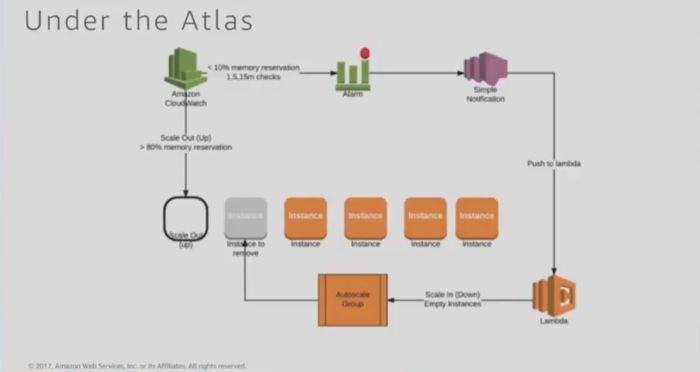
How Sansar uses the Amazon ECA application layer to drive the Atlas & managing experience instancing (screen capture). Credit: Linden Lab / Amazon Web Services Inc.

What’s interesting here is not only the way in which Amazon’s services are being used, but in understanding what is going on from the moment a Sansar user clicks the Visit button in the Atlas, and the lessons the Lab are learning even now, as people use Sansar.

This latter point is itself of interest, as it helps to explain why Linden Lab opened Sansar up to wider audience in what seemed to many of us familiar with virtual space – myself included – to be a premature move. Simply put, they needed more of a flow of people moving through experiences to better judge how experiences can be more efficiently / effectively managed within the Amazon environment – spinning them up / down, instancing, optimising server use, etc.

In terms of Second Life, perhaps the most interesting part of the video can be found at 32:14-34:36, with a look at the recently announced attempts to move all of the Second Life service – including (eventually) the simulators, if possible – the cloud. Officially announced as a project in August 2017, but has been discussed at various in-world meetings such as the TPV Developer meetings.

Credit: Linden Lab / Amazon Web Services Inc.

In particular, the presentation touches on one of the major reasons for attempting the move: costs. Right now, Second Life is dependent upon hardware the Lab has to source and operate through a data centre. Updating this hardware, and the underpinning infrastructure  – network, fibre, rack space, etc., – requires continuous and high levels of expenditure (even allowing for re-purposing / write-down of old equipment).

There are also limits, as touched upon in the earlier part of the video, on what can be done within specific areas of Second Life support and maintenance. For example, Tara specifically mentions the core database services (which have been subject to numerous issues over the last year plus). While recovery times for these services has been halved – from three hours to 45 minutes – it is still a considerable outage period from the users’ perspective, and one difficult to bring down further.
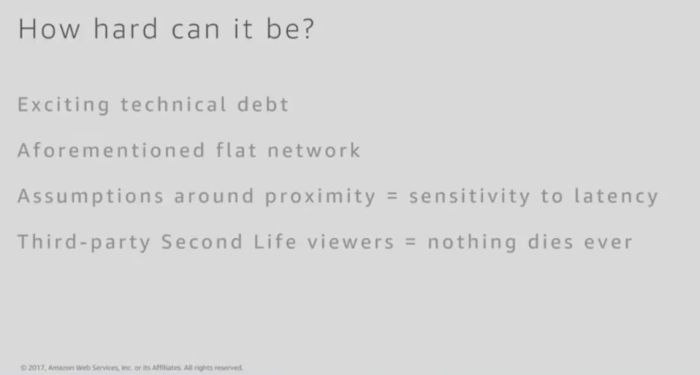
Second Life in the cloud – challenges. Credit: Linden Lab / Amazon Web Services Inc.

Thus, an attempt to move Second Life to AWS could resolve a lot of issues for the Lab, and potentially allow them to leverage lessons learned with Sansar together with the capabilities of newer services – like ProxySQL – to further update and improve SL. It might also allow the Lab to move their database operations away from MySQL to more robust products, again following Sansar’s lead.

The shift of a platform from being data centre centric to cloud based is obviously non-trivial, and involves considerable challenges, some of which are outlined by Tara (above). However, from the comments she makes, she is anticipating possibly a dramatic level of progress over the next year. If so, it could be an interesting twelve months.

With thanks to Dassni – The Mesh Cloud for the Twitter pointer to the video.

A Paranormal Investigation in Sansar

Paranormal Investigation

Paranormal Investigation is an experience by Abramelin Wolfe – of SL Abranimations fame – built specifically for the Sansar’s Scariest competition, which concluded in October. It was judged runner-up up in that competition – and deservedly so.

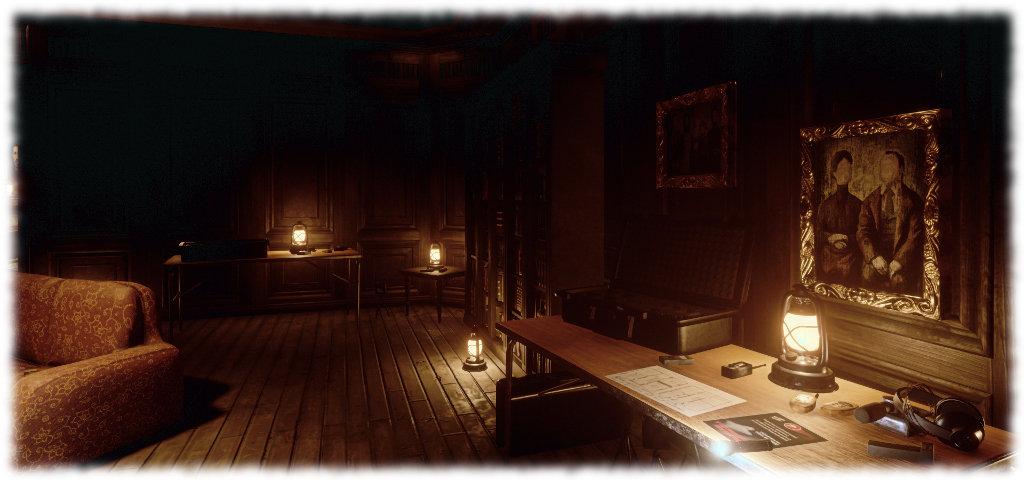
Given it was built for Halloween, this is – in lighting terms – a dark experience in which visitors are invited to join ghost hunters exploring a haunted house. As one might expect from such a place, the main lights are out – presumably to help spot spectres. However, lanterns have been placed out along floors and hallways to help illuminate the way, although it can seem a little dark for those in desktop mode.

Paranormal Investigation

A visit starts in the lounge of the house, where the ghost catchers have obviously set-up a base of operations, a case of equipment on the floor, and a table against one wall where a record of their work is being kept. This is worth getting a look at, as it includes a floor plan of the house (try first-person (F3) if in desktop or, if you’re handy with the movement keys and the mouse, freecam (F4) over to this and zoom in – use the – and + to reduce / increase the zoom speed).  Easy to fix the in mind, the plan helps with explorations as you move on through the house.

This is perhaps the quietest room in the house, and offers a doorway through to a study where the first hints of paranormal happenings are going on – books float through the air, a Ouija board is being kept busy by something. The books are worth watching; they don’t randomly fly around, rather, they are carefully removed from their place in the bookshelves, float around and are then returned to their resting place, as if removed and replaced with deliberate intent.

Paranormal Investigation

At the back of the house and across the hall from the lounge are the kitchen and dining room respectively, where more signs of odd goings-on can be found, as can the first indication of a ghostly presence. More apparitions can be found upstairs – including a skeleton seemingly determined to keep in trim. However, the biggest delight in this experience is to be found up in the attic, where the Thing That Goes Bump In The Night clearly has an interest other than haunting!

What makes this experience a delight is the attention to detail. There are various nods to paranormal investigations – the use of the term “ghost catchers” puts one in mind of the Ghost Hunters TV series; in the bedroom there’s both a jumping bed and a revolving head a-la The Exorcist, while elsewhere bodies float or appear as you explore. Again, if you are handy with freecamming in Desktop Mode, you might want to zoom into the bookcases in the lounge and study and check the titles of the book spines, such is the care poured into this design.

Paranormal Investigation

With a little interaction possible (chairs can be moved around), a good use of trigger volumes to generate things like the appearance of the floating body and localised sounds, Paranormal Investigation makes for a fun visit for those still looking for a bit of a spooky experience.

SLurl Details

Nature’s beauty in Sansar

Skye Naturae Virtualis

Alex Bader is one of the foremost creators of landscape elements in Second Life – trees, plants, land forms, textures, building kits, and so on, for temperate and tropical settings (he also produces a range of castles and buildings).

He’s also been working in Sansar as a part of the overall Creator programmed (Closed and Beta), and a visit to his experience there was added to my list of places to visit after Cube Republic (another creator of excellent plants and landscaping items in Second Life) prodded me about it recently.

Skye Naturae Virtualis

Unsurprisingly, Alex’s experience – called Skye Naturae Virtualis – is focused on nature: plants, trees, rivers, trails – which have been the hallmark of his work in Second Life. What is marvellous about it is the depth of realism Alex has achieved within it. So much so, that I can honestly say it is perhaps the first virtual environment I’ve seen that has made me regret not having ready access to a VR headset, just so I could experience visual immersion for the sheer pleasure of the setting, rather than out of any technical curiosity. It’s a place that quite honestly makes you want to be there.

You arrive on a woodland trail, rocks and cliffs visible through the trees, the sounds of birds and of flowing water. Ahead, the trail leads between tree trunks, fork to the left and right. Some paths are only short, others lead onwards, splitting again, crossing a bridge, offering a way to grassy slopes.

Skye Naturae Virtualis

This is very much a work-in-progress, with Alex noting that he plans to add to the setting over time as he creates more plants, trees and other elements for Sansar. This can be evidenced by one of the paths winding its way into a rocky cleft, the way only to be blocked by boulders, the path beyond them petering out in a space that looks like it is waiting to have detail added.

Alex says his hope is to, “Create a natural virtual space, just as exciting and captivating as the real (no harm in dreaming the impossible!).” On the strength of what is already available within the experience, I’d say he is achieving the impossible. Skye Naturae Virtualis is one of the most natural-looking environments that can be enjoyed in a virtual space, almost perfectly bringing together setting, sky, sunlight and sounds into a whole. Beautiful in Desktop mode, I can well imagine that in VR mode it could leave you feeling you’re almost anywhere in the temperate world, be it one of the national parks of the United States, the forests of Canada, the lowland Alps of Europe, the woodlands of Germany or anywhere else you care to think of.

Skye Naturae Virtualis

Experience SLurl

Sansar Product Meeting 2017 week #46

Creator Academy: Hall of Materials – location for the Friday, November 17th, 2017 Product Meeting

The following notes are taken from the 4:00pm PST Sansar Product Meeting held on Friday, November 17th. Product Meetings are usually held every Friday at 9:30am PST and 4:00pm PST, and are open to all. There is currently no set agenda, and the meetings are a mix of voice and text. The official meeting notes are published in the week following each pair of meetings, while venues change each week, and are listed in the Meet-up Announcements. and the Sansar Atlas events section.

Unfortunately, I was unable to attend the Friday, November 17th morning meeting, hence these notes only covering the one meeting.

Store Release

The November release will, as previously noted, focus on the Sansar Store. It will include a redesign of the Store’s main page.

The Sansar design team is working on the mean for designers to update store listings and to be able to distribute updates to customers, determining the likely workflow, etc. However, it will still be a while before this appears, and it won’t be part of the Store Release

Fashion Release

This is still on course from a planned December release. Invites to the “alpha test group” are due to start going out to designers. This release should also hopefully include non-fashion elements as well, such as the events information being added to the client Atlas – see my notes from week #45 for more.

Experience Access Control and General Security

Upcoming capabilities for Sansar will include the ability to control access to an experience. Initially this will be restricting it to Friends only, but further control abilities will be added, and the Lab is seeking feedback from users on what they would like to see. ideas thus far include:

  • Blacklist and whitelist access (i.e. those on a blacklist are permanently blocked from accessing an experience; or access can be contained to a whitelist of people, regardless of whether or not they are on the experience owner’s Friends list).
  • Ability to appoint “experience officers” (similar in notation to Second Life estate managers), with the authority to keep an eye on an experience and those visiting it.
  • The use of a maturity ratings system similar again to SL, which could be used within experiences and in the Sansar store to both help indicate what might be seen within an experience, and also what is permitted to be worn within an experience (e.g. anyone with an Adult rated attachment would be barred from accessing a General rated experience until the attachment is removed).
    • How straightforward this would be to implement is unclear.
    • It’s worth noting that Ebbe Altberg has in the past suggested that experience owners may eventually be able to define entry by avatar type / dress mode defined by the experience owner (so for, example, a merfolk-centric experience would require all visitors to be a merman or mermaid).
  • Abilities to deal with griefers, again, like SL, not jut ejection / banning, but ability to freeze them, indicating their actions have been observed and could result in a ban.
  • Overall account security is something the Lab is looking at, particularly given the means by which accounts can be hacked / abused within Second Life.

In Brief

  • The events section of the Web Atlas: when active, has been updated to present information a little more clearly.
  • Community Meetings: Sansar Community meetings are now being varied, visiting different experiences on different days, rather than the one experience being used for a whole week of meetings. Venues will continue to be announced via the web Atlas Events section and the Community Meet-up page.
  • Creator Academy: Hall of Materials: the first of Sansar’s experience-led learning facilities, the Hall of Materials opened on November 14th, 2017. You can read my review here. Apparently, the audio section of the experience utilises incorrect sounds, and will be updated soon, as well as capabilities being added (e.g. as noted in my review, better Desktop mode interaction).
  • Building and Design Collaboration: the groundwork for collaborative design within Edit mode is being laid, with particular emphasis on how the capability will work with Sansar’s upcoming permissions system. A suggestion put forward by Jenn is to see if edit spaces can simply be shared – so that if someone is working on a scene, they can invited a friend in to Edit mode with them so they can chat, etc.
  • Identifying Lab Staff in Sansar: in Second Life, Linden Lab staff are easily recognised by the use of the “Linden” last name, and the use of blue in name tags, text chat, etc. A means to similarly recognise Lab staff in Sansar is being considered. This may not involve the use of the “Linden” last name, but could be something like their names showing up in blue when highlighted by the mouse / controller. It might also include the means for Lab staff to turn it off if they wish.
  • Next Product Meeting: due to the US Thanksgiving holiday, the next Sansar Product Meet-up will be on Friday, December 1st, 2017.

Sansar: the art of Silas Merlin

Felsenmeer – Silas Merlin

I’ve been an admirer of the art of Silas Merlin since first coming across his pastel art in Second Life. A Maître Pastelliste of the Société des Pastellistes de France, his painting are remarkable, and I urge anyone who has not seen them in-world to do so. Over the last two years, Silas has also been branching out into 3D art, developing his skills as a sculptor – something I’ve been at times been privileged to witness.

For the last several months Silas has been working in Sansar, creating an experience to showcase his work. Called Felsenmeer, Silas describes it thus:

A sea of rock, peopled by creatures frozen in time. When you encounter the more detailed rocks, observe them from different angles, sometimes they reveal figures that want to be carved in more detail.

Felsenmeer – Silas Merlin

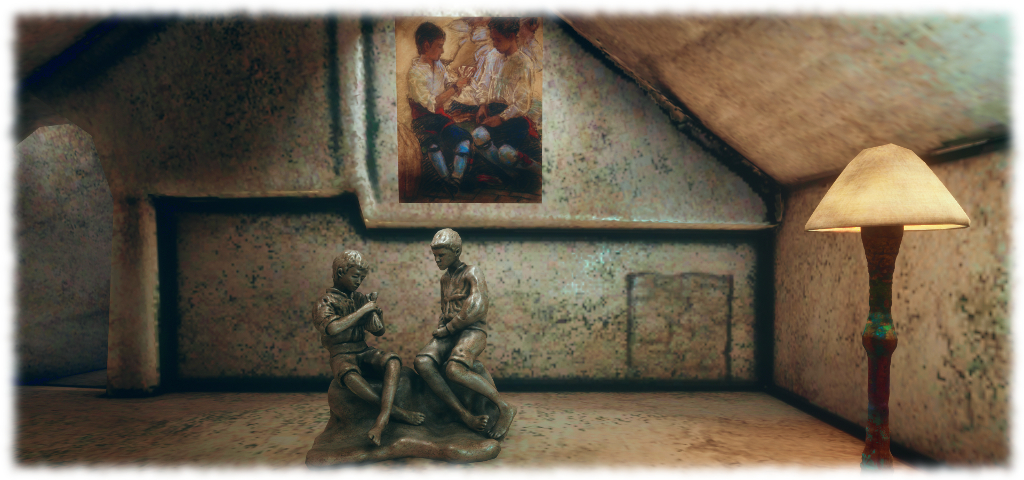
It’s a perfect description for the setting, in which sits a large house and smaller cottage, surrounded by a field of boulders  – genuine felsenmeer, together with larger rock formations, in turn surrounded by hills.  Look closely enough at some of the rocks, and you just might see sculptures waiting to be found: one formation, for example, suggests it might become a dancing couple, or perhaps a grandfather sitting his grandson on his knee…

Other stones and boulders have already had the sculptures within them released. Finely crafted, several sit close to the house. Others, further away, have the look of being cast in bronze – as do the trees, which add a certain alien feel to the landscape.

Felsenmeer – Silas Merlin

The ground floor of the main house is occupied by many of Silas’ circus characters, complete with one of his pastel pieces – a jester, appropriately enough. The house is also the home of a modern sculpture  – and find this, and you’ll find a ramp leading up to the upper floors (you may need to SHIFT-teleport to get onto one floor from the ramp), where more of Silas’ expressive pastels reside, together with some more sculptures; these are not to be missed, so do make sure you explore the house.

The rest of this intriguing landscape should also be explored; the landscape is all boulders and rock formations. Follow the paths outward from the house and you’ll find there are surprises to be found tucked away here and there. So don’t limit your explorations to just the vicinity of the house and cottage.

Felsenmeer – Silas Merlin

Experience URL

Sansar’s Creator Academy: Hall of Materials launches

Creator Academy: Hall of Materials

Linden Lab has launched its Creator Academy: Hall of Materials experience. It is intended to help creators explore and better understand the materials capabilities of Sansar, learn about the various shaders and physics materials using interactive kiosks, and how texture values interact and impact one another.

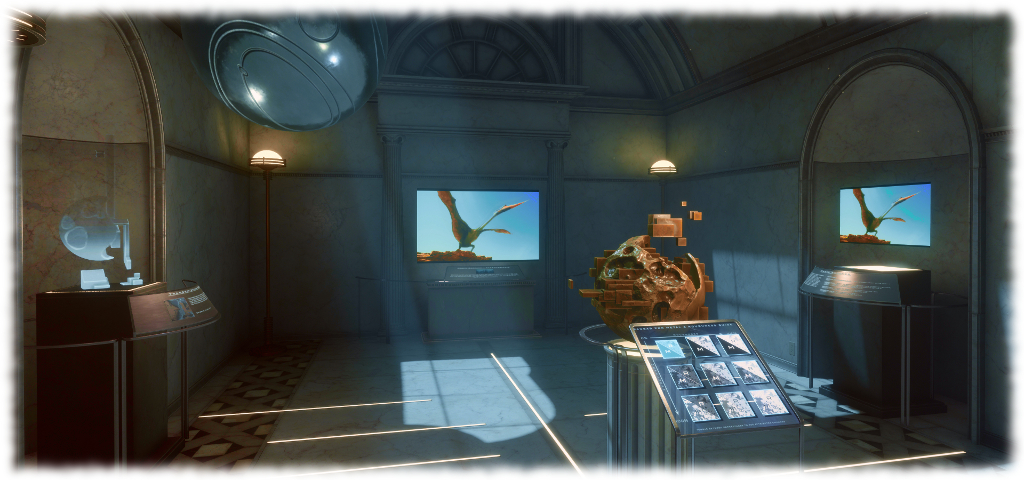
The hall comprises two sections; the first covers media surfaces, stereoscopic media, UV animation materials, emissive materials, standard materials, and metals. Overhead, spheres float as a physics demonstration. The second, rotunda-like section, provides insight into audio materials and materials layering.

Creator Academy: Hall of Materials

Kiosks provide overviews of specifics aspects of using mateirals, and some of these are are interactive. In the rotunda for example, walk across the different surface types (sand, water, ceramic, glass, carpet, etc) – to trigger the corresponding sound. With other, proximity might trigger a level of interaction.

However, it has to be said that some of the interactive elements appear to be more geared towards those in VR mode – as indicated in the introductory video. Some kiosks, for example, use panels of buttons which are currently largely inaccessible to those in Desktop mode. While this may well change as Desktop mode interactivity improves, it nevertheless limits the effectiveness of Hall of Materials as learning experience right now.

Creator Academy: Hall of Materials

Also, while I favour tutorials, it has to be said that Sansar’s very nature perhaps limits the effectiveness of experiences like this. Unless you tweak the client or have multiple accounts, you can’t visit the experience and simultaneously try things out directly for yourself in Sansar’s Edit mode, and fix concepts in your head by doing so. As such, I did wonder if the effort in building the experience might not have been better served in producing a series of short videos on the subject matter, perhaps in the manner of Torley’s famous SL TuTORials.

Given these points, Hall of Materials should perhaps be viewed as an experiment in teaching / learning more than anything else, and it’ll be interesting to see where the concept goes and how it develops. In the meantime, I’ll leave you with the introductory video, which provides a basic overview of the experience, in its own somewhat “novel” approach.

URL Details