“We got bored!” Ty Tenk of Calas Galadhon fame laughed, passing me an invite for Caitlyn and I to visit the Calas Skate-o-Rama. “Rolling skating in the middle of the desert. But be careful crossing the highway!”
It actually took us a couple of days to get the opportunity to visit, but with Friday night sitting with us, we hopped over to find out more – and in Typical Ty and Truck style, the venue is fetchingly presented and a lot of fun.
Visitors arrive at a roadside stop on Route 66. The moon hovers low in the sky, and sandstone mesas break-up the horizon. Across the road, resplendent in neon and art deco styling, sits the Calas Skate–O-Rama, searchlights sweeping the darkening skies. This is a poplar place: the asphalt car park is almost full. Once across the road, the deco style doors to the arena beckon – and hide a secret. Step through them, and far from leaving the desert skies behind and you going indoors, you enter an open-air rink, a 50’s style diner to one side, and a live performance stage on the other.
Between them sits the skating floor, and it is built to take a fair few! Roller skates can be obtained from the giver just inside the arena entrance – you just need to join the Calas Announcements Group if you’re not already a member. Swap your shoes for the skates, turn off your AO and you are all set. You can then free skate or – using the pose and dance system (instructions supplied in the air over them) – you can skate and dance.
Calas Skate-O-Rama: the burger bar help keep your energy up – and keep you warm under that clear desert sky!
It’s surprisingly a lot of fun, particularly if there are a number of you; and as is always the case at the Calas regions (the arena is on the Calas special events region of Erebor), the music is superbly selected. There are regular live music events planned throughout March as well, so check the Calas Galadhon blog for details.
Should you need a break from the dancing, you can enjoy a burger at the bar (or have it delivered to you by one of the roller skating staff 🙂 ), or take a seat on the couches to the side of the skating floor. And if you fancy a wander, the desert is worth seeing, and has one or two surprises!
Calas Skate-O-Rama: take care when crossing the road – there are big rigs passing!
As we skated, I asked Ty what would be happening at the end of March. “Oh, we have a few things planned for over the summer!” he said with a smile and a wink, but without saying more. We look forward to finding out – and to hopping back to the Skate-O-Rama well before then!
Update: Long Journey has relocated, and I have a new blog post about it.
Creativity in Second Life doesn’t always require an entire region – Full or Homestead – in order to be realised. This is something I’ve said in the past, and will doubtless say again in the future. All it needs is sufficient room in which the imagination can breathe; and if you want proof of this, then I can recommend you take a trip over to Long Journey.
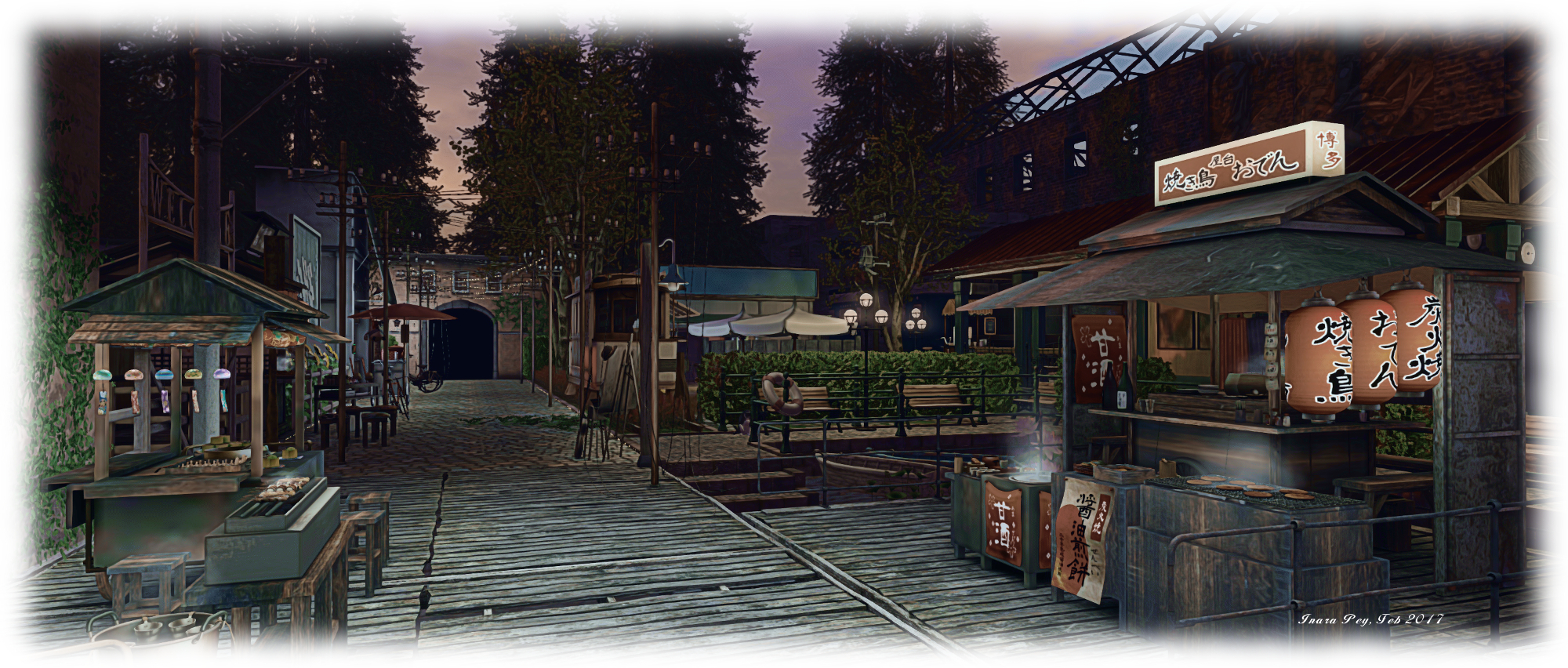
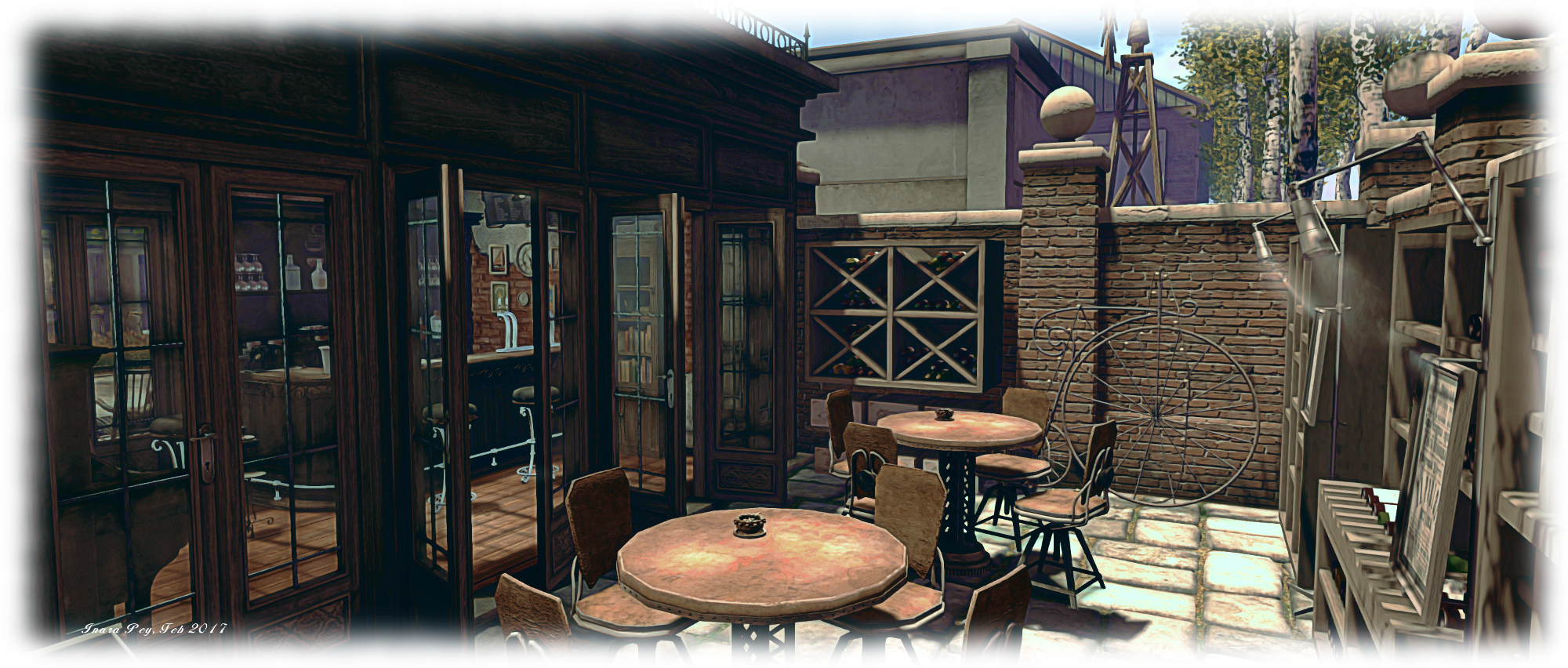
Covering a little under 7,000 square metres, Long Journey is an absolute delight. Designed by Yang (Sun2idea), it packs a lot into the space without ever feeling crowded or losing its sense of rural-edged peace. Visitors arrive at a little coffee-house and bar; to the rear is a cosy walled terrace with tables tucked between tall wine racks and the bar; to the front sits a paved street, the nearby end of which slips into a tunnel.
Along this street, bathed in the soft glow of a setting sun, lit by tiny LEDs strung along the curbstones and clusters of street lights, are a number of eateries with a decidedly oriental flavour to them. Vending machines line the wall of the building across the street from the coffee-house, while alongside it sits another cosy little café. Close by, a converted tram offers teas and cakes to patrons who can sit at tables occupying a tidy square of grass, one of several outdoor eating areas.
Just beyond the tram, the street ends, and a wooden board walk takes over, running alongside a small body of water. To one side of it is an old warehouse, one of its walls long since collapsed, exposing its metal frame. It is now home to a curious and eclectic mix of things. On the opposite side of the board walk, most of the water is taken up by an old house boat, its square prow abutting the whitewashed building forming the southern boundary to the street.
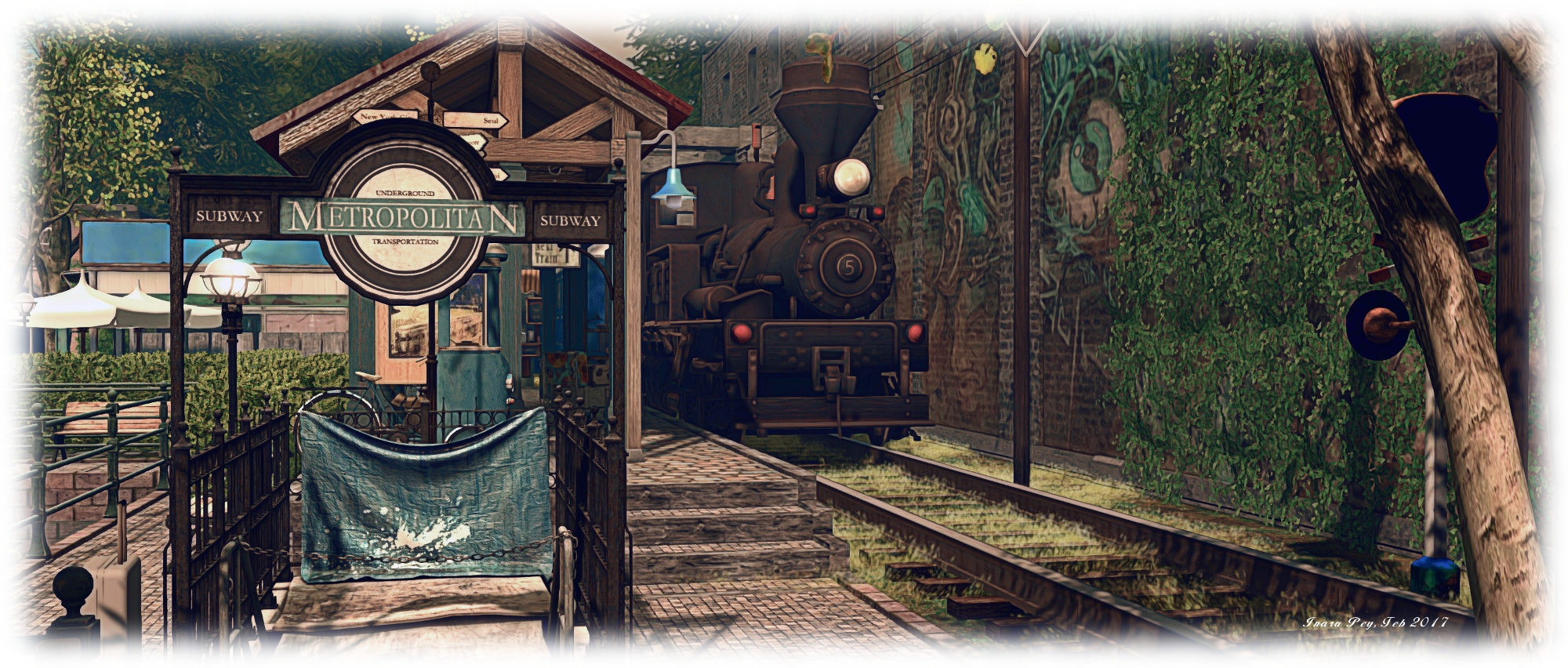
Nor is this all. At the point where the street gives way board walk, a tiled path points the way to one side. It runs between tram café and water to a little platform, where a steam train is just pulling in, its carriages slowly emerging from another tunnel. Alongside the track, the sheer wall of an old factory rises like a great brick cliff. Roofless, its windowless flank rich in graffiti and drawings, it invites exploration.
But to describe everything to be found here – the little house, what lies inside the old factory or the warehouse with its broken wall, the field of sunflowers marching into the scene and more – is really a waste. This is a place which really does deserve to be seen – to be savoured – to really be appreciated.
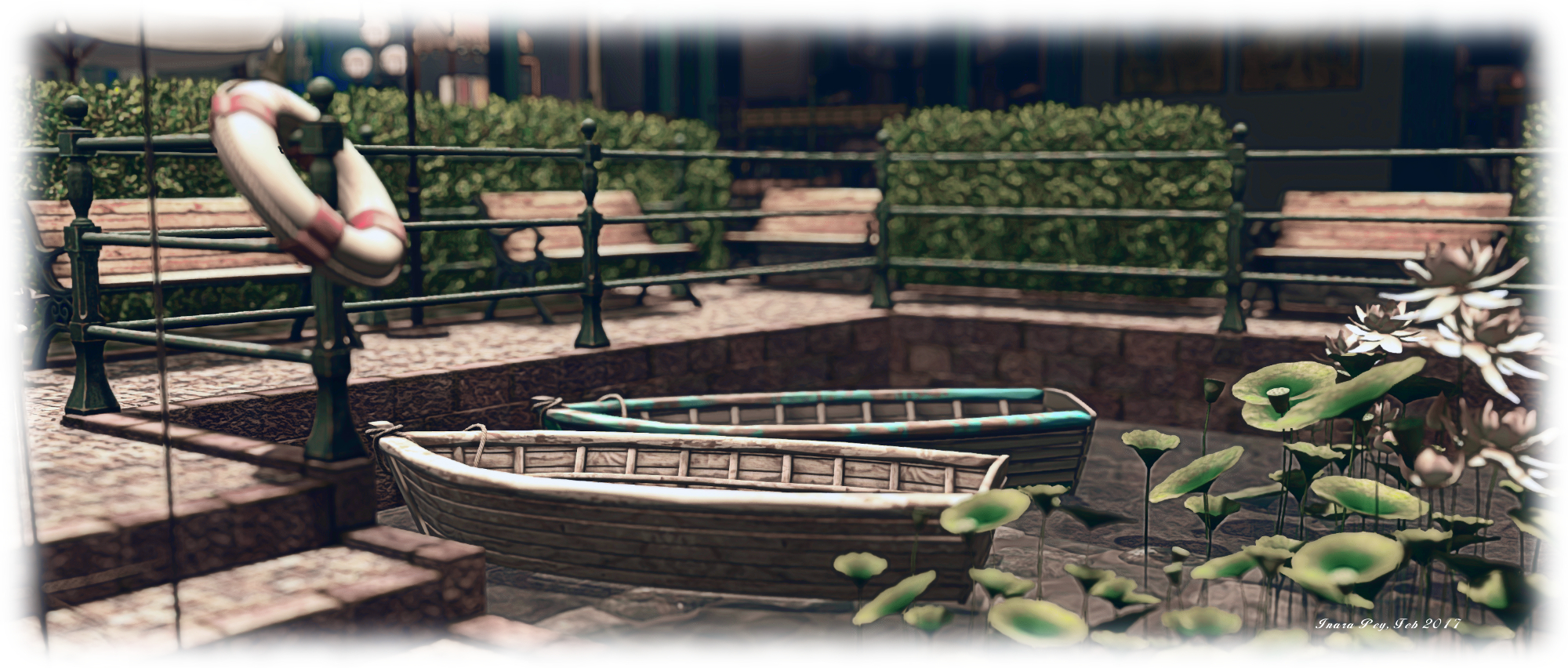
The level of detail packed into it is exquisite, from the richness of the trees, shrubs and plants, to the little vignettes such as the lilies and rowing boats, to the cats which sit in indifference to the world or watch from roof or corner, all the way to the many little touches which bring this scene to life in so many ways.
If you are looks for a photo location with a personality of its own, or a place where you can while away the time with a friend or loved one – then take a Long Journey, I promise you will not be disappointed. Our thanks to Shakespeare (once again! 🙂 ).
There are many, many activities you can try in Second Life which you may not by able to participate in or enjoy in the physical world. For me this has meant – among other things – playing the odd round of golf (a game I am not overly fond of outside of SL!).
I first tried my hand at a full 18-hole golf course in 2014, when I visited the AERO Golf Club (you can read about that visit here). As I hadn’t been golfing for a while, I suggested to Caitlyn we give it a try together. Given the last time I visited AERO was in mid-2015, it seemed natural for us to head there.
I have no idea how many golf systems are available in Second Life, but the one employed by AERO is very easy to get to grips with and enjoy. The course itself – the work of Kaja Ashland and Marcus Bremser – is very well laid-out, and was last redesigned in (I think) 2015. Visitors arrive on the east side of the region, on the front terrace of the clubhouse. A quick walk through to the back terrace will take you past the pool and to the golf shack tucked into a corner where you can pick-up your clubs, HUD and scorecard.
There are no fees for playing at AERO, but you will need to join the in-world group. When you have done so, touch the golf bag in the hut to receive your club (actually three in one), HUD and scorecard. Wear / add all three, and you are set to go! The first tee is just a short walk from the hut; a par 4, it takes you down the length of the canal which almost cuts the course in two.
Game play is a case of selecting your teeing spot between the two markers, selecting your club type from the HUD (driver, obviously when teeing-off), and then taking note of the wind speed and direction (indicated by a particle cloud which appears next to you when you select your club). The LEFT and RIGHT arrow keys can then be used to adjust the angle at which you will strike the ball (indicated by a pointer on the ground) to compensate for the wind and get your ball down towards the green. Then it is a case of making sure the cursor is over the ground and then clicking and holding the left mouse button to both commence your swing and select the force with which you hit the ball (indicated by a power bar). Releasing the mouse button completes your swing.
AERO Golf Club: about to chip the ball onto the green. Note the wind speed cloud and direction pointer
The flight of a ball is indicated by a line. By default, this is white, but you can use the Settings option on the HUD to select a preferred colour – handy when playing in a group. Additional strokes are played the same way, with the option of using a wedge for chipping up onto a green or getting out of a bunker, and a putter when on the green. Throughout it all your scorecard will track your shots and keep score.
The holes themselves vary in difficulty – and shorter par holes are not necessarily easier than those with a dog leg or other obstacle: the shorter par needs a steady finger on the strength of your swing or you can end up well into the rough on the far side of the hole!
The eleventh hole has a wicked shot across a bay which cuts into the course, requiring you select your teeing-off spot with care. Should your ball fall into the water at any time, the easiest thing is to remain where you are and try again.
One might argue that it would be nice to have a wider selection of clubs – particularly if you are a golfer – than just the driver, wedge and putter. But the truth is, these are more than adequate and mean that a round of golf is enjoyable without becoming taxing or complicated for the occasional / novice player.
I do have a couple of very small tips: if you use an over-the-shoulder camera view by default, you might want to centre your camera up when playing to get an more accurate view of the ground pointer. Also, if you have double-click to teleport enabled, you might want to turn it off; I carelessly mis-clicked on a putt and ended up attempting to teleport on the spot and lost a stroke.
As well as the 18 holes, AERO offers a poolside terrace and an indoor bar for socialising after a game. The cliff-sided bay I mentioned above has a small beach offering deck chairs and loungers, and there are several points around the course where you can take a break from play and enjoy a chat. You can also break-off from a round if the physical world or other requirements intrude; your card will retain your score and progress. However, the clubs are time-limited; should you return and find they have expired, simply obtain a new HUD, club and scorecard from the golf shack, and use the clubs / HUD with your “old” scorecard, and you’ll be able to finish your round.
Should you enjoy your time at AERO, do consider making a donation towards the upkeep of the course, and if you end up playing regularly there, you might want to purchase the pro scorecard – again, the fee goes towards the course.
AERO Golf Club is one of several scattered across Second Life and offers a fun way to enjoy golf in Second Life amidst gorgeous surroundings. Other clubs can be found in the Sports & Hobbies section of the Destination Guide (and doubtless elsewhere in the DG as well!).
Today, the telephone – in the form of pocket-sized smartphones – is an essential part of most people’s every day life. Looking at one, it is hard to imagine how far the technology behind this means of long-distance communication has come since its birth in the 1870s.
Of course, we all know something of the history of the telephone, with names like Alexander Graham Bell and Elisha Grey (if not poor Antonio Meucci) being familiar to many of us, if only as a result of our school days. But what is it’s real story? How did the early telephones work? what have been the various eras of the ‘phone?
Denzel Coy brilliantly and charmingly answers these questions in Second Life through his Telephone Museum. Within it, visitors can explore the telephone’s entire history, from its beginnings with the unfortunate Meucci, the unlucky Grey and the fortunate Bell, through the first box systems, to candlesticks and on to the rotary era – all the way up to the modern cellphone.
This is a fabulous environment for anyone interested in history or technology as well as the telephone. On displays are around 50 exquisitely crafted telephones from the last 140 years, made by a number of Second Life creators – Raya Jonson, Jin Zhu, Zaida Gearbox, Neotoy Story and Plato Novo, to name but a handful, as well as Denzel himself. Alongside of them are information boards complete with audio playback capabilities, allowing visitors to read or hear the information they contain, together with reproductions of adverts for telephones from the different eras, and more.
The displays are laid out around two levels, with the lower progressing from information on Meucci, Grey and Bell, through to the arrival of rotary dial telephones in the 1920s. These displays are all offered around a model of the very first telephone device from 1876. From here, visitors can progress to the mezzanine level, and the history of the telephone from the 1950s through to the present day, with a brief detour into the world of the military field telephone.
As well as the audio capabilities, the museum includes a number of interactive elements – including the display case of the aforementioned 1876 device being alarmed against theft! There is also a gacha station, where visitors can obtain a number of items, including some rare models of the ‘phones on display and the Telephone Museum Ultimate Guide. There is also a trivia competition on the main floor, where people can test the knowledge they’ve gained during their visit.
This is a superb exhibit to visit, perfectly presented in an environment designed by Denzel. Informative and educational, it is also entertaining and offers another look at just how exquisite mesh models can be in Second Life.
Shareta Osumai Tea Gardens – links in article; click any image for full size
As we all know, the Moles are the resident builders of Second Life who form the Linden Department of Public Works (LDPW). They take care of all the major Mainland infrastructure projects, up to and including activity locations such as PaleoQuest, The Horizons Experience, and other reached via the Portal Parks.
February tends to be Mole Month, with the annual Mole Day taking place in Bay City, celebrating the work of the Moles. 2017 has also been especially poignant for the Moles, as their long-term Mole-In-Chief, Linden Lab’s own Michael Linden, departed the company for pastures new. This being the case, I thought I’d take a little time out occasionally to visit some of the more notable Mole builds in Second Life which may not be as obvious as the “big” places like the Horizons Experience – and a good place to start, thanks to an indirect nudge from Kinnaird Flachra, seemed to be the Shareta Osumai Tea Gardens.
Shareta Osumai Tea Gardens
The Tea Gardens can be found in three locations in Second Life: in the Premium East continent (which also includes Cape Ekim, and the mystery of dragons and Professor Linden, which I first visited far back in 2013), and at Premium South 2 and Premium South 3. All three locations, unsurprisingly, are identical, and form part of the hub for the Japanese themed Linden Homes.
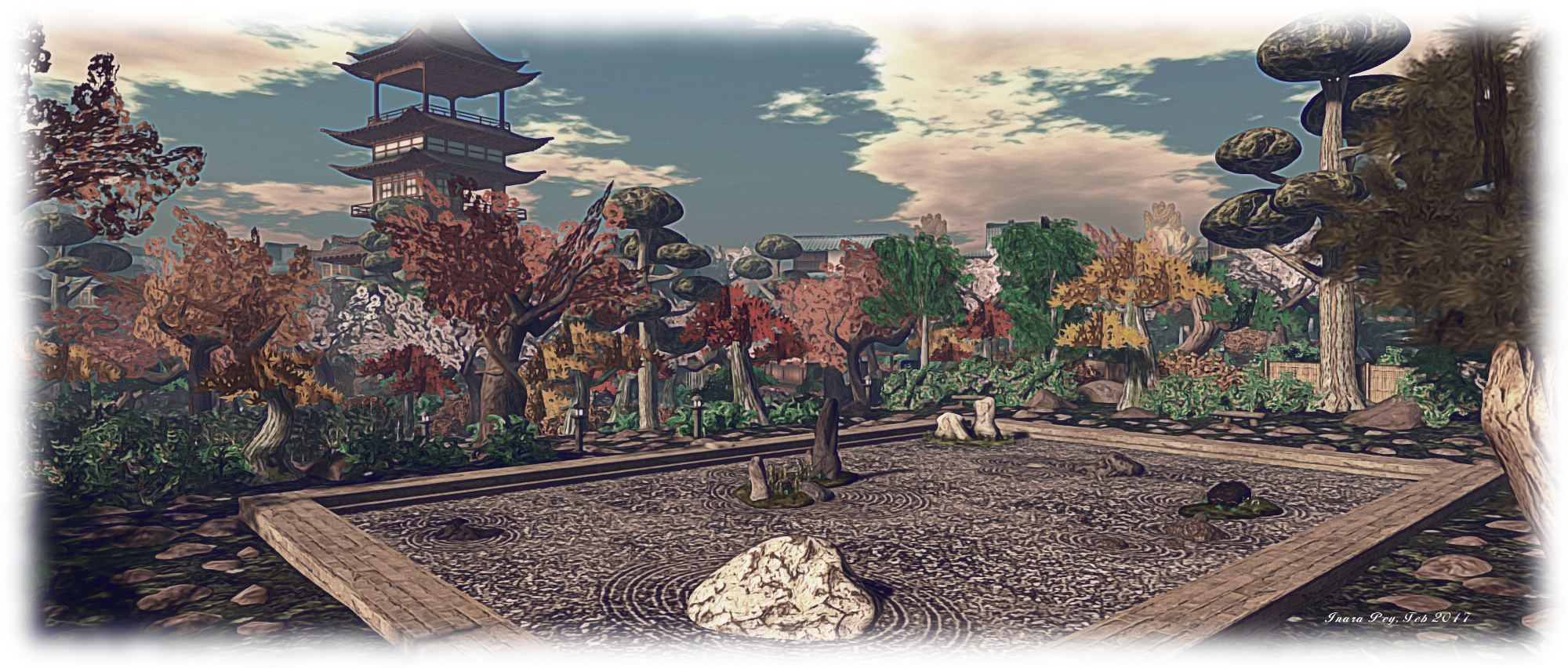
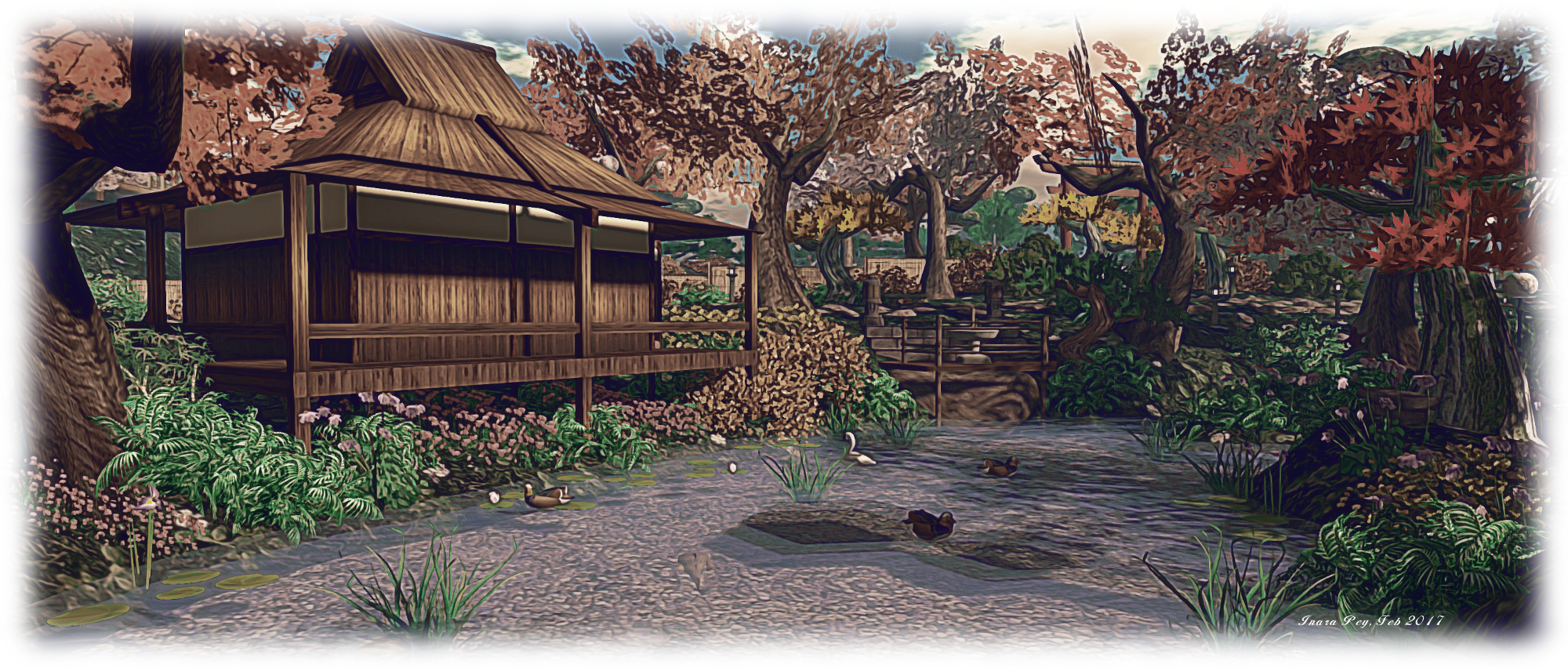
The major feature of the gardens is the pagoda tea house which sits alongside and ornamental pond fed by a stream which tumbles and meanders down from nearby uplands. The tea house is set within a fenced garden, filled with autumnal trees and offering cobbled paths for wandering, the stream cross by delicately arched bridges, and with a small sand garden or meditation. Those not wishing to walk can catch a ride around the garden on a mole-pulled ricksaw.
Shareta Osumai Tea Gardens
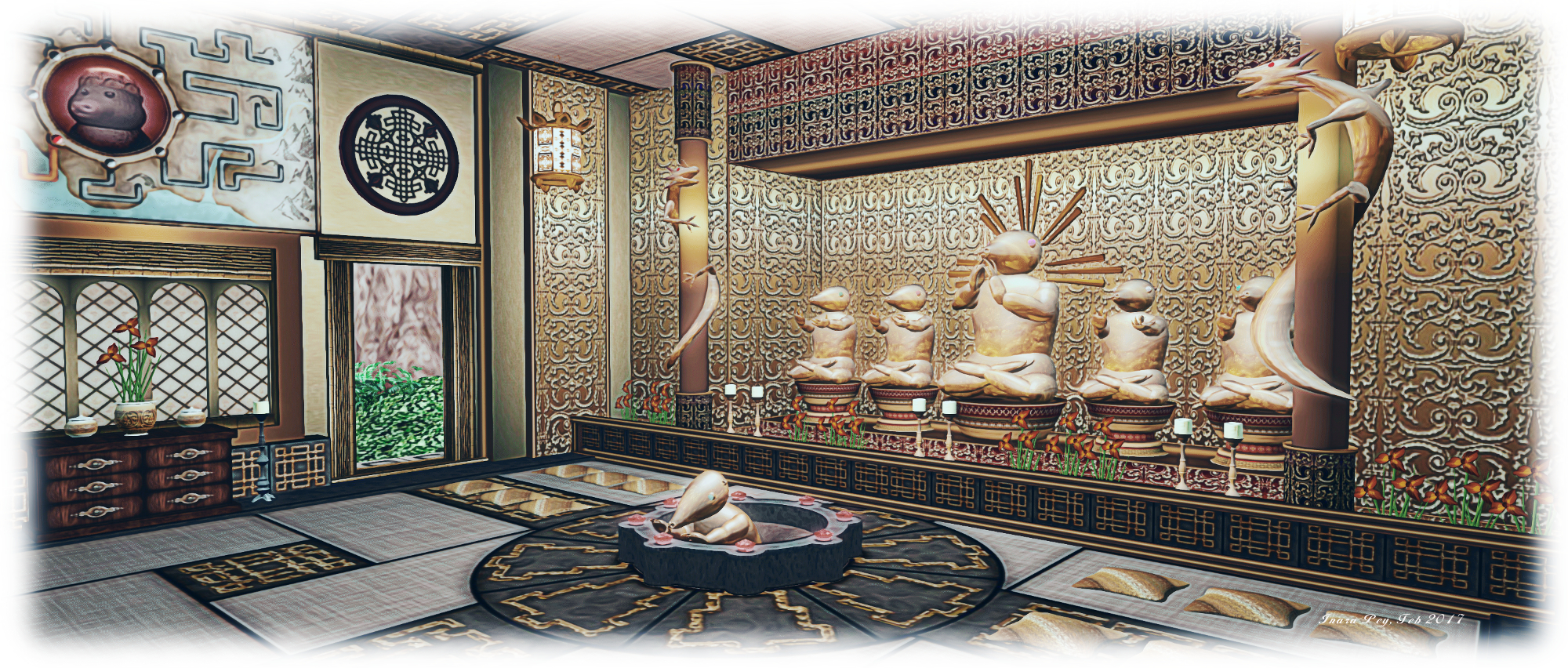
Beyond the garden is a broader area of trees and cobbled walks to be enjoyed and, northwards, lies a path winding up into the hills to the local Info Hub, where various freebies can be obtained and people can learn about Linden Homes. This path, winding via stone steps, also leads the way via Mole Temple – which (and while it didn’t contain anywhere near as many statues) reminded me a little of the Temple of 10,000 Buddhas, Shatin, Hong Kong.
It’s easy to be dismissive of the Linden Home continents – I’m not a great fan of many of the house styles myself, and do find myself wishing more was done to blend the edges of some more naturally into the sea where they form the edge of the grid – but areas such as the Shareta Osumai Tea Gardens, Cape Ekim and others scattered across these regions offer little gems awaiting discovery.
Brique Zeiner (Brique Topaz in SL), the driving force behind Feed A Smile and some of the Kenya children from poor families for whom the programme provides daily warm meals
We’ve made another small but important change at Holly Kai Park. Following discussions with Brique Topaz of Feed A Smile, we’re very pleased to announce that from February 2017 onwards, Holly Kai Park is an official supporter of Feed A Smile.
Feed A Smile is a programme run by Live and Learn Kenya (LLK) to provide nutritious warm lunches for over 400 children every day, paid for entirely from donations to the project – and over a third of the money comes from donations made by Second Life users. It is part of a broader programme managed by LLK, which includes finding sponsors to finance the education of children in Kenya, helping to provide them with everything they need: uniforms, shoes, text books, school supplies, etc., and even building a school in Nakuru, Kenya.
In addition, the organisation also provides medical and dental care for children, including check-ups and vaccinations. 100% of the donations received by LLK are transferred directly to Kenya to care for children, provide education, medicine, food, shelter and foster care. Nothing is lost to salaries, fees or administrative costs at LLK.
The Feed A Smile kiosk just inside the entrance to Caitinara Bar
To mark this modest collaboration, we have located a number of Feed A Smile donation kiosks around the key venues and locations in the park: the landing point, at the stage area on the Art Hill, at the Pavilion live events venue and, of course, in Caitinara Bar. We very much hope that when visiting the park, should you enjoy your time, you will consider making a donation to Feed A Smile in lieu of the more usual venue tips (we prefer not to take venue tips at the park).
Also, as we do not charge for the use of our venue spaces, we also ask that anyone booking and using them to please consider a donation to Feed A Smile / advertising the boards during their event.