Space Sunday: Jupiter, Enceladus and Ceres; SLS, SpaceX and Dream Chaser

This stunning enhanced colour images of Jupiter's south polar region was captured by the JunoCam instrument aboard the Juno spacecraft on February 2nd, 2017. It reveals a complex series of interactions occurring in the fast-spinning atmosphere
This stunning enhanced colour images of Jupiter’s south polar region was captured by the JunoCam instrument aboard the Juno spacecraft on February 2nd, 2017. It reveals a complex series of interactions occurring in the fast-spinning atmosphere. Credit: NASA/JPL / SwRI

Following its latest close flyby of Jupiter – passing just 4,200 km (2,600 mi) above the gas giant’s cloud tops on February 2nd, 2017, NASA’s Juno mission spacecraft is now heading away from the planet once more and the next of its 53.5 day orbits. As I’ve previously reported in these Space Sunday columns, the original plan had been to use one of these close passes over the planet (October 2016), in conjunction with a sustained burn of the spacecraft’s British-built rocket motor, to move it into a short, 14-day period orbit around Jupiter.

However, a potential fault detected within the engine system meant the October burn was cancelled, and since then, engineers had been trying to assess if the issue  – a set of faulty valves – could be overcome, and the consequences of attempting an additional engine burn if not. No definitive answer has been found and so, following the February 2nd flyby, the decision was taken to cancel all plans for the engine burn and leave the spacecraft in its current 53.5 day orbit around Jupiter.

Doing so doesn’t compromise the overall mission objectives, but it does reduce the number of close passes over Jupiter the vehicle can make. If the reduced orbital period had been possible, the spacecraft would have made some 30 close flybys over Jupiter’s cloud tops during the primary mission period, set to end in July 2018. Remaining in the 53.5 day orbit means it will only make around 12 such close flybys in the same period.

The Juno spacecraft was supposed to complete two 53-day orbits around Jupiter, then lower its orbit Oct. 19 to fly around the planet once every 14 days. That engine burn has been postponed. Credit: NASA / JPL
The Juno spacecraft was supposed to complete two 53.5-day orbits around Jupiter in July and August 2016 (shown in green), before using its main engine to brake itself into a 14-primary science orbit (shown in blue). Due to continued concerns about the vehicle’s engine unit, the decisions has now been made to leave it in the 53.5 day orbit. Credit: NASA / JPL

A positive point with the spacecraft remaining in its more extended orbit is that it will spend less time within the harsher regions of Jupiter’s radiation belts, and could thus remain active for longer than the primary mission period – and mission planners are already considering applying for further funding to allow the mission to extend beyond July 2018. It also means that the spacecraft will be able to engage in additional science activities.

The close encounters with Jupiter have already allowed the spacecraft to probe deep within the planet’s cloud belts and discover they extend far deeper into the planet’s atmosphere than had been imagined, and that Jupiter’s magnetic field and auroras are more powerful than previously thought.

“Juno is providing spectacular results, and we are rewriting our ideas of how giant planets work,” Juno principal investigator Scott Bolton, of the South-west Research Institute in San Antonio, Texas, said of the decision to leave the spacecraft in its current orbit. “The science will be just as spectacular as with our original plan.”

NASA Considering Crewed Option for Orion / SLS First Launch

NASA is considering making the first launch of its new Space Launch System (SLS) rocket, currently slated for September 2018, a crewed mission.

Under the agency’s existing plans, the first launch of the new rocket, topped by an Orion Multi-Purpose Crew Vehicle and dubbed Exploration Mission 1 (EM-1), would have seen SLS send an uncrewed Orion vehicle to the Moon and back, with around 6 days spent in lunar orbit. A crewed flight of the SLS / Orion combination would not take place until at least 2021, when crew would use Orion to rendezvous to a small asteroid previously captured via robotic means and moved to an extended orbit around the Moon – an idea which has garnered a certain amount of criticism from politicians.

An artist's impression of a Space Launch System / Orion combination lifting off from Kennedy Space Centre's Pad 39B. Credit: NASA
An artist’s impression of a Space Launch System / Orion combination lifting off from Kennedy Space Centre’s Pad 39B. Credit: NASA

If approved, the new proposal – put forward by NASA’s Acting Administrator, Robert Lightfoot – would see the planned EM-1 mission pushed back to 2019 (allowing the Orion vehicle to be outfitted with the crew lift support and flight systems) and flown with a crew of two. While this would mean a delay in the initial launch of SLS / Orion, it could ultimately accelerate NASA’s plans, allowing the agency to present a wider choice of crewed missions in the 2020s, and respond to criticism that it is not doing enough to demonstrate how it plans to achieve a return to the Moon and / or  missions to Mars.

Enceladus: Cradle for Life?

On February 17th, 2005 NASA’s Cassini space probe, part of the Cassini / Huygens mission, made its first flyby of Saturn’s moon Enceladus.

Scientists were naturally curious about the 500 km (360 mi) diameter moon, which is the most reflective object in the solar system, but assumed it was essentially a dead, airless world. However, Cassini immediately found this was not the case.

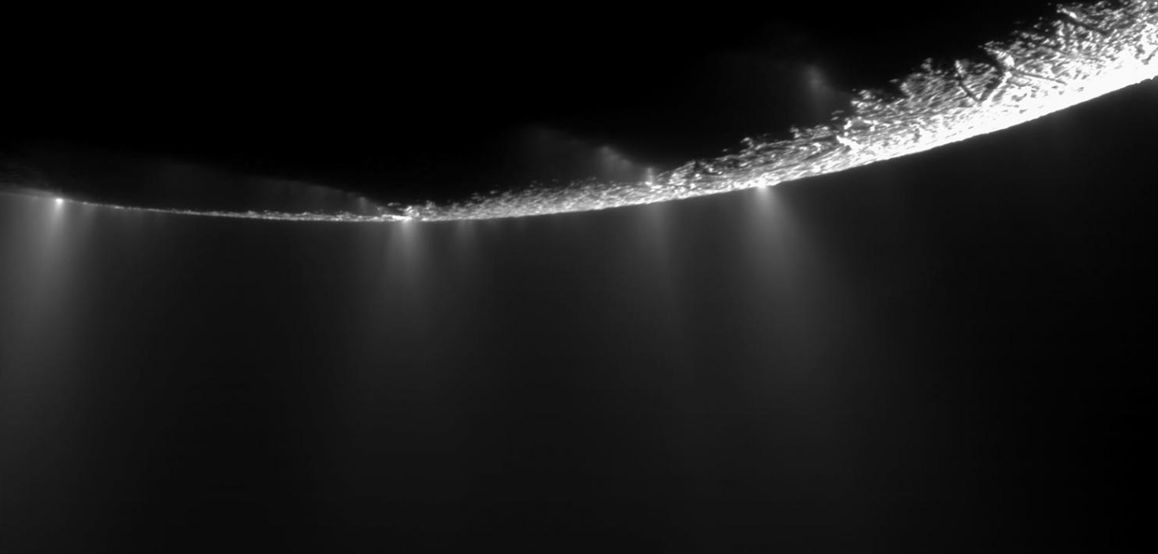
A dramatic plume sprays water ice and vapor from the south polar region of Saturn's moon Enceladus. Cassini's first hint of this plume came during the spacecraft's first close flyby of the icy moon on February 17, 2005. Credit: NASA/JPL / Space Science Institute
A dramatic plume sprays water ice and vapour from the south polar region of Saturn’s moon Enceladus. Cassini’s first hint of this plume came during the spacecraft’s first close flyby of the icy moon on February 17, 2005. Credit: NASA/JPL / Space Science Institute

The first thing that happened was the magnetometer on the spacecraft revealed that Saturn’s magnetic field, which envelops Enceladus, was perturbed above the moon’s south pole in a way that didn’t make sense for an inactive world – it was as if there was some interaction with an atmosphere.

In the second flyby, a month later, Cassini found the interaction seemed to suggest a plume of water vapour was rising from the moon. Then, in the third flyby, in July 2005, the probe imaged geysers of water vapour erupting from the moon’s south polar region, and thus Enceladus became the target of intense study. So much so, that while only those initial 3 flybys of the moon had been a part of the primary Cassini /Huygens mission profile, the mission was updated to allow 20 more flyby of the moon.

Today, we know that beneath the mantle of ice enclosing Enceladus there is an ocean of liquid water – the geysers are the results of that water breaking through this ice and jetting into space, giving rise to Saturn’s E-ring in the process. This ocean is likely to be warmed and kept liquid by hydrothermal vents on the sea floor, and these in turn – just like the vents theorised to be on the ocean floor of Jupiter’s Europa – might provide all the ingredients for basic life to arise.

To celebrate the 12th anniversary of Cassini’s discoveries with Enceladus, NASA has released a video documenting those initial findings from 2005.

Continue reading “Space Sunday: Jupiter, Enceladus and Ceres; SLS, SpaceX and Dream Chaser”

Space Sunday: Martian quandaries, universal epochs and Jovian journeys

"Yellowknife Bay" a region examined by the Curiosity Rover in 2012/13 indicated that a lake was once present in Gale Crater. However, the same rock has revealed that potentially, there was not sufficient carbon dioxide present in the atmosphere to help keep the water unfrozen
“Yellowknife Bay” a region examined by the Curiosity Rover in 2013 indicated that a lake was once present in Gale Crater. However, the same rock has revealed that potentially, there was not sufficient carbon dioxide present in the atmosphere to help keep the water unfrozen. Credit: NASA

Mars scientists are wrestling with a problem. Ample evidence says ancient Mars was sometimes wet, with water flowing and pooling on the planet’s surface. Yet, the ancient sun was about one-third less warm and climate modellers struggle to produce scenarios that get the surface of Mars warm enough for keeping water unfrozen.

A leading theory is that ancient Mars had a thicker carbon-dioxide atmosphere forming a greenhouse-gas blanket, helping to warm the surface. However an analysis of data from NASA’s Mars rover Curiosity, suggests that even 3.5 billion years ago there was too little carbon dioxide present in the Martian atmosphere to provide enough greenhouse-effect warming to prevent water freezing.

The source of these findings is the very same bedrock in which the rover found sediments from an ancient lake in which microbes might have thrived. When analysing the bedrock, Curiosity detected no carbonate minerals, leading to the conclusion that Mars’ atmosphere was almost devoid of carbon dioxide when the lake existed 3.5 billion years ago. And that’s a quandary for scientists.

Curiosity took this selfie while at "Yellowknife Bay" in 2013 whilst gathering rock samples for analysis. Note that while the shadow of the rover's robot arm can be assn, the arm itself is blanked from the images purely as a result of the angles used in individual shots and the way the images have been stitched together to provide a view of the rover
Curiosity took this selfie while at “Yellowknife Bay” in 2013 whilst gathering rock samples for analysis. Note that while the shadow of the rover’s robot arm can be seen, the arm itself is blanked from the images purely as a result of the angles used in individual shots and the way the images have been stitched together to provide a view of the rover. Credit: NASA

“We’ve been particularly struck with the absence of carbonate minerals in sedimentary rock the rover has examined,” Thomas Bristow, the principal investigator for Curiosity’s Chemistry and Mineralogy (CheMin) instrument,  the primary source of the analysis work. “It would be really hard to get liquid water even if there were a hundred times more carbon dioxide in the atmosphere than what the mineral evidence in the rock tells us.”

In water, carbon dioxide combines with positively charged ions such as magnesium and ferrous iron to form carbonate minerals, and CheMin can identify carbonate if it makes up just a few percent of the rock. Yet Curiosity has made no definitive detection of carbonates in any lakebed rocks sampled since it landed in Gale Crater in 2012. However, other minerals – magnetite and clay minerals – not only indicated in the same rocks indicate the ions needed to form carbonates were readily available, they also provide evidence that subsequent conditions never became so acidic that carbonates would have dissolved away over time.

The dilemma between a warm, wet Mars and the lack of carbonates has actually been growing for years. For two decades researchers have been using spectrometers on Mars orbiters to search for carbonate that could have resulted from an early era of more abundant carbon dioxide in the atmosphere, only to find far less than anticipated. Yet clues such as isotope ratios in today’s Martian atmosphere continue to indicate the planet once held a much denser atmosphere than it does now, which has largely been seen as being rich in carbon dioxide. Thus, a paradox has arisen.

Curiosity uses a spectrometer on its robot arm to check a rock dubbed "John Klein" in "Yellowknife Bay" for its suitability as a drilling target, January 25th, 2013. The drill itself can be seen on the robot arm's "hand", pointing up and to the right
Curiosity uses a spectrometer on its robot arm to check a rock dubbed “John Klein” in “Yellowknife Bay” for its suitability as a drilling target, January 25th, 2013. The drill itself can be seen on the robot arm’s rotating “hand”, pointing up and to the right. Credit: NASA

It had been thought that the lack of evidence for carbonates when seen from orbit could simply be the result of  dust covering them, or the carbonates having moved underground. Finding them would thus resolve the paradox and reveal what had happened. However, the Curiosity results tend to overturn this idea. Simply put, the rover has failed to detect carbonate minerals precisely where they should be located, within rocks formed from sediments deposited under water.

“This analysis fits with many theoretical studies that the surface of Mars, even that long ago, was not warm enough for water to be liquid,” said Robert Haberle, a Mars-climate scientist at NASA Ames. “It’s really a puzzle to me.”

One idea put forward is that perhaps the lake was never a body of open water, but was covered in ice. The problem with this idea is none of the expected evidence for an ice-covered lake, such as large and deep cracks called ice wedges, or “dropstones,” which become embedded in soft lakebed sediments when they penetrate thinning ice, have been found. Thus, scientists have a lot of head scratching and theorising to do in order to make sense of the dilemma.

Traversing Mars with Curiosity

A simulated Curiosity rolls over the "Naukluft Plateau" in this still from Seán Doran's video simulation of the rover's traverse
A simulated Curiosity rolls over the “Naukluft Plateau” in this still from Seán Doran’s video simulation of the rover’s traverse. Credit: Seán Doran

Ever wondered what it would be like to witness Curiosity trundling across the surface of Mars? Seán Doran has. What’s more, he’s been putting together animated films using Digital Terrain Model (DTM) data from the HiRISE imaging system on NASA’s Mars Reconnaissance Orbiter together with photomosaics of images from the rover, and combining them with a drivable correctly scaled model of the rover to provide movies of Curiosity as it rolls across Mars.

Continue reading “Space Sunday: Martian quandaries, universal epochs and Jovian journeys”

Space Sunday: remembrance and the future

Credit: NASA

The end of January / beginning of February is a time of pause and reflection for the American space programme and NASA. A span of five days, spread across a 36-year period, mark the three greatest tragedies of US human space flight, and so this period is always marked as a time of remembrance.

I’ve marked these three events – the Apollo 1 fire of January 27th, 1967, the Challenger disaster of January 28th, 1986 and the loss of the Columbia on February 1st, 2003 – in past Space Sunday updates. However, January 27th, 2017 marked the 50th anniversary of the Apollo 1 fire, which claimed the lives of Command Pilot Virgil I. “Gus” Grissom, Senior Pilot Edward H. White II, and Pilot Roger B. Chaffee in just 16 seconds. To mark it, and the start of NASA’s period of remembrance, the US space agency unveiled a new Apollo 1 tribute in its visitor complex at the Apollo/Saturn V Centre.

The Apollo 1 astronauts remembered at the Space Mirror Memorial, Kennedy SPace Centre's visitor centre
The Apollo 1 astronauts remembered at the Space Mirror Memorial, Kennedy Space Centre’s visitor centre. Credit: NASA

Grissom, White (the first American to walk in space during the Gemini 4 mission in 1965), and rookie Chaffee were participating in a “plugs out” test of the Apollo Command module intended to determine whether the vehicle was fit to fly at a time when many in NASA – Grissom included – felt it was not (Grissom had once famously hung a lemon in the Command Module simulator during training to signify his dissatisfaction with the state of the vehicle’s development).

It should have been a routine launch pad test of the vehicle the crew were due to fly in the first crewed test of Apollo in the run-up to a lunar landing. Instead, a spark from faulty wiring combusted the oxygen-rich atmosphere, causing a flash fire. This, aided by the many flammable materials used in the construction of the vehicle caused the air pressure inside the vehicle to rapidly rise, sealing the cabin’s inward opening hatch so that the crew could not open it themselves.

The deaths of these three men ultimately made Apollo – and the US space programme itself – far safer for those going into orbit. Flammable materials were all but eliminated from designs wherever possible; the atmosphere used within vehicles was altered so as not to be oxygen-rich, reducing the risk of fires rapidly building up and spreading; exit hatches were all changed so they would open outward, and the mechanisms for opening them either from within or without a vehicles were designed to be as simple and direct as possible.

To mark the 50th anniversary of the fire, NASA has placed the most significant part of the Apollo 1 vehicle – the hatch – on public display, with the full blessings of the surviving members of the astronaut’s families. It is a belated addition to similar exhibits of both the Challenger and Columbia accidents were placed on public display over 18 months ago in order to more fully commemorate those incidents.

All three disasters are commemorated at the Space Mirror Memorial  at the Kennedy Space Centre. However, while both Challenger and Columbia are also marked by memorials at America’s Arlington National Cemetery, no similar memorial currently exists for Apollo 1 (although Grissom and Caffee are interred there – White is interred at the West Point Cemetery). So, as a further mark of the 50th anniversary of the fire, Representative Eddie Bernice Johnson (D-Texas) has re-introduced a bill to Congress to have an Apollo 1 memorial established at Arlington.

The Challenger and Columbia memorials, Arlington National Cemetery
The Challenger and Columbia memorials, Arlington National Cemetery. Credit: Arlington National Cemetery

Apollo 1, Challenger and Columbia, together with a loss of life which occurred during the Soviet manned space programme, serve as a reminder to all of us that space exploration is still a dangerous undertaking, despite all of the “shit sleeve” images we see of people working aboard the International Space Station. But then, all acts of expanding the human frontier carry with them inherent risks and the potential for loss of life.

This doesn’t mean we should shirk such activities or retreat from them; the rewards are simply too great, not only in terms of our potential to learn and grow and ensure our continuance as a species, but also to out ability to mature as a species and reach beyond the petty nationalisms and narrow-minded thinking which plague so much of what happens in the world today.

Remembering; Apollo 1 (top): Virgil "Gus" Grissom, Edward H. White II, and Roger B. Chaffee; STS-51l (Challenger - left): Sharon Christa McAuliffe, Gregory Jarvis, Judith Resnik, Francis "Dick" Scobee, Ronald McNair, Michael J. Smith and Ellison Onizuka; STS-107 (Columbia, right): David M. Brown, Rick Husband, Lauren Blair Salton Clark, Kalpana Chawla, Michael Anderson, William McCool, and Ilan Ramon. All images credit: NASA
Remembering; Apollo 1 (top): Virgil “Gus” Grissom, Edward H. White II, and Roger B. Chaffee; STS-51l (Challenger – left): Sharon Christa McAuliffe, Gregory Jarvis, Judith Resnik, Francis “Dick” Scobee, Ronald McNair, Michael J. Smith and Ellison Onizuka; STS-107 (Columbia, right): David M. Brown, Rick Husband, Laurel Blair Salton Clark, Kalpana Chawla, Michael P. Anderson, William C. McCool, and Ilan Ramon. All images credit: NASA – click for full size

NASA’s official Day of Remembrance will be held on Tuesday, January 31st, 2017. With it comes the opportunity to not only look back to the sad events of January 27th, 2967, January 28th, 1986 and February 1st, 2003, but also to look forward to what might yet be achieved for all of human kind. Which is why I’m once again quoting Francis “Dick” Scobee, Commander of Challenger mission STS-51L, lost on that cold January morning in 1986.

Words: Francis Scobee via June Rodgers (formerly June Scobee). image: NASA

Continue reading “Space Sunday: remembrance and the future”

Space Sunday: the last man on the Moon

Eugene Andrew "Gene" Cernan, Commander, Apollo 17, in the Taurus-Littrow valley, December 1972
Eugene Andrew “Gene” Cernan, Commander, Apollo 17, in the Taurus-Littrow valley, December 1972. Credit: Harrison Schmitt / NASA via Getty / AFP

Eugene Andrew “Gene” Cernan, Captain, United States Navy (retired) and former NASA astronaut, passed away on Monday, January 16th 2017 at the age of 82. The commander of Apollo 17, he was – and currently remains – the last man to walk on the surface of the Moon, in what was arguably the most significant of the Apollo lunar missions.

Born in Chicago, Illinois in March, 1934, he attended Purdue University, Indiana, where he gained a Bachelor of Science degree in Electrical Engineering in 1956. While at the university. he took a commission as an Ensign in the U.S. Naval Reserve Officers Training Corps. Following his graduation, he attended U.S. Naval Flight Training, qualifying as an attack pilot, and went on to log more than 4,000 flying hours in jet aircraft and completed over 200 aircraft carrier landings.

In 1963, Cernan completed his education under the auspices of the US Navy, obtaining a Master of Science degree in Aeronautical Engineering from the  U.S. Naval Postgraduate School. Later that same year, he was selected by NASA as a part of their third intake of Astronaut Candidates, and participated in both the Gemini and Apollo programmes.

His first flight into space, aboard Gemini 9A started with a tragedy. The original Gemini 9 flight had been scheduled for Elliot See and Charlie Bassett. However, when they were unfortunately killed when their NASA aircraft crashed at the end of February 1966, the mission was re-rostered as Gemini 9A, and Cernan and his flight partner, Thomas Stafford, were promoted from back-up to prime crew.

Gemini 9A was to prove a mission plagued with misfortune. The first attempt to launch the mission, in May 1966 had to be scrubbed when the uncrewed Agena Target Vehicle Gemini 9A would rendezvous and dock with once in orbit  was lost not long after launch. This required a delay while a second Agena was prepared for flight, being launched on June 1st, 1966. However, once in orbit, telemetry from the vehicle suggested a launch shroud had not been correctly jettisoned.

On approaching the Agena following their launch on June 3rd, Stafford and Cernan confirmed the sections of the shroud, although open, had failed to detach, leaving the vehicle looking – in Stafford’s words – “Like an angry alligator out here rotating around”. He and Cernan indicated they were willing to carefully approach the Agena and try to nudge the shroud elements clear of the docking adapter, but mission control nixed the idea, fearing the Gemini vehicle might be damaged in the process. Instead, the crew rehearsed docking runs with the target vehicle and tested rendezvous abort procedures.

The "angry alligator" of the Agena target vehicle with launch shroud elements still attached, as seen from Gemini 9A on June 3rd, 1996. The nose of the Gemini vehicle can be seen at the top of the image, and the craft were some 20.3 metres (66ft) apart
The “angry alligator” of the Agena target vehicle with launch shroud elements still attached, as seen from Gemini 9A on June 3rd, 1996. The nose of the Gemini vehicle can be seen at the top of the image, and the craft were some 20.3 metres (66ft) apart. Credit: NASA

On the third day of the flight, Cernan became the third man (and America’s second) to walk in space. However, this part of the mission also proved troublesome. The Gemini spacesuits were not water-cooled, and had to be “inflated” prior to egressing the vehicle. Cernan found the latter made the suit almost completely inflexible and a serious impediment to his movement. This meant he had to exert himself a lot more, and because the suit had no proper cooling, he face the genuine risk of suffering heat prostration.

Nor was this all; the build-up of heat meant his helmet faceplate fogged to the point where he could barely see, and there were serious concerns about him getting back into the Gemini. His EVA was  curtailed without all goals being met, and after 128 minutes in space, Cernan eventually made it back inside the spacecraft. As a result of this experience, the Apollo spacesuits were redesigned to incorporate an undergarment using a water circulation system to cool the wearer – and approach still used in modern space suits.

Cernan next flew in space in May 1969 as part of the final Apollo dress-rehearsal mission for an actual landing on the Moon. Apollo 10, which saw Cernan and Stafford again fly together, and joined by John Young, became the second crewed mission to orbit the Moon (the first being Apollo 8, in December 1968), and the fourth crewed flight of Apollo overall. The focus of the mission was for Stafford and Cernan to pilot the Lunar Module to just 15.6 km (8.4 mi) above the lunar surface, gathering critical data which would allow the powered descent systems aboard future Lunar Modules to be correctly calibrated for their missions.

Gene Cernan in 1969, ahead of the Apollo 10 flight during a NASA press conference. A Snoopy toy sits next to him, indicative of the Apollo 10 lunar module call sign
Gene Cernan in 1969, ahead of the Apollo 10 flight during a NASA press conference. A Snoopy toy sits next to him, indicative of the Apollo 10 Lunar Module’s call sign. The Command Module was called Charlie Brown. Credit: NASA

In most respects, the Apollo 10 Lunar Module was fully capable of flying a mission to the surface of the Moon – it just lacked sufficient propellent in its ascent engine fuel tanks to make a successful flight back to rendezvous with the Command Module.  This later prompted Cernan to joke, “A lot of people thought about the kind of people we were: ‘Don’t give those guys an opportunity to land, ’cause they might!’ So the ascent module, the part we lifted off the lunar surface with, was short-fuelled. The fuel tanks weren’t full. So had we literally tried to land on the Moon, we couldn’t have gotten off.”

Apollo 10 reached lunar orbit on May 21st, 1969, three days after launch, and remained there for a further three days, completing the Lunar Module tests in the process, before returning to Earth. It was a mission which set both records and firsts. It was the first (and only) Apollo Saturn V mission to launch from Pad 39B at Kennedy Space Centre; it was the first (of only two, the other being Apollo 11) Apollo missions to comprise veterans of previous missions into space.

Continue reading “Space Sunday: the last man on the Moon”

Space Sunday: looking back on Earth and landing rockets and probes

The Earth and Moon, as seen from orbit over Mars, November 20th 2016

Two marbles sit on a midnight background, one a swirl of blue, white, brown and green, the other tinted in shades of grey. Together they are the Earth and her Moon as seen by the most powerful imagining system currently orbiting the planet Mars.

It is, in fact a composite image, although Earth and the Moon are the correct sizes and the correct position / distance relative to one another. The images were captured by the High Resolution Imaging Science Experiment (HiRISE) camera on NASA’s Mars Reconnaissance Orbiter (MRO) on November 26th, 2016.

The images were taken to calibrate HiRISE data, since the reflectance of the moon’s Earth-facing side is well-known. As such, this is not the first image of our home planet and its natural satellite captured from Martian orbit, but it is one of the most striking. Whilst a composite image, only the Moon’s brightness has been altered to enhance its visibility; were it to be shown at the same brightness scale as Earth, it would barely be visible. That it appears to be unnaturally close to Earth is in fact an illusion of perspective: at the time the pictures were taken, the Moon was on the far side of Earth relative to Mars, and about to pass behind it.

The image of Earth shows Australia prominent in the central area of the image, its shape just discernible in this high-resolution image, taken when Mars and the MRO were 205 million kilometres (147 million miles) from Earth.

For me, this is another picture demonstrating just how small, fragile and unique our home world actually is.

 Falcon 9 Makes Triumphant Return to Flight

With Federal Aviation Authority (FAA) approval given, SpaceX, the private space company founded by Elon Musk, made a triumphant return to flight status with its Falcon 9 launch system on Saturday, January 14th.

January 14th, 2017: the SpaceX Falcon 9, carry 10 advanced Iridium Next communications satellites in its bulbous paylod fairing, lifts-off from Space Launch Complex 4E, Vandenberg Air Force Base, California Credit: SpaceX
January 14th, 2017: the SpaceX Falcon 9, carry 10 advanced Iridium NEXT communications satellites in its bulbous payload fairing, lifts-off from Space Launch Complex 4E, Vandenberg Air Force Base, California Credit: SpaceX

SpaceX launches had been suspended in September 2016, after a Falcon 9 and its US $200 million payload were loss in an explosion during what should have been a routine test just two days ahead of the planned launch (see here for more). Towards the end of 2016, and following extensive joint investigations involving NASA and the US Air Force (The Falcon 9 was located at Launch Complex 40 at the Canaveral Air Force Station when the explosion occurred), SpaceX were confident they had traced the root cause for the loss to a failure of process, rather than a structural or other failure within the vehicle itself. However, they had to wait until the FAA had reviewed the investigation findings and approved the Falcon 9’s return to flight readiness before they could resume operations.

The January 14th launch came via the SpaceX West Coast facilities, again leased from the US Air Force, and saw a Falcon 9 booster lift-off from Space Launch Complex 4E at Vandenberg Air Force Base in California. The rocket was carrying the first ten out of at least 70 advanced Iridium NEXT mobile voice and data relay satellites SpaceX will launch over the coming months, as Iridium Communications place a “constellation” of 81 of the satellites in orbit around the Earth in a US $3 billion project.

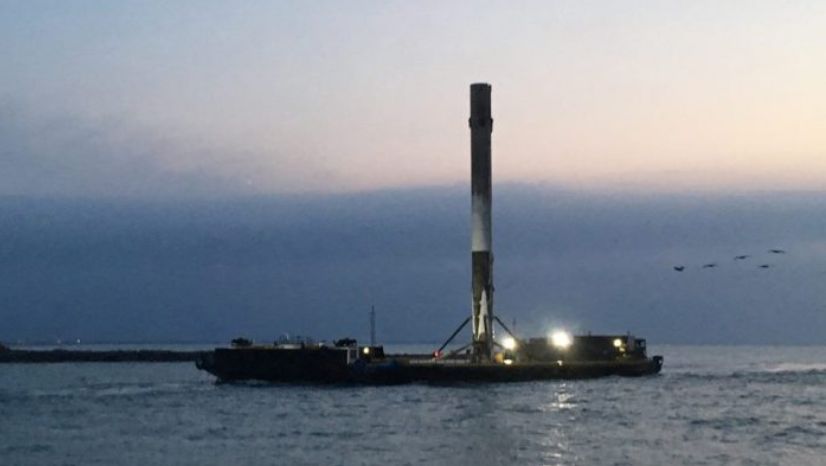
All ten satellites were successfully lifted to orbit and deployed following a pitch-perfect launch, which had to take place at precisely 9:54:34 local time (17:54:34 UT) in order for all ten satellites to be correctly deployed to reach their assigned orbits. However, all eyes were on the Falcon 9’s first stage, which was set to make a return to Earth for an at-sea landing aboard one of the company’s two autonomous drone landing barges, Just Follow The Instructions.

Down and safe: the Falcon 9 first stage, seen via a camera aboard the autonomous drone barge Just Follow The Instructions, shortly after touch-down on January 14th, 2017. Credit: SpaceX

Operating the Falcon 9 on a basis of reusability is core to SpaceX’s future plans to reduce the overall cost of space launches. While the company has previously made six successful returns and landings with the Falcon 9 first stage, this being the first attempt since September 2016’s loss added further pressure on the attempt. but in the event, it went flawlessly.

After separation from the upper stage carrying the payload to orbit, the first stage of the Falcon 9 completed what are called “burn back” manoeuvres designed to drop it back into the denser atmosphere. Vanes on the rocket’s side were deployed to provide it with stability so that it dropped vertically back down to Earth, using its engines as a braking system and deploying landing legs shortly before touchdown – and the entire journey was captured on video, courtesy of camera built-into the rocket’s fuselage.

Continue reading “Space Sunday: looking back on Earth and landing rockets and probes”

Space Sunday: a look at the year ahead

Artist's concept of Cassini's final orbits between the innermost rings and Saturn's cloud tops (see below). Credit: NASA
Artist’s concept of Cassini’s final orbits between the innermost rings and Saturn’s cloud tops (see below). Credit: NASA

As we enter a new year, I thought I’d take a quick dip into some of the astronomical and space events which will occur in 2017.

January / February

  • The Quantids Meteor Shower: reaching a peak on January 3rd / 4th, this should be visible for those in the northern hemisphere graced with clear night skies, as the Earth passes through the debris trail from asteroid 2003 EH1. Just look towards Ursa Major (The Plough / The Big Dipper) and you could see up to 100 “shooting stars” per hour as dust and minute debris from the comet’s tail burn up in the upper atmosphere.
  • SpaceX Return to Flight: while no date has been confirmed, it is expected this will take place in January / February 2017 – see my expanded report below.
  • Catch a Comet: February will see  Comet 45P/Honda-Mrkos-Pajdusakova pass the Earth on its way back out into space, having swung around the Sun in December. A short period comet, orbiting the Sun every 5.5 years, it should be visible just before dawn between the constellations Aquila and Hercules. On the morning of February 11th it will be at its closest to Earth – 12,320,000 km (7,700,000 mi), and should be visible to the naked eyes as a tiny fuzzy ball.
  • Southern Hemisphere Annular Eclipse: Africa and South America get to see an annular eclipse on February 26th. This is when the Sun and Moon are exactly in line with the Earth, but the apparent size of the Moon is smaller than that of the Sun. Hence the Sun appears as a very bright ring, or annulus, surrounding the dark disk of the Moon.

March / April

  • The Moon-Mars-Mercury Triangle: looking out toward the crescent moon just after dusk on March 29th should reveal the celestial triangle between the Moon, ruddy Mars (relatively high above the horizon) and tiny Mercury, much closer to the horizon. The latter will actually be at its most distant from the Sun at the time and at the highest above the horizon it ever gets, marking one of the rare occasions it can easily be seen as a naked eye object.
The Moon-Mars-Mercury "triangle". Credit: Andrew Fazekas
The Moon-Mars-Mercury “triangle”. Credit: Andrew Fazekas
  • Jupiter’s Bright Opposition: Jupiter and the Sun will be sitting almost exactly on opposite sides of the Earth relative to one another during March and April (opposition actually occurring on April 7th). This means that Jupiter will be one of the brightest objects in the night sky, and on April 10th will be a brilliant companion for the full Moon, appearing just above and to the right of the Moon’s limb.
  • Cassini’s Final Grand Tour: On April 22nd, NASA’s long running Cassini mission to Saturn will enter its final phase as the spaceraft bearing the mission’s name commences 22 final orbits which will see it passing between the planet and its rings to come within 1,630 km (1,013 mi) of Saturn’s cloud tops.
  • China’s Tianzhou 1 to Fly: while it has yet to be confirmed, April has been earmarked for the maiden flight of China’s automated resupply vehicle, Tianzhou 1, which should rendezvous with the Tiangong-2 orbital laboratory to deliver consumables, fuel and other supplies. The mission is key to China’s longer-term aim of establishing a crewed space station in orbit.

June

  • Saturn’s Opposition and Rings:  Saturn will also be in opposition in June, revealing it as one of the brightest objects in the night sky, sitting within the in the constellation Ophiuchus. Saturn will be angled to show its northern hemisphere at this opposition, so the rings will inclined at an angle of 26° to our line of sight, which is almost the maximum inclination they can have, making them visible to even a modest telescope (30-cm / 6-in).

August / September

  • Perseids Sparkle:  it’s the most prolific meteor shower in the year visible in the northern hemisphere, with 60-110 “shooting stars” visible per hour at peak times, with some visible for up to a second at a time. Peak activity will occur between the 9th and 14th August – just look towards the constellation Perseus. But you’ll have to be out really early to see them – around 2:00am local time where you are. They’re the result of the Earth passing through the debris trail left by 1992’s Comet Swift-Tuttle,
  • The Great American Eclipse: the United States gets the best of this year’s solar eclipses, with a total eclipse occurring on August  21st. Totality (the complete eclipsing of the Sun by the Moon) will be visible in a narrow band stretching across the continental United States – see the video from NASA, below. Check with NASA for the best observing times in your location.

  • Dragon V2’s fiery ascent: although the first crewed flight of the Dragon V2 capsule has been delayed until 2018, SpaceX are targeting August 2017 as the month for the first uncrewed flight of the system, an important step on the way toward full certification to carry astronauts to and from the International Space Station.
  • Farewell to Cassini: it won’t be visible from Earth, but at 11:07 UT on September 15th, 2017, NASA’s Cassini mission to Saturn will come to an end as the vehicle, which has been in space for 20 years, 13 of them in orbit around the planet, plunges into the upper reaches of Saturn’s atmosphere and burns up. It will be a fiery and sad end to a magnificent mission, and I hope to present a Cassini special in these pages later in the year.

Continue reading “Space Sunday: a look at the year ahead”