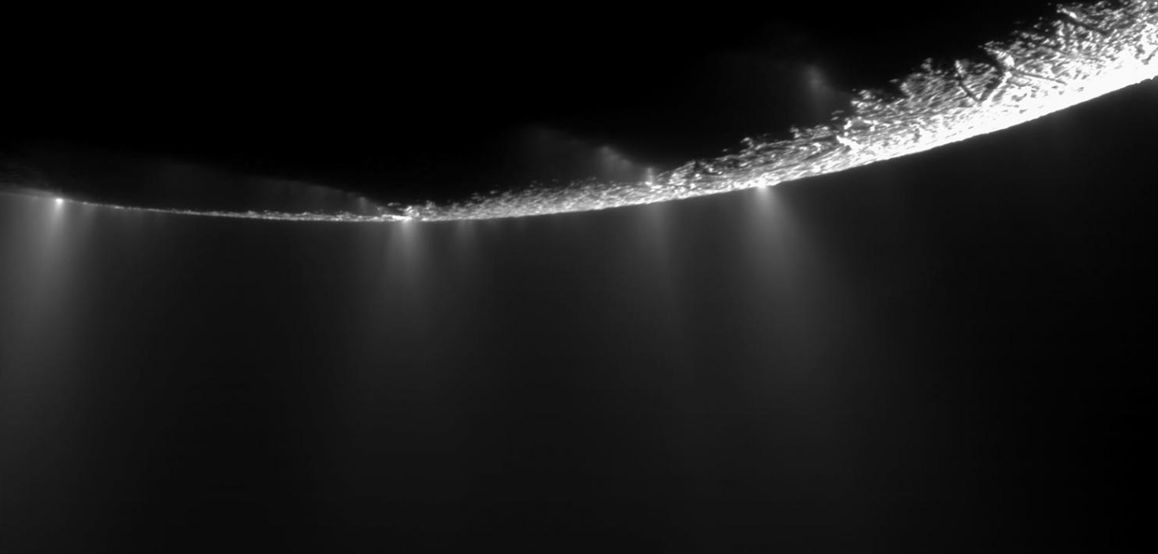
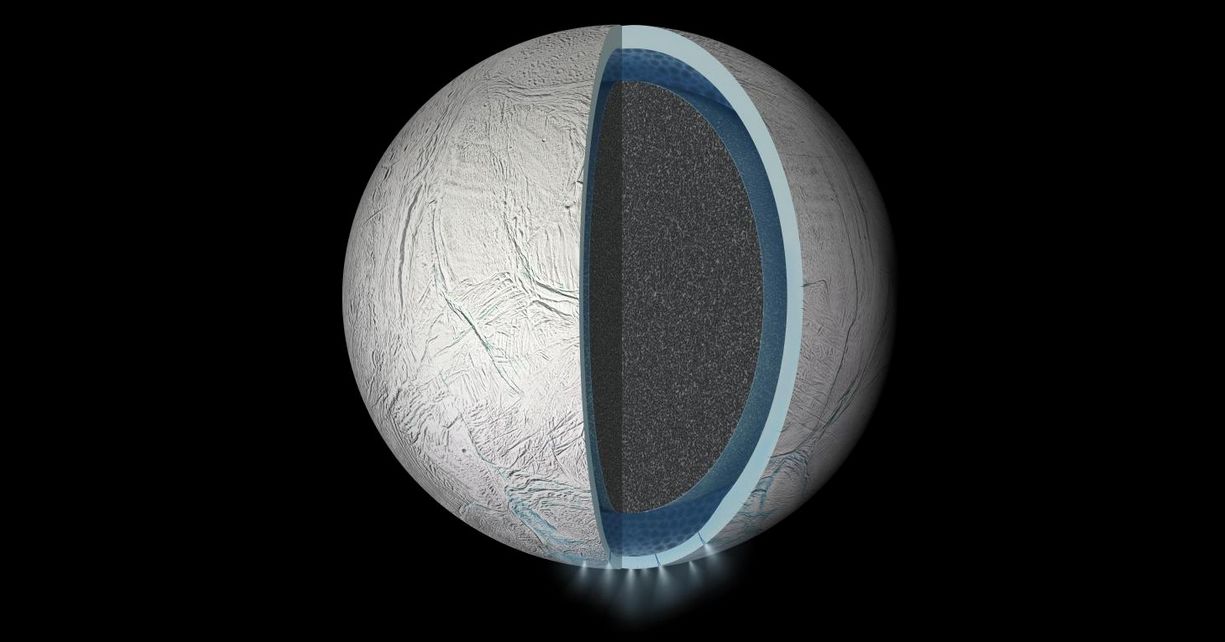
Saturn’s moon Enceladus is one of several icy worlds within the solar system that likely harbour a vast ocean beneath its icy crust. We know this because the Cassini mission spotted geysers of vapour bursting out from its south polar region. Following daring passes through these plumes, rising hundreds of kilometres from Enceladus, the spacecraft was able to obtain samples that confirmed they comprised water vapour.
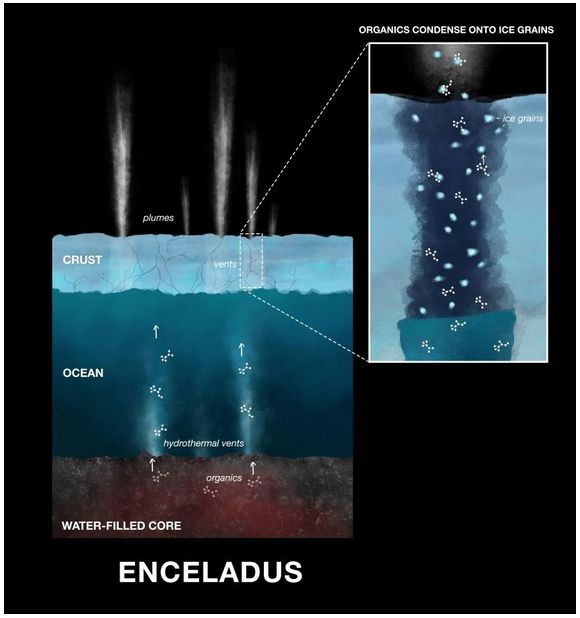
As I’ve noted in past Space Sunday articles, it is believed the vapour originates from a vast ocean under the moon’s ice, and that this ocean is kept liquid as a result of Enceladus being constantly “flexed” by the gravities of Saturn and its other moons, flexing that both causes the ridges and fractures seen on Enceladus’s surface and generates frictional heat deep within the Moon’s core. These heat could both keep the subsurface ocean liquid and also cause hydrothermal vents on the ocean floor. Such vents on Earth are sources of chemical energy and elements such as carbon, nitrogen, hydrogen and oxygen – the essential building blocks of life, and it has been suggested this could be the same on Enceladus.
2018, an international team based in Germany studying the data gathered by Cassini found the geyser plumes contained a range of organics. Now, as revealed in the October issue of The Monthly Notices of the Royal Astronomical Society. that same team have taken their studies further, finding evidence of organic compounds that could be the precursors to the actual building blocks of life. What’s more, these compounds are condensed within icy grains containing oxygen and nitrogen that are ejected any the geysers. On Earth, similar combinations of these compounds take part in the chemical reactions that form amino acids, core essential building blocks for life as we know it.
More excitingly, these reactions could be driven by the heat generated by hydrothermal vents, and on Earth, the oldest fossilised lifeforms have been found around such vents on the ocean floor, leading to the theory that they are the places where life first emerged on the planet.
If the conditions are right, these molecules coming from the deep ocean of Enceladus could be on the same reaction pathway as we see here on Earth. We don’t yet know if amino acids are needed for life beyond Earth, but finding the molecules that form amino acids is an important piece of the puzzle.
– Nozair Khawaja, study, lead Free University of Berlin
Here we are finding smaller and soluble organic building blocks — potential precursors for amino acids and other ingredients required for life on Earth.
– Jon Hillier, study co-author.
That these basic compounds have been found in material released by Enceladus does not automatically mean that life is forming in its deep ocean, but their discovery does point to the potential of amino acids being formed beyond Earth, which could have significant import with regard to the search for life in the universe.
Currently – and as I’ve again reported – both NASA and ESA are planning mission to Jupiter’s moon Europa, another moon with the potential of having a warm, liquid water ocean under its mantle of ice. These discoveries with Enceladus point to it also being worthy of further and detailed study. NASA has mulled such a mission in 2015 and 2017 – the Enceladus Life Finder (ELF) – but it has yet to receive funding.
ELF is designed to orbit Saturn and make repeated passes through the geyser plumes of Enceladus in order to locate any biosignatures and biomolecules that might be present in the vapours. It is also intended to measure amino acids, and analyse fatty acids or methane (CH4) that may be within the plumes found in the plumes and that might be produced by living organisms. These latest result may cause NASA to give the mission further consideration.
Could “Planet Nine” Actually be a Black Hole?
Planet Nine, the mysterious, yet-to-be-discovered world thought to be orbiting far out in the hinterlands of the solar system, and potentially responsible for the odd orbits of a number of bodies in the Kuiper Belt, is something I’ve written about numerous times in this column.
In my last piece on the subject, I noted a paper that suggested that gravity created by a large disc of dust and icy material orbiting well beyond the Sun might be largely responsible for the odd orbits of these trans-Neptunian Objects (TNOs). Now another paper suggests that if it is gravity responsible, it could actually be due to a black hole lurking on the fringes of the solar system.

The black hole in question is a primordial black hole (PBH), a hypothetical class of small black holes thought to have emerged soon after the Big Bang as a result of density fluctuations in the very early universe. It is believed that most PBHs have likely evaporated, but some with sufficient mass could still exist, wandering the galaxy, although none have thus far been directly observed.
In their paper, astronomers Jakub Scholtz and James Unwin suggest that a wandering PBH might have strayed close enough to our solar system to have been caught by the Sun’s gravity to orbit it at a distance between 300 and 1,000 AU. They note that there are certain similarities between the estimated mass of the object responsible for giving rise to the eccentric TNO orbits and that found in an excess in microlensing events.
Their hypothesis is that a PBH of around five Earth masses may have been captured by the Sun’s gravity – that’s well within the mass range hypothesised for Planet Nine. But finding it if it exists, will be problematic: a PBH of around 5 Earth masses would likely have a diameter of 5 cm (2 in), and have a Hawking temperature of approximately 0.004 K – making it colder than the cosmic microwave background (CMB) and thus exceptionally hard to detect.
The hypothesis is controversial, as Scholtz and Unwin note. However, they also suggest a way in which the idea could be proven or eliminated from consideration. PBHs are They propose a search for annihilation signals from the dark matter halo of the PBH. If it is annihilating, the halo would provide a powerful and localised signal offering a mix of X-rays, gamma-rays and other high-energy cosmic rays. If such a source were to be detected and found to be moving, it could be indicative of a local PBH.
Continue reading “Space Sunday: life’s building blocks, black holes and moles”






 Inara Pey: Living in a Modemworld