
Fifty years ago, on Friday, November 14th, 1969, the second Apollo Saturn V intended to place humans on the Moon lifted off from Launch Complex 39A at Kennedy Space Centre. Aboard it were mission commander Charles “Pete” Conrad Jr, Command Module Pilot Richard F. Gordon Jr, and Lunar Module Pilot Alan L. Bean.
Coming four months after the launch of Apollo 11, the Apollo 12 mission was intended to extend lunar surface operations, albeit modestly. Armstrong and Aldrin spent a total of 21 hours and 37 minutes on the Moon and completed a single surface EVA, Conrad and Bean would spend 31 hours and 29 minutes on the lunar surface, performing two EVAs in the process. However, it became the mission that almost had to be aborted thanks to a pair of incidents that occurred in the first minute after lift-off.
The crew for the flight were of mixed experience: Conrad was making his third trip into space, having flown the Gemini 5 and Gemini 11 missions; Gordon was making his second flight, having partnered with Conrad during Gemini 11; Bean was on his first flight into space. Conrad had joined NASA as part of the second astronaut intake group that included Neil Armstrong, while Gordon and Bean were both part of the third intake alongside of Edwin Aldrin.

Conrad joined NASA from the US Navy, where he was regarded as an outstanding carrier-based fighter pilot and first-class test pilot and flight instructor. He was regarded as one of the best pilots in his group, and was among the first of his group to be assigned a Gemini mission, flying alongside Mercury veteran, Gordon Cooper, the second American to orbit the Earth. He was also one of the most diminutive of the astronauts, standing just 5ft 6.5 inches tall. However, he made up for his small stature by being at times outspoken and a little irreverent (he facetiously referred to the Gemini 5 capsule as a “flying garbage can” during the then record-setting mission of almost 8 days in orbit, on account of the cramped size of the vehicle). While these qualities rankled some in NASA’s management, his forthrightness allowed him to become central to testing many spacecraft systems essential to the Apollo programme. These tests included the Gemini 11 mission with Gordon, and which remains the highest ever Earth orbital mission completed to date, with an apogee of 1,369 km (851 mi).
Conrad has a further distinction: under NASA’s original plans, he was selected to command the back-up crew for Apollo 8, the first test flight of the Lunar Module in Earth orbit. Under the standing protocol of back-up crews moving to a “prime” mission slot three missions later, he was in line to command Apollo 11. However, delays in getting the Lunar Module ready for flight meant that Apollo 8 and Apollo 9 were swapped, shunting his command slot to Apollo 12.
Both Gordon and Bean also came to NASA from the US Navy, where they had also served as fighter pilots before transitioning to test pilots. Both also served with Conrad during their military careers: Gordon with Conrad aboard the aircraft carrier USS Ranger, where the two shared a cabin and had become good friends, while Bean was trained by Conrad when becoming a test pilot, the two also forming a friendship in the process.

Apollo 12 launched from Cape Kennedy into a cloudy, rain-swept sky. 36.5 seconds into the flight, lightning struck the top of the vehicle and travelled through it and its ionised exhaust plume to strike the launch gantry it had just cleared. Protective circuits on the fuel cells in the service module (SM) took them off-line, along with much of the Command Module’s flight systems.
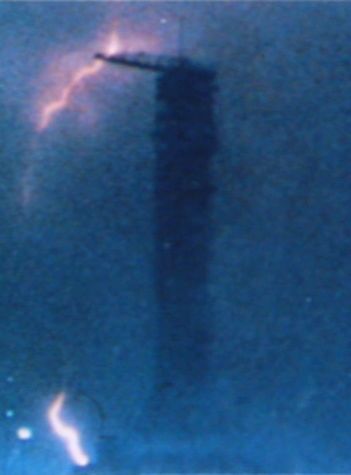
15.5 seconds later lightning again struck, disabling the attitude indicator and garbling telemetry being received by Mission Control. However, neither strike affected the Saturn V rocket’s instrument unit, allowing the vehicle to continue to climb towards orbit as planned.
The loss of the fuel cells placed the CSM on battery power, but this wasn’t up to the task of providing all the power necessary to power the Command Module’s instruments for the entire mission. Nor could the fuel cells be brought back on-line.
Flight Director Gerry Griffin was considering calling for an orbital abort, despite fears the lightning strikes may have affected the Command Module’s parachute deployment pyrotechnics, when John Aaron, the Electrical, Environmental and Consumables Manager (EECOM) realised he’s seen a similar pattern of telemetry disruption during an equipment test, when a power supply unexpectedly failed.
“Flight, EECOM. Try SCE to Aux,” he stated over the radio, recalling an obscure back-up power supply switch-over.
His call went unrecognised by Griffin, the CapCom, astronaut Gerald Carr, and Conrad on Apollo 12. However, rookie Alan Bean remembered the SCE switch from a training incident a year earlier during a rare simulation of such a failure, and flicked it over. The move brought the fuel cells back to power, and both Aaron and Bean were credited with saving the mission.
After the excitement of launch, the flight settled into “routine”, with Apollo 12 reaching the Moon late on November 17th, 1969. An initial engine burn put the combined Command and Service Module (CSM) Yankee Clipper and Lunar Module (LM) Intrepid into and elliptical orbit of 110.4 x 312 km (69 x 195 mi). On November 18th, this was adjusted to 99.2 x 121.6 km (62 x 76 mi), and on November 19th, Conrad and Bean entered to the Lunar Module ready for their descent and landing.
This began after Intrepid had separated from Yankee Clipper, with an engine burn on the far side of the Moon, out of contact with Earth. The landing site was set within a region of Oceanus Procellarum, the Sea of Storms that had been given the official name of Mare Cognitum (Known Sea) on account of it having been visited by three automated probes: Russia’s Luna 5 and America’s Surveyor 3, and Ranger 7. The aim was to put Intrepid down in a precisely-denoted area within walking distance of Surveyor 3, and which Conrad had dubbed “Pete’s Parking Lot”.










 Inara Pey: Living in a Modemworld