Space Sunday: a bit of JUICE, a flight test & celebrating 50

An artist’s impression of the European Space Agency’s JUpiter ICy moon Explorer (JUICE). Credit: ESA

What is widely regarded as one of the most important space missions yet undertaken has been successfully launched to much acclaim and excitement.

No, I’m not talking about the SpaceX Starship / Super Heavy orbital test flight – of which more anon – but that of the European Space Agency’s JUpiter ICy moons Explorer (JUICE) spacecraft, a 1.6 billion Euro (US $1.7 billion) mission designed to gain a more thorough understanding of Jupiter’s three major icy moons – Europa, Ganymede and Callisto.

JUICE started life in 2008 as part of a joint NASA/ESA mission which had the rather clunky name of Europa Jupiter System Mission – Laplace (EJSM-Laplace), a US $4.7 billion mission to study Jupiter’s moons with a focus on Europa, Ganymede and on Jupiter’s magnetosphere. The mission would have comprised at least two independent elements, NASA’s Jupiter Europa Orbiter (JEO) and ESA’s Jupiter Ganymede Orbiter (JGO), with the potential for involvement on the part of Japan and Russia.

By 2011, it was clear to ESA that NASA would not have the budget to fulfil its part of the mission by the 2020s, and the JGO element morphed into JUICE, which was selected for the agency’s first L-class mission in May 2012, with ESA being proven correct in regards to NASA’s involvement in EJSM-Laplace in 2015, when the US agency reformulated its plans into the Europa Clipper mission.

JUICE was launched on 14 April 2023 at 12:14:36 UTC on the penultimate flight of an Ariane 5. The launch has been delays by 24 hours due to weather concerns, but on the 14th, the launch vehicle lifted-off smoothly, the satellite successfully separating from the rocket’s upper stage some 26 minutes after launch prior to commencing an internal systems check, after which it was due to ‘phone home and say, “Hi there!”

This call came a little later than the mission plan had estimated at some 40 minutes after launch, but still within the overall expected time frame. Following confirmation from ground control, the 6-tonne space vehicle deployed its 27-metre spans of solar arrays, completing the task a little ahead of schedule, reporting the arrays to be fully deployed and active.

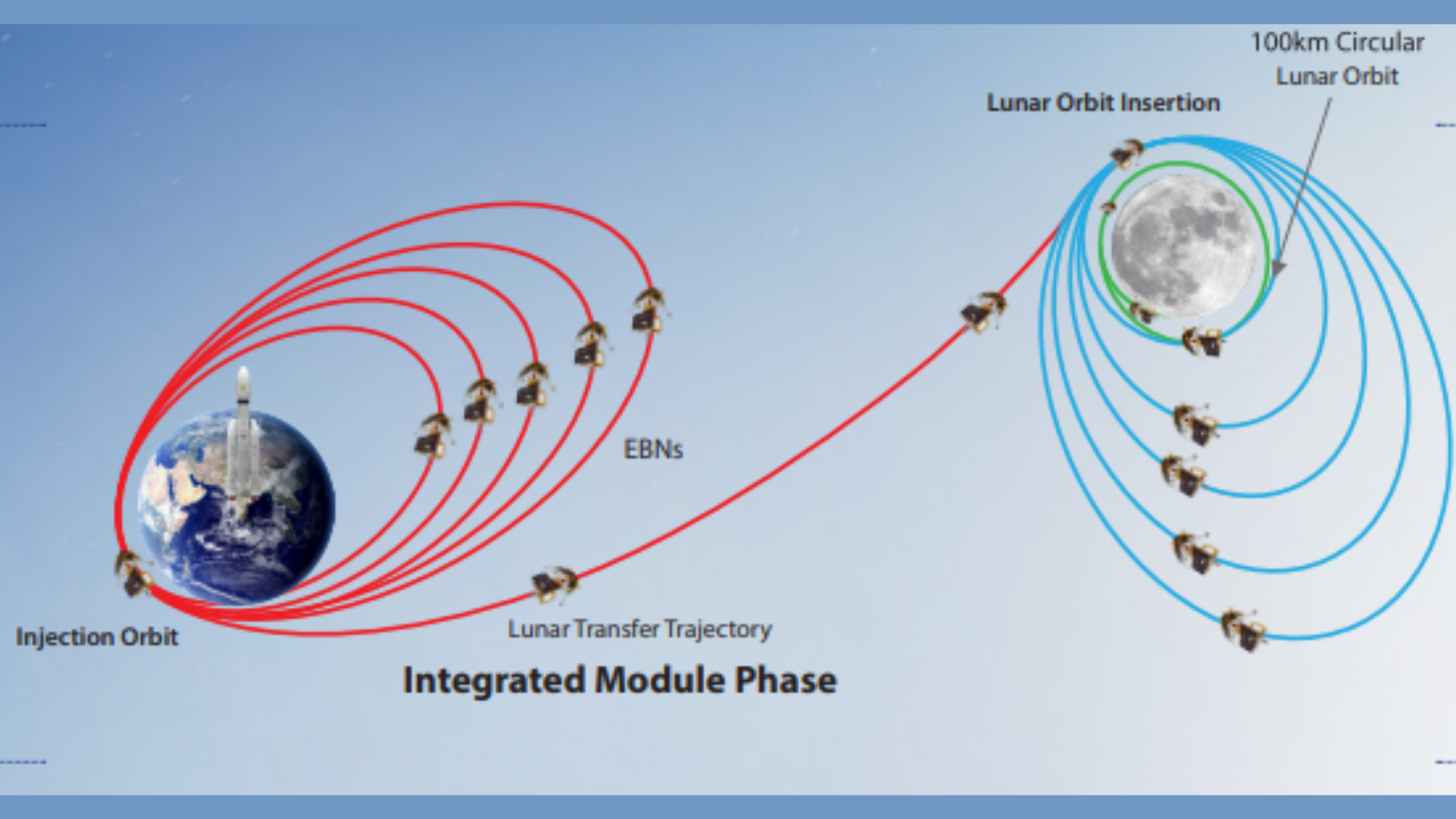
The deployment marks the start of a complex 8-year coast to Jupiter which includes four gravity-assists from the inner planets to both boost the spacecraft’s velocity and to help swing it onto the required trajectory required for a successful Jupiter rendezvous (and a possible fly-by of the asteroid 223 Rosa in October 2029). These flybys will comprise:

  • August 2024 – a return to Earth, using both the Moon and Earth to accelerate and adjust course. This will be the most accurate gravity assist manoeuvre ever carried out by an interplanetary vehicle.
  • August 2025 – a flyby of Venus whilst travelling around the Sun, again accelerating the spacecraft whilst angling it onto a trajectory that will see it swing by Earth
  • September 2026 a second flyby of Earth (confusingly called “Earth flyby I”, which will throw it out into the solar system almost as far as Mars before it swings back around the Sun.
  • January 2029 – a third flyby of Earth (“Earth flyby II”) which will slingshot JUICE on a two year journey to Jupiter, with the possible asteroid flyby along the way.
An animation of the Earth / Venus flybys JUICE will perform, and its flight to Jupiter. Credit: Phoenix7777

On arrival in the Jovian system, in July 2031, JUICE will first perform a flyby of Ganymede in preparation for Jupiter orbital insertion about 7.5 hours later. This will place the vehicle in an elongated orbit around the planet, allowing it to perform some 35 flybys of the target Moons. The orbit around the planet will gradually becoming more circular over time, and will have an inclination that will allow JUICE to also study Jupiter’s Polar Regions and its magnetosphere.

The flybys will allow JUICE to observe its targets over a 3.5 year span of time, with a major focus on Europa. However, in December 2034, the focus of the mission will shift as JUICE enters an extended, 5,000 km elliptical orbit around Ganymede. This will be rapidly circularised to 500 km in 2035, allowing the vehicle to carry out an in-depth study of Ganymede’s composition and magnetosphere.

It is anticipated that the vehicle’s fuel reserves will be depleted to a point where accurate guidance and manoeuvring cannot be maintained by the end of 2035, and the last remaining reserves will be used to impact the craft on Ganymede at the end of that year or possibly very early in 2036.

The Ariane 5 rocket carrying JUICE lifts-off from Europe’s Spaceport in Kourou, French Guiana, April 14th, 2023. Credit: JODY AMIET/AFP

The primary aim of the mission is to more fully characterise the overall surface and (particularly) sub-surface conditions on (notably) Europa and Ganymede, and also on Callisto. As regulars to this column (and to space exploration in general) will know, Europa is believed to have a surface crust of ice covering what could well be a deep liquid water ocean, heated and kept in a liquid (or near-liquid) state by the moon being constantly “flexed” by the gravitational influences of the other Galilean moons as they orbit Jupiter, and Jupiter itself.

With this in mind, JUICE will specifically study Europa to understand the formation of surface features and the composition of the non-water-ice material. In particular, it will attempt to gather information on any chemistry essential to life which may be present on Europa’s surface, including organic molecules, and it will carry out the first sub-surface soundings of the moon in order to try to determine the thickness of the icy crust over the most recently active regions of the moon, and attempt to gain a clearer understanding of what lay beneath it – such as liquid water or icy slush.

While further away from Jupiter and with a more one-side “pull” being exerted on them, it is believed that both Ganymede and Callisto might also have oceans of liquid water (or perhaps icy slush) under their surfaces, so the main science objects for these moons – with the particular emphasis on Ganymede comprise:

  • Characterisation of the ocean layers and detection of putative subsurface water reservoirs.
  • Topographical, geological and compositional mapping of the surface.
  • Study of the physical properties of the icy crusts.
  • Characterisation of the internal mass distribution, dynamics and evolution of the interiors.
  • Investigation of Ganymede’s tenuous atmosphere.
  • Study of Ganymede’s intrinsic magnetic field and its interactions with the Jovian magnetosphere.

In all, the information gathered on the three moons should help scientists better assess their potential as havens of basic life within any warm oceans which may exist within them.

I think this is something that Europe can be extremely proud of. This is a mission that is answering questions of science that are burning to all of us.

– Josef Aschbacher, ESA Director General

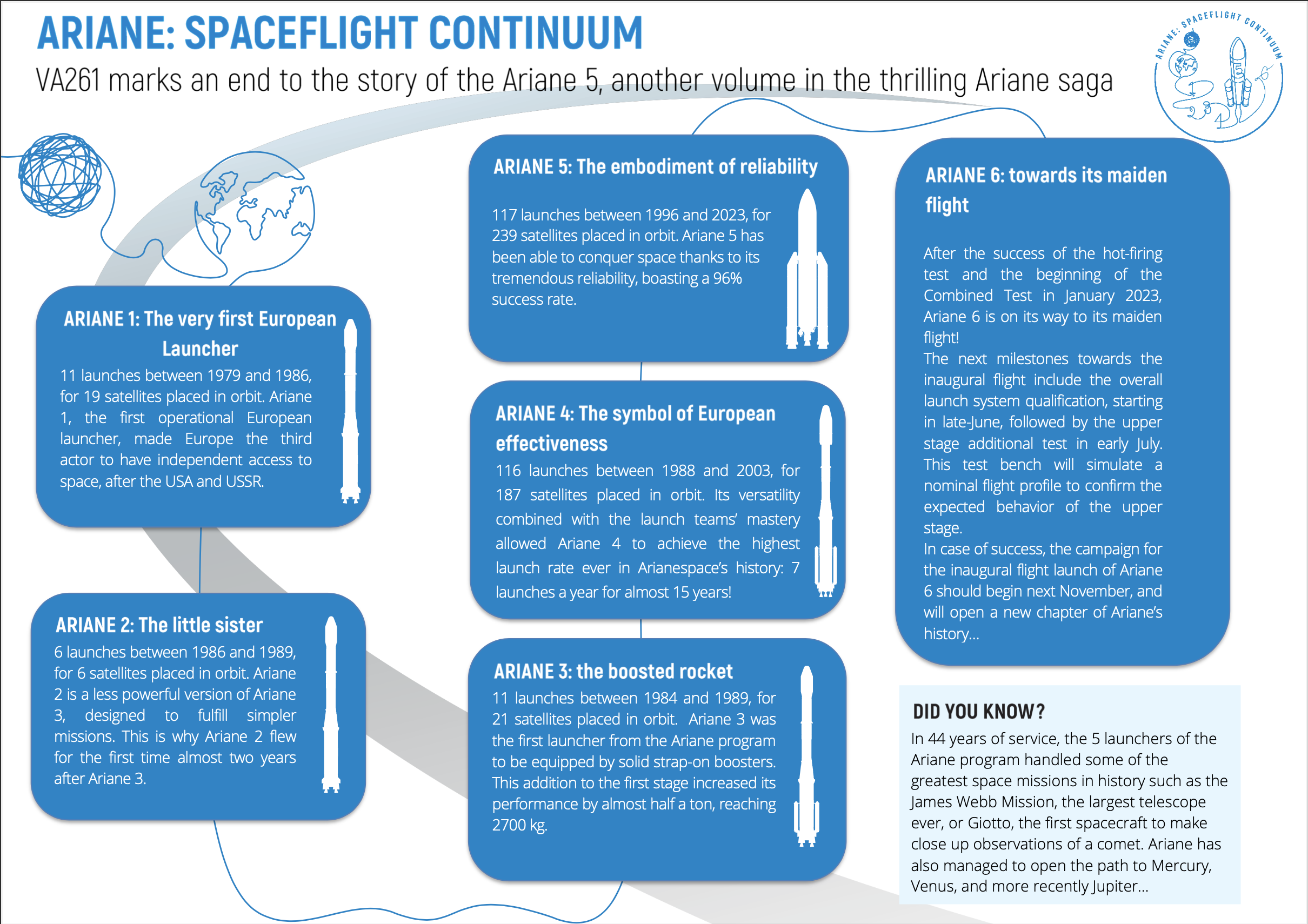
The launch was the sixth Ariane 5 flight to carry an ESA mission, a total that includes the December 2021 launch of NASA’s James Webb Space Telescope that features significant ESA contributions. It was the 116th Ariane 5 launch overall, dating back to 1996. However, it was also the last flagship mission launch for the ESA workhorse; after an upcoming launch of two communications satellites, for the French and German governments respectively, Ariane 5 will make way for its Ariane 6 successor, with the first launch of the new rocket – which has had a troubled development cycle – is due towards the end of 2023 or early 2024.

Continue reading “Space Sunday: a bit of JUICE, a flight test & celebrating 50”

Space Sunday: Artemis, Starship and Stirling

Official crew portrait for Artemis II, from left: NASA Astronauts Christina Koch, Victor Glover, Reid Wiseman, Canadian Space Agency Astronaut Jeremy Hansen. Credit: NASA

On Monday, March 4th, 2023, NASA announced the people selected to undertake the first crewed mission beyond the Earth’s orbit since Apollo 17 splashed down in the South Pacific Ocean on December 19th, 1972. The four individuals – three Americans and one Canadian  –  will undertake the first crewed flight of NASA’s Orion / Space Launch System (SLS) combination on an extended flight around the Earth and then out and around the Moon and back.

Along the way the Artemis 2 mission will tick of a number of firsts as it paves the way for the first of the planned Project Artemis missions to the surface of the Moon, which will commence with Artemis 3 in December 2025 / early 2026. For the crew, it will mark the first time a woman, a person of colour and a Canadian will fly beyond Earth’s orbit – and the mission will mark the Canadian’s first trip into space after a 14-year wait.

In announcing the crew, NASA Administrator Bill Nelson used words which echoed the words  (written by Ted Sorenson) spoken by John F. Kennedy in his September 12th, 1962 address at Rice University, Texas in which he rallied public support for the Apollo effort.

We choose to go to back to the Moon, and on to Mars. And we’re going to do it together, because in the 21st century, NASA explores the cosmos with international partners. We will unlock new knowledge and understanding. We’ve always dreamed about what more is ahead. Why? Because it’s in our DNA. It’s part of us. It’s who we are, as adventurers, as explorers, as frontiers people.

– NASA Administrator Bill Nelson, April 3rd, 2023

The four crew for the mission comprise:

  • Mission Commander Captain Reid Wiseman, USN. A US Naval aviator and test pilot born in Baltimore, Maryland, he was selected as an Astronaut Candidate in 2009 and flew in space on Soyuz TMA-13M, completing 165 days in orbit on the International Space Station as a part of the Expedition 40/41
  • Mission Pilot Captain Victor Glover, USN. Also a naval aviator, he was selected as an Astronaut Candidate in 2013, and flew the first operational flight of the SpaceX Crew Dragon to the ISS in 2020 as a part of the Expedition 64/65 crew. He was the first African-American to actually live and work on the ISS for an extended period (a total of 167days) rather than just visit it aboard the space shuttle.
  • Mission specialist Christina Koch. An engineer from Michigan, Koch is the most experienced of the crew, having already spent less than 30 days shy of a a year in orbit as a part of Expeditions 59/60/61 crews. Like Glover, she was selected for training in the NASA Astronaut Corps in 2013. However, prior to that, she was a graduate of the NASA Academy programme, and worked extensively on various space-related projects with NASA, the NOAA and various universities.
  • Canadian Jeremy Hansen, a colonel in the Canadian Air Force, is the the rookie of the crew – although he has extensive experience with NASA, the European Space Agency and the Canadian Space Agency. In 2013, Hansen served as cavenaut into the ESA CAVES training, and served as an aquanaut aboard the Aquarius underwater laboratory in 2014. His inclusion in the crew is in recognition o Canada’s longstanding support of, and partnership in, US space activities, which extends in the Project Artemis.

The four were initially selected by Joe Acaba, NASA’s Chief of the Astronaut Office, a role vacated by Wiseman so that he could have the opportunity to be selected for an Artemis mission. They were confirmed to the mission by NASA senior management, and the announcement featured a further Hollywood-trailer “trailer” video from NASA.

The flight itself is analogous to the Apollo 8 round-the-moon mission in 1968. Following launch, the Orion vehicle and crew will spend an extended period in Earth orbit, carrying out a series of vehicle checks and operational tests prior to making a free return around the Moon for a Pacific Ocean splash down after around a total of 10 days from launch. The mission will not launch earlier than November 2024.

Am I excited? Absolutely. But my real question is, are you excited? I see you and I ask that, because the one thing I’m most excited about is that we are going to carry your excitement, your aspirations, your dreams with us on this mission.

– Christina Koch

The three “driving principles” for Artemis 2 have been defined as: crew safety and survival; vehicle survival; and mission success. The mission success principle, the focus is on testing out the spacecraft subsystems, including in emergency and off-nominal conditions. There are additional flight test objectives the mission will attempt to carry out if time permits to help further reduce risk for later missions. One significant difference between Artemis 1 and Artemis 2 – outside of the latter carrying a crew – is that the Orion vehicle used for Artemis 1 was pushed to the limits, the vehicle going somewhat beyond the normal operations an Orion vehicle will experience during actual missions – the idea being to ensure the vehicle can survive the extreme end of its operational envelope.

The Artemis 2 mission – click for full size. Credit: NASA

With the announcement now out of the way, the Artemis 2 crew will commence formal training for the mission starting in June 2023 – the time between being given over to the four wrapping their other duties and work programmes so as to concentrate on the training and getting to know one another as crew and friends. Part of this training will extend to the famous WET-F tank at the Neutral Buoyancy Lab (NBL) in Houston, Texas.

This 12-metre deep pool is home to a full-scale mock-up of the external modules on the ISS, and is used to train astronauts for EVA work on the station’s exterior, and a part of which is being covered to offer a training environment to help crews train for the low-light conditions at the lunar south pole. It will be extensively used for the training of the Artemis 3 crew, but the Artemis 2 crew will help check the facilities out.

The core stage of the Space Launch System rocket that will launch the Artemis 2 mission. Credit: NASA/Michael DeMocker

More focused training will be on Orion operations, covering every aspect of the mission from pre-launch to post-splashdown and vehicle egress, together with a refinement of the overall mission parameters, spacecraft system performance checks, guidance system calibrations, etc.

SpaceX Re-Stacks Starhip as Expectations of a Launch Increase

SpaceX has completed re-stacking the first Starship / Super Heavy booster combination intended for launch, which has been taken by some to mean that the Federal Aviation Administration (FAA) is close to being ready to grant a launch licence for the attempt.

As I reported in my previous Space Sunday update, Booster 7 was returned to the orbital launch mount after both had undergone further upgrades. Following stacking, the booster went through a full propellant load test prior to Ship 24, the starship vehicle that will make the first sub-orbital launch attempt atop Booster 7, being returned to the orbital launch site at Boca Chica, Texas prior to being raised and stacked on the booster, allowing further propellant load tests to be carried out.

Excitement over the launch grew when it was noted that the FAA issued maritime and air traffic advisories for April 10th covering both the Gulf of Mexico and Hawai’i, with back-up dates of April 11th and 12th. However, these were later revised for a potential launch date of April 17th – with the FAA noting that the inclusion of any dates in its advisories did not indicate that a launch licence had, or was about to be, granted.

Space journalist Eric Berger, taking to Twitter, further dampened expectations by pointing out it is possible the FAA might actually seek an injunction against any launch attempt pending SpaceX demonstrating it has taken the required steps to protect the surrounding wetlands environment from contaminated water run-off from the launch site – although he also noted that if there are no environmental objections, it is possible the FAA will grant a licence before month-end.

The first flight will see Booster 7 attempt to lift Ship 24 into a sub-orbital trajectory before it performs a burn-back and attempts a soft splashdown in the Gulf of Mexico. Ship 24. meanwhile will continue on in what appears to be a transatmospheric Earth orbit, meaning it will fly enough to test its thermal protection system through re-entry into the denser atmosphere, but without the need to re-ignite its engines to perform a de-orbit burn beforehand. Once within the atmosphere, the vehicle will attempt a powered soft splashdown off the coast of Hawai’i.

Overall, the flight realistically has less than a 50% chance of overall success given this is a first attempt to launch a recover a brand new orbital launch system. Even if the flight achieves all of its stated goals and both the booster and the starship survive, SpaceX have a long way to go before the system is shown to by either reliable or capable of meeting stated goals – something I hope to return to in a future Space Sunday special.

Continue reading “Space Sunday: Artemis, Starship and Stirling”

Space Sunday: astronauts, water, images and launches

On Monday, April 3rd, NASA will announce the first crew it will send to the vicinity of the Moon since 1972.

The four-person crew is due to lift-off aboard the Artemis 2 mission, scheduled for launch in late 2024 as what is seen as the leading edge of the 23-nation Project Artemis, intended to establish a human presence on the Moon. Also participating in the announcement will be the Canadian Space Agency – one of the named crewed will be a Canadian in recognition of the country’s pivotal role in the providing a robotic arm for the planned Lunar Gateway station, and which is viewed as crucial to the station’s overall development.

Ahead of the announcement, NASA has been turning to Hollywood-style trailers to amp up the anticipation around the mission, hence the video at the top of this article, which also carries some echoes of Project Apollo from the 1960s and 1970s.

Artemis 2 will be the second mission to utilise NASA’s huge Space Launch System rocket, which first flew in November / December 2022, and will also be the first crewed flight of the Orion Multi-Purpose Crew Vehicle (MPCV), designed to carry crews from the surface of Earth to cislunar space and back again.

Planned for between 10 and 21 days, Artemis 2 will carry the four astronauts (the other three all being from the United States) to Earth orbit and thence on to the vicinity of the Moon using a multi-trans lunar injection (MTLI) trajectory which will initially push the vehicle into an extended elliptical, 42-hour orbit of the Earth.

The Artemis 2 mission – click for full size. Credit: NASA

This extended orbit will allow the crew to conduct multiple vehicle and system checks. They will also perform multiple rendezvous and proximity operations using the spent Interim Cryogenic Propulsion Stage (ICPS) of their SLS rocket as a target vehicle. These operations will put Orion’s ability to carry out precise orbital manoeuvring of the kind till will have to perform when rendezvous with the Human Landing System vehicle (Artemis 3 mission) and the future Lunar Gateway station.

Once these operations have been completed and as the vehicle reaches perigee, it will fire the main motor of its European-build service module and start its journey to the Moon. Using a free return trajectory, allowing it to loop around the Moon and return to Earth for a splashdown in the Pacific Ocean and recovery by the US Navy.

One of the four Canadian astronauts currently on active duty will fly on Artemis 2 in recognition of Canada providing a robot arm for the planned lunar gateway station. Credit: Canadian Space Agency

Those wishing to watch the crew announcement live via You Tube on April 3rd.

Water Power in Space and Taking Your Own Pictures from Space

There are many ways to provide in-space manoeuvring for satellites and space vehicles. They range from the relatively “safe” options – cold gas thrusters utilising simple Newtonian physics whereby you direct a jet of inert gas in one direction, and its pressure through the nozzle pushes / turns your craft in the opposite direction – through to more energetic means, such as through the use of hypergolic propellants, which can be quite toxic and require extreme care in their handling prior to launch (or following the return to Earth of a vehicle using them).

But what about a system using plain old simple H2O? That’s precisely what a Japanese company called Pale Blue has been asking itself.

Spun out of research initially carried out by the University of Tokyo three years ago, Pale Blue has been researching various means of using water to propel / manoeuvre satellites in their orbits. Now they’re successfully shown it can be done, using a water-based propulsion system mounted on a nano-satellite built and operated by Sony Corporation as a part of its Star Sphere space inspiration project.

Sony Corporation’s tiny EYE nano-satellite, seen in an artist’s rendering as it orbits Earth. Credit: Sony Corporation

In March, a small resistojet water thruster on the tiny satellite to manoeuvre it over a period of two minutes. A resistojet is essentially a kind of Newtonian thruster mentioned above: water held at low pressure is pushed through a tube, where it naturally vaporises on exit, the expanding gas of the vaporisation used to orient / move the satellite.

The test is seen as proof-of-concept for a series of water-based systems Pale Blue are developing, one of which is intended for direct propulsion of satellites. This will operate in a similar manner to an ion drive: water is vaporised under pressure via a microwave source and the pressurised gas is then ejected as an energetic exhaust in one direction, propelling the vehicle in the opposite. This method could use low volumes of water to produce sustained thrust over extended periods. Combined with the resistojet system, this drive system could be used as a hybrid system using a single water supply to provide both thrust and precise manoeuvring.

Water-based systems have the advantage of being pollution-free and safe in their handling whilst on Earth compared to system using hypergolic systems, but water itself is not entirely mass-efficient compare to other propellant types, so it will be interesting to see where this research leads.

Take Your Own Images and Video of Earth from Space

Star Sphere itself is a uniquely interesting concept. Starting later this year (and initially only available to people in Japan and the United States), it aims to allow “crew members” of “spaceship Earth” to use the satellite to capture their own images and video of Earth and the satellite orbits it. Participants can book a single 90-minute orbit in which they get a 10-minute time slot of their choosing in which to direct the satellite’s cameras to capture up to 50 images or around 30 seconds of video as part of the base membership package, with more images and video to be possibly offered at extra cost once the service opens to public use. Once selected, the images and video is for the exclusive use by the user.

Sony’s EYE nano-satellite. Credit: Sony Corporation

Find out more at Star Sphere.

Continue reading “Space Sunday: astronauts, water, images and launches”

Space Sunday: Artemis, asteroids and a bit more Artemis

NASA Moon to Mars, 2020. Credit NASA

The Biden Administration has published further details on it 2024 budget proposal in support of NASA in which further details of the agency’s “Moon to Mars Manifest were revealed. Key points on the latter include:

  • The crewed Artemis 2 mission, intended to fly a crew around the Moon in an extended mission similar to that of the successful Artemis 1, confirmed for November 2024.
  • Artemis 3, the first mission to return humans to the surface of the Moon by the United States, is scheduled for 2025.
  • Artemis 4, the second crewed landing on the Moon now pushed back to 2028, with annual landings from there on through to the end of 2031.
  • Both Artemis 3 and Artemis 4 will utilise the SpaceX Starship-based Human Landing System (HLS) for carrying crews to / from the lunar surface and lunar orbit, after which crew activities will switch to the (still to be contracted) “sustainable human landing system”.
  • 2024 will also – in theory – see a demo flight of the SpaceX HLS, whilst the end of 2025/start of 2026 will see work commence on the Lunar Gateway station with the launch of the power module and habitation module to their extended lunar orbit.
  • 2028-2031 will also see work continue on the Gateway station alongside of the lunar landings.
  • Automated mission to the Moon in 2027 will demonstrate lunar construction techniques for developing a base, extracting usable commodities from the lunar surface, and testing power systems. Further demonstrations of these will take place in 2030.
The NASA Moon to Mars infographic, which formed a part of the White House NASA 2024 budget proposal. Crew NASA – click for full size

In support of the above will be a series of demonstrator missions in Earth orbit, as well as development work on Earth for longer-term goals. These include:

  • In-space propellant replenishment and storage for reusable lunar landers and deep space transportation vehicles under a programme referenced as CFM: Cryogenic Fluid Management, involving SpaceX (optimistically in 2023), Lockheed Martin (2025) and United Launch Alliance (2025).
  • Development and flight test of the NASA/DARPA DRACO nuclear thermal engine (see: Space Sunday: propulsion, planets and pictures), with the design to be completed by the end of 2024, together with a conceptual design for a nuclear electric engine.
  • Development and delivery of a nuclear fission power unit demonstrator for use on the Moon or Mars, to the surface of the Moon in 2030.
An artist’s impression of the NASA/DARPA DRACO NTP demonstrator, included in the NASA 2024 budget proposal. Credit: NASA

The budget proposal includes an immediate request for US $180 million for the agency to start seeking proposals for a “deorbit tug” for the International Space Station (ISS). This would be a vehicle developed over multiple years and at a total cost of around US $1 billion specifically designed to dock with the ISS in 2030 and the proceed to gently push it back into Earth’s atmosphere along s pre-planned course so that it burns-up and the large element splashdown at Point Nemo.

Also within the 2024 allocation is US $30 million in support of Europe’s ExoMars rover, and an increased request for NASA’s side of the proposed NASA / ESA Mars Sample Return Mission.

 ExoMars Back on Track /  Sample Return on Track for Budget Overrun

The US $30 million requested in NASA’s 2024 budget is in part to provide ESA with a launch service for Rosalind Franklin, ESA’s ExoMars rover vehicle, together with various technology support activities for a lander vehicle.

This project has had its share of issues over the past two decades, and up until 2022, the plan had been for a joint mission with Russia, the latter providing the launch vehicle and a lander to deliver the rover to the surface of Mars. However, Russia’s invasion of Ukraine ended all ESA / Roscosmos cooperation.

Since then, ESA has remained relatively close-lipped about the rover’s future, but in a recently update, mission personnel confirmed 2028 is now being targeted for the mission’s launch. In addition they indicated that the agency will now build a dedicated lander for the rover which will leverage NASA’s expertise in propulsion, power and heat shield development. In addition, ESA has resumed testing of Amalia, the rover’s test bed vehicle.

The video below provides an inside look at Rosalind Franklin, and what marked the ExoMars rover mission unique among Mars missions.

In the meantime, the ambitious NASA / ESA Mars Sample Return (MSR) mission is threatening to overwhelm other elements of NASA’s science programme.

For the 2024 budget proposal, the White House has requested US $949.3 million for MSR – 19% more than the budget projection. It also notes that expenditure on the project will increase over projections through to the planned launch in 2028.

Working in concert with NASA’s Perseverance rover, which has been collecting samples from its travels across Jezero Crater and has recently started caching them for collection by MSR, the sample mission is designed as a two-part mission using a ESA-developed Mars orbiter to return the Perseverance samples to Earth, after they have been collected from the surface by a lander / recovery / ascent vehicle, primarily built by NASA.

An artist’s impression of the NASA / ESA Mars Sample Return mission. Credit NASA / ESA

NASA has already delayed the Venus Emissivity, Radio Science, InSAR, Topography, and Spectroscopy (VERITAS) mission, which had been due for launch in 2028 prior to being put on hold in November 2022 over concerns about MSR costs, and will now not launch before 2031 – if at all. Now, the Geospace Dynamics Constellation (GDC) mission, a 2013 heliophysics decadal survey recommendation, will now also be suspended. MSR itself was expected to exceed US $7 billion prior to it being revised in an attempted to lower costs – however, it was approved for continuance in 2022 under the  Planetary Science Decadal Survey, on the understanding total costs would not exceed US 5.2 billion – which it still might.

Continue reading “Space Sunday: Artemis, asteroids and a bit more Artemis”

Space Sunday: space stations, Vulcans, rockets

A Northrop Grumman Cygnus resupply vehicle approaches the International Space Station (ISS) to deliver supplies. Credit: NASA

ISS Updates

In a further sign that the International Space Station is in its final decade of operations, NASA is seeking to extend the current contracts for re-supply missions to the station from the period January 2027 through December 2030, in what is referred to as a “final” contract period.

In March 2022, NASA awarded additional contracts for ISS re-supply missions through until the end of 2026 to SpaceX (Cargo Dragon) Northrop Grumman (Cygnus) and Sierra Space (Dream Chaser Cargo). Under the extension, all three companies will be allowed to bid on remaining re-supply mission slots through until December 2030, but contract opportunities will not be issued to additional companies beyond these three.

Under the current contract, SpaceX are required to fly a total of 15 resupply missions through until the end of 2026, at an average of US $157 million per flight; Northrop Grumman 14 Cygnus flights at an average of US $150 million; and Sierra Space three Dream Chaser Cargo flights at US $367 apiece. It is not clear if any additional flights granted between January 2027 and December 2030 will be at the current rates or whether the three companies will seek to raise their fees – with the 2018 contract extension, SpaceX hiked their fees by 50%.

SNC’s uncrewed Dream Chaser Cargo and its external cargo module, which will also supply electrical power to the vehicle. Credit: Sierra Space.

No further re-supply missions to ISS to be scheduled beyond 2030, that is the year the station is to be decommissioned and the majority of it de-orbited to burn up in the atmosphere, with any surviving elements crashing into the Pacific Ocean at Point Nemo – the area of that ocean furthest of land in any direction. However, modules due to be delivered to the ISS by Axiom Space starting in 2025 will be detached to form the nucleus of a new private-sector space station.

Currently, it is not clear whether Russia plans to remain with the ISS programme through until 2030 or withdraw some time before. In 2022, the country announced plans to withdraw “after 2024” (which many pundits took to mean “from 2025”) in order to focus on a national space station – the Russian Orbital Service Station. The power module for this new station had originally been slated for 2024, with the core module targeting 2025. However, the power module will now not launch before 2027, and the core module “no earlier” than 2028, so it would seem likely Russia will remain engaged in ISS operations through until at least then.

A model of the Russian Orbital Service Station during the Russian Federation’s International Military-Technical Forum “Army”, August 2022, complete with Soyuz replacement crew vehicle (foreground). Credit: Kirill Borisenko

In the interim, there was a degree of excitement aboard the ISS in the past week. At 12:42 UTC on Monday, March 6th, 2023, the ISS has to use the thrusters on the Progress M-22 re-supply vehicle currently docked at the station’s Zvezda module to avoid a potential collision with an orbiting satellite.

The satellite in question – believed to be Nusat-17, part of an Argentinean earth observation constellation, the majority of which were launched in the 2020s, and all ten satellites in the network are in orbits deteriorating towards that of the ISS. The potential for collision was known in advance, allowing the orbital boost – called a pre-determined avoidance manoeuvre (PDAM) – to be completed with the minimum of fuss, the Progress firing its thrusters for 6 minutes and without disruption to overall ISS operations.

The manoeuvre marked the 33rd such change to the station’s orbital track resulting from the risk of collision since 1999, and there is mounting concern that the greater use of low-altitude constellations of satellites such as those operated by SpaceX Starlink and the UK’s OneWeb could see the ISS facing greater exposure to potential collisions over the next 7-8 years.

A graph showing the numbers of ISS collision avoidance manoeuvres between 1999 and 2023. Credit: NASA Orbital Debris Program Office (ODPO)

The distraction of the manoeuvre was not enough to delay preparations for the return of NASA’s Crew 5 mission from the ISS aboard SpaceX Crew Dragon Endurance, with the vehicle departing the ISS on Saturday, March 11th, 2023 at 0720 UTC. Aboard were NASA astronauts Josh Cassada and Nicole Mann, together the Japanese astronaut Koichi Wakata and cosmonaut Anna Kikina of Russia, returning home after 157 days on-orbit aboard the ISS, and having completed a hand-over to the personnel of Crew 6, who arrived at the ISS on March 3rd.

After undocking, Endurance performed a series of orbital manoeuvres throughout the day, prior to completing re-entry to splashdown off the Florida coast at 02:02 UTC on Sunday, March 12th, bringing to an end a mission marked by firsts: Mann being the first Native American to reach orbit; Kikina the first Russian national to fly on a private US space vehicle, and Wakata setting the record for the longest cumulative time a Japanese astronaut has spent in space thus far – 505 days in total. He is also the only Japanese astronaut to fly into space in three different space craft: the US space shuttle (4 times), Soyuz (once) and Crew Dragon (once).

The Crew 5 team, clockwise from bottom: Koichi Wakata, Anna Kikina, Josh Cassada and Nicole Mann. Credit: NASA

The Russian space agency Roscosmos is turning its eyes to the that the recent coolant leaks which left the crew of Soyuz MS-22 without a ride back to Earth and also affected Progress MS-21 towards a manufacturing fault.

Russian mission managers initially blamed a micrometeoroid strike on the leak which crippled Soyuz MS-22 on December 14th, 2022. However, when the Progress vehicle (referred to as Progress 82 by NASA) suffered a similar, but lesser rupture in its coolant loop, questions started to be asked as to whether something else was to blame – the Soyuz and Progress vehicles are essentially the same vehicles using the same systems, with the exception that Progress had none of the crew facilities or life support systems, instead being equipped for carrying cargo; they are also without any heat shield, so the entire vehicle burns-up on re-entering the atmosphere.

With Progress MS-21, Roscosmos stated the leak, which occurred in February, was the result of a launch incident five months before the vehicle docked with the ISS. However, Roscosmos has now joined with Soyuz / Progress manufacturer Energia to investigate a possible manufacturing issue affecting both vehicles – particularly given the failures occurred after both craft had been in space for roughly the same amount of time, suggesting some form of related failure.

Progress data. Credit: Karl Tate

As I noted in my previous Space Sunday update, Soyuz MS-22 has been replaced at the International Space Station (ISS) by MS-23, which is intended to provide the crew of Frank Rubio (NASA) and cosmonauts Sergey Prokopyev and Dmitry Petelin with a ride home in September 2023. However, NASA in particular is monitoring it and Progress MS-22 (launched in February 2023) for any signs of problems as the vehicles remain at the station.

Continue reading “Space Sunday: space stations, Vulcans, rockets”

Space Sunday: ISS, a lunar time zone and an aurora

Russia’s uncrewed Soyuz MS-23 spacecraft approaches the International Space Station for docking on Feb. 25, 2023. The round forward section of the vehicle is the orbital crew module, discarded before re-entry; the bell-shaped centre element is the Earth return capsule, and the aft end with the solar arrays provides power and propulsion, but is discarded before re-entry. Credit: NASA TV

Russia’s uncrewed Soyuz MS-23 launched for the International space station on February 24th, 2023, on its way to replace the Soyuz MS-22 vehicle struck by a major coolant leak in December 2022, leaving it incapable of returning crew members Sergey Prokopyev, Dmitri Petelin and Frank Rubio to Earth as planned at the end of their 6-month rotation.

Due to the lack of any return capability, NASA and Roscosmos had worked on an emergency scenario whereby the Soyuz seat for Rubio had been transferred to Crew Dragon Endurance to allow his return with the 4-person members of NASA’s Crew 5 in the event of an emergency evacuation being called for ahead of MS-23’s arrival; the theory being that this would reduce the heat load in the Soyuz return capsule, allowing Prokopyev and Petelin to survive a return to Earth in that vehicle.

Having arrived at the ISS on February 25th, the crew started work in off-loading the ~430 kg of cargo MS-23 carried to the ISS and then moving the flight seats for the MS-22 crew into the newly-arrived Soyuz. It is not clear when MS-22 will be undocked from the ISS to attempt an automated return to Earth; however, its crew will now spend almost a year in space, as MS-23 will not make a return to Earth until September 2023, giving Roscosmos time to completely reshuffle crew rotations.

Crew Dragon Endeavour is lifted off of Pad 39-A at Kennedy Space Centre, Florida by a SpaceX Falcon 9 at the start of the Crew 6 mission, March 2nd, 2023. Credit: Jordan Sirokie

In the meantime, NASA’s Crew 6 mission launched from Kennedy Space Centre on March 2nd, aboard SpaceX Crew Dragon Endeavour delivering NASA astronauts Stephen Bowen and Warren Hoburg, cosmonaut Andrey Fedyaev and Emirati astronaut Sultan Alneyadi to the space station on March 3rd, after a one-hour delay in docking whilst a faulty sensor on the docking system was corrected.

Bowen is due to take over the role of ISS commander from Prokopyev, marking the start of NASA Crew Rotation 69. Following handover, the Crew 5 mission, comprising NASA astronauts Nicola Mann and Josh Cassada, together with JAXA astronaut Koichi Wakata and cosmonaut Anna Kikina (the first Russian to fly a US commercial crew programme flight, and the first Russian to fly on a US spacecraft since 2002) will depart the ISS aboard Endurance for Earth, possibly around March 8th.

The NASA Crew 6 / Expedition 69 crew (in the blue jumpsuits) of (l to r) Sultan Alneyadi, Stephen Bowen, Andrey Fedyaev and Warren Hoburg, join the current ISS crew of (l to r foreground) Josh Cassada, Koichi Wakata and Frank Rubio, together with (l to r in the rear), Dmitri Petelin, Sergey Prokopyev, Anna Kikina  and Nicole Mann. Credit: NASA TV 

Crew 6 almost marks the last flight of Crew Dragon under the initial contract between NASA and SpaceX which pegged launch fees at US $220 million / US$55 million per seat.  From the August Crew 7 launch through until Crew 14 (~2028), SpaceX Crew Dragon flights will average US $288 million / US $72 million per seat.

Giving the Moon its Own Time Zone

A human return to the Moon and the potential for establishing a permanent presence there involves many things. Most of the time, efforts are focused on the technologies required: launch and landing systems, communications system, life support, etc. However, one thing people likely do not consider is the matter of how time will be kept.

Until now, missions to the Moon have operated on a time frame based on their country of origin, with their onboard chronometers synchronised with terrestrial time. However, this will not work going forward, when there will be multiple missions – crewed and robotic – operating on and around the Moon.

To facilitate these missions, NASA and the European Space Agency (ESA) are developing new orbital services such as the Lunar Communications Relay and Navigation System and Moonlight, both of which might be thought of a combination of communications as GPS data services such as the US GPS and European Galileo systems.

The latter have their own timing systems, but they possess offsets relative to one another of just a few billionths of a second, allowing them to operate on concert. In particular, they are fixed to the Universal Coordinated Time (UTC) global standard, which is also used by the internet and aviation, as well as scientific experiments that require highly precise time measurements. This allows both networks to remain fully in synch with one another and with ground-based units.

ESA’s Moonlight initiative plans to expand satellite-navigation coverage and communication links to the moon. Credit: ESA / K Oldenburg

Having a universal time standard for the Moon and cislunar space is important because clocks run slower on the Moon’s surface than on Earth by 56 millionths of a second per terrestrial day, whilst clocks placed in different orbits around the Moon will run at different rates to one another and those on the lunar surface. Over time, this can result in communications and data errors to be introduced, so having a singular reference point – time zone – unique to lunar operations is essential for such time-keeping and allowing for things like accurate navigation across the surface of the Moon and when in orbit around it.

To this end, and following meetings hosted by ESTEC, the European Space Research and Technology Centre, space organisations such as NASA, ESA and JAXA, have agreed to develop LunaNet. Based on the core concepts of GPS and Galileo, LunaNet is intended to provide a set of mutually agreed-upon standards, protocols and interface requirements for inter-operability between multiple space and surface units operating around on the Moon, all utilising the same time standard.

Exactly how this standard will be defined and will be responsible for maintaining it or what it should be called has yet to be determined. UTC, for example, is not maintained by any one nation, but by the intergovernmental International Bureau of Weights and Measures (IBWN) based in Paris, France. One suggested name for the new time zone is “selenocentric reference frame” (SRF), which doesn’t exactly roll off the tongue. It has also yet to be decided whether or not it should be synchronised with time zone on Earth. However, as a necessary requirement, developing and defining it could help with future deep-space missions.

UK Treated to Almost Nationwide Auroral Display

On February 24th and again of February 25th, the Sun gave off a pair of coronal mass ejections (CMEs) – massive eruptions of material throwing billions of tonnes of energetic material from the corona and free of the Sun’s gravity well. CMEs are a common event and can move in any direction relative to the Sun. As it so happened, this pair fired Earthward, travelling at around 3 million km/h, each arriving at a time when they were ideal viewing in the evening skies over the UK.

February 26th, 2023 auroral display seen from Hopeman Beach, Scotland. Credit: Alan Tough

After a journey of 150 million km, the material from the first CME slammed into the Earth’s magnetosphere over an UK just settling down for a quiet evening under clear skies on Sunday, February 26th. The result was a sizeable geomagnetic storm in which electrons in the magnetosphere were accelerated into the atmosphere by the blunt force of the CME material, sparking intense auroral displays which rapidly spread far further south than is usually the case, giving people across Britain with a glorious display.

Twenty-four hours later, the second CME struck, this time coinciding with lunchtime in the UK and largely overcast skies. However, such was the nature of the resultant geomagnetic disturbance, coming hard on the heels of the first, resulted in a second extensive auroral display which was still visible  in the evening across many parts of the UK as the skies darkened – and the weather cleared again.

Continue reading “Space Sunday: ISS, a lunar time zone and an aurora”