 Curiosity continues to operate well on Mars, with the MSL mission’s characterisation activity phase proceeding precisely as planned.
The last two Sols have been the focus of some intense work, including preparing the rover for what NASA has dubbed its “brain transplant”.
Like all computers, Curiosity’s computers have finite storage capacity, and to cram all the code required for the mission aboard the rover would be impossible. So the software in broken-down in sections that equate to various phases of the mission. The software is then uploaded to the rover and committed to its on-board computers as it becomes required, over-writing the previous mission phase software.
Prior to its arrival on Mars, Curiosity’s software was concerned with three things: the cruise phase of the mission (keeping the vehicle on-course for Mars and the planned landing site and correctly oriented for both this and communications with Earth); carrying out experiments to monitor radiation in interplanetary space and how it penetrates the vehicle (part of planning for a manned mission to Mars); and the EDL (Entry Descent, Landing) phase of the mission itself. Now the rover has landed, that software package (called the R9 Flight Software Package) has done its job, and so needs to be replaced with the software (called the R10 Flight Software Package) required for Curiosity to operate on Mars.
Sol 3
The day began with the upload of R10 files to Curiosity. Installation did not immediately take place – it is planned to commence on Sol 5 – but the rover’s back-up computer was powered-up and checked-out ready for the upcoming software upgrade. The transition will be handled on a per computer basis, in case anything unforeseen occurs. The software will, among other things, allow the robot arm and Curiosity’s “hand” of instruments to be activated and checked out. The software also contains software related to Curiosity’s ability to drive on Mars and self-navigate.

The hand is crucial to the mission, containing a range of instruments capable of a range of tasks including: viewing surface features in extreme close-up (the MAHLI camera); gathering soil and dust samples from the surface; scraping the surface of rocks and drilling into them to obtain samples, and so on, all of which can be returned to the rover’s onboard analysis lab.
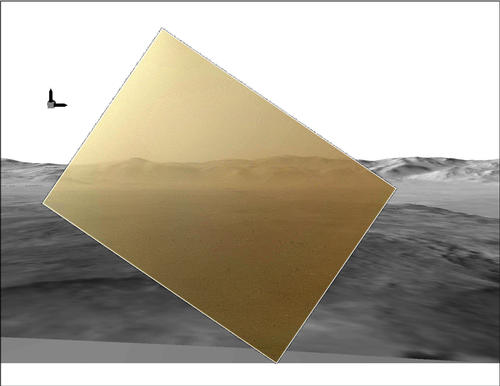
The Mastcam completed final calibration and then undertook a 360-degree look at Gale Crater around the rover with 130 images, each compressed into a 144×144 pixel format, returned to Earth and used to create the first colour panoramic view of the rover’s location.
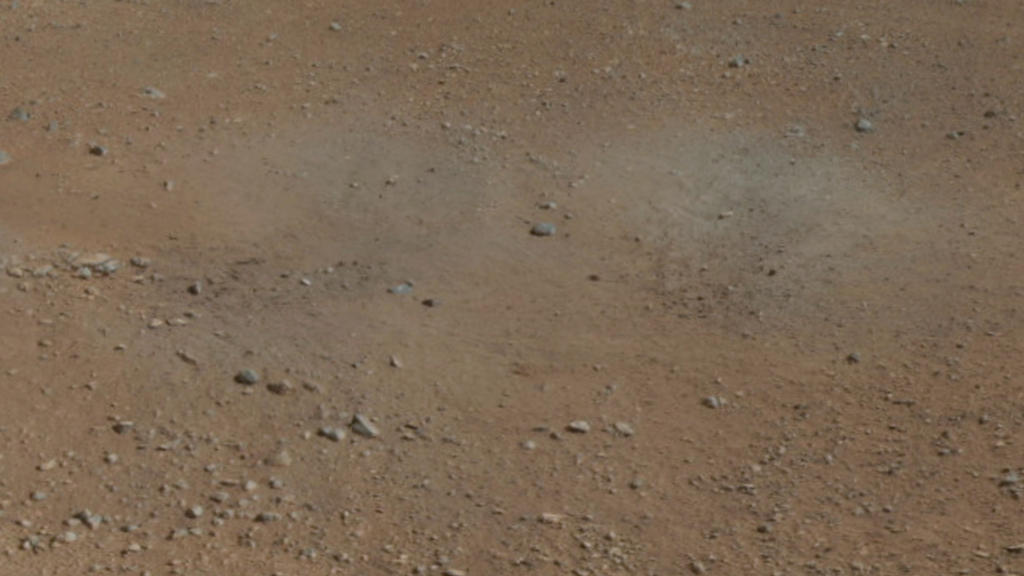
The Navcams were used to take high resolution images of the rover’s deck, taking a number of shots which revealed the vehicle to have some small debris scattered on the deck as a result of jet-wash from the descent stage motors, but nothing serious. These images were returned together with the low-res colour images during the scheduled overhead passes of Mars Odyssey and the Mars Reconnaissance Orbiter (MRO).

Image above: Curiosity’s rear deck. One the extreme left of the image, angling away from the deck is the RTG housing at the back of the rover. Immediately to the right of this, sitting on top of the raised structure is the arrow-like low-gain antenna (LGA). In front of this and side-on to the camera is the high-gain antenna (HGA). The rim of Gale Crater is the line of sun-brightened hills on the horizon.
Sol 3 also saw initial check-outs completed on a range of other instruments on the rover: the Alpha Particle X-ray Spectrometer (APXS), Chemistry & Mineralogy Analyzer (CheMin), Sample Analysis at Mars (SAM), and Dynamic Albedo Neutrons (DAN), all of which were successful. instruments were all successful. Issues with the Remote Environmental Monitoring Station (REMS) were resolved, allowing both REMS and RAD (Radiation Assessment Detector) to return further data on the environmental and climatic conditions in Gale Crater to Earth.
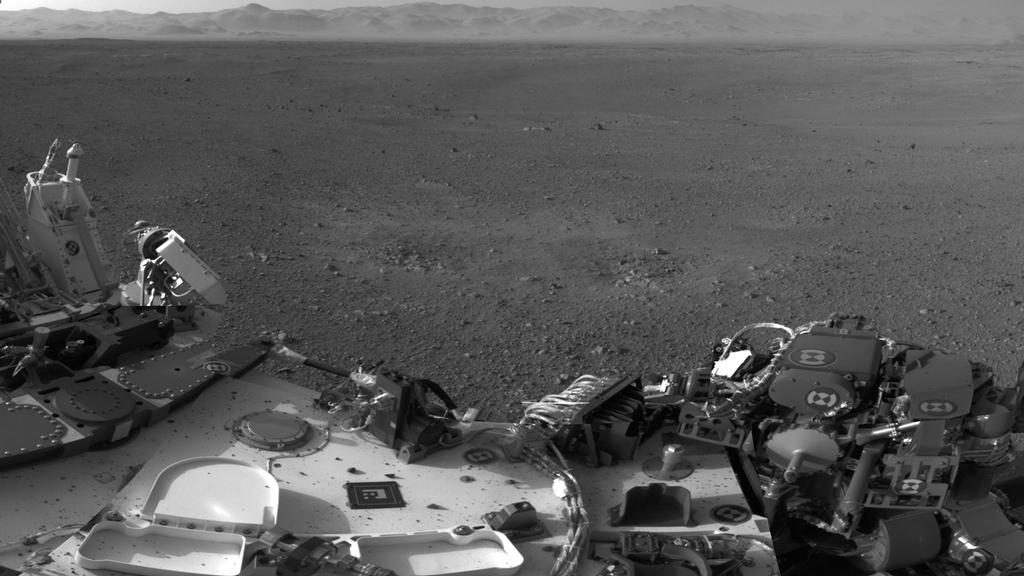
Image above: a further image of Curiosity’s deck taken as the Navcam rotates more towards the front of the rover in relation to the previous image. The LGA, HGA and drive system arm can still be seen to the left. In the right foreground is the rover’s “hand”, still in its stowed position against the front of the vehicle. Pebbles and dirt can clearly been seen on the rover’s deck, thrown-up by the jet-wash from the descent stage motors. Blast marks from the motors can themselves be seen a short distance from the rover.
Sol 4
Sol 4 was a relatively quiet day for the mission. Work continued on preparing the rover to transition to the R10 Flight Software. Key capabilities in the R10 package, as mentioned above, enable full use of Curiosity’s robotic arm and hand, and includes advanced image processing to check for obstacles while driving. This software will enable Curiosity far more autonomous than is the case with Opportunity, allowing it to make much longer drives along routes it identifies for itself and to avoid potential hazards along the way.
During the period of the transition, science and check-out operations have been deferred, and while the rover did return some images and additional data to Earth, the focus was on readying the on-board systems for the new software. The transition itself is expected to run through the weekend, with an end-time targeted for August 13th (PDT) Earth time. While this work is ongoing, the mission scientists have been putting together a geological map of a rough 390 square kilometre (150 square mile) region of Gale Crater, including the landing zone.
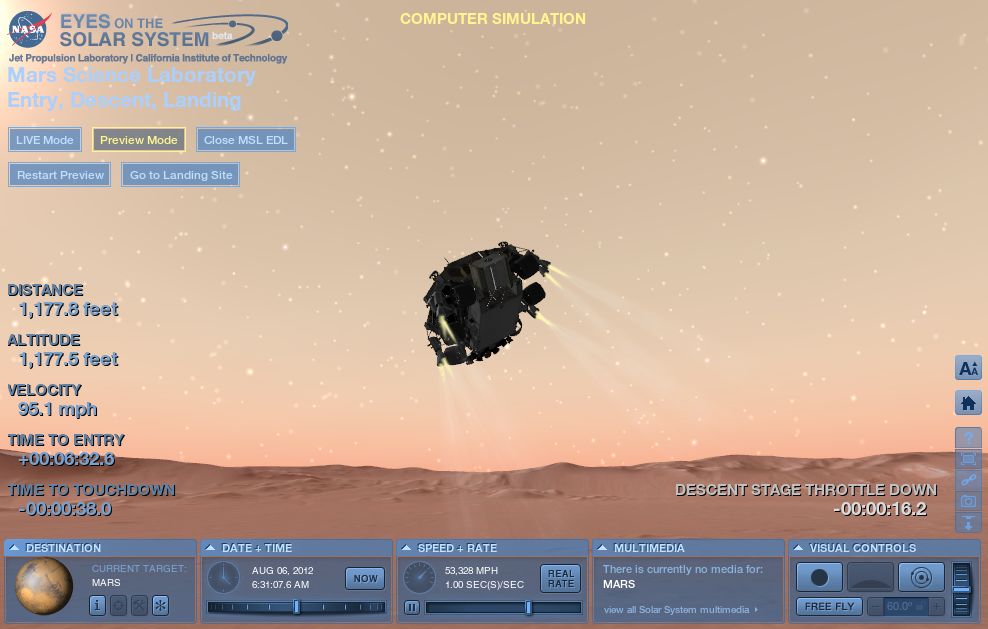
Elsewhere in JPL, and following the successful MSL landing, a unique video was cut together mixing footage from the “seven minutes of terror” simulation of Curiosity’s arrival on Mars with scenes from mission control at JPL during the actual sequence of events from EDL. The result is a unique film that puts a new perspective on the mission and the landing sequence.
Mission Trivia
Curiosity’s Sol 3 wake-up call came in the form of Good Mornin’ from Singin’ in the Rain.
All images: credit NASA / JPL







 Inara Pey: Living in a Modemworld