SpaceX is planning the maiden flight of its Falcon Heavy booster to take place in January 2018 – with an unusual payload. Credit: SpaceX
Elon Musk has announced the first payload that will be flown aboard the SpaceX Falcon Heavy, together with an ambitious goal in mind.
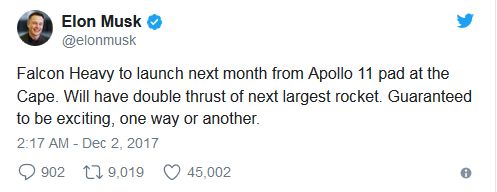
The maiden flight of the new heavy lift launcher had been expected to take place in December, as a part of an ambitious end-of-year five launch schedule. However, in tweets on Friday December 1st, 2017, Musk indicated the Falcon Heavy flight will now take place in January 2018. When it does, and if all goes according to plan, be sending Musk’s own car on its way to Mars – and possibly beyond.
Announcing the push-back on the Falcon Heavy launch
A car might sound a weird payload, but it is entirely in keeping with SpaceX’s tradition; the first Dragon capsule test flight in 2010 carried a giant wheel of cheese into space.
The first tweet on the launch also underlines Musk’s own uncertainty about its potential success; he has previously stated that he expects the first flight of the Falcon Heavy may end in a loss of the entire vehicle, simply because of the complexities of the system.
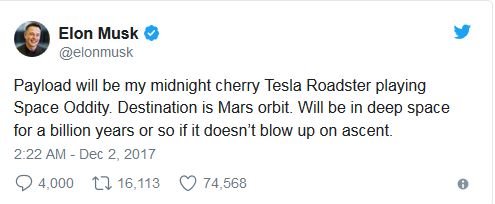
And the announcement about the payload and its (initial?) destination.
Comprising three Falcon 9 first stages strapped together side-by-side and firing 27 main engine simultaneously at launch means the vehicle will be generating a tremendous amount of thrust requiring all three stages to work smoothly together. They’ll also be generating a lot of vibration during the rocket’s ascent through the denser part of the Earth’s atmosphere. Only so much of this can be simulated and modelled; a maiden flight is the only way to find out where the remaining issues might lie.
However, if the launch is successful, it will be spectacular, involving the recovery of all three Falcon 9 stages to safe landings back on Earth. It will also boost Musk’s car towards Mars – which raises a question. Does SpaceX aim to orbit the car around Mars, or will the mission simply be a fly-by?
Elon Musk and his Tesla Roadser. Credit: Tesla.
Any attempt to achieve Mars orbit would require some kind of propulsion system to perform an orbital insertion burn, something which adds complexity to the mission. However, given Musk’s ambitions with Mars, placing even such an unusual payload into Mars orbit could yield valuable data for SpaceX. The car weighs 1.3 tonnes, so the total mass launched to Mars – car (likely modified somewhat, although the stereo will – according to Musk – be playing David Bowie’s Space Oddity during the ascent) payload bus, propulsion system, fuel, some kind of science system (why orbit Mars only to pass up the opportunity to gather data?) – could amount to around double that, if not more.
Musk’s comment about the payload being in “deep space for a billion years” seems to suggest the mission might by a fly-by, sending the car onwards and out across the solar system and beyond. Again, with a science payload sharing the space with the car, this could generate useful data. Either way the launch of such an unusual payload is likely to require additional US Federal Aviation Authority (FAA) approval; it will certainly require a launch license – which the FAA has yet to grant.
NASA Turns to Lunar Rover to Help With Next Mars Rover Mission
I’ve followed the Mars Science Laboratory (MSL) mission, more generally referred to as the Curiosity rover mission since 2012, tracking the discoveries made and the ups and downs of the mission. Overall, the rover has carried out some remarkable science and made a range of significant discoveries concerning ancient conditions within Gale Crater on Mars and the overall potential for the planet to have been able to potentially support microbial life at some point in its history.
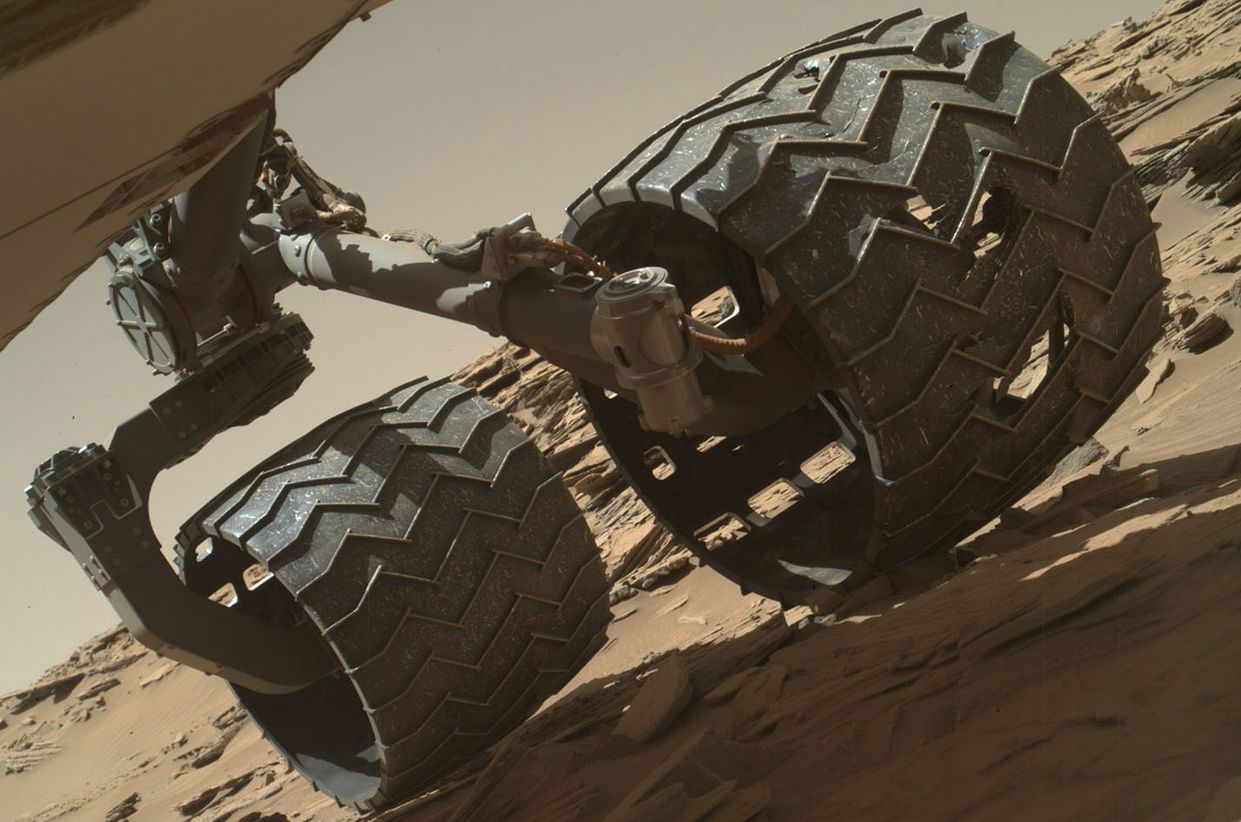
But there have been hiccups along the way – computer glitches, issues with some of the rover’s hardware, and so on. These included was the 2013 discovery that Curiosity’s wheels were starting to show clear signs of wear and tear less than a year into the mission. The discovery was made during a routine examination of the rover’s general condition, carried out remotely using the imaging system mounted on Curiosity’s robot arm.
This image taken on April 18th, 2016 (Sol 1,315) by the Mars Hand Lens Imager (MAHLI) camera on the rover’s robot arm revels areas of damage on Curiosity’s centre left wheel, the result of periodically traversing very rough terrain since the rover arrived on Mars in 2012. Credit: NASA/JPL
The images captured of the rovers six aluminium wheels, each some 50 cm (20 inches) in diameter, revealed tears and a number of jagged punctures in one of them (above), the result of passage over the unforgiving, uneven and rock-strewn surface of Mars. While damage was not – and has not – become severe enough to threaten Curiosity’s ability to drive, at the time they were found, it did cause mission planners to revise part of the rover’s mission as it drove along the base of “Mount Sharp” near the centre of the crater, in order to avoid traversing a region shown from orbit to be particularly rugged. Since then, care has been taken to avoid exposing the rover to particularly rough areas of terrain.
On Monday, November 27th, Amazon announced the preview of a new cloud-based AR / VR content creation / hosting platform called Amazon Sumerian, which is being pitched as a way to build 3D-powered applications to run on a range of hardware environments including high-end VR headsets, as well mobile products like the iPhone or iPad. It supports WebGL 2 and WebVR, and Amazon plans to make its tools compatible with Google’s AR software tools for Android-powered devices soon. ARKit is supported for AR development, with support for ARCore also promised.
In essence, Sumerian is geared towards those companies that are using gaming engines like Unity and Unreal to build virtual reality apps for corporate training, product development, employee education, etc., with them aim of providing them with a platform that can achieve the same while avoiding the overheads of requiring specific Unity / Unreal in-house skills or having to manage the systems require for such environments internally. In addition, Amazon see the platform as providing a means for businesses to provide things like concierge services, virtual house or land tours, and enhanced on-line shopping experiences.
Like Sansar, Sumerian uses one cloud-based environment in which to publish scenes (the Host), where users can access it, and a separate building / editing environment for actually constructing scenes. It also has an asset management system that allows customers to upload 3D objects in .FBX and .OBJ format, either as original content or from third-party sites such as TurboSquid (Sumerian also supports import from SketchFab), and which includes a library of pre-built Sumerian objects and scenes.
Scenes within the platform can be scripted using a dedicated visual workflow or JavaScript editors to provide comprehensive control over objects, including trigger mechanisms (allowing those accessing a Sumerian scene to interact with objects). Scripting support extends to working with web APIs to retrieve external data. The system uses a drag-and-drop interface to construct scenes, with everything from the user’s perspective being browser-based.
It’s not entirely clear how users interact with Sumerian scenes; no mention is made of avatars being used – and they probaly wouldn’t even be needed for AR environments. However, there is a concept of scene “hosts”, which should not be confused with avatars. Hosts are AI-drive characters capable of guiding users through scenes, respond to spoken-word questions, narrating a prepared script, use multiple languages, can be integrated with Amazon Lex and Amazon Polly, and so on.
For the preview period, use of Sumerian is free. there is no charge to design and edit your augmented reality (AR) and virtual reality (VR) applications. There will be no upfront costs or minimum fees for customers, instead charges are based on the amount of storage used for the 3D assets stored in Sumerian, and the volume of traffic generated by a scene, and for the use of any other AWS services, like Amazon Lex and Amazon Polly, used by a Sumerian Host. Those with Amazon AWS Free Tier, get access to Sumerian and can create a 50MB published scene that receives 100 views per month for free, for the first 12 months.
Again, in difference to those making Sumerian / Sansar / High Fidelity comparisons, Sumerian is less about making game-style or social environments, and far more about making the VR / AR application creation and hosting process a lot easier for companies that don’t necessarily have the expertise and resources of a dedicated software developer. They can whip up a training space or a VR shopping helper without having to worry about code. Of course, Sansar has also been promoted as an environment which could be used for training, simulation, education, and possibly other business uses; but it is not unfair to say that right now, it needs to mature somewhat before it is likely to be widely accepted in these environments. As such, it’ll be interesting to see how Sumerian fairs, and whether it might influence Linden Lab’s thinking around Sansar, perhaps pushing them even further towards the more social / games-led opportunities Sansar could encompass.
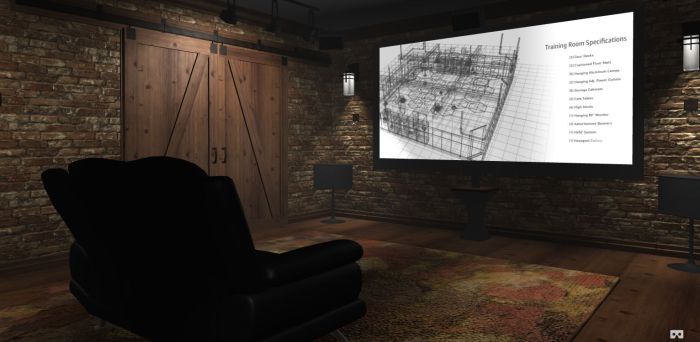
Sample Sumerian room scene in 360-viewing – click to view. Credit: Amazon
In the meantime, those wishing to take a closer look at Sumerian – and bearing in mind this does seem to be geared towards business use – can try the preview sign-up.
An artist’s impression of 1I/2017 U1 (or `Oumuamua), which was first seen by the Pan-STARRS 1 telescope in Hawaii on October 19th, 2017, and subsequently studied by a number of telescopes around the world, including the VLT of the European Southern Observatory (ESO) Credit: ESO / M. Kornmesser
On October 30th, 2017 I wrote about the extra-solar body which had crossed the orbit of Earth after swinging around the Sun during a rapid flight into and back out of the solar system. The object, originally designated A/2017 U1 and then as 1I/2017 U1 (the “1I” indicating it is the first positively identified interstellar object we’ve observed in 2017), was initially spotted on October 18th in Hawaii by the Pan-STARRS 1 telescope. Since then it has been closely tracked by astronomer around the world. What is particularly interesting about it is that Sun-orbiting eccentricity of between 0 (a circular orbit), and 1 (a parabolic orbit). Anything above 1 would tend to point to an object being entirely extra-solar in origin. A/2017 U1 has an orbital eccentricity of 1.2.
Since that time, the object has been under intense study, as has been reported in the media, and is proving to be most unusual. Now dubbed `Oumuamua, roughly translated as “scout” (ou being Hawaiian for “reach out for” and mua meaning “first, in advance of” – which is repeated for emphasis). At first thought to be a comet on account of initial observations, it was reclassified as an asteroid following more details observations.
In particular, observations made using the Very Large Telescope (VLT), operated by the European Southern Observatory (ESO) at the Paranal Observatory in Chile revealed the object to be cigar-shaped, rather than being a more rounded shape, as had been expected. Overall, it is estimated to be around 400 metres (1312 ft) in length, and approximately 40-50 metres (130-162.5 ft) in height and width. It is tumbling .
Using the VLT, ESO were able to accurately measure the brightness, colour and orbit of the asteroid and refine measurements of its trajectory as it leaves the solar system at a stunning 95,000 km/h (59,000 mph). These have revealed that `Oumuamua varies dramatically in terms of brightness (by a factor of ten) as it spins on its axis every 7.3 hours. As Karen Meech of the Institute for Astronomy in Hawaii explained in an ESO press release, this was both surprising and highly significant:
This unusually large variation in brightness means that the object is highly elongated: about ten times as long as it is wide, with a complex, convoluted shape. We also found that it has a dark red colour, similar to objects in the outer Solar System, and confirmed that it is completely inert, without the faintest hint of dust around it.
These observations also allowed Dr. Meech and her team to constrain `Oumuamua’s composition and basic properties. Essentially, the asteroid is now believed to be a dense and rocky asteroid with a high metal content and little in the way of water ice. It’s dark and reddened surface is also an indication of tholins, which are the result of organic molecules (like methane) being irradiated by cosmic rays for millions of years.
The measurements confirmed that the asteroid came to us from the general vicinity of Vega in the Constellation of Lyra, and has taken around 300,000 years to reach the solar system, which it has been passing through for the last 20,000. However, whether it originated around Vega is still being debated. Some of those observing the object believe it could have been wandering the interstellar void for 45 million years, having originally been ejected from a stellar system in the Carina–Columba association, which had once been far more aligned with the constellation of Lyra, relative to the solar system.
Passing through most of the solar system at a speed of around 80.0oo km/h (58,000 mph), the asteroid gradually accelerated under the Sun’s gravity so that it reached a velocity of 315,700 km/h (196,000 mph) at perihelion – the point closest to the Sun, which it reached on September 17th, 2017. Since then, the object has been heading away from the Sun and decelerating, again under the influence of gravity, passing the orbit of Earth in October. It will pass Jupiter’s orbit in May 2018, Saturn’s orbit in January 2019, and Neptune’s orbit in 2022, passing onwards through the solar system. It will be another 20,000 years before the object re-enters the interstellar medium.
Even it is of extra-solar origin, `Oumuamua is seen as being of significant import for our understanding of the formation of other solar systems. If nothing else, a study of the asteroid as it continues onward and outward from the Sun could potentially teach us a lot about its origins and the likely conditions within the system where it was born.
To this end, there have been numerous calls for the development of one or more missions to investigate the asteroid, some of which, such as Project Lyra, are already being mapped out. However, planning such a mission is one thing – actually pulling it off is quite another. `Oumuamua is currently travelling at 95,000 km/h (59,375 mph) – a velocity it will now more-or-less maintain.That is equivalent to 5.5 AU (Astronomical Units – the average distance from Earth to the Sun) per year, or 26 metres (84.5 ft) per second – what is technically referred to as its hyperbolic excess velocity.
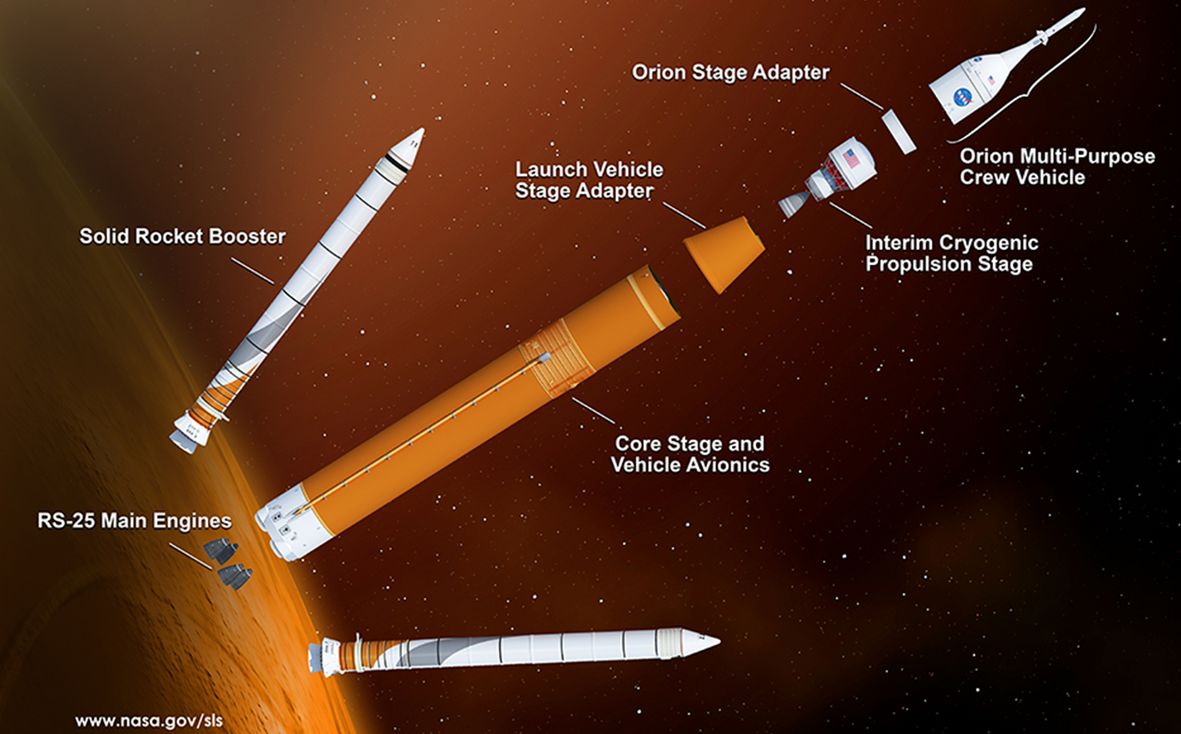
Project Lyra points to NASA’s Space Launch System rocket (left and centre) and the SpaceX Interplanetary System launcher (aka the BFR, right), as possible launch vehicle for a mission to intercept an extra-solar body. Credit: SpaceX
No space vehicle launched from Earth has been able to attain that kind of velocity – even the fastest human-made objects in space, Voyager 1, and the fastest space probe at launch, New Horizons, are both only managing around two-thirds of that velocity. So just getting to a point where we can launch a vehicle capable on eventually matching the speed of the asteroid is a major challenge – without the worry of getting it to a speed where it might eventually catch with `Oumuamua at a speed which would allow it sufficient time to gather data on the rock as it flies by, rather than shooting right on past it at such a speed, it has next to no time to gather data of significant value. Nevertheless, the proponents of Project Lyra are going so far as to suggest a mission might rendezvous with `Oumuamua and gather samples for on-board analysis.
Of course, the asteroid will be travelling through the outer solar system – and by that I mean the Kuiper Belt outwards to, and through, the Oort cloud – for thousands of years; it’s not just going to vanish in a decade or so. So this does give some leeway. An encounter with `Oumuamua within the Kuiper Belt for example (say, 50-200 AU from Earth) wouldn’t need to be launched for another 5-10 years. This could potentially allow for the use of an upcoming launch vehicle, such as NASA’s Space Launch System rocket or even SpaceX’s gigantic Interplanetary Transport System launcher, the BFR.
However, looking towards an encounter that far from earth still means that the probe would have to achieve a hyperbolic excess velocity of up to 76 metres (247 ft) per second – or half as much again as the asteroid’s velocity – again calling into question the effectiveness of a mission in gathering and returning data. Certainly, at those kinds of speeds, an actual rendezvous with `Oumuamua to gather a sample would be out of the question.
An alternative approach might be more “slow and steady” approach using solar sail technology – such as that being developed with projects such as the Breakthrough Initiatives’ Starshot. This might allow a vehicle propelled by an earth-based array of lasers to eventually catch the asteroid, and with a rate of steady acceleration, overhaul it at a rate at which data can be gathered in earnest. However, such technology is in its infancy; thus the chances of such a mission being used for catching `Oumuamua are perhaps slim. However, development of the technology and a mission for intercepting an extra-solar object in the future a distinct possibility – particularly as it is now estimated at least one extra-solar object passes through the solar system a year.
Whether intended to study `Oumuamua or one of these other interstellar wanderers, any such mission – using rockets, ion drive propulsion, solar sail technologies -, if pursued, could led to technological breakthroughs as well as scientific rewards. As the project authors note:
As 1I/‘Oumuamua is the nearest macroscopic sample of interstellar material, likely with an isotopic signature distinct from any other object in our solar system, the scientific returns from sampling the object are hard to understate. Detailed study of interstellar materials at interstellar distances are likely decades away, even if Breakthrough Initiatives’ Project Starshot, for example, is vigorously pursued. Hence, an interesting question is if there is a way to exploit this unique opportunity by sending a spacecraft to 1I/‘Oumuamua to make observations at close range.
[A] mission to the object will stretch the boundary of what is technologically possible today. A mission using conventional chemical propulsion system would be feasible using a Jupiter flyby to gravity-assist into a close encounter with the Sun. Given the right materials, solar sail technology or laser sails could be used… Future work within Project Lyra will focus on analysing the different mission concepts and technology options in more detail and to down select 2 – 3 promising concepts for further development.
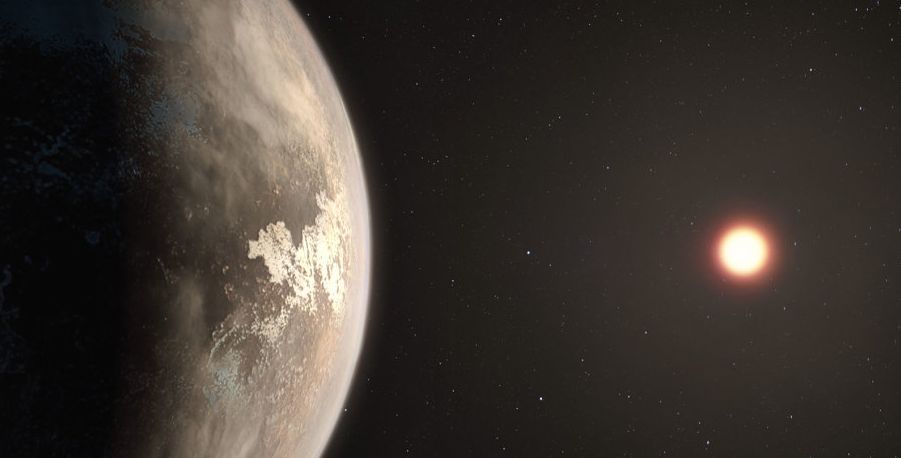
An artist’s impression of Ross 128. Credit: ESO / M. Kornmesser
The European Southern Observatory (ESO), responsible for finding a planet orbiting the Sun’s nearest stellar neighbour, Proxima Centauri (see here for more), has now discovered another exoplanet orbiting a nearby star.
The star in question is Ross 128, a red dwarf located in the constellation of Virgo. As I’ve previously noted, red dwarf stars tend to be extremely violent in nature. Their internal action is entirely convective, making them unstable and subject to powerful solar flares, generating high levels of radiation in the ultraviolet and infra-red wavelengths which can leave planets like the one orbiting Proxima Centauri or those orbiting TRAPPIST-1 unlikely to support life.
However, Ross 128 is different. It is a “quiet” red dwarf; it experiences less in the way of flare activity, meaning any planets orbiting it will be exposed to less radiation and stellar wind. In particular, the planet discovered by ESO could potentially be habitable.
The planet, designated Ross 128 b, was discovered using the ESO’s High Accuracy Radial velocity Planet Searcher (HARPS), located at the La Silla Observatory in Chile. HARPS uses measurements of a star’s Doppler shift in order to determine if it moving back and forth, a sign that it has a system of planets. The data gathered by the instrument allowed astronomers to confirm Ross 128 b is a rocky world, with roughly 35% more mass than Earth, orbiting Ross 128 at a distance of about 0.05 AU, and with a period of 9.9 Earth days.
Measurements of Ross 128’s likely radiative output, combined with the planet’s distance from the star put it on or near the star’s habitable zone – the region around a star where a solid body planet might have both an atmosphere and liquid water on the surface. It receives around 38% more light from its star than Earth does from the Sun. This has allowed the team making the discovery to estimate that Ross 128 b’s equilibrium temperature is likely somewhere between -60 °C and 20 °C – close to what we experience here on Earth, making it a temperate planet.
That Ross 128 is a “quiet” older red dwarf, less prone to violent outbursts, means Ross 128 b may well have retained any atmosphere which may have formed around it. Whether or not Ross 128 b has an atmosphere has yet to be determined; if it does, given the planet is likely to be tidally locked, with the same same side always facing towards its star, any atmosphere the planet may have could be subject to extreme weather.
Even so, given what is currently known about Ross 128 b, were it to have an atmosphere and liquid water on the surface, it would be the closest potentially habitable exoplanet to Earth so far discovered. This alone means Ross 128 b is liable to be the subject of a lot of additional study over the coming months.
Nor is this the first time Ross 128 has been in the news this year. In July 2017, Abel Méndez, an astrobiologist at the Arecibo Radio Telescope, reported that on May 12th, 2017, during a 10-ten observation of Ross 128, the telescope received a 10-minute wide-band radio signal “almost periodic” in natures, and which decreased in frequency.
While some were quick to link this event with the November discovery of Ross 128 b, it’s worth pointing out that Arecibo, the Green Bank Telescope in West Virginia and the Allen Telescope Array (ATA) in northern California, have all spent time listening to Ross 128 without any of them hearing any repeat of the signal. Currently the most widely accepted explanation for the May 2017 signal is radio frequency interference from a satellite orbiting the Earth.
A Lava World with an Atmosphere?
And staying with exoplanets, 55 Cancri e, also named Janssen, has also been in the news this week.
One of the few exoplanets discovered prior to the Kepler mission, it is one of five planets orbiting 55 Cancri A, the G-class main sequence star which forms one half of the binary star system 55 Cancri, some 41 light years away from the Sun, in the constellation of Cancer. At 7.8 Earth masses, and with a diameter almost 50% that of Neptune, it has the distinction of being the first “super-Earth” discovered in orbit around a main sequence star similar to the Sun.
An artist’s impression of super-Earth exoplanet 55 Cancri e and its parent star. Credit: NASA/JPL
Discovered in August 20o4, the planet has been subject of extensive study. As the closest planet to its parent, it takes 2.8 days Earth days to complete one orbit, and is tidally locked, always keeping the same side facing its parent. A study of the planet using the Spitzer space telescope in 2013 led astronomers to the conclusion 55 Cencri e is likely carbon planet, dominated by lava flows on its sunward side. In 2016, observations using the Hubble Space Telescope indicated the planet may have a thin hydrogen and helium atmosphere with suggestions of hydrogen cyanide.
However, an international team led by Cambridge University in the UK, has been re-examining the data gathered by the Spitzer space telescope. Using an improved model of how energy would flow throughout the planet and radiate back into space, their findings indicate that temperatures on the “dark” side of the planet average 1,300 to 1,400 oC (2,400 to 2,600 oF), much closer to to the average 2,300 oC (4,200 oF) on the sunward side than previously thought.
These finding suggest 55 Cancri e has a far denser, more complex atmosphere than had been thought, one which acts as transfer mechanism for circulating heat around the planet. What’s more, this atmosphere may well contain nitrogen, water vapour and even oxygen—molecules found in our atmosphere, too—but with much higher temperatures throughout.
The overall conditions on the surface of the planet preclude free-flowing water or the opportunity for life to arise, but they also present a further mystery. Given its proximity to its parent star, in theory 33 Cancri 2e’s atmosphere should have been stripped away aeons ago by the solar wind. so there are still mysteries with the planet yet to be resolved.
Orion’s first deep space mission, EM-1 will be an extended uncrewed flight to cislunar space, officially targeted for June 2020, but which may still make a December 2019 lift-off. Credit: NASA
NASA has provided an update on the first integrated launch of the Space Launch System (SLS) rocket and Orion spacecraft.
Planned as an uncrewed mission, Exploration Mission-1 (EM-1), planned as a flight to cislunar space and back, is a critical test on the road to NASA’s human deep space exploration goals, designed to verify the SLS / Orion’s capabilities in handling missions between Earth and the Moon.
The update comes after the completion of reviews of both the Space Launch System and the Orion vehicle systems – the latter of which took place on both sides of the Atlantic, given the Orion’s Service Module, which is providing the vehicle with power and propulsion, is being built by the European Space Agency. NASA initiated the reviews as a result of early studies, which raised concerns over meeting a December 2019 launch date as ambitious, leading to the agency pushing it the launch back to June 2020.
EM-1 will utilise the “Block-1” Space Launch System booster, with a 70-tonne payload capability. Credit: NASA
As a part of the update, NASA points to June 2020 still being the planned launch date, but indicates it is also working to keeping the December 2019 launch a possibility, providing no significant setbacks or issues arise, as several of the risks indicated in the earlier report have not been realised. However, even if EM-1 still achieves the 2019 launch date, the follow-up EM-2 mission, which will carry a crew into space, will still take place in 2023, rather than 2021 as originally planned, to allow additional time for the development of the SLS Block 1B launch vehicle which will be used in that mission.
As part of the recent reviews, and in order to help meet the December 2019 launch opportunity, the update indicates that a flight test of the Orion’s launch abort system, critical to SLS operations, and must occur prior to EM-1, have been brought forward to April 2019. Known as Ascent-Abort 2, it will validate the launch abort system’s ability to land the crew safely during descent, and also help ensure that the agency can remain on track for the EM-2 crewed flight in 2023.
To build the SLS and Orion, NASA is relying on several new and advanced manufacturing techniques, including 3D printing, which is being used to fashion more than 100 parts for the Orion capsule. In Germany, integration of the first Service Module is progressing. Recently, the 24 orientation thrusters were installed, complementing the eight larger engines that will back up the main engine, and more than 11 km of cables are being laid and connected to send the megabytes of information from the solar panels, fuel systems, engines, and air and water supplies to the module’s central computers.
With the SLS booster, welding has been completed on all the major structures for the mission and is on track to assemble them to form the largest rocket stage ever built and complete the EM-1 “green run,” an engine test that will fire up the core stage with all four RS-25 engines at the same time.
EM-1 will see a crew-capable space craft travel further from Earth than at any point in time since the dawn of the space age. Following launch, the vehicle will commence a 4-day flight to cislunar space, where it will remain in extended orbit around the Moon, before making a 4-day return to Earth.
SpaceX Looks to Falcon Heavy Launch and Operational Return of Pad 40
With NASA still looking at a potential of December 2019 for the maiden launch of the Space Launch System rocket, SpaceX is preparing for a December 2017 maiden flight of their new launch system, the Falcon Heavy. Originally scheduled for November 2017, the launch is now pencilled for December 29th, 2017 and will be one of five launches SpaceX plan to round-out the year.
SpaceX Falcon Heavy, slated for a December 29th maiden flight. Credit: SpaceX
The Falcon Heavy, when operational, will be capable of hoisting a maximum payload of 63.5 to low Earth orbit, although the more usual LEO payload limit will be around 55 tonnes. It will also be capable of lobbing 14 tonnes to the Moon, 10 tonnes to Mars and even 3.5 tonnes to the outer solar system.
The maiden flight, however, will carry little more than a dummy payload, but it will hopefully include the recovery of the three Falcon 9 rockets which make up the core of the Falcon Heavy.
Two of these rockets form “strap on boosters” for the Falcon Heavy, and are jettisoned first. If all goes according to plan, these will perform automated “boost back” manoeuvres and fly themselves to safe landings.. The central booster will continue until its fuel is almost expended, then separate from the upper stage, perform its own boost back manoeuvre and return to Earth.
Eventually, SpaceX plan to make Falcon 9 and Falcon Heavy fully reusable with the addition of a “fly back” upper stage as well.
Also in December, SpaceX plan to re-active their launch facilities at Launch complex 40 at Canaveral Air Force Station alongside Kennedy Space Centre, Florida. This has been out of commission sine September 1st, 2016, when a Falcon 9 booster exploded on the pad during a pre-launch test, completely destroying itself, its payload and severely damaging the pad.
Since that time, SpaceX’s east coast operations have been confined to launch complex 39A at Kennedy Space Centre, which will be used for all Falcon Heavy launches and – eventually – for the launch of the SpaceX Interplanetary Transport System.
Despite Canaveral Pad 40 being out of service, SpaceX has achieved its highest cadence of launches to date in 2017, and hopes to be able to commit to an even higher rate of launches in 2018 using both pad 40 and pad 39A.
The first scheduled flight from the repaired pad 40 should be a commercial cargo resupply services mission to the International Space Station (ISS), and subject to NASA approval, might utilise a previously flown Falcon 9 first stage.
Looking across Gale Crater as it might appear from NASA’s Mars Science Laboratory rover Curiosity. Render created by Kevin M Gill.
Kevin M. Gill is a software engineer, planetary and climate data wrangler at NASA’s Jet Propulsion Laboratory. He’s been working with digital terrain models and ortho images from the HiRISE imaging system aboard NASA’s Mars Reconnaissance Orbiter (MRO) to create some stunning computer models and images of Endeavour and Gale craters, where the Opportunity and Curiosity rovers are exploring, as well as other regions of Mars. These have caused a stir on social media this week, and rightly so.
Kevin provides a detailed description of how he produces the images, which involves a range of software tools including ImageMagick, Maya and Photoshop. For those interested in creating computer renderings, his post makes a fascinating read; for those who love images of Mars, his images offer a stunning new perspective on the planet. The images utilise a slight vertical height exaggeration and false colour / lighting adjusted to Earth daylight standards, but the results are undeniably stunning.
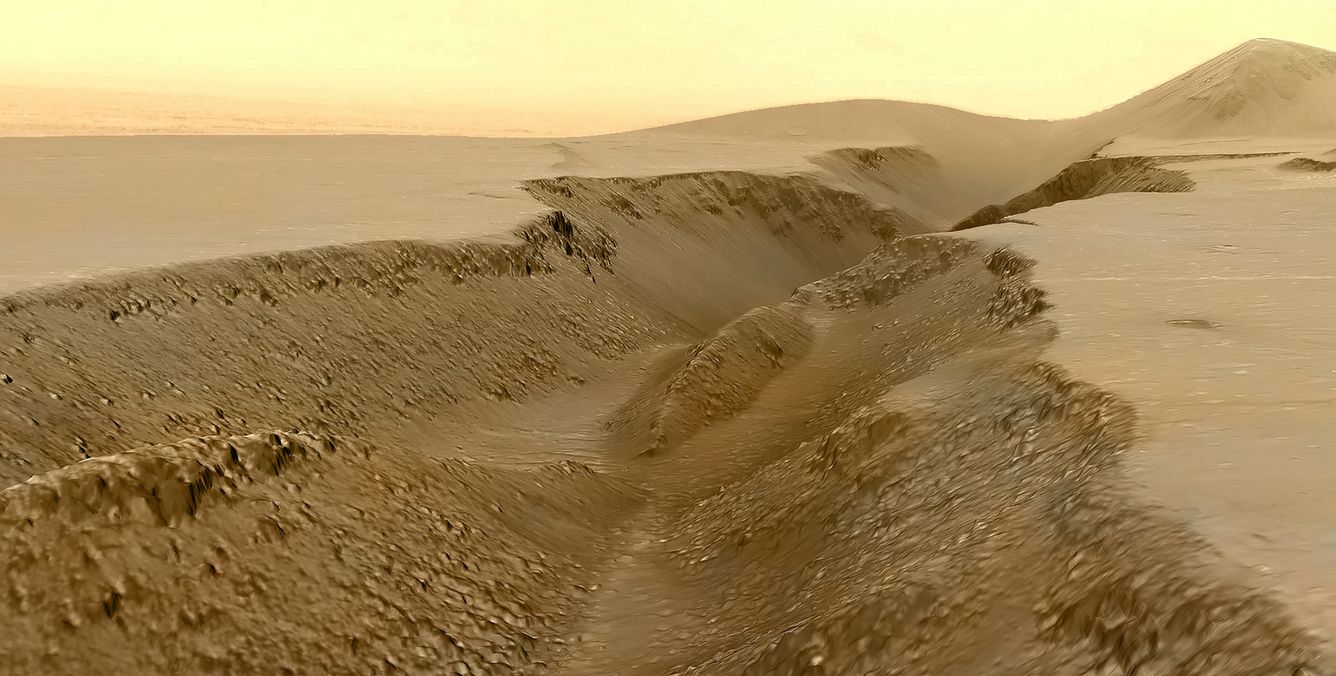
A view along a volcanic fissure in the Cerberus Palas region of Mars. Rendering by Kevin M. Gill
Some of the images offer a unique perspective on surface features, such as the one above, showing a volcanic fissure in Cerberus Palas in the north-eastern Elysium quadrangle of Mars.
For those interested in producing vistas of Mars in a platform such as Linden Lab’s Sansar, Kevin’s work and notes could offer a starting point. In turn, Sansar could offer the perfect VR visualisation platform for allowing people to “visit” and learn about Mars.
“Mount Sharp” (Aeolis Mons), the mound of material deposited against the central impact peak of Gale Crater. Render by Kevin M Gill.
Meanwhile, the MSL team are moving closer to resuming drilling operations with the Curiosity rover.
These were suspended in December 2016. Prior to that, Curiosity had used the drill system mounted on its robot arm a total of 15 times between 2013 and 2016. On each of those occasions, two contact post, one either side of the bit, were placed on the target rock before the bit was extended by the drill feed mechanism, helping to gauge and support the drill. It was reliability issues with the feed mechanism which led to the suspension of all drilling operations.
Engineers have been investigating ways to use the drill without any reliance on the feed mechanism. This requires the drill to remain extended, the rover’s arm bringing it directly in contact with the rock to be drilled, without any support from the stabilising arms. In order for this to work, it is essential the drill bit – which not only cuts into rocks, but gathers samples from within them – can be placed with minimal downward or side-to-side pressure or motion on it, to ensure it is not damaged or becomes stuck.
The issue here is that when supported by the stabilisers, the drill had only one axis of movement, without them, it could be subject to fix degree freedom of movement as vibrations from the drilling process feed back into the rover’s arm. To minimise this risk, tests are being carried out to determine if sensors in the robot arm are sensitive enough to detect potentially damaging motions in the drill when in use, and shut down the drilling operation.
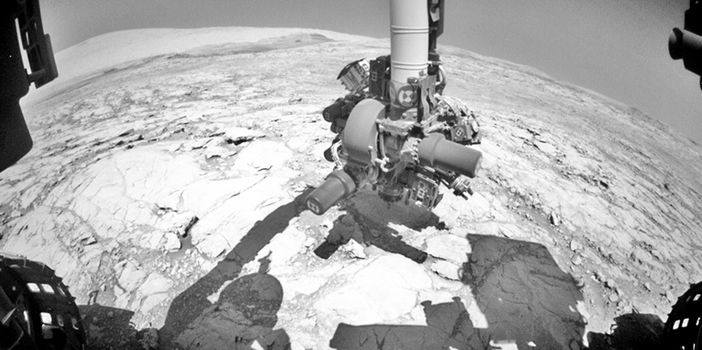
On October 17th, 2017, NASA conducted the first test with Curiosity’s robot arm aimed at resuming the rover’s ability to gather rock samples with the drill mounted on the arm. Credit: NASA/JPL
To this end, on October 17th, 2017, Curiosity was commanded to place the drill bit in contact with a rock for the first time in ten months and without the use of the stabilisers. The bit was then gently pressed downward and moved slightly from side-to-side to see how well the sensors responded, the idea being that when the drill resumes operations, the sensors can be used to automatically detect potentially harmful movements in the drill head which could result in the bit being damage or becoming stuck.
It’s still likely to be several months before Curiosity resumes drilling operations, with further tests in the planning. However, mission managers are optimistic the rover will at some point be able to resume use the drill to gather samples from within rocks for analysis.
Deep Space Gateway Gains Momentum
On November 1st, 2017, NASA awarded contracts to five companies to examine how they can develop a power and propulsion module as the initial element of the agency’s proposed Deep Space Gateway.
As currently envisioned, the power and propulsion module will generate electrical power for the gateway, provide a communications relay and use a solar electric engine for manoeuvring the station in cislunar space. NASA had been examining their own ideas for the module, but it is hoped that the contracts will allow industry the chance to present their own ideas and technologies in support of the module’s development.
Part of the NASA studies involve the use of a 50-kilowatt solar electric propulsion (SEP) motor for the module, the idea being that if successful, the system could be scaled-up for use on missions to Mars. While SEP systems can’t generate much thrust, they can run for long periods and are far more efficient than chemical systems.
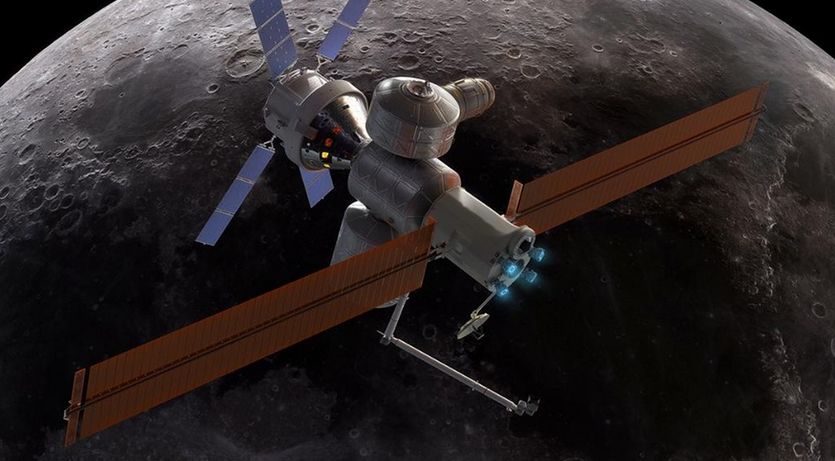
Artist’s concept of the Deep Space Gateway passing close to the Moon. Credit: NASA
NASA had planned to test the SEP concept on the robotic portion of the now-cancelled Asteroid Redirect Mission (ARM), in which a robotic spacecraft would obtain a boulder-sized sample of a near Earth asteroid and return it to cislunar space for examination by astronauts. With the cancellation of that mission, the SEP programme has been in limbo; so issuing the contracts might both help revive the SEP project and allow commercial organisations weigh-in on the work.
These contracts are separate from those issued in 2016 to examine development of habitat modules for the gateway. However, all five of the companies that received contracts for Power and Propulsion Element studies also either have a habitat award or are partnered with a company that does.
How NASA plans to proceed with development of the station, including how it procures it from industry, will depend on the outcome of the studies as well as NASA’s overall exploration planning. At this point in time – and despite the October 5th, 2017 directive from the inaugural meeting of the re-invoked US National Space Council (NSC) concerning an American return to the Moon – the Deep Space Gateway remains a concept, not a formal NASA programme.
Also interested in participating in the programme is the European Space Agency. They are hoping to have a dedicated module forming part of the station, and are offering to develop a resupply system potentially capable of delivering up to nine tonnes of supplies to the Gateway.
The resupply vehicle would likely use the Ariane 6 launcher and solar electric propulsion system, rated around 60 kilowatts. ESA representatives believe the system could be ready for operation in 2025 or 2026, which fits with the time frame for the station’s development – which could see the power and propulsion module launched in 2022, as part of NASA’s Exploration Mission 2 mission for the Orion / Space Launch System. In the meantime, the first launch of the Ariane 6 booster is currently scheduled for 2020.











 Inara Pey: Living in a Modemworld