Space Sunday: a view of Earth, a look at China, and 5 exoplanets

The Earth and Moon as seen from OSIRIS-REx. Credit: NASA/OSIRIS-REx team and the University of Arizona

NASA’s Origins, Spectral Interpretation, Resource Identification, Security – Regolith Explorer (OSIRIS-REx), launched in September 2016 is on a mission to gather samples from the surface of asteroid Bennu and return them to Earth (see my previous reports here and here). It’s a huge undertaking, one which will take the vehicle on a journey of some 7.2 billion kilometres (4.5 billion miles).

Part of this journey involved OSIRIS-REx looping past the Earth in September 2017, in a gravity assist manoeuvre design to increase its velocity by some  13,400 km/h (8,400 mph) to almost 44,000 km/h (27,500 mph), and swing it on to an intercept with the asteroid, which it will reach in October 2018. During this Earth flyby, scientists carried out an extensive science campaign, allowing them to check and calibrate the probe’s suite of science instruments.

A part of this campaign involved testing the probe’s camera system, using it to take pictures of the Earth and Moon during September and early October. Several of these images, captured on October 2nd, 2017, were used by NASA used to create a to-scale composite image of the Earth-Moon system, which was released into the public domain on January 3rd, 2018 (seen above).

At time the images were taken, the spacecraft was approximately  5 million km (3 million mi) from Earth – or about 13 times the distance between the Earth and Moon. It was created by combining pictures captured using blue, green and red filters, allowing it to present a true colour view of the Earth and Moon as they reflect sunlight. Looking at it, one cannot help by be reminded of just how small and fragile our place in the universe really is.

China’s Space Ambitions

In reporting on China’s space programme, I’ve frequently noted the growing ambitious nature of their endeavours.  A mark of this is that in 2017, China mounted more than 20 successful launches – including some for foreign nations such as Venezuela, as a part of China’s desire to expand their commercial launch operations – matching Russia’s launch efforts, and sitting not that far behind the USA.

At the start of January 2018, the China Aerospace Science and Technology Corporation (CASC) upped the ante, indicating that in 2018, they plan to carry out 35 launches through the year. At the same time, CASC’s sister organisation,  China Aerospace Science Industry Corporation (CASIC) indicated it would be carrying out at least 5 launches during the year – four of them in the span of a week – while the Chinese private sector corporation, Landspace Technology, indicated it would commence launch operations during the year. Like America’s SpaceX, Landspace plan to become a major force in commercial sector launch operations, initially with satellite payloads, but ramping to flying people into space in around 2025.

One of the more notable missions China plans to launch in 2018 is the Chang’e 4 mission to the Moon’s far side. This is a two-phase mission, commencing in June 2018 with the launch of a communications relay satellite to the Earth-Moon Lagrange point. It will be followed in December by a lander / rover combination which will land on the lunar far side to commence science studies. It will mark the first attempt to carry out long-term studies on the side of the Moon permanently facing away from Earth – not to mention the first far side lunar landing.

The Chang’e 3 lander (top) and Yutu rover share similar designs with the upcoming Chang’e 4 lunar surface mission. Credit: National Astronomical Observatories of China

The CE-4 Relay satellite is required in order for communications to take place between Earth and the Chang’e 4 lander and rover.

As the Moon is tidally locked with Earth, and always keep the same side pointed towards us, there is no way to have direct communications with any vehicle on the lunar far side. This is overcome by placing a satellite in the Earth-Moon L2 position, where it can maintain a steady position relative to the Earth and the Moon’s far side, enabling communications between the two, and keeping scientists and engineers on Earth in contact with the lander and rover.

The lander / rover combination will explore part of the 180 km (112.5 mi) diameter Von Kármán crater, believed to be the oldest impact crater on the Moon. It lies within the South Pole-Aitken Basin, a vast basin in the southern hemisphere of the far side which extends from the South Pole to Aitken crater.

The crater is of general interest because it contains about 10% by weight iron oxide (FeO) and 4-5 parts per million of thorium, which can be used as a replacement for uranium in nuclear reactors. In addition, the South Pole-Aitken Basin – one of the largest impact basins in the solar system (about 2,500 km / 1,600 mi across and some 13 km / 8.1 mi deep) – also contains vast amounts of water ice. These deposits are believed to be the result of impacts by meteors and asteroids over the aeons, which deposited ice within the basin, which lies in almost permanent shadow.

The water deposits will be part of Chang’e 4’s studies – China has already announced its intent to establish a human mission on the lunar surface, and relatively easy access to water ice could be a critical part of sustaining a human presence there. To carry out their studies, both the rover and the lander will carry a range of science instruments and experiments, including systems supplied by Sweden, Germany, the Netherlands and Saudi Arabia.

In addition, the lander will include a container with potato and rockcress seeds, together with silkworm eggs to see if plants and insects can survive in the lunar environment. It is hoped that if the eggs hatch, the larvae would produce carbon dioxide, while the germinated plants would release oxygen through photosynthesis, allowing both to establish a simple life-sustaining synergy within the container. If successful, it might allow larger biotic systems to be developed and used to augment the life support systems in a lunar base while providing additional foodstuffs.

2018 should also mark the return to flight of the Long March 5, China’s most powerful launch vehicle. This entered service in November 2016, but flights were suspended in 2017 following the failure of the vehicle’s second launch in July of that year. Long March 5 is critical to China’s ambitions, as it will be the launch platform for the Chang’e 5 (2019) and Chang’e 6 (2020) lunar sample return missions, the modules to be used in a planned space station, due to start in 2019 with the launch of Tianhe unit, and boost the Mars Global Remote Sensing Orbiter and Small Rover mission to the red planet in 2020.

A slight fuzzy TV image of the Long March 5 launch on July 2nd, 2017. The vehicle suffered “an anomaly” shortly after lift-off and eventually crashed into the Pacific Ocean. 2018 should see the Long March 5 resume operations. Credit: CCTV

The 2018 return-to-flight of the Long March 5 will likely involve placing a Dongfanghong-5 (“The East is Red”) communications satellite, which will be placed in low Earth orbit.

Continue reading “Space Sunday: a view of Earth, a look at China, and 5 exoplanets”

Space Sunday: in memory of John Young

John Young: Gemini (l), Apollo, shuttle and in 2002, two years prior to his retirement from NASA after 42 years with the agency (r). Credit: NASA / Getty Images

On Saturday, January 6th, 2018, NASA announced the passing of astronaut John Watts Young. The US space agency’s longest-serving astronaut during his career, Young passed away on January 5th at the age of 87. He flew in space six times across three different space programmes: Gemini, Apollo and the space shuttle.

Young was born in San Francisco, California, on September 24th, 1930, and earned a Bachelor of Science degree with highest honours in Aeronautical Engineering from the Georgia Institute of Technology in 1952. He served in the US Navy from 1952 through 1962, serving as a seaborne officer prior to entering flight training , qualifying as a jet fighter pilot in 1953. After flying front-line fighters for 5 years, he joined the US Navy Air Test Centre in 1959, evaluating fighter aircraft and weapons systems.

In 1962, Young joined NASA and was part of Astronaut Group 2 alongside Neil Armstrong first man on the Moon, Charles “Pete” Conrad, commander of the first crewed Skylab mission,  Frank Borman, commander of the first Apollo flight to the Moon (Apollo 8), James “Jim” Lovell, commander of Apollo 13, Thomas Stafford, commander of the US part of the Apollo-Soyuz Test Project (ASTP) mission, and Edward “Ed” White, who was to be killed in the Apollo 1 pad fire. He was the first of that group to fly in space as a part of the Gemini programme, the second of America’s manned spaceflight programmes, and the precursor to Apollo and the lunar effort.

John Young (r) with Gemini 3 commander Virgil “Gus” Grissom, standing in front of the Gemini simulator. Credit: NASA

He first flight into space was aboard Gemini 3 on March 23rd, 1965, sitting alongside Virgil “Gus” Grissom, the mission commander. The primary goal of the mission was to put the Gemini capsule through its paces during a 3-orbit flight – America’s seventh crewed spaceflight (or ninth, if you count two X-15 flights). It was also the final mission  controlled from Cape Kennedy Air Force Station in Florida (Cape Canaveral Air Force Station today), before mission control functions were shifted to the newly opened Manned Spacecraft Centre, known today as the Johnson Space Centre.

The mission was noted for the “contraband” corned beef sandwich Young smuggled onto the flight in his spacesuit. Grissom knew nothing of the sandwich until Young produced it, and both men took a couple of bites each before Young stowed it again to avoid crumbs getting into the capsule’s electronics. Post-mission, Grissom commented, “After the flight our superiors at NASA let us know in no uncertain terms that non-man-rated corned beef sandwiches were out for future space missions. But John’s deadpan offer of this strictly non-regulation goodie remains one of the highlights of our flight for me.”

The sandwich incident seemed to leave Young sidelined; rather than being pencilled for a command slot, he was relegated to the role of back-up. However, with the Apollo programme starting to ramp-up, Ed White was rotated over to the Apollo 1 crew, and this opened a slot in the Gemini programme for Young to take the command of Gemini 10 in 1966. The 8th manned Gemini flight and with Michael Collins flying alongside Young, Gemini 10 was the first to perform a rendezvous with two Agena target vehicles.

The spacecraft launched on July 18th, 1966, 100 minutes after its dedicated Agena target vehicle. After a successful rendezous and docking, they re-ignited the Agena’s motor, the first time this had been done, and used it to raise their orbit from an average altitude of 265 km (145 nautical mile) to a 294 by 763 km (159-by-412-nautical-mile) orbit, ready for a rendezvous with the Agena target vehicle intended to be used by Gemini 8, which was unable to complete its mission. Collins then completed the first of two EVAs after the crew had rested, and then Gemini 10 detached from its own Agena to make a successful docking with the passive Gemini 8 target vehicle – the first such docking without any assistance in handling the target vehicle from Earth. After a further rest period, Collins performed a second spacewalk. With a double doubling, two EVAs and 10 science experiments, Gemini 10 was one of the most comprehensive space missions completed up to that time, with the capsule splashing down on July 21st, 1966.

John Young and Michael Collins, the crew of Gemini 10, 1966. Credit: NASA

For the Apollo programme, Young was initially assigned to back-up crews. However, following the Apollo 1 fire which killed Grissom, White and Roger Chaffee, the flight roster was reshuffled, and Young was placed on the Apollo 10 crew as Command Module Pilot. This mission, which also included Thomas Stafford and Commander and Eugene Cernan as the Lunar Module Pilot, was the final Apollo mission prior to the missions to the surface of the Moon, and was the second – after Apollo 8 –  to actually fly to the Moon.

Launched on May 18th, 1969, the only Apollo Saturn V mission to lift-off from Launch Complex 39B, and only one of two Apollo missions to feature crews who had all previously flown in space (the other being Apollo 11). Reaching the Moon on May 21st, 2969, the Apollo 10 crew became – and remain – the humans  who have travelled the farthest from their homes. This is because the Moon is in an elliptical orbit around the Earth, which varies by some 43,000 km (23,000 nmi) between perigree (the point closest to the Earth) and apogee (the point farthest from the Earth), and Apollo 10 was the only Apollo mission to take place as the Moon was approaching apogee, meaning the crew were some 408,950 km (220,820 nmi) from their homes and families in Houston.

On reaching the Moon, Young was left aboard the Command and Service Module (CSM), code-named Charlie Brown, while Stafford  and Cernan took the Lunar Excursion Module (LEM) Snoopy to some 14.4 km (8 nmi) of the lunar surface, allowing them to overfly and survey the Apollo 11 landing area in the Sea of Tranquillity. To avoid the risk of Stafford and Cernan actually landing on the Moon, the LEM had been short-fuelled, forcing them to fire the descent unit motor to start an ascent back up to orbit. However, this initially did not go smoothly.

Due to a small series of input errors by Stafford and Cernan, Snoopy’s guidance system had the craft pointing in the wrong direction, and on engine firing, the LEM went into a violent spin. It took both men several seconds to recover control – time enough for the LEM to crash on the Moon. In the event, control was regain, the decent unit was jettisoned as its feul was expended, and the ascent stage motor carried Cernan and Stafford safely to a rendezvous with the CSM. Following the excitement of the initial ascent, Stafford reported the successful rendezvous and docking by radioing Earth with the message, “Snoopy and Charlie Brown are hugging each other.”

After Apollo 10’s return to Earth on May 26th, 1969, Young started training as back-up commander for Apollo 13. When disaster stuck that mission he played a central role in the team that developed procedures to stretch the Lunar Module consumables and reactivate the Command Module systems prior to re-entry, saving the Apollo 13 crew. Young then rotated into the Command slot for Apollo 16, with LEM Pilot Charles Duke and CSM Pilot Ken Mattingly.

Apollo 16 lifted-off on April 16th, 1972, and Young and Duke arrived in the Descartes Highlands on April 21st, 1972, at the start of the second-longest lunar surface mission (Apollo 17 being the longest). In 71 hours on the Moon, conducting three extra-vehicular activities or moonwalks, totalling 20 hours and 14 minutes, driving Lunar Roving Vehicle (LRV) 26.7 km (16.6 mi) and collecting 95.8 kilograms (211 lb) of lunar samples for return to Earth. Young was the ninth man to walk on the surface of the Moon, and in typical style, was exuberant throughout: jumping clear of the surface while saluting the US flag, and setting a speed record driving the LRV.

Continue reading “Space Sunday: in memory of John Young”

Space update special: the 8-exoplanet system and AI

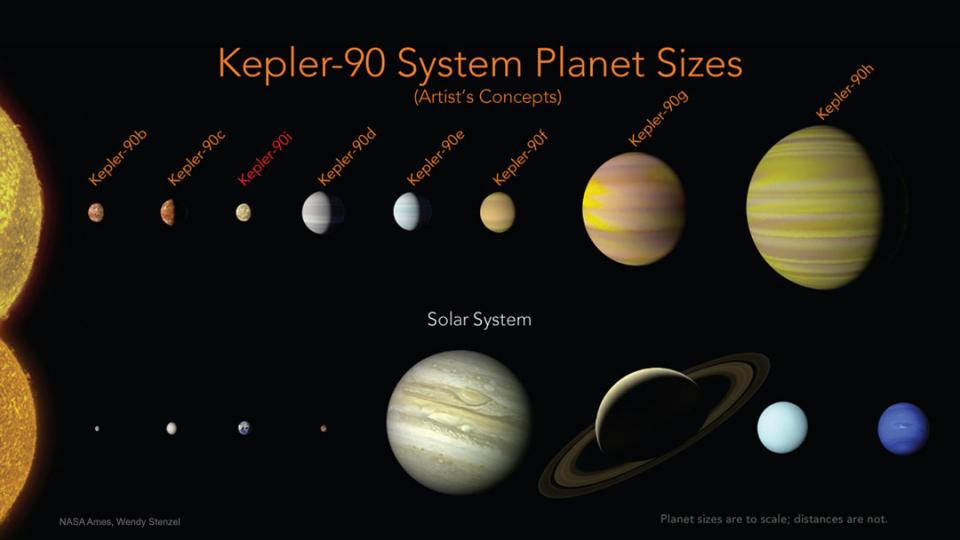
Artist’s impression of the Kepler-90 planetary system. Credit: NASA / Wendy Stenzel

I missed my usual Space Sunday slot due to Christmas activities taking up much of my time, so thought I’d round out the year of astronomy / spaceflight reporting with a last look at a subject that has dominated space news this year: exoplanets.

Back in February, it was confirmed that a red dwarf star had no fewer than seven planets in orbit around it, all of them roughly Earth-sized, and three of them within the star’s habitable zone (see Space update special: the 7-exoplanet system for more). At the time it was the largest number of planets thus far found to be orbiting a star – in this case, TRAPPIST-1, as it is informally called – named for the Transiting Planets and Planetesimals Small Telescope (TRAPPIST) system that discovered it.

At the time, the discovery meant TRAPPIST-1 tied with Kepler-90 for having the most exoplanets discovered to date orbiting it. However, as announced earlier in December, Kepler 90 has now regained the title, thanks to the work of a researcher from Google AI, and an astronomer from the Harvard-Smithsonian Center of Astrophysics (CfA), with the discovery of an eighth planet orbiting the star designated Kepler-90. However, what is particularly interesting about this discovery is both the way in which it was made.

Located about 2,545 light-years (780 parsecs) from Earth in the constellation of Draco, Kepler-90, unlike TRAPPIST-1 and the majority of other planet-bearing stars, in not a M-class red dwarf star. Rather, it is a G-class main sequence star, with approximately 120% the mass and radius of the Sun. It is thought to be around 2 billion years old and it has a surface temperature of 6080 Kelvin – compared to the Sun’s 4.6 billion years of age and 5778 Kelvin surface temperature. Thus, the star and its planetary system has certain key similarities to our own solar system in terms of Kepler-90’s nature, the number of major planets now known to be orbiting it, and their distribution – the smaller rocky planets being closer to their parent than the system’s gas giants.

The Kepler system roughly compared in terms of planet sizes, with our own. Credit: NASA / Wendy Stenzel

The Kepler designation for the star indicates it was a subject of study for the Kepler Space Telescope. Prior to that, the star was designated 2MASS J18574403+4918185 in the Two Micron All-Sky Survey catalogue, compiled following the 1997-2001 whole sky astronomical survey of the heavens visible from Earth. At that time, transit data gathered from earth-based observations suggested it may have a planet orbiting it, so it was made a target for observation by Kepler, and re-designated Kepler Object of Interest 351 (KOI-351). In 2013, thanks to Kepler’s observations, it was confirmed the star had six or possibly seven planets orbiting it (the outermost remained a subject of doubt for a while after it was initially identified).

All seven of the initial discoveries were made using the transit method (Transit Photometry) to discern the presence of planets around brighter stars. This consists of observing stars for periodic dips in brightness, which are an indication that a planet is passing in front of the star (i.e. transiting) relative to the observer. Kepler’s data revealed the seven planets orbiting the star over a period of two months, with the planets being designated as follows (in order of distance from their parent star):

Kepler-90 b Kepler-90 c Kepler-90 d Kepler-90 e Kepler-90 f Kepler-90 g Kepler-90 h
Radius: 1.31 Earth Radius: 1.19 Earth Radius: 2.9 Earth Radius: 2.7 Earth Radius: 2.9 Earth Radius: 8.1 Earth Radius: 11.3 Earth
“Super Earth” “Super Earth” “Mini Neptune” “Mini Neptune” “Mini Neptune” “Saturn size” “Jupiter size”
Orbital period: 7 days* Orbital period: 8.7 days* Orbital period: 59.7 days* Orbital period: 92 days* Orbital period: 125 days* Orbital period: 210 days* Orbital period: 311 days*

*=terrestrial days

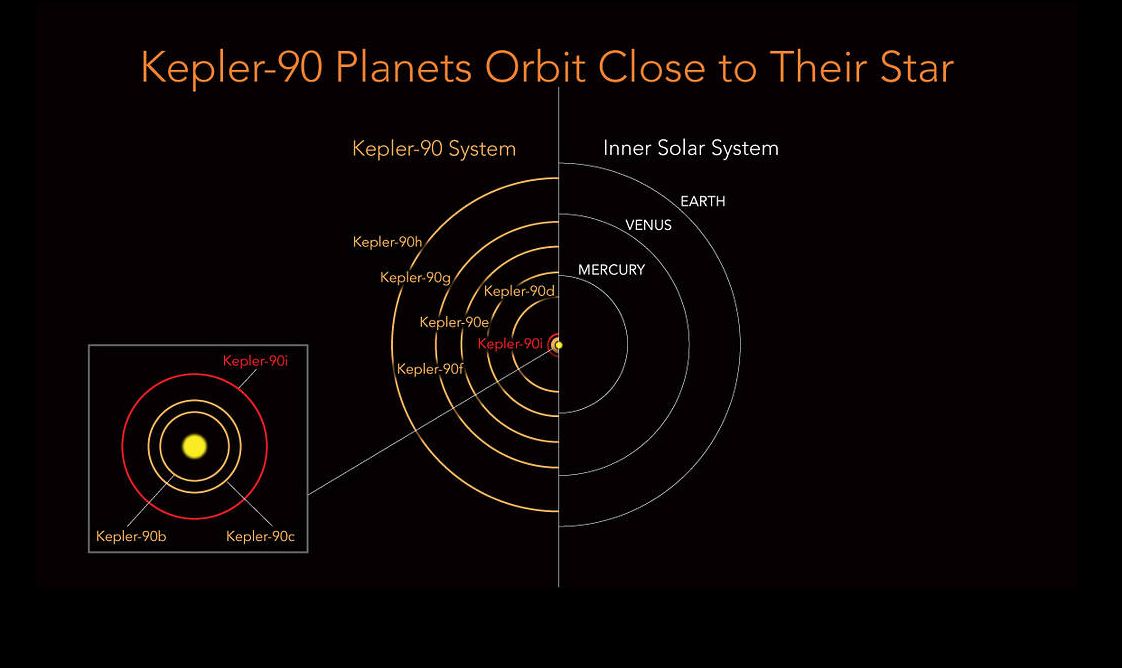
However, while the system does have similarities to our own, all of the planets within it orbit much closer to their parent star than do the planets of the solar system. So much so that the largest and outermost of those discovered, the Jupiter-sized Kepler-90 h, is the only one to orbit within the star’s habitable zone – the point at which liquid water and other essentials for life might exist in the right combinations. And while it may well sit on the inner edge of the star’s habitable zone, given that Kepler-90 h is a gas giant world somewhat equitable with Jupiter in size and mass, it is highly unlikely it is a suitable environment in which life might arise – but there is the intriguing question that should it have a sufficiently large moon orbiting it – say one the size of Titan or Ganymede – which has a good magnetic field protecting it, life might arise there.

The inner planets of the system, while more Earth-like in their size, are unlikely to support life, even if the three “mini Neptunes” were to prove to be solid bodies with atmospheres. Kepler 90 b through Kepler 90 e all orbit within or at about the same distance Mercury orbits the Sun, meaning they all experience similar or hotter surface temperatures the innermost planet of the solar system experiences. Kepler-90 f orbits at approximately the same distance as Venus does from the Sun, which likely means that if it is a mini-Neptune and, it could well be like Venus it terms of the conditions within any atmosphere it might have.

The Kepler-90 planetary orbits compared to those of the solar system’s planets. Credit: NASA / Wendy Stenzel

Continue reading “Space update special: the 8-exoplanet system and AI”

Magic Leap previews its first AR/MR system

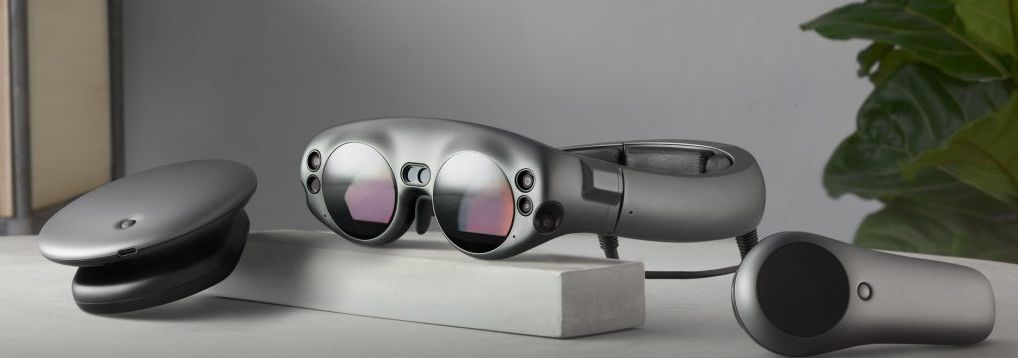
Magic Leap One. Credit: Magic Leap

Magic Leap has had its share of ups-and-downs over the past few years. Founded by tech wizard Romy Abovitz, the super-secret company has been at the centre of hype, speculation and doubt. Much of the hype has been spun by the company itself, much of the doubt has been driven by reports of friction in the company, issues with the technology, and so on.

Now, a year after scepticism around the company overtook the hype, Magic Leap has announced the availability of its first product: the Billed as the Magic Leap One Creator Edition augmented (or mixed) reality system, the unit comprises three parts:

  • Lightwear: a headset utilizing the company’s “Digital Lightfield” display technology with multiple integrated sensors to gather spatial information.
  • Lightpack: a  circular belt-worn hip pack that contains the computer powering the headset via a tether.
  • Control: a hand-held controller that can be tracked in space that helps users navigate menu selections, etc.

As an augmented / mixed reality system Magic Leap One is designed to blur the divide between the digital and the real, with the company promoting a series of potential use-cases for it, including:  web browsing and shopping, working on multiple virtual monitors, social telepresence, theme park “rides” and experiences, and gaming.

The system is somewhat removed from some of the hype built-up around Magic Leap’s initial designs – which tended to suggest something far more glasses-like.

There’s no doubt the headset is a lot bulkier than might have been imagined from past descriptions, and while nowhere near as bulky as a VR headset, it leaves a lot to be desired in the ergonomics department, particularly when compared to the likes of AR headsets like Google’s Glass Enterprise Edition or AR systems using  Qualcomm’s snapdragon processors. My own impression on seeing the Magic Leap One images is that the headset looks sci-fi bug-eyed  – almost sinister – and the size of the lenses has me wondering about effective field-of-view.

Lightwear, Lightpack and Control. Credits: Magic Leap

The Lightpack has also come in for critique, with some tech journos calling it “large” or “bulky”. been called “large” by some in the tech press, it’s actually about the same size as Walkman CD players people used to happily clip onto their belts and wear.

The Control has a trackpad and six degrees of freedom (6DOF) tracking, and some six option buttons.

Other than that – details are currently light right now. There are no technical specifications or pricing. However, and in fairness, Abovitz does refer to the announcement as “a small reveal“, rather than any kind of pre-release notification. Instead, interested parties (defined as developers, reporters and the curious) can register their wish to learn more by supplying their e-mail details via a form as the bottom of the Magic Leap home page.

So far, Magic Leap has demonstrated various iterations of their equipment to assorted people from the technology and entertainments industries. All seem to have been thoroughly impressed – although sworn to secrecy – which has been frustrating for those trying to figure out exactly what the company has got. This approach actually continues with this pre-announcement about Magic Leap One – Rolling Stone magazine has an extensive article about Magic Leap in Glixel – but the use of an NDA prevents much in the way of really solid facts around the technology from being revealed, while descriptions of environments are sans images.

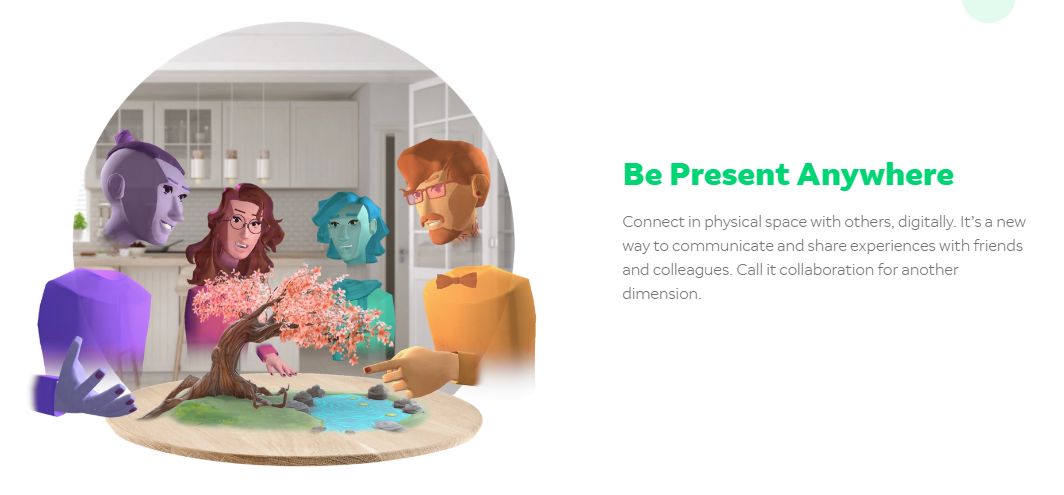
Telepresence with Magic Leap One? Credit: Magic Leap

There are, however, some intriguing little pieces of information within the article – such as this ability to generate very life-like characters, which Brian Crecente, writing for Glixel, suggests could become a kind of virtual assistant for those using the Magic Leap:

She walked up to me, stopping a few feet away, to stand nearby. The level of detail was impressive, though I wouldn’t mistake her for a real person, there was something about her luminescence, her design, that gave her away. While she didn’t talk or react to what I was saying, she has the ability to [do so] … I noticed that when I moved or looked around, her eyes tracked mine. The cameras inside the Lightwear was feeding her data so she could maintain eye contact. It was a little unnerving and I found myself breaking eye contact eventually, to avoid being rude.

One day, this human construct will be your Apple Siri, Amazon Alexa, OK Google, but she won’t just be a disembodied voice, she will walk with you, look to you, deliver AI-powered, embodied assistance.

Which sounds very sci-fi-ish, raising the idea of virtual tour guides and suchlike – as well as the question of whether or not we’ll have to cross the uncanny valley with AR as well as (possibly) VR.

I’m somewhat of the belief that AR / MR has the potential to be far more ubiquitous that VR, and garner a much larger, multi-use audience. The likes of Glass Enterprise and several of snapdragon headsets demonstrate considerable interest within healthcare, engineering and retail. The very nature of the technology means it can be integrated far more easily into our everyday lives and work than VR allows. That said, where and if Magic Leap fits into all of this remains as murky as ever. Perhaps the upcoming “Creator Portal”, promised for “early 2018”, coupled with a lifting of the restrictions concerning direct reporting on the system will do more to answer questions.

Space Sunday: reusability, habitability, survivability

SpX-13 lifts-off from Space Launch Complex 40 at Cape Canaveral Air Force Station, Florida, marking the first time SpaceX has launched a previously-flown Dragon 1 resupply capsule atop a previously flown Falcon 9 first stage, in SpaceX’s 17th launch for 2017. Credit: NASA

SpaceX Has completed its first mission to the International Space Station with a Falcon 9 first stage and a Dragon 1 resupply vehicle which have both previously flown.

The launch took place at 15:36 GMT (10:36 EST) on Friday, from Space Launch Complex 40 at Cape Canaveral Air Force Station. As well as being the first time a previously used Falcon 9 first stage and Dragon capsule have flown together, the launch also marked the first from SLC-40 since a pre-launch explosion of a Falcon 9 rocket in September 2016, which completely destroyed the rocket and its Israeli payload, and severely damaged the launch facilities.

Three minutes after the launch, the first and second stages of the Falcon 9 separated, the latter continuing towards orbit while the former performed its “boost-back” manoeuvre, and completed a safe return to Earth and a vertical landing at SpaceX’s Landing Complex 1 at Canaveral Air Force Station. The landing marked the 20th successful recovery of the Falcon 9 first stage – with 14 of those recoveries occurring in 2017.

The Dragon capsule, carrying some 2.2 tonnes of supplies for the ISS, was first used in a resupply mission in April 2015. In its current mission, it reached the station on Sunday, December 17th, where it was captured by the station’s robotic arm and moved to a safe docking at one of the ISS’s adaptors where unloading of supplies will take place. The capsule will remain at the station through January, allowing science experiments, waste and equipment to be loaded aboard, ready for a return to Earth and splashdown in the Pacific ocean, where a joint NASA / SpaceX operation will recover it.

The SpX-13 Dragon sits alongside the International Space Station on Sunday, December 17th, waiting to be grappled by one of the station’s robot arms and moved to its docking port. Credit: NASA/JSC

The mission is a significant milestone for SpaceX, bringing the company a step closer to it goal of developing a fully reusable booster launch system. Thus far the company has successfully demonstrated the routine launch, recovery and reuse of the Dragon 1 capsule and the Falcon 9 first stage. On March 30th, 2017, as part of the SES-10 mission, SpaceX performed the first controlled landing of the payload fairing, using thrusters to properly orient the fairing during atmospheric re-entry and a steerable parachute to achieve an intact splashdown. This fairing might be re-flown in 2018. That “just” leaves the Falcon 9 upper stage, the recovery of which would make the system 80% reusable.

However, recovering the second stage is a harder proposition for SpaceX – at one point the company had all but abandoned plans to develop a reusable stage, but in March 2017, CEO Elon Musk indicated they are once again working towards that goal – although primary focus is on getting the crew-carrying Dragon 2 ready to start operations ferrying crews to and from the ISS.

The major issues in recovering the system’s second stage are speed and re-entry. The second stage will be travelling much faster than the first stage, and will have to endure a harsher period of re-entry into the Earth’s denser atmosphere. This means the stage will require heat shielding and a means to protect the exposed rocket motor, as well as the propulsion, guidance and landing capabilities required for a full recovery.

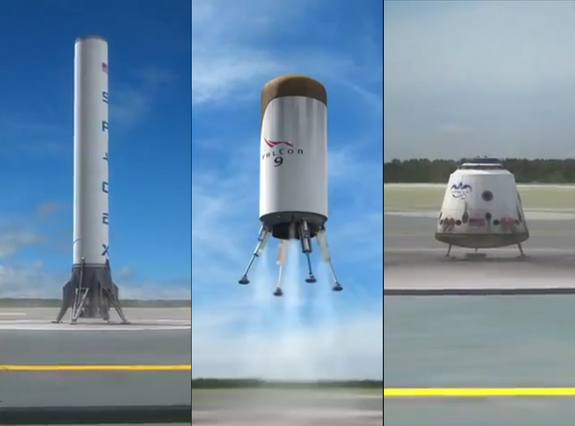
SpaceX has proven the reusability of the Falcon 9 first stage (left) and the Dragon capsule system (right). All that remains is developing a reusable second stage, most likely for use with the Falcon Heavy – or as a part of the ITS / BFR. This image shows the discontinued proposal for a reusable Falcon 9 second stage. Credit: SpaceX

The problem here is that of mass. The nature of rocket staging means that – very approximately, every two kilos of rocket mass on the first stage reduces the payload capability by around half a kilogramme.  With a second stage unit, this can drop to a 1:1 ratio. So, all the extra mass of the re-entry / recovery systems can reduce the total payload mass, making the entire recovery aspect of a Falcon 9 second stage both complex and of questionable value, given the possible reduction in payload capability. However, with the Falcon Heavy due to enter service in 2018, a reusable second stage system does potentially have merit, as the combined first stages of the system can do more of the raw shunt work needed to get the upper stage and its payload up to orbit.

The Habitability of Rocky Worlds Around a Red Dwarf Star

Red Dwarf stars are currently the most common class (M-type) of star to be found to have one or more planets orbiting them. Many of these worlds appear to lie within their parent’s habitable zone, and while that doesn’t guarantee they will support life, it does obviously raise a lot of questions around the potential habitability of such worlds.

There tend to be a couple of things which often run against such planets when it comes to their ability to support life. The first is that often, they are tidally locked with their parent star, always keeping the same face towards it. This creates extremes of temperature between the two side of the planet, which might as a result drive extreme atmospheric storm conditions. The second is – as I’ve noted in past Space Sunday articles – red dwarf stars tend to be extremely violent in nature. Their internal action is entirely convective, making them unstable and subject to powerful solar flares, generating high levels of radiation in the ultraviolet and infra-red wavelengths. Not only can these outbursts leave planets close to them subject to high levels of radiation, they can cause the star to have a violent solar wind which could, over time, literally rip any atmosphere which might otherwise form away from a planet. This latter point means that one of the most vexing questions for those studying exoplanets is how long might such worlds retain their atmospheres?

In an attempt to answer to that question, planetary astronomers have turned to a planet far closer to us than any exoplanet: Mars.

Continue reading “Space Sunday: reusability, habitability, survivability”

Space Sunday: exoplanets update

K2-18, a red dwarf star with its two “super-Earth”planets: K2-18c and, foreground, K2-18b, orbiting in the star’s habitable zone. Credit: Alex Boersma

K2-18 is a red dwarf star system located about 111 light-years from Earth in the constellation Leo. It has been of interest to astronomers because it is home to an exoplanet – K2-18b, also referred to as EPIC 201912552 b, discovered in 2015 by the Kepler Space Observatory.

At the time of its discovery, K2-18b was placed within its parent star’s habitable zone, and was believed to be receiving around the same about of radiation as Earth does from the Sun. However, at the time of its discovery, it was unclear if the planet was a rocky super-Earth or a mini-Neptune gas planet. Because of this, an international team of scientists have been studying the planet using the High Accuracy Radial Velocity Planet Searcher (HARPS) instrument at the European Southern Observatory.

They had been intending to more accurately characterise K2-18b’s mass, the first step in determining it’s atmospheric properties and bulk composition. And they actually succeeded, determining that K2-18b has a mass of about 8.0 ± 1.9 Earth masses and a bulk density of 3.3 ± 1.2 g/cm³. This is consistent with a terrestrial (aka. rocky) planet with a significant gaseous envelope and a water mass fraction that is equal to or less than 50%. This makes K2-18b is either a super-Earth with a gases atmosphere, or it is a “water world” with a surface layer of thick ice.

However, the team also found something that had not been expected: a second planet orbiting K2-18.

Now referenced as K2-18c, this planet is much closer to its parent star than K2-18b, orbiting its parent once every nine terrestrial days. The team responsible for the discovery believe the planet is 7.5 ± 1.3 Earth masses, making it a “warm super-Earth”. It is far too close to its parent star to be within the habitable zone, making it an unlikely candidate to support life. It was most likely “missed” by Kepler both because of its proximity to the star, and because its orbit does not lie in the same plane.

The discovery of K2-18c was actually made in October 2017. But because it had been missed by Kepler, those detecting it were initially cautious with their findings and sought to further verify them before announcing the find. As the study’s lead, Ryan Cloutier of the University of Toronto said:

When we first threw the data on the table we were trying to figure out what it was. You have to ensure the signal isn’t just noise, and you need to do careful analysis to verify it, but seeing that initial signal was a good indication there was another planet… It wasn’t a eureka moment because we still had to go through a check list of things to do in order to verify the data. Once all the boxes were checked it sunk in that, wow, this actually is a planet.

However, now it has been discovered, it will be the subject of further investigation – as will K2-18b.

In fact, given the findings of the study, K2-18b is now considered as having a reasonable chance that it might have conditions suitable for life. Thus, it is now likely to be a candidate for study by the James Webb Space Telescope (JWST) when it starts operations in 2019.  JWST will be able to probe the planet’s atmosphere and determine how extensive it is, its composition, and what lies beneath it – be is a planet of an ice-covered ocean or a dry, rocky world – or something between the two.

In addition, the K2-18 system further underlines M-class red dwarf stars as the home of multi-planet systems, while the relatively proximity of K2-18b make it a prime target to further our understanding of the atmospheres around Earth-type exoplanets.

Icy Worlds Might Offer More Chances for Life and Rocky Planets

That K2-18b might be an icy water world fits with the findings of a new study form the  Harvard Smithsonian Centee for Astrophysics, which suggests such planets might be far more prevalent in the galaxy than rocky Earth-type planets.

When we discuss exoplanets, there is a tendency to focus on those within the so-called habitable zone around a star, because this is the most likely region where conditions – based on our own solar system – where life is to arise.

However, as the new study notes, there are actually two other planets within the Sun’s habitable zone where conditions are such that life either never got started or didn’t last that long (Venus) and another where life, if it got started, would have encountered environmental conditions which may have limited it or again, destroyed it. However, there are at least five worlds outside of the Sun’s habitable zone  – Europa, Ganymede, Enceladus, Dione and Titan – which all have the potential to support life. Thus, the so-called “habitable zone” around a star need not necessarily be the only place where conditions for life to arise might exist.

Icy worlds with sub-surface oceans may be more common than rocky world in the galaxy – and offer more chances for life to arise. Credit: unknown

Using the solar system as a basis for modelling, the researchers widened their consideration of habitability to include worlds that could have subsurface biospheres. Such environments go beyond icy moons such as Europa and Enceladus and could include many other types deep subterranean environments.

They then went about assessing the likelihood that such bodies are habitable, what advantages and challenges life will have to deal with in these environments, and the likelihood of such worlds existing beyond our Solar System (compared to potentially habitable terrestrial planets).

There are several advantages to “water world” when it comes to harbouring life. They tended to be internally heated (keeping the ocean liquid), may suffer of tectonic activity (as is now thought to be the case with Europa), which could pump living-forming energy and minerals into their oceans, while their icy crusts could offer shielding from harsher UV radiation and cosmic rays (energetic particles). The latter could be a major consideration considering the propensity for re dwarf stars to form planetary systems, and the fact they tend to be quite violently active.

Overall, the researchers determined that a wide range of worlds with ice shells of moderate thickness may exist in a wide range of habitats throughout the cosmos. Based on how statistically likely such worlds are, they concluded that “water worlds” like Europa, Enceladus, and others like them are about 1000 times more common than rocky planets that exist within the habitable zones of their parent stars.

Cross-section of Saturn’s moon Enceladus, showing how hydrothermal vents in the seabed could give rise to hotspots with sufficient heat and mineral release to support life – as well as heat the ocean under the ice and generate the plumes images by the Cassini mission. Credit: NASA/JPL / SwRI

However, while such worlds might be more common, there are negative aspects to the findings. Ice covered ocean worlds would lack sunlight as a source of energy, limiting the available energy supply to localised sources – ocean bottom fumeroles, etc., which in turn limit the size of available biospheres where life might survive – and tectonics could lead to these energy sources shifting or even dying. Also, nutrients needed to support life would likely be available in lower concentrations. That these worlds are ice-covered also makes identify whether the do in fact support life nest to impossible.

Thus, the finding could indicate that basic life might be far more prevalent in the galaxy – but also potentially much harder to detect.