Space Sunday: moon water and space telescopes

A visualisation of subsurface water ice deposits within PSR – permanently shadowed regions – of the Moon’s south pole, including the craters Cabeus, Shoemaker and Faustini. Credit: NASA Goddard Space Centre

The Moon is a fascinating place; there is no two ways about it. Like many bodies within the solar system, it is proving to be a lot more surprising than we’d previously thought. Up until 2009, for example, it was accepted that the Moon was a dry, arid place with little or no subsurface bodies of water ice. This idea was turned on its head in 2009 after India’s first lunar mission, Chandrayaan I, and NASA’sLunar Reconnaissance Orbiter (LRO) confirmed the presence of water ice within the so-called permanently shadowed regions (PSRs) – deep craters around the lunar poles which never see direct sunlight in their basins.

However, one of the questions surrounding these discoveries is just how much water might actually exist as ice within these shadowed craters? A new study,  published in August 2018, has sought to address this question; it is the work of Shuai Li – a post-doctoral researcher at the University of Hawaii, and  produced with the assistance of researchers from Brown University, the University of Colorado Boulder, the University of California Los Angeles, John Hopkins University, and NASA’s Ames Research Centre.

Li’s study focuses on data returned by NASA’s Moon Minerology Mapper (M³), flown aboard the Chandrayaan I mission. M³ was designed to measure light being reflected from the illuminated regions on the Moon, making its use over the PSRs had been considered of minimal value. Nevertheless, Li believed that what data M³ had gathered on the south polar craters might hep in determining the potential volume of water ice within those craters, as indicated by the Lunar Orbiter Laser Altimeter (LOLA), Lyman-Alpha Mapping Project and Diviner Lunar Radiometer Experiment on the LRO mission. However, what he found came as a complete surprise.

While I was interested to see what I could find in the M3 data from PSRs, I did not have any hope to see ice features when I started this project. I was astounded when I looked closer and found such meaningful spectral features in the measurements … We found that the distribution of ice on the lunar surface is very patchy, which is very different from other planetary bodies such as Mercury and Ceres where the ice is relatively pure and abundant. The spectral features of our detected ice suggest that they were formed by slow condensation from a vapour phase either due to impact or water migration from space.

– Shuai Li, leader of the study team


Exposed water ice (green or blue dots) in lunar polar regions and temperature. Credit: Shuai Li

While likely the results of vapour capture following asteroid impacts, Li’s study again opens the door as to how much sub-surface water ice might also exist deeper within the polar regions of the Moon. As I recently noted, a separate study, evidence has been put forward for periods in the Moon’s early history when liquid water existed on the lunar surface at a time when the Moon had a volcanically-induced atmosphere. Much of this water was likely lost to space as that atmosphere dissipated at the end of the Moon’s active volcanic period; however, some of it may have gone underground again, notably in these polar regions.

Either way, the existence of water ice deposits strengthen the case for a return to the Moon and – as NASA Administrator Jim Bridenstine recently indicated – see the establishment of a permanent human presence on the Moon.  An available and plentiful supply of water would go a long way to easing many of the logistical requirements for such a human presence. Once melted, a local supply of water can be filtered and purified to provide drinking water; it can also be used in construction work and as “grey” water for use in growing local foodstuffs through hydroponic or other means; it can be electrolysed to produce oxygen in support of the atmosphere within a base and hydrogen than could be used to power fuel cells, and so on.

The European Space Agency (ESA) in particular is researching ways and means to build a lunar settlement using what is called “in-situ resource utilisation” (ISRU), or the use of locally available materials. In particular ESA has been using locally available “lunar simulants” available here on Earth – notably certain types of volcanic dusts that have been shown to have very similar properties to the dry dust of the surface-covering lunar regolith on the Moon – to test potential options for base construction.

One of these I’ve again previously written about, is the idea of using regolith to effectively “3D print” a protective “shield” of regolith over the facilities of a lunar base to protect it against solar radiation. Referred to as “additive manufacture”, such a technique might be aided with a readily available source of water which can help mix the regolith into a cement-like form that can be “printed” over the structure of a base in layers. In addition, ESA is using a regolith simulant to make “bricks” which can be used to physically construct the walls, floors and ceilings of a base – a process that might again  be easier with a supply of water for use in the process.

A “lunar brick” produced by ESA using “3D printing” techniques and lunar regolith simulants. Credit: ESA

But it is in production of oxygen and hydrogen, as well as offering a source for liquid water, that the ice deposits offer the greatest potential benefit. Up until now, ideas for oxygen production on the Moon have focused on “cracking” the regolith to release the oxygen within it (thought to be around 40% by volume). This requires a lot of energy to achieve –  more than is needed to melt and electrolyse ice to produce both oxygen and hydrogen.

However, it’s not all plain sailing for humans on the Moon. The dust comprising lunar regolith is extremely electro-statically charged, making it stick to just about anything – so keeping it out of a lunar habitat could prove difficult. Worse, it also presents a range of potential health hazards – up to and including major respiratory problems such as lung cancer. These risks have yet to be fully assessed, and countering them as far as possible must be a priority before there can be real talk of a long-term human presence on the Moon.

But in the meantime, Li’s study potentially adds important food for thought for those thinking about establishing research facilities on the Moon.

Continue reading “Space Sunday: moon water and space telescopes”
Space Sunday: exoplanets, flying crews to orbit and a movie

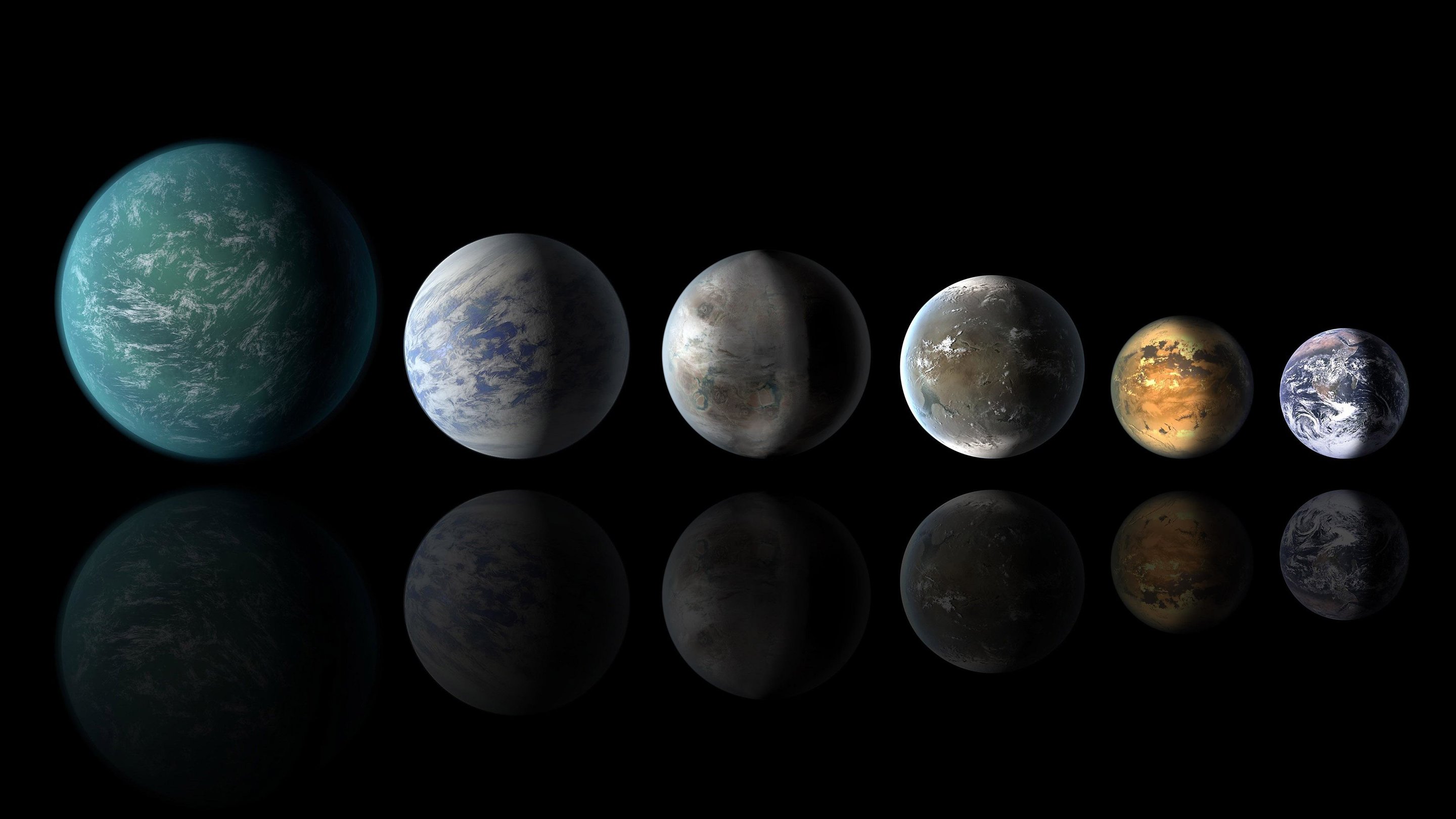
Could up to 35% of the Earth-sized exoplanets so far discovered be “water worlds”? Credit: NASA

Exoplanets between 2 and 4 times the size of Earth may feature water as a large component in their make-up, with many comprising perhaps up to 50% water by weight (by contrast, Earth has just 0.02% water content by weight).

This is the conclusion drawn by an international team of researchers who have being pouring (pun intended) over data from the Kepler Space Telescope and the Gaia mission gathered on the 4,000+ exoplanets discovered thus far, many of which tend to fall into two categories: those with the planetary radius averaging around 1.5 that of the Earth, and those averaging around 2.5 times the radius of the Earth.

It was a huge surprise to realise that there must be so many water-worlds. We have looked at how mass relates to radius, and developed a model which might explain the relationship. The model indicates that those exoplanets which have a radius of around x1.5 Earth radius tend to be rocky planets (of typically x5 the mass of the Earth), while those with a radius of x2.5 Earth radius (with a mass around x10 that of the Earth) are probably water worlds. Our data indicate that about 35% of all known exoplanets which are bigger than Earth should be water-rich.

– Dr. Li Zeng of Harvard University, lead researcher on the study

The teams findings could have major implications for our understanding of the composition of Earth-sized exoplanets. However, if the team’s conclusions are correct, it doesn’t necessarily mean these are especially balmy places. Many orbit so close their parent stars their surface temperatures are liable to be in the 200-500o Celsius range (392-932oF), so the water on them is liable to be very different to how we find it on Earth, existing as saturating vapour in the atmosphere, then a world-girdling warm ocean with ice under increasing pressure below it, wrapped around a sold core.

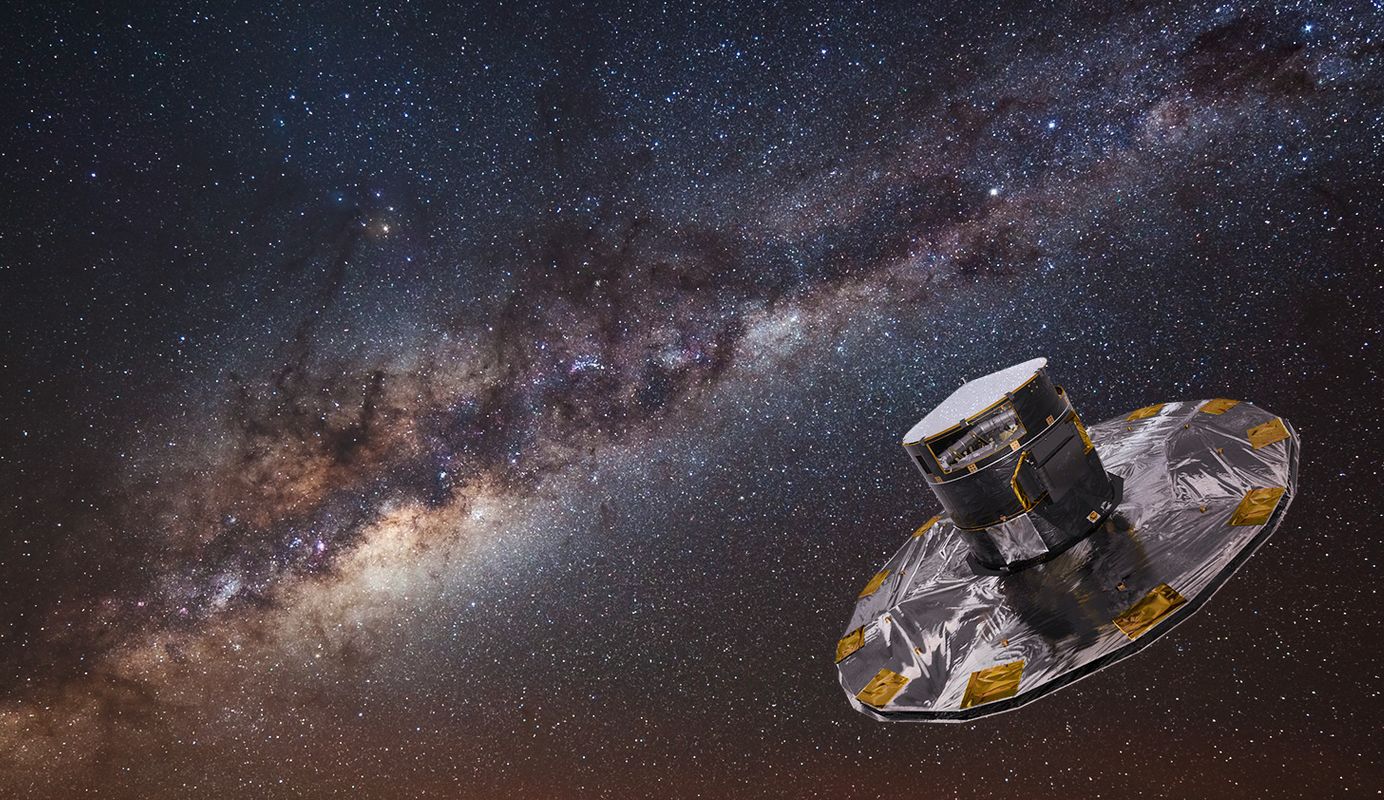
Data from the European Space Agency’s Gaia mission was used by the researchers. Launched in 2013, Gaia is on a mission to take a “census” of one billion of the stars visible from its orbit around the Sun-Earth L2 position. And if that sounds a lot, it is actually represents just 1% of the galaxy’s total population of stars. Credit: ESA

The beauty of the model is that it explains just how composition relates to the known facts about these planets, and offers insight into how they were formed – most likely in a similar manner to the cores of the giant planets in our own solar system.

With a new generation of Earth-based telescopes capable of peering at distant planets currently gaining remarkable optical updates (such as ESO’s Very Large Telescope)  or under construction (the Giant Magellan Telescope or GMT), not to mention the James Webb Space Telescope and the Transiting Exoplanet Survey Satellite (see below for more in this), the hope is that the findings presented by the team will soon be backed-up with hard data as atmospheres around these distant worlds are properly characterised.

TESS Starts Work

TESS, the Transiting Exoplanet Survey Satellite launched on April 16th, 2018, has started its primary mission – taking over from the ailing Kepler mission in locating exoplanets. This initial primary mission will last for 2 years, in which it is anticipated TESS will pay particular attention to the 200,000 brightest stars around us in the hope of detecting planetary bodies in orbiting them. It will do this using the transit method of observation – looking for dips in the brightness of stars which might indicate the passage of an orbiting planet between the star and the telescope.

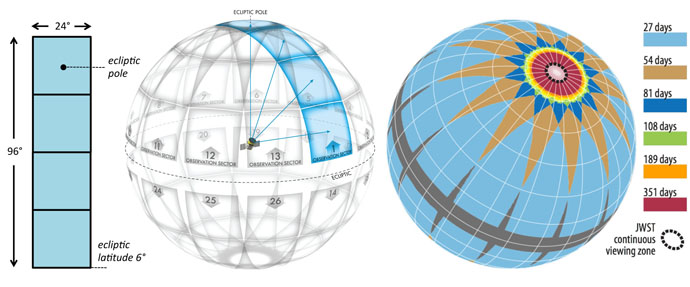
How TESS will survey the stars around it. Left: The combined field of view of the four TESS cameras. Middle: Division of the celestial sphere into 26 observation sectors (13 per hemisphere). Right: Duration of observations on the celestial sphere. The dashed black circle enclosing the ecliptic pole shows the region which JWST will be able to observe at any time. Credit: NASA Goddard Spaceflight Centre

The first data gathering element of the mission commenced on July 25th, and will continue through most of August before the data is transmitted by to Earth from TESS’s unique orbit, a “2:1 lunar resonant orbit“, which allows the craft to remain balanced within the gravitational effects of the Moon and Earth, providing a stable orbital regime which should last for decades.

As a part of the mission, the TESS science team aims to measure the masses of at least 50 small planets whose radii are less than four times that of Earth, offering the opportunity to characterise their likely structure and composition. Many of TESS’s planets should be close enough to our own that, once they are identified by TESS, scientists can zoom in on them using other telescopes, to detect atmospheres, characterise atmospheric conditions, and even look for signs of habitability.

In this latter regard, TESS will pave the way for detailed studies of candidate exoplanets by the James Webb Space Telescope (JWST), now scheduled for launch in 2021. While TESS cannot look for atmospheric or other signs of life on the distant worlds it locates, JWST will be able to do just that, which could see the 2020s a decade of remarkable extra-solar planetary discoveries.

Continue reading “Space Sunday: exoplanets, flying crews to orbit and a movie”

Space Sunday: to touch the face of the Sun

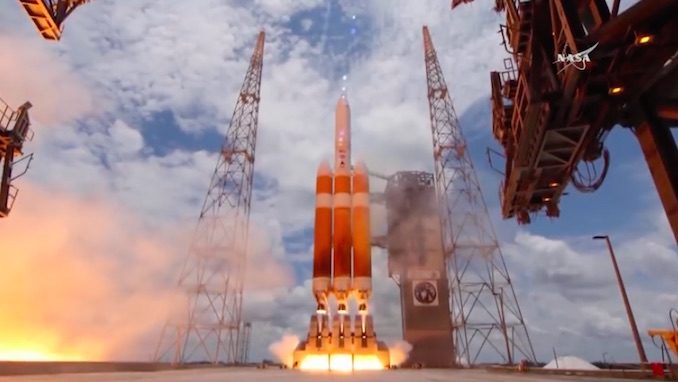
Ignition! The three main stages of the Delta 4 Heavy fire, starting the Parker Solar Probe on its mission to examine the Sun up close and personal. Credit: NASA

On the morning of Sunday, August 12th, 2018, NASA launched the Parker Solar mission, which it describes as being “to touch the face of the Sun”. It will be the first mission to fly through the Sun’s corona – the hazardous region of intense heat and solar radiation in the Sun’s atmosphere that is visible during an eclipse, and it will gather data that could help answer questions about solar physics that have puzzled scientists for decades. Over the course of its initial 7-years the Parker Solar Probe mission will allow us to better understand the fundamental processes going on in, on, and around the Sun, improving our understanding how our solar system’s star influences, affects and changes the space environment, through which we travel as the Earth orbits the Sun.

The probe and mission are named for Dr Eugene Parker, an American solar astrophysicist, who in 1958 first posited  the theory of the supersonic solar wind, and who also predicted the Parker spiral shape of the solar magnetic field in the outer solar system. Now 91, he was present at NASA’s Kennedy Space Centre as a distinguished guest of the agency, to witness the probe’s launch, the mission (and vehicle) being the first in NASA’s history to be named after a still-living person.

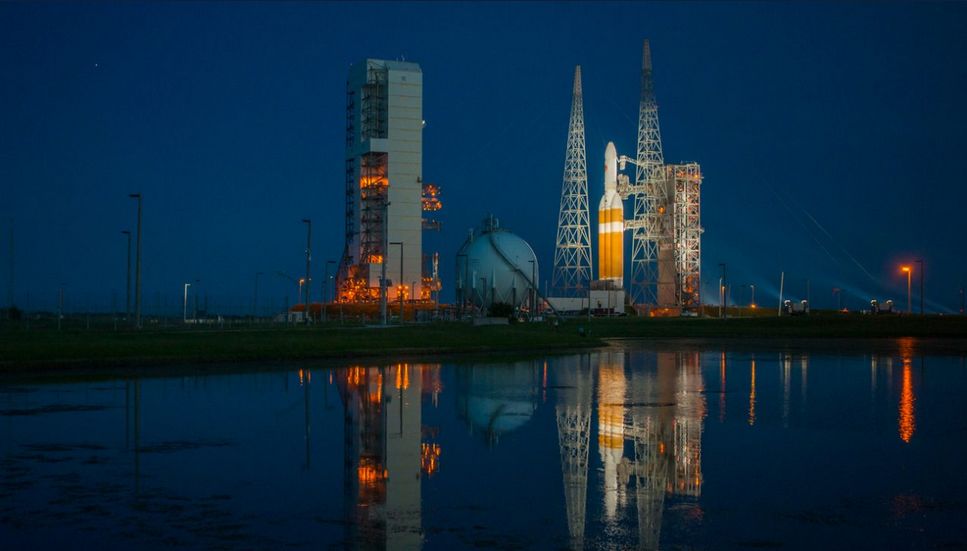
The Delta 4 Heavy carrying the Parker Solar Probe sits on the pad of Space Launch Complex (SLC) 37 at Canaveral Air Force Station, Florida, following the aborted launch attempt of Saturday, August 11th, 2018. Credit: Vikash Mahadeo / SpaceFlight Insider

Lift-off came at 03:31 EDT (6:31 GMT / 7:31 BST) on Sunday, August 12th, after the initial launch attempt was scrubbed on Saturday, August 11th, when a troubled countdown was halted just one-minute, 55 seconds before the engines on the United Launch Alliance (ULA) Delta 4 Heavy rocket were to ignite. The halt was called following a gaseous helium red pressure alarm, and investigations into its cause extended beyond the 65-minute launch window, resulting in the launch scrub.

The Sunday morning launch countdown proceeded without any significant hitches, and the Delta 4 Heavy – the most powerful rocket in ULA’s fleet of launch vehicles, comprising 3 Delta 4 first stages strapped side-by-side, the outer two functioning as “strap-on boosters” – lit up the Florida coastline as it took to the early morning skies.

Although a flight to the Sun might sound an easier proposition than reaching the outer solar system, it actually isn’t; it actually requires 55 times more launch energy than a launch to Mars. Hence why the relative small and light Parker Solar Probe, weighing just 685 kg (1,510 lb) at launch, required the massive Delta 4 and a rarely-used Star 48BV variant of the Payload Assist Module (PAM).

Originally developed as the upper stage for Delta 2 launch vehicles in the 1965, the Star family of solid-fuel PAM units were commonly used with the space shuttle for satellite launches from orbit: the shuttle would carry them aloft, release the PAM / Satellite combination, then move to a safe distance before the PAM motor was ignited to push the satellite on to its require Earth orbit. For the Parker Solar Probe, the Star 48BV was used to impart as much velocity as possible into the vehicle at is starts on it journey.

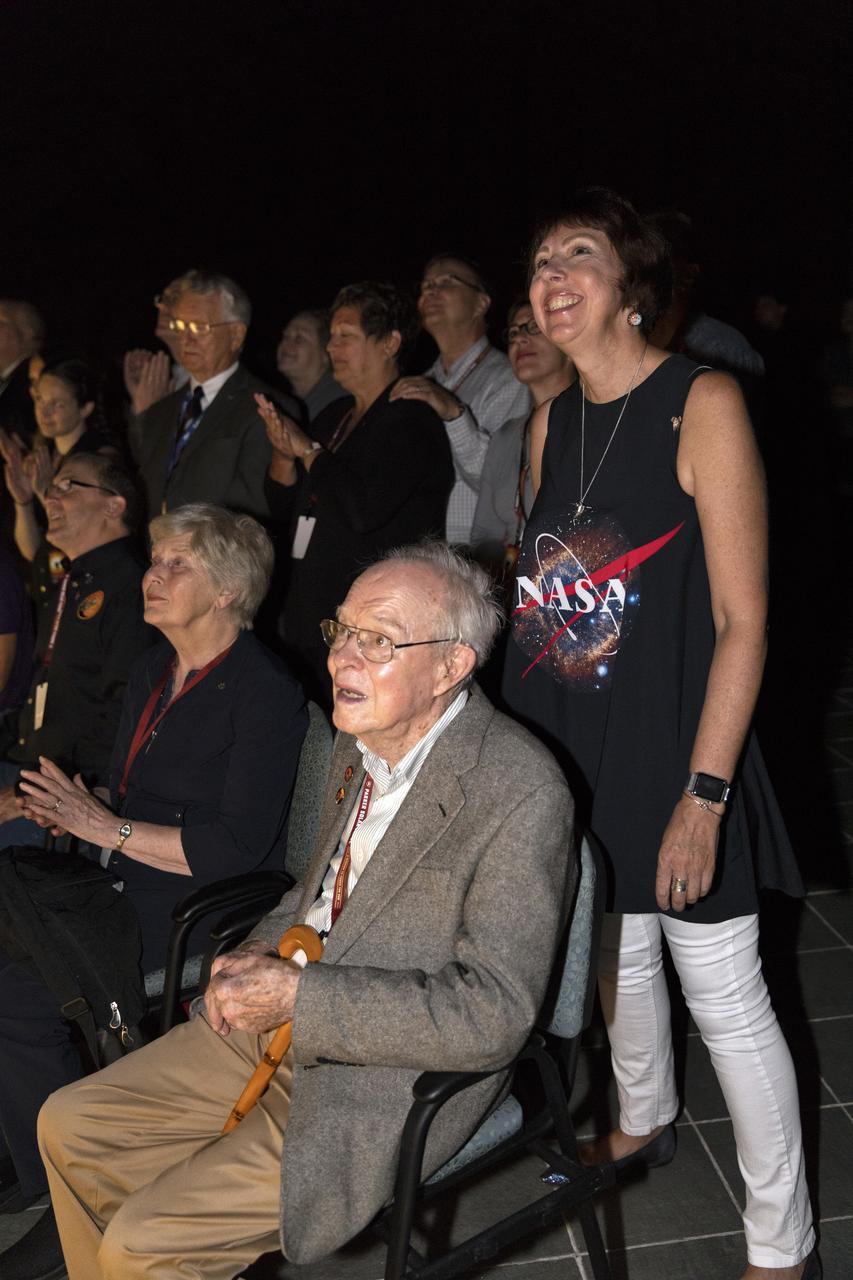
Dr. Eugene Parker, now 91, watches the launch of the probe named in his honour as it lifts-off from SLC-37, Sunday, August 12th, 2018. Credit: NASA / Glenn Benson

What makes a flight to the Sun so hard is that the Earth is moving “sideways” relative to the Sun at about 107,000 km/h (67,000 mph), and the probe has to cancel out a whopping 84,800 km/h (53,000 mph) of that “sideways” motion as it makes its way to the Sun in order to achieve orbit. At the same time, the probe needs to gain velocity as it moves in towards the centre of the solar system in order for it to balance the Sun’s enormous gravitational influence and achieve the required elliptical orbit.

The use of the Delta 4 / Star 48BV combination got both of these requirements started, by pushing the probe towards Venus in an arc that will both start to shed the “sideways” velocity, whilst also accelerating the craft in towards the Sun. But it will be Venus that does the real grunt work for the mission.

On October 1st, 2018, the probe will make the first of a series of flybys of Venus, where it will use the Venusian gravity to shed still more of the angular velocity imparted by Earth’s orbit and increase its velocity towards the Sun.

In all, seven such fly-bys of Venus will occur  over the 7 year primary mission for the probe, and while only the first is required to shunt the vehicle into its core heliocentric orbit, the remaining six play an important role in both maintaining the vehicle’s average velocity across the span of the mission and in gradually shrinking its elliptical orbit around the Sun as the mission progresses.

The first pass around the Sun  – and the start of the science mission – will occur in November / December 2018. At perihelion, the vehicle will be just 6.2 million km (3.85 million mi) from the Sun’s photosphere (what we might call its “surface”). During this time, the vehicle will be well within the corona, and will also temporarily become the fastest human-made vehicle ever made, achieving a velocity of around 700,000 km/h (430,000 mph) – that’s 200 km per second (120 mi/s), or the equivalent of travelling between London and Tokyo in around 50 seconds! At aphelion – the point furthest from the Sun, and brushing Earth’s orbit, the craft will be travelling a lot slower.

The corona is a very hot place – hotter than the “surface” of the Sun, however, it is also comparatively thin as far as an “atmosphere” goes. The distance at which Parker Solar Probe will be travelling from the Sun at perihelion, combined with its speed, mean that the ambient heat of the corona isn’t a significant issue. Direct sunlight radiating out from the Sun, however, is a significant problem.

Continue reading “Space Sunday: to touch the face of the Sun”

Space Sunday: questions of life, and the “Commercial Nine”

A computer generated terraformed Moon. While it may not have looked like this in its past, the Moon may once not only have had an atmosphere and liquid water on its surface, it may have had conditions suitable for life. Credit: unknown, via Lunar wikia

Throughout human history – and outside of flights of fancy – the Moon has always been thought of as an airless ball of rock, tidally locked to Earth so that it shows the same, almost never-changing face to us in the night sky. But it may not always have been so.

In recent years, our perceptions of the Moon have been changing as a result of a number of studies and missions. In 2009, for example, India’s first lunar mission, Chandrayaan I, produced a detailed chemical and mineralogical map of the lunar surface, revealing the presence of water molecules in the lunar “soil”. In that same year, NASA launched a pair of missions to the Moon, the Lunar Reconnaissance Orbiter (LRO) mission and the Lunar Crater Observation and Sensing Satellite (LCROSS).

LCROSS was a small satellite designed to follow the upper stage of the rocket used to launch it and LRO to the Moon and analyse the plume of debris created by the impact of the upper stage with Cabeus crater in the Moon’s south polar region. The impact came with a kinetic energy equivalent of an explosion created using 2 tons of TNT, and LCROSS recorded strong evidence of water within the resultant impact plume.

For its part, LRO entered lunar orbit to commence a comprehensive campaign of mapping, imaging and probing the Moon’s surface and environment. In doing so, it further confirmed the presence of abundant concentrations of water in the lunar south polar regions. At the same time and LRO has been studying the Moon, an ongoing analysis of the rock samples brought back by the Apollo astronauts has revealed strong evidence for a large amount of water being present in the lunar mantle – possibly as much as is present in Earth’s upper mantle.

An artist’s impression of the 2009 LCROSS satellite “shadowing” the Centaur upper stage used to launch both it and the Lunar Reconnaissance Orbiter (LRO), as the upper stage heads towards its lunar impact. Credit: NASA

These results and findings have given rise to the idea that very early on in the Moon’s history conditions could have been very different to how it is now. In the immediate period following the Moon’s creation (roughly four billion years ago), there are a period when it was very volcanically active (about 3.8-3.5 billion years ago), releasing considerable amounts of superheated volatile gasses, including water vapour, from its interior. This outgassing could have given rise to an atmosphere around the Moon dense enough to support that water vapour condensing out into liquid on the surface which could have conceivably lasted for several million years whilst the atmosphere remained dense enough to support it, before it either (largely) evaporated or retreated underground to eventually freeze.

In their new study, published in July 2018, Dirk Schulze-Makuch, a professor of astrophysics at Washington State University, USA, and Ian A. Crawford, a professor of planetary science and astrobiology at Birkbeck College, University of London, UK, review the evidence for liquid water to have been present on the Moon and examine the potential for it to have been life-bearing. In particular, they note that when all is said and done, if the early conditions on the Moon did give rise to a dense atmosphere and a water-bearing surface, then the conditions there wouldn’t have been that different to those being experienced on Earth when life here was starting up, and would have occurred in the same time frame.

A false-colour image of the Moon’s south pole highlights areas that are in permanent shadow. These account for around 3% of the south polar region, and could be places where frozen water exists beneath the surface (note the blue colour is not indicative of water, but simply a means of highlighting the shadow spots). Credit: NASA Goodard Space Centre

It looks very much like the Moon was habitable at this time. There could have actually been microbes thriving in water pools on the Moon until the surface became dry and dead.

Dirk Schulze-Makuch, co-author of Was There an Early Habitability Window for Earth’s Moon?,
quoted in Astrobiology Magazine

So does that mean life, however transient, got a start on the Moon? Possibly; however, some have suggested rather than giving rise to life directly, the conditions on that early Moon might have been ideal for life from Earth to gain a toe-hold.

As noted, the period when the Moon may have had its dense atmosphere coincided with life starting on Earth in a period referred to as the Late Heavy Bombardment, (4.1 and 3.8 to 3.5 billion years ago). During that time, bacteria such as cyanobacteria were believed to be already present on Earth, even as it was being bombarded by frequent giant meteorite impacts (hence the period’s name). So the suggestion is that this bombardment could have thrown chunks of bacteria-laden rock into space, where they were “swept up” by the Moon, transferring the bacteria to its surface, where it might have taken hold.

It’s unlikely that if it go started, life on the Moon got very far; within a few million years after the end of the Moon’s volcanic period the atmosphere would have been lost, and conditions would have become far too harsh for life to endure. However, in noting this, Crawford and Schulze-Makuch use their study as a call for a more robust study on the potential ancient habitability of the Moon, including a hunt for possible biomarkers.

Not related to the article: this image taken by LRO in 2011 highlights the Apollo 17 landing site and areas explored by Gene Cernan and Harrison Schmitt in 1972. Credit: NASA / NASA Goddard Space Centre.

Such an endeavour would likely be focused on the lunar south polar regions, simply because of the potential abundance of subsurface frozen water there. And as it is, NASA, India and China are already committed to studying the region in great detail. NASA will initially do so from orbit, while the Indian Chandrayaan-2 mission will attempt to place a lander and rover close to the Moon’s south pole in 2019. Also in 2019, China will send its  Chang’e 5 mission to the Moon’s north polar regions to gather and return around 2 kg of rock samples for detailed analysis on Earth.

Continue reading “Space Sunday: questions of life, and the “Commercial Nine””

Space Sunday: an eclipse, a space ship, lasers and a birthday

The total lunar eclipse as seen over the columns of the acropolis. Greece, on July 27th, 2018. Credit: Valerie Gache / AFP Getty Images

Friday, July 27th marked the longest lunar eclipse of the 21st century, which was visible from southern Africa, Australia, and Madagascar, Europe, South Asia and South America. Although many of us in the UK largely (and typically!) missed out, as the summer heat wave gave way to rain and clouds, a bit of a double blow, given we were just outside the reach of totality.

For about half the world, the Moon was partly or fully in Earth’s shadow from 17:14 to 23:28 GMT; six hours and 14 minutes in all, with the period of totality – when the Moon lies entirely within the Earth’s shadow, and so is at its darkest – lasting from 19:30 to 21:13 GMT.

Another view of the eclipse from Greece: the Moon appears between the ancient gods Apollo and Hera in Athens. Credit: Aris Messinisaris / AFP / Getty Images

In a special treat, Mars, which is currently at opposition, sitting on the same side of the Sun as Earth, and thus at its closest to Earth (roughly 92 million km /  57 million mi), was visible just below the eclipsed Moon, appearing as a bright “star”. Those blessed with clear skies also had the treat of Saturn, Jupiter and Venus being visible in the sky as well.

The reason the eclipse lasted so long was that the alignment between Sun, Earth and Moon meant that the Moon was passing right across the middle of the disc of shadow cast by the the Earth. This also meant this eclipse created a particularly strong blood Moon. This is a phenomena caused by the lensing effect of the Earth’s atmosphere scatters blue light from the Sun outwards, whilst refracting red light inwards, so the Moon appears rusted as  seen from Earth.

The July 2018 blood moon, seen from Siliguri, India, on July 28th, 2018 (local time). Credit: Diptendu Duttadiptendu Dutta / AFP /Getty Images

Virgin Galactic Reach Mesosphere for the 1st Time

VSS Unity took to the skies on July 26th, 2018, and reached its highest altitude yet: 52,000 metres (170,800 ft), the highest any Virgin Galactic vehicle has thus far reached.

VMS (Virgin Mother Ship) Eve, the WhiteKnightTwo carrier aircraft, took off from the Mojave Spaceport at 15:45 GMT and climbed to an altitude of 14,000 metres (46,500 ft), prior to releasing Unity, which dropped clear prior to its single rocket motor being ignited. The engine burned for some 42 seconds, powering the vehicle into a near vertical ascent and a speed that reached Mach 2.47.

This was enough to propel Unity on a parabolic flight that topped-out at 52,000 m, inside the mesosphere, which spans heights from approximately 10 km (33,000 ft; 6.2 mi) to 100 km (62 mi; 330,000 ft), representing the heights to which Virgin Galactic flights will typically carry fare-paying passengers so they can enjoy around 5 minutes of weightlessness.

VSS Unity mid-flight on July 26th, 2018, as seen from a chase plane. Credit: Virgin Galactic / MarsScientific.com / Trumbull Studios

It was a thrill from start to finish. Unity’s rocket motor performed magnificently again, and Sooch [co-pilot Mike Masucci] pulled off a smooth landing. This was a new altitude record for both of us in the cockpit, not to mention our mannequin in the back, and the views of Earth from the black sky were magnificent.

– Virgin Galactic’s chief pilot, Dave Mackay

The mesosphere is sometimes referred to the “ignorosphere”, as it sits above the range of instrument carrying balloons, but well below the height from which it can be studied from space, and so remains one of the least-studied parts of the atmosphere. As well as carrying passengers aboard their vehicles, Virgin Galactic plan to change this by also flying experiments up to the mesosphere that might be used to probe it.

VSS Unity about to touch down, July 26th, 2018. Credit: Virgin Galactic

As with previous flights, today’s test flight was designed in part to gather additional data about conditions in the cabin during flight, but it also marks a significant step closer to the company starting commercial tourist flights, which are currently earmarked to commence in 2019, or possibly the end of 2018. Before that, however, the company will make at least one flight  with Unity’s motor fuelled for a full duration burn of 60 seconds. When that might be, and whether it might follow  directly on from this flight (which represented an 11 second longer engine burn than previous flights) or be worked up to, has yet to be stated.

When operational, VSS Unity will be joined by at least two more SpaceShipTwo vehicles, and – at some point in the next couple of years – an additional WhiteKnightTwo carrier vehicle, given the company are looking to operate flights out of Italy as well.

Continue reading “Space Sunday: an eclipse, a space ship, lasers and a birthday”

Space update special: the lake on Mars

An artist’s impression of Mars Express probing Mars using its MARSIS instrument superimposed on a radar cross-section of the southern polar layered deposits. The continuous white line at the top of the radar results above marks the beginning of the South Polar Layered Deposit; a layered accumulation of water ice and dust. The blue spots are areas of very high reflectivity and thought to be water. Credit D. Coero Borga/ESA / INAF

Whether or not liquid water exists on Mars has long been a source of study with regards to the Red Planet. There are many signs that the surface of Mars was once affected by free-flowing liquid – most likely water – in the planet’s ancient past. Curiosity, NASA’s Mars Science Laboratory rover, has confirmed the crater it has been exploring was home to several lakes during the early part of Mars’ history. What’s not clear is whether and how much of the remnants of that water still survives in liquid form today under the planet’s surface. Now a group of European scientists believe they have found direct evidence a sub-surface lake of liquid water on Mars.

The news comes via a paper published on Wednesday, July 25th in the Journal Science by a team of researchers involved in analysing the data from the European Space Agency’s Mars Express orbiter – something of a “forgotten mission” around Mars, given the volume of US missions on and orbiting the planet.

Mars Express arrived at Mars on December 25th, 2003. Since then, it has been quietly working away, observing Mars, gathering data about the planet’s atmosphere, surface and sub-surface, using a range of instruments including the Mars Advanced Radar for Subsurface and Ionosphere Sounding (MARSIS) package capable of “seeing” what lies under the surface of the planet. It is data from MARSIS which points to the presence of the subsurface lake.

An artist’s impression of Mars Express over Mars. The long booms (40m in length) extending from the vehicle are the deployed radar emitters for MARSIS. Credit: ESA

The story actually begins in 2007, when data from a MARSIS survey of a region near the Martian south pole revealed very strong differences in the radar returns (“echoes”) of two subsurface layers. On Earth, such a strong differentiation in returns typically tends to be the result of one of the layers being subsurface water. Analysis of the data from MARSIS initially suggested the “bright” return from the region on Mars might be caused by a layer of carbon dioxide ice. However, as further data was gathered on the region, researchers noticed something odd: the measurements of the layer kept changing over relatively short periods of time, rather than remaining relatively constant as might be expected from a body of subsurface ice.

Investigations of the apparent fluctuations in different radar returns of the same area revealed something unexpected: such was the volume of data point being collected by MARSIS, the software aboard Mars Express to initially process the returns was effectively averaging things out – giving the impression whatever the radar was encountering beneath the surface of Mars was somehow fluctuating: present in quantity during one pass, all but gone a few passes later, only to suddenly return in volume.

A composite image showing the south pole of Mars (r) and the region where the MARSIS radar reflections have been found (l). Credit: ESA

With their understanding of what was happening with the MARSIS processing, researchers were able to work out a means of compensating for it, and began a campaign of gathering data from the region, which ran for three years between mid-2012 mid mid-2015. It is the Earth-based analysis of this data over the last couple of years that has led to the conclusion that not only had MARSIS discovered something under the surface of Mars, but that it is very likely liquid water sitting under a covering of relatively cleat ice.

It is unclear if the body, some 20 km (12 mi) across and at least 2 metres deep and lying some 1.6 km (1 mile) beneath the surface, is actually an ice-covered body of water, or if it is an aquifer created by water filling interconnected pores in Martian rock beneath the ice.

However, given the extremely low temperatures on Mars, any water under the surface of the planet would require high concentrations of salt held in suspension within it, because salt helps reduce the temperature at which water freezes (a 20% solution lowers the freezing point of water to -16oC (-2oF), for example).  The data gathered by MARSIS is consistent with the liquid containing high concentrations of salts.

The discovery also has possible repercussions for the idea of Martian life.

For Life to get started, it needs three things: liquid water, an energy source such as minerals leeching into the water, and a biological seed. As noted at the top of this article, the evidence for water once having existed on Mars is strong. What’s more, NASA’s Curiosity rover has already found evidence for the second requirement – an energy source in the form of leeching minerals – was present at the time the planet had liquid water on its surface. So, if the third element – the biological seed – was available, then it is possible that microbial life may have started on Mars. Thus, there is the tantalising question of whether those Martian microbes might have followed the water into places like the south polar lake. However, we’re still a very, very long way from answering this particular question.

From what I think we have learned about this sub-glacial lake, the most likely analogue for this environment is the sub-glacial lake that was recently discovered in Canada… in which the lake itself is in contact with a deposit of salt, and so it is very, very salty. There are micro-organisms that are capable of surviving well below zero even without being in contact with water, and there are micro-organisms that can use the salt, presumably the salt in the water on Mars… for their metabolism.

– Roberto Orosei, MARSIS instrument co-investigator, and co-author of the lake study

Continue reading “Space update special: the lake on Mars”