Space Sunday: space stations, sample returns and falling rockets

The ISS: US Congress signals NASA funding through to 2030 now possible. Crew: NASA
The US Congress has approved NASA’s request or funding to extend International Space Station operations through until the end of 2030. However, this does not mean the station’s future is necessarily set in tablets of stone.

The approval came not through NASA’s core budgetary process, but as a result of an additional NASA authorisation bill being appended to the newly passed Creating Helpful Incentives to Produce Semiconductors (CHIPS) Act of 2022, intended to increase semiconductor manufacturing in the United States in the wake of pandemic-induced supply chain shortages.

The authorisation bill included in the act specifically targets NASA to receive funding to support ISS operations, and to further the agency’s lunar ambitions and robot exploration of Mars. In addition, the 2023 Commerce, Justice and Science (CJS) spending bill. currently being drafted in Congress, looks as though it will seek to provide NASA with the US $25.9738 billion it has requested for its 2023 operational budget – albeit it with one or two small strings attached. These include ensuring the asteroid-hunting NEO Surveyor mission launches in 2026 as planned, rather than slipping to 2028; cutting a part of the space technology spending that includes nuclear thermal propulsion work; and adding $50 million to support a new commercial crew provider beyond Space and Boeing to increase program options.

However, while paying the lion’s share towards ISS operations, the US relies heavily on the assistance of its International partners: a further 15 nations (Brazil having withdrawn in 2007), with both the European Space Agency (ESA) and the Japan Aerospace Exploration Agency (JAXA) providing core modules for the station, and the Canadian Space Agency (CSA) crucial support systems. While 14 out of the 15 (the majority operating under the auspices of ESA), the same cannot be said for the 15th – Russia, which is also the second largest financial contributor to the station, as well as the largest contributor of pressurised modules.

Russia has long bulked at any attempts to extend ISS operations beyond 2024, and while it appeared that a shorter extension to the station’s life to take it through to 2028, that was thrown into doubt in early 2021, when the Russian space agency, Roscosmos, announced that a module – the Solar Power Module-1 (SPM-1, also referred to as NEM-1) – due for launch in 2024, would be repurposed to serve as the core power module for a new, smaller, all-Russian space station, provisionally called the Russian Orbital Service Station (ROSS).
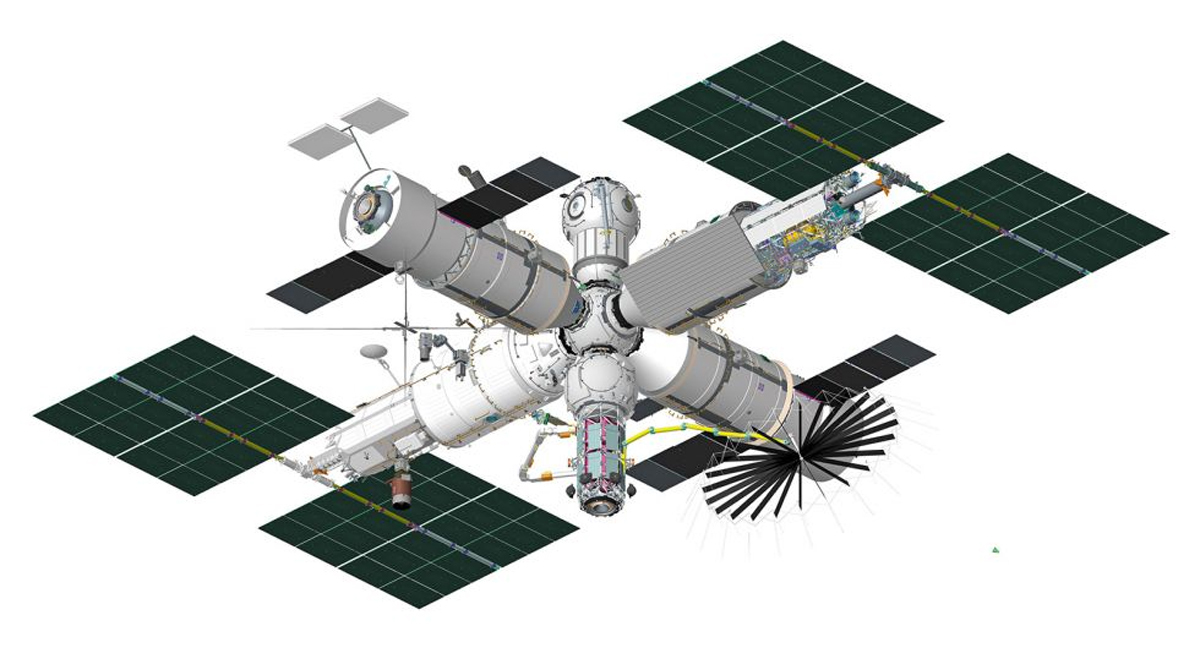
The Russian Orbital Service Station, as rendered during a recent presentation by Vladimir Solovyov, chief designer at RSC Energia, and the director of Russian involvement in the ISS. To the left and right, with the large four-panel solar arrays are the two core modules for the station. To the left foreground and right background as the additional science modules. Credit: Roscosmos

At the time, it was indicated that work on ROSS would commence in 2024 and conclude around 2029. However, that time line was then pushed back to 2030-2035, possibly signalling Russia would remain fully engaged in ISS operations through until 2030. Then came the Russian invasion of Ukraine, international outrage, condemnation and the rest. This included assorted (and somewhat silly) threats on the part of the then head of Roscosmos, Dmitry Rogozin, which included statements that Russia would depart the ISS in 2024 – and might take parts of it with them…

While Rogozin has now departed Roscosmos for pastures new, his replacement at the agency, his replacement – equal hardliner Yuri Borisov – Has sounded something of a warning that attitudes towards ISS operations have not shifted, telling the TASS news agency that Russia’s engagement in ISS will come to an end “after 2024” – the date to which the committed to support the station.

Exactly what “after 2024” means in practice remains unclear. ISS partners are obligated to give at least 12 months warning of an intention to depart the project – and Russia has never taken that step through to now, and it could be argued that 2030 is as much “after 2024” as 2025.

That said, coming on the heels of Borisov’s comments to TASS, Vladimir Solovyov – who is both the chief designer at RSC Energia, the company responsible for developing space station modules and the director of the Roscosmos department directly responsible for ISS operations – presented the first detailed overview of the proposed ROSS platform, including the fact that the first modules are to be operational by the end of 2028.
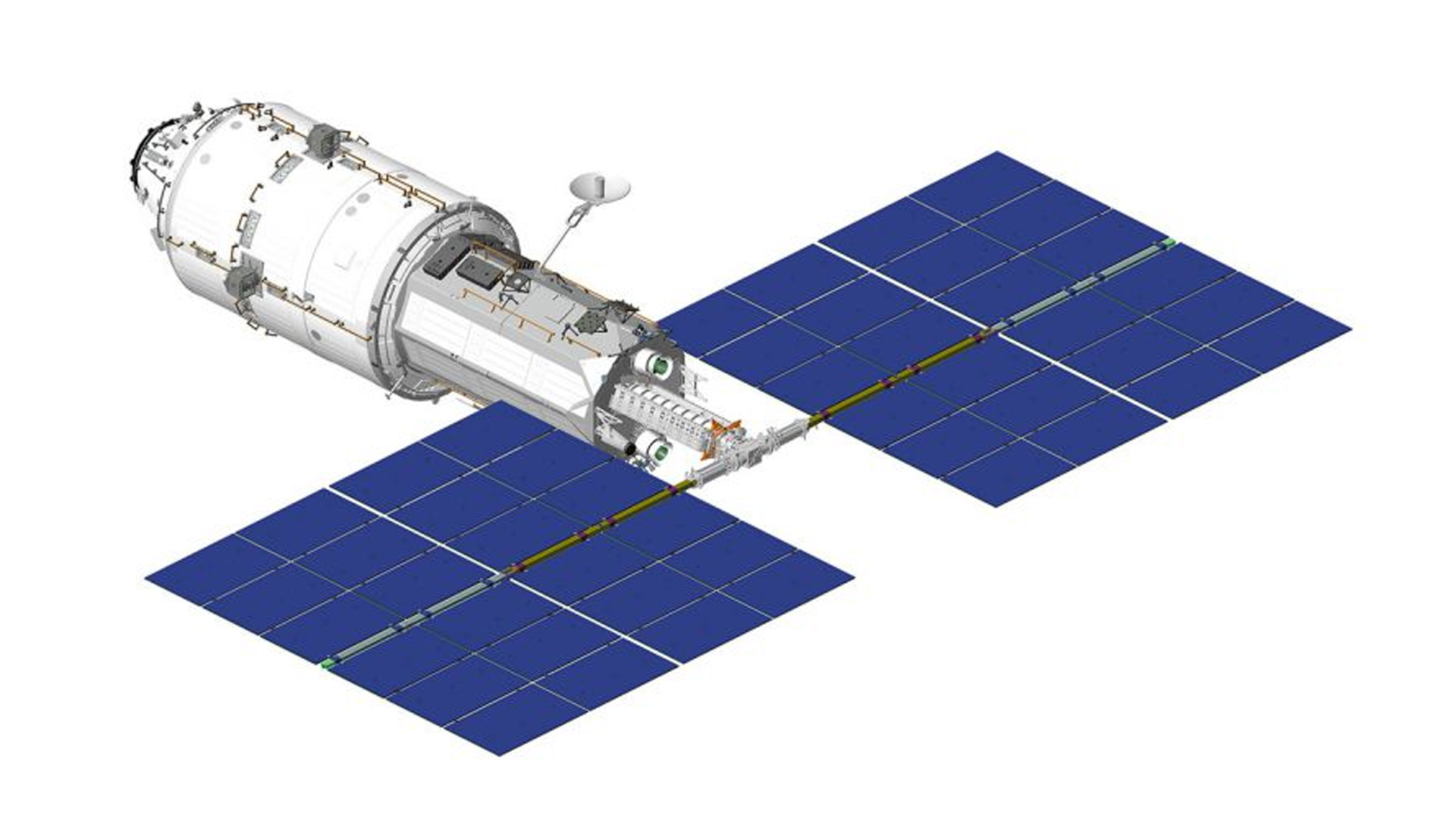
ROSS: the SPM-! (NEM-1) core module, originally intended for the ISS is currently being repurposed to provide the new space platform with all its required power management capabilities. Credit: Roscosmos

While not explicitly named by Solovyov, the first of these modules appears to remain the re-purposed SPM-1 / NEM-1, Solovyov indicated would launch in 2026. This will then be followed in 2028 by a Core Crew Module (CCM – this nomenclature will likely change), providing crew living facilities and additional power systems, with the two units operating as a baseline station until two additional science modules can join them in 2030.

This tends to indicate that from 2025, Roscosmos will start pivoting priorities away from ISS and to ROSS; but it does not signal they will be ending all involvement in ISS. Further, and while again not indicated by Solovyov, the fact that the science modules will not be flown until 2030 might be indicative that consideration is being given to perhaps utilising the Nauka module, which only joined the ISS in 2021 and which is capable of its own propulsion, within ROSS.

This might come down to the orbit ROSS eventually placed within. During his presentation Solovyov stated the some of Russia’s frustrations with ISS is that the station operates at an orbital inclination that precludes much of the Earth and space science Russia would like to carry out. As such, a wide range of potential orbits are being considered for ROSS, some of which would exclude any transfer of Nauka from ISS to ROSS.
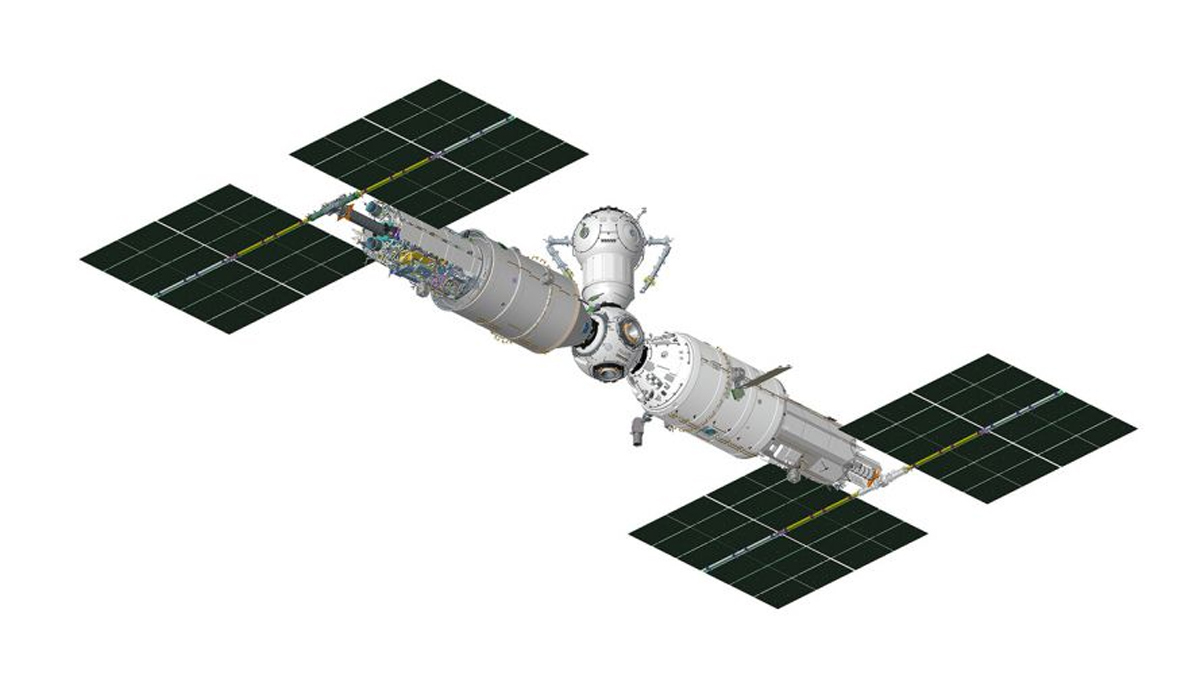
ROSS: a further view of the Core Crew Module (CCM – left) and the core power module (SPM-1/NEM-1 – right) linked by the multi-port docking hub, which also has an unidentified vehicle docked to it. These elements of the platform are being targeted for operational use starting in 2028. Credit: Roscosmos

As well as the four core modules, Solovyov indicated that the station’s facilities could be expended through the use of a (yet-to-be built) large-scale automated re-supply vehicle that could perform a number of roles from straightforward delivery of supplies and consumables through performing required orbital boosts to offering temporary additional working space when needed. It is additionally possible this re-supply vehicle might be combined with a capsule-like crew vehicle, allowing it to deliver both personnel and supplies to the station, with dedicated crew-only flights to and from ROSS carried out aboard a smaller vehicle intended to replace the veritable Soyuz

Most interestingly, Solovyov  stated ROSS would not necessarily be permanently crewed, but will utilise a high degree of automation for science operations, with crews visiting it to carry out very specific science research and / or to collect data and carrying out maintenance and other work. However, as he also indicated that the station could well form a part of Russia’s ambitions for the Moon and Mars (some of least at which will likely include working with China), the station could become more fully crewed from 2030 onwards.

ESA / NASA Simplify Mars Sample Return Mission

In May I wrote about the proposed ESA / NASA Mars Sample return mission to bring core samples gathered by NASA’s Perseverance rover back to Earth for analysis. At the time of that report, NASA and ESA were responding to calls for the mission to be prioritised and take place earlier than the early-to-mid 2030s. However, the plan being forward back then stuck me as being overly complicated, involved six vehicles and three individual launches; and bless them, NASA and ESA now seem to share that view:  on July 27th, 2022, the two agencies issued an update that reduced the mission to just two launches and changes the overall line-up of vehicles involved, although the fine details have yet to be worked out.

As it was: the Mars Sample Return (MSR) mission in March-May 2022: top right is the ESA-built Earth Return Vehicle (ERV); lower right the Mars Ascent Vehicle (MAV) mounted on its lander; in the centre is the ESA-built “fetch” rover (minus its lander) which would transfer samples from where they had been deposited by Perseverance (left) to the MAV. Credit; NASA / ESA

In the March-May plan, Perseverance would have deposited a cache of core sample tubes somewhere in Jezero crater. This cache would then be targeted by two landers – one carrying the Mars Ascent Vehicle (MAV), and the other a small, European-built “fetch” rover. This would collect the sample tubes from the cache and deliver them to the MAV, which it turn would launch from its lander to carry them up to a waiting Earth Return Vehicle (ERV) built by ESA, with the sample tubes transferred to that vehicle for the return to Earth.

Under the new plan, the ERV remains, as does the MAV and its lander. However, the “fetch” rover and its lander have been scrapped. Instead, the MAV will launch to Mars in 2028 and its lander will use telemetry from Perseverance to land in the vicinity of the rover, which will then drive to the MAV and perform the transfer of samples directly.

Exactly how this transfer will be managed is unclear – Perseverance isn’t exactly designed for such a task. So, as a contingency, the lander carrying the MAV will carry will also be equipped with two “Ingenuity class” helicopters. Fitted with wheels and a small grappling arm, as well as flying, these will be capable of scooting around on wheels, collecting sample tubes from the cache rack Perseverance will deposit on the surface of Mars and delivering them to the MAV. Once loaded, the MAV will launch to orbit, rendezvous with the ERV, and the sample pack transferred for its return to Earth.
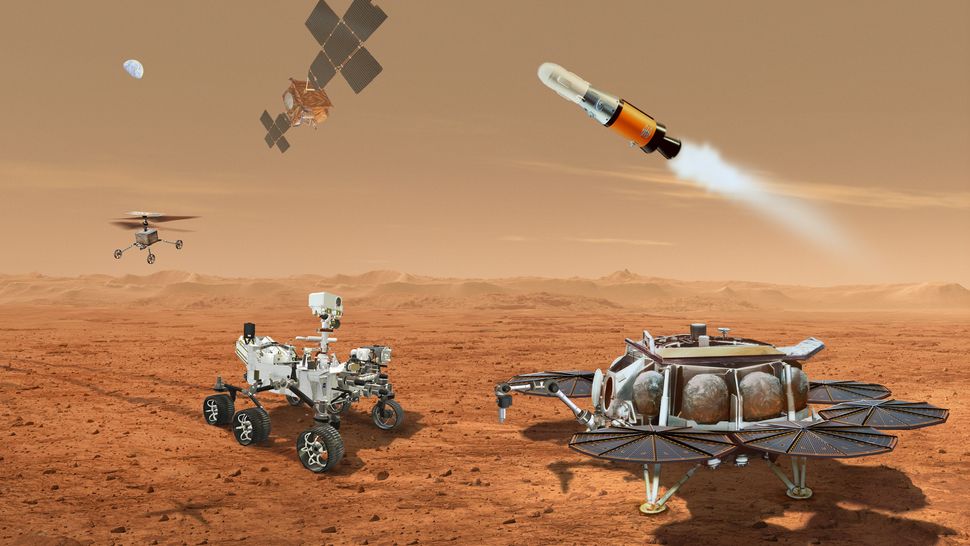
As it now is: the current Mars Sample Return mission hardware: the ESA-built Earth Return Vehicle (top), with the Mars Ascent Vehicle (MAV) flying up to it from its lander (right), and one of the two “ingenuity-class” helicopters hovering close to the Mars 2020 rover. Credit: NASA / ESA

Overall, the approach is still somewhat complicated, but assuming a methodology can be employed to allow Perseverance to complete the sample transfer to the MAV unaided, it means NASA will have two fresh helicopters available to support the rover in its further explorations in and around Jezero Crater. And even if the helicopters do have to be used for sample retrieval, by combining them with the MAV and its lander, an entire additional launch – and the development of a complex small-scale “fetch” rover – can be avoided, both reducing the overall cost of the mission and reducing the potential for long-term delay which might occur with the development of an entirely new class of rover.

Which is not to say the target 2027 launch date for the ERV isn’t itself challenging; three years to develop and test a space vehicle is an extremely short time-frame; as such it would seem likely this mission will slip back into the early 2030s.

Continue reading “Space Sunday: space stations, sample returns and falling rockets”

Space Sunday: galaxies, launches and health in space

Gz-13, as seen by the James Web Space Telescope, one of the earliest known galaxies in the universe and seen as it would have appeared just a few million years after the Bi Bang. Credit: NASA / ESA / CSA / STScI

The above image may not look to be much, but it in fact a glimpse at one of the most distance galaxies from our own, a place called Gz-13. It is so far away, the light captured by the image departed it about 300 million years after the universe itself was born.

Gz-13 is a part of a cluster of galaxies seen within one of the first set of images released by NASA from the James Webb Space Telescope (JWST), and which I covered in my previous Space Sunday update. So far away are these objects, that they can only be seen via the effect of gravitational lensing – using the gravity of an object much, much closer to our own solar system to “bend” the light from them and focus it so that JWST can capture images.

Gz-13 lies tucked away in the SMAC-0723 grouping of very distant objects. Originally imaged by the Hubble Space Telescope (HST), the grouping has been given sharp, new high-definition exposure by JWST. Some much definition, in fact, that GZ-13 hadn’t been seen by Hubble.

While it may seem like a blob of red-shifted light, massively distant objects like Gz-13 (and Gz-11, another far-distant galaxy that was seen when Hubble viewed SMACS-0723) are important targets for study, as they represent a period of time literally just a blink (in cosmic terms) after the universe went off with its Big Bang; thus thus represent an opportunity for us to understand what was going on very close to the origin of literally everything there has ever been.

SMACS 0723 as it appeared 4.6 billion years ago. Tucked away inside this cluster sits Gz-13. Credit: NASA/Goddard Space Centre / STScI

What is particularly interesting about the likes of Gz-11 and Gz-13 is that despite being formed just 150-200 million years after the first stars are believed to have started forming, they still have masses that suggest they are home to several billions stars with a mass equivalent to our own Sun. Thanks to them being so bright in the infra-red, they offer an unparalleled opportunity for astronomers to carry out extensive spectrographic analysis  to help us to discover more about them and the nature of the stars they contain – including, potentially, whether any of their stars might be surrounded by disks of dust and gas that might have gone on to form planets.

Given the nature of the expanding universe, Gz-11 and Gz-13 are liable to be just the tip of a massive iceberg of galaxies far, far, away that are waiting for JWST to find. This is turn will massively increase our total understanding of the nature of the universe, and the formation and growth of the galaxies within it. In fact, it is very possible that JWST will look so far out that we are looking almost back to the very edge of the Big Bang itself.

China Launches First Space Station Science Module

China has launched the first of two science modules to its nascent Tiangong Station (TSS).

The Wentian module was lifted into the sky atop a Long March 5B heavy-lift rocket at 06:25 UTC on Sunday, July 24th, the launch taking place from the Wenchang spaceport on the southern island of Hainan.

Measuring 17.9 metres in length and with a diameter of 4.2 metres, the module has an operational mass of around 23 tonnes, putting it on a par with US and international modules on the ISS. At the time of writing, the module was due to make an automated docking manoeuvres with Tianhe-1, the core module of the Chinese space station.

Chinese Space Station supplemental module Wentian. Credit: Leebrandoncremer via Wikipedia

Wentian, which literally means “quest for the heavens,” is the first of two science modules intended to join with Tinahe-1 to complete the currently-planned elements of TSS and bring its all-up mass to around 66 tonnes (the ISS, by comparison, masses 460 tonnes). In addition, operations aboard the station can be added-to through the use of Tianzhou automated re-supply vehicles.

The module’s docking will be overseen by the three crew of the Shenzhou 14 mission. It will initially dock with Tianhe’s forward docking port, where it will remain during initial tests and check-out by the crew to confirm its overall condition. The crew will then commence initial science activities, which will include a live broadcast via Chinese state media.

At some point in the future, Wentian will be relocated to a side port on Tianhe’s forward docking hub to form one arm of an eventual “T” that will be made by the core module and the two science modules, leaving the forward port free for visiting crews, and the after port at the far end of Tianhe available for visiting Tianzhou vehicles.

Whilst classified a science module, Wentian is actually a multi-purpose facility. It includes an airlock of its own to enable crew members to complete space walks, it has an external robot arm of its own to assist with such spacewalks, and additional living space for 3 tiakonauts, allowing up to six to live in comfort on the station during hand-over periods. The first such hand-over (similar in nature to ISS handovers) is due to take place in December 2022, when the crew of Shenzhou 14 pass the station over to the 3-person Shenzhou 15 crew. However, prior to that event, the second science module, called Mengtian (“Dreaming of Heavens”), is due to be launched to the station in October.

NASA Sets Artemis-1 Launch Dates

On July 20th, 2022, NASA announced they are targeting three dates at the end of August / beginning of September for the first flight of their Space Launch System (SLS) super rocket which sits at the heart of their plans for a return to the Moon.

The Artmis-1 mission will launch an uncrewed Orion Multi-Purpose Crew Vehicle (MPCV) on an extended mission to cislunar space. Each of the three launch dates has different launch windows and mission durations:

  • August 29th: the launch window runs from 12:33 to 14:33 UTC, and would result in a 42-day mission ending with a splashdown on October 10th.
  • September 2nd: the launch window runs from 16:48 to 18:48 UTC, and would result in a 39-day mission splashing down on October 11th.
  • September 5th: the launch window opens at 21:12 UTC for 90 minutes, and would result in a 42-day mission splashing down on October 17th.
The Artemis-1 Space Launch System rocket, seen during the initial Wet Dress Rehearsal test in April 2022. Credit: NASA

Splashdown for all three launch opportunities will occur off the coast of San Diego, California.

The dates themselves have been defined based on the need to complete post-Wet Dress Rehearsal  test work on the vehicle. They all represent “long-class” flights for the Orion, with Artmis-1 originally being planned around shorter 4-week flights in order to test out all of its handling characteristics in cislunar space. However, given all of the delays thus far experienced with Artemis-1, NASA opted to push for these launch dates rather wait until the end of October when windows for shorter-during flights would open, together with a further rick of slippage of the launch back into 2023.

Continue reading “Space Sunday: galaxies, launches and health in space”

Space Sunday: Webb’s views, booster bang + Rogozin’s roulette

Where they are: the five subjects of the first five science images release by NASA for the James Webb Space Telescope (JWST). 1: the Carina Nebula; 2. the Southern Ring Nebula; 3. Stephan’s Quintet; 4. WASP-96b; 5. SMACS 0723. Credit: NASA/Goddard Space Centre / STScI
The first series of science images from the James Webb Space Telescope (JWST) were released on July 12th, 2022 rightly grabbing the headlines around the world, revealing as they did elements of our universe and our own galaxy in stunning detail and offering a superb launch for the observatory’s science mission.

At the time of their release, NASA also confirmed that, thanks to the extreme accuracy achieved by the European Ariane 5 rocket in delivering the observatory into is transfer orbit which allowed JWST to establish itself in its L2 position halo orbit, 1.6 million km from Earth, sufficient propellants remained aboard the observatory for it to operate for around 20 years – double its original extended mission time.

The mission itself is broken into periods of 12 months apiece, with science institutions, universities, etc., from around the world able to submit papers outlying studies they like to carry out using JWST to the Space Telescope Science Institute (STScI) in Baltimore, USA which form the management and operational centre for both JWST and the Hubble Space Telescope (HST). As such, the initial images selected for release on July 12th represent study targets for JWST accepted for its first year of observational science – but they are not the only targets. Since formally commencing its science programme in June, JWST has already gathered around 40 terabytes of images and data, and following the high-profile release of the initial images, on July 14th, 2022, STScI started issuing raw images of other targets so far examined by the observatory, including images of objects without our own solar system.

Webb is designed to collect light across the entire red to mid-infrared spectrum wavelengths of light that are blocked by Earth’s atmosphere, and while Hubble crosses from visible light into the near-infrared, JWST has a light collection area 5 times greater than that of HST. Taken together, these facts mean that JWST can reveal objects near and far with a lot more detail than we’ve ever been able to see them, and can also see much further out in the cosmos, allowing us to see the light of objects as they appeared close to the birth of the universe. Add this to the fact that the four science instruments on JWST can be combined to operate in a total of 17 different modes, and JWST is genuinely unparalleled in its capabilities.

The following is a brief summary of the images released on July 12th.

Carina Nebula

Lying some 7,600 light-years away and visible in southern hemisphere skies within the constellation Carina, this nebula (NGC 3372) is a familiar sight among astronomical photographs and studies. It is a massive birth-place of stars, with multiple young stellar groupings like Trumpler 14, and Trumpler 16.

The former, measuring just 6 light-years across (or roughly 1.5 times the distance between our Sun and the Alpha Centauri system) is just half a million years old – but it is home to around 2,000 young stars! Slightly older, Trumpler 16 is home to two of the most luminous stars in our galaxy: Eta Carinae and WR 25. These are two of the most luminous objects in our galaxy – while both are invisible to the naked eye on Earth, they are nevertheless several million times brighter than the Sun.

The “cosmic Cliffs” of NGC within the Carina Nebula, showing the blue “bowl” of hot stars that have pushed interstellar dust and gases into to a ring that resembles towering cliffs and mountains, and within which younger, new stars can be seen. Credit: NASA/Goddard Space Centre / STScI

Neither of these stellar groups was the focus in the Carina Nebula image release on July 12th. This honour went to the “Cosmic Cliffs”, part of a nebula-within-a-nebula (NGC 3324). A ring of dust and debris, it has been formed by the young, super-hot, super-active blue-white stars at the centre of NGC3324 (seen at the top of the image above) generating a collective powerful radiative force that has pushed the remaining gases and dust left over from their formation outwards to a point where the pressure of their own radiation is matched by that of the surrounding larger nebula.

Normally invisible to the naked eye, the portion of the “Cosmic Cliffs” have been beautifully rendered using images from both the Near-Infrared Camera (NIRCam) and the Mid-InfraRed Instrument (MIRI) on JWST, which have been processed to produce a remarkable composite image that reveals never-before-seen details. Within this ring of material, compression and gravity are combining to create even younger stars, many revealed in this image for the first time – with some even showing protostellar jets of material shooting outwards from them. Images like this shed enormous light (so to speak!) on the process of star formation.

Southern Ring Nebula

Catalogued as NGC 3132, the Southern Ring Nebula stands in contrast to the Carina Nebula, being the home of a binary star system where one of the stars is in its death-throes.

The pairing sits in a tight mutual orbit, and the elder of the two stars has gone through a series of events where it has thrown off shells of gas and mass, which are being mutually “stirred” by the two stars as they continue to orbit one another, leading to a complex pattern of gases around both.

The Southern Ring Nebula as seen by JWST’s NIRCam (l) and MIRI (r). Credit: NASA/Goddard Space Centre / STScI

JWST imaged the nebula with both NIRCam (seen on the left, above) and MIRI (seen on the right), with the latter showing for the first time that the second star is surrounded by dust, suggesting a more “recent” ejection of mass. The brighter star (visible in both images) is in an earlier stage of its stellar evolution and will probably eject its own planetary nebula in the future.

Studies of phenomena like the Southern Cross Nebula is like watching a slow motion film of a star’s evolution towards the end of its life, each of the shells of gas and dust from outer to inner representing increasingly more recent events in its life, allowing astronomers gain insight in the life and death of stars, whilst studies of the gases released provide insight into how these delicate layers of gas and dust will dissipate into surrounding space.

Stephan’s Quintet

This is a visual grouping of five galaxies, four of which (called the Hickson Compact Group 92) are a genuine grouping of galaxies that are gradually being drawn together by gravity, and will all eventually merge. The fifth member of the quintet is the result of line-of-sight alignment, rather than an actual part of the group. It is possibly best known for its appearance in the classic film It’s a Wonderful Life.

Imaged numerous times in the past, JWST nevertheless reveals the quintet in a new light via a mosaic image that represents Webb’s largest image to date, containing over 150 million pixels and comprising 1,000 individual pictures of the galactic group.

Stephan’s Quintet, comprising a close-knit group of four galaxies, two of which have already merged (centre right) to form NGC 7318. Also visible in the image are clouds of sat-forming dust and material, and the shockwave of the NGC 7318 merging rippling through NGC 7319. Credit: NASA/Goddard Space Centre / STScI

The quartet of galaxies are some 280 million light-years from our own, and of particular note in this composite image is the details of gaseous clouds where star formation is going on; the clear view of the two galaxies in the group which have already collided (UGC 12099 and UGC 12100, now collectively classified as NGC 7318) – the lower right of the “three” close-packed galaxies in the central group – and the white shockwaves of that collision as they sweep towards the top right galaxy, NGC 7319.

Continue reading “Space Sunday: Webb’s views, booster bang + Rogozin’s roulette”

Space Sunday: JWST, interstellar communications and Mars sailplanes

The “Pillars of Destruction” (aka Region R44) within the Carina Nebula, 7,600 light-years from Earth, as seen by the MUSE instrument on ESO’s Very Large Telescope. Towering fields of dust, the pillars are slowly being destroyed by the the stars they helped form; while the nebula is one of the focal-points for initial science imaging by the James Webb Space Telescope. Credit: ESO

Our first glimpse through the eyes of the James Webb Space Telescope (JWST) will be unveiled through a live broadcast on Tuesday, July 12th at 14:30 UTC. However, on Friday, July 8th, NASA announced details on what will be featured in the broadcast and the images that will be published during the presentation, promising that the latter will reveal an unprecedented look into some of the deepest views yet of the cosmos.

The targets were selected by an international committee of scientists from NASA, the European Space Agency (ESA), the Canadian Space Agency (CSA) and the Space Telescope Science Institute in Maryland, which manages the observatory. They include:

  • The Carina Nebula (NGC 3372): lying some 7,600 light-years away, and visible in southern hemisphere skies, where it appears to lie within the constellation Carina, this nebula is the home of the famous “Pillars of Destruction”, long finger-like structures of cosmic gas and dust.
  • Southern Ring Nebula (NGC 3132): appearing to lay within the constellation of Vela (also visible in the southern hemisphere sky) this distinctive nebula of gas and material surrounds dying star is some 2,000 light-years from Earth.
  • Stephan’s Quintet: a visual grouping of five galaxies, four of which (called the Hickson Compact Group92) are a genuine grouping of galaxies that are gradually being drawn together by gravity, and will all eventually merge. The fifth member of the quintet is the result of line-of-sight alignment, rather than an actual part of the group.
  • WASP-96 b: a “hot Saturn” exoplanet orbiting the star WASP-96, some 1,120 light-years away, within the southern constellation of Phoenix. With a mass roughly half that of Jupiter, the planet orbits its parent every 3.4 terrestrial days and is the first known planet with an entirely cloudless atmosphere, which has a profoundly strong sodium signature.
  • SMACS J0723.3-7327: an experiment in using gravitational lensing, using the gravity of relatively “nearby” galaxies to “bend” the light from much more distance galaxies to obtain a deep-field view of their stars.
The initial science images from JWST will be part of a science briefing scheduled for 4:30 UTC. on July 12th. Credit: NASA

The presentation and images will mark the first time “operational” data and images relating to scientific targets for the observatory have been made public since the completion of all tests relating to the calibration and commissioning of its four science instruments, all of which allow JWST to operate in a total of 17 different science modes.

It is believed that even though only initial studies of their targets, the images captured by the telescope have stunned science teams and already led to increased understanding of exoplanets, galaxies and the universe itself.

Could Stars be used as Communications Relays?

In June I covered a proposal suggesting the Sun’s gravity could be used to help image exoplanets orbiting other stars using gravitational lensing (see:  Space Sunday: exoplanets, starship and the Sun as a lens). Now a paper accepted for publication in The Astronomical Journal lays out the idea that the lensing effect of the Sun’s gravity, and that of other stars, could be used as some kind of interstellar communications network.

The study discusses the idea that gravitational lensing, involving the bending of light as it passes by massive objects like stars and black holes, could be used to focus communications between one point and another, amplifying the signal like an interstellar cell phone tower.

For the purposes of the paper, a team of students at Penn State University working under Jason Wright, professor of astronomy and astrophysics and the director of the Penn State Extra-terrestrial Intelligence Centre, used the Sun as a model, calculating that the gravitational focus on the solar lensing effect lies some 550 AU out from the Sun – or a distance equitable to roughly half-way between the orbits of Jupiter and Saturn.

Communications across interstellar distances could take advantage of a star’s ability to focus and directing communication signals through an effect called gravitational lensing. A signal from—or passing through—a relay probe would bend due to gravity as it passes by the star. The warped space around the star acts somewhat like a lens or transmitter, focusing the beam towards an itended target. Credit: Dani Zemba / Penn State

This is the point where a communications satellite could be placed such that it could use the Einstein Ring effect of gravitational lensing by the Sun to focus its signals on a distant target – and also receive incoming communications from that target as the Sun’s gravity focuses them down onto the satellite.

The most obvious use of such a system would be to enable communications with deep-space probes we might eventually send to nearby stars (assuming they could be accelerated to reach said stars in a reasonably time-frame). However, the students also noted that if the Sun were to be a part of so alien communications network, then we now have a sphere around it where we might detect any relay, which we might try to eavesdrop on.

Whilst a pretty far-fetched idea in terms of an “alien relay station” sitting in our own back yard, the study does offer some food for thought in how signals from ET (if they exist) might leverage stellar objects, and thus offers a potential new avenue to be explored within SETI and CETI (as in Communications) research.

Exploring Mars by Air: the Case for the Sailplane

The success of the Mars Ingenuity helicopter has been encouraging engineers to consider and reconsider all options for remote aerial observations of the Red Planet over the course of the past year. Additional methods for birds-eye views of Mars would not only provide higher resolution data on the landscapes where rovers can’t go — such as canyons and volcanoes — but also could include studying atmospheric and climate processes that current orbiters and rovers aren’t outfitted to observe.

Once such option that had been considered years ago and is now coming back into focus is that of a sailplane. In particular, students at the University of Arizona have been investigating the possible use of small, relatively lightweight (just 5 kg) unpowered sailplanes that could be carried to Mars as secondary payloads alongside larger missions.

Aerospace engineering doctoral student Adrien Bouskela (left) and aerospace and mechanical engineering professor Sergey Shkarayev hold an experimental Mars sailplane. They hope to one day send a custom version of a similar plane to Mars. Credit: Emily Dieckman/College of Engineering.

Protected through their entry into the Martian atmosphere, these sailplanes would fall free from their aeroshells to unfold their 3-metre wingspan to use the so-call boundary layer of atmosphere known to exist around Mars and which is of considerable interest to scientists.

You have this really important, critical piece in this planetary boundary layer, like in the first few kilometres above the ground. This is where all the exchanges between the surface and atmosphere happen. This is where the dust is picked up and sent into the atmosphere, where trace gases are mixed, where the modulation of large-scale winds by mountain-valley flows happen. And we just don’t have very much data about it.

– Alexandre Kling, NASA’s Mars Climate Modelling Centre

Potentially also using fully or partially inflatable fuselage, such sailplanes could ride the wind and air pressure, gathering data whilst exploiting atmospheric wind gradients for dynamic soaring to extend their gradual descent to the ground.

Despite their relatively light weight, the students believe the sailplanes would be capable of carrying an array of navigation sensors, a camera system to images the terrain below it, and temperature and gas sensors to gather information about the Martian atmosphere. As a part of their studies, the students have experimented with radio-controlled sailplanes adjusted to fly themselves and which have been lifted to altitude under weather balloons before being released to see how they manage the dynamics of a descent through Earth’s atmosphere.

he Mars sailplanes will contain a custom-designed array of navigation sensors, as well as a camera and temperature and gas sensors to gather information about the Martian atmosphere and landscape. Credit: Emily Dieckman/College of Engineering

In addition, the students have used computer modelling to research general vehicle handling within the far more tenuous Martian atmosphere. A particular technique used in sailplaning is to use updrafts and thermals in which a pilot can circle and gain lift to increase altitude. Mars is known to have similar phenomena, and the modelling shows that they could be used in a manner akin to sailplaning on Earth – with the added advantage that the higher effective wind speeds often recorded with such updrafts on Mars have the potential to help carry the sailplanes over much greater distances.

If such vehicles were released over terrain features such as Gale Crater (home of the Mars Science Laboratory rover Curiosity or Jezero Crater, home to the Perseverance Mars 2020 rover, they could be used for detailed high-altitude surveys of the craters, using updrafts as the crater walls to regain momentum whilst mapping the crater floors for surface exploration. However, they could also be used in the first highly-details studies of the nature of Vallis Marineris, the 5,000-km long “Grand Canyon” of Mars.

According to the modelling completed by the students, a sailplane could use the rugged, deep base of the canyon, rich in mesas and plateaus to regularly recover 6-11%  lift energy on a cyclic basis, which together with the higher atmospheric pressure within the canyon system could allow each sailplane to fly for “days”, offering unparalleled opportunities to study this unique environment.

A further attraction with sailplanes is that of cost: development of a suitable glider vehicle could be measured in years rather than decades, utilising common off-the-shelf parts, particularly where instruments are concerned, with most of the effort going into the delivery / deployment system, gaining a better understanding of the Martian atmosphere and its thermal qualities in order to better determine vehicle flight characteristics, and in how to develop the means to recharge the sailplane’s batteries to power its instruments and controls without relying on a potentially cumbersome solar array system.

Currently, the work by the students has been a project largely internal to the university; however, Kling has worked with the team, and he and professor Sergey Shkarayev from the university who has overseen the work, hope that a formal proposal to extend the research might yield NASA funding.

Space Sunday: life, planet, moons and robots

Scientists using data from NASA’s Curiosity rover measured the total organic carbon – a key component in the molecules of life – in Martian rocks for the first time, and have discovered that there is potentially more to be found on Mars than in the driest environments to be found here on Earth.
Organic carbon is carbon bound to a hydrogen atom and is the basis for organic molecules; they are created and used by all known forms of life, and it has been previously detected within Martian rock samples studied by the rover. However, the key difference between those results and those published within this study is that other attempts to examine rock samples for the presence of carbon have only looked for specific compounds that contribute to organic carbon or only represented measurements capturing just a portion of the carbon in the rocks; this study presents the total amount of organic carbon detected in samples gather by the rover during an intensive examination of exposed rock made in 2014.

Total organic carbon is one of several measurements [or indices] that help us understand how much material is available as feedstock for prebiotic chemistry and potentially biology. We found at least 200 to 273 parts per million of organic carbon. This is comparable to or even more than the amount found in rocks in very low-life places on Earth, such as parts of the Atacama Desert in South America, and more than has been detected in Mars meteorites.

– Jennifer Stern, NASA Goddard Space Flight Centre, Maryland

To make the measurement, Curiosity delivered the sample to its Sample Analysis at Mars (SAM) instrument, where an oven heated the powdered rock to progressively higher temperatures. This experiment used oxygen and heat to convert the organic carbon to carbon dioxide (CO2), the amount of which is measured to get the amount of organic carbon in the rocks. Adding oxygen and heat allows the carbon molecules to break apart and react carbon with oxygen to make CO2. Some carbon is locked up in minerals, so the oven heats the sample to very high temperatures to decompose those minerals and release the carbon to convert it to CO2. While the samples were gathered and analysed in 2014, it has taken years of ground-based analysis to fully understand the data and to put the results in context of the mission’s other discoveries at Gale Crater to reach a point of being ready for publication.

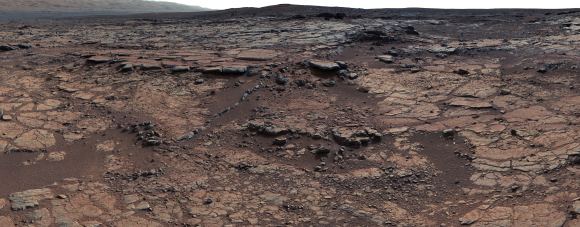
A mosaic of images captured by the Curiosity rover of the “Yellowknife Bay” rock formation, the location where the rover carried out its extensive search for carbon isotopes. The sedimentary rocks within the formation were laid down by an ancient stream and a lake that might have also contained the ingredients for life. “Yellowknife” was exposed about 70 million years ago by the removal of overlying layers due to erosion by the wind. Courtesy NASA/JPL / MSSS

A specific interest of the study was to identify the carbon isotope ratios. Isotopes are versions of an element with slightly different masses due to the presence of one or more extra neutrons in the nucleus of their atoms. In particular, two of the most common carbon isotopes are Carno-13, with seven neutrons tends to be of largely inorganic origin, while Carbon-12, with six neutrons, tends to be more associated with organic processes – and the study found this to be more abundant than had been anticipated.

But this doesn’t mean that it is absolute evidence that life may have formed on Mars. While the planet was once much warmer and wetter, with a dense atmosphere and free-flowing water on the surface that may have given rise to life, it’s important yo note the “more” used above for Carbon-12 -it can also be the result of non-organic processes such as vulcanism; and Mars was once extremely volcanically active.

Nevertheless, the confirmation that rock samples studied by Curiosity are richer than expected in Carbon-12, coupled with the general environment know to have once existed in Gale Crater – a place that once have an abundance of water and energy sources – further points to the crater being very conducive to life perhaps having gained a toehold there.

Exomoons as the Abode of Life?

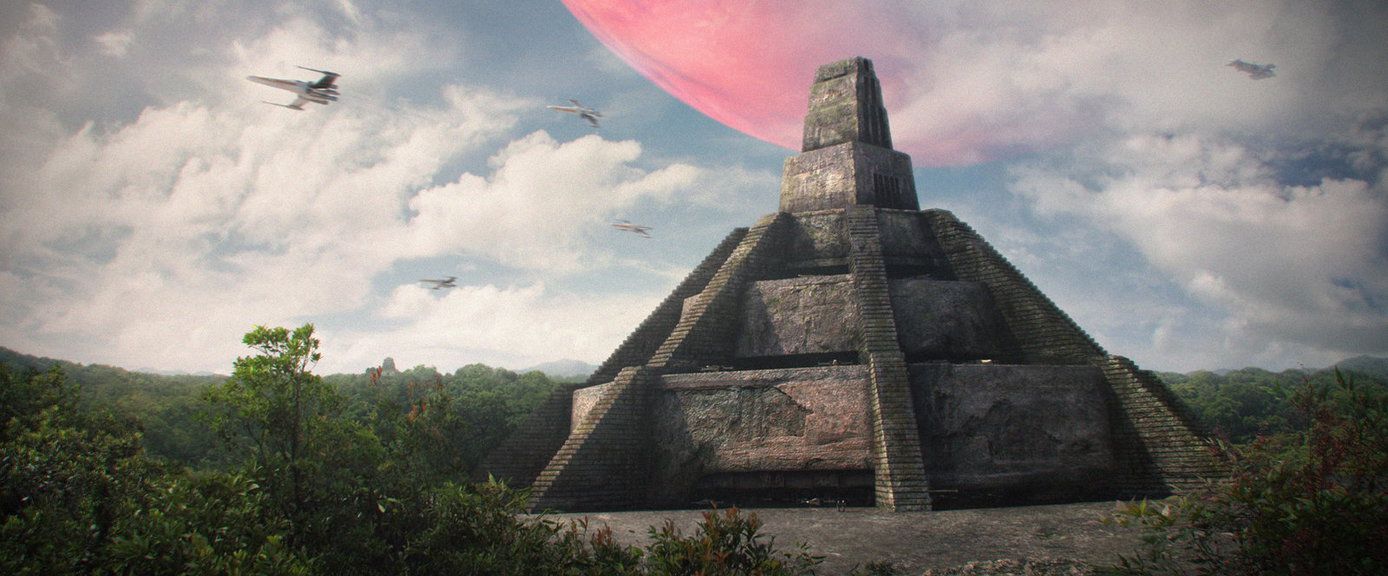
We’re all familiar with the Star Wars franchise of films and TV series. In 1977, the original film in the series depicted a rebel base on the fourth moon of the fictional gas giant Yavin.

Many probably didn’t pay much attention to this at the time – beyond noting how the planet played a crucial role in keeping the base shielded from the Death Star, and its cool appearance in Yavin 4’s sky; however, the film was, in many respects well ahead of its time in its depiction of a  habitable Moon. In 1977, the exact nature of moons like Jupiter’s Europa and Saturn’s Enceladus as places of ice and, possibly, water, was suspected rather than known, whilst guesses were also being made about what might lie under the atmosphere of Titan. It would be a couple of decades before we really started to understand the potential for some of the Moons of our outer solar system to have the conditions in which basic life might gain a hold.

The idea of a moon of a planet being habitable was an idea ahead of its time when visualised in the original Star Wars film, but given what we’ve come to understand about the moons in our own solar system, such potentially life-hosting places may exist elsewhere in our galaxy. Credit: 20th Century Fox / LucasFilm / Disney

While our own solar system moons like Europa are cold place and any life than may form within them sitting within an evolutionary cul-de-sac, the mechanics that make them potentially life-bearing is now being looked at as having the potential to make exomoons like Yavin 4 possible elsewhere in the galaxy.

The major factor in the life-bearing potential of places like Europa and Enceladus is that of tidal forces. In short, as these moons orbit their parents, they are subject to the gravity of the planet exerting a pull on them at the same time as the other moons orbiting the planet also exerting forces on them, all of which causes the moon to “flex”, heating its interior. With Europa and Enceladus, this heating may have resulted un liquid water oceans being possible under their icy surfaces.

Of course, such is the distance between the Sun and these Moons of Jupiter and Saturn than the moons don’t get enough solar heating to remain warm. However, a lot of exoplanets orbit their parent stars a lot closer than our gas giants do to the Sun. While some are clearly too close to their parent, forming what are called “hot Jupiters”, others are at a distance such that any Moons orbiting them could be subject to both tidal action and receive enough solar heating to maintain a potentially temperate atmosphere.

There are question marks around the theory – would such moons be tidally locked with their parent planet, such that the same side of the moon always faces the planet and the same face facing the local star? Would the planet itself be tidally locked to its parent star? How would the atmosphere of a moon fare caught between the outflow of radiation from both star and planet? However, it also promises a new avenue of research for exoplanets and exomoons and the search for signs of life elsewhere in the galaxy, as has been proposed in a paper published in the Astronomical Journal.

What is particularly interesting about the paper is that while the team behind it initially focused on gas giants and their possible moons, their computer modelling suggests that solid rocky planets of the size of Earth or a little bigger / heavier that have Moons could actually become far more habitable themselves.

Could moons orbiting the planets in the “goldilocks zone” of TRAPPIST-1 help those planets avoid becoming tidally locked with their parent, and thus be more naturally temperate and amenable to life than might otherwise be the case. Credit: NASA

This is because the majority of Earth-sized worlds, such as those of the TRAPPIST-1 seven-planet system are so close to their parent star so as to be tidally locked, so with one side in perpetual heat and the other in perpetual cold (and darkness), it would be hard for them to offer a foothold for life. However, should such worlds have a reasonably-sized moon orbiting them in a 2:1 resonance, the team’s results showed the planet would itself be far more likely to maintain its own axial spin, thus helping to even-out temperatures across its surface and possibly help maintain an atmosphere.

Thus the importance of exomoons as aiding life, either by supporting it directly or by helping their parent planet remain habitable, has gained further significance, as has the detection of such moons by direct infra-red and spectrographic analysis of their parent worlds by the likes of James Webb Space Telescope and the Extremely Large Telescope.

Walking on the Moon

With humans on the cusp of a return to the Moon, notably via the US / International Artemis programme, a lot of research is going into support systems crews on the Moon will require , such as surface rover vehicles and robot assistants capable of going where astronauts might encounter issues – such as climbing down the steep walls of craters while an astronaut might easily fall.

These robot assistants are being developed by a range of companies and agencies around the world, and one of those with considerable experience in the field is the German Space Agency (DLR). They have come up with a range of small rovers that can operate autonomously or via tele-operation be crews within pressurised environments such as a rover or a base station – or even from orbit.

For the last couple of months, DLR have been testing some of their designs on the upper slopes of Mount Etna, Italy, where the volcanic ash and loose lava is of a similar consistency to lunar regolith. One of the most intriguing of these robots is called Scout, a squat vehicle with a segmented body and which travels not on wheels or tracks, but on rotating “legs” that allow it to “run” over loose ground with relative ease.

The DLR Lunar Scout walking on the slopes of Mount Etna. Credit: DLR

Fitted with camera systems and capable of carrying science instruments within its segments, Scout could be used to both  scout for safe routes through difficult terrain than astronauts might then use, and to carry out science functions of its own.

NASA Uses Cygnus to Boost the ISS Orbit

Not long after Russia invaded Ukraine, the head of Roscosmos, Dmitry Rogozin went on a bit of a Twitter / television bender, making a series of aggressive statements regarding Russian co-operation with the United States and the West in the matter of space activates and the International Space Station.

With regards to the latter, one of Rogozin’s claims was that Roscosmos could refuse to use their Progress resupply vehicles to carry out periodic “boosts” to the station’s orbit – required because, even at 450 km altitude, there is still sufficient drag exerted by the very tenuous atmosphere to cause the station to very slowly spiral back towards Earth. Since the US retired the space shuttle, Russia has carried out these boosts using their Progress vehicles. While Roscosmos pushed back against Rogozin’s rants, emphasising continued cooperation with the west with regards to the ISS.

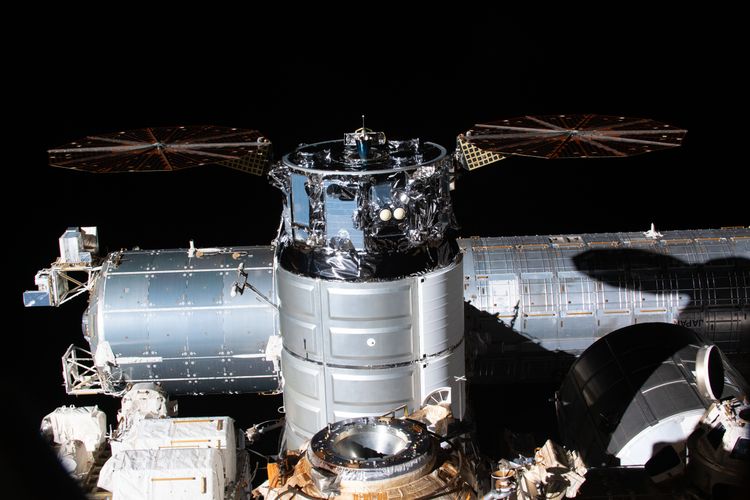
Cygnus NG-17 docked with the ISS. Credit: NASA

After Rogozin’s threat concerning the required boosts, the US said little, other than noting Progress was not the only option for raising the station’s orbit. In particular, there are two other vehicles with the propulsive capabilities able to perform the task: the Japanese Kounotori HII Transfer vehicle and the American Cygnus craft.

The latter of these performed a proof-of-concept attempt, raising the station’s orbit by 90 metres, but given the use of Progress, nothing further was tried. So, in the light of Rogozin’s comments, and with Cygnus NG-17 docked with the ISS (it had arrived in February 2022), NASA decided to use the vehicle to carry out a required ISS orbital boost.

The first attempt to do so was made on June 20th, but a data hiccup caused the Cygnus vehicle’s motor to cut after just 5 seconds. A further attempt was made on June 25th, with a 301-second engine burn raised the station’s perigee by 0.8 km and apogee by 0.2 km. With the move a success, NG-17 – called Piers Sellers in memory of the Anglo-American astronaut who passed away in 2016 – departed the station on June 28th, loaded with trash and waste from the ISS and performed a controlled re-entry into the denser atmosphere to burn up.

Space Sunday: SLS, satellites and a rover

The Artemis 1 Orion MPCV and its European Space Agency service module sit atop the first NASA Space Launch System (SLS) on Pad 39B at Kennedy Space Centre, a full Moon framed between the vehicle and one of the pad’s lightning towers. Credit: NASA

NASA’s Space Launch System (SLS) has finally cleared the last significant hurdle in the preparations to launch the first of the vehicles on its much anticipated lunar flight.

On Friday, June 24th, agency officials declared the test campaign for the maiden vehicle to be almost complete after it finally cleared the critical wet dress rehearsal (WDR) test on a fourth attempt – the first three in May each ending with issues that forced NASA to roll the vehicle and its mobile launch platform back to the Vehicle Assembly Building (VAB) at Kennedy Space Centre, Florida, so both could receive modifications.

The final dress rehearsal started on June 20th, and concluded 20 seconds early due to a leak in a hydrogen bleed line. While this did not compromise the test itself, it did prevent 13 of the planned 128 command functions from being performed as a result. Most of these had been previously tested, so the curtailing any testing of them during the WDR was not seen as cause for concern.

However, mission managers opted to perform one additional test prior to rolling the vehicle back to the VAB for final inspections and launch preparations. This will be a test of hydraulic power units used to gimble the nozzles of the vehicle’s solid rocket boosters to provide directional guidance while the boosters are firing. One it has been completed, the roll-back to the VAB will be carried out on July 1st.

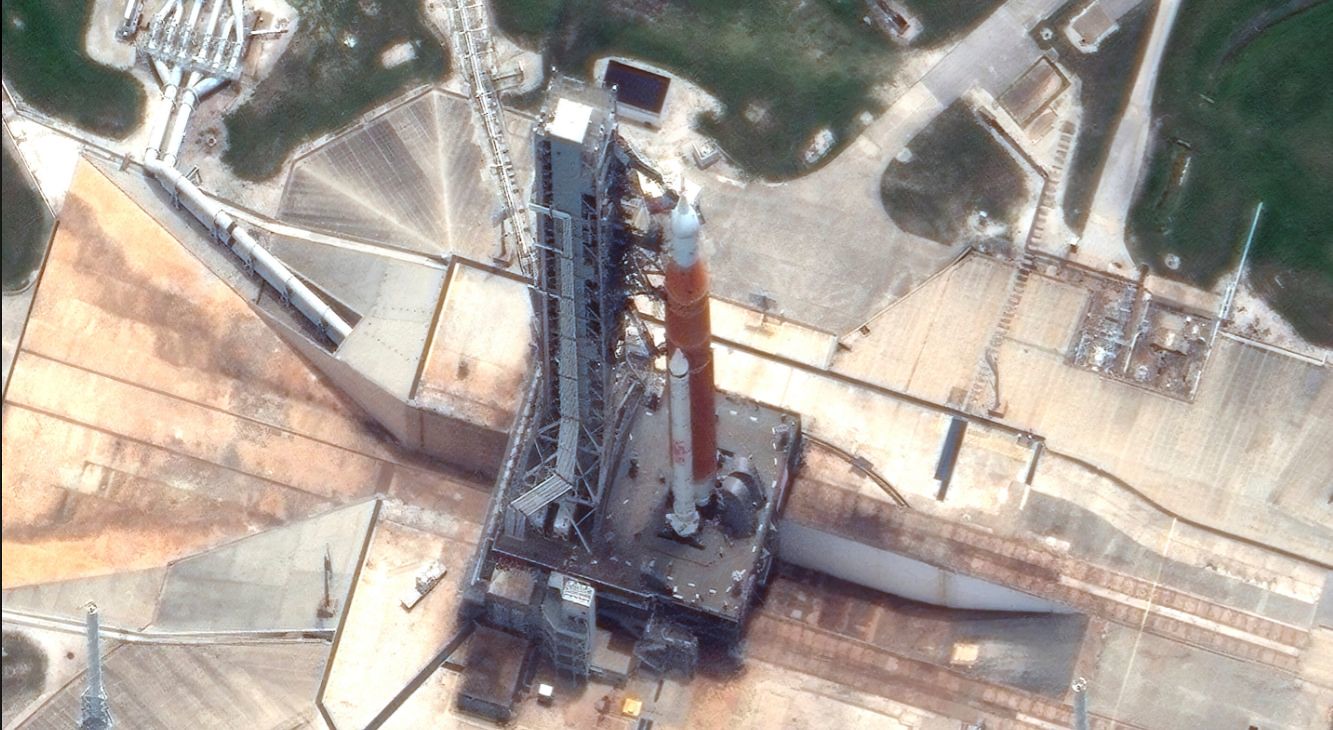
The Artemis 1 SLS vehicle sitting on its mobile launcher at Pad 39B, Kennedy Space Centre, imaged from orbit on June 18th, 2022 by a Maxar Earth observation satellite. Credit: Maxar Technologies

At the VAB, the vehicle and its launch platform will undergo a final post-WDR inspection, which will include replacing the seal responsible for the hydrogen leak. It’s expected that overall, the final check-out plus any required work will run through until early August. Providing nothing serious is found, the vehicle will be rolled back to the pad to commence 10-14 days final launch preparations. This will be in time to meet two immediate launch windows: August 23rd through September 6th (excluding the period August 31st-September 1st) and September 19th through October 4th, 2022.

The Artemis 1 mission is designed to fly an uncrewed Orion Multi-Purpose Crew Vehicle (MPCV) on 20+ day mission to cislunar space including 6 days in lunar orbit. It will be a preliminary check-out of Orion’s life support, propulsion, guidance and communications systems during an extended mission, prior to repeating the flight with a crew on board with Artemis 2.

CAPSTONE

On Monday, June 27th, NASA will be launching another mission to cislunar space.

The Cislunar Autonomous Positioning System Technology Operations and Navigation Experiment (CAPSTONE), is a 25 kg cubesat the size of a microwave oven designed to study what is called a lunar near-rectilinear halo orbit (NRHO) – an extended elliptical orbit around the Moon that will bring the satellite to within 1,600 km of the lunar surface before lifting it away to up to 70,000 km. It is a similar orbit to the one that will be used by NASA’s planned Lunar Gateway station.

While extreme, such an orbit allows for continuous communications with Earth and allows for extensive study of the Moon. When placed in a similar orbit, Gateway will allow astronauts to reach almost any point on the lunar surface using suitable landing systems.

The CAPSTONE cubesat sitting on an engineering bench during testing of its solar arrays. Credit: NASA / Dominic Hart

CAPSTONE is due to be launched from New Zealand aboard a Rocket Labs Electron rocket at 10:00 UTC om Monday, June 27th, 2022. As the Electron is not capable of delivering CAPSTONE directly to the Moon, it will use the company’s Photon kick stage to push the cubesat into an extended 4-month flight to the Moon, where it will enter orbit on October 15th. The extended, slow flight will allow CAPSTONE to carry out a range of tests prior to reaching the Moon and is not reflective of the kind of transit time crewed flights will require to reach lunar NRHO (5-10 days).

Once in orbit around the Moon, CAPSTONE will spend a further 6-months studying the NRHO environment around the Moon and in communication tests both with Earth and with NASA’s Lunar Reconnaissance Orbiter, which has been orbiting the moon since 2009.

SpaceX Triple Header with a Touch of Mystery

SpaceX carried out three near “back-to-back” launches over the weekend of June 17th-19th, albeit from different launch complexes:

  • On Friday, June 17th, a Falcon 9 lifted-off from Pad 39A at Kennedy Space Centre, carrying aloft the company’s latest batch of Starlink satellites for deployment.
  • On Saturday, June 18th, a Falcon 9 lifted the SARah-1 radar imaging satellite to orbit on behalf of the German military, after lifting-off from Space Launch Complex 4E at Vandenberg Space Force Base in California.
  • On Sunday, 19th, the third launch lifted-off from Space Launch Complex 40 at Cape Canaveral Space Force Station in Florida, ostensibly to place the commercial Globalstar FM15 into a “parking” orbit as a back-up for the company.
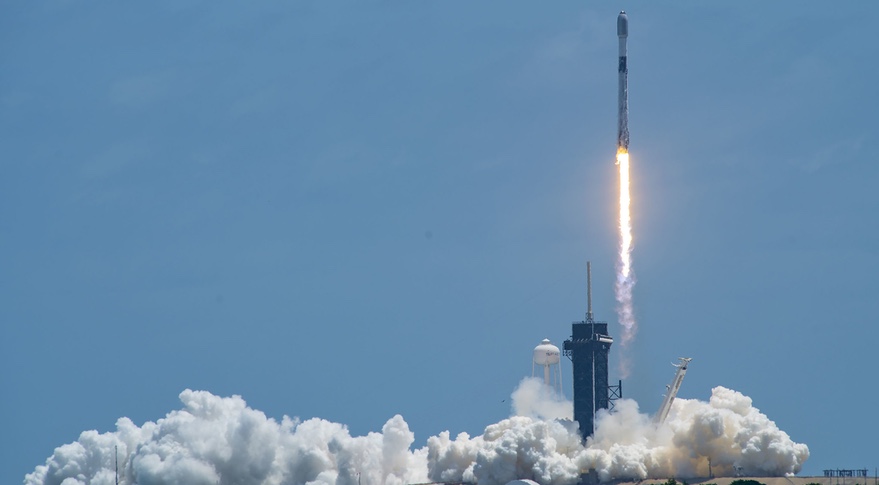
A Falcon 9 lifts off June 17 carrying a batch of Starlink satellites, the first of three launches SpaceX performed over a little more than 36 hours. Credit: SpaceX

While all three saw the successful return and landing of the Falcon 9 first stage of each booster, the June 19th mission has raised eyebrows due to the apparent secrecy around it. The Globalstar FM15 is a relatively small satellite – just 700 kg – which should have allowed the Falcon first stage to return to the SpaceX landing zone at Canaveral; instead it landed on a drone ship at sea, suggesting it was flying a heavier payload that required greater thrust to push it to orbit.

SpaceX also did not cover the launch with anything like the kind of live streaming they generally put out for their launches; what footage that was put out suggested the vehicle was carrying an additional payload adaptor, hinting at a further payload – although nothing has been said to confirm or deny this.

Continue reading “Space Sunday: SLS, satellites and a rover”