Space Sunday: JWST, Artemis, DKIST and starship

Caught by the NIRCam on the James Webb Space Telescope, this image reveals the details at the very heart of 30 Doradus. Credit: NASA / ESA

The above image is of a region of space officially called 30 Doradus, located in the south-east corner (from Earth’s perspective) of the Large Magellanic Cloud (LMC), one of the “satellite” galaxies to our own.

Known more familiarly as the Tarantula Nebula, the region has long been a subject for study by astronomers as it is the largest and brightest star-forming group in our local group of galaxies. Its popular name originates in the way the dusty filaments within it suggest the web found within the holes of burrowing tarantulas, the black “holes” within the suggesting the spider lying in wait in its hide, ready to pounce on any prey passing by.

Even though it and other nebulae have been imaged many times over the years, the Tarantula and its cousins still contain many secrets about the processes involved in the formation of stars. As such, they remain targets of considerable interest to astronomers, and the these images, captured by the Near-Infrared Camera (NIRCam) and processed by the Near-Infrared Spectrograph (NIRSpec), and also by the Mid-infrared Instrument (MIRI) on the James Webb Space Telescope (JWST), reveal the Tarantula Nebula in never-before seen details.

A mosaic view of 30 Doradus, assembled from Hubble Space Telescope photos, The focus of the JWST image is the smaller of the two dark areas within the nebula. Credit: NASA, ESA, ESO.

Visible in depth for the very first time are thousands of young stars, distant background galaxies, and the detailed structure of the nebula’s gas and dust formations as they are pushed, pulled and twisted by the solar winds within the nebula. Such is the unprecedented power of Webb’s imaging systems; it was even able to capture one young star in the act of shedding a cloud of dust from around itself, dust which may eventually form one or more planets orbiting the star.

Processing of the images by (NIRCam), combined with the NIRSpec data show that the cavity at the centre of the nebula is the result of powerful solar winds radiating outwards from a cluster of massive young stars, which appear as pale blue dots.

Only the densest surrounding areas of the nebula resist erosion by these stars’ powerful stellar winds, forming pillars that appear to point back toward the cluster. These pillars contain forming protostars, which will eventually emerge from their dusty cocoons and take their turn shaping the nebula.

– Part of a statement on the Tarantula Nebula image by the JWST imaging team

This image is one of the most recent to the published from the cache JWST has already gathered and transmitted back to Earth – but it is not among the more recent to be received. Ironically, despite its beauty, it was one of those received following the telescope completing its commissioning and starting formal science operations. However, it was passed over as one of the images to be selected for the very first release of JWST images back in July on the ground NASA / ESA had “more interesting” subjects to be included in the initial release and press conference!

Artemis Update

Following the September 3rd launch attempt scrub for the Artmis-1 mission, featuring NASA’s new Space Launch System, engineers have been hard at work. The scrub was the result of a significant liquid hydrogen leak during the propellant loading process, and following the scrub, it was unclear as to whether the rocket would be rolled back to the Vehicle Assembly Building (VAB) for repairs or an attempt would be made to fix matters on the pad.

On September 6th, the decision was made to try the latter, and would focus on replacing the seal on the 20-cm liquid hydrogen feed within the quick disconnect system that connects the propellant feeds from the mobile launch platform to the rocket. Work on replacing the seal commenced on September 8th, and was successfully concluded on September 9th.
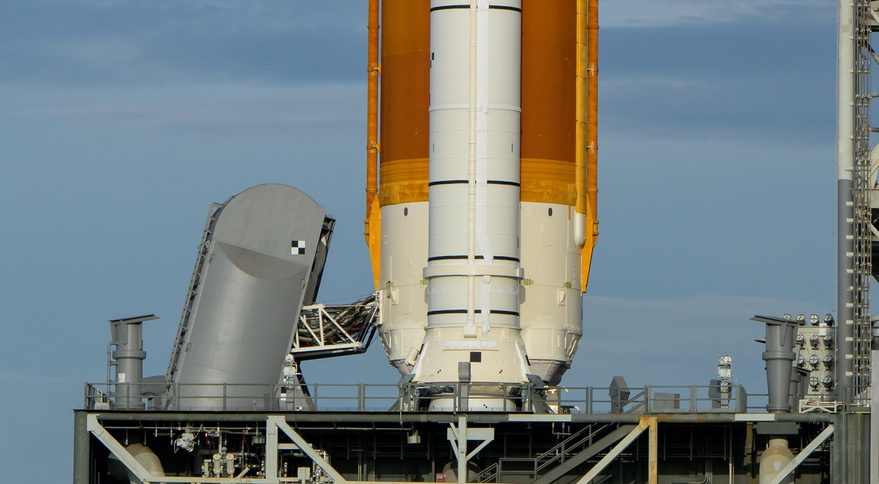
The Base of the Artemis 1 SLS rocket on the mobile launch platform at Pad-39B,  Kennedy Space Centre. To the left is the quick disconnect system with its protective rocker cover. It was the seals at the end of the pipes connecting this to the rocket which failed to prevent liquid hydrogen leaks during propellant loading. Credit: NASA

At the same time, a smaller 10-cm bleed valve located between the rocket’s core and upper stage was also replaced as a precautionary repair; this valve refused to obey ground instructions when engineers were trying to use an overpressure of the liquid hydrogen pipe to try and force the feed seal to work. With both repairs successfully completed, NASA looked towards possible dates for a third launch attempt, settling on either September 23rd or September 27th.However, these are dependent on a couple of significant requirements.

The first is a fuelling test designed to ensure the propellant feeds are now working correctly, and will involve loading both liquid hydrogen and liquid oxygen in a revised propellant loading process. This will take place on September 17th and will involve loading the tanks of both the core stage and the upper stage of the SLS. This test will also be used to perform a “kick-start bleed test” on the SLS rocket’s four main engines. That test is designed to chill the engines down to a temperature of -251º Celsius) to prepare them for their super-chilled propellant during a launch.

The second requirement is the granting of a waiver by the U.S. Space Force for the vehicle’s flight termination system (FTS). This is the package designed to destroy the rocket if it veers off course during launch. Powered by batteries, the FTS needs periodic checks, and the current certification period ended on September 6th. Therefore is the USSF do not agree to a waiver, the SLS will need to be rolled back to the Vehicle Assembly Building in order for the FTS packages to be inspected, and possibly replaced; all of which would mean missing the September launch dates.
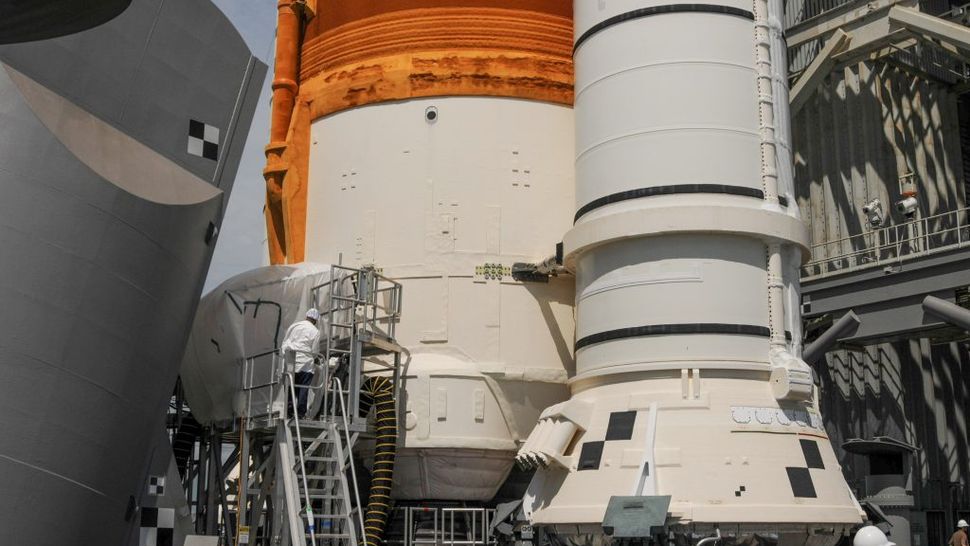
A close-up of the base of the SLS rocket, showing engineers working on the quick disconnect system, demonstrating the sheer scale of the rocker and its boosters. Credit: NASA

If Artemis 1 were to launch on September 23rd, it will be on a so-called “short class” mission lasting 26 days, with splashdown on October 18th. However, if the 27th launch date is used, it would mark a “long class” mission, with splashdown not occurring until November 5th for total mission duration of 41 days.

Prior to the repair attempt on the Artemis 1 SLS, NASA announced the contract for the Artemis space suits due to be used with the Artemis 3 mission and the first lunar landing for the programme.

As I’ve previously noted, the development of an entirely new space suit NASA could use to replace the current suits – themselves based on the Apollo design – started in 2007. however, development was riddled with issues to the point where even after a “final” design was announced, NASA’s own Office of Inspector General (OIG) rated it as unsuitable and unlikely to be ready for the then-planned 2025 lunar landing of Artemis 3 (see: Space Sunday: Mars, Starliner woes, accusations & spacesuits).

Because of this, earlier in 2022, NASA turned to Axiom Space – who are already engaged in space station activities; and to Collins Aerospace + ILC Dover – a team that has decades of experience with the current EVA suits used by NASA – and offered them the opportunity to put forward initial designs for a new EVA suit,  with potential to gain a US $3.4 billion contract to supply NASA with suits through until 2035.

That contract has now – somewhat surprisingly, given the track record Collins / ILC Collins have in space suit design – gone to Axiom, who will supply NASA with a “moonwalking system” of suits and support systems to be used as a part of the Artemis programme, starting with Artemis 3. Neither NASA nor Axiom have been particularly forthcoming as to why the latter was chosen, and few details on their suit – outside of a partial image and the idea that it will be “evolvable”  – have been provided.
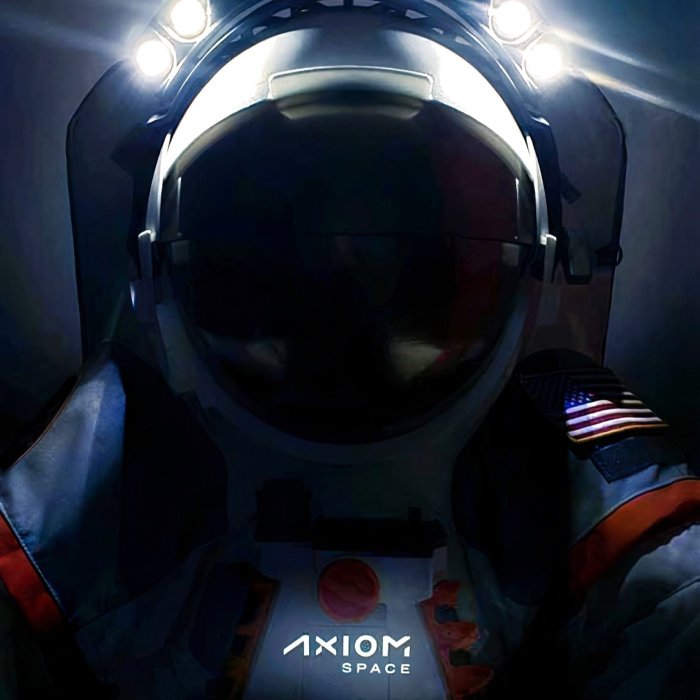
The only image available of the new lunar space suit to be developed by Axiom Space for NASA. Credit: Axiom Space

By contrast, and prior to the announcement, Collins / ILC Denver presented concepts of their suit designs, and opened a new facility for suit development and construction on August 31st.

However, documentation suggests that pricing has been a major consideration: Axiom’s pricing is said to have been some 23% below NASA’s cost estimate for suit development, and Collins / ILC Dover’s pricing was just 2% below the estimate – which may actually reflect a more realistic estimate for suit development.

Continue reading “Space Sunday: JWST, Artemis, DKIST and starship”

Space Sunday: equations and launch scrubs

Dr. Frank Drake and his equation

Anyone with a reasonable interest in astronomy will recognise the above image as containing the Drake Equation, sometimes referred to as “the second most famous equation after E=Mc2

It was first proposed in 1961 by American astronomer and astronomer and astrophysicist Dr. Frank Drake as a probabilistic argument to estimate the number of active, communicative extraterrestrial civilisations in the Milky Way Galaxy. Its values are defined as:

N = the number of civilisations in our galaxy with which communication might be possible (i.e. which are on our current past light cone);

And:

R = the average rate of star formation in our Galaxy.

fp = the fraction of those stars that have planets.

ne = the average number of planets that can potentially support life per star that has planets.

fl = the fraction of planets that could support life that actually develop life at some point.

fi = the fraction of planets with life that actually go on to develop intelligent life (civilisations).

fc = the fraction of civilisations that develop a technology that releases detectable signs of their existence into space.

L = the length of time for which such civilizations release detectable signals into space.

In the decades since its initial publication, the Drake Equation has been widely critiqued by astronomers and mathematicians because the estimated values for several of its factors are highly conjectural  such being that the uncertainty associated with any of them so large, the equation cannot be used to draw firm conclusions.

However, these critiques actually miss the point behind Drake formulating the equation in the first place, because he was not attempting to quantify the number of extra-solar civilisations which might exist, but rather as a way to stimulate scientific dialogue about what had been very much looked upon as an outlier of research, and to help formulate constructive discussion on what is regarded on the first formalised discussion on the search for extra-terrestrial intelligence (SETI), as he noted in his memoirs:

As I planned the meeting, I realised a few day[s] ahead of time we needed an agenda. And so I wrote down all the things you needed to know to predict how hard it’s going to be to detect extra-terrestrial life. And looking at them it became pretty evident that if you multiplied all these together, you got a number, N, which is the number of detectable civilizations in our galaxy. This was aimed at the radio search, and not to search for primordial or primitive life forms.

– Frank Drake

Frank Drake not only hosted the first US meeting to discuss the potential for seeking signs of possible extra-terrestrial civilisations, he pioneered several of the earliest attempts to seek any such signals as demonstrating methods that might be used as a means to intentionally communicate our existence to other civilisations within the galaxy. As such, his work did much to put our speculative thinking about intelligences elsewhere in the galaxy on a solid foundation of scientific research, as will as being responsible for some for the foremost research in the field of modern radio astronomy.

This is his story.

Born in Chicago on May 28th, 1930, Frank Drake was drawn to the sciences and to electronics from an early age, and in order to further his education in both, he enlisted in the US Navy Reserve Officer Training Corps (ROTC).  This allowed him to obtain a scholarship at the prestigious Cornell University, ostensibly to obtain qualifications in electronics, but also study astronomy.

While at Cornell, Drake’s astronomy class were able to attend a lecture by astrophysicist Otto Struve. While his name may not be instantly recognised, Struve was one of the most distinguished astronomers of the mid-20th century, a member of a generational family of astronomers stretching by to the 18th century and Friedrich Georg Wilhelm von Struve. He was also one of the first astronomers to openly promote radio astronomy as a key to determining whether there might be other intelligences living in our galaxy – an idea his contemporaries tolerated, rather than embraced.

Struve’s presentation positively affected Drake, and following his required 1-year military service following graduation in 1951 (served as the Electronics Officer aboard the cruiser USS Albany), Drake enrolled at Harvard University, where gained his doctorate in astronomy, with a focus on radio astronomy.

Frank Drake in one of his official portraits at Green Bank observatory (1962). Credit: Green Bank

In 1956 Otto Struve was appointed as the first director of the National Radio Astronomy Observatory (NRAO)), and he started overseeing the establishment of a number of national radio astronomy centres across the United States. One of these was at Green Bank, Virginia, a facility Drake joined as a researcher in 1958. His initial work here started with the static arrays at Green Bank, carrying out the first ever mapping of the centre of the Milky Way galaxy, and the discovering that Jupiter has both an ionosphere and magnetosphere.

However, Struve was keen to enhance the facilities with steerable radio dishes, and to this end purchased an “off-the-shelf” 26 m dish and had engineer Edward Tatel (for whom it was later named) design a motorised mount for it so it could be pointed around the sky. This work was completed in 1959, and Struve turned to Drake to formulate the telescope’s first science mission.

At the time, Drake had just read an intriguing article in Nature magazine entitled Searching for Interstellar Communications. Within it, physicists Giuseppe Cocconi and Philip Morrison proposed using a large radio dish to monitor “incoming” radiation from stars along the 21-cm / 1,420.4 MHz wavelength – the radio frequency used by neutral hydrogen.  Given this is the most common element in the universe, Cocconi and Morrison speculated it would be logical landmark in the radio spectrum to manipulate as a message carrier.

Taking this idea, Drake developed Project Ozma, a three-month programme run at the start of 1960 to listen for any signals coming from the vicinity of either Tau Ceti or Epsilon Eridani. At the time, no-one knew if either star fielded planets (although both were found have at least one planet orbiting them almost 50 years after Drake’s experiment).

Frank Drake in front of the 85-1 (Tatel) Telescope. the first steerable telescope built at NRO Green Bank (and now one of 3 such telescopes, collectively referred to as the Green Bank Interferometer), used in Drake’s first SETI experiment, Project Ozma. Credit: NRAO Green Bank

Following Ozma, Drake was encouraged to formalise SETI research into a more co-ordinated effort (various programmes, such as Ohio State University’s work using the Big Ear telescope, were already in existence but without any real coordination). To this end, he helped put together the first small-scale meeting / conference on the subject in 1961 – the event at which he used his equation to  stimulate the discussion.

Among those attending were Otto Struve (now retired), Phillip Morrison, astronomers Carl Sagan and Su-Shu Huang, chemist Melvin Calvin, neuroscientist John C. Lilly, and inventor Barney Oliver. Together they called themselves The Order of the Dolphin (due to  Lilly’s work on dolphin communications), and together they laid the groundwork for a systematic approach to SETI research, which over the coming years would in turn give birth to numerous programmes, and more fully legitimise such research within scientific circles.

In the mid-1960s, and still based at Green Bank, Drake was nominated to spearhead converting the massive Arecibo Ionosphere Observatory  – originally built as a project to study the Earth’s ionosphere as a means of detecting nuclear warheads inbound towards the United States – into what would become more famously known as the Arecibo Observatory, for several decades the largest radio telescope in the world.

This work finished in 1969 when the National Science Foundation formally took over the Arecibo faculties, and two years later Drake was approached by Carl Sagan with another intriguing proposal. Sagan had himself been approached English journalist Eric Burgess – who at the time was writing about the upcoming NASA Pioneer 10 and Pioneer 11  missions – about the idea of sending a physical message out to the stars.

Continue reading “Space Sunday: equations and launch scrubs”

Space Sunday: “we are go for launch” – Artemis 1 on the pad

Backlit by the setting Sun illuminating rainclouds, NASA’s Artemis-1 Space Launch System rocket sits on launch pad £9B at NASA’s Kennedy Space Centre, August 26th, 2022. Credit: ESA

If all continues on track, Monday, August 29th, 2022 will mark the start of America’s return to the Moon with crewed missions, just a few months shy of the 50th anniversary of the last crewed mission, Apollo 17 (December 7th-19th, 1972). It will come with the lift-off of the Artemis 1 mission, and the maiden flight of NASA’s new heavy lift launcher, the Space Launch System.

The mission will be – as most no doubtless know only too well – uncrewed, and the destination not the lunar surface, but cislunar space in what will be the most comprehensive test of the SLS rocket and the Orion Multi-Purpose Crew Vehicle (MPCV) ahead of crewed flights, which are due to commence with Artemis 2.

The final countdown for the launch commenced on Saturday, August 27th at launch pad 39B within the Kennedy Space Centre, Florida, and providing no significant hitches occur, it is due to terminate at 12:33 UTC on August 29th with the ignition of the booster’s four RS-25 shuttle-derived motors and two massive solid rocket boosters (also derived from those used in the space shuttle programme). At the time of writing this piece, and despite a thunderstorm leading to a lighting strike at the launch facility on the evening of August 27th, everything was on course for the launch, and the forecast indicated a 70% likelihood that the weather at Cape Canaveral and downrange from the launch pad would be good for the launch.

Artemis 1 SLS in Pad 39B at Kennedy Space Centre, imaged from orbit by one of the Maxar constellation of Earth-imaging satellites on August 25th, 2022. Credit: Maxar Technologies

However, all things are not guaranteed, and the mission has a slim 2-hour launch window in which to get off the pad. Should the launch have to be scrubbed for any reason, further launch windows will be available on September 2nd (2 hours), and September 5th (90 minutes).

There is a lot riding on this mission; while Orion has already flown once in space – eight years ago in the uncrewed Exploration Flight Test-1, launched atop a Delta IV Heavy rocket – this will be the first flight of the vehicle outside of directly orbiting the Earth; however, for SLS, the mission could very much be make-or-break. The vehicle has been beset by issues throughout its development programme (many of which amounted to either unforced errors or came as a result of the entire Artemis programme being unduly accelerated by the Trump Administration to achieve a crewed landing by 2024 rather than 2028, as originally planned. As such any major or catastrophic failure could have major repercussions for NASA and the US government space programme.

SLS has been more than two decades in development. It started life in the early 2000s as the Ares V under NASA’s Constellation programme. Instigated by the then NASA administrator Michael Griffin, Ares 5 was to be the heavy-lift launch vehicle intended to help return humans to the Moon and (eventually / primarily) help pave the way to Mars, working alongside the smaller Ares 1 crew launch vehicle and what was then called the Orion Crew Exploration Vehicle (CEV). I say “primarily”, because Griffin was a strong advocate of human missions to Mars and the Ares programme was actually named for (and pretty much lifted from) the Mars Direct humans-to-Mars concept first proposed by Robert Zubrin and David Baker  in 1990.

Despite enormous strides made in the development of Ares 1 (the first of which actually few in 2009) and the Orion CEV, the Obama administration opted to scrap the constellation programme on the grounds of cost. While Ares 1 went away in its entirety, Orion and Ares V underwent a redesign process, the former having its capabilities increased, whist Ares V went back to the drawing board to later emerge as the SLS.

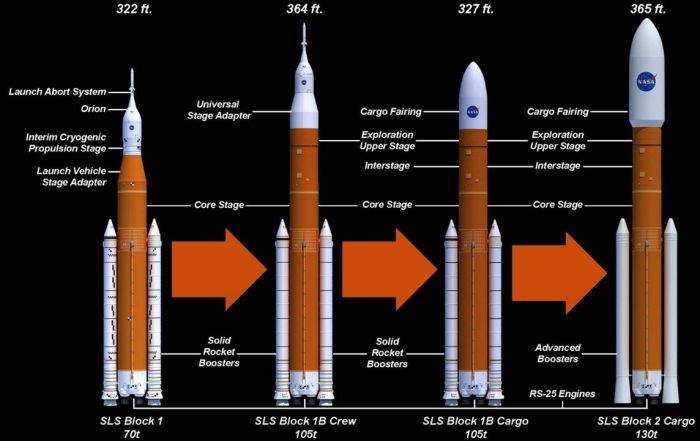
SLS development: on the left, the Block 1 with ICPS that will fly Artemis Mission 1-3.  Centre left: the Black 1B  EUS crew variant to flay Artemis 4-5(+). One the right, the proposed Block 1B and Block 2 cargo variants, that latter of which most closely resembles the Ares V Credit: NASA

The key differences between Ares V and SLS is the former was intended to be a heavy-lift cargo launcher, capable of delivering up to 168 tonnes to low-Earth orbit (LEO), up to 71 tonnes to lunar orbit and around 60 tonnes to Mars, with Ares 1 left to carry crews up to orbit. SLS, on the other hand is intended to be both a crewed and cargo launch vehicle, capable of delivering between 95 and 130 tonnes to LEO depending on the vehicle type, or some 46 tonnes to lunar orbit (Block 2 cargo) and 30-40 tonnes to Mars (Block 2 cargo).

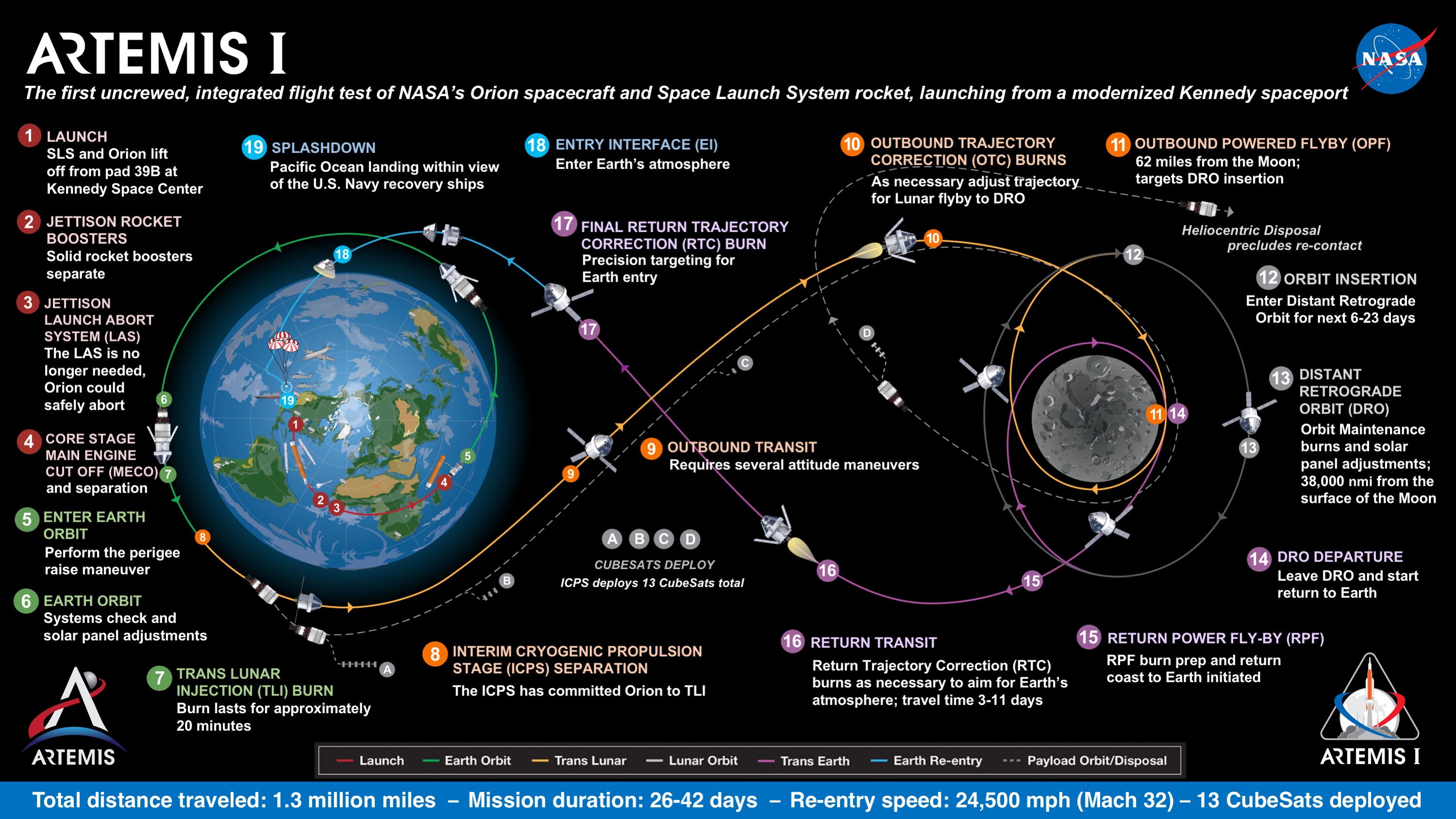
The primary objectives for Artemis 1 are to prove the SLS launch system’s Block 1 launch capabilities; achieve a distant retrograde orbit (DRO) around the Moon, and make a safe return to Earth with a successful atmospheric re-entry and splashdown by the Orion MPCV capsule. The overall mission duration is expected to be some 42 days.

This first flight – which will also mark the first use of the European-built Orion service module (Orion’s flight in 2014 didn’t require a service module) – is to be one of only three launches of the SLS Block 1 rocket. This uses what is called the  Interim Cryogenic Propulsion Stage (ICPS) – essentially the upper stage of a Delta IV rocket. From Artemis 4 onwards, launches will use the more powerful Exploration Upper Stage (EUS) in what is termed the Block 1B SLS variant, and which will also be used in the Block 2 cargo variant (if this eventually flies).

The ICPS will be used to insert Orion into its trajectory to the Moon prior to separating from the capsule and its service module and performing one further crucial mission task. It will then pretty much parallel Orion to the Moon before using the latter’s gravity to slingshot itself away into a highly elliptical orbit of its own.

The flight of Artemis 1 as depicted in the mission’s Press Pack. The mission phase durations are variable to account for the different possible launch dates at the time the pack was published. Credit: NASA (click for full size)

As well as being used to check-out SLS and Orion, Artemis 1 has a number of science goals, and the Orion MPCV is not the only payload for the mission. Shortly after Orion separates from the ICPS, the latter – in that other crucial aspect of the mission mentioned above – will deploy multiple cubesats on trajectories to the Moon. These will carry out an range of scientific tasks, including:

  • Detecting, measuring, and comparing the impact of deep space radiation on living organisms (yeast in this instance) over long durations.
  • Studying the dynamic particles and magnetic fields that stream from the Sun and as a proof of concept for the feasibility of a network of stations to track space weather.
  • Imaging Earth’s plasmasphere to study the radiation environment around the Earth.
  • Searching for additional evidence of lunar water ice from a low lunar orbit.
  • Mapping hydrogen within craters near the lunar south pole, tracking depth and distribution of hydrogen-rich compounds like water over a 60-day, 141 lunar orbit mission.
  • Flying by the Moon to collect surface spectroscopy and thermograph and return the results to Earth for analysis.

In addition, some of the cubesat missions will be technology demonstrators, including a further solar sail demonstrator; using very small automated vehicles to operate in close proximity to large vehicles and image them / look for potential damage; using small, low thrust gas motors for trajectory control in the space between Earth and the Moon.

Nor is that all; Orion itself will be carrying a number of experiments within the capsule, with a focus on gaining a better understanding of the radiation regime between the Earth and Moon and within cislunar space.

The most evident of the onboard experiments is “Commander Moonikin Campos”, a mannequin dressed in the Orion Crew Survival System Suit. Sharing (OCSSS).  Sharing same iconic orange colour as the survival suits used on shuttle missions, the OCSSS is a much more advanced version, designed to be worn continuously for periods of up to 6 days at a time (so whilst en route to the Moon, whilst in lunar orbit and during a return to Earth), to offer enhanced radiation protection for the wearer whilst aboard Orion. To this end the mannequin – named for Apollo 13 electrical subsystems engineer Arturo Campos, who played a major role in bringing that crew back to Earth alive – is equipped with a plethora of radiation sensors to test the effectiveness of the suit.

Continue reading “Space Sunday: “we are go for launch” – Artemis 1 on the pad”

Space Sunday: Voyager at 45

Voyager: 45 years on. Credit: NASA

August and September 2022 mark the 45th anniversaries of the launches of Voyager 1 and Voyager 2, NASA’s twin interplanetary – and now interstellar – explorers.

Designed to take advantages of a planetary alignment which occurs once every 176 years, allowing the use the gravities of one of the outer planets to “slingshot” a vehicle on to the next, the two Voyager mission vehicles remain in operation today, and continue to stand at the forefront of our understanding of the local space surrounding our solar system.

Voyager 1 continues to set records as the furthest man-made object from Earth – it is now over 23.3 billion kilometres away – whilst Voyager 2 remains famous for giving us our first detailed views of Uranus and Neptune during its 20-year voyage through the outer solar system.

Products of the 1970s, the Voyager craft stand as museum pieces by today’s standards. Each has around 23 million times less memory than a modern cellphone, their communications systems can only transmit and receive data some 38,000 times slower than a modern cellular network, and they record the data they gather on an 8-track tape recorder prior to transmitting it back to Earth. Nevertheless, the amount of knowledge they have gathered and returned to us about the outer reaches of the solar system, the heliosphere (the bubble of space around the Sun in which the solar system resides), the heliopause (the boundary between that Sun-dominated “bubble” and the galaxy at large) and the realm of interstellar space beyond that bubble.

Operated by NASA’s Jet Propulsion Laboratory (JPL), the Voyager craft were launched in reverse order, with Voyager 2 lifting-off on August 20th, 1977 and Voyager 1 following on September 5th, 1977. The reason for this ordering was simple: during the development of the mission, Saturn’s moon Titan, known to have an atmosphere, was identified as a primary target for fly-by investigation, and so was assigned to Voyager 1.

Animation of Voyager 1’s trajectory around Jupiter: Pink – Voyager 1; Light Blue · Jupiter; Red · Io; Dark Blue -Europa; Yellow – Ganymede; Green · Callisto. Credit: Phoenix777

However, in order to reach the moon, the vehicle would have to follow a course that would carry it over Saturn’s northern reaches, and throw it “down” and out of the plane of the ecliptic and away from any chance of reaching the outer planets. Instead, Voyager 2 was tasked with completing the “grand tour” of the major planets – Jupiter, Saturn, Uranus and Neptune, and in order to achieve this, it would have to be launched first.

Even so, thanks to the nature of orbital mechanics requiring Voyager 2 to be thrown out on a more circular, “indirect” path towards Jupiter whilst Voyager 1 could be launched more directly towards Jupiter meant it could reach the gas giant first, arriving in January 1979, having “overtaken” Voyager 2 in December 1977. . Its passage through the Jovian system revolutionised our appreciation of the Galilean moons of the system, after which it travelled on to its November 1980 encounter with Saturn and then Titan.

Voyager 2’s more circular trajectory meant it did not reach Jupiter until July 1979, six months behind Voyager 1, but its route allowed it to make a much closer fly-by of Europa, the ice-covered Galilean moon, giving scientists the first hint of the nature of the mechanisms at work deep within the moon.

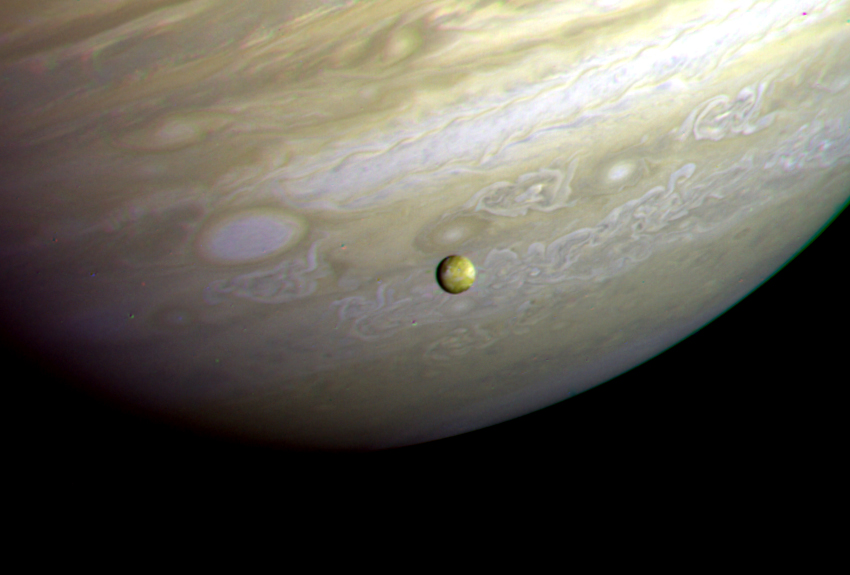
A transit of Io across Jupiter as imaged by Voyager 2 in July 2022. Credit: NASA/JPL

From here the vehicle journeyed on to an August 1981 encounter with Saturn and then Uranus in 1986 and then Neptune in August 1989, whilst Voyager 1 continued onwards toward the heliopause, all of which I covered in  Space Sunday: Voyager at 40.

In 2010, Voyager 1 commenced a two-year transition from the space dominated by the Sun and its outward flow of radiation, and the realm of interstellar space. The first indications that it was beyond the influence of the Sun’s radiation came in later 2012 – although it was not until March 2013 that this was empirically confirmed through analysis of multiple data returned by the vehicle.

Voyager 2 commenced its voyage through the heliopause in 2013; however, as it was still travelling within the plane of the ecliptic, it was effectively travelling through a “thicker” part of the “bubble wall” of the heliosphere, so it did not enter interstellar space until November 2018.

Even so, and possibly confusingly, neither craft have actually departed the solar system per se. This is because the “size” of the solar system is measured in two ways: the influence of the Sun’s outward flow of radiation and by the influence of its. Despite having passed through the former, both craft are sill within space affected by the latter, and neither will reach the Oort Cloud – the source region of long-period comets and seen as marking the outer limits of the Sun’s gravitational influence – for another 300 years.

As such, both of the nuclear-powered vehicles are now engaged in a multi-vehicle mission (having been joined in it by the likes of the New Horizons spacecraft, the Parker Solar Probe and others) referred to as the Heliophysics Mission.

The Heliophysics Mission fleet provides invaluable insights into our Sun, from understanding the corona or the outermost part of the sun’s atmosphere, to examining the sun’s impacts throughout the solar system, including here on Earth, in our atmosphere, and on into interstellar space. Over the last 45 years, the Voyager missions have been integral in providing this knowledge and have helped change our understanding of the sun and its influence in ways no other spacecraft can.

– Nicola Fox, director of the NASA’s Heliophysics Division

Voyager 2 left the heliosphere on November 5, 2018. Credit NASA/JPL
Today, as both Voyagers explore interstellar space, they are providing humanity with observations of uncharted territory. This is the first time we’ve been able to directly study how a star, our sun, interacts with the particles and magnetic fields outside our heliosphere, helping scientists understand the local neighbourhood between the stars, upending some of the theories about this region, and providing key information for future missions.

– Linda Spilker, Voyager’s deputy project scientist at JPL

Continue reading “Space Sunday: Voyager at 45”

Space Sunday: Curiosity’s 10th, and motors for rockets

Ten years ago, on August 6th, 2012, the world held its breath as a capsule the size of a small truck slammed into the Martian atmosphere at the start of 7-minute descent referred to as the “seven minutes from hell”.
It would either end with the extraordinary sight (had we been able to see it) with a rocket-propelled platform hovering just metres above the surface of the planet as it gently winched a rover the size of an SUV to the floor of Gale Crater – or in a fresh new crater within the crater.

Fortunately, the former was the case, marking the true start of the Mars Science Laboratory (MSL) mission on Mars, an attempt to seek evidence that, billions of years ago, Mars had the conditions needed to support microscopic life. Coincidentally, it marked the start of the column that would morph into Space Sunday.

Since that heady day, the rover – called Curiosity – has clocked up some impressive statistics, including:

  • Achieving its primary mission objective – to discover whether Mars had the conditions under which life may have arisen – within its initial 90-day mission period.
  • Driving almost 29 kilometres around Gale Crater.
  • Ascending 625 metres above the floor of the crater.
  • Analysing 41 rock and soil samples using its onboard suite of science instruments, furthering our understanding about Mars.
  • Providing huge insights into the Martian climate and weather.
  • Being so successful, it has seen its mission initially extended to its full 2-year “post landing” period, and then in multi-year increments, including a recent 3-year further extension.

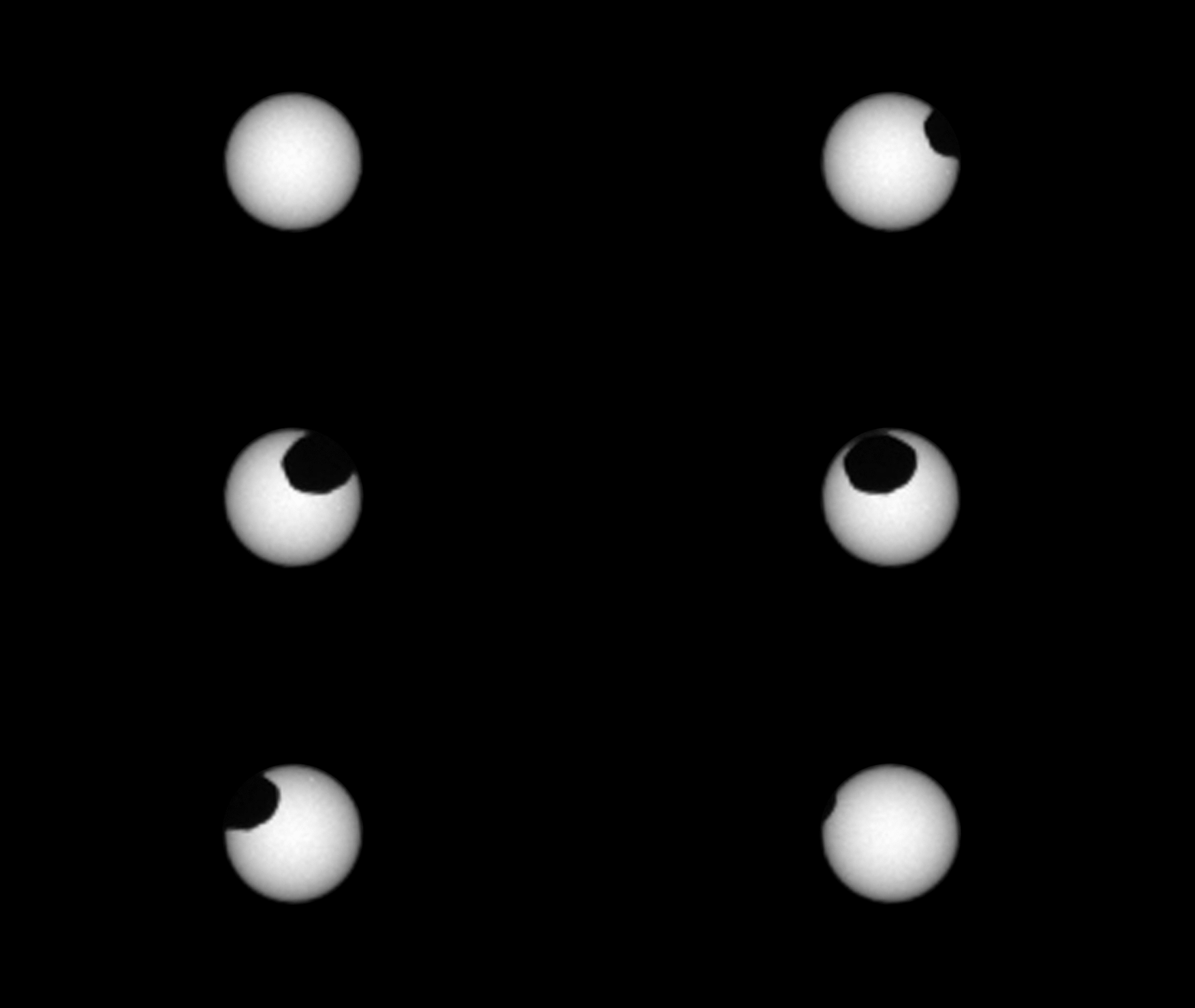
While Curiosity’s work has been more recently overshadowed by its sibling, Perseverance, it is still ongoing. In the last ten years, the rover has studied the Red Planet’s skies, capturing images of shining clouds and witnessing the transit of the Martian moons Phobos and Deimos across the face of the Sun, causing very localised eclipse phenomena.

This series of images shows the Martian moon Phobos as it crossed in front of the Sun, as seen by NASA’s Curiosity Mars rover on Tuesday, March 26th, 2019 (mission Sol 2359). Credit: NASA/JPL / MSS

In addition, the rover’s radiation sensors have helped scientists measure the amount of high-energy radiation future astronauts would be exposed to on the Martian surface, increasing our understanding of what will be needed to keep them as safe as possible – both in terms of practical protections and the types of procedures required to minimise their overall exposure whilst working on the surface of Mars.

However, Curiosity’s most important work is that of determining that liquid water as well as the chemical building blocks and nutrients needed for supporting life were present for at least tens of millions of years in Gale Crater – and that similar conditions could exist elsewhere on Mars. These discoveries directly confirmed the need for the Mars 2020 mission with Perseverance – which is designed to look for the direct evidence that microbial life did take hold in the conditions Curiosity found to be true.

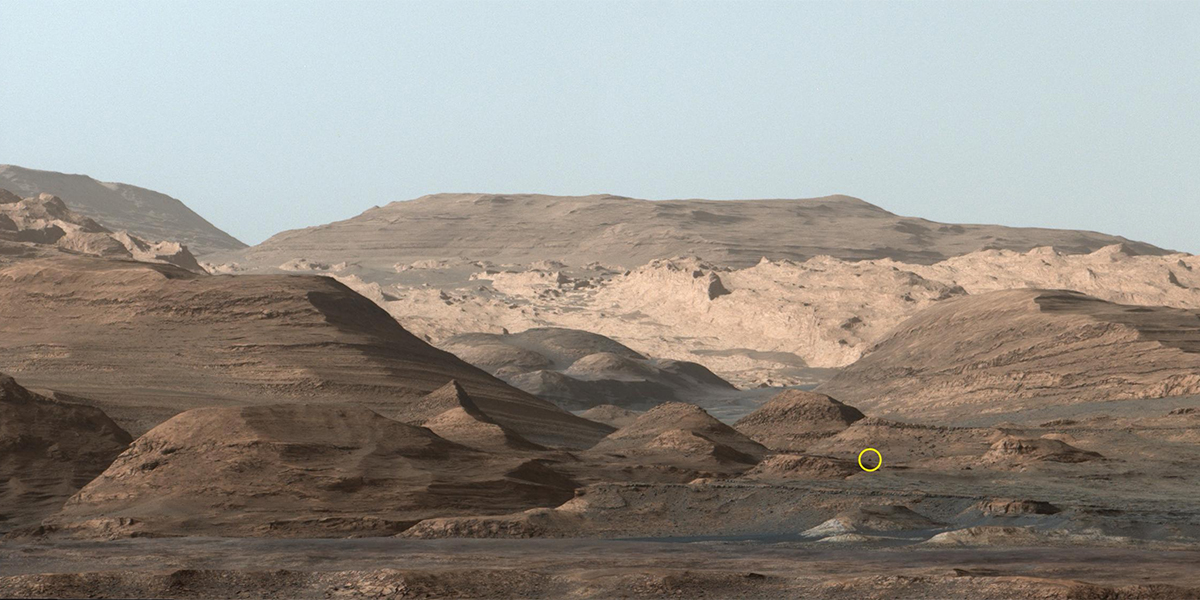
A view across the slopes of “Mount Sharp” captured on September 9th, 2015 using Curiosity’s MastCam. The circle denotes a boulder roughly the size of the rover, to the left of which is “Paraitepuy Pass,” which Curiosity started traversing in 2022. Credits: NASA/JPL

After exploring the bedrock floor of the crater, Curiosity started on a major phase of its mission – scaling the flank of “Mount Sharp”, a 5-km high mound of materials deposited against and around the crater’s central impact peak during the many warm, wet periods that marked the very early history of Mars, and which meant Gale Crater was once the site of a huge lake of liquid water.

The climb has taken up the majority of the rover’s time on Mars, and is still continuing, with Curiosity recently move into an entirely new phase of operations. For the last few months the rover has been making its way along a canyon marking the transition between the more submerged parts of “Mount Sharp” – officially called Aeolis Mons – a region believed to have formed as water was drying out, leaving behind salty minerals called sulphates.

Centred in this 360-degree collage of 27 images is the boulder circled in the above image, and which Curiosity drove by on July 15th, 2022 (mission day Sol 3533). Credit: NASA/JPL
We’re seeing evidence of dramatic changes in the ancient Martian climate. The question now is whether the habitable conditions that Curiosity has found up to now persisted through these changes. Did they disappear, never to return, or did they come and go over millions of years?

– Ashwin Vasavada, Curiosity’s project scientist

The team plans to spend the next few years exploring the sulphate-rich area. Within it, they have targets in mind like the Gediz Vallis channel, which may have formed during a flood late in Mount Sharp’s history, and large cemented fractures that show the effects of groundwater higher up the mountain.

All this progress has come at a cost, however. Along the way, Curiosity had suffered several issues – all of which have been overcome as a result of a team of literally hundreds of engineers and scientists based at the Jet Propulsion laboratory (JPL) and other NASA centres as well as research centres and universities across the United States.

This has allowed major issues that might otherwise have crippled the rover’s abilities. How Curiosity drills for samples has been reinvented a number of times to overcome problems that as the very least might have ended the rover’s ability to drill at all and at worse, crippled its ability to use its robot arm.

Another area of concern has been the rover’s aluminium wheels. These bear the brunt of the sheer force of Curiosity’s progress as it makes its way over the unforgiving Martian landscape; and even while the rover’s daily progress can only be measured in metres-per-day, the fact is that it is constantly traversing terrain which could rip any one of the large aluminium wheels apart given sufficient time. As such, damage was to be expected – but the speed with which it occurred early in the mission still came as a shock, with engineers going so far as to have the rover reverse course and find a new way around some particularly rough terrain at the foot of “Mount Sharp”.

Captured earlier in 2022, this image shows the damage suffered by Curiosity’s left centre wheel after almost 10 years of operations on Mars. Credit: NASA/JPL

To counter the risk of wheel breakage, Curiosity’s driving has been extensively revised, and new algorithms written to help the rover better maintain traction whilst manoeuvring over rocks and to better analyse feedback from wheel motors to prevent them overworking or forcing the rover into an manoeuvre that might result in the loss of a wheel. In addition, the rover routinely examines the state of its wheels using both the MastCam system and the MAHLI imager on the robot arm.

Another threat to the rover’s future is that of electrical output. Curiosity utilises the radioactive decay of plutonium pellets within its radioisotope thermoelectric generator (RTG) to create heat which can be converted into electrical power. On the plus side, this means the rover is not dependent on the vagaries of solar power and can (initially) produce much higher levels of electrical power – some 2,000 2atts on its arrival on Mars.

The downside, however, is that the 4.8 Kg of plutonium within Curiosity’s RTG have a half-live of 14 years – and the rover is now 10 years into that period. As such, it is generating a lot less heat that can be turned into electrical power,, and as a result engineers and scientists are now looking at ways to operate the rover more efficiently and reduce the daily power requirements. This includes switching some operations to run in parallel, effectively sharing power.

Despite this latter points, Curiosity is still performing at near-optimal levels for this period in its life, and with caution and forethought, in is not inconceivable to believe the rover will not still be investigating “Mount Sharp” – even on a reduced basis – in another 10 years.

Continue reading “Space Sunday: Curiosity’s 10th, and motors for rockets”

Space Sunday special: Nichelle Nichols, First Lady of Space

via NASA / Paramount +

While I have written about the passing of noted individuals involved in astronomy and space exploration in previous Space Sunday articles, this obituary – coming a little later than intended – focuses on the life of a woman who never actually flew in space or worked directly on any space programme, but who nevertheless has a profound impact on the shape of the US space programme from the late 1970s through mid-1980s. who who served as an inspiration for woman and those from diverse ethnic backgrounds to seek careers with NASA, and who sadly passed away on July 30th, 2022

Her name is Nichelle Nichols, known the world over as Lt. Uhura from the original Star Trek TV series and the first six of the franchise’s big screen outings, and this is her story.

Born Grace Dell Nichols on December 28th, 1932 to Samuel Earl Nichols, a factory worker who Lishia (Parks) Nichols, in Robbins, Illinois (a suburb of Chicago), where Samuel Nichols served as both the local mayor (1929) and its chief magistrate. From the start, she was determined in her aims: as a youngster, she informed her parents she did not like her given first name and asked them to change it, any they suggested “Nichelle”, which she adopted.

By the age of 16, Nichelle Nichols was singing professionally for Duke Ellington. Credit: Unknown

Studying ballet, dance, music and singing at High School and the Chicago School of Ballet, Nichols landed her first professional gig when just 16, singing in a revue at The College Inn, a well-known Chicago night spot.

It was there that jazz legend Duke Ellington witnessed her performance and he invited her to join his big band as a singer / dancer. This was followed by time with Lionel Hampton’s band, which she joined as a lead singer and dancer.

Nichols’ acting break came in 1959, when she appeared in Porgy and Bess, Starring Sammy Davis Jr., Sidney Poitier, Dorothy Danridge and Pearl Bailey. While she was uncredited in the film, her appearance led to a series of small stage roles, then in 1961 she was cast opposite Burgess Meredith in Oscar Brown’s Kicks and Co, a musical satire poking fun at Hugh Hefner’s Playboy.

The show wasn’t a success, closing not long after it opened, but it ran for long enough for a curious Hefner to attend a performance. He was so impressed by Nichol’s stage presence and singing voice, he immediately offered her the chance to sing at his original Playboy Club, which has opened to great success as a nightspot in 1960.

Three years later, Nichols gained her first TV part, a small role in The Lieutenant starring Gary Lockwood (2001 a Space Odyssey) and created by a certain Eugene “Gene” Roddenberry. The episode, entitled To Set It Right, guest-starred Don Marshall (Land of the Giants) and the legendary Dennis Hopper, and dealt with the controversial subject of racism – so controversial in fact that NBC initially refused to air it, a decision that Roddenberry later said helped spur him in his desire to create Star Trek and use the science-fiction format by which to tell morality tales and socially-aware stories without upsetting the network censors.

Nichol’s role in The Lieutenant was small but memorable (and actually led to a short-lived affair with Roddenberry). More particularly, in appearing in the show, she joined a distinguished list of actors who would go on to have an impact on Star Trek, including cast members Majel Barrett (with whom Roddenberry also had an affair before eventually marrying her) Leonard Nimoy, William Shatner and Walter Koeing, and guest stars Ricardo Montalban (Khan Noonian Singh from Space Seed and later, Star Trek II: The Wrath of Khan) Paul Comi (Lt. Styles, Balance of Terror), and Lockwood himself (Lt. Commander Gary Mitchell from Where No Man Has Gone Before).

As Lieutenant Uhura in Star Trek, Nichols became an icon for women and people of colour the world over, and particularly in the Untied States. Her position as a female officer serving on the bridge of a quasi-military vessel (part of an organisation clearly modelled on the US Navy), was unprecedented, while the role itself was one of the first times an African American actress was portrayed a non-stereotypical role on television.

However, thanks to the core focus on the series leads – Shatner and Nimoy – by the end of the first season, Nichols was dissatisfied in having little to do, and on the final day of shooting, Wednesday, February 22nd, 1967, she handed her resignation to creator-producer Roddenberry, stating her intention to take an offer to appear on Broadway. Rather than accept, Roddenberry requested she take time to think about leaving the show some more before making her decision final.

Nichelle Nichols in her iconic and inspirational role of Lt. Uhura in Star Trek. Credit: Paramount – CBS

The following Saturday, February 25th, 1967, Nichols attended an event at the Beverley Hills Hilton in connection with the Nation Institute (although later attributed as an NAACP banquet) at which Dr. Martin Luther King Jr, was to speak. It was an event to go down in history as the first time Dr. King publicly condemned the war in Vietnam. However, for Nichelle Nichols it was memorable for another reason entirely. Ahead of King’s address, she was informed her “greatest fan” wanted to meet her.

I said, ‘Sure.’ I looked across the room and thought whoever the fan was had to wait because there was Dr. Martin Luther King walking towards me with this big grin on his face. He reached out to me and said, ‘Yes, Ms. Nichols, I am your greatest fan.’ He said that Star Trek was the only show that he, and his wife Coretta, would allow their three children to stay up and watch. When I told he I was leaving the series, he said, ‘you cannot, you cannot! For the first time on television, we will be seen as we should be seen every day, as intelligent, quality, beautiful, people who can sing dance, and can go to space, who are professors, lawyers … If you leave, that door can be closed because your role is not a black role, and is not a female role; he can fill it with anybody even an alien.

– Nichelle Nichols, recalling her 1967 meeting with Dr. Martin Luther King Jr.

So deeply affected by King’s words, Nichols didn’t only return to Start Trek and stay with it through the Star Trek VI: The Undiscovered Country, the last outing for the entire original series cast, she sought to do more for the people of whom King spoke.

Most notably, she helped found and run Women in Motion, a company that initially produced educational materials using music as a teaching tool and which focused on young women and girls. However, during a visit to a NASA facility, she commented about the lack of apparent diversity among the staff. NASA responded by asking her to help them broaden their recruiting activities, providing a grant to Women in Motion to help with the work.

Nichelle Nichols one one of the two Apollo Mission Operations Control Rooms (MOCR, popularly referred to as “Mission Control”) in 1977. Credit: NASA

Continue reading “Space Sunday special: Nichelle Nichols, First Lady of Space”