Space Sunday: a rover and some astronomy

After a treacherous journey, NASA’s Curiosity Mars rover has reached an area that is thought to have formed billions of years ago when the Red Planet’s water disappeared.

Lying part-way up the slopes of “Mount Sharp”, the mound of material deposited at the centre of Gale Crater (and formally called Aeolis Mons), is rich in salty minerals scientists think were left behind when the streams and ponds on the slopes of the mound finally dried up. As such, this region could hold tantalizing clues about how the Martian climate changed from being similar to Earth’s to the frozen, barren desert we know today.

These salty minerals were first spotted from orbit by NASA’s Mars Reconnaissance Orbiter before Curiosity arrived on Mars in 2012, and that discovery marked the deposits as a prime target for the rover to examine.  However, such is the rich diversity of rocks and minerals making up “Mount Sharp”, all of which have been subject to examination by the rover, it has taken the mission almost a decade to reach this “prime” target.

Even so, before Curiosity could obtain any samples from the site, the rover faced a couple of challenges.

The first lay in the fact that the rover’s position on “Mount Sharp” meant that the mission team had to drive and position the rover to ensure its antenna could remain aligned with the various orbiters it needs to use to communicate with Earth; this made navigating to the deposits a challenge, as has ensuring it can reach rocks that might yield interesting samples.

A view through “Paraitepuy Pass” captured by the MastCam on NASA’s Curiosity rover on August 14th, 2022, the 3,563rd Martian day, or sol, of the mission. Credits: NASA/JPL / MSSS

The second required further tests had to be carried out on the rover’s sample-gathering drill to ensure it would handle the stresses in cutting into the region’s rocks. As designed, the drill was intended to use a percussive action as it drilled into any target- but as I’ve reported in these pages, this hammering action started to affect the drilling mechanism as a whole, so a new algorithm was created and uploaded to the rover to minimise any use of the percussive action.

Because of this, the mission team now approach each sample gathering operation with an additional step: after scouring the surface of a sample rock to remove dust and debris, the team then position the drill bit against the rock and attempt to scratch the surface – any resultant marks would be a good indication the rock is soft enough to be drilled without the need for the hammer option.

In the case of this rock – nicknamed “Canaima” – no marks were left, indicating it might prove a difficult subject. However, a further test with the drill head turning revealed it could cut the rock without the use of the hammer action, so on October 3rd, 2022, Curiosity successfully obtained its 36th sample for on-board analysis.

A MastCam view of the 36th successful sample hole Curiosity has drilled, this one on the sulphate-rich rock dubbed “Canaima.” Inset: the hole as imaged by the Mars Hand Lens Imager (MAHlI) mounted on rover’s robot arm, along with the drill mechanism. These mages were taken on October 3rd, 2022, the mission’s 3,612th Martian day, or sol. Credits: NASA/JPL / MSSS

The route to this sulphate-rich area also required Curiosity pass through a narrow, sand-rich location dubbed “Paraitepuy Pass”, bordered on either side by slopes the rover could not drive over or along. Such is the nature of the sand the rover took over a month to traverse the pass, moving cautiously in order to avoid getting bogged-down. This meant that the rover celebrated its 10th anniversary crossing the pass.

The challenges also haven’t ended; the salty region comprises rocky terrain that is so uneven, it will be difficult for Curiosity to place all six wheels on stable ground. This isn’t a problem when on the move, but it could limit science operations in the area: if all of the rovers wheels are not in firm contact with the ground under them, operators won’t risk unfolding its instruments-loaded robot arm in case it clashes with jagged rocks.

Even so, the rover still has a lot of opportunities for science and discovery as it continues to climb “Mount Sharp”.

JWST Wows, HST, Chandra and IXPE Respond

It is now 100 days since the James Webb Space Telescope commenced operations, and in their most recent updates, NASA released a stunning image the observatory captured of the iconic Pillars of Creation.

The Pillars of Creation as imaged by the James Webb Space Telescope. Credit: NASA / ESA

Located in the Serpens constellation, roughly 6,500-7,000 light-years from Earth, the Pillars are gigantic “elephant trunks” of interstellar gas and dust, a birthplace of new stars,  constantly, if slowly being changed by the very stars born within them. They were imaged by the Hubble Space Telescope (HST) in 1995, the image becoming famous the world-over despite HST imaging them again it 2014. However, the image developed by JWST’s Near Infra-red Camera (NIRCam) eclipses the Hubble image, revealing the pillars and their surroundings in incredible detail.

Newly formed stars lie outside of the column. Seen merely as a few bright red orbs with strong diffraction spikes radiating from them, they are reveal by JWST as in their truer colours – blues, yellows, whites, indicative of their spectral classes, a veritable sea of stars, These are the stars that are causing the pillars to change and collapse as a mix of their gravities and radiative energy influence their form.

The Pillars of Creation as images by the Hubble Space Telescope in visible light (1995 – left) and by the James Webb Space Telescope in the near infra-red (right – 2022). Credit: NASA / ESA

Also visible along the edge of the pillars are wavy forms, the ejections of gas and dust from stars that are still forming. The crimson glow seen within some of these wave-like forms is the result of energetic hydrogen molecules interacting with the supersonic outbursts of the still-forming stars. Within the cloudy forms of the pillar are red points of light – newly-formed stars that are just a few hundred thousand years old, the light just stars to break through the surrounding clouds of dust and material.

Around all of this is a translucent blue glow, a mix of dust and gas known as the interstellar medium, found in the densest part of our galaxy’s disk. It serves to block the view of the deeper universe, bringing the Pillars of Creation to the fore.

This new view of the Pillars will help researchers revamp their models of star formation by identifying far more precise counts of newly formed stars, along with the quantities of gas and dust in the region. Over time, they will begin to build a clearer understanding of how stars form and burst out of these dusty clouds over millions of years.

Continue reading “Space Sunday: a rover and some astronomy”

Space Sunday: collisions, gamma bursts and rockets

A Hubble Space Telescope image from Oct. 8 shows the debris blasted from the surface of an asteroid called Dimorphos 12 days after it was struck by NASA’s DART spacecraft. Credit: NASA / ESA / STScI / Hubble

The results are now in – to a degree – on the success of NASA’s Double Asteroid Redirect Test (DART) mission which has been the focus of my two previous Space Sunday updates.

An attempt to test the theory that a vehicle launched from Earth could successful divert the orbit of a near-Earth obit (NEO) threatening this planet with a collision simply through the kinetic force imparted through crashing into it, DART struck Dimorphos, a 160-m asteroid orbiting the much larger Didymos as both orbit the Sun every 2.11 years crossing and re-crossing Earth’s orbit.

As I’ve previously noted, Dimorphos was selected as a target as scientist know a lot about its orbits – it shares a stable solar orbit with Didymos, it had a near-circular equatorial orbit around Didymos once every 11.9 hours, allowing DART to strike it pretty much head-on, thus transferring all of its 22,530 km/h velocity into a force to counter Dimorphos’ own velocity and 5 million tonnes of mass.

Prior to the impact, the DART team indicated any change in Dimorphos’ orbit of Didymos of 73 seconds or more would be considered a success – although it would likely take a couple of weeks after the impact before the exact change in the asteroid’s orbit would be known, as detailed Earth-based observations would be required.

It turns out that DART didn’t affect the orbit of Dimorphos by seconds – by a whopping 32 minutes, altering it from 11 hours and 55 minutes to 11 hours and 23 minutes and also reducing the average distance between Dimorphos and Didymos. This strongly suggests such a mission, undertaken a the right time, could be an effective means of diverting an Earth-threatening asteroid. However, the team note further observations are required.

This result is one important step toward understanding the full effect of DART’s impact with its target asteroid. As new data come in each day, astronomers will be able to better assess whether, and how, a mission like DART could be used in the future to help protect Earth from a collision with an asteroid if we ever discover one headed our way.

– Lori Glaze, director of NASA’s Planetary Science Division.

One of the reasons DART may have had a much greater impact (no pun intended) on Dimorphos and give pause for further consideration is that while much was known about its orbit around Didymos, little was known about its composition. Post-impact, the images captured by the Hubble and James Webb space telescopes and Earth-based observatories suggest Dimorphos is essentially a ball of loosely packed gravel, dust and ice. Thus, DART’s impact was amplified by the jet of ejecta throw off of the asteroid. As such, it is unclear as to whether the impact would have had the same effect against a more closely-bound asteroid, such as those which are iron-rich.

A mosaic of enhanced imagery shows the material that was ejected from the asteroid Dimorphos as a result of the DART collision. The nested “windows” in the picture reflect how the exposure was adjusted to compensate for the brightness of the material. Credit; NASA

Given this, getting an early a warning as possible of a potential impact so that the threatening asteroid or comet could be struck at a point in its orbit where it is far enough from Earth, it only requires a slight alteration to its orbit in order to be deflected.

An upcoming mission that could achieve this is the Near-Earth Object (NEO) Surveyor. Due for launch in 2026, this Earth-orbiting observatory is specifically designed to seek out NEOs of 140 m diameter or larger which regularly cross Earth’s orbit around the Sun and come within 30 million kilometres of our planet while doing so.

An artist’s impression of the Near-Earth Object (NEO) Surveyor, due for launch in 2026. Credit: NASA

By using two heat-sensitive infrared imaging channels, the observatory will be able to make accurate measurements of NEO sizes and gain valuable information about their composition, shapes, rotational states, and orbits, allowing scientists and engineers to determine the best means to divert any that may come to present a real impact threat.

Gamma Ray Burst “The Most Powerful Flash of Light Ever Seen”

Astronomers just detected what may be the most powerful flash of light ever witnessed.

Gamma ray busts are the most energetic type of electromagnetic explosion known to exist in the universe. They are believed to come in two forms: short bursts, lasting around 2 seconds and believed to be caused by ultra-dense neutron stars colliding; and long bursts, lasting several minutes, believed to be caused by so-called “hypernovas”, – the death explosion of really super-massive stars prior to them collapsing into black holes.

Gamma-ray bursts are the most energetic flashes of light known to exist in the universe. Credit: NASA, ESA and M. Kornmesser

Up to 100 times brighter than supernovas, and therefore also referred to as super luminous supernovae, these latter blasts can give off as much energy in a minute or so as the Sun will generate throughout its 10 billion year lifespan.

The blast detected on Sunday, October 9th by NASA’s orbiting Neil Gehrels Swift Observatory, appears to have released 18 teraelectron-volts (TeV; one trillion electron volts) – almost double the energy of any such other burst thus far detected. In fact it was so powerful, it confused astronomers. Initially, it was believed the burst came from somewhere relatively close to the solar system and that it was an X-ray burst. It took additional analysis to confirm the flash was in fact a gamma-ray burst, and that it originated some 2.4 billion light-years away – which still makes it the closest such burst ever seen.

An artist’s impression of the explosion of SN 2006gy, a superluminous supernova. Credit: NASA

Officially designated GRB221009A, the burst was far enough away to cause excitement among astronomers rather than concern. However, should such a blast occur anywhere close to our stellar neighbourhood, it could very realistically end all life on this planet. In fact, it is believed that one of the biggest mass-extinction events in Earth’s history – the Late Ordovician mass extinction (LOME) event, which occurred 450 million years ago and eliminated up  60% of marine genera and nearly 85% of marine species in the second-largest mass extinction event of Earth’s history – may well have been triggered by such a blast.

Exactly which star caused GRB221009A isn’t known at this point, but it is so bright across all spectrums – X-ray, optical, radio and gamma – it is easy for observatories on Earth to monitor, allowing an extensive catalogue of data about it to be gathered.

When you are dealing with cosmic explosions that blast out stellar remains at near the speed of light, leaving a black hole behind, you are watching physics occurring in the most extreme environments that are impossible to recreate on Earth. We still don’t fully understand this process. Such a nearby explosion means we can collect very high quality data to study and understand how such explosions occur.

– Astronomer Gemma Anderson, Curtin University in Australia

Continue reading “Space Sunday: collisions, gamma bursts and rockets”

Space Sunday: collisions, storms, aspirations and servicing

A high resolution image of Dimorphos made by stacking the last images received from DART. Credit: Eydeet on Imgur.

On Monday, September 26th 2022, NASA’s DART (Double Asteroid Redirection Test) spacecraft, massing 570 kg slammed into the 160-m  diameter, roughly 5 million tonne asteroid Dimorphos as the latter orbited its parent asteroid, Didymos.

As I outlined in my previous Space Sunday update, the aim of the mission was to test the ability of a vehicle launched from Earth to alter the orbit of a near-Earth object (NEO) purely through the transfer of kinetic energy, in order to prevent a collision between planet and NEO.

Didymos / Dimorphos are NEOs. They orbit the Sun every 2.11 years, hopping across the orbit of Earth in the process and swinging out as far as the orbit of Mars before heading back towards the Sun, Didymos and Dimorphos are ideal subjects for such tests because the former’s orbit around the Sun can be accurately tracked, as can the latter’s near-circular 11.9 hour equatorial orbit around Didymos.

Images of Dimorphos captured simultaneously by the Hubble (l) and James Webb (r) Space Telescopes several hours after DART struck the asteroid. These images mark the first time the two observatories have taken simultaneous images of the same target. and show the spread of material ejected materials  Credit NASA, ESA, CSA, and STScI

At the time of impact, DART was travelling at around 22,530 kmh, and its impact with the asteroid was described as the equivalent of “a golf cart ramming into the Great Pyramid of Giza”.

Prior to the impact, NASA indicated they expected the head-on collision between spacecraft and asteroid should slow the latter’s orbital velocity around Didymos by around 1% – or 10 minutes. This might not sound a lot, but it should result is a clearly observable change in Dimorphos’ orbit.

The impact was observed from a number of vantage points – including aboard DART itself, thanks to DRACO, the Didymos Reconnaissance and Asteroid Camera for Optical navigation, which recorded the spacecraft’s approach all the way up to impact (and loss of signal), a host of ground-based telescopes and both the Hubble and James Web space telescopes.  In addition, a fly-by cubesat called Light Italian CubeSat for Imaging of Asteroids (LICIACube) built by the Italian Space Agency and released by DART roughly two weeks prior to the impact, should be returning post-impact images of Dimorphos in the next few days.

An animation of images captured by the Hubble Space Telescope following the DART impact with Dimorphos, showing the spread of ejecta following the strike. Credit: NASA, ESA, CSA, and STScI

While scientists know a reasonably amount of the orbits of Dimorphos and Didymos, there is far more that is not known about either – such as their overall composition. As such, what would happen as a result of the impact was also unknown – and as seen from the likes of Hubble and James Webb and telescopes on Earth, the impact appeared much brighter than had been expected.

In particular, Hubble and JWST were both able to monitor and image the ejecta generated by the impact. Being able to do this is an added science goal for the mission, as analysis of the streaks of ejecta captured in both visible and infra-red wavelengths will help determine the asteroid’s likely composition and structure.

However, it is still going to be a while for the overall results of impact to be fully calculated, although initial estimates of the change in Dimorphos’ orbit might be known within a week or two following the collision.

China’s International Aspirations

China is looking to build partnerships for its upcoming missions to the moon and deep ventures into the solar system, while omitting mention of (current?) main partner Russia.

Speaking at the International Astronautical Congress (IAC) in Paris on September 21st, 2022, Wang Qiong of the Lunar Exploration and Space Engineering Centre under the China National Space Administration (CNSA) stated that China was open to proposals for science payloads aboard its Chang’e-7 lunar south pole orbiter / lander mission, and the Chang’e-8 in-situ resource utilization test mission, as well as already having the participation of Sweden, Pakistan, the UAE (in the form of a small rover) and the European Space Agency (ESA) for the 2024’s Chang’e-6 mission.

In addition, China is working on a number of deep space missions for which international co-operation is welcomed in the form of:

  • Tianwen-2 (2025), a near-Earth asteroid sampling mission which will also visit a main belt comet.
  • Tianwen-3, a Mars sample return mission.
  • Tianwen-4 (2029) a mission to Jupiter (with a fly-by Uranus).

Finally, China is looking for further partners in the International Lunar Research Station (ILRS) programme to establish a permanent robotic and later human-occupied moon base in the 2030s.

However, the presentation avoided mention of China’s current partner in ILRS: Russia. Per an agreement signed in June 2021, China and Russia are nominally equal partners in the project, and up to Russia’s invasion of Ukraine, ILRS was referred to as a joint China-Russia programme (Russia was not represented at the IAC due to their on-going aggression in Ukraine).

It’s not clear if the conspicuous absence of Russia from China’s presentations signifies sensitivity to the situation in Ukraine and Russia’s isolation, or a change in Chinese thinking towards their engagement with Russia – although there is speculation the latter is the case.

Be it in space or elsewhere, China has a very realistic view of Russia and partnering with Moscow has never been Beijing’s most preferred outcome, for the two countries are not natural partners. This uneasiness is well reflected in their joint ILRS, which still remains little more than a coordination mechanism rather than a bold undertaking sharing a common goal. In moving forward, however, Beijing now seems to be increasingly confronted with a difficult dilemma: turn the relationship into a real partnership or drop it altogether.

– Marco Aliberti, European Space Policy Institute (ESPI)

Thus, given Russia’s current standing in the world, a partnership with Moscow could limit China’s ability to attract new, potentially more auspicious, international partner.

In Brief

Artemis 1

It now appears that the first launch of NASA’s new Space launch System rocket in the Artemis 1mission is unlikely to occur prior to November 2022 – although speculatively, the mid-to-end of October launch window remains possible.

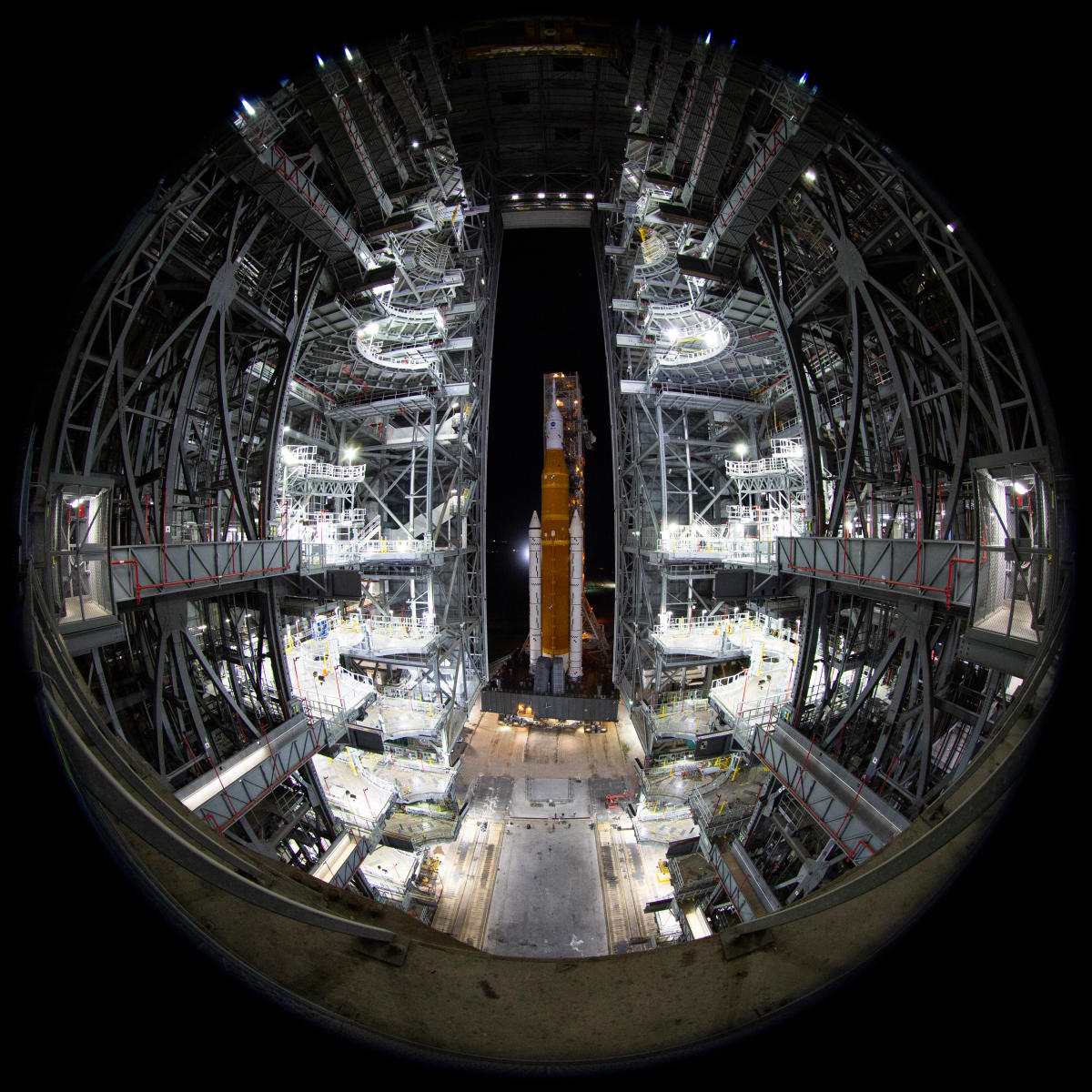
Thanks to the arrival of hurricane Ian, NASA was forced to roll the massive rocket and its launch platform back the Vehicle Assembly Building (VAB) at Kennedy Space Centre overnight on Monday, 26th, / Tuesday, 27th September 2022 in what was (literally, given roll-back commenced at 23:00 local time on the 26th) a 11th hour decision.

As a result of the roll-back, NASA has opted to replace the batteries on the vehicle’s flight termination system (FTS) – the package which destructs the rocket should it veer off-course during its ascent through the atmosphere.

A dramatic shot of Artemis 1 arriving at the Vehicle Assembly Building shortly after 7:00am local time in Florida on Tuesday, September 27th, 2022, even as the weather front of Hurricane Ian moves in. Credit: Greg Scott

This is a non-trivial task, and given the technicalities involved, NASA managers have indicated getting the work completed and returning the rocket to the pad before the end of October could be difficult.  Should the launch slip into November, opportunities for that month exist from November 12th through 27th.

Crew 5

Hurricane Ian has also impacted the NASA / SpaceX Crew 5 ferry mission to the International Space Station (ISS). The 4-person crew – comprising NASA astronauts Nicole Mann and Josh Cassada together with Japanese astronaut Koichi Wakata and Russian cosmonaut Anna Kikina – had been scheduled for October 3rd, but has been pushed back to October 5th as a result of the storm.

The Crew 5 Dragon vehicle and its Falcon 9 booster being prepared at the SpaceX facilities, Pad 39A, Kennedy Space Centre. Credit: SpaceX

This is something of a historic mission – Mann will be the first woman to reach space, and Kikina will be the first cosmonaut to fly to the orbiting lab with SpaceX.

Hubble: NASA and SpaceX Consider Dragon Servicing Mission

NASA and SpaceX are carrying out a study to see if it would be possible to use the latter’s Dragon vehicle to reach the Hubble Space Telescope (HST) and boost its orbit – and, if Crew Dragon is used, deliver a crew to HST to carry out basic, but essential servicing.

From its launch in 1990 through until 2011, HST had to be routinely visited by the space shuttle to allow astronauts carry out essential servicing and the replacement of aging parts, as well as use the shuttle’s reaction control system to periodically raise Hubble’s orbit around the Earth.

NASA and SpaceX are studying the feasibility of using the latter’s Dragon vehicle to boost the Hubble Space Telescope’s orbital altitude, and possibly deliver a crew to Hubble to carry out servicing operations. Credit: NASA

However, in 2011, the shuttle was retired, leaving NASA without a vehicle capable of servicing the observatory, was has lowered its orbit by some 60km compared to when it was launched as a result of atmospheric drag. Unless countered, this drag will continue until HST will tumble uncontrolled into the denser atmosphere and break-up in the mid-2030s. To avoid this, NASA is planning a controlled de-orbit mission to HST using an automated vehicle in 2029/30, ensuring it burns-up safely and any surviving debris falls into the Pacific Ocean. By contrast, should a servicing / orbital boost be possible with Dragon, then Hubble’s operational life could be extended by up to 20 years.

Even so, such a mission by Dragon – crewed or otherwise – will not be easy; as noted, HST is specifically designed to be services by the space shuttle, and while a capture mechanism was installed during the very last shuttle servicing mission to Hubble, it is intended to be used as a part of the de-orbit mission mentioned above. But should the study show a Dragon-based boost / service mission is feasible, it could come at little to no cost to NASA.

This is because billionaire Jared Isaacman, who has already financed and commanded the Inspiration4 mission and who is financing a series of further crew flights on Crew Dragon under the Polaris project, has indicated he believes a mission to Hubble would be a worth goal for Polaris – and he is actively involved in the study.

Space Sunday: collisons, rockets, and telescopes

Official poster for the DART mission, a joint NASA-John Hopkins University Applied Physics Laboraroty (JHUAPL) mission. Credit: NASA

Monday, September 26th 2022 will see NASA’s Double Asteroid Redirection Test (DART) reach its primary goal when a small space probe will collide with an asteroid called Dimorphos in an attempt to test a method of planetary defence against near-Earth objects (NEOs) by deflecting their path around the Sun via a kinetic impact.

The risk we face from Earth-crossing NEOs – asteroids and cometary’s fragments that routinely zoom across or graze the Earth’s orbit as they follow their own paths around the Sun – is not insignificant. More that 8,000 of such objects are currently being tracked, and that number is still rising. Such objects range in size from the relatively small to objects like the infamous 99942 Apophis (370m along one axis). which were it to strike Earth, would result in an estimated explosive force equivalent to 1,000 megatons, through to objects large enough to result in possible extinction events.

In 2013, a cometary fragment roughly 20m across entered Earth’s atmpsohere to explode 26km above the the Russian oblast of Chelyabinsk with a force of 400–500 kilotons of TNT. The resulting shockwave damaged some 7,200 buildings and injured over 1,500 people in 6 cities. This image captures the fragment’s path as it burnt up through the denser atmosphere. with the poiint of its explosive destruction marked by a distinctive “mushroom cloud” towards the right-hand end of the trail. Credit: Alex Alishevskikh

Over the years, various means of prevent such an impact have been suggested, with one of the most popular being the use of the kinetic energy from one or more impacts against the threat to alter its orbital track around the Sun so it would miss Earth. It is a popular option because if we get sufficient warning about a threatening object, it should be possible to plan an intercept mission to strike it at a point in its orbit where only a very small deflection in its track would be enough to ensure it misses Earth, allowing smaller, more manageable payloads to be used.

DART is the final incarnation of what started as two independent missions by NASA and the European Space Agency (ESA) to achieve the same goal. These were then combined into a single mission –  AIDA (for Asteroid Impact & Deflection Assessment(, which would have seen ESA launch a observation platform intended to fly to the designated target asteroid and carry out observations and analysis prior to NASA’s DART impactor arriving, and then observing the impact on the latter and the effect it had on the target’s orbit.

However, the ESA element of the mission was cancelled, leaving NASA to push ahead with DART, with the role of observing the impact taken over by Earth-based based observatories and a small payload carried by DART. To compensate, ESA now plans to launch Hera in October 2024, a mission and vehicle that will rendezvous with the target asteroid in 2027 to observe the overall results of the DART mission.

Dimorphos, the target for DART, is actually a relatively small asteroid, some 170m across (but still large enough to result in considerable destruction and loss of life were it to enter Earth’s atmosphere and explode). It has been selected for a combination of reasons, the most pertinent being it is actually the moon of a much larger asteroid, 65803 Didymos (Greek for “twin”), itself a NEO forming part of the Apollo group, and noted as being potentially hazardous to Earth. It is around 780m across, and it orbits the Sun every 770 days, its orbit eccentric enough  for it to cross both the orbits of Earth and Mars, and thus present a potential impact hazard to both.

Dimorphos (Greek: “having two forms” and discovered in 2003, seven years after Didymos was first located) occupies an equatorial and near-circular orbit around Didymos with a period of 11.9 hours. This makes it an attractive target because its position is easy to calculate / track, and the fact that it is orbiting a large object means that the angle of deflection as a result of DART’s impact can be directly measured against its motion around Didymos, and from this it will be possibly to extrapolate the amount of deflection achieved had Dimorphos been a solo asteroid en route to a collision with Earth.

DART launched on November 24th, 2021 atop a Falcon 9 rocket. In order to impact the asteroid at a speed sufficient to affect its velocity, the vehicle has been propelled towards its target by a solar-powered NEXT ion thruster, and will strike Dimorphos head-on at a speed of 6.6 kilometres per second. This should be sufficient to effectively slow it in its orbit around Didymos and result in a charge to the orbital period and shape. Given Dimorphos is large enough to exert some gravitational influence over its parent, it is expected that Didymos’ velocity and orbit will also be affected to a small degree.

An artist’s impression of how the LICIACube cubesat might witness the outflow of ejecta from DART’s impact into Dimorphos. Credit: ESA / Italian Space Agency

Exactly how small or obvious all these changes will be is unknown – we simply do not know the topography of Dimorphos to know where and how DART will strike it. However, to assist with Earth-based observations of the impact, earlier this month DART released the Light Italian CubeSat for Imaging of Asteroids (LICIACube).

Built by the Italian Space Agency, this cubesat is now on a trajectory that will carry it through the Didymos / Dimorphos pairing, allowing it to observe and hopefully record DART’s impact and also gather initial data on the immediate results of the impact – although it is estimated that it will be a week or so before the overall effects of the impact can be properly interpreted. Similar cubesats, originally dubbed “Luke” and “Leia” but now officially called Milani and Juventas (a case of football winning out over Star Wars in the Italian science team?) will accompany the Hera mission in 2024.

DART itself carries little in the way of science instruments related to the mission, other than a 20 cm aperture camera called Didymos Reconnaissance and Asteroid Camera for Optical navigation (DRACO, which should record and return images of both Didymos and Dimorphos right up to the actual impact). However, it is in many respects also a technology demonstrator, making use of the  Roll Out Solar Array (ROSA) system recently deployed to the International Space Station, and which allows for more efficient harvesting of sunlight over a smaller area of solar array surfaces to generate power, and also RLSA, the spiral Radial Line Slot Array, a new type of compact and lightweight high gain communication antenna.

An artist’s impression of the NASA DART vehicle under propulsive thrust from its ion engine, moments before impacting with the asteroid Dimorphos. Credit: NASA

Currently, DART remains on course for an impact with Dimorphos at 23:14 UTC on Monday, September 26th, 2022. The images returned by the DRACO camera ahead of the impact will mark only the 6th time we have received close-up images of the surface of an asteroid.

Big Boosters: SpaceX Booster 7’s Seven and Artemis 1’s Weather Delay

It’s been a week of ups and downs for the two big boosters which are most prominently on spaceflight enthusiasts’ minds.

At the SpaceX Starbase Facility in Boca Chica, Texas, Booster 7, the vehicle seen as the favourite to lift the company’s massive Starship into the sky on the system’s first orbital attempt, completed a second spin-start test of seven of its 33 Raptor 2 engines  on September 19th. This looked to be a different selection of motors to those tested the previous week, meaning that between 14 and 17 of the booster’s motors have now completed spin-starts. Nor was this the end of things: just a few hours after the spin-start – which lasted around 13 seconds – the booster was re-pressurised with fuel and warning given of a further engine test.

This was a full static fire of seven of the engines, marking the largest number of Raptor 2 motors to go through such a test thus far. Slow-motion payback of high-speed film shot of the event reveals that – as with the spin-start tests – rather than igniting all seven engines simultaneously, engine ignition was staggered, which might be indicative of how actual orbital launches will be managed; staggering engine starts by just a few milliseconds could help with reducing noise vibration resulting from all 33 engines coughing into life at the same time, and may even help reduce the amount of sound being deflected back up against the vehicle and the launch stand.

Following this test, SpaceX announced that, rather than remaining at the orbital launch facility for further engine tests, Booster 7 would be returned to the production centre at Starbase for “robustness upgrades”, and Booster 8 would replace it on the orbital launch mount to undergo its own testing. Whilst not entirely clear from the tweets given, it appears these tests will include a full wet dress rehearsal (WDR), which could involve stacking the booster with Starship 24, then fully tanking them and proceeding through a launch countdown that stops short of engine ignition. Then, after this, there will be a full 33-motor static fire test for a booster.

Whether this means Booster 8 will overtake Booster 7 to become the vehicle to make the first orbital launch attempt with a Starship on top, or whether the two boosters will again be swapped to allow Booster 7 make the attempt – which SpaceX appear to be hoping to make in November (still subject to the granting of an FAA license) – is unclear.

Either way, Booster 7 was removed from the launch mount mid-week, and the launch mount itself then went through a series of tests of its upgraded sound suppression system, which appears to deliver both water and nitrogen as to the flame pit of the launch table to both absorb sound (and reduce the potential for it causing damage to the vehicle or launch facilities) and reduce the risk of unexpected fire.

Booster 8 (centre left) imaged on Highway 4, Boca Chica, on its way to the Starbase test and launch facilities. Just to the right of the booster stands Starship 24, located on a sub-orbital test stand. Centred in the photo is the orbtial launch tower, with the mechazilla lifting arms lowered and rotated away from the launch table and Booster 7 (hidden by the bulk of the launch tower). Credit: NASASpaceflight.com (not a NASA afilliate)
Meanwhile, on September 21st, NASA held a further fuelling test of the massive Space launch System rocket that will launch the uncrewed Artemis 1 mission to cislunar space. Earlier attempts to complete this test – a critical final step in readying the massive launcher for its maiden flight – had to be curtailed due to leaks in the liquid hydrogen fuel feed system at the base of the rocket, leading to padside repairs, as I noted in my previous Space Sunday update.

While the September 21st test also encountered leaks with the liquid hydrogen propellant flow, they were now sufficient to curtail operations, and the tst was successfully completed with both the core and upper stage liquid oxygen and liquid hydrogen tanks being fully fuelled roughly 6 hours after operations commenced.

One September 23rd, and after post-test checks on the vehicle, NASA held a press conference to confirm they would be making a launch attempt on Tuesday, September 27th, 2022 – only to have to call off the attempt on the 24th September due to tropical storm Ian threatening to roll across Florida and over the Space Coast, potentially requiring the vehicle to be rolled back to the safety of the Vehicle Assembly Building (VAB).

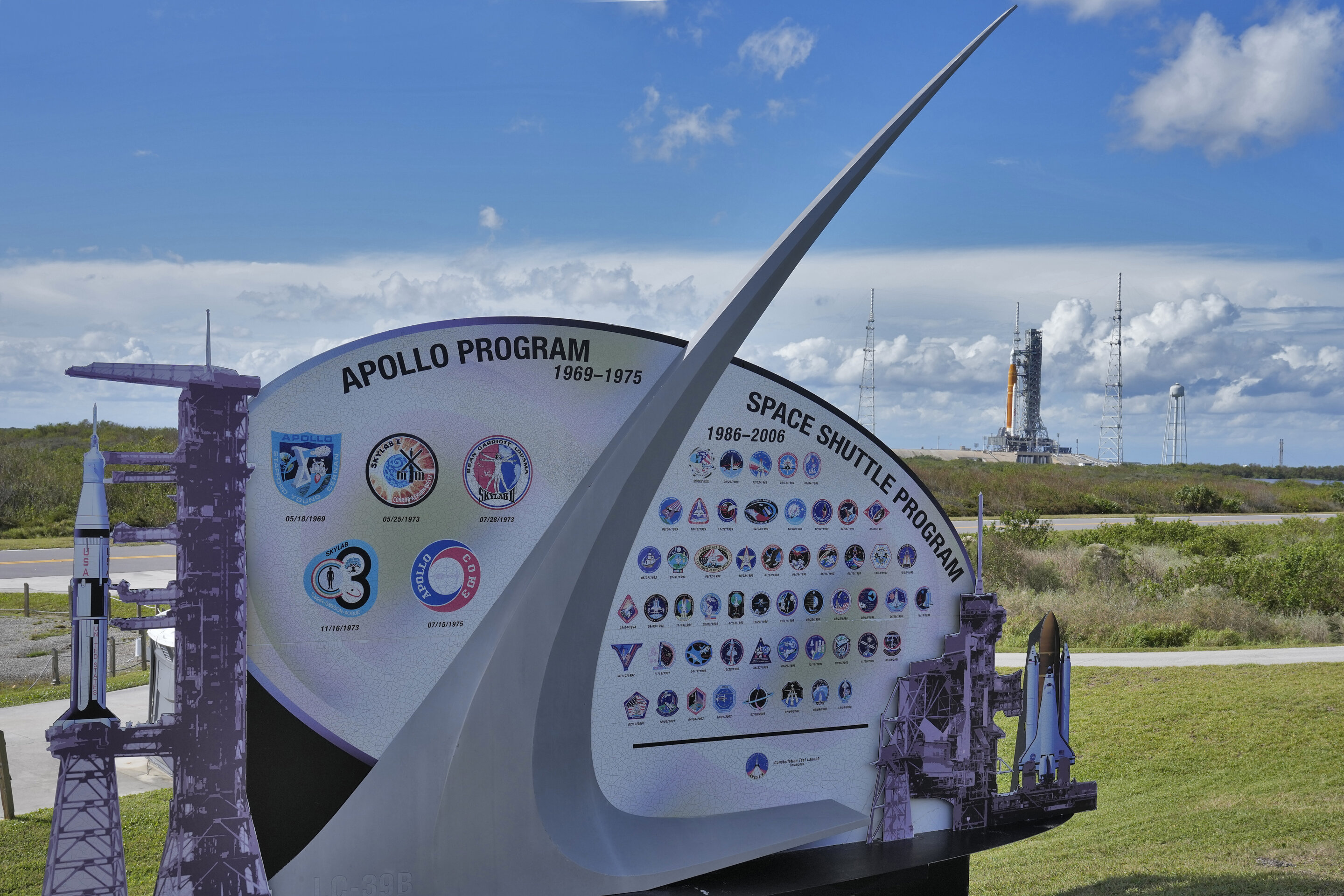
The Artemis 1 SLS booster on launch pad 39-B at Kennedy Space Centre. Credit: NASA

At the time of writing, no final decision had been announced regarding the roll-back proceeding. Should it occur, it is likely to occur overnight (local time) on Sunday 25th / Monday 26th September). This roll-back would mean the earliest launch opportunity would be October 2nd; however, this is a date in doubt due to the planned October 3rd launch for the NASA / SpaceX Crew 5 mission to the ISS from neighbouring Pad 39A. As both pads within launch Complex 39 at Kennedy Space Centre use the same infrastructure, back-to-back launches from the two pads are logistically difficult, and was there are further windows for the Artemis 1 launch, letting this slip is seen as preferrable to disrupting ISS operations.

The one good piece of news for Artemis 1, is that the flight termination system (FTS) has received a recertification waiver from the US Space Command at Cape Canaveral Space Centre. The FTS is used to destroy a rocket should it veer off-course post-launch. However, its batteries have a limited service life, and so packages need routine re-certification to state their batteries are suitable for use – or the batteries require replcing. Re-certification  / replacement means returning the vehicle to at VAB, further delaying any launch. However, the USSC has agreed that the package on the SLS could have the recertification delayed until mid-October, allowing the vehicle o be available for the late September / early October launch windows.

JWST Update: Images and Issues

On September 24th, NASA released images of the solar system’s outermost planet, as captured by the James Web Space Telescope. The pictures, taken in July 2022, show not only Neptune’s thin rings, but its faint dust bands, never before observed in the infrared, as well as seven of its 14 known moons.

Neptune, its rings and some of its moons as seen by JWST in July 2022. Credit: NASA

Neptune has fascinated researchers since its discovery in 1846. Located 30 times farther from the Sun than Earth, it is characterised as an ice giant due to the chemical make-up of its interior, whilse because of the great amounts of methane and heavier elements within its atmosphere, it has a disntinctive ocean blue colouring when seen in visible light.

The JWST images capture Neptune in the near-infra-red wavelengths which are readily absorbed by the planet’s atmosphere. This results in it appearing very differently to how it appears in visible light, looking light a misty, crystal marble lit from within by bright streaks – actually the atmospheric interactions only previously hited at b the passge of high-althitude cloud zipping around the planet. Beyond it, and more particularly, the planet’s ring and dust system is revealed in the clearest detail seen in more than 30 years.

Three views of Neptune over the decades, each revealing different information about the planet and its rings. Credit: NASA

Among the seven moons also captured in the JWST images is massive Triton, which appears to float over Neptune like a giant star – the result of the moon reflecting around 70% of the sunlight striking it, thanks to the frozen sheen of condensed nitrogen covering it.

The images of Neptune came at a time when it was confirmed the observatory has developed a minor issue. This lays with a grating wheel mechanism within the Mid-Infrared Instrument (MIRI), resulting in suspension of one of the instrument’s four operating modes (medium-resolution spectroscopy observations).  The other three observing modes — imaging, low-resolution spectroscopy and coronagraphy — are not affected, and observations using those modes of MIRI are continuing.

Naptune and its rings and moons, as omaged by JWST in July 2022. Credit: NASA

The cause of the friction within the mechanism is not clear. Hoever, NASA made it clear the decision to suspend the affected operations with MIRI was not as a result of failure, but rather “an abundance of caution” so that engineers could review telemetry data from the instrument and the mechanism in order to understand the extent of the issue, what might be done to correct it and the potential for impact on mid-range spectroscopy data already gathered by the instrument. In the meantime, mission managers remain confident MIRI will return to full operations in the near future.

Space Sunday: the Sun, Moon and updates

An artist’s impression of a ustaining Lunar Development (SLD) lander heading for the Moon (see below). Credit: NASA

The launch of Artemis 1, provisionally scheduled for September 23rd has been … postponed,  just days after NASA indicated the date was their preferred new target for the uncrewed mission to cislunar space.

As I noted in my previous Space Sunday update, this date and the one following it (September 27th 2022), hinged on a number of factors, including a test of the repaired propellant feed lines on the mobile launch platform which have proven to be the thorn in NASA’s paw when it comes to the first launch of the massive Space Launch System rocket.

This test had been scheduled for Saturday, September 17th. However, it was decided to push it back to the 21st to allow more time for the ground crew to have more time to prepare for the load test. Attention has therefore switched to attempting the launch on September 27th with October 2nd a provisional back-up date. However, the latter remains under review as NASA plan to launch a crew to the International Space Station (ISS) aboard the SpaceX Crew 5 Falcon 9 / Crew Dragon combination from Pad 39A on October 3rd.

Artemis 1 on pad 39B at Kennedy Space Centre: no launch before September 27th, 2022. Credit: NASA/Joel Kowsky

A further potential hurdle for meeting either launch date is the need for the US Space Force to grant a waiver on the recertification of the Flight Termination System (FTS) – the package used to remotely destroy the rocket if it veers off-course during its ascent through the atmosphere. The request for a waiver is still being evaluated at Canaveral Space Force station; if denied, then the rocket will have to be rolled back to the Vehicle Assembly Building (VAB) so the FTS can be fully re-certified – a porcess that is liable to push any launch back until after October 2nd.

The September 27th launch window opens at 15:37 UTC for 70 minutes and presents a “long class” mission for the uncrewed Orion space vehicle, lasting 41 days, with splashdown occurring on November 5th, off the coast of San Diego, California.

NASA Requests Proposals for Additional Lunar Landers

On September 16th, NASA issued a call for proposals for a lunar lander vehicle in support for crewed lunar missions beyond the initial Artemis 3 mission – the first mission to land an American crew on the Moon since 1972’s Apollo 17 mission.

That first mission is due to utilise a modified version of SpaceX’s Starship for place a crew of two on the surface of the Moon and return them to orbit. However, the contract granted to SpaceX – which has yet to actually proceed with work on the modified vehicle in earnest – was viewed as controversial at the time it was given, being granted in the face of two far more capable – if more expensive – proposals. As a result, NASA was ordered by Congress to seek an additional lander vehicle under what is referred to as the Sustaining Lunar Development (SLD) project. Companies interested in responding to the call have until November 15th, 2022 to do so.

The call is for a far more versatile vehicle than that defined by the contract for the initial Human Landing System (HLS) contract awarded to SpaceX. It calls for a lander vehicle type capable of “sortie” style missions with crews of 2 and landing up to 25 days apiece, with the crew living aboard the vehicle. These missions will likely be “scout missions” to evaluate potential sites on the Moon where a base might be established.

The NASA NextStep HLS-SLD includes the development of the lunar gateway station orbiting the Moon and stratgies for carrying technologies developed for lunar operations for use on Mars. Credit: NASA

In addition, and supported by habitat units delivered separately to the lunar surface, the vehicle must be capable of landing crews of 4 astronauts on the Moon for up to 33 days at a time. Finally the vehicle design must be capable of automated cargo landings on the Moon in support of crewed missions.

It is not currently clear whether the two completing proposals for the original HLS contract – led respectively by Blue Origin and Dynetics – will participate in submitting proposals. Two of Blue Origin’s partners for the original HLS contract, Lockheed Martin and Northrop Grumman, have remained non-committal towards further participation in any additional lander projects since the SLD project was formally announced in March 2022.

Dynetics, however, were one of five companies to receive US $40.8 million each from NASA as a part of a 15-month initial SLD study initated in September 2021. As  a part of this work, Dynetics committed to risk-reduction activities and provide feedback on NASA’s requirements to cultivate industry capabilities for crewed lunar landing missions. Of the three original HLS  proposals, the Dynetics design – whilst the most expensive – most closely matched the requirements outlined in the SLD call and offered the advantage of being launched to the Moon using vehicles other than SLS. As such, there is some speculation they will respond to this new call for proposals.

An artist’s concept of the Dynetic’s HLS lander, originally rejected by NASA. Credit: Dynetics

SpaceX is excluded from responding to this new call for proposal. However, NASA indicating it plans to exercise an option in SpaceX’s existing contract and call on SpaceX to evolve is lunar Starship design “to meet an extended set of requirements for sustaining missions at the moon and conduct another crewed demonstration landing.”

Continue reading “Space Sunday: the Sun, Moon and updates”

Space Sunday: JWST, Artemis, DKIST and starship

Caught by the NIRCam on the James Webb Space Telescope, this image reveals the details at the very heart of 30 Doradus. Credit: NASA / ESA

The above image is of a region of space officially called 30 Doradus, located in the south-east corner (from Earth’s perspective) of the Large Magellanic Cloud (LMC), one of the “satellite” galaxies to our own.

Known more familiarly as the Tarantula Nebula, the region has long been a subject for study by astronomers as it is the largest and brightest star-forming group in our local group of galaxies. Its popular name originates in the way the dusty filaments within it suggest the web found within the holes of burrowing tarantulas, the black “holes” within the suggesting the spider lying in wait in its hide, ready to pounce on any prey passing by.

Even though it and other nebulae have been imaged many times over the years, the Tarantula and its cousins still contain many secrets about the processes involved in the formation of stars. As such, they remain targets of considerable interest to astronomers, and the these images, captured by the Near-Infrared Camera (NIRCam) and processed by the Near-Infrared Spectrograph (NIRSpec), and also by the Mid-infrared Instrument (MIRI) on the James Webb Space Telescope (JWST), reveal the Tarantula Nebula in never-before seen details.

A mosaic view of 30 Doradus, assembled from Hubble Space Telescope photos, The focus of the JWST image is the smaller of the two dark areas within the nebula. Credit: NASA, ESA, ESO.

Visible in depth for the very first time are thousands of young stars, distant background galaxies, and the detailed structure of the nebula’s gas and dust formations as they are pushed, pulled and twisted by the solar winds within the nebula. Such is the unprecedented power of Webb’s imaging systems; it was even able to capture one young star in the act of shedding a cloud of dust from around itself, dust which may eventually form one or more planets orbiting the star.

Processing of the images by (NIRCam), combined with the NIRSpec data show that the cavity at the centre of the nebula is the result of powerful solar winds radiating outwards from a cluster of massive young stars, which appear as pale blue dots.

Only the densest surrounding areas of the nebula resist erosion by these stars’ powerful stellar winds, forming pillars that appear to point back toward the cluster. These pillars contain forming protostars, which will eventually emerge from their dusty cocoons and take their turn shaping the nebula.

– Part of a statement on the Tarantula Nebula image by the JWST imaging team

This image is one of the most recent to the published from the cache JWST has already gathered and transmitted back to Earth – but it is not among the more recent to be received. Ironically, despite its beauty, it was one of those received following the telescope completing its commissioning and starting formal science operations. However, it was passed over as one of the images to be selected for the very first release of JWST images back in July on the ground NASA / ESA had “more interesting” subjects to be included in the initial release and press conference!

Artemis Update

Following the September 3rd launch attempt scrub for the Artmis-1 mission, featuring NASA’s new Space Launch System, engineers have been hard at work. The scrub was the result of a significant liquid hydrogen leak during the propellant loading process, and following the scrub, it was unclear as to whether the rocket would be rolled back to the Vehicle Assembly Building (VAB) for repairs or an attempt would be made to fix matters on the pad.

On September 6th, the decision was made to try the latter, and would focus on replacing the seal on the 20-cm liquid hydrogen feed within the quick disconnect system that connects the propellant feeds from the mobile launch platform to the rocket. Work on replacing the seal commenced on September 8th, and was successfully concluded on September 9th.

The Base of the Artemis 1 SLS rocket on the mobile launch platform at Pad-39B,  Kennedy Space Centre. To the left is the quick disconnect system with its protective rocker cover. It was the seals at the end of the pipes connecting this to the rocket which failed to prevent liquid hydrogen leaks during propellant loading. Credit: NASA

At the same time, a smaller 10-cm bleed valve located between the rocket’s core and upper stage was also replaced as a precautionary repair; this valve refused to obey ground instructions when engineers were trying to use an overpressure of the liquid hydrogen pipe to try and force the feed seal to work. With both repairs successfully completed, NASA looked towards possible dates for a third launch attempt, settling on either September 23rd or September 27th.However, these are dependent on a couple of significant requirements.

The first is a fuelling test designed to ensure the propellant feeds are now working correctly, and will involve loading both liquid hydrogen and liquid oxygen in a revised propellant loading process. This will take place on September 17th and will involve loading the tanks of both the core stage and the upper stage of the SLS. This test will also be used to perform a “kick-start bleed test” on the SLS rocket’s four main engines. That test is designed to chill the engines down to a temperature of -251º Celsius) to prepare them for their super-chilled propellant during a launch.

The second requirement is the granting of a waiver by the U.S. Space Force for the vehicle’s flight termination system (FTS). This is the package designed to destroy the rocket if it veers off course during launch. Powered by batteries, the FTS needs periodic checks, and the current certification period ended on September 6th. Therefore is the USSF do not agree to a waiver, the SLS will need to be rolled back to the Vehicle Assembly Building in order for the FTS packages to be inspected, and possibly replaced; all of which would mean missing the September launch dates.

A close-up of the base of the SLS rocket, showing engineers working on the quick disconnect system, demonstrating the sheer scale of the rocker and its boosters. Credit: NASA

If Artemis 1 were to launch on September 23rd, it will be on a so-called “short class” mission lasting 26 days, with splashdown on October 18th. However, if the 27th launch date is used, it would mark a “long class” mission, with splashdown not occurring until November 5th for total mission duration of 41 days.

Prior to the repair attempt on the Artemis 1 SLS, NASA announced the contract for the Artemis space suits due to be used with the Artemis 3 mission and the first lunar landing for the programme.

As I’ve previously noted, the development of an entirely new space suit NASA could use to replace the current suits – themselves based on the Apollo design – started in 2007. however, development was riddled with issues to the point where even after a “final” design was announced, NASA’s own Office of Inspector General (OIG) rated it as unsuitable and unlikely to be ready for the then-planned 2025 lunar landing of Artemis 3 (see: Space Sunday: Mars, Starliner woes, accusations & spacesuits).

Because of this, earlier in 2022, NASA turned to Axiom Space – who are already engaged in space station activities; and to Collins Aerospace + ILC Dover – a team that has decades of experience with the current EVA suits used by NASA – and offered them the opportunity to put forward initial designs for a new EVA suit,  with potential to gain a US $3.4 billion contract to supply NASA with suits through until 2035.

That contract has now – somewhat surprisingly, given the track record Collins / ILC Collins have in space suit design – gone to Axiom, who will supply NASA with a “moonwalking system” of suits and support systems to be used as a part of the Artemis programme, starting with Artemis 3. Neither NASA nor Axiom have been particularly forthcoming as to why the latter was chosen, and few details on their suit – outside of a partial image and the idea that it will be “evolvable”  – have been provided.

The only image available of the new lunar space suit to be developed by Axiom Space for NASA. Credit: Axiom Space

By contrast, and prior to the announcement, Collins / ILC Denver presented concepts of their suit designs, and opened a new facility for suit development and construction on August 31st.

However, documentation suggests that pricing has been a major consideration: Axiom’s pricing is said to have been some 23% below NASA’s cost estimate for suit development, and Collins / ILC Dover’s pricing was just 2% below the estimate – which may actually reflect a more realistic estimate for suit development.

Continue reading “Space Sunday: JWST, Artemis, DKIST and starship”