Space Sunday: Exoplanets and updates

Newly discovered Earth-size planet TOI 700 e orbits within the habitable zone of its star in this illustration. Its Earth-size sibling, TOI 700 d, can be seen in the distance. Credit: NASA/JPL-Caltech/Robert Hurt

Since its launch in April 2018, TESS, the Transiting Exoplanet Survey Satellite, has located 5,969 candidate exoplanets within the immediate (cosmically speaking) neighbourhood of our solar system. Of these, 268 have been confirmed as actual planets – although 1,720 have been dismissed as false positives.

Three of the positives were located orbiting a red dwarf star called TOI 700, some 100 light-years away and within the constellation Dorado, one of which sits within the star’s habitable zone where liquid water might exist on the surface.

And now a fourth has been added to the tally, with the confirmed discovery of TOI 700-e, another planet within the star’s habitable zone. Like TOI 700-d, the other planet within the star’s habitable zone, it is roughly Earth-sized – around 95% the size of Earth, marking it as slightly smaller than TOI 700-d, which is 1.1 times the side of Earth.

This is one of only a few systems with multiple, small, habitable-zone planets that we know of. That makes the TOI 700 system an exciting prospect for additional follow-up. Planet e is about 10% smaller than planet d, so the system also shows how additional TESS observations help us find smaller and smaller worlds.

– Emily Gilbert, NASA’s Jet Propulsion Laboratory

TOI 700-d was actually the first Earth-sized planet TESS located within the habitable zone of s star, and wobbles in its orbit, and those of the other two planets TOI 700-b and TOI 700-c, led Gilbert and her team to task TESS with a re-visit to the system in the belief another planet might be hidden within it, hence the discovery of TOI 700-e.

All of the planets are likely tidally locked to their star – always keeping the same side facing it as they make their orbits. This makes the chances of them supporting life complicated, as one side is always exposed to the heat of the star, and the other to the freezing cold of space. Between them, along the terminator, they may have more temperate regions, but assuming the planets have an atmosphere, the temperate regions could be ravaged by storms where warm and cold fronts continuous meet.  All four planets have short orbital periods – 10 days for the innermost planet 700-b to just over 37 days for the newly-discovered 700-e. Planets b, d, and e are likely rocky, while planet c is likely more similar to Neptune.

The term habitable zone also deserves some expansion, as it actually covers two overlapping zones around a star, the optimistic habitable zone (OHZ) and the conservative habitable zone (CHZ). The former is a region around a star where water may have existed at some point in the planet’s history; the CHZ is a more tightly-constrained region where scientists hypothesize liquid surface water might have existed for most of a planet’s history and it may have developed a more Earth-like atmosphere. TOI 700-e is in the optimistic habitable zone for its star.

That said, determining the habitability of solid rocky planets within the OHZ / CHZ of a star is impossible at our stage of exoplanet science. Simply put, they are fat too small to be seen well enough to make firm conclusions. All scientists can say is that a planet might be potentially habitable and then explain their detailed findings. In the case of TOI 700-e, the science team notes:

With a radius of 0.953 Earth radii, TOI-700-e is likely a rocky planet with a probability of 87%, [and a] timescale for tidal locking of to be on order a few million years. Given the age of the system, it is likely that the planet is in a locked-in synchronous or pseudo-synchronous rotation.

– Emily Gilbert, NASA’s Jet Propulsion Laboratory

One interesting aspect of the TOI 700 system is that while the star in an M-type red dwarf, a spectral type known for violent, powerful flares which could play havoc with the atmosphere and environment of the planets orbiting it. However, TOI 700 is older and more quiescent than its siblings and so perhaps less violent towards its children. Given this, and the fact it is a multi-planet system with two Earth-sized planets sitting within it OHZ, it forms a counterpoint to TRAPPIST-1, a younger, more aggressive M-class star with seven Earth-sized planets orbiting them, four of them within its own OHZ. Studies of both systems offers the potential for extended comparative study, potentially helping scientists better understanding of exoplanet systems form and M-type stars (the most numerous type of star in the galaxy), and how the planets within them retain (or lose) their atmospheres.

The discovery of TOI 700-e is a further demonstration on how the search for exoplanets is progressing. Prior to the launch of the long-running Kepler Space Telescope, only a handful of exoplanets had been discovered, and the number is now over 5,000, with discoveries in recent years revealing more and more Earth-sized worlds and multi-planet systems.

While the number of confirmed planets is small, TESS is adding to that total, and out ability to understand such worlds is gaining a boost thanks the James Webb Space Telescope (JWST). The instruments on the telescope are designed to study exoplanet atmospheres and use spectroscopy to determine their compositions. In fact, this work has already started with the planet Bocaprins (WASP 39b), a “hot Jupiter” planet 700 light years way, with JWST confirming its atmosphere contains sodium, potassium, carbon dioxide, carbon monoxide, water vapour and most significantly, sulphur dioxide.

The James Webb Space Telescope could both assist in the discovery of exoplanets and in analysing their atmospheres. Credit: NASA

The last is important both because it is the first time scientists have found this molecule anywhere outside of our Solar System, confirming photochemical reactions can take place in the atmospheres of exoplanets, and confirms JWST can detect such photochemical reactions within planetary atmospheres over vast distances – .something which could be an important factor in determining what interactions might be taking place in the atmospheres of many exoplanets.

As such, exoplanet science is maturing rapidly.

Soyuz MS-22 Update

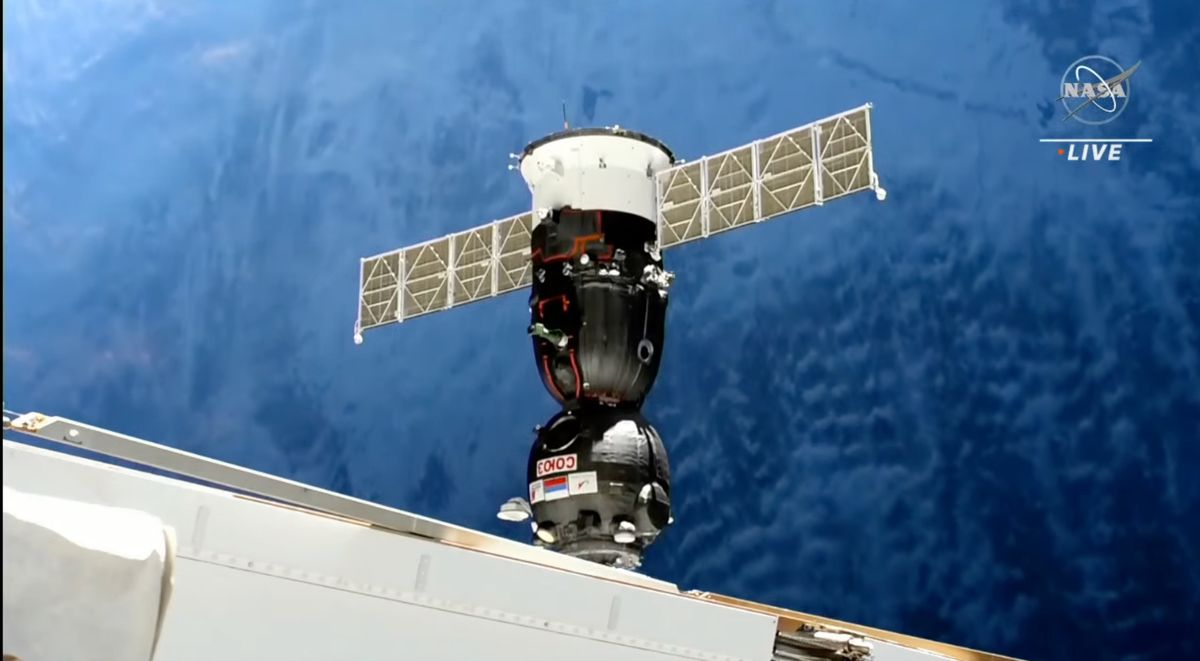
Russia has confirmed it will launch Soyuz MS-23 to the International Space Station in an uncrewed mode to replace the Soyuz MS-22 vehicle which suffered a major coolant leak in December 2022, following what is theorised a piece of dust striking the external radiator at a speed of 7 km/s.

Following the accident, a number of western experts suggested the Soyuz vehicle would be incapable of maintaining a safe temperature in the crew cabin during a return to Earth. After a month-long review of the situation, including examining options for a space-based repair, the Russian space agency Roscosmos has reached the same conclusion.

Video of the Soyuz MS-22 coolant leak, December 14th 2022. Credit: NASA

Soyuz MS-23 will therefore launch on or around February 20th in an automated configuration to provide the means for cosmonauts Sergey Prokopyev and Dmitri Petelin and NASA astronaut Franco Rubio to return to Earth at a later date – exactly when that will be is unclear; as a result of needing to use MS-23 as a replacement vehicle, crew rotations on the Russian side of things will be disrupted, and so Roscomos expects the MS-22 crew to extend their stay on the station by “several months”.

However, the February launch for MS-23 still means that should an emergency evacuation of the station be required in the next month, the crew of MS-22 would be without a ride home. To cover this, it has been suggested at least one MS-22 crew member (likely Rubio) could return on Crew Dragon 5 with the four astronauts it flew to the ISS in October 2022, and remaining MS-22use that vehicle -the thinking at Roscosmos being that with a smaller crew, the damaged cooling system on the Soyuz wouldn’t be so strained and could maintain “safe” temperatures within the vehicle.

Once MS-23 has docked at the station, MS-22 will be prepared for an automated return to Earth, where the investigation into the coolant loss will continue.

Repairs to the damaged vehicle were ruled out due to the difficulties involved in any spacewalk to do so – not the least of which was the risk of ammonia contaminating the spacesuits used and then being brought back into the ISS in high enough concentrations that it might pose a serious health risk if inhaled by any of the crew.

Continue reading “Space Sunday: Exoplanets and updates”

Space Sunday: a launch, a budget, a station & an astronaut

Cosmic Girl being readied to participate in the first space launch to commence from the United Kingdom

Virgin Orbit is – weather and systems permitting – due to make history on January 9th, 2023, with the first attempt to deliver a payload to orbit from UK soil (and Western Europe as a whole).

Clues that the launch – delayed from late 2022 due to final bureaucratic issues in the delay in a launch permit being issued by the UK’s Civil Aviation Authority (CAA) –  first appeared on Wednesday, January 4th, 2023, when maritime navigation warnings were issue by the UK and the Republic of Ireland identifying a region of open sea close to both denoted as “hazardous operations area for rocket launching”, and keen-eye observers noted it was consistent with the airspace identified as the drop zone for Virgin Orbit’s LauncherOne rocket.

The formal announcement of the launch attempt, which confirmed the warnings had been issued in relation to it, was made on Friday, January 6th, 2023. This indicates that the mission – called Start Me Up – is due to get underway at 22:16 UTC, when Virgin Orbit’s 747 carrier aircraft Cosmic Girl will take off from Spaceport Cornwall (aka Newquay Airport), the LauncherOne rocket mounted under the port wing, inboard of both engines.

The aircraft will then climb to an altitude of 11,000 metres, turning out over the sea to reach the launch zone where LauncherOne will be released and Cosmic Girl will enter a climbing turn, allowing the rocket to ignite its motor and accelerate into a near-vertical ascent to orbit. On board the rocket will be a total of nine smallsats with a total combined mass of roughly 100 kg or one-third of the launchers payload capability when launching into a Sun-synchronous orbit (SSO – also referred to as polar orbit), or one-fifth its payload capacity when delivering payloads to low Earth orbit (LEO).


Highlights of a 2021 Virgin Orbit launch

As well as being the first payload-to-orbit and rocket launch originating out of the UK / Western Europe, the mission marks the first joint launch mission by the US National Reconnaissance Office (NRO) and the British Ministry of Defence (MOD), managed under the guidance of the UK’s Space Operations Centre. Their intent is to place two cubesats, Prometheus 2A and 2B, into orbit to test the ability of such shoebox-sized satellites to perform a range of tasks including communications, GPS navigation data relay, and image gathering.

Following the launch, Cosmic Girl will return to Spaceport Cornwall and, later in the month, make a return flight to Virgin Orbit’s main operations centre at the Mojave Air and Spaceport, California, where it will remain for the rest of 2023 carrying out at least seven further LauncherOne flights. It is currently unclear when the next such flight will take place from UK soil.

NASA 2023 Budget Causes Tensions (As Usual)

The NASA budget for fiscal year 2023 has been set at US 25.4 billion in the Congressional Omnibus Spending Bill signed-off during the final session of the 2022 Congress. On the surface, the Bill represents an apparent 5.6% increase in the agency’s spending over 2022, but comes in at less that the US $26 billion requested by the Biden Administration and initially matched by the US Senate. As such, it is a compromise between the proposed Senate budget and the somewhat lower House budget proposes for the agency.

In terms of the human Exploration programme, the budget sees a US $88 million decrease in spending on both for the Space Launch System and the Orion Multi-Purpose Crew Vehicle (MPCV), which is in line with NASA’s proposed spending on both vehicles.

This is more than offset by an increase of US $300 million in spending on the Human Landing System (HLS) required to transport crews between lunar orbit and the surface of the Moon. However, and of potential interest is the fact that none of this money is to be directed towards the use of the SpaceX HLS despite NASA indicating it was looking to exercise “Option B” on that programme for a second lunar landing beyond Artemis 3, the money instead being solely directed towards additional funding for a n additional (i.e. replacement, in the long term) HLS vehicle.

An artist’s rendering of the ascent vehicle of a sustainable lunar Human Landing System lifting-off from its descent stage base, carrying a departing crew back to the orbital Gateway station. Credit: NASA

No budget is (again)is directly provided for the Lunar Gateway station; however, the budget report specifies NASA shall, before the end of the first quarter 2023, provide a breakdown on how it proposes to spend the US $2.63 billion of funding defined as the Artemis Development Programme,  which may offer a breakdown of proposes spending on the Gateway. In addition, part of this $2.63 billion may be used in the development if a “habitation systems programme office” to provide recommendations on the capabilities and technologies required to develop sustainable lunar surface habitats.

In terms of space sciences, the budget initially appears to offer an increase in spending over 2022. However, this again hides some harder realities. The total budget allowance for science missions is US $3.2 billion – some US $80 million more than 2022. However, the majority of this increase  – as per the 5.6% total increase in NASA’s budget – will be absorbed in costs incurred as a result of the COVID pandemic (which also impacted the 2022 budget), coupled with cost increases linked to inflation.

This means that in practical terms, NASA’s science operations are under enormous pressure. While some relief has been gained through missions such as the Mars Sample Return mission being pushed back by two years (2026 to 2028), allowing their costs to be spread more, NASA is also having to juggle other missions.

The Psyche mission to rendezvous and examine the battered 16 Psyche asteroid – the heaviest known M-type asteroid and thought to the exposed iron core of a protoplanet, has received funding in the 2023 NAS budget after being delayed by the COVID pandemic, but at the expense of the VERITAS Venus mission, which will now not launch until at least 2032. Credit: NASA

As a result, the agency has already announced the VERITAS mission to Venus will now launch “no earlier” that 2032 rather than the planned 2029, to allow the Psyche asteroid mission to achieve its planned October 2023 launch date. Elsewhere, the triple Earth Observation Science missions of Terra, Aqua and Aura, thought to have their funding secured through what is effectively their 21st year of operations, have been asked to submit justifications for their continued funding through 2023 and beyond, despite the fact that, while  all three satellites are running low in station-keeping propellants and are thus drifting slightly in their orbits, they continue to return excellent data on the global environment.

Some of the pressure on science budgets has caused both the Senate and the White House to try to intervene. In a joint letter to the Office of Management and Budget (OMB), they have requested an additional $150 million be provided each to NASA and the National Science Foundation (NSF) in order to support ground and space-based telescopes. If awarded. the NSF’s extra $150 million would go directly to continued funding of the prestigious Giant Magellan Telescope (GMT), the massive 25.5 metre diameter primary mirror optical telescope currently under construction at the  Las Campanas Observatory facility, Chile.

An artist’s impression of the Giant Magellan Telescope (GTO), for which the White House and US Senate are seeking an additional US $150 million. Credit: GMTO Corporation

Overall, the 2023 budget is being championed as the 10th successive increase in NASA’s budget, lifting it from US 17.7 billion in 2014 to US $25.4 billion – an apparent increase of almost US $8 billion. However, when inflation alone is accounted for, this amounts to just a US $2.54 billion increase in the same period, the majority of which has been taken up by increases in labour, materials, and other costs.

Nor is this money devoted to just highly-visible projects and space missions; the NASA budget covers a broad range of science, aerospace and R&D programmes, as well as STEM activities, materials development, small business funding and grants (aerospace and science related), university research grants, and more. All of which mean that, in real terms and accounting for inflation, NASA – despite the greater demand being placed on it to develop ever more complex human space capabilities – continues to be a highly cost-effective government organisation.

Continue reading “Space Sunday: a launch, a budget, a station & an astronaut”

Space Sunday: China’s plans, Hubble and Soyuz

An artist’s rendering of the Tiangong space station is it is at present. but showing a Shenzhou crew vehicle attached to the nadir port of the main docking hub. Any additional core module will be attached to the axial port of the hub (and so would extend to the left of this image). Credit: CCTV

China continues to grow and expand its astronomy and space aspirations. In a series of announcements, the country has indicated its aims for Earth-based astronomy, the expansion of its space station, international co-operation and more on it plans for a presence on the Moon.

With the Tiangong station only having recently been “completed” in terms of its pressurised modules with the arrival of the Mengtian science module in October, China had originally indicated that the only remaining module awaiting delivery to the station was the Xuntian space telescope, capable of docking with the station for maintenance, but designed to operate as a free-flying automated platform to be launched in 2023.

However, Wang Xiang, director of space station systems at the China Academy of Space Technology (CAST), has indicated China is considering adding a second “core” module to Tiangong. If this goes ahead, it will be mated to the axial port of the current docking hub at the forward end of the Tinahe-1 module.

According to Wang, the new module will provide a larger and more comfortable living environment for crews, and would include its own docking hub capable of supporting two further modules as well as accepting vehicles docking at its the axial port. This would allow the station to double in size and support larger crew numbers, as well as allowing it to operate for considerably longer than the planned 10-year time frame.

A breakdown of the current Tiangong space station modules and supporting vehicles. Credit: Shujianyang (via Wikipedia)

In addition, CAST has announced China is working with Saudi Arabia, the United Arab Emirates and other Gulf states to reach partnership agreements which could see these states working alongside China aboard Tiangong, developing a human presence on the Moon and in deep-space astronomy and robotic exploration.

Among other aspects of the agreement is the potential to establish a China-GCC (Gulf Cooperating Council – comprising Saudi Arabia, Qatar, UAE, Bahrain, Oman, and Kuwait) joint centre for lunar exploration, which would also oversee the selection and training of tiakonauts from GCC member states.

In terms of the latter, China is keen to gain international partners in its vision for lunar exploration in order to match the Artemis Accords. The latter is a set of a non-binding agreements that (to date) has seen 23 nations agree to support the US-led return to the Moon with personnel, materiel and scientific endeavours.

China’s lunar aspirations are seen by some as potentially kicking-off a new “space race”, given both it and the United States have identified the Moon’s south polar regions as the most likely location for establishing bases, given the relative accessibility of water ice within craters there. Whether this proves to be the case remains to be seen; certainly, there is a degree of chaffing within China at being excluded from all international space efforts involving the United States; however, the country has been developing its own approach to space exploration for decades without feeling the need to be seen as directly competing with the US in a manner akin to the US / Soviet space race.

A computer generated model of the interior of the EAST observatory showing the competed 8-metre primary mirror on its focusing support mechanism (in deep blue) and the secondary mirror supports (red) complete with the secondary mirror housing at the top (brown). Credit: Peking University

With regards to astronomy, China is also looking to build its own version of the James Webb Space Telescope (JWST), with the first phase of the observatory being operational by 2024, and the completed facility operational by around 2030.

The project is to be led by the Peking University, but rather than being launched into space, this observatory will be Earth-based. Referred to as the  Expanding Aperture Segmented Telescope (EAST), the observatory will have a primary mirror similar to that of JWST, a 6-metre diameter made up of 18 individual hexagonal mirrors which work both individually and collectively to focus the light they gather into the secondary mirror for transfer back into the telescope and its instruments.

The site for the observatory is Saishiteng Mountain within the Qinghai Province on the Tibetan plateau, 4.2 kilometres above sea-level, well above the majority of the denser atmosphere, making it much easier for the telescope to also compensate for the distorting influence of that atmosphere.

But that’s not all; as an Earth-based telescope, EAST will be constructed in two phases. Once the 6-metre primary mirror system has been completed, and as funding allows, the addition of a further 18 mirror segments, increasing the mirror’s diameter to almost 8 metres; 1/3 as big again as JWST.

A drawing showing the initial 6, primary mirror design (to be completed by the end of 2024) and the planned expansion to an 8-metre mirror (r). Note the black hexagon marks the focusing port / tertiary mirror which carries light gather by the primary and scondary mirrors down to the instruments. Credit: Peking University

The cost estimate for the first phase of the observatory’s construction has been put at a mere US $69 million, with the expansion work – to be completed by 2030, as noted, to cost around a further US $20 million, compared to JWST’s estimated US $9 billion construction cost – although in fairness, EAST is an optical, rather than infra-red telescope, and so doesn’t require the need to operate at extremely lower temperatures, making it a lot less complex. When completed, EAST will be the largest optical telescope in the eastern hemisphere.

NASA Issues RFI Regarding Hubble Reboost

Since its launch in to a 540 km orbit above Earth in 1990, the Hubble Space Telescope (HST) has required regular “reboosting” as drag caused by friction contact with the tenuous upper atmosphere caused its orbit to decay. Up until 2009, these operations were completed by the US space shuttle as a part of scheduled HST servicing missions, with the very last mission serving to push HST to its highest orbit in anticipation of the shuttle being retired from active duty in 2011.

However, since then, atmospheric drag has reduced its orbit by some 60 km, and unless countered, it will force NASA to de-orbit HST in 2029/30 to ensure it burns-up safely and any surviving debris falls into the Pacific Ocean. By contrast, a re-boost mission could extend Hubble’s operational life by another 20 years.

In September 2022, NASA joined a study involving SpaceX and the Polaris group examining the feasibility of using a Crew Dragon vehicle in a servicing / reboost mission to the Hubble Space Telescope (HST). This work has now been expanded into a request for information on possible reboost mission options. Credit: NASA

To this end, in September 2022, SpaceX and billionaire Jared Isaacman – who has already funded one private mission to space using a Crew Dragon vehicle (Inspiration4) and is currently planning a further series of flights under the Polaris mission banner – started work on an unofficial mission outline to  rendezvous with HST and then boost its orbit. NASA then joined in these discussions on a non-exclusive basis or commitment to manage any reboost mission.

On December 22nd,  NASA issued a formal request for information (RFI) based on those discussions and exercising their non-exclusive nature to invite any interested parties to propose how a reboost mission might be completed, whether or not it expressly uses SpaceX hardware or some other, likely automated, booster vehicle. The RFI period is short, closing on January 24th, 2023, and the information gathered from respondents will be assessed over a further 6-month period and alongside the SpaceX / Polaris study to determine the best means of carrying out such a mission.

In this, there are both challenges and opportunities: HST is primarily designed to be serviced by shuttle, so by default it does have the capability to dock with the likes of SpaceX Dragon or other craft without the risk of damage. However, during the 2009 servicing mission, it was equipped with a Soft Capture Mechanism (SCM), a device primarily designed to allow a small automated vehicle attach itself to Hubble as part of a de-orbit mission. But with a suitable adapter, it might be used by a vehicle the size of Dragon to safely mate with HST and then ease it to a higher orbit.

Soyuz MS-22 Leak Update

The Russian space agency, Roscosmos, has stated it will conclude its investigation in to the status of Soyuz MS-22 towards the end of January 2023.

As I’ve reported in recent Space Sunday updates, the vehicle was used to carry cosmonauts Sergey Prokopyev and Dmitry Petelin and NASA astronaut Francisco Rubio up to the ISS in September 2022, where it has been docked ever since. However, on December 14th, 2022, the vehicle suffered an extensive ammonia coolant leak, potentially crippling it.

The exact cause of the leak has yet to be determined, although Roscosmos remains convinced it was the result of either meteor dust or a tiny piece of space debris impacting the Soyuz coolant radiator, puncturing it. However, their focus has not been on determining the cause of the leak, but in trying to determine whether or not the vehicle is capable of returning the three crew to Earth safely, or if a replacement vehicle will be required.

Video of the Soyuz MS-22 coolant leak, December 14th 2022. Credit: NASA

As I noted in my previous Space Sunday update, should Roscosmos decide a replacement vehicle is required to return Prokopyev, Petelin  and Rubio to Earth, it will likely be Soyuz MS-23, which would be launched in February 2023 to make an automated rendezvous with the space station. However, it is now being reported that NASA has also contacted SpaceX to assess the feasibility of using Crew Dragon to return some or all of the MS-22 crew to Earth.

In this, it is unclear as to precisely what NASA has requested of SpaceX, and neither party is commenting. One theory is that the request is to determine whether the current Crew Dragon vehicle currently docked at ISS could carry additional personnel to Earth, if required. Another is NASA wishes to access the potential of launching an uncrewed Dragon to the station as a means to act as an emergency back-up for evacuation of the station – should it be required – prior to MS-23 being available to launch.

Both options are long-shots; getting Crew Dragon vehicle and its Falcon 9 rocket ready for launch in advance of MS-23 – a mission already in preparation, regardless of whether it flies with its planned crewed or uncrewed – is not an easy task. Further Dragon isn’t equipped to handle Russian space suits, the kind used by Prokopyev, Petelin  and Rubio. As such, to even consider Crew Dragon as temporary lifeboat  – much less a replacement for MS-23 to bring the three crew back to Earth – would require not small modification to its support systems. Similarly, while the Crew 5 vehicle might be able to return one or two of the MS-22 crew to Earth should it be necessary to do so, there is also the no insignificant matter of getting its life support systems to work with the Russian space suits.

One particular area of concern is that a number of experts outside of NASA / Roscosmos have opined that whatever Roscosmos may announce at the end of January, MS-22 is unlikely to be safe to bring its crew home. Therefore, should Roscosmos opt to do so, NASA might opt to look to other means to return astronaut Rubio to Earth as a matter of safety.


Space Sunday: Mars missions and the Soyuz leak

NASA’s Mars 2020 Perseverance rover has started preparations to have some of the samples it has gathered to be returned to Earth for extensive analysis.

Since its arrival on Mars in February 2021, the rover has been exploring Jezero Crater and collecting samples of sub-surface rocks in much the same manner as its older sister, Curiosity, which arrived within Gale Crater half a world away on Mars 12 years ago.

Some of these samples have been subject to on-board analysis by the rover’s internal lab, but for the most part they have been sealed in special tubes stored in an on-board cache, part of a total volume of 43 such tubes it carried to Mars tucked within its underside.

The idea behind the tubes – one of which has been used to collect a sample of the Martian atmosphere, and five more contain various materials intended to capture particulates in the ambient environment – is that they would form one or more sample caches Perseverance could deposit at locations where they could later be collected for return to Earth by a European-American sample-return mission.

Thus, on December 21st, 2022, the rover started building the first of these caches with the “drop” of the first tube to be selected for surface caching. The operation involved the rover parking at a recognisable feature within Jezero crater – dubbed “Three Forks” – and then rotating the rotunda of sample tubes so that the selected tube – containing samples of igneous rock collected at the start of 2022 – could be released and dropped to the Martian surface. Then, to confirm the operate had succeeds, and the tube wasn’t snagged somewhere in the mechanism, NASA commanded the rover to use its robot arm to peer down between its wheels and use the camera mounted on the end of the arm to confirm the position of the tube and check its overall condition.

Somewhat resembling a light sabre from the Star Wars franchise, the sample tubes are made up of a mix of materials designed to protect their contents from the rigours of being placed out in the harsh Martian environment and and rick of contamination by solar radiation or by the future process of transferring them to the vehicles that will be used to return them to Earth.

Resembling a Star Wars light sabre, a sample tube dropped by the Mars 2020 rover Perseverance on December 21st marks the start of an operation to place 10 sample tubes in a cache for collection by a future mission which will return them to Earth. Credit: NASA

This resemblance to a light sabre is something that has not been lost on the mission team at NASA’s Jet Propulsion Laboratory.

I’ve been holding out my hand to my computer screen to see if the tube will be transported from Mars, since as director, I’m pretty sure the Force is with me, right? OK, so no joy so far, but I’ll keep trying!

– Laurie Leshlin, NASA’s Jet Propulsion Laboratory director

A photo of the “Three Forks” cache site in Jezero Crater, Mars, depicting the points at which the ten sample tubes will be dropped by the Perseverance rover. Credit: NASA

In all, ten of the 22 tubes so far used by the rover will be dropped around the “Three Forks” location – each one in its own drop point to facilitate easier pick-up. The second of the ten – containing the longest core sample thus far collected by the rover, comprising sedimentary rock taken from the edge of an ancient outflow delta in the crater – was dropped on December 22nd. A second cache of tubes will be established elsewhere in the crater at a later period in the rover’s mission to offer an alternate collection point for samples.

The current plan for the sample-return mission (July 2022) requires an orbiter / return vehicle to be supplied by the European Space Agency and delivered to Mars orbit in May 2028. At around the same time, a Sample Retrieval Lander built for NASA, will also arrive on Mars relatively close the the selected sample cache and carrying an sample ascent vehicle and two small helicopters similar to Ingenuity, already operating on Mars in concert with Perseverance.

The Mars Sample-Return Mission elements. top: the ESA- built orbiter / return vehicle; right: the sample lander with the ascent vehicle above it, carrying the sample back to the orbiter; left: the Perseverance rover and an Ingenuity-class Mars helicopter, one or other of which will be used to transfer sample tube to the lander vehicle, which will load them into the ascent vehicle. Credit: NASA / ESA.

Perseverance, which will have returned to the cache site in the interim, will then collect the sample tubes and pass them to the lander vehicle, which will then use a special robot arm to stow them in the ascent vehicle. Should Perseverance be unable to carry out the collection and transfer, the two helicopters will do so instead. Once all the samples have been collected, the ascent vehicle will launch to a rendezvous with the orbiter, and the containment unit with the sample transferred to it for the return to Earth, arriving in 2033.

Goodnight, InSight

As one team at NASA’s Jet Propulsion Laboratory were celebrating the success of the latest phase of their mission, another team was saying a final “farewell” to their mission vehicle.

Having operated for a total of four years on Mars – two years longer than its primary mission period – the NASSA InSight lander’s mission was officially brought to an end on December 21st, 2022, its mission team no longer able to communicate with it.

InSight on Mars, December 1 2018, on Flickr
Three images captured by the HiRISE camera on NASA’s Mars Reconnaissance Orbiter, released on December 13th, 2018. Left: the lander’s aeroshell and parachute. Right: the heat shield, discarded after EDL and ahead of parachute deployment on November 26th, 2018. Centre: InSight itself with a surrounding ring of regolith blasted by the lander’s landing motors. The teal colour is not genuine, but the result of sunlight being reflected off of the lander and its parts saturating the HiRSE imaging system. Credit: NASA/JPL

Whilst not as exciting as an ambulating rover mission, InSight – short for  INterior exploration using Seismic Investigations, Geodesy and Heat Transport – was a massively ambitious mission, full details of which can be found in Space Sunday: insight on InSight. As the name suggests, the overall aim of the mission was to gain information on the processes going on deep within Mars.

To achieve this, the lander notably included two experiments it had to transfer from its deck to the surface of Mars, post-landing. One of these experiments, the Heatflow and Physical Properties Package (HP3) and involving a self-propelled “Mole” designed to investigate how much heat is emanating from Mars’ core, did not fare too well, the Mole becoming stuck very early in its attempt to burrow into the ground.

However, the second surface package, SEIS (Seismic Experiment for Interior Structure) – the primary mission element for the lander – proved to be highly successful in its goal of recording details of “marsquakes” and other sound-generating events within and on the planet (such as recording meteor impact later traced to a new 150m diameter crater on the planet), allowing scientists build up a clearer understanding of the planet’s internal structure and activity.

In all, SEIS measured over 1300 seismic events in 4 years, marking Mars as still being geologically active deep below its surface. Fifty of these events were “loud” enough to reveal information about their location on Mars, with a large cluster of them coming from Cerberus Fossae, a region of the planet having been thought to be geologically active relatively recently in its 4.5 billion year history, with many “young” surface features.

SEIS also showed that the Martian core is molten but is larger than thought and less dense than the lower crust. Lighter elements mixed with molten iron in the core lower its density, which explains how the core can still be molten even after cooling considerably.

As a static lander, InSight always had a limited lifespan; as a solar-powered vehicle, its panels would inevitably become so coated in dust and subject to deterioration in the harsh Martian environment that they would no longer be able to generated sufficient power to charge the lander’s batteries.  However, it had been hoped that dust devils, tiny Martian tornadoes created during the changing of the Martian seasons, might help “clean” the panels in much they same way they have with the solar-powered MER rovers. Unfortunately, this was not the case – possibly because the 2m diameter solar arrays used by the lander were simply too big for passing dust devils to effectively blow accumulated dust off of them.

Continue reading “Space Sunday: Mars missions and the Soyuz leak”

Space Sunday: spaceship leaks, exo-Earths & an ancient solar observatory

Ammonia coolant spews from the Soyuz MS-22 vehicle docked against the Rassvet module of the International Space Station. Credit: NASA TV

A potentially serious issue occurred at the International Space Station this week when Soyuz MS-22 developed a coolant leak in the early hours of Thursday, December 14th, almost 3 months after the vehicle had docked with the station to deliver Russian cosmonauts Sergey Prokopyev and Dmitry Petelin, together with American astronaut Francisco Rubio to commence a 6-month tour of duty.

Named for Konstantin Tsiolkovsky, the father of Russian cosmonautics, the vehicle experienced an uncontrolled leak of ammonia coolant which started at 00:45 UTC and ran for several hours, generating stream of material jetting outwards from the vehicle and causing the station crew to have to stabilise the structure.

At the time the leak was detected, cosmonauts Petelina and Prokopyev were preparing to embark on a spacewalk to carry out maintenance work on the Russian segment of the ISS, where the Soyuz is docked. The EVA was called off due to concerns the cosmonaut’s spacesuits could be contaminated with the hazardous coolant fluid.

A second Russian EVA set for December 21st was also later cancelled over concerns about the leak; however, NASA initially indicated a spacewalk due to talk place on the US / International side of the station would go ahead, later deciding to postpone it in favour of assisting Roscosmos in trying to assess the amount of damage caused to the Soyuz – and possibly to the ISS.

As the leak curtailed, cosmonaut Anna Kikina – the first Russian to fly to the ISS aboard an American commercial crew vehicle as a part of a seat exchange programme between NASA and Russian space agency Roscosmos – used a European-built robotic arm attached to the Russian Nauka science module delivered to the ISS in 2021 to inspect the Soyuz craft. Further inspections by both the Russians and Americas using their respective robot arms are also being scheduled.

Operated by Anna Kikina, the European- supplied robot arm attached to the Nauka module is extended to image the exterior of Soyuz MS-22 in an attempt to assess the damage caused by the coolant leak. Credit: NASA TV

The exact nature of the leak is unknown. However, the former head of spaceflight safety at the European Space Agency Tommaso Sgobba, believed the leak occurred with the vehicle’s active coolant system, most likely crippling it “beyond repair”. This appeared to be borne out both by the images captured by Kikina using the Nauka module’s robot arm – which shoe extensive damage to the outer skin of the instrument and assembly compartment of the vehicle. Since the leak, Roscosmos has reported the interior temperatures of the vehicle’s pressure modules had risen to 30C which, despite being referred to as being within “acceptable limits”

On Friday, December 16th, 2022, the Russian space agency began remote testing of a number of the vehicle’s systems – including its thrusters – in an attempt to ascertain its space-worthiness.

If the vehicle is unfit to fly, it means Prokopyev, Petelin and Rubio will be unable to use it to make their scheduled return to Earth in March 2023 – although reports that this leaves the three “stranded” in space are somewhat exaggerated. There are a number of ways in which the three can be returned to Earth either individually or collectively:

  • Soyuz is fully capable of automated flight and docking with the ISS (it can use the same system as the Progress re-supply vehicles – themselves essentially uncrewed Soyuz – to reach the ISS and provide the three with a ride home.
  • Failing this and allowing for the necessary crew alterations, both Soyuz and Crew Dragon can fly to the ISS with a vacant seat, which can then be used by one of the MS-22 crew.
  • The Boeing CST-100 Starliner is due to make a crewed flight to the ISS in April / May 2023, a month or two after MS-22 is scheduled to return. It could, with some adjustment to the mission, be used to return one or two of the MS-22 crew as well as the main crew at the end of its week-long stay at the ISS.

Of these three options, the first would appear to be the most likely. For now however, assessments of MS-22’s overall condition are on-going and (for now) leave the door open on a fourth option: if the vehicle is deemed safe to make an immediate return to Earth, the three crew members curtail their mission and come home three months early.

The Artemis 1 mission to cislunar space is a potential watershed moment in space exploration., potentially the first genuine step in a human return to the Moon, with the potential to reach even further into the solar system. It’s a mission I covered in these pages over a number of articles, up to an including the previous piece. However, for those who would like to relive it in a compressed manner NASA has released a video of the mission’s highlight from launch to splash-down.

Running to 24 minutes – just shy of a total reflecting  the duration of the mission in days – the video is a fascinating compression of the mission, presenting many iconic images of the vehicle, the Moon and Earth.

Continue reading “Space Sunday: spaceship leaks, exo-Earths & an ancient solar observatory”

Space Sunday: 50 years – last and first at the Moon

Apollo 17 lifts off from Launch Complex 39A, Kennedy Space Centre, December 7th, 1972. Credit: NASA
At 05:33 UTC on December 7th, 1972, the last of the Moon-bound Saturn V rockets thundered into the Florida skies from Kennedy Space Centre’s Launch Complex 39A At the start of the Apollo 17 mission.

Looking back at the Apollo era now, it is incredible to think that the entire project was conceived and – in terms of its lunar aspirations –  executed in just 13 years, with the missions to the land humans on the Moon all taking place within a span of just 42 months. It was originally initiated in early 1960 under the Eisenhower administration as a means for the US to expand its space capabilities by providing a vehicle system capable of being used in the construction of a space station and, eventually, of carrying humans to the Moon. But in 1961 the project was co-opted as the best means of achieving President Kennedy’s desire to see America “commit itself to achieving the goal, before this decade is out, of landing a man on the Moon and returning him safely to the Earth”.

In doing so, Apollo set in motion the biggest single increase in NASA’s capabilities ever witnessed, giving rise to the facilities – such as the Merritt Island Launch Operations Centre with its massive VAB and two launch facilities at pad 39A and Pad 39B, and the sprawling mass of the Johnson Space Centre in Texas (often colloquially referred to as “Mission Control”) – people take for granted today as the most public elements of NASA’s infrastructure. Even so, by the time Apollo 11 landed on the Moon, the programme had already started towards closure: Apollo 20 had already been diverted for use in the Skylab project, while Apollo 18 and 19 would be cancelled early in 1971, leaving Apollo 17 as the last Apollo flight to the Moon.

The Apollo 17 crew: seated in the lunar rover replica is Gene Cernan, with Harrison Schmitt to the left behind him, and Ronald Evans to the right
The Apollo 17 crew, 1972: seated in the lunar rover replica is Gene Cernan (Commander), with Harrison Schmitt (Lunar Module pilot) to the left behind him, and Ronald Evans (Command Module pilot) to the right, and the Saturn V launch vehicle on the pad behind them. Credit: NASA

A “J-Class” mission, Apollo 17 was one of only three of the lunar flights designated as being for “extensive scientific investigation”, the missions up to and including Apollo 14 being focused primarily on the task of making precision lunar landings, with all science activities running secondary to that. It was also the only Apollo mission to the Moon to carry a full trained scientist in the form of geologist Harrison H. Schmitt.

Initially, Schmitt had been slated for Apollo 18, but when that mission was cancelled, there was a push from the science community to have him moved to Apollo 17 – a push resisted by mission commander Eugene Cernan, who (understandably) wanted to keep his original team of himself, Ronald Evans and Joe Engle. However, Cernan’s own leadership of the mission was seen as questionable by some at NASA after pilot error on his part caused during a training flight resulted in a helicopter crash; so when it became clear the choice was to replace Engle with Schmitt or have the who crew replaced, Cernan capitulated – and he and Schmitt went on to form a strong working relationship and friendship.

En-route to the Moon: Harrison Schmitt catches a cheeky-looking Eugene Cernan (l) and Ronald Evans (r). Credit: NASA

The only night-time launch for an Apollo lunar surface mission, Apollo 17 proceeded precisely on schedule despite a brief launch-pad delay. Planned as the longest of the Apollo missions at 12 days and 14 hours, it would also become the most successful of the three lunar science flights for Apollo, with the science work commencing whist en route to the Moon, with the crew carrying out observations of Earth and its weather patterns. Also carried aboard the Command Module were 5 additional crew members: pocket mice the crew unofficially named Fe, Fi, Fo, Fum and Phooey. Carried in their own self-contain life support unit, they were part of an experiment to investigate exposure to cosmic rays in interplanetary space, although the findings of the experiment were ultimately inconclusive.

This science work took a further turn when, as the CSM and LM combination approached the Moon, a panel on the side of the Service Module was jettisoned to expose the contents of the Scientific Instruments Module (SIM), a battery of lunar science packages Evans would monitor whilst his crewmates were on the Moon’s surface.

America’s exposed Science Instruments Module (SIM) imaged from the Lunar Module Challenger. Credit: NASA
These experiments comprised a lunar sounder designed to map the interior geology of the Moon to a depth of 1.3 km; an infra-red scanning radiometer intended to obtain a temperature  map of the Moon’s surface to assist in understanding structural differences in the lunar crust; and a far-ultraviolet spectrometer to obtain data on the composition, density, and constituency of the lunar atmosphere and detect far-UV radiation emitted by the Sun that had been reflected off the lunar surface. Also in the SIM bay were a pair of cameras for imaging the Moon and a laser altimeter.

twenty-four hours after entering orbit around the Moon, Schmitt and Cernan boarded the Lunar Module Challenger, departing the Command Module America on December 11th, 1972 to touch down within the Taurus-Littrow valley at 19:54:58 UTC that day. The landing marked the start of some 75 hours on the lunar surface. During this time, Cernan and Schmitt carried out 3 EVAs, two of them making use of the third Lunar Rover vehicle to the carried to the Moon.

Challenger orients itself ready to start its descent to the lunar surface, as captured by Ronald Evans aboard America. Credit: NASA

The rover was deployed during the first EVA, with Cernan managing to repeat an error made by John Young on Apollo 16, accidentally ripping off one of the dust guards over the rover’s wheels such that both he and Schmitt would be showered in lunar “fines” (dust) kicked up by the wheel when the rover was in motion despite efforts to make repairs under Young’s supervision. In addition, this EVA also saw the two men deploy the surface experiments designed to be used within the vicinity of the Lunar Module.

The second EVA, on December 12th set a series of records for lunar surface operations: the furthest distance travelled from the LM (7.6 km), the longest distance travelled in a single EVA overall, the most time spent of the surface of the Moon in a single EVA (7 hours, 37 minutes) and the largest haul of samples from a single EVA to that point – 34 Kg. Along the way they visited several sites – Nansen Crater, at the foot of the South Massif; Shorty crater, and Camelot crater,

This EVA would go down in history for other reasons as well. At Shorty Crater, Schmitt came across orange soil, never before seen on the Moon. Initially it was thought he’d come across a volcanic vent in the lunar crust, but subsequent analysis of the material’s tiny volcanic beads revealed it has been formed some 3.5 billion years ago during the Moon’s volcanic period, and was exposed when a small asteroid slammed into the Moon to form Shorty a mere 20 million years ago.

Between Nansen and Shorty, the crew also stopped at a then-unnamed crater where Schmitt stumbled and fell in an awkward pirouette. While the fall left him uninjured, it prompted duty CapCom Robert Parker to quip to the crew that the Houston Ballet had called, requesting Schmitt audition for them on his return to Earth (in 2019, the crater was officially named Ballet Crater in honour of Schmitt’s tumble). Also during the EVA, both men (led by Schmitt) offered their own take on the popular song I Was Strolling in the Park One Day, which more than anything else revealed the bond that had grown between them.

The final Apollo era lunar EVA began at 22:35 UTC on December 13th, 1972, carrying out surveys of three “stations”: the North Massif and the Sculptured Hills; a house-sized boulder Cernan dubbed “Tracy’s Rock” after his daughter; and Van Serg crater. Whilst short in distance that the second EVA, this one set a further new record for samples collected – 66 Kg, including the 8 Kg sample designated 70215, a small part of which is now displayed at the Smithsonian Institution as one of the few samples of lunar rock the general public can touch.

At the end of the EVA, Schmitt and Cernan unveiled a plaque mounted on the side of the Lunar Module’s descent stage, commemorating both their own time on the Moon and the Apollo mission as a whole. Schmitt then climbed back into the LM, leaving Cernan as The Last Man On the Moon, expressing some of his thoughts thus:

I’m on the surface; and, as I take man’s last step from the surface, back home for some time to come – but we believe not too long into the future … And, as we leave the Moon at Taurus-Littrow, we leave as we came and, God willing, as we shall return, with peace and hope for all mankind.

– Eugene Cernan, December 13th, 1972

A composite image of Harrison Schmitt alongside of “Tracy Rock”, taken by Eugene Cernan. Credit: NASA

Cernan and Schmitt successfully lifted off from the lunar surface in the ascent stage of the LM on December 14th, 1972 at 22:54 UTC. Following a 7-minute ascent, they entered lunar orbit and coasted to a rendezvous with America, where Evans had been busy with his own work. Following docking and transfer, Challenger was jettisoned at 04:51 UTC on December 15th, 1972, to be successful de-orbited to crash on the Moon’s surface where seismometers left by several Apollo mission recorded the impact.

While en route back to Earth, Evans completed one of only three “deep space” EVAs so far performed, and the last EVA of the Apollo missions to the Moon. At 296,000 km from Earth, he departed the Command Module, watched over by Harrison Schmitt, and retrieved the film cassettes from the cameras in the SIM on the Service Module.

America re-entered Earth’s atmosphere and splashed down safely in the Pacific Ocean at 19:25 UTC, December 19th, 1972 just 6.4 km from the recovery ship USS Ticonderoga. The splashdown brought the Apollo lunar missions to a close. However, 5 more missions would fly under the Apollo banner: the four Skylab missions between 1973 and 1974 (which included the final flight of an Apollo Saturn V rocket), and the lS half of the Apollo-Soyuz Test Project (ASTP) in 1975.

Apollo 17 marked the last time Cernan flew into space, and the first and last times Schmitt and Evans did likewise. In 1976, Cernan departed NASA for the private sector, but maintained strong views on the direction of the US space programme, being highly critical of the Obama administration’s cancellation of the Constellation Programme and NASA’s move to rely on private sector resources. He passed away in January 2017, and is the subject of an obituary in these pages,

Ronald Evans remained at NASA until March 1977, performing key roles in both the ASTP mission and in the development of the space shuttle system. He passed away in 1990 after suffering a heart attack in his sleep. Harrison Schmitt was the first of the three to depart NASA, doing so in 1975 to pursue his political aspirations as a Republican Senator for New Mexico (1976-82). He became chair of the NASA advisory council in 2005  but then abruptly resigned 2008, clashing with NASA on the subject of climate change – of which he is a fervent denier (going so far as to state in 2013 that rising CO2 levels in the atmosphere are “good” because they allow us “to grow more crops”). He has also aligned himself with extremist conspiracy theorists such as Alex Jones.

Artemis 1 Comes Home

While it was not planned this way, fate determined that the 50th anniversary of Apollo17 landing on the Moon would be shared with the return to Earth of the first of NASA’s next generation of crew-carrying, lunar orbit capable vehicles, the Orion Multi-Purpose Crew Vehicle (MPCV).

I’ve covered the 26-day mission of Artemis 1 over the last few editions of Space Sunday. In many respects, it is the “reverse book-end” of Apollo 17; while the latter brought America’s first forays to the Moon to an end, Artemis 1 opens the door to a far more ambitious, international, and potentially far-reaching return to the Moon.

Perhaps the most iconic image of the Artemis 1 mission. Captured on December 5th, 2022 as the vehicle swings around the Moon, it shows the crescent Earth in the distance, the shadow of the Moon partially covering it. Credit: NASA

The mission, launched on November 16th, 2022, sent the Orion vehicle on a wide, slow cruise out to the Moon, which it transited past on November 21st, to enter a distant retrograde orbit (DRO), where it remained until December 5th, when a second close pass by the Moon allowed it to fire its main engine and start its way back to Earth.

The extended nature of the mission was to allow the systems on Orion to be thoroughly checked out over the duration of a typical mission duration, and to gather data on how well the vehicle protects the crew from radiation in the interplanetary medium – and the likely impact of exposure to the likes of cosmic radiation on humans who will spend 20-30+ days away from the protection of Earth’s magnetic fields.

December 11, 2022: Artemis 1 approaches Earth ahead of the Orion capsule separating from the Service Module. Credit: NASA

Approaching Earth on December 11th, 2022, the Orion capsule separated from is its European-built Service Module at 17:00 UTC, immediately performing a “skip” re-entry. This saw the capsule descend to around 60 km above the Earth before rising once more to 90 km to start its “full” re-entry. This “skip” manoeuvre allowed the vehicle to shave off its huge velocity – 40,000 km/h – in stages, both reducing  the over G-load the vehicle would face in a single go whilst also offering a greater flexibility in selecting a  splashdown location should there be an issue with the primary.

Splashdown came at 17:40 UTC bringing to an end a test flight covering a total distance of 2.3 million km. Prior to striking the water, the last of the vehicle’s velocity was reduced through the use of no fewer than 11 parachutes, opened in groups during its descent through the denser atmosphere.

Splashdown! 17:40 UTC, December 11th, 2022: the flight of Artemis 1 concludes as the Orion capsule splashes down safely off the coast of California. Credit: NASA / US Navy

While the mission will be subject to an extensive post-flight analysis, the general consensus is that SLS rocket and the Orion vehicle passed the test with more-or-less flying colours, helping to ensure things remain on course for the crewed mission of Artemis 2, due to take place in May 2024 over 10 days, head of the first planned lunar landing for Artemis 3, currently planned for launch in 2025.