Peter Gray has just informed me that on Wednesday February 5th, the board of directors of Linden Lab formally announced the appointment of Ebbe Altberg as the company’s Chief Executive Officer.
The press release announcing his appointment reads in part:
SAN FRANCISCO — February 5, 2014 —Linden Lab®, the makers of Second Life®, BlocksworldTM, DesuraTM, and more, today announced that Ebbe Altberg will lead the company as its new Chief Executive Officer.
Ebbe Altberg (image courtesy of Linden Lab)
“We remain committed to world-changing innovation from Linden Lab,” said Jed Smith of the company’s Board of Directors. “We’re keenly focused on providing incredible experiences for all of our customers, and Ebbe is the perfect person to help lead our team as we continue to serve and grow our global audience of active users.”
“Linden Lab has long been at the forefront of building experiences that entertain people while empowering them to express themselves and profit from their creations,” said Altberg. “Our customers’ creativity is unparalleled, and I’m proud to join the talented team that serves them. Second Life is now in its eleventh year, and every day, users continue to create more and more amazing experiences to enjoy. Though much younger, Blocksworld has already seen hundreds of thousands of unique user-created worlds shared for everyone to play with. I’m absolutely committed to supporting our customers and helping them become even more successful. There are significant opportunities ahead, and I look forward to leading us into the next phase of growth.”
The appointment brings to an end almost two weeks of silence on the matter of the CEO position, following Rod Humble’s surprise announcement that he had departed the company, which was made via his Facebook account, and the news broken by Jo Yardley on January 24th, 2014.
Update, October 9th, 2014: Linden Lab announced that development work on Patterns has been discontinued.
I’m not sure what has happened with the Patterns roadmap; when launched, the original idea was that the product would remain in a Genesis version for about a year prior to progressing to an official “version 1.0” release. However, here we are at the start of 2014, and Patterns is still apparently in Genesis mode with version 0.06 released on Monday January 20th, and the development team promising lots more to come as Patterns progresses.
Not that this is necessarily a bad thing; a lot of what is going on appears to be as a direct result of user input, and the development team are refreshingly engaged with the Patterns community through blog posts, wiki updates, forum posts and live streams. Makes one long for the crazy, heady, communications-rich days of old in Second Life!
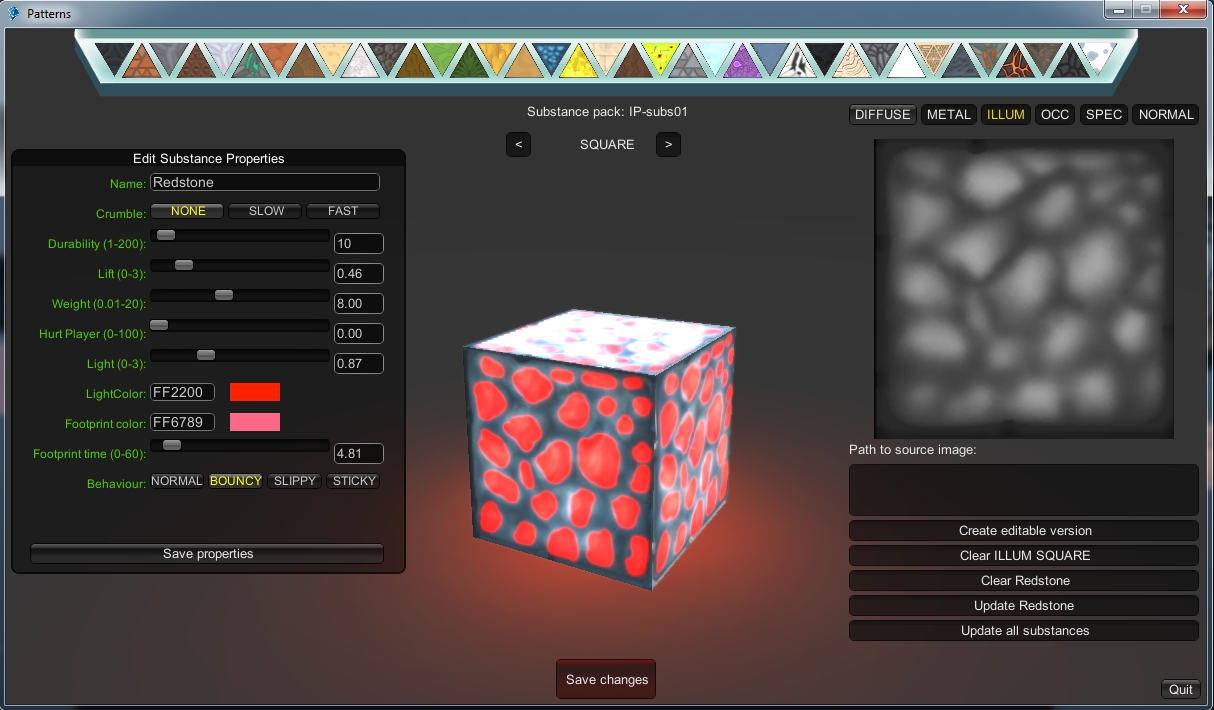
The 0.06 update further enhances the Substance Editor introduced at the end of 2013, and which I covered in brief at the start of January. As explained back then, the Substance Editor allows users to modify the existing surface and other substances (clay, copper, moonstone, etc.), and to create new substances for use in-game. The initial release included the ability to edit the diffuse (texture) normal (bumpiness) properties of substances. Version 0.06 adds the ability to edit and modify a number of additional substance properties:
Specular: the shininess of a substance – this uses a greyscale palette with white being the most shiny
Occlusion: – to map darker and lighter pixels resulting in a texture with an illusion of relief, and so allows the creation of hotspots and shadows on substances. The brick and bonestone substances are good examples of substances using occlusion maps
Illumination: defines the glow and light emission effect for materials, using the range of white (most illuminated) to black. The lava and moonstone substances are good examples of the use of illumination
Metal: affects the metallic quality of a substance. The default is black with white being the most metallic.
The updated substance Editor with the added tabs for specular, occlusion, illumination and metallic properties (right)
In addition, the Substance Editor gets an HD mode which doubles the texture resolution when using it, although the release notes indicate this makes using the Substance Editor performance intensive. It is also possible to define the total number of substances you include in a new Substance Pack.
The first part of a new video has been produced to explore the Substance Editor. This is described as “in-depth”, but I have to admit that this first part leaves something to be desired; the new properties in the Editor are glossed over with a “I’ll leave you guys to look these up…” Hopefully, there will be a more detailed look at them in the future as these series progresses, this is only an introduction, after all. However, given there has already been a far more detailed introduction to the Substance Editor already (albeit with only diffuse and normal maps), one has to wonder why the approach in that video was not followed, and a more informative piece produced to kick this new series off; as it is, the initial video is – frankly – disappointing and waffly.
First Person Camera Lock
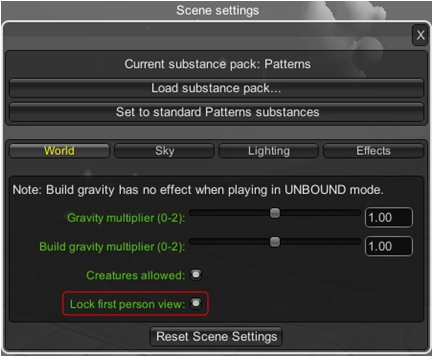
The new first person camera lock option in Settings. also note the option for applying your own substance sets to a world (top)
Another new element introduced to Patterns is the ability to lock the camera into first person view (consider Mouselook in SL). This is activated via the Scene Settings options (ESC > Scene settings > Lock first person view).
Update, October 9th, 2014: Linden Lab announced that development work on Patterns has been discontinued.
Patterns, the PC / Mac Minecraft-esque sandbox building game / application / creative environment from Linden Lab, had originally been aiming for an “official release” of Version 1 around the end of 2013, after a 15-month gestation period as a “Genesis” product, in which much feedback and involvement from Patterns users has been encouraged.
As it stands, the formal release has yet to be made – the latest version being 0.05a – but that shouldn’t be taken to mean Patterns hasn’t been going anywhere over the course of the year. A small (Or what appears small, it could easily be much larger) and very enthusiastic community has developed around it, and the back-and-forth between the Lab’s devs and that community appears to have been lively – including a series of livesteam events, one of which I reported upon back in October (which was the last time I stuck my nose into Patterns).
While the official release has yet to come, November and December did see something of a flurry of activity around Patterns, with videos reviewing some of the progress through the year, as well as some significant updates and news on the future; all of which suggests that perhaps things are now being pushed closer to the point where Patterns gets that all-important “official” release.
As it has been a while since I last covered Patterns. this piece is aimed at rounding-up everything, and may not come entirely as news to everyone, so bear with me as I play catch-up.
The Future
The major news on the future of Patterns initially came on November 27th, 2013, when the Lab issued a letter outlining some of their plans for 2014. While the “first release” was referenced, no actual date as to when this might be was given. However, what was mentioned made interesting reading:
The introduction of a Substance Editor to modify the existing surface and other substances (clay, copper, moonstone, etc.), and to create your own substances for use in-game
A character creator to customise / create basic Patterns characters
A LUA-based scripting system which will “access to script APIs that control game variables such as lighting values and the pull of gravity”
The promise that “even more functionality will come from the ability to author moving platforms and control behaviour in support of a variety of gameplay types.”
To help illustrate these new features, happyhappygaming, an Admin for the Patterns wiki managed by Curse, produced a little video.
Substance Arrival
This news was followed in December by two releases of Patterns – 0.05 and 0.05a – which introduced the Patterns Substance Editor referred to the “state of the game” letter.
The Patterns standalone Substance Editor
The Substance Editor allows users to create new surface and other substances for use within Patterns either by using the existing substances or completely from scratch. It appears as a new option after logging-in to any version of Patterns from 0.05 upwards, and is actually a separate application to Patterns itself – clicking on the link in the Patterns start-up menu will ask you to confirm you wish to quit and close Patterns and launch the editor.
Once launched, the editor allows you to edit or define a substance, change its properties, such as whether it will crumble or not if a character tries to harvest it, how fast it will crumble, how durable it is as a building substance, what behaviour it has (“bouncy”, “slippy”, etc.), and so on. The editor also allows you to define the diffuse (texture) and normal map for a substance.
The use of an additional tool such as Photoshop or GIMP will likely be required for any modification of existing substances which requires changes to the diffuse and normal maps, but this isn’t actually a huge hardship.
Happyhappygaming has produced a video introducing the basics of the editor, including the use of GIMP for texture modifications, with the promise of more to follow.
An interesting aspect of this is that it appears as though – like Patterns custom worlds – substance packs created by users can be shared within the Cosmos for others to use and further modify and re-share.
In 2011, Desura announced that their client-side software would be released under the GNU GPL v3, allowing it to be developed and enhanced by the open-source community, with the server-side of the service remaining proprietary. The code itself was released on January 21st, 2012 under the project title Desurium.
A small community formed around the project, focusing on the development of the Linux client, with release candidates appearing from November 2012 through until around May 2013 (RC 0.8.0 RC10 for Linux 32 and 64-bit). Since then, things have been relatively quiet, no doubt in part because of Desura being acquired by Linden Lab in July 2013, although commits have continued to the project’s repository on Github.
Essentially, the Lab will be continuing the project, but under a structure that mirrors the current arrangements for open-source development of the Second Life viewer. Part of this is a proposal to change the licensing for the client from the General Public Licence v3 to LGPL version 2.1, which is currently used with the SL viewer. The company is also proposing introducing a Contribution Agreement “substantially similar” to the Contribution Agreement used with the Second Life Viewer.
The Lab believes the licence change will “help to clarify that game developers can incorporate Desura client technology in their products however those products are licensed, and remove the need to drive software design in order to insulate non-open source games from the viral aspects of the GPL.” It is noted that all work submitted to the project prior to the licence change will remain under the GPL v3 licence, and the change, once implemented, will only apply to the project and contributions from that point forward.
Rather than seeking to make an arbitrary change to the licence, the Lab is looking to do so collaboratively, with the announcement noting:
Changing the license will require that we initiate discussions with past contributors. If some contributors are uncomfortable with this new structure, we may need to evaluate the impact that could have and whether we may need to make any adjustments. Contributors should each expect to hear from us soon.
The announcement also highlights that the Lab wishes to see client development move forward on the Windows and Mac platforms as well. It also carries strong indicators of their commitment to Desura, noting that they are in the process of recruiting additional personnel to undertake Desura / Desurium related work in terms of client development and project management, with a strong emphasis on coordination between development work undertaken in-house and development work undertaken by open-source developers.
Response to the announcement has been muted but favourable from the Desurim community.
On Wednesday October 2nd Linden Lab announced it would be offering all nominees and official selections at the IndeCade International Festival of Independent Games, “an agreement for global distribution, without any listing fees, via Desura, a leading digital distribution service for independent games.”
The offer is open to all developers of games aimed at the PC, Mac or Linux platforms nominated / selected for the event, which is due to be held in Los Angeles on October 5th and 6th. In addition, all qualifying nominees and official selections opting to take up the offer “will also automatically be a part of Desura’s new partner program and will be supported with promotional advertising, courtesy of Linden Lab.”
An estimated 21 of the 36 nominees in this year’s IndieCade festival qualify for the offer.
The announcement came via an official press release, posted to both the Lab’s corporate website and on the Desura website. The press release reads in part:
SAN FRANCISCO – October 2, 2013 – Linden Lab® and IndieCade have announced a special prize for the IndieCade 2013 Festival, held October 5-6 in Los Angeles: for the first time, all nominated and official selection PC/Mac/Linux games will be offered an agreement for global distribution, without any listing fees, via Desura, a leading digital distribution service for independent games.
Additionally, IndieCade nominees and official selections that choose to take advantage of the distribution offer will also automatically be a part of Desura’s new partner program and will be supported with promotional advertising, courtesy of Linden Lab.
Desura has a large catalogue of successful commercial games as well as free titles. IndieCade-nominated free games are eligible for this offer and will be also extended the opportunity to participate in a forthcoming promotional initiative.
“We’re a proud supporter of IndieCade and its mission,” said Rod Humble, CEO of Linden Lab. “Celebrating and supporting independent developers is a goal Desura shares with IndieCade, and we’re happy to be able to award distribution and promotion to all nominated and official selection games at this year’s event.”
Desura puts the best games, mods, and downloadable content from developers at gamers’ fingertips, ready to buy and play. The free Desura application can serve and patch games, mods, and add-ons directly for customers around the world. Developers and publishers can share news, images, videos, and other content through their profiles, while every member of the Desura community can post comments, submit reviews, and upload screenshots from their own playing experiences. Desura also demystifies user-made mods and add-ons for games by making them as easy to find and install or update as professional titles.
IndieCade is an international juried festival of independent games, and is often referred to as “the video game industry’s Sundance Festival”. At IndieCade, independent video game developers are selected to screen and promote their work at the annual IndieCade festival and showcase events.
The link-up between Linden Lab and IndieCade would appear to be a logical step, given that the Lab has recently acquired the Desura digital distribution platform, which has been a sponsor of the event, and that Will Wright serves on both the Board of Directors of Linden Lab and on IndieCade’s Board of Advisors.
The move is clearly aimed at strengthening Desura’s market status and positioning as a front-runner in the global distribution of independent games and mods. It also potentially raises Linden Lab’s profile among independent game developers.
Update, October 9th, 2014: Linden Lab announced that development work on Patterns has been discontinued.
It’s been a while since I last looked in detail at Patterns, Linden Lab’s desktop sandbox environment for the PC and Mac. Since that time, the game has come on in leaps and bounds, adding many new features and capabilities, including multiple worlds, multi-player options, creatures, new playing modes and more.
The last significant update to the game itself was in May 2013; however, work developing both the game and the supporting websites is continuing – including the creation of a nascent Patterns wiki.
The updates Patterns website
The forums have also had a much-needed overhaul in terms of appearance, although active participation remains small. They do see a reasonable amount of developer activity, particularly where features and updates are concerned – which is hardly surprising given the game is still in its Genesis mode until the end of the year – although responses to questions are perhaps a little slow. It’s been over a month since an “Ask the Devs” thread requested questions on the platform from users, and despite only four questions being asked, replies have yet to be posted.
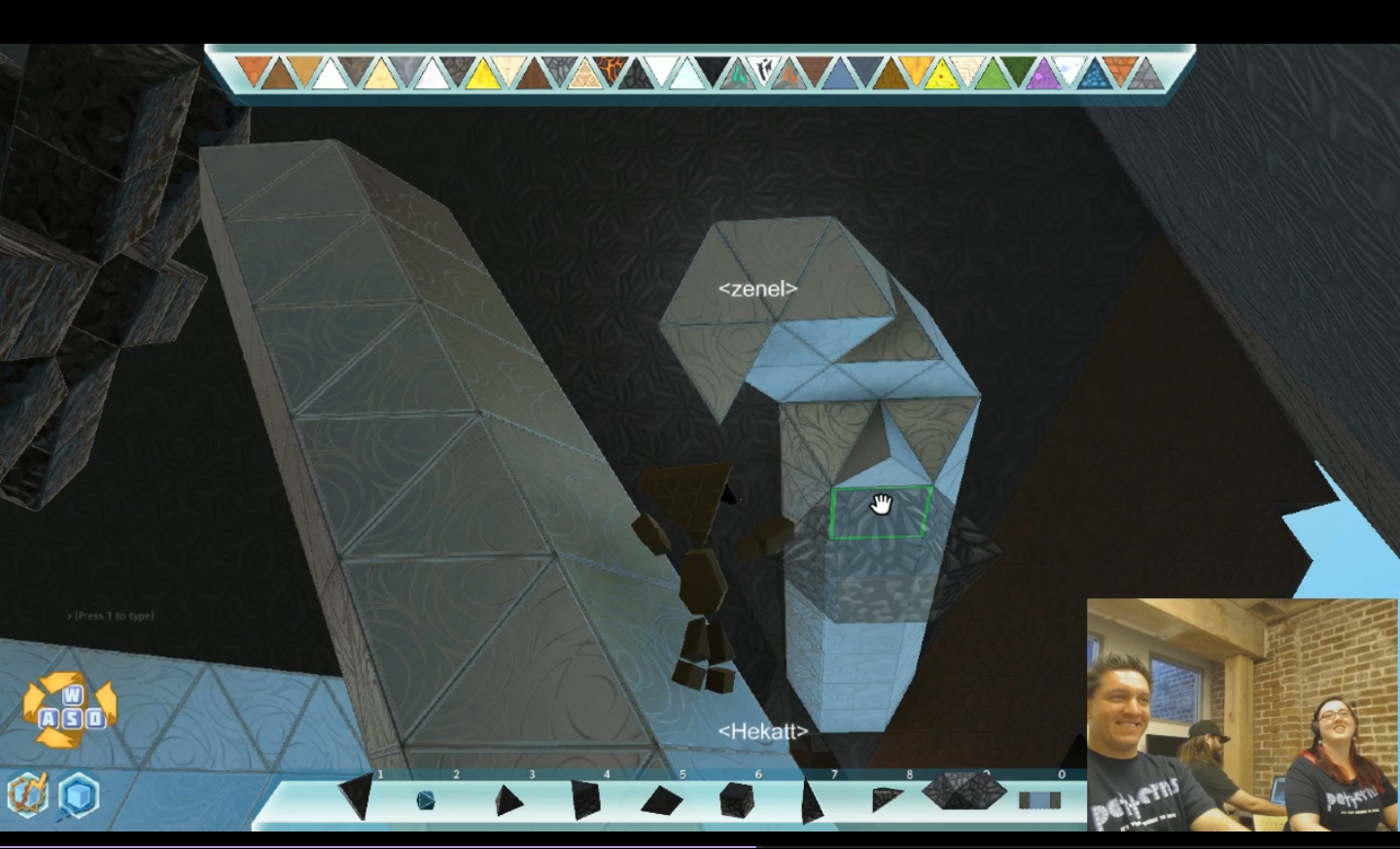
The Linden Lab team responsible for Patterns recently held a live stream event in September, which they promised would be “the first”, run in association with Twitch TV. How many more there are liable to be is open to question, but it’s an interesting way of reaching out to the Patterns community and gaining feedback. It appears to have garnered a lot of interest.
The Patterns team at the Lab recently held an informal livestream event via Twitch
The stream offered users the chance to see the devs, learn about features and ask questions – such as whether or not the game will gain a character editing mode (the team revealed that while discussions on the subject have been held, and the idea considered, no definite decision either way has been made), together with other questions on the possible future directions for the platform.
At just over an hour in length, the recording has some interesting tidbits for those who are enjoying Patterns. Unfortunately, WordPress.com refuses to let me embed the video, even via Gigya, so all I can do is provide a link.
A ram-like creature from Patterns (l) and a more malevolent monster (r)
If the Lab are keeping to their original roadmap for Patterns, the formal release of version one should come around the end of the year.
 Peter Gray has just informed me that on Wednesday February 5th, the board of directors of Linden Lab formally announced the appointment of Ebbe Altberg as the company’s Chief Executive Officer.