Update, October 9th, 2014: Linden Lab announced that development work on Patterns has been discontinued.
With recent focus being on the axing of three of LL’s initial new product offerings – and particularly Versu – it is easy to forget that the longest-running of LL’s moves to diversify is still out there, and actually has yet to officially launch in a release mode.
I’m of course talking about Patterns, LL’s PC / Mac game / content building sandbox application. This first appeared in September 2012, although there had been clues as to its name, if not what it would be about, as far back as July 2012, when Rocky Constantine spotted what appeared to have been a slight boo-boo.
I’ve not followed Patterns as closely as perhaps I could, but I have tried to provide periodic updates under my Patterns tag (menu: News-Updates-Opinion > Linden Lab > LL Products > Patterns), including recent notes on it gaining the ability for users to edit and create their substances, followed by support for materials.
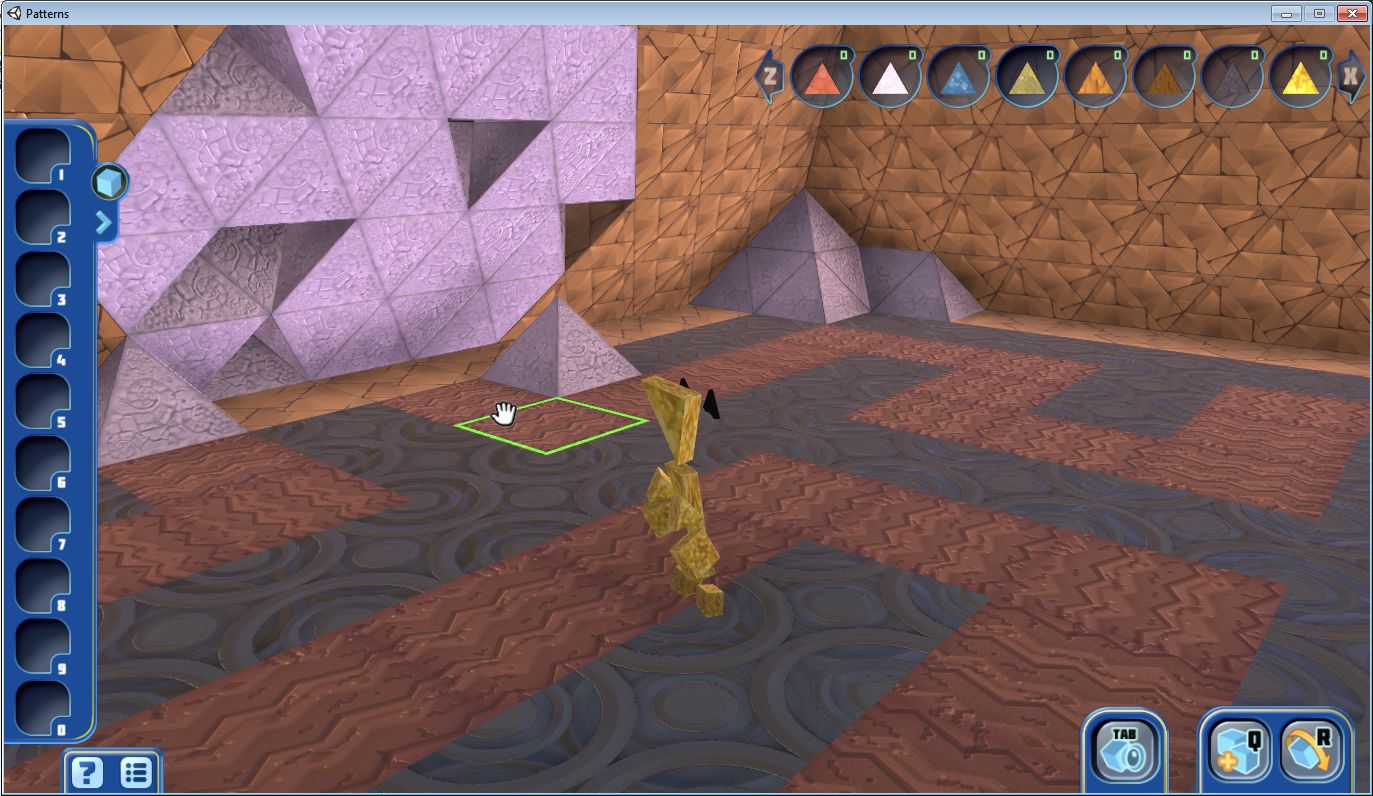
The original Patterns UI
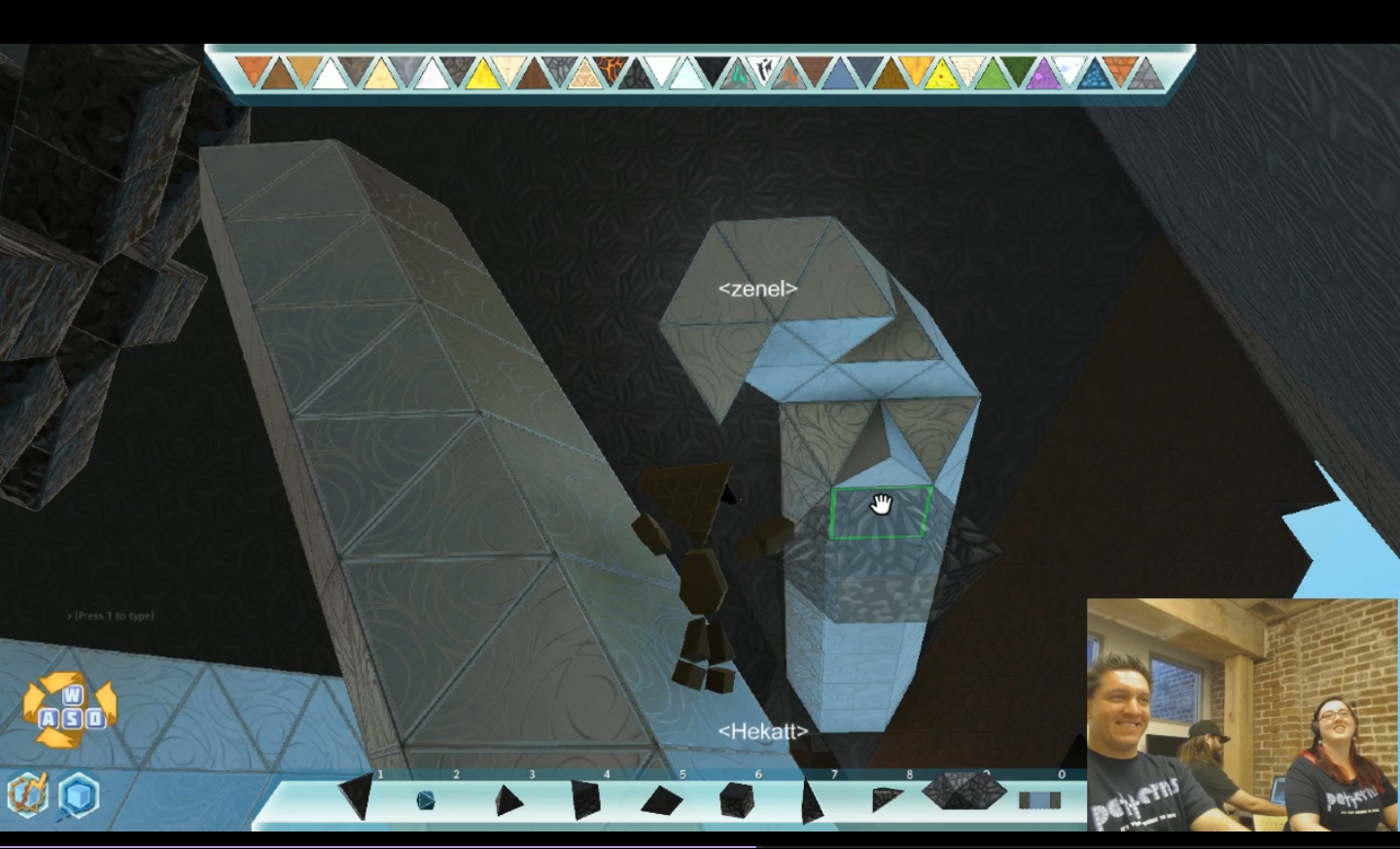
While still in its “Genesis” form, Patterns has built-up a small but strong following in the gaming community and via the likes of Desura and Steam. Many of those who have purchased Patterns have provided feedback and input to the game’s development over the last 18 months, which have seen new capabilities added, functionality improved and a number of enhancements to the UI.
The Patterns UI as seen during a Livestream event with members of the Patterns team (lower right)
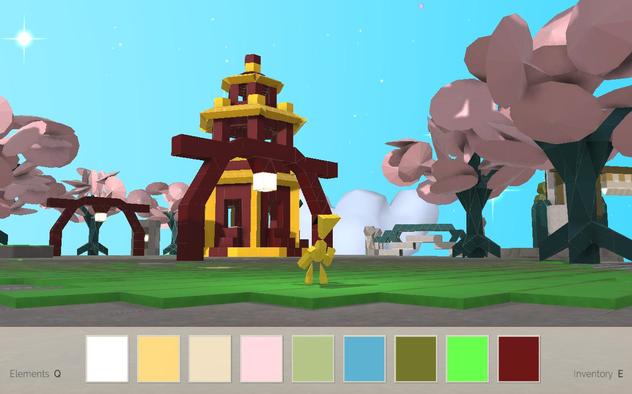
On March 18th, 2014, the Patterns team revealed that as part of the run-up to release (which had originally been indicated as being “late 2013” when the Genesis version first appeared, but has yet to have a date firmly pinned to it), the UI will shortly be getting potentially its most radical overhaul yet, aimed at “optimizing the play space by cleaning up the real estate”, and which will see the move of the tools, substances, and shapes into “one clean area at the bottom of the screen, where you’ll be able to quickly toggle between each of these different toolbars with ease by hitting the Q or E buttons on your keyboard.”
Patterns: extensive UI overhaul coming soon
There’s currently no ETA on when the new UI will appear in Patterns, but the team are promising more sneak peeks in the future as work continues. Also coming in the future, I assume under a separate cover, is the Patterns scripting capability, which should further enhance the application’s creative capabilities.
I’ll endeavour to update as further releases are made for those of you still following Patterns.
Following the Lab’s move to axe Creatorverse, dio and Versu, I raised the question with Emily Short and the Lab on whether it might be possible for Versu to continue. I wasn’t alone in cogitating the idea, several others raised the same question, such as Ciaran Laval.
At the time I made my enquiries, Emily confirmed that discussions were underway while the Lab were reticent to comment – understandably, simply because discussions were in progress.
On Saturday March 8th, and true to her promise that she would blog on the matter when she was in a position to do so, Emily issued a brief update, stating:
So for those who were curious, Linden has now given me a definite no about selling me the codebase and IP.
In reply to a comment expressing the hope that this won’t spell the end of Emily’s forays into social IF, she replied in part:
This is definitely not the end of my trying to build more socially-focused IF [interactive fiction], and we did learn a huge amount about how to make that work, not just in terms of a technical engine but in terms of authoring approaches. So there are things that can be built on even without access to the code or IP.
There is understandably a huge amount of disappointment involved here as well. Blood and Laurels, the latest title Emily had been developing for Versu, represents the culmination of a concept she had been periodically working on for some fifteen years, and she acknowledges that she was really excited to see it finished. Even so, Emily remains pragmatic:
Still, on a total scale of possible bad things to have happen to one, it’s not very far along the bad thing spectrum. So we go on to the next.
Whether the Lab’s decision was based on them seeing a possible means of using the IP and code elsewhere is unknown. However, as Tateru Nino points-out in a further comment, that while regrettable, the decision by Linden Lab is actually a logical business decision, as whether it is used or not, the Versu IP represents a company asset. Even so, if the IP and code is destined to sit on a shelf unused, it is a shame a way could not be found to allow the project to survive. While it may not fit the Lab’s “shared creative spaces” model, the IF market does represent a viable niche market, and Versu itself represented a unique approach to presenting IF – and of even reaching beyond it into other fields of use.
While I never got to use Versu, of all the initial new product offerings from the Lab, it was the one that intrigued me the most; I’ll miss it.
Update, February 19th. Linden Lab has confirmed Creatorverse, dio and Versu have all been removed from their product portfolio with immediate effect.
When meeting with members of the SL community on Tuesday February 18th, 2014, Ebbe Altberg (Ebbe Linden in SL), Linden Lab’s new CEO indicated that an announcement should be forthcoming about the “simplification” of the Labs product portfolio.
Whether this means the Lab will be divesting itself of one or more recent acquisitions or cutting items from its portfolio – or whether it means the side of the company managing those aspects of its business is being reorganised, is unclear. In indicating the forthcoming announcement Mr. Altberg said:
I’ve already helped support some decisions of simplifying our portfolio a little bit, and there will be more news on that later this week. They won’t have significant ramifications for us with regards to resources and stuff like that, so it’s more lightening the load on our minds more so than the work we do every day, but it’ll be a little bit simplified.
I’ve very interested in Blocksworld, because it’s very aligned with what we do in Second Life, which is empowering users to create things, to share things, and hopefully over time to monetize their creations.So that one is clear to me.
Some of the other products, I’m sort-of still getting up to speed on, I haven’t even necessarily had product reviews or anything like that on those. but there will be a little bit of … a simplification of our portfolio later this week.”
It’ll be interesting to see what is announced. In the meantime, more of Mr Altberg’s comments and views given at the meeting with users can be found by following the links at the top of this piece or below.
On Tuesday February 18th, 2014, Linden Lab’s new CEO said an informal “hello” to Second life users through the SL blog.
His message comes just over a week after he officially started working at Battery Street, and it’s something of a personal piece, explaining why he decided to take-up the challenge of helming the Lab (and doubtless much to the delight of LL board member and close personal friend, Jed Smith, who has apparently been trying to get Ebbe to work with him for quite a while…). The post drew immediate comments in the forums … to which Ebbe also replied.
At the same time the blog post came out, Ebbe sat down with a small group of us in an informal meet and greet arranged by the Lab’s Director of Communications, Peter Grey, to talk about his appointment, Second Life, Linden Lab and its products, and other things joining Ebbe and Peter in a friendly session which lasted about an hour at the Lab’s PR island were myself, Saffia Widdershins, Jo Yardley, Mal Burns, Draxtor Despres and Daniel Voyager.
Some of the highlights of the chat were:
Ebbe has had a long-term awareness of both Linden Lab and Second Life. He is close friends with board member Jed Smith and also friends with Philip Rosedale. his knowledge is not in-depth, but it is certainly not an unknown to him
He is deeply passionate about user-generated content and about empowering people’s creativity
His son, Aleks, actually joined SL while still too young and got kicked from the platform – twice! – prior to becoming one of the founding members of the old SL Teen Grid
He is aware that the new user experience needs to be addressed, as does user retention levels and is already starting a preliminary look into the history of these issues
He’s already providing guidance on simplifying the Lab’s portfolio of products, and news is due on that later in the week
He’s conscious of the fact that the Lab no longer carries the message about Second Life where the media and the world at large are concerned
He is enthusiastic about Oculus Rift, Leap Motion an emerging VR and AR technologies and the potential for Linden Lab to help shape how they are used and gain acceptance.
While I had sound issues, I recorded proceedings, and have permission to reproduce Ebbe’s comments in this article. For those who want to know more, please do also listen to this Friday’s (February 21st) The Drax Files Radio Hour, where there will be more analysis of the conversation. Please note that what follows is not presented in the order in which things were discussed. Instead, I’ve ordered things to try to give something of a progressive flow to the comments made in response to questions and observations.
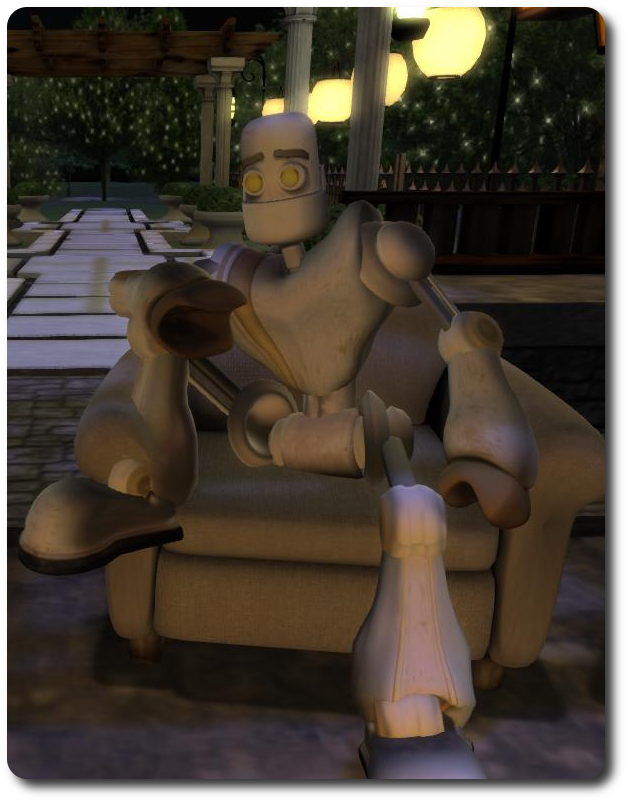
Ebbe Linden (the robot, rear right) and Pete Linden (rear left) meet with a small group of SL users
A Little Introduction
“Hi, everybody! I’m Ebbe and I’m extremely excited to be here. I’ve already interacted with a few of you a little bit, or at least read or heard or watched your amazing videos or cities or whatever, and I’ve only been here for a week, and I’ve spent pretty much of the whole first week doing almost nothing but just talking and meeting with employees. and so that’s been pretty much wall-to-wall, so I’ve explicitly avoided diving into Second Life … but I’ve managed to get just the basics going; signed my paperwork and managed to log-in find parking and all these little things, just to get comfortable and getting my office up-and-running, my computers up-and-running.
“So it’s been just fundamentals, no extreme things. I’m obviously starting to have some meaningful conversations with team players and customers alike about top issues, top concerns, top opportunities; things to do more, things to do less and stuff like that. Just a few decisions have been made so far; most of it has been just conversations with team members and colleagues. So with that … I’m really excited to get to talk with you in person right here.”
On Deciding to Join the Lab
“I’ve known Linden since [its] early beginnings. Jed Smith, who is on the board, is a good friend of mine … I was an early beta user and as Drax said, my son was very involved early on, and I thought it was a fantastic experience for him, the ability to create, collaborate and also to earn. At a young age, he became sort-of a producer working with engineers and designers and clients and partners in creating solutions for people.
Ebbe Linden
“So I’ve always known about it, then I’ve really been too busy in my work life to really participate on an ongoing basis. but when Jed came to me and said he wanted me to do this – and he’s been trying to get me for a number of companies, but this was the first time he succeeded – it was not a difficult decision for me at all with regards to what Second Life is or what Linden Lab is or what we can do because those things are just instantly fascinating to me. I love products that empower people to do things that otherwise would not be possible. I prefer these kinds of products. Call them products that are enabled user-generated opportunities or platforms that can really scale and empower people to succeed as opposed to doing products that are just selling widgets to people.
“So I was instantly passionate about the subject matter, or the materials as they call …a product that enables this tremendous creativity but using technology to do it on a massive scale, and the communication and collaboration elements are also very near and dear to me. So the materials to work with, if you’re someone like me in software product development and digital product development, are just fantastic.
“The only thing that took a little while to overcome was Jed and I are close friends and we had to look each other in the eye for a few days and make sure we could this together, him being on the board and me being CEO, and not have that be damaging to our personal relationship. But after having talked to our wives and families, we completely agreed that we could do it and do it very successfully.
“So that’s kind-of a little bit about why I took this on … I’ve worked on similar things for quite some time at Ingenio, the start-up I joined having left Microsoft, where we basically worked on apps, or I worked on apps – although very successful apps, I think all of us have used those at some point – at Ingenio it was really a marketplace for people to sell what they know. We thought of it as the E-bay of what’s in the top of your mind as opposed to the top of your attic. And we empowered a lot of people to run some very successful businesses on top of the platform we created by just taking ‘phone calls and helping people. and the three days later we would direct deposit their earnings they’d made from helping their customers.
“And at Yahoo!, even, there were a lot of UGC [user-generated content] products I worked on; I was responsible for Yahoo! answers for a while and also at the end responsible for a platform … we bought a company that created the Yahoo! Contributor Network, where we could have hundreds of thousands of people contributing content which could make it into one or many of the Yahoo! verticals to broaden the amount of content we could create, and again empower people to do what they love and to make money doing it.
“So this is a context that’s very familiar to me and near and dear to things that I’m passionate about.”
Update, February 19th, 2014: Versu was discontinued by Linden Lab on February 19th, 2014. Links to the Versu website, etc., have therefore been removed from this article.
Of the various new products the Lab have launched, Versu has, to me, always looked to be the most interesting of those in the “apps” category (although I admit I’d also like to fiddle around with Blocksworld).
Launched on the iPad in February 2013 with four accompanying titles, there was the promise that people could expect both more titles and tools they could use to create their own stories for Versu which they could then sell. There was also the assumption that the app would move to the Android platform much as Creatorverse has before it.
The additional titles – well, two of them at least – arrived in August 2013, penned by Deirdra Kiai. However, while former Linden CEO Rod Humble talked-up the “democratisation” of the creative process while discussing Versu, nothing has actually appeared in that vein as yet.
Indeed, the two titles from “Squinky” (as Deirdra Kiai likes to be known!) and the fact that the Versu engine would appear to have great potential as a means of studying real-world social situations (as the UK’s New Scientist magazine reported in June 2013) notwithstanding, the app appears to have been all but forgotten by the Lab.
Emily Short’s new Versu title – available soon
Such has been the situation that I’d actually given-up checking on progress with Versu, despite Emily Short herself breaking the news late last year that she was working on a new title.
Fortunately for me, the Gov’ner, Ciaran Laval, is still watching things, and he brings word Ms. Short actually revealed some news on the new title back in January.
Details are still scant, but the new title is to be Blood and Laurels and is to feature, according to Ms. Short, “Cults. Conspiracies. Poison. Stabbing. Blackmail. Seduction. Prophecies and rumors. Divine wrath — or possibly just bad weather.”
So death and glory is to be Coming Soon (TM) to the iPad. But what of the app’s expansion to Android or elsewhere? It’s the one question Emily Short seems to get asked every time she blogs about Versu (which, if nothing else, would suggest that interactive fiction fans are more than aware of the app). Sadly, however, she’s not in a position to comment.
Ebbe Altberg at Yahoo! circa 2008 (image courtesy of LaFlecha)
Update: February 20th: I was fortunate to attend a meet-and-greet with Ebbe Altberg in-world, and have published an article presenting his views on the Lab, You can read and listen to his comments by following this link.
So Ebbe Altberg is the new CEO at Linden Lab, and will formally take up his new position on Monday February 10th. But who is Ebbe Altberg?
You can read his official LL biography here, and I’m using that as a leaping-off point for a slightly deeper look at his career.
Mr. Altberg, Swedish by birth, graduated fromTärnabySkidhem in 1983. This is categorised as a “general college / university” in Foursquare, but appears to (also?) be a ski school.
Tärnaby itself is a locality (“urban area”) situated in Storuman Municipality, Västerbotten County, northern Sweden. It is noted for being the home of several of the country’s top international skiers and is regarded as one of the country’s best ski resorts.
Following this, he attended Middlebury College, Vermont, USA, where he graduated with a BA (subject not clear). Founded in 1800, Middlebury is one of the oldest liberal arts colleges in the United States, and offers 44 majors in the arts, humanities, literature, foreign languages, social sciences, and natural sciences.
After eleven and a half years as Product Unit Manager at Microsoft, where he was involved in products such as Word, Office, Mac Office, and multimedia products, he moved on to Internet and Telecommunications company Ingenio in March 2000. Here he was responsible for managing the engineering, program management, operations, and quality teams. Interestingly, and as noted in the LL bio, he also served as the company’s interim CEO.
Joining Yahoo! in February 2008, he spent two years and nine months working as Vice President, Head of Audience for the company’s EMEA division, based in Rolle, Switzerland. Here he was responsible for consumer strategy, products and content throughout EMEA, including Search, Mail, Homepage, Media products, including News, Sports, Finance, Music, Movies, Autos, Travel, Games, Answers, Flickr etc. He ultimately managed all teams responsible for product management, design, editorial, programming, content, production, content business development and product marketing – some 180 people in total across six countries.
During this period, he also served on the board of Yahoo! SARL (Société à responsabilité limitée) – think the equivalent of a Pvt Ltd company in the UK or a limited liability partnership in the USA.
In October 2010, Mr. Altberg became the Senior Vice President for Media Engineering at Yahoo! with global responsibly for Media Engineering for all of Yahoo! Homepages, News, Sports, Finance, Movies, Music, TV, Games, OMG, Lifestyles, Weather, Screen, Livestand and IntoNow products, including related partner portals, publishing platforms and the Yahoo! Contributor Network, across all devices (PC, Tablet and Mobile). This position involved managing an organisation of more than 600 engineers, architects, program managers and quality engineering staff, as well as having dotted-line oversight of some 150 product managers and designers.
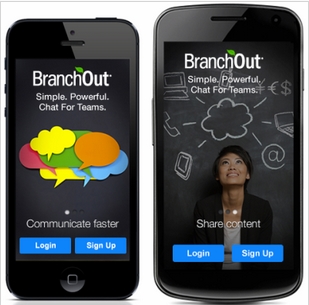
Ebbe Altberg joined BranchOut as the company sought to pivot its ailing Facebook app, resulting in the launch of Talk.co
Thirteen months later, in October 2012, he moved to join BranchOut, based in San Francisco, as Chief Operations Officer. At the time of his joining, the company had already experienced something of a rough time.
Founded in 2010 by Rick Marini as an application designed for finding jobs, networking professionally, and recruiting employees, it proclaimed itself to be the “largest professional network on Facebook”.
The app attracted some $49 million in three rounds of funding between 2010 and 2012, and in March 2012 it boasted some 25 million users and was active in at least 60 countries. However, by August of that year, user numbers had fallen to some 3 million, and the company had indicated it would be working to pivot BranchOut into a workplace chat app, As COO, Mr. Altberg played a key role in this effort, which saw the development of Talk.co, a private messaging application. Launched in October 2013, Talk.co promotes itself as “a better way to communicate with those you work with”.
Mr. Altberg defines his key skills as:
Specialties: Team development, strategy, provide vision, software and business inventions, product design, engineering, product/program management, quality engineering, operations.
Manage teams that invent, create, define, spec, build, produce, test, ship, market and operate products.
Unsurprisingly, Mr. Altberg is a keen supporter of his son’s racing and driving career with APR Motorsport and elsewhere (image courtesy of Talk.co)
Away from work, Mr. Altberg appears to have an interest in space exploration, particularly efforts from within the private sector. He’s also a follower of Formula 1 racing, and (obviously) a keen supporter of his son, Aleks, a former instructor at the Dirtfish Rally School and who is currently an instructor at the Lamborghini Driving Academy, as well as being a winning driver with APR Motorsport.
From his résumé, it’s fairly clear why Ebbe Altberg has been seen as a good fit for Linden Lab by the board of directors. He has considerable breadth and depth of experience in both product development and product management, as well as in multi-discipline team management and developing and operating software across multiple platforms and product categories.
A lot of Mr. Altberg’s background revolves around social media and the need to establish strong communities. Indeed, his lists his motivating factors as creating “fantastic and profitable experiences that positively impact millions of people.” This might actually bode well for Second Life, particularly if he has the freedom to ensure the company more broadly re-engages with the SL user base, and becomes more pro-active in key areas of communication (such as with changes to the ToS and better communications about legal and requirements which impact users, etc.). He has already received a number of Tweets from SL users (myself included) requesting he takes this into consideration while welcoming him to the company.
Time will obviously tell as to how well Mr. Altberg fits-in at Linden Lab, as well as revealing the direction in which the board would like him to take the company.; in this respect it is perhaps interesting to note how the press release announcing his appointment is directly focused on Second Life and Blocksworld (with a mention in passing of Desura). In the meantime, I’ll once again welcome him to Linden Lab. The hot seat awaits!
 Update, October 9th, 2014: Linden Lab announced that development work on Patterns has been discontinued.