Desura and Linden Lab: through the founder’s eyes

Update: Linden Lab sold Desura to Bad Juju Games on November 5th, 2014.

I came across a short interview conducted by the Linux-focused Root Gamer with Desura founder Scott Reismanis held shortly after the news broke that the Lab had acquired the digital distribution service, but which seems to have gone unnoticed elsewhere.

Since the announcement of the acquisition, there has been considerable interest in whether it means Desura / LL will compete more directly with others in the same marketplace – notably Steam. In a recent interview with Gamasutra’s Kris Ligman, which I also covered here, Rod Humble had a few pokes at this himself (although some of his comments on competition would appear to have a much wider context which includes Second Life). Reismanis sees the “competition” element of the acquisition in terms of providing Desura with much-needed additional ability to pro-actively attract games developers, rather than having to react to overtures from games developers, commenting:

Scott Reismanis
Scott Reismanis

At the moment we are largely dependent on developers reaching out to us about getting published – that’s what our small team had time to do. With Linden Lab help we will expand our team working with the game developers helping us target and bring more on board.

In reading both Reismanis’ and Humble’s comments around the acquisition, it would appear that both are very much of the same mind in how they regard the Lab’s initial relationship with Desura and in terms of future plans.

Both, for example, couch the Lab’s role as initially being more supportive than directive; providing additional muscle in key areas to assist the Desura team to carry on with their business in a more structured and focused manner, rather than the Lab charging in and absorbing everything and trying to reinvent the wheel. In this, the approach appears to be more of a partnership more than an outright acquisition and, given the marketplace is new to Linden Lab, not an unwise move.

Not that this means there won’t be any visible changes. Work is already underway to overhaul (or at least update) the Desura client in order to make the Lab’s involvement more apparent. Exactly what form this will take isn’t clear at present, but the work is seen as priority, although dependent upon Desura (or the Lab?) bringing in new staff.

Desura and the Lab: proceeding more as a partnership? (image courtesy of Root Gamer)

The interview also hints that both Humble and Reismanis share the same grand ambitions for the future of a service – and that the ambitions may have been there prior to the acquisition (and by extension, might have been one of the reasons the Lab was attracted to Desura).

Commenting on the Desura blog about the acquisition following the formal announcement, Reismanis give additional insight as to what he believes this means for developers and customer using the service:

To date Desura has been built and run by a dedicated small team – and it’s grown to the point where we list over 1,000 games and have served over 1,000,000 customers. We are very passionate about the developers and community we represent, and I want to assure you now this policy isn’t changing.

With Linden Lab’s support, we plan on expanding our team and providing you with more co-ordinated coverage, sales, marketing efforts, reporting, and assistance from us. We want to solve challenges like discoverability and giving your customers’ choice, and we look forward to doing so. We are going to continue to polish and innovate so Desura stands out and does its most important job better: getting your game into customers’ hands.

So far reaction to the acquisition from within the Desura community appears to be mostly positive, with those responding to the news wishing Reismanis and his team good luck, although there are obviously some questions about what it means in practice for game developers in terms of publishing, DRM, etc., – all of which are liable to only become clearer once the initial dust has settled and both the Desura team and the Lab have worked out priorities and directions and have settled into working together over long distances.

It’ll be interesting to see how this develops over time, starting with the roll-out of the new Desura client, and whether the approach does develop along lines of a partnership rather than a buy-out, and if so, for how long.

Related Links

Blocksworld +1 week: opinions favourable

LL logoBlocksworld has been out a week now. I covered the launch on August 1st, but as I don’t have a iPad, I’m stuck with pining for its possible appearance as an Android app in order to review it myself (even though I haven’t got an Android tablet either *cough*).

This leaves me reliant upon reviews posted elsewhere. So, as with the early appearance of Creatorverse, I’ve been keeping an eye on the Lab’s press page and waiting for a number of reviews to pop-up there. It’s not an ideal way of doing things, but as the likes of 148apps and Kotaku do generally appear in the listings, I decided to see what comes up as well as Googling for reviews.

Overall, and allowing for it being early days, the reactions of reviewers seem favourable. Rob Rich over at 148apps gives Blocksworld a solid four (out of five) stars, noting that the interface is easy to grasp, building is relatively quick and easy to learn, and that the ability to create and build with blocks is something kids the world over can identify with. However, he also notes that there are some inherent weaknesses in the app: vehicles can be difficult to drive, and connecting blocks to build things is limited (you can only connect blocks face-on). As such, he notes that it is fun to play with, but in terms of using it as a form of a game, it’s not so much fun to play.

Mike Fahey over at Kotaku has a fair amount of experience in reviewing the Lab’s products. His reviews are always informative and also lighthearted at times, making them a fun read. It’s actually his reviews I turned to in order to get a handle on both Patterns and Creatorverse before I had access to either. In reviewing Blocksworld he notes that:

Linden Lab is all about creating, or at least they have been since Rod Humble took charge, transforming the company behind Second Life into a company that creates creativity. It was as if Linden Lab only made doughnuts before he arrived, and now they’re making a wide variety of pastries. The delicious, sexy, wildly deviant doughnuts are still there, but then so is Creatorverse and Patterns and Blocksworld and maybe, if we’re very good, some scones.
Blocksworld promotional image (courtesy of Linden Lab)

Like Rob Rich, he comments on the overall simplicity of design and that the UI is very easy to grasp. He also delves more into the mechanics of the app, noting that using it can be approached in a number of ways, from “dive in a build” through to using the supplied “kits” to learn how to build specific items and use specific capabilities.

Interestingly, both reviews touch upon a fact hitherto unmentioned here: that the number of blocks you can use is limited. If you run out, you have to either “win” more or purchase more.

“Winning” additional blocks is a case of using the in-built kits, each of which includes a puzzle / challenge. Build the kit, complete the challenge and your reward is more blocks.

Continue reading “Blocksworld +1 week: opinions favourable”

dio gets an overhaul, but will it increase the appeal?

dio-logoUpdate, February 19th, 2014: dio was discontinued by Linden Lab on February 19th, 2014. Links to the dio website, etc., have therefore been removed from this article.

I received an e-mail on July 30th informing me that dio (remember that?) has received a major overhaul, with the upshot being, in the words of the e-mail, “dio is now focused on making it easy to turn your photos into interactive experiences to share. Just upload a picture, then tag it with interactive hotspots to add photos, text, and videos. You can even create an interactive album by linking to other images.”

The update means that some concepts previously found within the application have vanished – there are no scripted objects and no “rooms” for example. What there is instead is what might be sort-of described as “Flickr with hotspots”.

Essentially, under the new dio, you can still create places, which now comprise one of more “scenes”. Each scene is a photo (without or without a short description) into which you can embed text, other photos, videos and links to other scenes, all with considerable ease. Scenes can be stand-alone, or can be linked together to create things like photo albums or interactive tours, and so on. All this has, apparently, been done in response to requests from users.

A Quick Look

Getting started with the new dio – assuming you have an account – is easy enough. Just log-in and click on the Star Creating! button.

The new dio banner.
The new dio banner and “start” button

This leads you to a page where you create your new “scene”. Here you can enter a title, select a photo to upload to dio from your hard drive (or enter a suitable URL for an image) to form the background to the scene. Once you’re happy, save it.

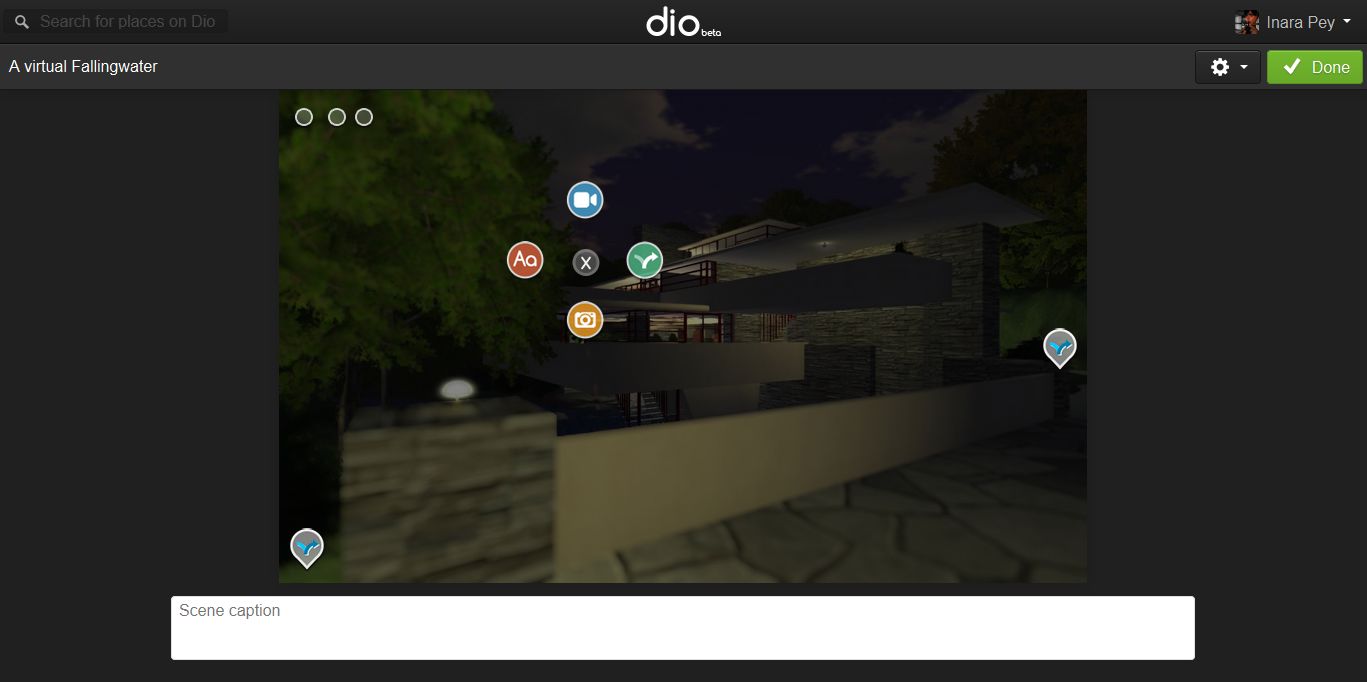
The image is displayed as it will appear to others, and you can start adding elements to it. This is done by entering the Edit mode (button on the top right of the window), then clicking on the photo itself to display the hotspot options.

Creating hotspots for a dio place

There are four types of hotspot at present:

  • Text – for unformatted text (i.e. you can arrange the text into distinct paragraphs, but they’ll all be concatenated into a single block of text on saving, so best to keep things short)
  • Other photos (with text captions if you want)
  • videos
  • links to other scenes.

To create a new hotspot, click on the required hotspot icon. This opens a window with easy-to-follow instructions. When you’re done, click Save in the window to save the hotspot on the photo. There is no limit to the number of each type of hotspot you can add to a given scene / photo, and the art of dio is, as with the previous version, having an idea of what you want to achieve and then working out how best to achieve it.

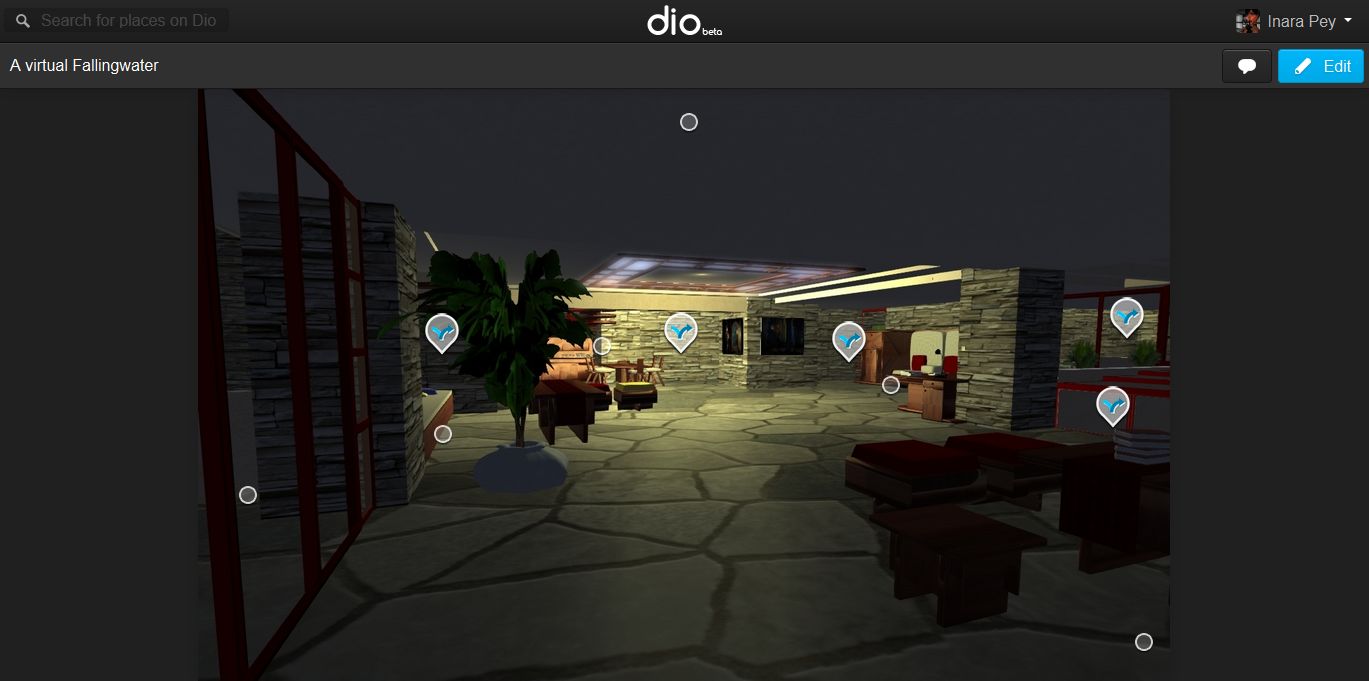
An example of a scene with lots of hotspots

And that’s really it (for the present), as far as I can see.

Note that if you have previously created a place in dio, it may well have been made “Private” and viewable only to you. To enable it as “Public” again, go to any scene within the place and click the Edit button, then click the cog button which will be displayed next to it, and select Place Settings. You can then flick it back over to Public.

For those navigating your places / scenes, it is simply a matter of clicking the available hotspots in whichever photo comes up. As with the original version of dio, if someone who is logged-in to the application leaves your place at a particular scene, they’ll be returned to it the next time they access that particular place (users who are not logged-in will return to the first scene in the place.

Feedback

The overhaul gives dio a much cleaner look and feel when trying to do something with it. The concepts are very easy to grasp if you’ve used the previous version, and rebuilding previous places isn’t as onerous as I thought it would be, while putting together a new scene / place is very quick and easy (I did this in – quite literally – 2 minutes).

A noticeable absence from the revised dio is Google Adsense. Originally, the Lab has intended to “profit share” on people’s dio creations using Adsense, which was visible at the bottom of the “old” dio pages, but which is absent the new. Have LL abandoned the idea?

The hotspots idea is interesting and certainly allows a good degree of creative use of pictures. I found it very easy to re-work my Fallingwater tour on the fly (although it will need more TLC before I’m happy with it again). However, one thing I would like to see changed in the icons used for finished hotspots. When creating new hotspots, each icon is clear: a camera for adding photos, text for adding text, a video camera for videos, and a double arrow for links to other scenes. However, only the latter icon is displayed in completed scenes; text, photos and video all have the same nondescript dot which is hardly attention-grabbing.

That said, the opportunities to create fun scenes using hotspots seems pretty broad and limited only by one’s imagination. Want to share you YouTube videos in a different way? Here’s how (and yes, videos now play on being selected, no more additional faffing around); want to be silly with videos and photos? You can; and people can leave you their thoughts! Oh wait, they can on Flickr as well.

And therein lies the rub. OK, so dio has entertaining little bells to it. You can embed pictures in pictures, text in pictures and video in pictures, you can link pictures with other pictures and so on and so forth. But, the question still remains – why? As easy as the new UI is, the fact remains that if you want to share a bunch of photos with friends, it’s still easier to slap them up on Flickr or a similar site, and all the pretties be damned. As it is, dio is increasingly looking like it is trying to be far too many things, and that like Jack, it’s going to remain master of none.

The new update is nice and neat (although LL have some catch-up work to do as far as the “about dio” page is concerned – it still references the “old” beta) and it’s easy grasp. Whether it increases dio’s appeal, however, remains to be seen. I’ll be honest here and say that, given the lack of visible activity with the application prior to the arrival of the Lab’s e-mail, I had actually thought dio was DOA.

Related Links

Blocksworld launches

LL logoOn Thursday August 1st, Linden Lab launched Blocksworld, the latest in its new product line, a day later than anticipated.

Announced in a press release from the Lab, Blocksworld was originally the work of Boldai AB, a team of three programmers who jokingly refer to themselves as being, “From the country that gave you Minecraft and the country next to the country that invented Lego”. It is described as, “A perfect mix of Lego and Minecraft.” Boldai were acquired by Linden Lab at the start of the year.

The press release announcing the launch of the application for the Apple iPad states in part:

Blocksworld is a light-hearted build-and-play system for kids and grownups alike that brings the imaginative play of toy blocks to your iPad’s touch-screen, allowing you to bring your digital creations to life. Snap together colourful 3D blocks to create anything you can imagine – from crazy characters to cars, space rockets, animals, robots, planes, monsters, and much more – and then bring your creations to life and play with them! Simple drag-and-drop controls make it easy to add interactivity and animations to anything you make. Tap “Play” and get ready to smile as your creations walk and talk, jump, drive, fly, shoot lasers, fire rockets, or even explode.

A new video accompanies the launch, which sees a return of some of the humour found in Boldai’s own video promos.

In keeping with the Lab’s philosophy with its new products, Blocksworld creations can be shared with other users.

The app is available free of charge on Apple’s App store, with the Lab going with the model they eventually adopted for Creatorverse – sell “themed packs” as in-app purchases which users can then bolt-on to the basic application and increase their creative opportunities. The expansion packs can be seen in action on the Blocksworld website, and it would seem that some of them call into question as to what capabilities are actually available in the free product. The promo video shows rockets flying, for example, but the rocket capability is one of the in-app purchases, along with wheels and walkers, which also feature in the promo video.

As a 3D building tool which has already been shown to have appeal among children prior to Boldai being acquired by LL, and allowing for the possible need to buy the various expansion packs to do much of what is shown in the promo video, Blocksworld could prove to be far more of a success that Creatorverse, and more visually engaging (think electronic Lego).

Whether Blocksworld will debut on other devices – such as Android tablets – remains to be seen. Boldai did originally have plans in this regard, but little has been said on the subject since they were acquired by LL.

Related Links


Desura and Blocksworld debut on LL’s corporate pages

LL logoUpdate: Linden Lab sold Desura to Bad Juju Games on November 5th, 2014.

Both Desura and Blocksworld have made their individual debuts on Linden Lab’s corporate website, with Desura appearing on Friday July 26th, and Blocksworld a little earlier in the week.

Both have links to introductory pages which in turn lead to their respective websites, as well as  banners at the top of the corporate site’s home page.

Blocksworld and Desura both now appear on LL's corporate website, with links to introductory pages and their own banners
Blocksworld and Desura both now appear on LL’s corporate website, with their own banners at the top of the home page and links to their introductory pages

The Desura introductory page includes a brief description of the service, which reads:

Desura is a community-driven digital distribution service for gamers, putting the best games, mods and downloadable content from developers at gamers fingertips, ready to buy and play.

The free Desura application can serve and patch games, mods, and add-ons directly for customers around the world.

Developers and publishers can share news, images, videos, and other content through their profiles, while every member of the Desura community can post comments, submit reviews, and upload screenshots from their own playing experiences.

The page also includes an introductory video from August 2011 entitled Introduction to Desura and (presumably) narrated by DesuraNET’s founder, Scott Reismanis.

While in-depth and useful for someone wanting to get to grips with Desura, the video is not really in keeping with the other promotional videos on the other product pages, so I wouldn’t be surprised if it is swapped-out for something a little lighter from the Lab in the near future (“Hello everyone. I’m Rod Humble, CEO of Linden Lab, makers of shared creative spaces…” ;-)) .

The link from the page goes directly to Desura’s website, which has yet to show any signs of rebranding – which is hardly a surprise, all things considered. The Lab has some grand ambitions for the service, and so it’s likely to be a while yet before we start seeing significant changes and updates.

The last time I reported on Blocksworld, I pointed to rumours that it could be launching in July. These came via All Things D’s Eric Johnson, following a Q&A with Rod Humble which appeared at the start of July.

The new(ish) Blocksworld introductory page on the Lab’s website is a little less forthcoming, stating only that it is coming soon to the iPad, with the rest of the text reading:

Blocksworld is a lighthearted build-and-play system for kids and grownups alike that brings the imaginative play of toy blocks to your iPad’s touch-screen, allowing you to bring your digital creations to life.

Snap together colorful 3D blocks to create anything you can imagine – from crazy characters to cars, space rockets, animals, robots, planes, monsters, and much more – and then bring your creations to life and play with them!

The Lab’s “official” Blocksworld video also appears on the page, and while it is good, I confess to still preferring Boldai’s own videos, but I’m again including it here for completeness.

The Blocksworld website hasn’t changed since my last report on it, and it most likely won’t until we do see the app launched. I wonder if the Lab will still push the product forward on Android, once it has launched…

Related Links

Desura – grand ambitions

Update: Linden Lab sold Desura to Bad Juju Games on November 5th, 2014.

Kris Ligman over at Gamasutra had an interesting chat with Rod Humble recently, in which the Lab’s CEO discussed the acquisition of Desura earlier in July, providing more of an insight into why it was done and – perhaps – some of the longer-term thinking going on at the Lab.

I’ve been intrigued by the acquisition since first reading the press release. Of all of the Lab’s moves to establish itself beyond SL, this is perhaps the one which could stick, and stick well – if they can follow-through on it. For one thing, Desura isn’t a start-up facing an uphill fight to gain a marketshare. It’s already established and, despite being a minnow to Steam’s whale, has nevertheless carved out a niche for itself in a sector which offers the potential for growth.

I’m not a gamer by any stretch of the imagination, but in digging around Gamasutra, Desura et al, I tend to agree with Iris Ophelia on the positives around the move.

Desura: have LL boxed clever on their latest acqusition

There would also appear to be attractions beyond those Iris states. For a start, there could be the opportunity for something of a symbiotic relationship between the Lab and game developers which grows out of the acquisition.

The Lab is looking around and trying to establish a broader portfolio of products and hopefully develop them into revenue streams. At the same time, it is possible that some game developers are looking at Desura as a means of honing skills and perhaps getting noticed “out there” by a games house. Thus, through Desura, the Lab potentially gains a platform through which they can scout talent they may wish to recruit at some point, and game developers have a service they can use to promote their offerings without jumping through hoops or fighting for attention, as Iris points to being the case with Steam’s Greenlight, and be aware that the Lab might just see something they like and snap them up.

While it is unlikely to have been a consideration in the acquisition, Desura does now mean the Lab has a direct channel-to-market for any PC / Mac  / Linux games and software they produce – such as Patterns, which is already offered through Steam, but which would appear to be a good fit for Desura as well. Might we yet see the hinted-at versions of Creatorverse for PC and Mac popping-up on Desura at some point in the future (assuming Creatorverse is actually still under active development)?

Patterns: an additional channel-to-market via Desura?

However, Humble’s comments in the article make it clear that the Lab is looking at Desura in far broader and more ambitious terms. In framing the reason for acquisition to Ligman, Humble states (emphasis mine):

[We want] to make it the most open, developer- and user-friendly distribution service for all kinds of digital goods, starting out with games and mods and going from there. For us it’s a natural step… We’re about user-to-user transactions and empowering people’s creativity.

This is a pretty hefty ambition, and suggests that the Lab might be willing to take Desura into more open competition with Steam, which started offering “other” digital goods in the form of non-games software last year. And while this is pure speculation on my part, could it perhaps also be that LL have their eye on content creators interested in being able to sell their mesh creations to users of virtual worlds – not just SL, but OpenSim (and perhaps even Cloud Party)?

This may not happen immediately (if at all), but the idea needn’t be that much of a stretch. Desura is already geared to handle payments in the user’s local currency, so it would be relatively easy – and attractive to content creators – to provide a means by which they could potentially reach multiple grids without having to fiddle-fart with local on-line markets or deal with different virtual currencies. Sure, users would mostly likely have to upload whatever they buy to their chosen grid (and pay any associated upload costs), but this needn’t necessarily be a huge blocker to the idea.

Pushing my own speculations to one side, that the Lab does have ambitions for Desura inevitably raises a couple of questions: can the Lab actually live-up to its own ambitions. and will it actually be allowed to do so?

In terms of the first question, the concerns are twofold. Desura is community-oriented, and the Lab’s track record of community relations within SL hasn’t exactly been stellar. Can they fare better with the Desura user community? The other, perhaps more vital, point is that while it is already up and running and has its own community, Desura is still pretty small and needs a lot of commitment and nurturing in order to grow. This will require time and effort on the Lab’s part – do they actually have the patience and willingness to run the course (as well as the expertise to run it well), particularly among the board, who are liable to have one eye firmly on ROI? In this, it is interesting that the Lab may not actually be looking to go it alone, with Humble admitting they could well be looking to bring-in partners.

The answer to the second question  – will the Lab be allowed to develop Desura in keeping with their ambitions – in a way comes down to Valve and Steam. Currently, Steam’s focus is slewed towards the bigger names in games development, and Steam Greenlight currently appears to have a number of barriers standing in the way of the smaller developers. However, should Valve sense that Desura is getting a little too big, there would be nothing stopping them from making their own offering far more appealing to game devs across the board, undermining Desura’s appeal, and leaving it starved for growth.

The interview with Ligman is perhaps one of the more forthcoming Humble has given – in some respects, would that he’d be as candid when talking SL. It’s fair to say that in the piece he’s gone a good way to answering the question of “why?” regarding the acquisition, and which has been on a lot of lips since the move was announced. As to the additional questions as to whether they can bring their ambitions for the service to fruition – well that, as they say, will be determined in time.

Related Links