On Wednesday, November 4th, Linden Lab launched a new look to its corporate website.
The new design has much in common with other tech-related (and some purely blog) sites, offers a fresh, clean and scrollable home page which introduces the company’s products: Project Sansar (at the rate that name is being used and gaining familiarity, it’s liable to become the de facto name for the new platform!), Second Life and Blockworld, each with buttons specific to them – the Second Life section, for example will launch secondlife.com. At the bottom of the page is a link to the Lab’s careers page.
An image from the top of the redesigned Linden Lab corporate home page possibly showing a scene from “Project Sansar”
The home page offers one of two different images at any given time (you might be able to swap between them by clicking). One of these appears to be taken from within “Project Sansar”, showing as it does a model of the Golden Gate Bridge, which the Lab has indicated to be one of the major initial scenes built within that platform.
The main pages for the site include a simple, clean menu at the top right, and all have had a similar facelift to the home page, and some nice refinements. The About page, for example, has a much more refined approach to presenting the management team which helps keep the page clean and tidy, although the fact that the images are clickable isn’t entirely clear when hovering the mouse over them.
The corporate home page introduction to Second Life includes a button to take interested parties directly to secondlife.com, while the Blocksworld intro has a link to the Apple Apps store, both offering a no-nonsense link to the products
All told, a simple, clean and fast redesign of the website which, to me at least, is a lot more contemporary than previous looks, and which somewhat matches the approach taken with the Second Life landing pages.
In a further more to sweeten Premium memberships, Linden Lab has announced that with immediate effect, those Premium members who have traditionally have had to pay VAT on their membership subscriptions will no longer have to do so.
The announcement is coupled with a reduction in the Monthly billing plan for Premium from US $9.95 a month to US $9.50, and reads in full:
Being Premium comes with many perks, including a weekly L$ stipend, more privacy with a Linden Home, exclusive gifts and experiences, and now, live chat with the Concierge Support team at Linden Lab.
If you missed your chance to take advantage of our recent 50% off monthly Premium Membership offer – there’s no reason to worry! Now, we’re reducing the standard cost of a monthly Premium subscription to just $9.50 a month. Enjoy all the benefits of Premium Membership for less!
We will also no longer charge VAT for Premium subscriptions. If you live in a region where VAT applies, this means an effective savings in some countries of more than 20% below what you would have previously paid!
VAT payment were introduced by the Lab in 2007. At the time, there was a widespread – and mistaken – belief that the Lab were having to pay VAT as a result of holding offices and European (notably Brighton, UK). Further misconceptions were voiced (and sometimes still are) about the Lab charging VAT “unnecessarily” on the grounds that they no longer have offices within Europe.
However, as Forbes noted in 2014 when changes were being made to the basic requirements, the EU has, since 2003, always levied VAT against the delivery of electronic services (which Second Life is) from non-EU countries, including the USA. The difference was that prior to 2007, the Lab opted to absorb the VAT charges rather than passing them on to their European customers – at last until things reached a point where it was no longer economically viable for them to do so.
With immediate effect, those Premium members previously liable for VAT on their subscriptions will not longer have the charge passed on to them by the Lab. In addition, the monthly billing plan for Premium is reduced to US $9.50 a month
With the announcement, it would appear that – in part – the Lab is once again willing to absorb VAT charges, and in doing so, offer a very credible benefit for EU members who may have been put off upgrading to Premium as a result of the VAT surcharge.
Speaking as an EU resident, I’m more than happy to see my annual subscription reduced from US $84.00 to the standard US $72.00. Together with the perks and bonuses recently introduced – such as the move of Premium live chat support to the Concierge team, this is precisely the kind of creative thinking by the Lab which could go some way to making Premium membership more popular among some sections of the existing user base.
There has been another recent spate of articles on Linden Lab, Project Sansar, Second Life and the potential for avatar-based virtual spaces with the upcoming advent of VR. Even Moviepilot, whom I took to task in 2014, has been busy looking at what’s going on, while Gamasutra rushed out what is essentially a nutshell version of Eric Johnson’s excellent Re/code article examining the question of the metaverse, which I looked at here.
However, the pick of the latest crop has to be Alice Truong’s article published in Quartz: Could the Oculus Rift help give Second Life a second life?While the title might sound Second-Life centric and suggestive of a piece looking at how it will faire under the Rift (“not very well”), it is anything but.
What is actually presented is a well-rounded piece on the future of avatar-based virtual spaces which uses Second Life as the measure of their mark and launchpad for their future. Within it, Second Life is examined from a number of angles and Sansar is explored, together with a nodding look towards High Fidelity.
Alice Truong: thought on virtual spaces and avatars in Quartz (image credit: Quartz.com)
As with most of the pieces which had appeared over the last month or so, little real news on Sansar (or SL’s development for that matter) is given out. This is hardly surprising, as the Lab does like to hold its cards close to its chest – the relative newness (and thus the difficulty in highlighting specific tablets-of-stone facts) of Sansar notwithstanding.
What makes this article a joy, is that it provides a solid framing for the subject of the Lab and virtual worlds, reaching back to 1999 and the original efforts with The Rig. This is nicely packaged and offers a solid foundation from which Ms. Truong expertly weave her piece. Some of the path she takes will be familiar, particularly where SL and Sansar is concerned. We get to hear about SL’s growth, revenue, the US $60 million collectively cashed-out of the platform by many of its users, etc.
We also get fair mention of the decline in the number of active users on the platform, but again, this is properly framed. At its peak, SL had around 1.1 million active users; eight-ish years later, that number stands at around 900,000. A decline, yes. but as Ebbe Altberg points out hardly any kind of “mass exodus”; and certainly nowhere near the dire haemorrhaging of users we tend to hear proclaimed to be happening every time the Lab makes what is perceived as an irksome decision.
For Sansar, similarly familiar ground is covered – the revenue model (and the comparison with SL’s model and its weakness), the promise of VR, the opportunity to grow a platform for “tens, if not hundreds” of millions of users, the aspect of much broader “discoverabiilty” / ease of access for Sansar in order to help generate more appeal, and so on.
Mention is made of the Lab planning to “commercially release” Sansar by the end of 2016. Given what has been said by the Lab to date concerning time frames for future work, and allowing for Ebbe’s comments of perhaps having something worthy of a “version 1.0” label by the close of 2016, I’m taking the comment to be more of a misunderstanding on Ms. Truong’s part than any revelation as to Sansar’s roadmap.
Hunter Walk (l), the Lab’s former “Director of Everything Non-Engineering” as well as a founder of the company, and now a VC in his own right, and Bernard Drax, aka Draxtor Despres (r) offer thoughts on Sansar
Another enjoyable element of this article is that Ms. Truong casts her net wide for input; thus she captures both Hunter Walk and Draxtor Despres. Their comments serve to both offer the means by which ideas can be further explored in the piece, and serve to offer a measure of counterpoint to the assumed mass appeal spaces like Sansar and High Fidelity will have.
Hunter Walk, for example, underlines the most critical problem in growing users Second Life has faced throughout its lifetime – that of accessibility and use. As he states, “ultimately, the work you had to put in was, for most people, more than the fun you got out.” Not only does this underline the essential truth about SL’s longest-running issue (it’s as true today for many as 2003/4), it lays the foundation for an exploration of some of Sansar’s fundamental differences to SL later in the article.
Hunter also passes comment on the idea of these spaces finding many millions of users, pointing out that “tens of millions” was always an unrealised dream at the Lab for Second Life; perhaps a cautionary warning about focusing on user numbers. He also seems to offer something of a warning on investment returns in such ventures as well, again referencing Second Life, although if intended as a warning, it is more relevant to High Fidelity (which has received around US $16.5 million in investment to date).
Draxtor similarly questions whether user numbers should necessarily be the focus / rationale for building these kind of virtual spaces. Like him, I’m far from convinced Sansar will have the kind of broad-ranging reach to draw in “hundreds of millions” (or, if I’m honest, even more than the low tens of millions). I’ve explained some of the reason why I think in my review of Eric Johnson’s piece linked to towards the top of this article, so I won’t repeat them here.
Could the promise of 2mixed reality” technologies which combine VR, AR and physical world activities yet serve to keep avatar-based virtual spaces a niche endeavour? (image: Magic Leap, via the New York Times)
If I’m honest, my only regret is that while Ms Truong’s tone is (rightly) sceptical in places, there is no outright challenge to the idea that people will embrace avatar-based interactions on a massive scale just because VR is on our doorstep.
Right now, there is a lot going on in the world of technology: VR, AR, the potential to fuse the two; faster communications capabilities, much better mobile connectivity, and so on. All of these could serve to dramatically marginalise any need to persistently engage in avatar-based interactions outside of very defined areas. As such, the inescapable whiff of “will we build it, they will use it” (to utterly mangle an already oft-misquoted line from a certain film) which seems to pervade the talk of high Fidelity and Sansar does perhaps deserve a degree of challenge.
Perhaps I should drop a line to Peter Gray suggesting an interview on those lines…
Nick Ochoa and Ebbe Altberg talk Sansar, SL and virtual spaces (image courtesy of UploadVR)
On August 3rd, Upload VR posted a video chat to YouTube which features a cosy fireside chat between Nick Ochoa and Linden Lab CEO Ebbe Altberg, which examines Sansar and virtual environments – touching on Second Life in some places.
The 30-minute conversation is very relaxed and approachable; Ebbe is clearly at ease (possibly helped by the glass of red wine!) and Nick is a very competent host in his ability to keep a conversational flow going. The camera is a tad wobbly in places, suggesting whoever was holding it may have been enjoying a sip or six of the wine / beer (!), but not excessively so. A lot of ground is covered in the time, and while it may be frustrating that some items are passed on rather than followed-up, keep in mind that this is more a conversation than in-depth interview / QA, serving to offer a non-SL audience a flavour of what that Lab is up to.
In terms of Sansar, we do get to learn that times are running very slightly behind schedule, in that we’re still a “couple of weeks” away from the start of initial closed alpha testing under NDA, but everything else remains pretty much as stated: NDA Alpha ramp-up through 2015 into 2016 and a more public beta in 2016.
We do get to learn a little more about how the closed alpha will run: those invited to join will be able to install and application with hooks into Maya, the tool of choice for initial testing. They build their “scenes” (“experiences”) in Maya and push a button in the application to “publish” the results on Sansar and obtain links they can share with others involved in the testing. Given Ebbe’s previous comments about “optimising” content for delivery across Sansar, I wonder if this approach will be how things are handled when Sansar is broadened to encompass other external content creation tools.
Beyond this, we get more on the Sansar / WordPress.com analogy, which first came to the fore in an article published by Variety online. This whole aspect of Sansar is a fascinating point of speculation to me, in that it suggests the platform is conceptually analogous to the concept of a Platform as a Service (PaaS), something which I think stands to make Sansar potentially far more powerful and flexible than people perhaps credit. However, as this is only speculation on my part, I’ll leave that to one side for now – but promise I will explore it further in a future article.
Within the UploadVR discussion, Ebbe’s focus on the WordPress.com analogy is tightly focused on the aspect of “discoverability”. The idea that right now and with SL, people have to join the platform in order to discover the experience, whereas Sansar should be more like WordPress – where people discover the blogs and don’t necessarily care about the platform on which the blogs are run.
A clearly relaxed Ebbe gets into talking avatar dancing (image courtesy of UploadVR)
Sansar’s revenue model gets a little more clarification, with the “sales tax” aspect clearly being applied to the platform’s GDP as a whole – which is Second Life’s case is an estimated half billion US dollars a year. Previously, there had been some confusion as to precisely where the “sale tax” might fall, particularly following an article in Xconomy.com, so the further clarification is welcome.
A direct parallel is drawn to on-line retail sites where up to 30% might be charged in commission. However, I wouldn’t take this to mean that’s necessarily what the Lab is looking to charge; Ebbe is making comparisons, not stating policy.
A more meaningful question to ask here is to how rapidly can Sansar realistically grow in user numbers order for such a model to be able to push the platform into the black? Unless there is some immediate and large influx of users, it could take a while for the Sansar economy to really get rolling; so conceivably, and depending on the associated overheads in providing the platform, the Lab could be operating Sansar as something of a loss leader for a time after it is “launched” to the world at large.
From here, the conversation broadens out to discuss the virtual opportunities that already exist in Second Life, from content creation through activities to monetization for users, to an overview of the many different communities present in-world, all of which almost seamlessly blends into more of a general chat on the potential and perils of VR which in turn bounces across health, the work of Jeremy Bailenson at Stanford University, and more besides. This actually makes for the interview’s most entertaining 10 minutes, as Ochoa and Altberg, obviously at ease, forget the presence of the camera as they chat.
Overall, this is a comfortable and pleasing discussion – not revelatory or packed with news, but one which is nevertheless interesting and within its own personal richness – not the least is the rapport which is clearly present between Altberg and Ochoa.
Ebbe and Saffia get ready for the discussion (Jo was off-line at this point)
On Friday, June 26th, Linden Lab CEO Ebbe Altberg faced questions from Saffia Widdershins, Jo Yardley and the audience in the last of the Meet the Lindens series sponsored by Prim Perfect.
The session lasted just over the hour, after initial teething problems in getting everything working, in which he addressed a wide range of question on both Second Life and Sansar, and offered-up some information of his own.
The following is a transcript of the event, based on a video by Chakat Northspring, which is embedded at the end of this article. My thanks, as always, to North. The official video will be available in due course via the Prim Perfect website.
Are there any things that have changed since you’ve been in charge that you are especially proud about?
[0:01:04] There’s a number of things. I think primarily it’s the relationship between the Lab and residents., I think is much better today. It was a little bit tense, I would say, the relationship, when I came on board; and it seems to be much more casual and fun and collaborative. And I think many of you have seen more of us than you had for a while previously.
I’m also proud of the quality of the product. The performance, we’ve made lots of strides, the quality; [group] chat had lots of issues. So we’ve made a lot of progress on just making it a more stable product, a better performing product.
And I’m also proud of the focus we have at the Lab. When I came aboard, there were quite a few projects sprinkled about, and today I feel we have what I call four very strong focus areas with really good drive across each of them. So it feels like a healthier environment, not just between us and residents, but also amongst us Lindens, and a better quality product, and a better focused organisation. So I’m pleased with the progress.
Can you tell us what those four areas of concentration are?
[0:02:56] Obviously, continued to improve Second Life is something that we do. And you guys often hear from Oz and Danger on our progress there. We have Blocksworld; a fairly small team working on this neat little app for a younger audience to be able to build virtual experiences on the iPad. We have obviously a very huge investment in Project Sansar, our next generation experience platform, and we’ve worked really hard for over a year now, and we’ll start to get some external customers on-board in just a month or so. Just a few, but it’s great progress.
And the forth one, I would say, is compliance; making sure we run a tight ship when it comes to the linden dollar and who can cash out, and just running a tight ship when it comes to compliance … whether that’s fraud controls, identity controls – a number of things we need to do to make sure we and banks are comfortable with the business that takes place in Second Life.
So those are the four areas of focus.
The last thing you said about cashing out. You’ve said before that you want to speed that up. [do you have] any idea when this is going to happen, or how is the progress to that?
[0:04:39] The progress is good. We’ve now managed to automate a lot of things so that we can see what percentage we would be willing to pay out rapidly in an automated fashion. We’re still tuning the rules as to who we would trust to pay out; to make sure that we’re 100% certain that people who would be paid out should be paid out. And we continue to increase that percentage by continuing to dial the rules and make tweaks,
When we get to a significant enough percentage, then we should be able to start automating the process as well. not just the data saying we could, but we actually will pay out. I don’t have a date for exactly when we can turn that on; but it’s our goal for the vast majority of people that we have a trusted relationship with, to be able to pay within 24 hours or something.
I mean, there’s obviously external processes a well, that we’re not 100% in control of; but on our end, when someone clicks the button that says, “I want to be paid out”, we hope to, within 24 hours, to be able to automatically say, “start the process”, and then like I say, there’s actually some external dependencies for how quickly that actually takes place.
I think it’s interesting that you’ve given on compliance an equal status with the other three projects.
[0:06:14] Well, I wouldn’t say they’re all equal; but it’s a focus area, and it’s very important for us to run a trusted, large-scale business, to make sure that fraud cannot take place. For the sake of us as a business, as well as for the sake of you not having bad things go on. So it is an important aspect.
Danger Linden was actually saying that it’s one of Linden Lab’s advantages coming into Sansar, because all the new virtual worlds that are planning to come on-line, and you’ve got to get this right, and you have a head start.
[0:06:59] Yeah, we are pretty much alone in having had a virtual currency with a floating exchange with cash-out and all these capabilities. There’s no-one else like it. so yes, we have a pretty significant leg-up compared to others if your intent is to have a virtual economy as we do. I mean, there are other business models that one could apply, but the way we are doing it, there’s no-one else really doing it as well as we do. And so that’s something we’ll certainly leverage; both operational experience and [the] technology, as we move forward with Sansar.
Second Life still gets some negative feedback in the media, although it seems like it’s become a lot less recently … but which kind of negative feedback do you pick-up [on], both in the media and form people in second Life themselves, that annoys you the most.
[0:08:15] Well, it’s not that much that annoys me … I’ve only had the opportunity to hear negativity for about a year … but I hear very little of it. whomever I talk to, it’s mostly … surprise that it’s still around, or more neutral. It’s very rarely that I’ll run into people that start off with the negative. So that’s a very small percentage of the population. Usually the negative people tend to be quite loud, but it’s not something I stress about.
I guess my biggest annoyance is people intolerance for various types of content. and when you look at the content in the real world, and people’s tolerance for that content in the real world. Then suddenly, when it’s in a virtual space, then it’s, “Oh my God!” Then there’s like a different level of acceptance for all kinds of content for some reason.
And that annoys me. So whatever the subject matter is, I can always draw a parallel to how it’s always “so much worse”, or it has just as much interesting stuff going on in the real world as in Second Life, whether it’s art, whether it’s sex, whether it’s whatever it is, all of this stuff is all around us in the real world, so why would it not be completely reasonable and acceptable to also have it in a virtual world. That’s maybe the most annoying part; when people don’t get that.
I know that your family have come into Second Life as well, and you actually have a family home here in Second Life and have actually had that for some time before you became CEO. So presumably, they get Second Life as well. But when you talk to friends … when they’re new to it, how do you explain what your job is?
[0:10:31] Well, it sort-of depends a little bit on the context of whom I’m trying to explaining it to; and it also really depends on their experience with various things. Bit generic when I explain that we’re trying to create a three-dimensional canvas that users can chose how to fill it, and how to populate it with what type of experiences, and that we want to create as much freedom as possible to allow people to create as much stuff as they can imagine.
So, kind-of suggesting that in something like Second Life, you can be whatever you want and do whatever you want and create whatever you want, as long as it’s legal and as long as it’s somewhat appropriate for the rest of us.
But then you can go into the incredible breadth of things that are really already working so well in Second Life; whether it’s education, health, art, role-playing. There’s almost as much variety of hobbies and interests and creations and experiences in something like Second Life like people can enjoy in their real lives.
So yeah, sometimes it’s tricky because it’s so broad. It’s so many different things to so many different people. So usually in a conversation, you usually have to figure-out what is of interest to the other person and figure-out how to relate to them with subject matter that they can get into or understand. And that’s part of the challenge of trying to explain something that’s so broad, because it’s obviously easier to explain a product that is narrow in its application or focus. So it’s usually a bit of dialogue that usually makes it easier than just a simple statement; it’s hard to think of a simply statement that sort-of captures it all for everybody.
Have you had a chance to Look around SL12B yet?
[0:12:50] I was around, I think it was two days ago. I was probably in there about half an hour or so; so I didn’t get too deep into too many things. but I really enjoyed some techno music over in the corner somewhere for a while. saw some fascinating art and creations, all kinds of interesting music, but not really enough time to have a chance to see all of it.
Many Lab staffers have been exploring SL12B and enjoying themselves
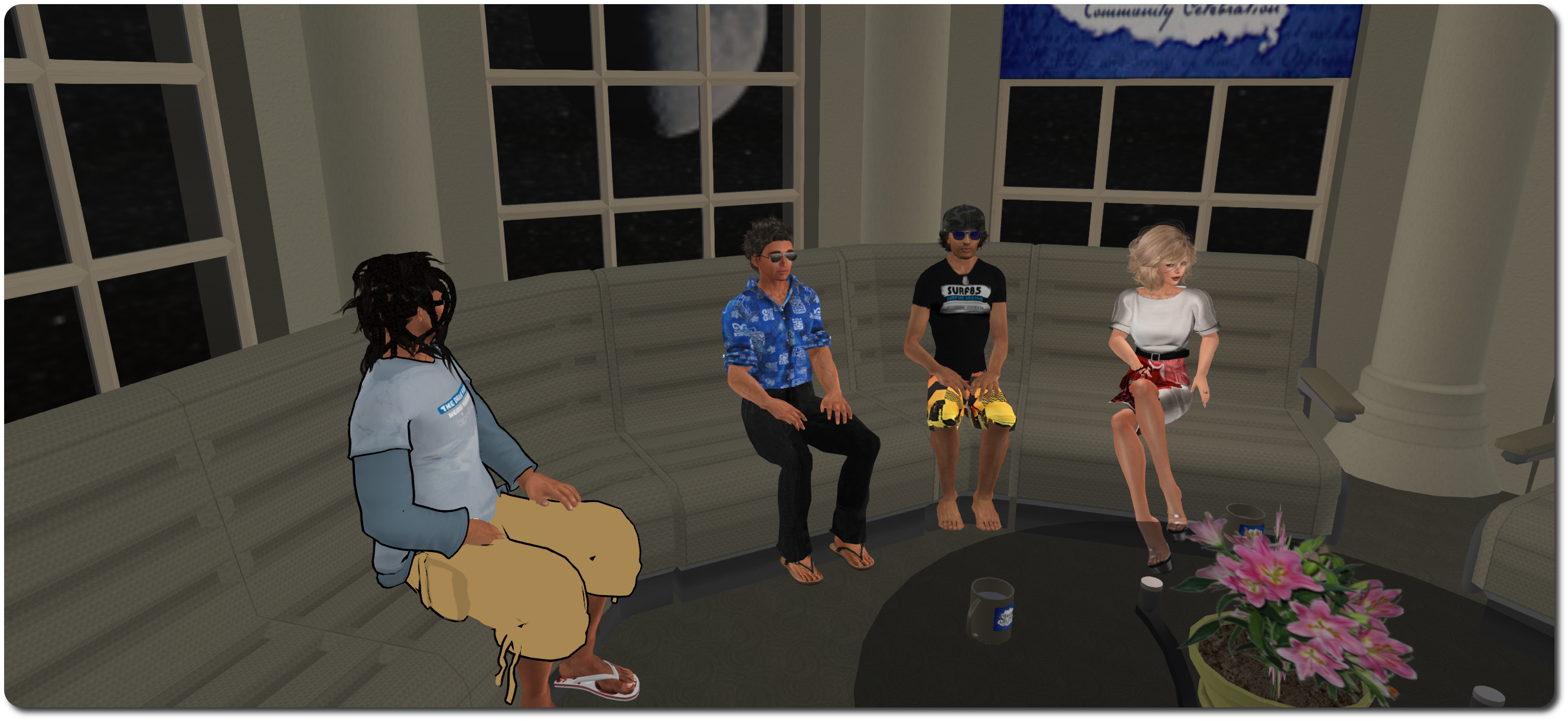
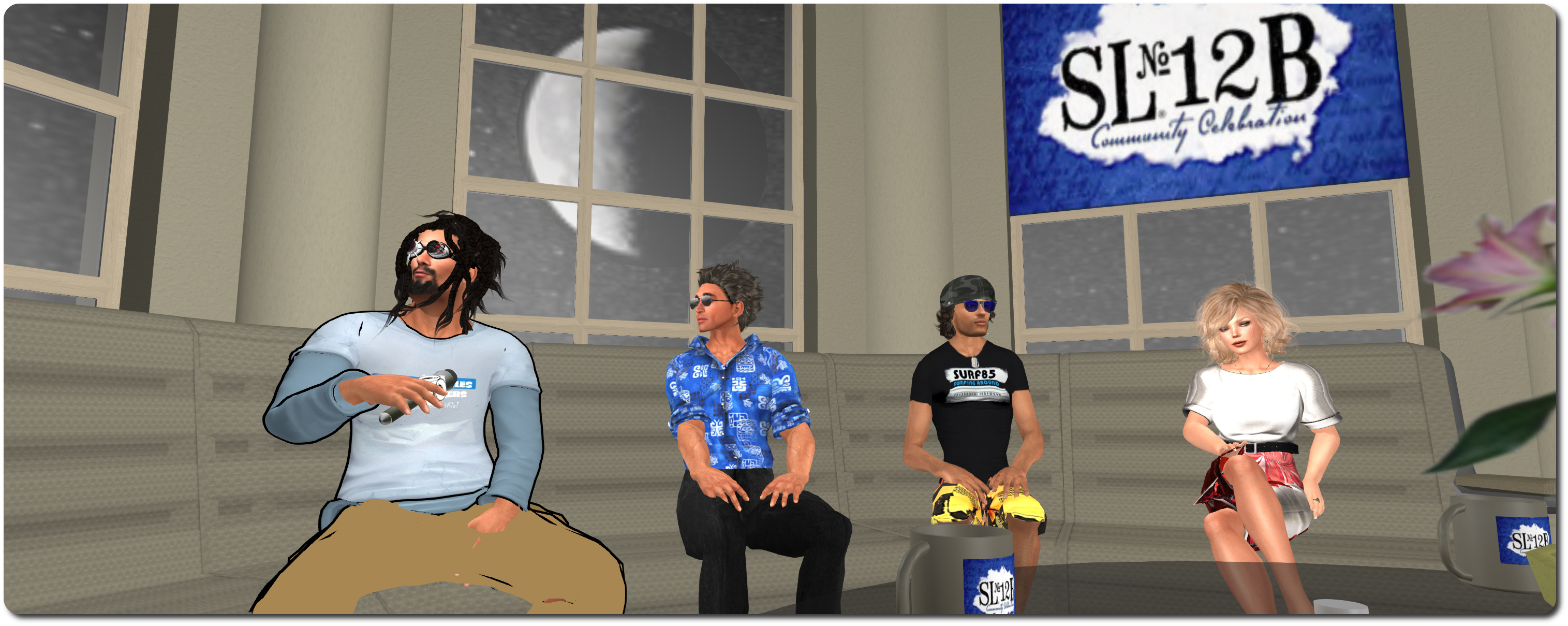
Danger Linden (centre left) and Troy Linden (centre right) discuss Second Life and Project Sansar with Draxtor Despres and Saffia Widdershins at SL12B
Linden Lab’s next generation virtual worlds platform, code-named Project Sansar made the news in Second Life and in the media on Thursday, June 25th.
In the media, Bernadette Tansley, writing in Xconomy covers how Second Life Creator Linden Lab Prepares To Test Parallel VR Universe, delving into the forthcoming closed alpha testing for the new platform, which we know to be code-named Sansar.
In terms of Sansar news, the article specifies:
It can already run at 75 frames per second
The Lab plans to accelerate the platform to 90 frames per second to sync with specifications expected for the Oculus Rift and other headsets
The initial closed alpha, involving a limited number of creators experienced in the use of Maya, will commence in July 2015
If all goes according to plan, the programme will gradually be expanded to a more public beta testing phase around the first half of 2016
A “version 1.0” of the platform might be ready by the end of 2016.
Outside of LL and Sansar, the article is interesting in that it suggests Cloud Party, which was acquired by Yahoo in 2014, is still in the running to develop a virtual world that can be operated with the upcoming new range of VR headsets, etc., alongside the Lab, Philip Rosedale’s High Fidelity and new start-up AltspaceVR.
You can read the entire piece by following the Xconomy link given above.
Drax, Danger Linden, Troy Linden and Saffia at the Meet the Lindens at SL12B
During an interview with Danger Linden, Sr. Director, Product, Virtual Worlds and Troy Linden, Senior Producer, held as a part of the SL12B Meet the Lindens series of conversations, the subject matter inevitably came around to Project Sansar, and the following tidbits of information were given.
Further confirmations of Known Basics
SL users will be able to use there SL identities with Project Sansar if they wish
Linden dollars will be the transaction currency / tokens on Project Sansar
Both voice and text will be supported in Sansar for chatting / communications.
However, neither of the above mean you’ll be able to teleport directly from SL to Sansar or vice-versa; both are separate entities.
“Master” Accounts
Users will be able to have a “master account”, under which they can then have multiple avatar accounts they can use.
The “master account” will be known only to the user and Linden Lab, and will use an e-mail address as the main form of authentication
Users can create multiple avatar accounts (or “persona names” as Danger Linden referred to them) under this “master” account, which they can use to access Sansar, and will be known to other users only by the avatar account they are using
Inventory and account balances will apparently be associated with the “master account”, allowing them to be shared between the avatar accounts under the master account
It is not clear what format avatar / persona names will take, and whether it will be a first name, last name format.
(The idea of having a “master account” with this kind of flexibility has long been on users’ wish lists for Second Life for a long time – see JIRA SVC-6212 and my own article from 2011 on the subject. As such, this is liable to be a popular move among those SL users interested in trying Second Life.)
Anonymity and Trust
Sansar users will be able to have as much anonymity as they wish. However, the more information that users provide to Linden Lab – be it wallet identity, a verified e-mail address or payment information – the more capabilities they’ll have in-world.
The idea here is to try to address the issue of griefing while still maintaining a relatively low barrier to entry – obviously, the easier it is to access the platform, the easier it is for muppets to run amok. So, the idea is that as more information is provided, the greater the level of trust established between user and Lab, allowing people to “do more” in-world and participate more. However, the exact relationship between platform capabilities awarded, and the information users will be asked to provide in order to access them, is still being determined.
Obviously, the content of the information you provide to the Lab remains private and confidential (i.e. if you supply a verified e-mail address, that e-mail address is not revealed to any other users). However, if a verified e-mail is required to, say, publish a Sansar “world”, then the fact that you have published that world will tell other users you have a verified e-mail with the Lab.
Mesh, Terrain and Building Tools
Sansar content will obviously be focused on mesh – but not necessarily exclusively mesh
Subject to further confirmation, it should be possible to also build in-world objects using voxels
Maya is the tool that is being used purely to assist with testing when the closed alpha commences. It will not be the only tool, and it will not be the sole tool for content creation (see Ebbe Altberg’s comments on alpha access and tools from the Virtual Worlds Best Practice in Education, March 2015)
A goal for Project Sansar is for people to be able to build in-world and to share in collaborative building
Sansar will include a full “professional” (in terms of its capabilities not in the need for people to have to be professional animators in order to use it) animation system, which will be based on Havoc animations (Havoc being the SL physical system), overlaid with additional capabilities / code directly from the Lab
All objects in Sansar will be fully scriptable and animated; it is not clear whether on-the-fly modifications to mesh items in-world will be possible
It is acknowledged that content creation tools can be a barrier to adoption / use; it is therefore a goal with Sansar to “make it easier to make things in Sansar than it is in Second Life”
 On Wednesday, November 4th, Linden Lab launched a new look to its corporate website.



 Inara Pey: Living in a Modemworld