SL23B Meet the Lindens: Philip Rosedale – summary

via Linden Lab
On Monday, June 22nd 2026, Linden Lab held the first of the SL23B Meet the Lindens events, featuring Second Life and company founder, Philip Rosedale, in conversation with Brett Linden. The session was live and featured a mix of pre-submitted questions, and those asked during the session. Table of Contents

Notes:

  • This is a summary (not a full transcript) of the majority of topics discussed at the session, and the official video of the session is embedded at the end of this article, not a full transcript.
  • Timestamps are provided to the relative points within the video where specific topics are discussed, allowing readers who prefer to listen to the comments directly to be able to do so.
  • The session did not address a lot of technical / product-related questions, due to the fact that these would likely be addressed by the representatives of the relevant teams attending other SL23B Meet the Lindens sessions.
  • Some of the questions addressed were answered only in part or somewhat differently to how they were phrased. Where this is the case, the bullet points obviously reflect the answers given.
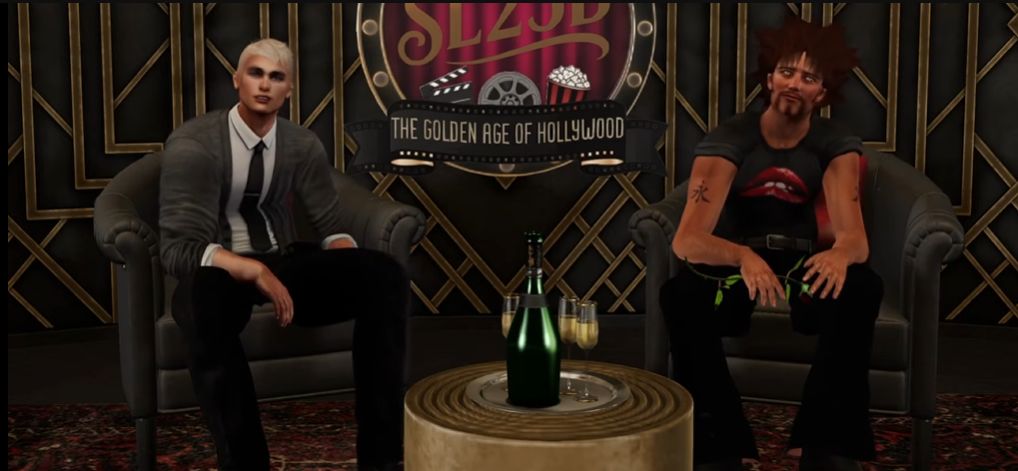
SL23B Meet the Lindens: Philip Rosedale, with Brett Linden (l)

Pre-Submitted Questions

On Second Life

[Video: 2:38-25:38]

[2:38-5:00] When you first imagined Second Life, what was the most important thing you hoped people would do there; and what have residents done that has surprised you the most?

  • As first imagined, Second Life was more of an artificial life simulator than it was a virtual world.
  • It was going to have a much more complex / stripped set of physics laws and a lot of emergent behaviour within it, up to and including the evolution of artificial life-forms in addition to having a human presence within the world.
  • In this respect, the original vision might be seen as somewhat closer to Minecraft, where there are rules to be negotiated, with “all of the magic” coming out of human interactions with those rules.
  • However, in development, SL became far more focused on a combination of the ability of the individual to be artistically and creatively expressive together with the development of avatars.
  • At the time Second Life was developing, the concept of the avatar was largely undetermined.
    • In the very early days, there weren’t human avatars, but little spaceship-like creations with “a Cylon-like eye”, and “a giant eyeball”.

[5:02-6:57] Looking back after more than 20 years, which of your beliefs about virtual worlds turned out to be right and which turned out to be completely wrong?

  • This has multiple possible answers, so the focus will be on just one.
  • As SL started to take off with mass media coverage [around 2006], his belief was that everyone in the world would use an avatar “at least a little” (e.g. people would not fly from coast to coat for business meetings, but would all meet as avatars).
  • In this respect he believed that Second Life will be more like the Internet has become [supporting on-line meetings and presentations, etc.] in that respect.
  • It turned out that while most people were not willing to use avatars even for work, a much smaller portion of people would be willing to use avatars as a primary means of personal expression.
  • Feels that the use of avatars remains one of the mysteries and challenges about Second Life and virtual worlds in general.

[6:58-9:26] You’ve often described SL as a place which gives people “freedom”. Why do you think freedom remains a powerful ingredient in virtual worlds when many modern platforms are moving towards more controlled experiences?

  • It is interesting to look back and note that too much freedom can be overwhelming. Just standing in-world for the first time with an empty space before you and all of SL’s creation / building tools and options at your disposal can be both powerful and overwhelming, and people opt out of it.
  • However, if there is too little freedom, such as the limited means by which to give personal expression in a video game, then people also opt out of it.
  • The ideal balance is obviously somewhere in the middle of these extremes, even if Second Life is biased towards too much freedom.

[9:27-12:01] If you were inventing SL for the first time in 2026, what would you build differently, and what would you keep the same?

  • Again, multiple possible answers, but will focus on two things: in-world building and the avatar.
  • In-world building:
    • The ability to build something in front of someone or work collaboratively on building something is “electrifying”, and the ability to both edit the world at the same time as using it is “critical”. As such, would “double-down” on this.
    • The decision to fully implement mesh support was a practical decision because creators wanted the detail and additional abilities inherent in creating mesh models.
    • In this, while it might have been something of a “trade-off”, allowing the import of model build “off-line” was absolutely the right decision at the time. However, in today’s world if SL was just starting, he would insist on having the necessary mesh toolsets in-world, with no off-line creation.
  • The avatar:
    • If SL were just starting in 2026, he would look to have the avatars “made of [/by?] the same stuff as prims”.
    • Feels that something was missed in having the avatar toolset separate and distinct from the content creation tools (“building model”), and so would want to re-examine that.
    • Was never his intention to have such a division between world-building and avatar building – hence the use of Primitars in LindenWorld.

  • [Note that you can obtain a “modern” take on the Pirmitar for free on the Marketplace.]
  • In 2026, it should be possible to build avatars using the same materials and capabilities as used in building the world.
  • In general for content creation if building SL in 2026, would also look at capabilities such as 3D Gaussian splatting, again for both world-building activities and avatar-building.

[12:01-14:07] What do you think makes a virtual world feel truly “alive”? Is it the technology, the economy, the creators, the social connections, or is it something else entirely?

  • To him, the two things that made Second Life “real” in the early days were:
    • It had a sufficient set of live building tools to enable people to be genuinely and personally expressive.
    • There was an economy which allowed people to share / trade / help each other [e.g. those who found in-world building difficult / confusing could still purchase houses, etc., and share in the world].
  • In addition to the above, to ensure the world can continue, there needs to be a real density of diverse people using it – a lesson he feels other virtual worlds that have come along have failed to grasp.
Virtual worlds with no people in them are not really virtual worlds. It’s all about the world being a space between us.

– Philip Rosedale

[14:12-17:45] What has Second Life taught you about human nature which you don’t think you could have learned in any other way?

  • Feels that one of the things he has been privileged with throughout his long association with Second Life is what it has taught him about human nature.
  • One of these lessons is that SL demonstrates people want to help one another far more than they want to fight or compete.
  • Much of the physical world is predicated on competition with others rather than cooperation; SL shows that people would much rather cooperate and help one another.
  • Example: early in SL history, he heard someone was “giving away” land, leading to concerns of a scam / ponzi scheme. But investigations revealed they were buying parcels and giving them to people at no charge to take over and use [and presumably pay tier on], just to help them get started in SL.
  • SL has also demonstrated it can take away physical danger from people by offering them a place they can share and participate which does not have the means to inflict physical violence on them.

[17:49:20:46] What lessons from SL do you wish today’s social media platforms had learned?

  • Simple answer: ads are evil; micro transactions are a lot better.
  • One of the questions for the early Internet corporate users was how to pay for it. Two schools of thinking emerged: to either just place ads on everything; or to figure out how to charge very small amounts of money for things.
  • Obviously, the former won, but Second life is perhaps the richest exploration of the potential of the latter, and has proven it to be a better and most honest direction to take.
  • Acknowledges that this is a simplistic view, given what micro transactions actually cover and the form they take, but very much believes having a direct economy is much better.
  • Second Life also initially [before the advent of the Basic account] also provided an income [stipend] as well as an economy.
  • This approach has proven its value in terms of how little personal information LL gathers on its users, allowing them to remain relatively anonymous; something which is increasing important in the “surveillance economy” of ad-based revenue generation.

[20:56-23:14] SL pioneered the creator economy long before the term existed. What do you think modern creator platforms still get wrong?

  • One thing modern platforms get wrong is that their fees are not low enough, particularly on transactions.
  • SL has a variety of different fees for a variety of different things, but:
    • There remain no fees for in-world purchases of goods and services from others.
    • Where fees are charged for things like Marketplace transactions, they remain single-digit percentages.
  • By contrast, many other platforms with “creator economies” have revenue splits between themselves and the creators in high double-digit percentages [and other charge “commission fees” in the double-digit realm – e.g. at least 15% on creator sales].

[23:40-25:38] What creator-made experience in Second Life left the strongest impression on you?

  • Cubey Terra’s [now defunct, sadly] Abbot’s Aerodrome with its skydiving experience.
  • AM Radio’s The Far Away – which is still in Second Life and curated by Ziki Questi.
  • Robbie Dingo’s Watch the World video [which remains one of my all-time favourite SL videos, and has been featured in these pages].

[33:16-34:03] What aspect of Second Life are you most proud of, regardless of business success or technology?

  • The positive impact on people.
  • Feels this is truer today than previously given the way technology is doing so much to damage human relationships.

[36:56-37:20] If you could instantly grant every resident one new ability tomorrow, what would it be? [Answered in fun.]

  • The ability to fly in the physical world the same way as we can fly in SL.

On Technology, the Future and AI

[Video: 25:40-36:45]

[25:52-28:23] Do you think AI-generated characters will eventually become meaningful members of on-line communities or will human-created communities always remain fundamentally different?

  • Believes the answer is yes, AI-generated character will become meaningful members of on-line communities, but not the AI systems that currently exist.
  • The current AI systems are neither “alive” nor as compelling as prospective friends and neighbours in a virtual environment when compared to humans.
  • Developing more compelling AI systems is part of the work being carried out at the California Institute of Machine Consciousness, where he both spends some of his time working and fulfilling an oversight role as treasurer and board director.
  • CIMC’s work is focused on the development the development of neural networks which learn and “grow-up” via direct interactions with humans, rather than depending on large language models (LLMs) as with the current crop of AI systems. They will hopefully have deeper and more compelling “personalities”.
  • See also: Awakening the Angels by Philip Rosedale.

[28:32-33:14] What technological breakthrough do you think will most dramatically improve virtual worlds today?

  • Believes the ability to convey non-verbal cues when communicating in virtual world is one of the most vital components in making them more broadly compelling.
  • The biggest thing missing is emotional non-verbal communication; body language, expression, eye movement, etc., which can communicate far more than words, and help us to determine whether a personal can be trusted or not.
  • Obviously, those in SL have learned to operate and interact without these non-verbal cues, but it is a skill to be learned over time and not having such cues is a tremendous impediment for platform growth.
  • Believe that the ability for convenient body, expression and emotion tracking is coming, and that AI can help with the detection of all three.
  • SL obviously has avatars that can be expressive, all that is lacking is the ability for them to directly convey the expression, emotion, etc., of the people using them.
  • Does not believe technologies used by the likes of VR Chat and similar do not do a good enough job in this respect.
  • Couches the idea as the “spouse test”: if body language, etc., could be accurately transmitted by a person’s avatar, could that person’s spouse recognise them purely on the basis of the avatar’s movement and expression and without voice or similar?

[34:22-36:45] What problem are you most interested in solving today, which you weren’t interested in 20 years ago?

  • Is working on Fair Share [via his In Reality Lab based out of the Linden Lab office complex], a project to investigate how the design of Second Life’s currency systems might be used to create better forms of physical world local community currencies they are able to produce, based on mutual trust (rather than artificial scarcity) and funded by a simple transaction tax.

  • In this, has a similar conviction with the idea as he did with Second Life 20+ years ago (in this case, people will “stop using dollars” in favour of local currencies).
  • Emphasised this is not a Bitcoin, Etherium or other high-end crypto currency.

Questions from the Audience

[Video: 37:46-40:18]

[37:49-41:23] do you think that virtual worlds still have an under-developed role to play in serious adult learning? Are the blockers technological, institutional or cultural.

  • Absolutely virtual worlds have an underdeveloped role to play in adult learning .
  • The learning process is complicated, relying much more on interpersonal interactions – meeting friends outside of the classroom, chatting, sitting together, etc., than had at one time been thought.
  • When done correctly, virtual worlds like Second Life can present the whole campus experience – from moving to classes to meeting people, thus enhancing the learning process..
  • The challenge, however, goes back to the lack of non-verbal communications already mentioned. In this case, how people are responding to a lesson, who is looking where or at whom, etc., which remains a blocker to many learning experiences.
  • As such, sees the major blocker to widespread use of virtual worlds for learning as being more technological than not; and alongside the current lack of non-verbal communications, also sees things like voice, video and screen sharing having to work at high fidelity as intrinsic to the virtual learning process as well.

[44:06-46:48] Can you address the future of Second Life, where you believe it’s headed? For example, user growth and retention. How much future proofing is really possible?

  • Believes that the development of non-verbal communications is key to the platform as a whole, as it will help people feel far more comfortable around the use of avatars.
  • Believe small steps can be taken in attracting new users, such as the work in improving the overall marketing of the platform, which is starting to bear fruit.
  • Recognises that there is a degree of challenge in both meeting the needs of established users and attracting new users to the platform; particularly when many have known SL as their virtual home for up to 20 years. These challenges can result in trade-offs.
  • Is personally comfortable if the platform doesn’t grow as fast as it might otherwise, and with the trade-offs the company has made in keeping its users engaged and in attracting new users. As such, he doesn’t have a given answer as to the one thing that might make it suddenly grow “explosively”.
[46:54-48:39] As a lover of SL history, are the builds like those mentioned being preserved?

  • One of the problems with region preservation is that of cost; every region cost money whether running or stored. With SL representing 2.8 petabytes of data, that’s a lot.
Side Note: The Second Life Region Preservation Society (SLRPS)

Established by Patch Linden does maintain a number of historically significant region builds, including:

However, the status of SLRPS is unknown following the May 2026 reorganisation at Linden Lab.

  • Another issue is that of copyright [when someone removes a region from SL, if it is entirely their own work, they may not want it preserved].
  • Certain regions / builds of historical interest might not actually work correctly if available now.
  • Some environment were historic builds could be preserved via a rezzing system might be possible, but again would require space, engineering support, etc.

[48:32-50:16] During the “boom” period (2006-2008) dozens of companies joined Second Life, and there was an expectation of company meetings and workshops occurring in-world. This didn’t materialize. Do you have regrets on that, or are you happy with how things have actually turned out?

  • Is less a big business person and more of a community content and community, so is happy with how it turned out.
  • Again believes the lack of non-verbal communications tracking makes it hard for SL to be a viable business / marketing tool.
  • Also doesn’t think it makes particular sense for really big consumer brands to come to SL as a marketplace (e.g. because of geographic issues compared to the global nature of SL’s user base), so is happy with the way things are.

[50:19-52:49] Could SL develop programmes in theatre, art, sports, leadership, and other areas that allow the moles, creators, and the community to participation? Could these be a kind of scholarship to help defray costs for those developing programmes and events?

  • The Positive side of supporting the arts say separate from supporting commercial activates is that it provides the opportunity to uh grow art in the world. So at a high-level, funding for the arts makes a lot of sense.
  • However, such a top-down curated approach can become difficult for LL to manage [e.g. claims of FICs, favouritism, etc.]. Further, such an approach can lead to people focusing more on predicting “what the powers want” than on producing the art they wish to produce.
  • As such, he is OK with the Lab not being too closely involved in the support of such endeavours and would prefer the baseline experience to open for people to offer what they’d like others to experience.
  • [Note: this is why LL provide the regions for the Second Life Endowment for the Arts, but not involve itself in select the art and installations displayed within the SLEA regions.]

[53:01-55:06] What are some things we can do to help keep this place around even if we don’t have money?

  • Personally on-boarding people into Second Life and helping them get started (or “adopting a noob”), then providing LL really specific actionable feedback on what exactly happened and what in particular could be done to directly improve the new user’s experience.
  • What is not really required in opinions on things like Welcome Hubs, etc., as these are generally highly subject and when taken together, often run contrary to one another. Plus, many ideas that get suggested have been tried in the past and tended not to work.

[55:10-56:18] What fiction are you reading?

  • Most recent has been reading The Philosophy of Ted Chang and prior to that Project Hail Mary (before seeing the film).
  • Does not really listen to audio books. Much prefers the idea that physical books and turning the pages is far more memorable.

[56:25-58:55] Will Second Life ever bring back the Cornfield?

  • For those unfamiliar with the Cornfield, it was the punitive region to which people exhibiting bad behaviour would be sent and would have to log-in there and remain there for a certain amount of time.
  • It was literally a cornfield with televisions strewn across it giving out public information messages.
  • Believes it is one of the reasons SL is so positive, as it demonstrated there were consequences to bad behaviour – although some might argue there are not enough consequences for bad behaviours.
  • Thinks that people understanding that their membership in their community and the norms that they should follow are very much a product of everyone’s involvement in the platform is part of the magic of Second Life.
  • Would like to see LL make incremental changes that further enable local communities in SL better restrict, control, normalise their own behaviours and memberships, rather than it being managed top-down.

[59:53-1:01:55] Any thoughts about ways the community’s collective expertise might be leveraged for the betterment of Second Life?

  • Is open to ideas on this. If people have specific ideas (rather than generalities / subjective observations), they can be e-mailed to him.
  • Would also appreciate suggestions on how to actually bring together such a broad-based coalition and then manage it in a format where actionable ideas which can be carried out by a relatively small team might be brought forward. So those with ideas on how to select and organise such a group, examples of processes by which they might work, etc., would also be welcome.
  • Also noted that he’s personally had a lot of conversations around ideas and suggestions from “old hands”, but the solutions, the engineering costs, etc., have tended to be complicated.

End of Session.

SL23B Meet the Lindens Summaries

Gaeta1 and Zindra changes: Town Hall meeting summary

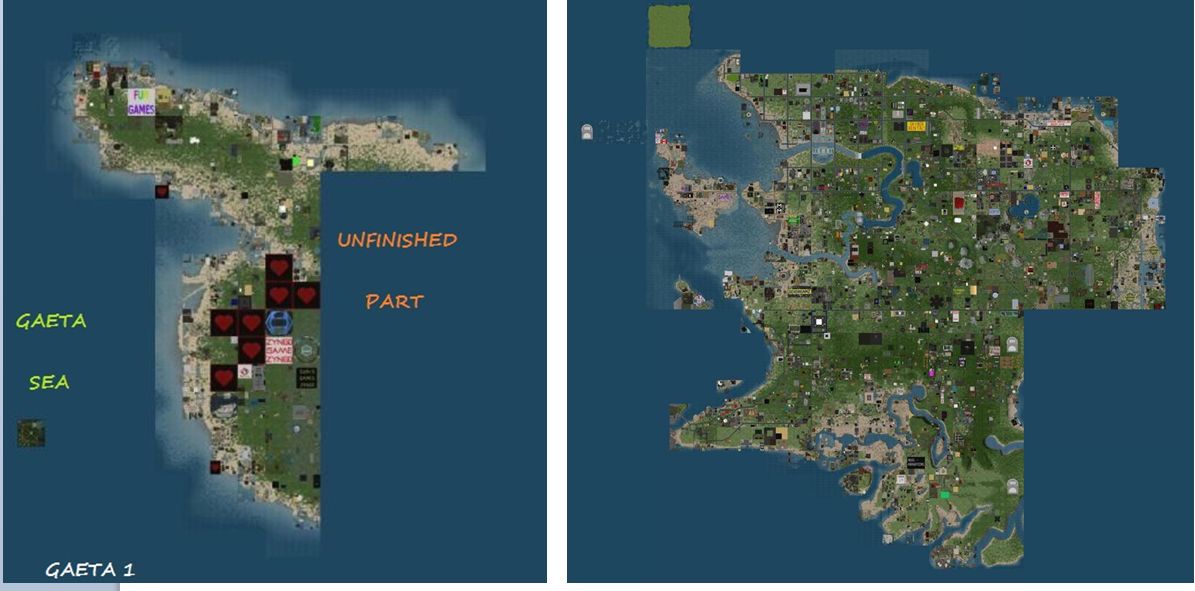
Linden Lab has announced changes to the standalone Gaeta 1 continent, and the Zindra adult continent. Via the SL Wiki
On Monday, April 20th, 2026 Linden Lab hosted a Town Hall meeting to discuss the upcoming transition of the Gaeta 1 standalone Mainland continent and the 90-region expansion to the Zindra Adult continent. For detailed context on these changes, please refer to the following blog posts:

Table of Contents

The Town Hall was held to offer more information on the upcoming changes – which will be implemented over the course of the rest of the year and see those on Gaeta 1 transitioned away from that continent to land holdings of equitable size elsewhere on Mainland (and not necessarily Zindra), prior to Gaeta 1 being taken off-line, with the steady built-up of the more coastal region of Zindra over the same time period – and to address questions and feedback from Second Life residents.

A number of Lab Land and Support staff attended the meeting, with Derrick Linden fielding the majority of questions, with support from Oatmeal Linden, Whitney Linden and Wendi Linden.

The following is not intended as a full transcript of the Town Hall, but a summary of key questions / suggestions and their responses.

There was a large degree of conversation, particularly during the latter parts of the meeting, which was technically outside the scope of the meeting. This broader conversation included subjects like Zindra land prices, GTFO hubs, extending Mainland road systems, ad farms, Tiny Empires bots, and Yava pods, and is not reflected in the notes below, given the topics a) were mostly outside of any discussion on the Gaeta-1 / Zindra focus and b) did not garner significant responses from the Lab personnel at the meeting.

The meeting utilised local chat rather than Voice, and these notes have been taken from a chat transcript of the meeting provided by Pantera Północy (I missed the meeting myself, due to various reasons), and a summary of major questions and answers supplied by Neon Lyter. Pantera’s video of the session is also embedded at the end of this article – my thanks to both Pantera and to Neon for providing the video and information.

Introductions – Main Speakers

  • Derrick Linden – Senior Manager of Product Operations, who has been with the Lab for almost 15 years.
  • Whitney Linden – Supervisor of the Land Operations Team, who has been at the Lab for 14 years.
  • Oatmeal Linden: Land Specialist with 4+ years at the Lab.
  • Wendi Linden: Land Specialist with 7 years at the Lab.

Recap: Why are These Changes Being Made?

  • Overall, these changes are designed to reflect how Mainland is currently being used.
  • Adult regions continue to see strong demand and high occupancy, while some General and Moderate areas, including Gaeta 1, have seen lower usage over time.
  • Rather than expanding total Mainland size, LL is reallocating capacity to better match that demand.

Impact on Gaeta 1 Residents

  • For Gaeta 1 landowners, this will be a gradual, supported process running through the end of 2026.
  • No regions will close without advance notice, and every impacted landowner will receive direct outreach with relocation options.
  • This includes size-for-size parcel replacements, with flexibility to move to Zindra or other Mainland areas depending on individual preferences.
  • The goal is to make this transition thoughtful and resident-focused, and LL want to give residents time, clear options, and direct support throughout.

Questions and Answers

General

Suggestion: Zindra has lots of troubles with open water traversal. The HOA-gated nature of Linden Homes could be a solution here. Build A-rated Linden Homes along the outskirts of the new expansion, among water like the stilt/houseboat concept, so that LL doesn’t have to run water regions with no paying customers in them while also restricting people from blocking access routes?

Response: Unfortunately we’re not here to talk about Bellisseria or Linden Homes products. This is certainly an option that we have available to us, and we will take it into consideration as we consider future plans here.

Q: Will small areas of protected land possibly be opened?

A: Currently we don’t have any plans to open any existing protected areas, and the new regions that are being created in Zindra will have protected roads and waterways.

Q: will there be any water regions along the protected waters opening for purchase? Most of the ones that are here have already been purchased up by land companies.

A: Yes, there will be some water regions that will be resident occupied. However, the first priority is the individuals that are impacted on Gaeta 1 and those are getting first dibs on the new land being made available on Zindra. We will not make any of the new land available for anyone else to purchase or claim until those individuals are sorted through.

Q: I live in a PG location so I have a concern: is this the beginning of a trend to reduce PG lands to zero?

A: No, no plans on that with PG land.

Q: [Is] Sharp (formerly the Teen Grid continent, and also unfinished, like Gaeta-1) next?

A: We have no plans or changes anticipated for Sharp or any other Mainland continents at this time.

Q: Four older (Nascera) Linden Homes continents were deleted last year. What has happened to those regions (and the financial savings they created) and why have those Nascera regions not been redistributed to complete both Zindra and Gaeta 1, while also connecting Gaeta 1 to the remainder of Mainland?

A: Those four continents of old Linden Home regions were brought down and the redistribution of those regions is a slower phased process, and are being released with new style Linden Homes over the longer period of time. Those regions were earmarked for Linden Homes, and not Mainland.

[Note: a follow-on question to this asking why resources are allocated / reserved for Linden Homes when the older themes have such a high vacancy rate, rather than revamping them. This went unanswered as outside the scope of the meeting.]

Q: Is this part of an overall resurgence in a focus on Mainland architecture? Or is this a one- time project?

A: This is definitely one step in the direction of looking at working with our Mainland product, and we have several initiatives that we’re currently working on. For instance, we’ve been doing some stuff that I don’t really want to spill the beans on here, however, those of you that have been paying attention to New Bloom Mountain might have some indication on things to come.

We have also been doing more maintenance on existing Mainland (for example, the snow lands chair lifts, etc.). Please let us know about other potential broken content that needs some fixing, too.

Q: Will we see more projects like this in the future of land being recycled to for better purposes to be more efficient and progress SL forward?

A: We are entirely focused and only have plans currently for Gaeta 1. Afterwards, I can make no guarantees for what the future holds, but I want to make it clear that we understand how impactful this is and do not take decisions like this lightly. So this will continue to be evaluated for the future of the Mainland and SL as a whole.

Concerns were also raised throughout the meeting about:

  • The potential lack of available land facing open water on other Mainland continents which could be offered like-for-like to those on Gaeta-1 who have shorefront / open water land at present.
  • The risk of those on Zindra losing their open water views as new regions are added.
  • Neither of these concerns were directly addressed by the Lab.

Gaeta 1 Specific

Q: Did the Lindens already mention how many people this is estimated to actually affect who actually log on?

A: There were 349 unique land owners or groups as of April 15th that owned land on Gaeta 1.

Q: How will the actual moving process take place? Is the land owner responsible for actually moving their own items?

A: Yes, however we’re planning to work with each individual person and give them time to move the content they need or want to move over, and pick up anything they don’t plan on carrying over.

Q: Why not finish Gaeta 1?

A: This was certainly an option that we had considered, however, there are large swaths of land available here, especially those that are not along any waterways or nearby roads which is unoccupied and unutilised. As mentioned in the blog, we want to shift this land into more desirable adult Mainland, and use it as an opportunity to finish out the Zindra continent.

Q: Will residents be able to hold Gaeta1 land and the replacement land without additional costs during the move to allow for builds to be more easily moved? Or will they have to drop one and start over on another?

A: This is something we anticipate some users needing, and we will absolutely be working with them to the best ability we can to make this transition as smooth as possible. And that does include possibly assisting them in this exact manner.

Q: What about people who have SL families with child avatars who are living on Gaeta I? They can’t move to an adult continent.

A: We are assisting everyone with their particular land needs. If they are unable to or do not prefer Adult Mainland, we are helping them find alternatives.

[Also it has been made clear in the official blog post that no-one currently on Gaeta 1 must move to Zindra, the creation of new Zindra regions is somewhat tangential to the Gaeta 1 transition, the two only linked by timing and the aforementioned wish to re-balance land allocation towards the higher demand of Adult regions.]

Q: [abridged and partially paraphrased for length]: Gaeta 1 was originally created in 2008. Why was the continent left unfinished? Zindra meanwhile, was announced in June 2009 with work on the land starting shortly after, but then left incomplete for 15 years. Why the change of heart after over a decade of residents pleading with Linden Lab to provide additional adult Mainland? Why is Gaeta 1 being sacrificed? Gaeta 1 has 10.2% of land abandoned, but Jeogeot has 29.6% and Satori 27%. Why should the residents of these continents not be concerned that their creations, their effort and time, might just be done away with?

Bellisseria also has large tracts of unoccupied homes (e.g. Alpine Homes (69%); Fantasy Homes (48% occupied), with Bellisseria as a whole only 39% occupied. Why is more effort being put into expanding Bellisseria when there’s this much product currently unused? Why not halt the expansion of Bellisseria or repurpose land from there instead?

A: I can’t speak to Gaeta 1’s creation or its unfinished state, this happened prior to my tenure here, and pretty much all of the individuals that were in decision-making positions at the time are no longer here. I totally understand this sentiment, but I unfortunately don’t have much I can answer on this front.

However, I did see the figures on the forums that are being quoted here based on externally-collected data, and these numbers are not accurate to the information that we have. Gaeta 1’s occupancy on non-protected parcels was actually only 44%. And it being disconnected was a contributing factor, but not the primary reason.

Q: If we have a xx amount of land in Gaeta 1 we will be given choice for equal amount of land or we can also choose to buy more than what we currently own for example if it’s a 1/2 sim can we get a full region in the expansion option too? And what will be the pricing on that?

A: No, it will be same sized parcels for parcel placement.

Q: When managing relocations or land disputes on Gaeta, do you take into account how long someone has owned their land? Specifically, do long-term residents receive priority over those who purchased land just this week?

A: Overall, our priority is the largest impacted communities first. Afterwards, we’ll be working with individuals and smaller groups. However, we are giving priority to residents and groups who owned their land prior to April 15th when this blog was released.

Q: What if you first tried to redesign Gaeta I and move it to Gaeta V, for example between the North-western part of Gaeta V and the North-eastern part of Corsica, reducing Gaeta I’s size so that you get rid of the abandoned land but keep the Sandy Beach Trail, the coastline and the existing communities, moving the other regions as needed to reshape it? It cannot be more work than these planned relocation efforts, and if that doesn’t bring you the desired results, you can still shut it down, but trying couldn’t hurt more than keeping all the abandoned land online already has for so many years.

A: There were considerations put into this, but the primary concern that we’re attempting to work toward a resolution here is that there is an imbalance between A vs. G/M regions. This opportunity allows us to help the land market on Zindra while also solving for lower occupancy numbers on Gaeta 1.

Q: What is LL going to do to help residents with very strong memories attached to their land? For example, residents who still have things rezzed out from family and friends who have passed away in real life. Is there some way for Linden Lab to move these objects to the new land?

A: Unfortunately, we don’t have any options available to us to selectively relocate specific objects like this.

Q: Can we have a meeting with just Gaeta 1 people, just to sort out things more in detail?

A: We’re currently planning to do a smaller town hall specifically as an invite-only to individuals and groups that have land on Gaeta 1. These will be sent as personal invitations, so keep an eye out for incoming communication over the coming couple of weeks. These will be sent via notecard from a Linden.

Q: How is contact being handled in the case of group owned land?

A: We’re balancing and weighing depending on if the founder still active, in lieu of that we prioritize the individuals that are contributing the tier to the groups.

Q: Does anyone know if any of the Gaeta I regions have already begun to disappear?

A: Not yet – we’re beginning the process over the next 2-3 weeks.

We are not deactivating any regions until the land owners there have been able to find new locations.

Zindra Specific

Q: What steps are you going to take to ensure that the new land in Zindra is not immediately bought up by land barons?

A: We are not making any parcels of land available there until everyone that is being moved from Gaeta 1 has been taken care of and have claimed parcels there, or elsewhere, as they desire and we work with them. That leaves us several months ahead that these regions will begin to be added to Zindra, but not made available to claim the land.

The timeline for this whole process is through the end of this year, so realistically no land will be made publicly available until that time. After that, we’re currently discussing strategies for how to make the remainder of the new land available, and it will likely be some sort of mixture of auctions and/or a possible lottery system that we are discussing internally. However, if you have other thoughts, we’d love to hear about them.

Q: So, will Gaetans also get first dibs on scooping up some additional Adult land before the land hoarders that aren’t Gaetans? If so how much we looking at pricing wise?

A: Answered this already, but just to reconfirm – yes, Gaeta 1 landowners will get first dibs [on the new Zindra lands, if they want]. Pricing will remain the same on your current tier structure as long as you’re just doing a like-for-like parcel switch.

Q: In terms of void edge land on Gaeta, what is considered comparable on Zindra? Is it ocean access?

A: This land [void on Gaeta 1] is being considered as interior land and not water. However, the new land being spun up on Zindra has plenty of available water, and that doesn’t necessarily immediately disqualify you from owning water-adjacent parcels.

Q: Will the new Zindra regions have PBR terrain?

A: We are updating the land textures to a higher resolution [2k], but not PBR.

Q: Can you set expectations as to how much land will be available to non-Gaeta residents?  97 regions are moving to 90.  What percent of those 97 were abandoned before the announcement?

A: We don’t have any clear indications yet just because we don’t know how many will opt for new land on Zindra vs. existing G/M land. We anticipate having left over land on Zindra, we just can’t estimate exactly how much.

Q: Will there be a possible chance in the future that Zindra might be connected to the rest of Mainland?

A: No, this is not possible. We do not place Adult and G/M rated regions adjacent to one another.

Those wishing to offer feedback on the Gaeta-1 and Zindra changes, these can be posted via the forum discussion thread.

LL announce Mainland changes & Town Hall to discuss

Linden Lab has announced changes to the standalone Gaeta 1 continent, and the Zindra adult continent. Via the SL Wiki

On Wednesday April 15th, 2026, Linden Lab announced some significant Mainland changes involving the Gaeta 1 continent and the Adult continent of Zindra.

The Changes

Gaeta 1

  • A transitioning of all current residents from Gaeta 1 to other Mainland continents. This is to start in April 2026, with an aim to complete by the end of 2026.
  • This transitioning will be handled carefully, with personalised outreach to residents on Gaeta 1 by members of the Lab’s staff.
  • Land holders on Gaeta 1 will be offered size-for-size parcel replacements, and LL will work with them to find a comparable parcel that suits their needs and preferences.
  • No region on Gaeta will be retired without due consultation with the land holders currently based on it. Time will be given for all land holders to plan, examine options and discuss matters with the Lab as the process commences and progresses over time.
  • The transition is expected to unfold “over many months”.
  • Once complete, Gaeta 1 will go offline as a continent.

Zindra

  • Zindra will see an expansion of approximately 90 regions.
  • This expansion will be rolled-out alongside the transitioning of Gaeta 1 – but does not mean Gaeta 1 land holders “must” accept parcels within Zindra.
    • However, if moving to Zindra is seen as preferable by any Gaeta 1 land holder, they will be given priority access to the new Zindra regions.
  • These new Zindra regions will include scenic waterfront, extended road networks, coastal water passages, and additional development that helps complete and enhance the Zindra continent.

Why is this being done?

To quote from the official blog post:

Adult mainland continues to operate at very high occupancy and shows consistent demand. At the same time, some General and Moderate mainland areas, including Gaeta 1, have seen lower overall use over time. Instead of expanding the total size of mainland, we are adjusting existing capacity to better reflect where Residents are most active today.
This change applies only to the unconnected continent named Gaeta 1. IT IS NOT PART OF A BROADER MAINLAND CLOSURE, and there are no changes to content policy connected to this announcement.

– From the Lab’s official blog post on the Gaeta 1 and Zindra changes

Town Hall Meeting

As a part of the consultation process and to answer initial questions  / hear feedback on these changes, Linden Lab will be holding an in-World Town Hall meeting on Monday, April 20th, 2026, commencing at 11:00 SLT. The Town Hall meeting area can be accessed using the following SLurls:

In addition, the Lab has opened a forum discussion thread on these changes, and invited users to join that conversation.

Related Links

September LL Zoom call: an update on Second Life

On Thursday, September 25th, 2025 Linden Lab held a further Zoom Call with bloggers and content creators to and update on SL and respond to questions.

The following is summary of the meeting; however, as my aide mémoire audio recording of the meeting refused to play back in full post-meeting, some of the Q&A elements of meeting are absent.

Table of Contents

Note that the order of topics does not necessarily reflect the order in which they were discussed.

New Option for Premium Plus Subscriptions

  • Due to be launched in October 2025, “Premium Plus, no Stipend” is a new option being added to Premium Plus to reduce the annual cost of this subscription level whilst retaining all of the “physical” benefits.
  • This option removes the Stipend and sign-up bonus from Premium Plus, reducing the annual cost by US $105.12 (+ any applicable taxes).
  • For full details, please see: Coming Soon: new option to reduce the cost of SL Premium Plus subscriptions.

Support Update

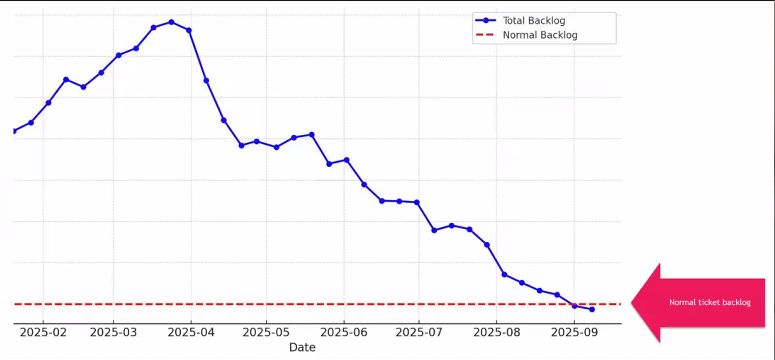
  • Backlog of tickets for support & trust and safety now down to “normal” levels.
  • Processes for helping users / responding to issues have been streamlined, and further staff have been recruited into the support and trust and safety teams.
  • The focus now is now maintaining the faster turn-around and keeping users satisfied with responses.
  • Support may be expanded in certain areas in the future – this is currently TBA.
The support ticket backlog as of September 2025

SL Viewer Summary

  • A note on the faster release cadence and the highlighting of new features – such as Inventory Favourites with the 2025.07 viewer release.
  • A note that the next release (2025.08) is focused on native Apple Silicon support, which should see a good performance boost for Mac users on that OS, particularly those on newer hardware.
  • Viewer notes and features are covered in my SL Viewer Summaries, Content Creation UG meeting summaries and Open Source Development UG notes (formerly the TPVD developer meeting).

SL Mobile, Project Zero and the New User Experience

Mobile and Zero: Incoming Users

  • The Lab estimates it is now able to get around 10x the people to try SL on mobile / Zero than had previously been the case.
  • This is allowing LL to try small, fast experiments with new users to help them get them started, such as with the on-going current focus on helping new users to dress / customise their avatar.
  • One of these is a new “helper” island where new users can go to for help (e.g. in dressing / customising their avatars, and Project Zero (viewer-in-a-browser). Zero is already geared for this.
  • The aim is to fully on-board new users ASAP to get them engaged.

Retention and Experiments

  • Despite the rise in initial engagement with new users trying SL via Mobile and Project Zero, overall retention of those users is still proving hard – the current figure is only around 7% of those coming into SL are actively being retained.
  • Some of the experiments mentioned in the meeting have involved dropping new users into established locations and hubs, rather than welcome hubs.
  • It was noted by meeting attendees that some of these experiments have not always gone well.
    • One cited example was the use of Ahern, which has become a hang-out for established users, many of whom have been witnessed as harassing and being abusive towards incoming new users.
    • Part of the problem here is that mentors were not aware of these switches / experiments, and so could not attend to provide support.
    • The use of Ahern in particular has now ceased as a result of this feedback.
    • It was further noted that LL are planning to involve mentors in future experiments.
  • The observation was made that established users who are already invested in the platform (as those at Ahern causing trouble appeared to be) and who spend time denigrating / insulting / trolling new users to the point of driving them away is somewhat self-defeating, in that it potentially damages SL’s ability to grow / remain viable as a product through the acquisition of new, engaged users.

User / Community Involvement

  • The question was asked if LL could offer incentives to those users (e.g. club owners) and communities able to demonstrate a track record of being able to attract new users and convert them into retained users.
  • It was pointed out that there is the Second Life Creator Partnership Programme, which includes the potential for incentives to communities, etc, and which includes things like Community Gateways.
  • Brad Oberwager offered a challenge – those who can develop and demonstrate a means of converting new users to retained users through their own means should contact the Lab to discuss ideas and possible incentives.

Linden Lab offers comment on acquisition of Blush AI

Via the Blush AI website

Towards the end of August 2025, I was contacted to ask if I knew anything about a recent acquisition by Linden Lab – that of Blush AI, a dating simulator  available for both Android and iOS that (quote) “helps you learn and practice relationship skills in a safe and fun environment”.

Blush AI was originally developed by Luka Inc., the company behind Replika, an emotional artificial intelligence (AI) companion chatbot first released in 2017, and which has proven highly popular with a claim of over 30 million users – although it has not been without its share of concerns around user data protection.

At the time I was contacted, the acquisition of Blush AI from Luka Inc., was causing some concern within the forums and on social media, with some of the concerns being around the possible use of SL chat logs being used to train the AI. As there had been no official announcement on the matter, I contacted Linden Lab to see if they would comment on the acquisition. Due to matters of vacations, etc., it took a while to obtain a response, but this week I did receive an official statement on the acquisition, which hopefully addresses some of the concerns raised in the forum thread:

Linden Lab has always been a place where new ideas are explored both in and outside of Second Life. Blush is one of those explorations—a small, independent product with its own team and no connection to Second Life user data. Blush is a separate effort focused on AI companionship, while our focus in Second Life is on growing and improving the world our creators have built.
We have no plans now or in the future to use Second Life conversations or content to train AI systems. Any such use would require explicit disclosure in our Privacy Policy. Second Life remains our flagship offering, built around empowering human creativity, and we are continuing to invest heavily in it with recent updates like glTF imports, WebRTC voice, our mobile app, and Project Zero.

– Linden Lab spokesperson

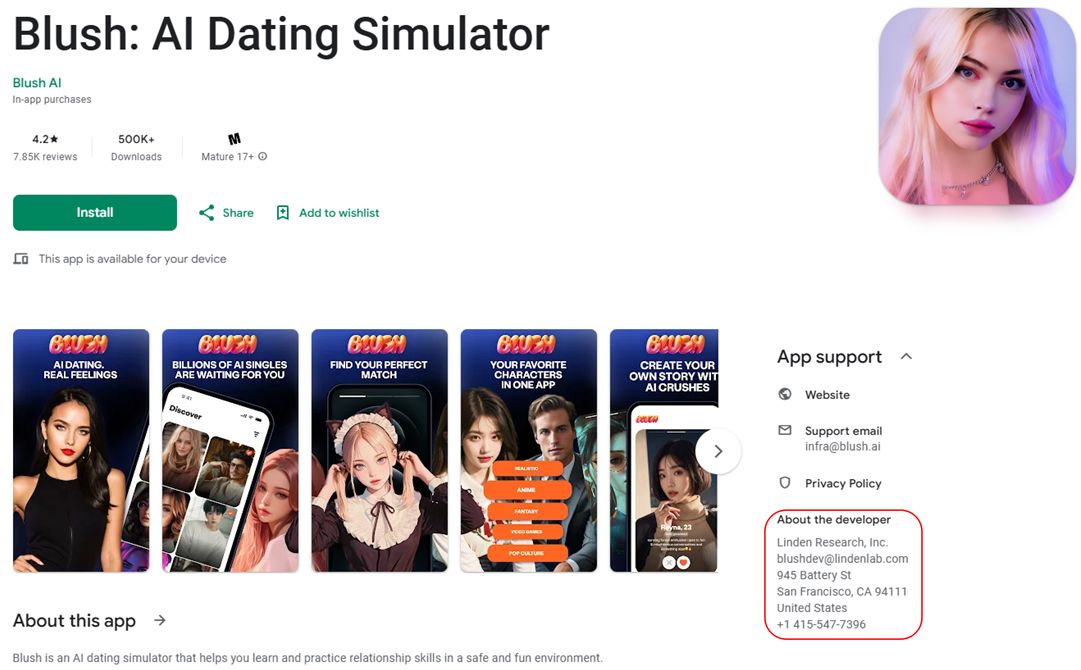
The Blush App page on Google Play, listing the Lab as the new developer

Given this, it would appear that the intent is to have Blush AI continue to operate independently from Second Life using its own revenue stream via in-app purchases. Most particularly, it makes clear that conversation logs, etc., from Second Life will not be used to help train the Blush AI, nor is likely that there be any other connections between Blush AI and Second Life user data.

Obviously, the question remains why make such an acquisition in the first place. Without any direct statement from the Lab, anything relating to this question is pure supposition. On a personal level, I have no strong opinion on; AI tools / entertainment of this nature simply do not interest me at all. So long as the acquisition doesn’t interfere with /detract from the on-going effort to enhance and grow Second Life, which remains the Lab’s bread and butter, then I can happily ignore Blush AI. That said, given that past acquisitions by the Lab haven’t always gone that well (Blocksworld being the only real exception), I will admit to my curiosity being piqued as to how this one progresses and how long it lasts.

An Update from Linden Lab

On Thursday, July 24th, Linden Lab held a Zoom Call with bloggers and content creators to provide a series of updates and take questions on a number of initiatives, changes and issues that have been the subject of recent discussion through forums such as the Zoom Calls, and recent announcements made through the likes of the Meet the Lindens sessions at the SL22B. Table of Contents

The following is an attempt to summarise the discussion and questions raised. Note that the order of topics does not necessarily reflect the order in which they were discussed..

Support: Status and Ticket Backlog

  • Most support issues have a 72-hour (3 business days) SLA for turnaround, with some priority items having a 12-hour or 24-hour (1 business day) turnaround SLA.
  • This includes carrying a “balance” forward of around 1000-1500 tickets
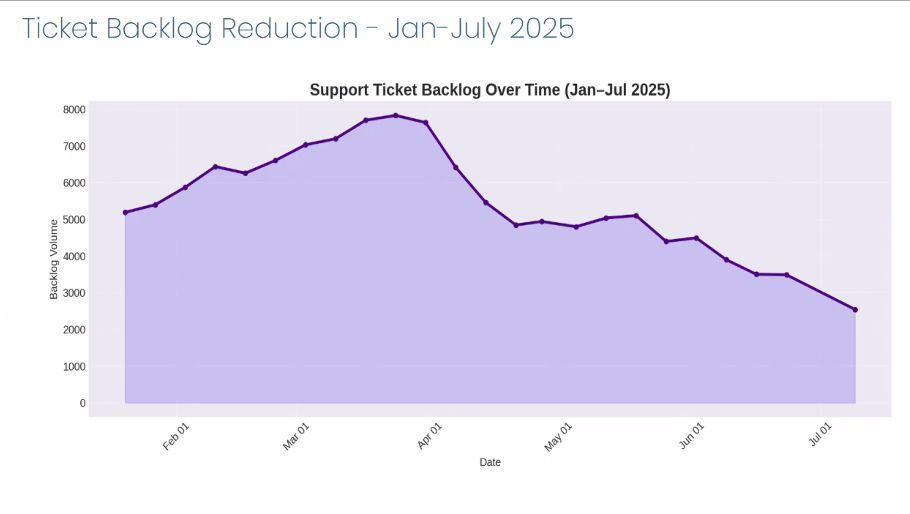
  • There has been a significant backlog of tickets due to things like the support reorganisation in late 2024, but the number of outstanding tickets is being brought down, per the graph below.
Graph supplied by Patch Linden showing the declining in the size of the support ticket backlog
  • In addition, and as Patch indicated at SL22B, weekend support hours have returned, so there is now 7-day a week support from 06:30 through 15:30 SLT.
  • In addition, new in-world support and Discord support options are in development and should be announced soon.

Tilia/Thunes and Pay-outs

  • Recap of the reason for the sale (completed in June, see: LL completes Tilia sale to Thunes: What you need to know). In short, Tilia as a Fintech operation was taking up too much time for LL to effectively manage and build.
  • As anticipated, there were some issues with pay-outs for some immediately following the completion of the sale; however, the majority of these should now be sorted out.
  • Whether the sale will potentially increase / decrease the time taken to complete pay-outs depends on a number of factors:
    • When LL moved to offering real-time pay-outs, Second Life became the target for attempts at fraud by outside forces, and the Lab wasn’t quick enough to catch all cases.
    • Ergo, before moving back towards real-time pay-out, the Lab is now focused on the issue of account security at their end of things.
    • Additionally, LL is looking to Thunes to be able to offer more pay-out options to SL creators, some of which might also reduce the times taken to receive money.
    • However, time frames for introducing the latter are a matter for Thunes, not LL.

Linden Dollar Exchange Rate and the Economy

Concerns have be raised about the recent increases in the Linden Dollar exchange rate (roughly a 5% increase thus far over the course of 2025), with questions on whether the Lab will intervene / cap the increase, and whether the increases were due to user behaviour or system tweaks.

  • The LindeX operates entirely independently of Linden Lab on an open order book basis: anyone can participate in placing buy / sell orders, with matching engine determining which orders can be fully or partially filled. There is no direct intervention by the Lab.
  • One of the negatives of the open order book mechanism is that it is subject to the laws of supply and demand: if the supply of Linden Dollars exceeds the demand for them, the LindeX is going to move.
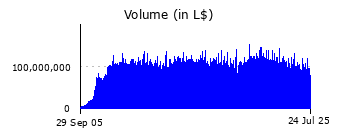
  • LindeX volumes, 2005-2025

    Whilst the 5% increase thus far over the course of 2025 is concerning:

    • It is perhaps not excessive when seen in terms of the economic disruption going on in the world at large.
    • Across 20 years of history, the LindeX has actually been remarkably stable (see: LindeX Exchange: Market Data and click on the All option beneath the graphs at the top of the page), particularly when compared to more recent crypto-currencies – or even when compared to natural inflation in the real world.
    • In this latter respect, SL might be seen as a city which, for 20 years, has seen almost zero inflation.
  • Quantitatively, the LindeX should have been moving at a rate of around 2% a year, forcing creators to periodically adjust their prices. Had this happened, it would have become the norm, and no-one would have been alarmed at the current increases.
  • That this hasn’t happened is largely down to market sinks – actions that cause Linden Dollars to “disappear” from the LindeX.
    • This tends to happen when the Lab accepts L$ as a payment for something that does not have a real-world cost associated with it (so the Lab does not make money on the L$, nor does it lose money in providing the service for which the L$ payment is made). When this happens, it can cause the supply of Linden Dollars to be reduced, boosting demand.
  • In the years prior to the COVID pandemic (i.e. 2017-2020), the number of sinks had been decreasing, causing the LindeX to rise. However, during the pandemic, demand for L$ rose exponentially, reversing the trend completely. Since COVID the trend has reversed once more, with supply again outstripping demand and leading to the current volatility.

What Can Done?

  • The Lab could directly intervene and change how the LindeX operates, either by becoming a market maker, or pegging the market rate for L$.
    • Neither option is seen as optimal for various reasons (e.g. the perception that LL is now manipulating the market to their benefit; the potential for increased fees to be charged, etc.).
    • However, the market maker is an option the Lab could possibly experiment with alongside the open order book in the future.
  • Currently, two potential actions are in development at the Lab. These are focused on the supply side of things with the aim of alleviating some of the current upward trend. Neither option was specified in the meeting, but one is liable to be launched in the near future, while the other is more medium-term.
  • Longer-term, the solution is seen as redressing the supply and demand balance in favour of the latter. There are two primary ways of doing this:
    • Find the means to introduce more sinks into the market, so that L$ can be “taken out of circulation”.
    • Stimulating demand for L$ – most particularly through bringing more active users in to SL so they engage in the economy (see below for more on this), and through short-term promotions such as the April 2025 50-hour reduction in L$ buy fees.
  • In terms of providing more sinks for L$, the Lab is open to suggestions from the user community at large on how this might be achieved – however, a sink only works if it involves no base cost to Linden Lab. For example:
    • While paying for a subscription (Plus, Premium, Premium Plus) using L$ might some like a sink, subscriptions have a base cost for LL, which is covered by the revenue LL obtains through the fiat money subscription fee. So if L$ are used instead, that revenue is removed and in order to recover it, LL must sell the L$ back into the market, keeping them in circulation and eliminating the sink.
    • The above is also true to ideas such as allowing region holders to pay for multiple regions using L$.

Platform Growth Initiatives

This was both an update on the impact of Project Zero (the viewer in a browser) and SL Mobile in bringing-in new users – and how established users can help with this.

  • Both Project Zero (viewer in a browser) and SL Mobile, together with new on-boarding initiatives and advertising has seen a month-on-month grow in the number of people trying SL over the last three months.
  • This has resulted in a tenfold increase in the number of people trying out Second Life than has historically been the case.
  • However, this is only translating to around a twofold increase in the number of retained users (those logging-in to SL repeatedly over a 30-day period) – or approximately 1 in every 100 who try SL for the first time.
  • While the Lab is trying to improve on this by directing incoming new users to meaningful locations, they are seeking help from users and creators.
  • If creators (e.g. content creators, region holders, etc) / communities can create in-world locations specifically to engage with and encourage new users to become more involved in Second Life, LL is willing to work with those creators / communities to drive incoming traffic to those locations.
  • Those interested in partnering in this way should apply to join the Creator Partnership Programme.
  • As a part of this, LL will also work closely with the creators on these new user experiences / flows to help understand what is working and what is not, where new users might be getting frustrated (and possibly leaving), how to address this, provide relevant stats on all of this, etc. The overall aim being to help iterate and build experiences and processes that result in more new users becoming more fully engaged in SL.
  • For the Lab, the focus is on trying help new users get to grips with the basics – how to dress and customise their avatars – rather than the more esoteric aspects of SL (e.g. managing land and / or Groups).
  • There are some general things existing users can do to help new users.
    • This could be as simple as engaging with them in conversation, to the likes of clubs and stores not blocking access to accounts under a certain number of days (30, 60, whatever).
    • Yes, the latter may mean having to deal with trolls / idiots, on throwaway accounts – but there are tools to help with this, and making new users feel more welcome as they hop around SL trying to find places they might enjoy (and spend L$) than making them feel utterly unwelcome.

Copyright and IP Infringements

A number of meetings with content creators earlier in 2025 raised the issues of copyright / IP infringement, content ripping, and similar (some based around the appearance of a viewer that had a focus on content ripping).

  • In response to the concerns, LL has been pro-active in trying to address the “top” problems with content theft, with those doing so receiving “more than nasty letters”, and as a result departing Second Life.
  • This was supported by the opening of a special support channel to respond directly to matters of content theft.
  • As a broad indicator of the change, the number of reports of content theft (not DCMA filings, which tend to remain constant) has fallen from around 300 per year to just 27 since the new measures were introduced earlier in 2025.
  • Content creators at the meeting largely agreed with the Lab’s point of view, confirming that some of the more notorious content thieves have not gone from SL, and the aforementioned content ripping viewer appears to now be blocked.
  • It is acknowledged that this likely does not eliminate all content ripping completely from SL, but should be taken as indicative that LL and their legal team are not prepared to be complacent on the matter.