Mad Hatter’s Tea Room, September 2024 – click any image for full size
Sometimes when exploring Second Life it’s easy to miss what is pretty much in your own back yard, so to speak.
For example, it’s no secret I have a home in Second Norway – and I’m very proud of the fact I’ve been able to put down roots there. Recently I added to this by visiting New Deer Isle, a superb setting in Second Life created and held by Kaiden Glocke Tray (KaidenTray), writing about it here. With September arriving, I’ve been able to visit another public location within Second Norway, this one sitting within a cosy parcel of land just under 3,500 square metres in size.
Created by Karmagrl Nesbith (Karmagrl),this setting is genuinely magical and a total delight, with its core theme obvious from its title: Mad Hatter’s Tea Room.
Mad Hatter’s Tea Room, September 2024
However, to view it purely as some form of homage to the most famous literally works of Lewis Carroll (aka Charles Lutwidge Dodgson)would perhaps be an error. Yes, characters like the Cheshire Cat, the caterpillar, the dormouse, the dodo – as well as the Queen of Hearts, Alice, the White Rabbit and the Mad Hatter himself – and more, are all waiting to be found; but they are the icing on the cake for what is a richly engaging setting that sits on, under, and above the parcel.
Welcome to the Mad Hatter’s Tea Room! After you come in through the main gate, wander into the gardens through the pink gate. Follow the flower pathway to the main building- the Tea Room. Stop in, sip some tea, imbibe in some delectable bakery delights, and just enjoy the view.
Be sure to walk off the Second Life calories that don’t really count, and take a trip through the grounds, enjoying the whimsical Alice in Wonderland décor. Be sure and go down to the waterfront, and have a glass of wine or a beer, or even a mixed drink in the secret bar that is through the dull looking door that seems to go no where…
– From the introductory notecard to Mad Hatter’s Tea Room
Mad Hatter’s Tea Room, September 2024
From the pink gates at the landing point (those arriving by road can park their cars outside of the larger wrought iron gates if they wish!) visitors have a choice of following the path directly to the Tea House or cross to the a large terrace overlooking a natural cove cut by water flowing both into and out from the land.
Motifs from Carroll’s books are immediate: the presence of the Queen of Hearts and Alice as greeters in the inner car park as your arrive; the bushy-tailed herald looking as if he’s ready to announce your passage through the pink gate, your arrival, the playing card guard, oversized teacups and caterpillar cars on the terrace…
Mad Hatter’s Tea Room, September 2024
Meanwhile the garden path meanders gently up to the tea house, offering it own delights of colourful blooms, fountains, budgies in the trees, bunnies at play (or asleep!) and a branching path cutting back across the gardens to reach the upper end of the terrace. A further path leads the way over a little pool of water to where visitors can join the Hatter himself for tea outdoors if they wish, seated at a table cupped in the arm of a stream as it tumbles away from the pool to join with a second stream before both drop away into the cove.
The non-calorific cakes, cream buns and other delights can be enjoyed on both floors of the Tea House, which offers further celebrations of Alice’s adventures as immortalised in animation and film. And don’t let the White Rabbit outside holding his fob watch trick you into believing you’re in any way late for any for of important date and that you need to be moving on; take a choice of tables indoors or out and just enjoy the setting.
Mad Hatter’s Tea Room, September 2024
Places to sit actually abound throughout the setting, whilst the terrace itself sit over the bar mentioned in the introductory notecard, two sets of steps leading out to its waterfront entrance. Teas and coffees might also be enjoyed in the bar – as might a beer or a cocktail by those so-minded. The terrace also offers chess for those who might fancy a game, and a small teleport base back alongside the pink gates will carry you up to the sky platform and its maze and mix of characters from the books.
To describe Mad Hatter’s Tea Room, however, is to mis the point – it’s a place to be visited and enjoyed. As such, I’ll encourage you to do so, particularly if you love Alice’s adventures, and I’ll leave you instead with a couple more images.
NeverendingSL: Souru Sosaeti, August 2024 – blog post
The following notes were taken from the Tuesday, September 3rd, 2024 Simulator User Group (SUG) meeting. They form a summary of the items discussed, and are not intended to be a full transcript, and were taken from my chat log. Pantera’s video is embedded at the end – my thanks to her for providing it.
Meeting Overview
The Simulator User Group (also referred to by its older name of Server User Group) exists to provide an opportunity for discussion about simulator technology, bugs, and feature ideas.
Meetings are open to anyone with a concern / interest in the above topics, and form one of a series of regular / semi-regular User Group meetings conducted by Linden Lab.
Dates and times of all current meetings can be found on the Second Life Public Calendar, and descriptions of meetings are defined on the SL wiki.
Simulator Deployments
On Tuesday, September 3rd, the SLS Main channel was restarted without any deployment.
On Wednesday, September 4th:
The BlueSteel and Ferrari simulator RC channels will receive the Picnic simulator update (which includes: llFindNotecardTextSync, llDerezObject, for the viewer side, group member lists can now be retrieved in a paginated manner).
Picnic also include the first of the region crossing improvements Monty Linden has been working on. These should see a) avatars already in a destination region getting better frame rates as others arrive in the region; b) crossing avatars with too many scripts will experience slower but smoother crossings.
The remaining simulator RC channels will be restarted without any new deployment / update.
SL Viewer Updates
No updates at the start of the week, leaving the currently available public versions of official viewers as:
Release viewer: version 7.1.9.10515727195, formerly the Atlasaurus RC (object take options; improved MOAP URL handling) promoted August 26.
Release channel cohort: DeltaFPS RC, version 7.1.10.10622905308, issued August 30.
Performance boosts. Memory management has been optimized and users will experience a higher FPS across various systems. A comprehensive range of bug fixes are also provided. This includes better PBR material handling and resolving frequent crashes. See the release notes for more.
UI for scheduling region restarts now available via a new button located in the Region/Estate floater. (Note: there is currently an issue with scheduled region restarts working correctly and a fix is due to come in the next server release).
In Brief
The recent updates to the SL Map system appears to have been generally well received, with those providing feeding at the meeting noting the Map does appear to load a lot quicker and that changes to regions are more timely in being reflected on the Map.
The ability to see ground-level details of regions using regions surrounds where the scale is > 256*1.33 on either the x or y axis (rather than them appearing a flat grey) has been particularly appreciated.
The next element of this work will include improvements to pruning “ghost” regions from the Map (i.e. regions that appear on the Map but are no longer a part of the grid).
This sparked a general discussion on the Map and its capabilities and possible updates.
Github issue: [PBR] PBR Material resets to legacy material after teleport. #853 – while there is no fix for this at present, it sparked a discussion on issues related to broken meshes, which appear to result from the simulator and viewer not agreeing on how many faces a mesh has. Some of this may have been fixed in the Altasaurus release viewer, and Brad Linden noted, there are more coming in the 7.1.10 (DetlaFPS) RC and the viewer to follow it.
A reminder that if people have issues where log files might help LL with investigations, this article provides information on where to locate said logs for attaching to a bug report.
Need a function for easy PBR alpha switching: Brad Linden indicated he had started working on this, but he’s had to shift over to doing some viewer-related work, so things are currently on hold.
A discussion on a means for scripted Group join invites, rather than requiring a bot – please refer to the last third of the video.
† The header images included in these summaries are not intended to represent anything discussed at the meetings; they are simply here to avoid a repeated image of a rooftop of people every week. They are taken from my list of region visits, with a link to the post for those interested.
In Dreams is the title of an exhibition of Second Life images by Zeeva Quintessa being hosted at the Ground level galleries spaces at NovaOwl Social corner and Gallery through September and October 2024.
While Zeeva and I have not met, we are something of kindred spirits on some respects, as I noticed on reading her biography. We’ve both found a strong attraction in seeking out, exploring and spending time within art regions and regions designed expressly for public exploration and photography – with both of us being drawn to photograph said regions.
NovaOwl Social Corner and Gallery, September 2024: Zeeva Quintessa
We’re also both keen SL sailing and flying afficionados, enjoying time out on the waters of Blake Sea or flying over it (and elsewhere!). However, there is one aspect of our SL lives where we are very different: Zeeva is an accomplished Second Life photographer-artist, instilling the images of the places she visits with a depth of feeling that is simply marvellous and well beyond anything I can achieve.
This is very much in evidence within In Dreams, which occupies both of the ground-level gallery buildings at NovaOwl, presenting as it does a photo-journal of Zeeva’s travels through Second Life, expressed both artfully and with a depth of emotion that is by turns captivating and breath-taking. While each image might be particularly personal to Zeeva, as she notes in her biography, such is the richness of expression to be found in them, I have little doubt they will resonate with anyone viewing them.
NovaOwl Social Corner and Gallery, September 2024: Zeeva Quintessa
These images and the process were (still is) always an emotional experience for me, often times bringing tears to my eyes for some feeling that was brought to surface by the location, the image and the music playing at that time. My photos are mainly done for me, as it can be very therapeutic…however it was wonderful to find out others were also taking notice of some of my creations.
– Zeena Quintessa.
Zeeva is also one of the few photographer-artists whose skill extends to producing simply gorgeous panoramic images captured from within Second Life. Not since Ziki Questi have I come across an artist able so thoroughly able to make this format / approach to SL photography so visually impressive. It’s an technique I’ve never really grasped myself, and find it both admirable and distinctive when so perfectly embraced as seen within Zeeva’s images.
NovaOwl Social Corner and Gallery, September 2024: Zeeva Quintessa
As noted, In Dreams will be open throughout September and October, and I have no hesitation in recommending it to all.
Logos representative only and should not be seen as an endorsement / preference / recommendation
Updates from the week through to Sunday, September 1st, 2024
This summary is generally published every Monday, and is a list of SL viewer / client releases (official and TPV) made during the previous week. When reading it, please note:
It is based on my Current Viewer Releases Page, a list of all Second Life viewers and clients that are in popular use (and of which I am aware), and which are recognised as adhering to the TPV Policy. This page includes comprehensive links to download pages, blog notes, release notes, etc., as well as links to any / all reviews of specific viewers / clients made within this blog.
By its nature, this summary presented here will always be in arrears, please refer to the Current Viewer Release Page for more up-to-date information.
Note that for purposes of length, TPV test viewers, preview / beta viewers / nightly builds are generally not recorded in these summaries.
Official LL Viewers
Release viewer: version 7.1.9.10515727195, formerly the Altasaurus RC, promoted August 26.
Performance boosts. Memory management has been optimized and users will experience a higher FPS across various systems. A comprehensive range of bug fixes are also provided. This includes better PBR material handling and resolving frequent crashes. See the release notes for more.
UI for scheduling region restarts now available via a new button located in the Region/Estate floater. (Note: there is currently an issue with scheduled region restarts working correctly and a fix is due to come in the next server release).
La Côte Sauvage, September 2024 – click any image for full size
Update, November 2024: La Côte Sauvage has relocated and has been remodelled
Sitting within a half Homestead region is La Côte Sauvage (The Wild Coast), a natural location held and design by Second Life artist-photographer Caly Applewhyte (Calypso Applewhyte). It takes as its inspiration the Breton Coast, France – although whether it is predominantly inspired by Brittany’s northern or southern coastline or an amalgam of both is unclear; and while there is a stretch of French coast along the Bay of Biscay actually called La Côte Sauvage, this lies within Nouvelle-Aquitaine further to the south, so is potentially not a factor in the setting’s design.
Note that where or upon what the setting might be directly inspired is particularly relevant; Caly’s La Côte Sauvage speaks entirely for itself as a small but highly photogenic setting; a place which uses elevation to its advantage, allowing it to represent a coastal area without relying on being backed-up against one side of the parcel or another (or maybe two sides) within which it sits, thus allowing to stand as something of an island setting, whilst also allowing the imagination to interpret as a stretch of coast whilst wandering between valleys and hilltops.
La Côte Sauvage, September 2024
Although sitting within a half Homeland region, the setting is actually split into two parcels: to the south is La Côte Sauvage itself, primarily given over to dray land and with a richness of content that does not feel it is in any way overcrowding the parcel. Then, to the north is the largely open water La Côte Sauvage 2, to which I’ll circle back in a bit.
The landing point is located on the southern side of the land, where a small boardwalk reaches over the water from one of the setting’s beaches to a little knob of an isle that offers the first of many places where those who wish to sit and spend time in the region. On the landward side of the boardwalk, a signboard for the Nature Collective can be found, where donations for the settings upkeep can be made. Close by are further places to sit, one in the lee of one of the setting’s hills, the other on the beach itself.
La Côte Sauvage, September 2024
The main path of exploration runs north between two of the elevated parts of the location, dog-legging a little to the east to reach the bank of a stream as it cuts through the landscape in a reverse “s”, before turning north again and open out to access another of the beaches. To the left of this path are steps leading up the side of the hill to reach a low plateau claimed by the local sheep and which includes a comfy little seat for any shepherd wishing to keep and eye on them 🙂 . From here it is possible to climb up to the highest point in the setting, where a rotunda has been built to house a small gallery of Caly’s photography, together with a vendor where copies of Caly’s work can be purchased.
This gallery overlooks the beach mentioned above, behind which sits a carpet of grass between the beach and the stream on which can be found a summer house. Neatly utilising the larger half of Cory Edo’s Yara Treehouse outfitted to offer a cosy retreat, complete with a sofa to watch the ebb and flow of the sea.
La Côte Sauvage, September 2024
The second half of the treehouse structure sits as another little cosy hideaway on the south side of the landscape. It can be reached one of two ways: when following the main path between the hills, a turn to the right at the foot of the the hill there and using the stepping stones to cross the stream; alternatively, a walk east along the beach at the landing point and then following a rock (and spray-drenched!) walk around the base of the cliffs to where a bridge spans the mouth of the stream. On the far side of the cabin from the stream offers a way up to the hill behind it, as well as to a little cove that offers a bit of a hideaway place to sit and spend time.
Turning to the stream, this starts to the north-east of the land, snaking its way south and west and then back to the east again to reach its mouth. It’s possible to follow a good part of the stream towards its source using its southern bank and two bridges. Doing so will bring visitors to the two final points of interest on the northern side of the setting: the ancient ruins on the northern-eastern hills, and the raised walkway reaching out over the water to an aged stone pavilion surmounting a single island.
La Côte Sauvage, September 2024
Both the ruins and the pavilion, although of different ages, sit will together and add a sense of history to the setting – and in the case of the ruins, with their stand stone, alter and ancient Norse horn, offer a sense of mystery and mysticism, while the columned steps leading up to these points carry a hint of ancient Central American architecture. Meanwhile, the pavilion carries with it a hint of the Romanesque in both its style and its furnishings (and even in foodstuffs set out on the table).
All of the above still misses out on so much the reach has; the manifold places to sit and / or take photos, the coastal soundscape, and the ability to rez items – most notably as props for photography – but do remember to pick up your bits when done.
La Côte Sauvage, September 2024
It’s this aspect of rezzing that brings me back to the the open water to the north of the land, offering as it does the opportunity to rez something like a rowboat, pedal boat, windsurfer or similar and take to the water and travel around the setting (just be careful about straying into the neighbouring half of the region!
In all, a beautifully crafted setting, relaxing, and fun to explore – but don’t just take my word for this!
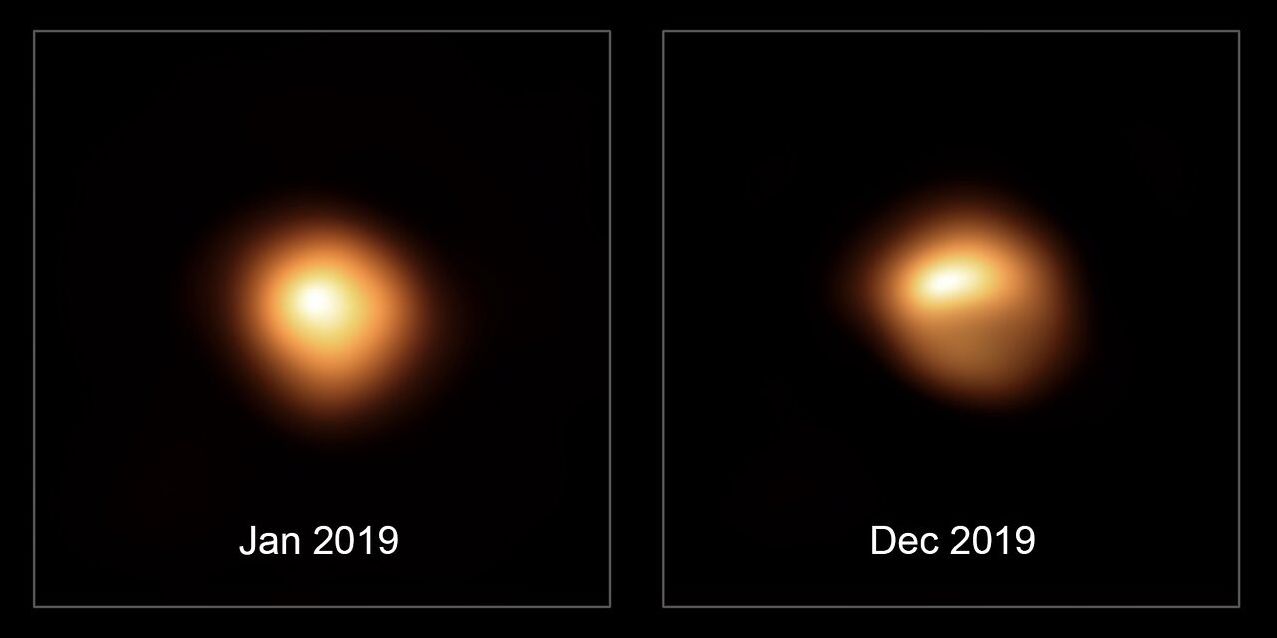
Side-by-side comparison of Betelgeuse’s dimming, as seen by the SPHERE instrument on ESO’s Very Large Telescope prior to (left) and during (right) the “great dimming” of 2019/2020. Credit: ESO/M. Montargès et al.
Back in 2019 / 2020 the red giant star Betelgeuse caused considerable excitement among astronomers on account of it undergoing a period of exceptional dimming – far more than is customary, given it is a pulsating variable star – which fuelled speculation that what was being seen might be the precursor to the star having gone supernova some 643 years ago (that being the time it takes for light from it to reach us), and the dimming was actually the star going through the kind of collapse the comes before such a supernova explosion.
However, despite the rapid and unusual dimming witnessed over December 2019, January 2020 and February 2020, by April 2020, the star had returned to its normal levels of brightness, and by August of that year, astronomers thought that had an explanation for the unwarranted dimming: the star’s pulsating nature gives rise to clouds of energetic particles to be ejected, some of which form a illuminate cloud around the star whilst more cool and form a blotchy cloud too dim an cold to be detected by optical or infrared means, and which can result in the star dimming significantly in addition to any normal variations in its brightness as see from Earth.
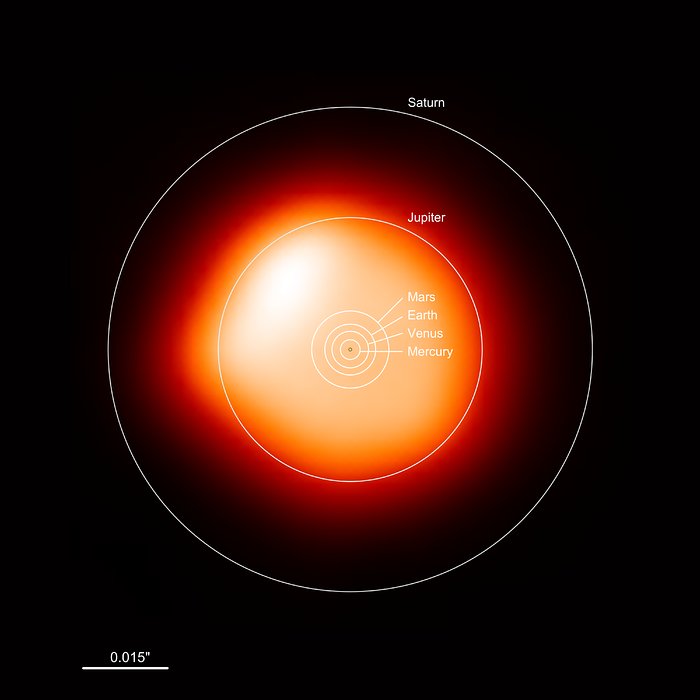
“Betelgeuse is big. Really big. You just won’t believe how vastly hugely mind-bogglingly big it is. You might think it’s a long way to the Moon, but that’s just peanuts to Betelgeuse!” (with apologies to the estate of Douglas Adams). A diagram showing the approximate size of Betelgeuse compared to our solar system. Credit: unknown
Because of the “great dimming”, astronomers have continued to observe Betelgeuse and gather a lot more data about it, particularly with regards to trying to understand the drivers of the star’s Long Secondary Period (LSP) of variability. Stars like Betelgeuse tend to have overlapping periods of variability: the first tends to be a fairly short cycle of dimming and brightening. In the case of Betelgeuse, this cycle of dimming and brightening again lasts some 425 days.
This overlaps a much longer period of variability – the LSP – which in the case of Betelgeuse lasts somewhere in the region of 2,100 terrestrial days, or roughly 6 years. These periods, short and long, can occasionally synchronise so that both reach a period of maximum dimness or brightness. Originally, it had be thought that such a period of synchronicity had caused with the 2019/2020 “great dimming”, until data and observations showed otherwise. However, and more to the point, the actual mechanisms which cause LSPs for variable red giant stars is not well understood, and have been ascribed to several potential causes.
One of these is the potential for the red giant to have a smaller companion star, one very hard to observe due to the behaviour and brightness of the red giant. Such is the conclusion reached in a new paper: A Buddy for Betelgeuse: Binarity as the Origin of the Long Secondary Period in α Orionis published via arxiv.org (and thus still subject to peer review). In it, researchers Jared A. Goldberg, Meridith Joyce and László Molnár walk through all of the accepted explanations for LSPs among red giant stars as they might be applied to Betelgeuse, concluding that perhaps the most likely is that the red giant has a very low-mass (comparatively speaking) companion orbiting it at roughly 2.43 times the radius of Betelgeuse.
This puts the companion within the observable and illuminated dust cloud around Betelgeuse, potentially making the companion – referred to as α Ori B – exceptionally hard to observe, as it would be subsumed in the brightness of the surrounding dust and Betelgeuse’s own corona. further, it would be unlikely to form its own accretion disk, something which might otherwise aid its observation.
This December 2019 VLT VISIR image reveals the infrared light being emitted by the dust surrounding Betelgeuse. These clouds are formed when the star sheds its material back into space, while the black disk at the centre of the image obscures the star and its corona and inner dust cloud in order for VISIR to see the infra-red light of the dust clouds. An image of Betelgeuse is overlaid to scale at the centre of the disk. The disk also covers the area within which the proposed companion object might reside. Credit: ESO / P. Kervella / M. Montargès / Eric Pantin
In particular, the paper notes that such a low-mass companion orbiting at the calculated distance from the red giant would actually give rise to an LSP of some 2,000-2,100 days as seen from Earth.
The one wrinkle in the idea – as noted by the authors – is that the calculated mass for α Ori B is well in excess of the calculated potential mass for such theoretical binary companions as provided by established (and peer-reviewed) papers investigating possible causes for LSPs among variable red giants. As such, and given the unlikely ability to optically identify any companion to Betelgeuse, the paper’s authors outline upcoming periods when α Ori B might be particularly susceptible to detection via repeated targeted radio-interferometric observations, in the hope their theory might be proven or disproven.
But why is all this important? Well, notably because Betelgeuse, at around 10-12 million years of age, could have entered the period in which it might go supernova (such massive stars evolve and age much more quickly than main sequence stars like our on Sun). When it does so, even though it is over 640 light years away, it will shine in the night sky with a brightness equivalent to that of the half Moon for a period in excess of three months before it fades away; hence why the “great dimming” caused so much excitement.
An artist’s impression of how Betelgeuse might look in our night sky when it goes supernova. Via wikimedia
However, we could equally be as much as 100,000 years from such an event occurring. By understanding precisely what is going on around Betelgeuse, such as the presence of a cooler, darker dust cloud orbiting it affecting its brightness and as potentially found by the Hubble Space Telescope, or confirmation that the star has a smaller companion which plays a role in its cyclical brightening and dimming, astronomers are better available to judge whether or not any prolonged or unusual dimming of the star might indicate it has started collapsing in on itself and is heading for a supernova explosion – or are simply the result of expected and identified events unrelated to any such collapse.
New Shepard Aces Return to Flight Mission
Blue Origin took six people, including a NASA-funded researcher, on a New Shepard suborbital spaceflight on August 29th, the first such flight after issues have kept the system grounded almost continuously for two years.
The NS-26 flight carried its occupants to an altitude of 105.2 km, thus passing through the Kármán line, which is seen by some as the “boundary” between Earth and space at 100km above mean sea level. Interestingly, whilst named for Theodore von Kármán, the limit was not actually defined by him; instead, he calculated a theoretical altitude for aeroplane flight at 83.8 km (52.1miles) above mean sea level, which has led to 80 km (50 miles) also being regarded as the “boundary” between the denser atmosphere and space – however, some nations and organisations raised this to 100km based on calculations which showed that any satellite dropping to or below that altitude without any attempt to boost its orbit will see its trajectory decay before it can complete one more orbit.
The flight, which took off from Blue Origin’s Launch Site One in West Texas at 13:07 UTC, lasted 10 minutes and 8 seconds, the New Shepard booster safely landing some 7 minutes 18 seconds after launch, having separated from the capsule First Step, which continued upwards under ballistic flight. Aboard the flight were six people, including Robert Ferl, a University of Florida professor who conducted experiments on how gene expression in one type of plant changes when exposed to different phases of the the flight, including microgravity.
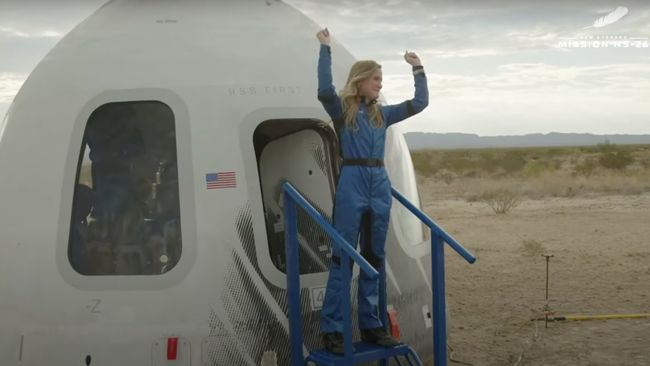
Also aboard was Karsen Kitchen, a 21-year-old University of North Carolina student, who became the youngest woman to cross the Kármán Line – but not necessarily the youngest woman to reach the edge of space; in August 2023, Eighteen-year-old Anastatia Mayers flew aboard Virgin Galactic 02 and passed through the 80-km “boundary” (also becoming one half of the first mother-daughter duo to reach the edge of space with her mother, Keisha Schahaff).
21-year-old student Karsen Kitchen exits the New Shephard capsule RSS First Step at the end of NS-26, and becoming the youngest woman thus far to cross the Kármán Line. Credit: Blue Origin
The remaining passengers on NS-26 comprised Nicolina Elrick, a philanthropist and entrepreneur; Ephraim Rabin, an American-Israeli businessman and philanthropist; Eugene Grin, who works in real estate and finance; and Eiman Jahangir, a cardiologist and Vanderbilt University associate professor (making a sponsored flight, rather than for research, his seat paid for via cryptocurrency group MoonDAO).
As noted, the flight came after almost two years New Shepard during which the vehicles barely flew. In September 2022 Blue Origin launched the first of 2 planned uncrewed flights – NS-23 – utilising the capsule RSS H.G. Wells carrying a science payload. During ascent, the booster’s main engine failed, triggering the capsule launch escape system. Whilst the capsule successfully escaped and made a safe landing under parachute, the booster was lost, resulting in the system being ground for investigation.
It was not until December 2023 that flights initially resume, again with a payload-carrying science mission. However, whilst successful, that flight was followed by crew-carrying NS-25 in May 2024. While no-one was injured, this flight suffered a partial deployment failure with one of the capsule’s three main parachutes, prompting a further grounding whilst the matter was investigated and remedial actions taken. NS-26 is thus the first flight since that investigation and subsequent work on the parachute systems had been completed.
New Shepard’s propulsion module makes a powered landing during the NS-26 mission on August 29th. Credit: Blue Origin webcast
For Ferl, the flight was a vindication of the value of sub-orbital flight to carry out research, despite their brevity. A long-time advocate of the use of sub-orbital crewed flights for carrying out packets of research , his work was funded by NASA’s Flight Opportunities programme and supported by the agency’s Biological and Physical Sciences Division, and marked him as the first NASA-funded researcher to go on such a flight.
Brief Updates
Polaris Dawn
The first all-private citizen spaceflight scheduled to include a spacewalk by two of the crew is currently “indefinitely” postponed – although that could now once again change fairly soon.
As I noted in my previous Space Sunday article, the mission, financed by billionaire Jared Issacman and to be carried out using a SpaceX Falcon 9 launcher and the Crew Dragon Resilience, had been scheduled for lift-off from Kennedy Space Centre at 07:38 UTC on the morning of August 27th. However, the launch was scrubbed as a result of a helium leak being detected in the quick disconnect umbilical (QDU) that connects the propellant feed lines to the launch vehicle. Helium is used to safely purge such systems of dangerous gases that might otherwise ignite. Ironically, helium leaks are a part of the issues which have plagued the Boeing Starliner at the ISS.
The Polaris Dawn crew are currently awaiting news on when their mission is likely to fly. Credit: Polaris Dawn
The launch was initially re-scheduled for August 28th, but this was then called off as a result of weather forecasts indicating conditions in the splashdown area for the capsule at the end of the mission would likely be unfavourable for a safe recovery and would probably remain so for several days. As the Crew Dragon will be carrying limited consumables for the crew and so cannot remain in orbit for an extended period, it is essential it is able to make a return to Earth and safe splashdown within n a limited time frame.
It was then postponed altogether later on August 28th after the longest-serving core stage of a Falcon 9, B1062 with 22 previous launches and landings to its credit, toppled over and exploded whilst attempting its 23rd landing – this one aboard the autonomous drone ship A Shortfall of Gravitas. The accident prompted the US Federation Aviation Administration to suspend the Falcon 9 launch license pending a mishap investigation. However, following a request from SpaceX, the license was reinstated on August 30th, allowing launches to resume whilst the FAA continues its investigation into B1062’s loss.
SpaceX has yet to indicate when the Polaris Dawn mission might launch, with much depending on other operational requirements both for SpaceX and at Kennedy Space Centre.
Starliner Update: One Down, Two Up
Again in my previous Space Sunday article, I updated on the Boeing Starliner situation and NASA’s decision not to have astronauts Barry “Butch” Wilmore and Sunita “Suni” Williams fly the beleaguered craft back to Earth. At that time, it had been decided to fly the next crewed flight – Crew 9 / Expedition 72 – to the International Space Station (ISS) with just two crew, leaving two seats on the Crew Dragon vehicle available to bring Williams and Witmore back to Earth at the end of that mission in February / March 2025.
Since then, NASA has confirmed that the two members of Expedition 72 who will launch on the Crew 9 flight will be NASA astronaut Tyler Nicklaus “Nick” Hague, and Roscosmos cosmonaut Aleksandr Vladimirovich Gorbunov. I’d previous pointed to Hague making the flight, but had pegged mission commander Zena Cardman as flying with him. However, in order to keep the seating agreement with Roscosmos (who provide seats to NASA on their Soyuz craft flying to the ISS in return for NASA reciprocating with their flights), rookie Gorbunov was first announced as flying the mission, with Hague taking over the Commander’s seat on the basis of experience – he has flown into space previously aboard Soyuz TM-12, whereas Crew 9 would be Cardman’s first flight, and NASA does not fly all-rookie crews.
A composite image of NASA’s Nick Hague (left) and Roscosmos’s Aleksandr Gorbunov in their SpaceX crew suits and helmets. The two will now form the Crew 9 Expedition 72 team flying to the International Space Station on or after September 24th.
In fact, Hague has had something of an exciting time in his NASA career: his very first launch was on Soyuz TM-10 (Expedition 57) in October 2018 – only for that mission to suffer a booster failure mid-ascent to orbit. This triggered the crew escape system, which pushed the capsule containing Hague and mission commander Aleksey Ovchinin clear of the booster prior to the later breaking up, and then make a safe return to Earth under the capsule’s parachutes.
Currently, Crew 9 is slated for launch no earlier that September 24th.
Prior to that, and somewhat sooner than may have been expected, Boeing will attempt to bring their Starliner capsule Calypso back to Earth safely on September 6th. The announcement was made on August 29th, Boeing having indicated earlier in the month that it would take “several weeks” to prepare and upload the required software to the vehicle. Under the plan, the craft to undock from the ISS at 22:04 UTC on Friday, September 6th, and then complete a 6-hour return to Earth, the capsule landing at White Sands Space Harbour in New Mexico at 04:03 UTC. If this schedule holds, the vehicle will have spent exactly 3 months at the ISS on what should have been a week-long flight.
Of particular concern during the return attempt will be the performance of the vehicle’s primary propulsion thrusters, mounted on the Starliner’s service module. These are required for the vehicle to manoeuvre accurately and complete critical de-orbit burns prior to the service module being jettisoned to leave the Calypso capsule free to re-enter the atmosphere and make its descent.
The Boeing CST-100 Starliner, comprising the capsule Calypso and it service module, is now set to depart the ISS on Friday, September 6th, under automated flight. Credit: NASA
Should the return be successful, it will enable engineers to carry out a complete assessment of the capsule and its systems to assess how it stood up to its unexpectedly extended stay at the ISS. However, determining what needs to be done to overcome the propulsion systems issues might take longer to resolve, as Boeing and Aerojet Rocketdyne (who built the thrusters systems on the service module) will only have data to work from – as the service module will be jettisoned to burn-up in the atmosphere, they will not be able to eyeball the faulty elements to determine more directly where root causes lay. Only after this work has been completed is it likely that Starliner will again carry a crew – although whether this is as part of an operational flight or as a second crew flight test (possibly completed at Boeing’s expense), remains to be seen.









 Inara Pey: Living in a Modemworld