Evermore the Folklore, September 2024 – click any image for full size
I recently had the chance to visit Evermore the Folklore, a full private region leveraging the Land Capacity bonus, held by Persephone Smythe (LeriaDraven) and landscaped by her and Elfie (WeeWangle Wumpkins). It’s a curiously delightful setting, mixing together a range of elements to offer a blending of the natural, the whimsical, the mystical and the fantastical, with just a hint of things that sit well with the approach of Halloween
Welcome to a dream inspired by the world of Evermore and Folklore. Take my hand, wreck your plans, and let’s go to the lakes were the poets went to die. We are so enchanted to meet you and hope you enjoy your time in this era!
From Evermore the Folkore
Evermore the Folklore, September 2024
To be honest, I have absolutely no idea if the reference to Evermore and Folkore concern to Taylor Swift albums or something else – so please forgive my ignorance on that; but to be honest, the meaning of the references barely matters when it comes to exploring and appreciating the region – it genuinely speaks for itself.
Visits begin to the north-west side of the region, on the platform of a little train station that once served a (very modest) little hamlet – it’s little more than a couple of little cottages overlooked by the local lighthouse up on a bluff. Small it might by, but the hamlet has it own industrious-looking wharf and boat repairs warehouse / fishing centre.
Evermore the Folklore, September 2024
The north coast is fairly rugged for the first part of its run, albeit with a couple of sandy points. However, once past the lighthouse it drops down to a sandy stretch of beach backed by gently sloping grasslands occupied by a small farm. But as gentle as the beach might appear, the wreck of a trawler and the remnants of what might have once have been a set of piers and moorings suggest the sea here can be a little unkind to the unwary.
From the little hamlet it is possible to follow the winding railroad tracks as they pass through a tunnel and appear to set out across the countryside – only to come to a abrupt end, indicating that whilst there might well have once be a little service between the hamlet and its fishing wharf and somewhere else, those days are long gone. No matter, because the tracks point the way to both the lighthouse atop its headland bluff and to the farm – the route to the latter being via a covered bridge passing between headland and rocky hills. The bridge is old, but clearly safe – as testified by the highland cattle meandering across it!
Evermore the Folklore, September 2024
The tunnel use be the train burrows under a small hill which also has a footpath climbing over its back to lead the way inland. It is here that things start to get more mystical and fantastical. Crossed by rutted tracks, the land is a mix of low-lying grasslands, rugged hills and headlands, a broad body of water served by the sea to the east, where it gains access to the land between two high thrusts of rock; and a gorgeous waterfall-carved horseshoe of rock into which the water of the falls drops. Up on the rocky cliffs above, meanwhile, stone fairies dance, an almost Ent-like Autumn Guardian weeps silent tears into his cupped arms and an ivy shrouded piano awaits someone to sit so it might be played for the spirit of the lake as she stands over the waters below.
And that’s just the start of the region’s mysterious and captivating elements. Ruins high and low await discovery, each with their own attraction; gazebos offer places to sit on land and over water; grassy paths run under the bough of tall trees, mixing with sands and giant mushrooms, whilst coves hidden between the rocks await discovery.
Evermore the Folklore, September 2024
But of all the elements awaiting exploration, the great castle is perhaps the most obvious and demanding. Straddling the rocky uplands where the sea enters the region, its tall towers and high windows command views right across the landscape, whilst inside it offers an intriguing welcome. But beware – here, quite literally, there be a dragon!
With mist wrapped around its legs and bat circling its towers, the castle is an imposing sight, standing tall over the little farm and over the damaged remains of a lone tower topped by a statue of the Lady of the Lake as she holds aloft Excalibur (presumably), and lighting arcs all about.
Evermore the Folklore, September 2024
Statues abound throughout the setting, from the village to the hills and towers, adding to the beauty and mystery of the region. Several (understandably) are to be found within the graveyard sitting down below the flanks of the castle’s hill. Whether this be the burial ground of those who have occupied the high towers, I’ll leave you to decide; it is, however, the place with that little twist of Halloween to be found.
Throughout all of this there are multiple places to sit and pass the time, whilst local fauna and creatures add their presence to the mix, bringing more of a sense of life and beauty throughout, and in some cases as sense of mystery (just where has the puppy’s owner gone, leaving behind the little fellow, their bags and books – and a bag of fresh groceries?
Evermore the Folklore, September 2024
All of the setting appears open to exploration, although there is one gated A-frame cabin on the region’s west side; while it is not specifically marked as private, the sign outside – which might well be meant in harmless fun – suggest folk don’t rick crossing the gate. As such I took this as a gentle hint to keep out, and didn’t wander further so as not to invade privacy, if so.
Rounded out with a well considered soundscape and with more to discover than I’ve mentioned here, Evermore the folklore is well worth visiting.
Logos representative only and should not be seen as an endorsement / preference / recommendation
Updates from the week through to Sunday, September 15th, 2024
This summary is generally published every Monday, and is a list of SL viewer / client releases (official and TPV) made during the previous week. When reading it, please note:
It is based on my Current Viewer Releases Page, a list of all Second Life viewers and clients that are in popular use (and of which I am aware), and which are recognised as adhering to the TPV Policy. This page includes comprehensive links to download pages, blog notes, release notes, etc., as well as links to any / all reviews of specific viewers / clients made within this blog.
By its nature, this summary presented here will always be in arrears, please refer to the Current Viewer Release Page for more up-to-date information.
Note that for purposes of length, TPV test viewers, preview / beta viewers / nightly builds are generally not recorded in these summaries.
Official LL Viewers
Release viewer: version 7.1.9.10515727195, formerly the Altasaurus RC, promoted August 26.
Performance boosts. Memory management has been optimized and users will experience a higher FPS across various systems. A comprehensive range of bug fixes are also provided. This includes better PBR material handling and resolving frequent crashes. See the release notes for more.
UI for scheduling region restarts now available via a new button located in the Region/Estate floater. (Note: there is currently an issue with scheduled region restarts working correctly and a fix is due to come in the next server release).
Isla Myvatn, my Second Norway home, now completely converted to represent the remnants of a former fortification, and now forming a series of semi-wild courtyard gardens, with the exception of the pool house and boat moorings (bottom of picture) and the little cliff-edge summer house. The ruins are elevated above the pool house so it does not interfere with their sense of age.
Two of the things I love doing in Second Life are landscaping and building / kitbashing; I have in the past droned on about the commercially available houses I’ve purchased and then adapted for personal use (as well as some of my personal prim-based builds modelled after real and film structures). The former have been written in the hope of encouraging others to give kitbashing ago (with a couple of additional articles being written to help with this; however, regulars have probably noticed that over the last year-ish, I’ve not said much on the home front.
Well, buckle-up (or run away!), because here I go again 😀 .
As it used to be: A copy of Marcthur Goosson’s NO Cottage Bizar converted into a comfortable house opening onto the main courtyard of the original “castle ruins” which utilised some of Marcthur’s Ruined Wall kits
The major reason for not writing is because in Marcthur Goosson’s NO Cottage Bizar, I found what – for me – has been the perfect design from which to create an ideal home. I did provide a articles about a couple of my projects to adapt it for use as both a house and also to contain a swimming pool; but since those first went out, I’ve continued to refine and improve upon ideas, creating What I like to think of as a cosy home – I’ve just not wanted to bore people by banging on about all the updates and changes!
Some of this work has included a move to a larger island within Second Norway, which has allowed me to play with ideas for extended gardens and yet more ruins, making further use of Marcthur’s ruined Wall kits (all five of which can be purchased as a single full perm pack as well as individual Copy / Mod items – see his Marketplace store for more). Whilst this hasn’t been written about, some of the on-going work has appeared in my Primfeed gallery.
With the removal of one set of internal walls and a re-panelling of others (and using the structure’s tower stairs to reach the upper floor rather than the metal stairways), the NO Cottage Bizar lends itself to providing a large living room area with the remaining lower floor room making an excellent kitchen + dining space.
With the latter, I’ll freely admit to being inspired to play around with designs using Marcthur’s kits thanks to Lilly Blackwood and her SL and RL partner William Winchester, who have used seveal of the wall kits to great effect within their Winchester Harbor region design which I visited in August 2024, and their work did more than a little to prompt me to look at my own use a little more creatively – so thank you, Lily and William for the inspiration!
The thing I like about the NO Cottage is the fact it so easily lends itself to so much in the way of kitbashing: internal walls and stairways can easily be removed to open-out interior spaces; new internal walls can be linked into the design; the external courtyard is easily converted into an additional room, if required – it is just and absolute joy to work with and tweak. However, throughout all the recent work, an itch I’ve suffered on-and-off for a fair number of years now decided to make itself felt again.
I re-worked the swimming pool in the pool house version of the NO Copy Bizar Cottage earlier in the year, and more recently added a mirror to the far wall, together with a stairway to reach the upper gardens and summer house.
As a Premium account holder, I’ve often availed myself of the Linden Homes perk provided to such account by LL. I’ve both reviewed themes as they’ve been released and I’ve shared ideas on how to customise them to offer more unique and personal interiors (notably with the Houseboat theme, which has long been my favourite). However, I’ve never really lived in any of the modern Linden Homes for any real length of time; rather, I’ve simply furnished them and then used them as a bolt-hole into which I could dive in order to avoid the Ravenous Restart Beast of Agni. Yet I’ve often wondered how I might somehow more comfortably link island home and Linden Home in a way that lets me make more use of both.
Although it took a while to register (because I’m not exactly the fastest train on the tracks), the answer has been staring me in a face for about as long as I’ve been going through my on / off phases in thinking about the issue. In short: why not simply extend the local experience I have on the home island for various purposes (such as maintaining privacy from folk randomly teleporting in), and use it to include the Linden Home in a manner that makes passing between the two feel as natural as possible?
One of the summer houses on the island – this one is used with the re-vamped “castle ruins” and utilises one section of Cory Edo’s Yara Treehouse. Cory is another go-to building designer for me, because many of her designs are extremely flexible in terms of modding or kitbashing them
One of the key benefits in finding a means of linking the Linden Home with the island home as seamlessly as possible meant I could potentially remove the (much loved) No Cottage Bizar conversion and extend the ruins and gardens to present a place of quiet retreat, with my Linden Home becoming the “house” for this setting. Admittedly, this did mean moving out of my Linden Houseboat (as it just didn’t sit well with the rst of my ideas), but this was offset by that fact that the Linden Home theme best suited to matching the rest of my design ideas was that of the Log Homes – and these happen to be a style I’ve always liked but never actually held; this therefore seemed to be the perfect opportunity to try them on for size.
So, for the last couple of weeks, and using the aforementioned kits from Marcthur, plus plants and landscaping kits from some of my preferred creators – such as Cube Republic, Alex Bader, Sasaya Kayo, and Krystali Rabeni – I’ve been once more re-doing the grounds of the island home to extend the ruins and gardens to occupy the space previously taken by the NO Cottage house; I left the pool house and boat moorings in place because I still want to make use of the waters in Second Norway (and beyond) for sailing / boating / flying, and because – well, where else am I going to “own” property with a large private swimming that come maintenance free?
One of the “garden courtyards” that replaced the NO Cottage Bizar house. Maybe at one time it was a hall or something. Now it is occupied by some of the statues from CioTToLiNa Xue and ArtemisGreece I’ve collected or have been gifted over the years
Not that the House has gone forever; I’m a great believer in rezzing systems, keeping a number available in my inventory toolbox. One of these, Seedro Lowey’s Magic Rezzer, is ideal for swapping between scenes quickly (well, once you’re sorted through want is to go where and as a part of which scene!). This has allowed me to take the No Cottage house and its immediate surroundings – lawns, summer house, plants, trees – and create a scene, and then do the same with ne expanded ruins and their flora and immediate surroundings. Thus, with a click on the rezzer and then on the dialogue box, I can happily switch between the two, and without affecting the rest of the build.
In doing so, I’ve also been able to maintain additional individually between the two settings through the simply use of different summer houses, etc. For these I turned to Cory Edo, one of my go-to building designers, because her structures are generally very kitbashable / moddable. In particular, her Moosehead Lake Log Cabin formed the basis for a summer house to go with the No Cottage house layout, whilst one of the two structures from her Yara Treehouse became the basis for a small “hideaway” outside of the ruins, complete with a little “balcony” from where passing boats can be observed.
One of the garden paths winding around the island to connect the ruins
As to the “integration” of the Linden Home, that was simply a case of installing a doorway in one of the archways within the ruins. Behind it, I placed a TP-on-collision-scripted prim using the local Experience to direct Group members to the Linden Home location. A photo of my Log Home taken at the appropriate angle and in the right ratio means that when the door is opened, it seems to give you a view through the arch to the Linden Home on the “other side” of the wall; then when you “step through” the arch, you arrive in the Linden Home parcel on the “other side” of the doorway.
Using an identical door set into an identical wall on the Linden Home parcel does the same in reverse – the door opens to reveal the island gardens beyond, and “stepping through” the archway teleport you to them. This is not a particularly new trick with portals, but it has achieved what I want, and to further assist in the sensation that both island and Linden Home are connected, I’ve used the same EEP 24-hour Day Cycle in both (obviously set to UK time!), thus maintaining the same overall ambience between the two.
The teleport portal leading to my Linden Home, allowing me to “connect” it with the island, making them sort-of extensions to one another
All that’s needed now is for me to add a further script to the TP prims so that the images they show switch between daylight and night-time to (roughly) match the EEP settings, and I’ll be done 🙂 . However, that’s an “if / maybe” project for another day!
Whether or not this approach to help “conjoin” or “integrate” a Linden Home was other property you may hold is of any use to you is obviously up to you; all I can say is, it keeps my little mind happy 🙂 . If it does appeal, and it’s something you hadn’t considered / would like to try – feel free to run with it; as noted, the basic idea isn’t in any way original to me and has been used in various forms for years – so just take it and run with it as you please!
And with that, I’ll shut up and leave you in peace!
My Linden Log home showing the door of the portal to the island off to the left of the house, within the old walls (it’s closed in the picture because I felt it looked odd seeing it open to show the gardens of the home island through it, whilst over the wall above it, my neighbour’s house is clearly visible!) Each end of the teleport is oriented so people arrive as if they’ve simply opened either door and walked through
A zoomed-in shot from the Earth-controlled camera within the nose cone hatch, showing Sarah Gillis as she climbs up onto the “skaywalker” platform inside the nose area of Crew Dragon Resilience to start her EVA. Credit: SpaceX via NBC News
After delays related to a ground-side helium leak at the launch pad followed by a prediction of several days of poor weather in the region where the mission would splashdown at its conclusion, thus potentially hampering recovery operations if not put the crew and vehicle at outright risk, the Polaris Dawn private venture mission lifted-off from Kennedy Space Centre, Florida on September 10th, 2024.
The Falcon 9 rocket carrying Crew Dragon Resilience and its crew of four private citizens lead by billionaire Jared Isaacman, departed Launch Complex 39-A at 09:23 UTC at the start of an extreme 5-day mission in an extended elliptical orbit around the Earth with a number of potentially high-stakes goals, including the very first spacewalk by non-career astronauts.
The first part of the mission called for the capsule to be placed in an orbit of around 200km perigee and an apogee of 1,200 km. This required the first stage of the Falcon 9 booster to operate in expendable mode, running for some 12 minutes prior to separation, after which it fell back into the Atlantic Ocean. On arrival in their initial orbit, the crew commenced an extended period of pre-breathing an oxygen-rich atmospheric mix designed to remove nitrogen from their blood, organs and muscles.
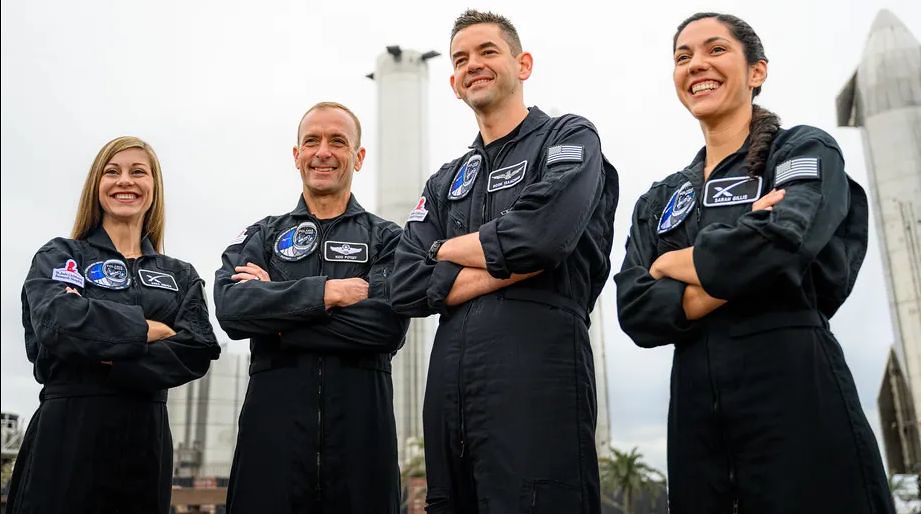
The Polaris Dawn crew (l to r): Anna Menon, Scott Poteet (vehicle pilot), Jared Isaacman (Commander) and Sarah Gillis (EVA-2), pictured in 2021. Credit: SpaceX
Such pre-breathing (very similar in nature to that undertaken by divers going down to significant depths in the oceans) is a requirement of all EVA work, as space suits operate at very low pressures (e.g. roughly 5 psi compared to the average sea-level atmospheric pressure of 14.8 psi). If the nitrogen is not flushed from the body, it can bubble and cause decompression sickness, causing serious injury –and potentially death – to the sufferer as the pressure is raised back to normal levels.
Normally, such pre-breathing would be carried out only be the astronauts making the EVA, and they would use an airlock in which to do so, spending several hours undergoing the process. However, Crew Dragon does not have any form of airlock, so the entire vehicle must be depressurised, hence the entire crew going on the oxygen rich mix. As this happened, work also started on very slowly reducing the overall cabin pressure from 14.5 psi to 8.6 psi, a process that continued over the first three days of the mission leading up to the actual EVA.
A SpaceX Falcon 9 rocket carrying the Polaris Dawn mission lifts off from Kennedy Space Centre in Florida at 09:23 UTC (05:23 EDT) on September 10, 2024. Credit: Polaris Programme / John Kraus
After some eight orbits around the Earth, the Dragon’s motors fired, elevating its apogee to around 1,400 km above sea level. This marked the furthest anyone has been from Earth since Apollo 17 in 1972, whilst also breaking the highest altitude record for a crewed mission orbiting Earth, originally set by Gemini 11 in 1966.
Both the 1200 and 1400km limits of the orbit meant the vehicle would skirt the Van Allen radiation belts, periodically passing through the South Atlantic Anomaly. This meant that during their five days in space, all four crew would be exposed to the same amount of radiation an astronaut on the International Space Station (ISS – orbiting at an average of some 400 km) would require some three or more months to experience. Whilst such a concentrated exposure marked a great long-term risk to the health of the four, it formed part of the science programme for the mission.
In brief, radiation exposures as a fact of space travel, but despite all the work aboard the ISS and other orbital vehicles like the space shuttle on extended missions, there are numerous active factors of radiation exposure in space that are not clearly understood. To this end, Polaris Dawn flew a series of experiments put together by Translational Research Institute for Health (TRISH), a NASA-funded consortium of academic institutions specifically aimed at investigating some of the more usual aspects of space-based radiation exposure, in order to better understand them.
Polaris Dawn crewmembers participating in these TRISH studies will provide data about how spaceflight affects mental and physical health through a rigorous set of medical tests and scans completed before, after, and during the mission. The work will include assessments of behaviour, sleep, bone density, eye health, cognitive function and other factors, as well as analysis of blood, urine and respiration.
– NASA statement on the Polaris Dawn NASA-sponsored science
Much of this work will continue well after the mission’s conclusion, with studies and checks on their health and welfare continuing over the next few years.
Scott Poteet rehearses with one of the TRISH instruments designed to test the effects of space-based radiation exposure on the human eye (notably bright flashes seen when they eyelids are closed). Credit: Polaris Programme
In addition, the mission flew Tempus Pro, a commercial package NASA has been adapting for use on space missions. It is designed to collect collect multiple health measurements from astronauts and compare them with a database of medical data on Earth, allowing flight surgeons to more fully diagnose an astronaut’s overall physical and mental health and well-being. The system can also be used to provide real-time telemedicine support (including any consultations from specialist almost anywhere on Earth) to assist medical personnel on space missions in provide physical and mental treatment to their fellow crewmembers.
In all the mission carried a total of 36 experiments from 31 partner institutions around the world. However, it was the EVA – to be undertaken in turn by Isaacman as crew commander (and major financier, who originally flew the Inspiration4 private venture orbital flight in 2021, and which also utilised Crew Dragon capsule Resilience), and Sarah Gillis, the senior space operations engineer at SpaceX – which had captured the attention of the world ahead of the mission.
The EVA took place on Flight Day 3, after the vehicle’s orbit haf been lowered and circularised at some 730 km above sea level. It commenced some time in advance of the actual hatch opening, with a further round of pre-breathing a 100% oxygen atmosphere to purge remaining nitrogen from the astronauts’ bodies, and a slow final lowering of the cabin pressure prior to full venting. All four then donned their IVA / EVA suits and tested their umbilical life support and power feeds (the SpaceX suits do not operate with the kind of back-pack common to NASA / Roscosmos EVA suits, but are reliant on a physical connection to the space vehicle).
A helmet cam view as Jared Isaacman looks up at the “skywalker” platform in the nose area of Resilience, as he’s about to climb up onto it for his part of the EVA. Credit: SpaceX via NBC News
At 15:12 UTC on Thursday September 12th, 2024, all four crew reported their suits were sealed and operational, and they were operating entirely off of the life support reserves supplied to their suits. The final de-pressurisation of the capsule cabin could then commence, causing their suits to expand to their pressurised size. Some 37 minutes after final depressurisation had started, the vehicle was ready for the inner hatch to be unlatched by Isaacman, as EVA-1, and the pressure seal broken. This then allowed the hatch opening mechanism to be triggered, with the hatch sliding fully open at 15:56 UTC.
Isaacman then egressed through the nose chamber onto the “skywalker”, a special ladder-come-work platform with hand holds and foot restraints, design to allow a crew member to both raise themselves out of the nose of the craft and anchor their feet on the platform so that they can perform hands-free work.
A zoomed-out shot from the Earth-controlled camera within the nose cone hatch of Resilience, showing Isaacman as he paused on the “skywalker” platform to carry out the first set of arm mobility tests. Credit: SpaceX via NBC News
A camera mounted on Resilience’s nose cone cap (which had been opened as per standard practice since the craft’s arrival in orbit to help with general heat regulation) filmed Isaacman as he emerged from the nose of the vehicle, initially rising to waist level before carrying out a range of mobility tests as the spacecraft raced over Australia and towards New Zealand and the terminator between the day and night sides of Earth.
The mobility tests were designed to test both ease and range of movement within a pressurised IVA / EVA suit, both with arms and legs, moving up and down the steps on the “skywalker”, testing the ease of use of the foot restraints, and the overall freedom of movement and reach allowed by the suits when in the near-vacuum of space. In all, Isaacman spent roughly 8 minutes on the platform before climbing back down into the capsule.
Sarah Gillis then replaced him, moving into the nose of the capsule and onto the “skywalker”. Unfortunately, shortly after she anchored herself on the “skywalker” to commence her own series of tests, Resilience passed out of video relay range of NASA Tracking and Data Relay Satellite System (TDRSS), so the live video feed was lost, leaving only verbal communications. However, she spent almost the same amount of time as Isaacman in her EVA, allowing her to give an engineer’s perspective on the usability of the suits.
By 16:21 UTC, Gillis was back inside Resilience and the inner hatch was closed, leaving Isaacman with the task of latching and locking it securely. Over the next 50 minutes, the pressure inside the vehicle was restored to a point where the crew could use the cabin’s atmosphere and start removing their IVA / EVA suits.
The EVA by the numbers (from space commentator Jonathan McDowell:
Total elapsed time (starting when the capsule was fully depressurised through to being re-pressurised to approx 5 psi): 1 hour 46 minutes.
Total “spacewalk time” (time from unlatching the inner hatch to re-latching it): 33 min 25 seconds.
Total time Isaacman spent on the “skywalker” and outside the cabin: 7 minutes 56 minutes.
Total time Gillis spent on the “skywalker” and outside the cabin: 7 minutes 15 seconds.
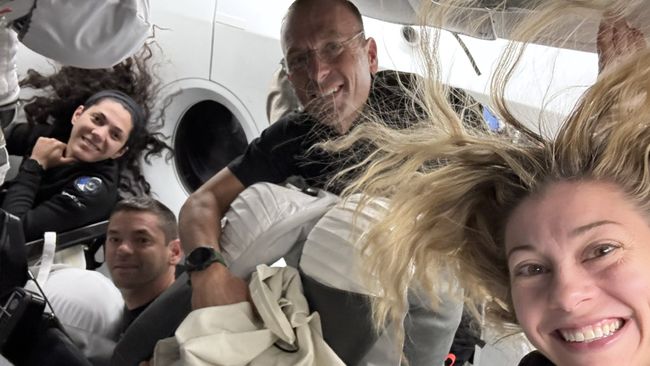
The crew seen after the EVA period and following the removal of their IVA / EVA suits (l to r): Sarah Gillis, Jared Isaacman, Scott Poteet, and Anna Menon. Credit: Polaris Programme
These may not be record-breaking numbers, but they are nevertheless extraordinary and of potential significance as a starting-point for such operations by non-career astronauts. Private venture EVA operations are bound to become more and more commonplace and of longer and more complex duration as the next generation of private / commercial orbital facilities by the likes of Axiom and the Blue Origin / Sierra Space led Orbital Reef consortium come on-stream.
The remaining two days of the mission saw the four astronauts resume their science work as cabin pressure within the vehicle was gradually brought back up to more reasonable pressures in advance of a return to Earth. As well as the science work, the crew also conducted tests in using the SpaceX Starlink satellite network for audio and video communications with mission control.
Sarah Gillis filmed aboard Resilience as she plays Rey’s Theme from the music for Star Wars: The Force Awakens, composed by John Williams. Credit: Polaris Programme
Part of the latter once again involved Sarah Gillis, who is also a classically-trained violinist. On September 13th, she performed of Rey’s Theme by legendary composer John Williams. Whilst the performance was misreported in some media as the “first” performance of a musical instrument in space (instruments have been played in space for decades; for example, Catherine Coleman played the flute on the ISS in 2011 and Chris Hadfield, commander of ISS Expedition 35 famously recorded a music video of David Bowie’s Space Oddity, marking it as the first music video ever shot in space), it was nevertheless still and important factor for the mission’s overall objectives.
One of the things Isaacman has done with her personal fortune and through his private space ventures is to raise money St. Jude Children’s Research Hospital in Memphis, Tennessee. In 2021, for example he both donated several million to the hospital and auctioned off seats on the Inspiration4 mission with the money raised going to the hospital. Gillis’ rendition of Rey’s Theme was combined with six orchestras from around the world to produce a recording and video entitled Harmony of Resilience to help raise further funds for the hospital from this mission.
As we travel around our beautiful planet Earth on this five-day mission, we wanted to share this special musical moment with you. Bringing together global talent, this performance symbolizes unity and hope, highlighting the resilience and potential of children everywhere.
– Sarah Gillis, September 13th, 2024, from orbit aboard SpaceX Crew Dragon Resilience
Polaris Dawn ended on Sunday, September 15th, 2024, with de-orbit operations starting at 06:34 UTC. These saw Resilience orient itself ready for atmospheric interface and jettison its service module – the Trunk, in SpaceX parlance to expose its heat shield. A series of thruster firings of the capsule’s Draco motors followed, slowing it velocity. These were completed by 06:50 UTC and the forward nose cone was swung back into its closed positions and latched.
At 07:15 UTC, the vehicle reached interface and entered a roughly 7-minute period of descent through the upper atmosphere during which the vehicle experience peak frictional heating around it, together with a loss of communications. The track of Resilience meant it was not only caught on camera by recovery vessels in the Gulf of Mexico, but also seen by the crew of the ISS.
A dramatic shot captured by tracking systems on the recovery ship Bob, showing Resilience living up to its name as super-heated plasma surrounds it and streams behind it as it passes through the upper reaches of Earth’s atmosphere at over 20,000 km/h. Credit; SpaceX
Things then proceeded rapidly. After re-entry, the vehicle’s drogue parachutes deployed so start slowing it, and not long afterwards, the four large main parachutes deployed, with Resilience splashing down at 07:37 UTC.
An initial safety and recovery team approached the capsule in a RHIB deployed by the SpaceX recovery vessel Bob (named for astronaut Bob Behnken, one of the first two people to fly a Crew Dragon to space (the other being Doug Hurley, who has the larger recovery ship Doug named for him) to confirm the capsule was safe and not venting harmful gasses. At the same time, additional RHIBs sought to recover the spacecraft’s parachutes.
With the confirmation all was safe, the recovery operation began, the RHIB team preparing Resilience for hoisting onto Bob’s stern deck as the recovery vessel slowly closed with the capsule to arrive alongside at 08:00 UTC. Eight minutes later, with the lifting lines secured, the loading arm at the stern of Bob raised the capsule up onto the ship’s deck, where it was moved forward to the egress platform under the cover of the ship’s helipad and at a height that allows for easier opening of the capsule’s hatch.
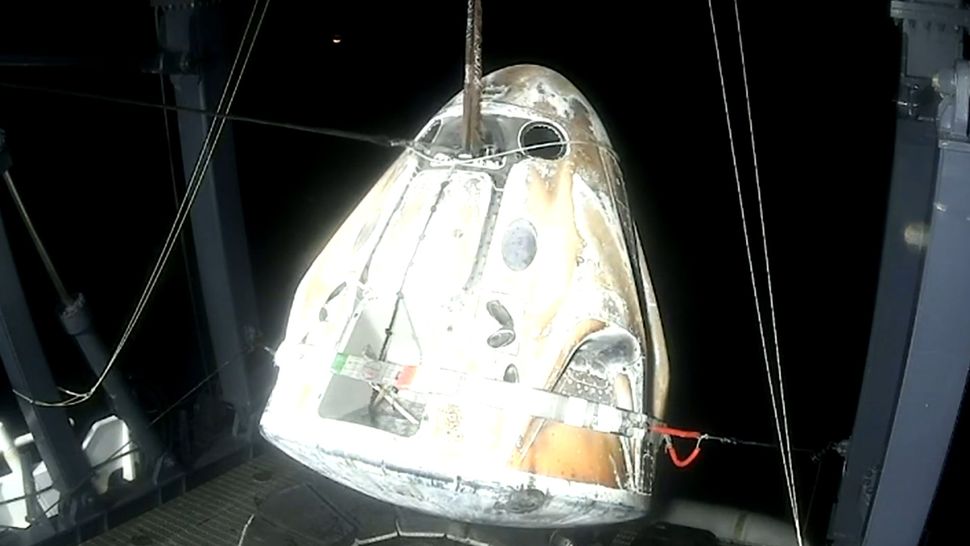
Resilience comes aboard Bob at the conclusion of the Polaris Dawn flight, 08:08 UTC, September 13th, 2024. Credit: SpaceX
The latter was opened at 08:20 UTC, after a final round of checks, and the recovery ship’s surgeon entered the capsule to check on the overall condition of all four crew to ensure they were showing no signs of decompression sickness or other issues. After this, the crew were allowed to exit the vehicle, with SpaceX lead space operations and mission director Anna Menon the first to leave the capsule, followed by Sarah Gillis then pilot Scott Poteet and finally Isaacman. All were in a jubilant frame of mind – and rightly so.
Polaris Dawn was in many respects a high-stakes mission; Resilience had to be extensively modified for the flight – not just her forward nose area, but throughout, with electronics and other systems inside the vehicle being “hardened” for us in the near-vacuum of Earth orbit; the IVA / EVA suit, despite extensive testing on Earth was still unknown in terms of how it would work in space, and the crew themselves took on a lot in respect of future health and welfare through such an intense exposure to Earth’s radiation fields over so limited a time. In this latter aspect, the mission’s work will continue through post-flight research, as noted above.
First glimpse on hatch opening following recovery (l to r): Anna Menon, Scott Poteet, Jared Isaacman and Sarah Gillis, all in a jubilant frame of mind, September 13th, 2024. Credit: SpaceX
Two more Polaris missions are in development, although their time frames and goals have yet to be confirmed. One will most likely involve another Crew Dragon flight, and Isaacman has stated he plans the third to be the first crewed flight of SpaceX’s Starship vehicle; so that one at least is unlikely to be in the immediate (and potentially foreseeable) future.
Sorcha Tyles is a long-time acquaintance in Second Life; as an artist she is rightfully highly regarded for her Second Life landscape and avatar studies; as a former gallery owner she offered many (including myself) the opportunity to display their work. Now, as a the holder of two parcels within a Homestead region she shares with a close friend (I believe the other two parcels within the region are private), she offers two small and similarly-themed settings where people can visit, relax, take photos, chinwag and enjoy a dance or two if the mood takes them.
Separated by a channel of gently flowing water, Dutch Pavilion and Ameland are two sides of the same coin of creativity, and given that travelling between the two can easily be enjoyed via rowboat, they make for a pleasant joint visit.
Dutch Pavilion, September 2024
Both sit as low-lying sandy islands, Dutch Pavilion the slightly smaller of the two, with the sand meeting the sea to the north to form a shallow-beachy bay held between two rocky headlands, and behind which sits the Pavilion itself, a delightful structure of brick, steel and glass fronted by a terrace with outdoor seating guarded by both flowers and rocks.
Relax, hear the waves and have a cup of coffee at the café, while chatting with friends or just hangout at the beach and recharge! Discover the hidden spots and go fishing while watching the sun set…or start the day with breakfast by the fire.
– Dutch Pavilion About Land description
Dutch Pavilion, September 2024
Grass and scrubby dunes guard the back of the café, while the Landing Point for those arriving by teleport sits over to the island’s east side, close to a former lifeguard station which now serves and an information kiosk. If the café is a little busy, there are various places to sit out on the sand – one of which is alongside the fire pit mentioned in the location’s description (above) where breakfast might be enjoyed, and another in the lee of one of the north side rocky headlands, complete with an upright piano for company. Deck chairs and towels are side out on either side of the beach’s sweep – but do watch out for the local scorpion!
There are some gentle touches to be found around the setting – notably on the dunes behind the café, with lots of touches of detail that bring the setting to life. For those wishing to take photos, rezzing rights are available by joining the local Group (as is the case with Ameland) – but do please remember to pick your bits and pieces up after!
Ameland, September 2024
Sitting to the east of Dutch Pavilion is Ameland, which could be reached via a simple teleport (by, say, camming and double-clicking or via LM or using the teleport signs on either island) – but where’s the fun in that? Particularly when you can take a rowboat from the beach and then – after excusing yourself for disturbing the local sealions – row your way across the intervening channel and make landfall along the Ameland’s shoreline.
Welcome to Ameland, loosely based on the real Ameland. Enjoy the calmness, listen to the waves, the birds and find tranquility. Enjoy the free pancakes at the pancakehouse 😉
– Ameland About Land Description
Ameland, September 2024
For those unfamiliar with it, Ameland, it “is a municipality and one of the West Frisian Islands off the north coast of the Netherlands. It consists mostly of sand dunes and is the third major island of the West Frisians” (via Wikipedia). For her iteration, Sorsha offers some light touches from its physical world namesake (such as the lighthouse), with the focus of the setting being the pancake house sitting under the shade of a large monkeypod tree.
The Landing Point for the setting for those who do TP in, is to the south of the island, and a track smoothed into the sands of the island runs from here around the west shore, passing the little deck where fishing can be enjoyed and a rowboat obtained for crossing to Dutch Pavilion, before looping past the dunes on the north side of the island to roll up to the back of the pancake house, curling a set of playground swings in its arm as it does so.
Ameland, September 2024
The pancake house takes the form of an old farmhouse with seating on both floors indoors, as well as out on the stone-laid terrace set before it. The pancakes are plentiful and offered with a range of fruits and syrups (including one I’m rarely without, often taking it with my coffee: hazelnut – if you’ve not enjoyed a hazelnut latte (assuming no nut allergy!), then I’d be tempted to say you’re missing out!).
As with the Dutch Pavilion, dancing might be had here for those so inclined, whilst drinks and nibbles can be enjoyed out on the benches places on the sands. It is also along the sands of the shoreline that multiple places to sit and pass the time might be found, either on your own or with a friend or two, while the more active can always grab a bicycle from the rezzer close to the rowboat dock, and take it for a peddle around the sandy track – just please mind the bunnies hopping around!
Ameland, September 2024
Both Dutch Pavilion and Ameland are very engaging and pretty, ripe for photos and ideal for relaxing within. They are each offered under their own EEP settings (and lend themselves to personal EEP settings, as I used with my shots of Ameland), and both are finished with a gentle soundscape. So, why not hop over and see for yourselves?
One of the most popular technical requests for Second Life in recent months has been to extend 2K texture support to the Bakes on Mesh service, so it can be accessible for use directly on avatar clothing layers. During the Simulator User Group (SUG) meeting of September 10th, 2024, Pepper Linden indicated that an initial release of 2K Bakes on Mesh support could be forthcoming within the next week or so via the Beta grid – or Aditi, as it is called.
In an announcement posted of September 1th, 2024, Pepper confirmed that the capability is now available on Aditi for testing – and that accessing Aditi had now been simplified. To quote from the announcement:
Previously, residents were required to submit a support ticket to manually copy their accounts to Aditi. This process is now automated. Upon your first login attempt to the beta grid, your account will automatically sync, significantly simplifying access. Please be aware that the initial login may experience a brief delay as your account is copied over, but subsequent logins will proceed without delay.
And:
Inventory Synchronization
Each night, the beta grid will sync your inventory from Agni, provided you have logged into the beta grid within the past 24 hours. If you encounter issues where inventory items appear to be missing after synchronization, clearing your viewer’s cache should resolve the problem, as it may have cached your old inventory.
2K Bakes on Mesh Notes
In order to reduce the rendering impact in using 2K textures on system layers (skins, tattoo layers, clothing layers), there are limitations imposed on the system, whereby bakes will only be made at the highest resolution texture used in the avatar layers. So, for example:
If all the layers are at 512×512 resolution, the resultant bake will be 512×512.
If the majority of the layers are 512×512, but one is at 1024×1024, then the resultant bake will be 1024×1024, with the 512 textures upscaled to 1024×1024.
If the layers are all 1024×1024, the resultant bake will be 1024×1024.
If the layers are predominantly 1024×1024, but one is 2048×2048, the result bake will be 2048×2048, with the 1024×1024 textures upscaled to 2048×2048.
As Pepper revealed at the SUG meeting, the exception to this is eye textures: these are capped at a maximum resolution of 512×512, no matter what the resolution of the rest of the bake.
Issues and Feedback
Again to quote the official blog post:
We anticipate a temporary increase in system activity due to these enhancements. If you encounter any issues with these new enhancements, we highly recommend attending the Server User Group meetings held every Tuesday at 1 PM PST in the Denby region. Alternatively, you can submit a bug or feature request on feedback.secondlife.com. Your feedback is essential for refining and improving our services.













 Inara Pey: Living in a Modemworld