Glastonbury, the 5-day festival of contemporary performing arts that normally takes place annually in Pilton, Somerset, in England, may well be cancelled due to the SARS-CoV-2 pandemic – but that doesn’t mean the music cannot go on!
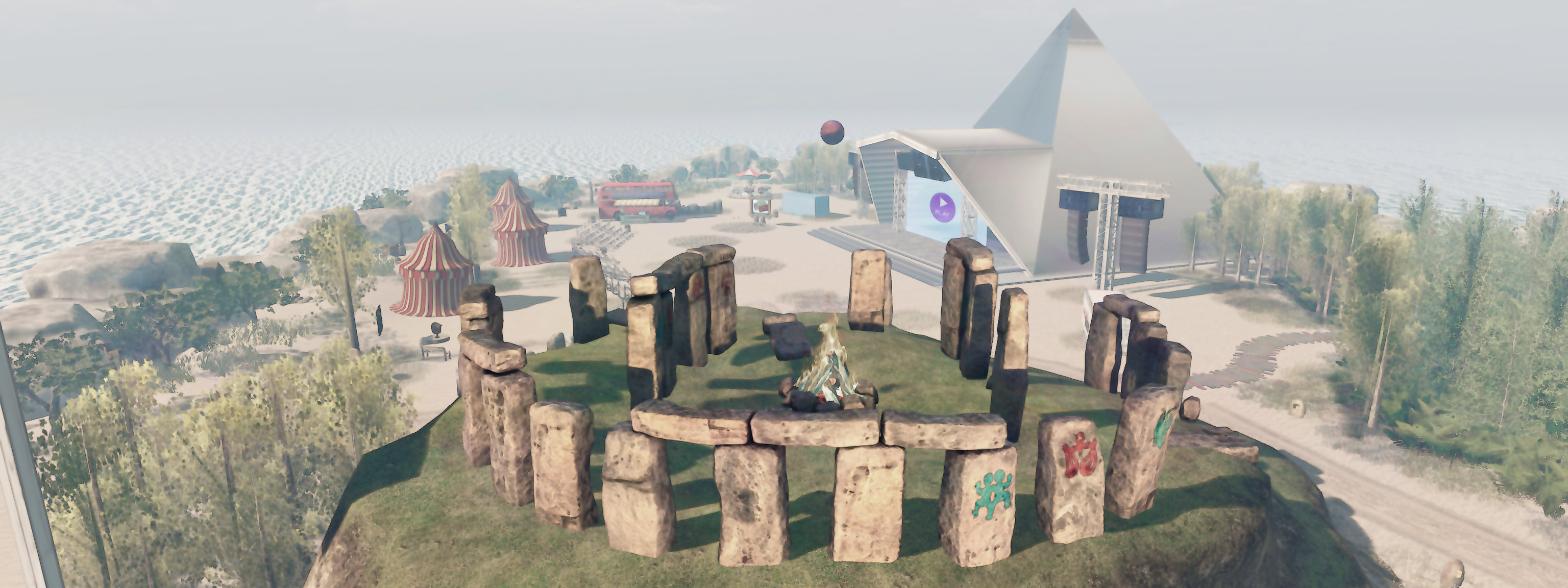
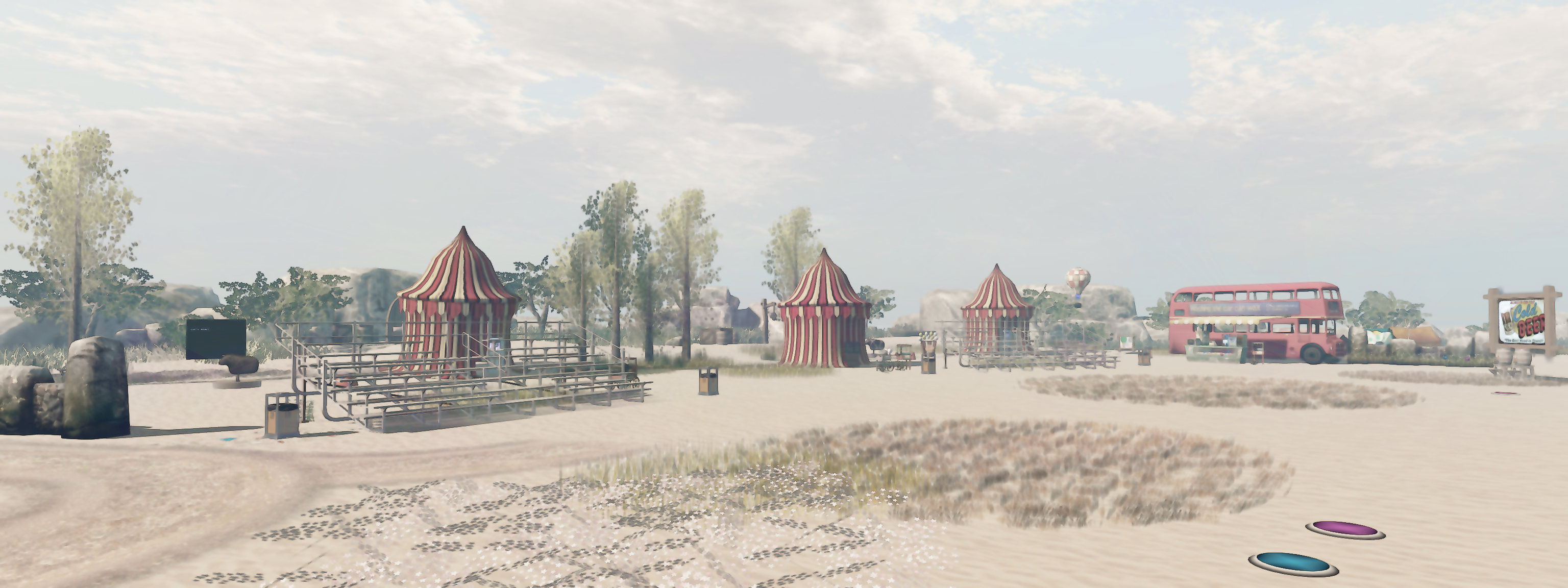
To help those who might feel they’re missing out on their annual “fix”, and to mark the summer Solstice in the run-up to the SL17B birthday celebrations, the Bellisseria Fargrounds will play host to Glastonbelli, a 2-day festival of music and fun.
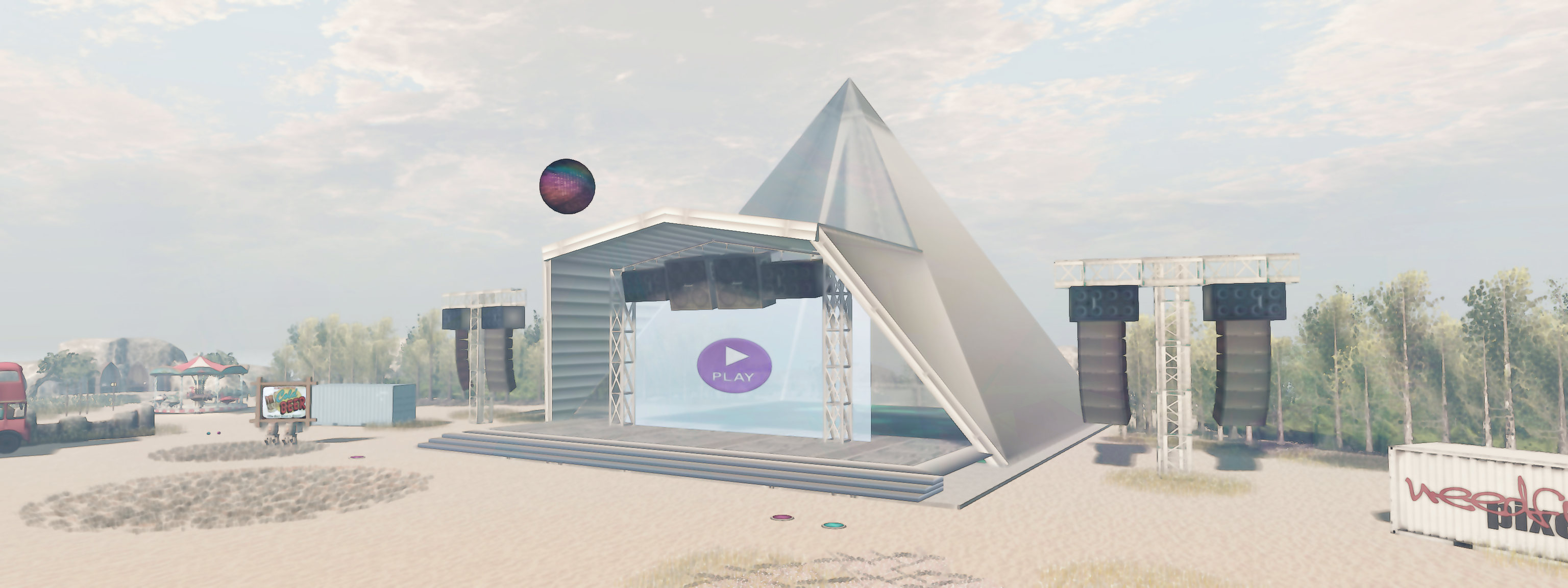
To mark the event, the Fairgrounds have their own version of Glastonbury’s famous Pyramid Stage, and also include a nod to the real festival’s famous portaloos!
Glastonbelli
Taking place on Tuesday 16th and Wednesday 17th June, 2020, the festival line-up is as follows:
Tuesday, June 16th
Wednesday, June 17th
10:00
The Vinnie Show
10:00
The Vinnie Show
11:00
lexus Melodie
11:00
Joe Paravane
Noon
Da5id Weatherwax
Noon
Baz (avantgarde.frequency)
13:00
Larree Quixote
13:00
Suzen Juel
14:00-16:00
Jed Luckless
14:00-16:00
Tukso Okey
16:00
Moondance Parx Particle Show
16:00
Moondance Parx Particle Extravaganza
So why not get into the summer festival mood and hop on over to the Bellisseria Fairgrounds from 10:00 on Tuesday, June 16th – you won’t even need your wellies, unlike what is often the case at Glastonbury.
Open as of June 14th, 2020 at The Sim Quarterly is Le Déraciné (The Uprooted), an installation by JadeYu Fhang.
Described as being a study about “How to transform the pain of uprooting into a poetic vision”, it’s a typically layered and semi-interactive piece by JadeYu; one that invites interpretation more than it offers one for itself. Also, and in keeping with YadeYu’s viewpoint, it is a piece that perhaps blurs the line between the physical and virtual dimensions, being present in one whilst created from the other, whilst also standing as a dream linking both.
The landing point sits above the main installation, a board presenting the required graphics settings needed to best appreciate the installation, while local sounds should also be enabled for the fullest experience. Once visitors are set, an Anywhere Door teleporter offer the way down to ground level and the installation proper.
The Sim Quarterly: Le Déraciné
Here the setting is made up of multiple parts: a central hill form which grows an enormous tree; a great vale of flowers that extends out into the water; and a village in the air, set as if floating upon wafer-thin clouds. The tree at first appears to be denuded, but slivers of green flow over the branches and wrap around the trunk, which is in part carved into a female form, while more green floats around the branches as orbs. A second figure lies in the shallows below, legs entangled into a network of roots. As well as the green on and around the tree, paths of light glimmer as they rise from the lowlands to pass over the tangle of roots that form the hill’s crown, offering a way up to the tree as then converge upon it, whilst a single path rises to the cloud village.
Throughout the setting, the motif of roots is clear: but what of the idea of being “uprooted”? Perhaps it is in relation to physical relocation: there is the village in the air and the one at the landing point – are these then symbolic of the pain of moving home? Or is the meaning more bound in matters of ecology or in the erosion of cultural identity due to the demands of an increasingly homogeneous modern world, perhaps invoked through the dancing figures?
The Sim Quarterly: Le Déraciné
As noted above, interpretation is down to the observer. What is apparent is JadeYu’s rooting in surrealism, edged with a sense of spirituality.
Open through a period of three months, Le Déraciné offers plenty of time for you to visit and consider it for yourself.
Logos representative only and should not be seen as an endorsement / preference / recommendation
Updates for the week ending Sunday, June 14th
This summary is generally published every Monday, and is a list of SL viewer / client releases (official and TPV) made during the previous week. When reading it, please note:
It is based on my Current Viewer Releases Page, a list of all Second Life viewers and clients that are in popular use (and of which I am aware), and which are recognised as adhering to the TPV Policy. This page includes comprehensive links to download pages, blog notes, release notes, etc., as well as links to any / all reviews of specific viewers / clients made within this blog.
By its nature, this summary presented here will always be in arrears, please refer to the Current Viewer Release Page for more up-to-date information.
Note that for purposes of length, TPV test viewers, preview / beta viewers / nightly builds are generally not recorded in these summaries.
Official LL Viewers
Current Release viewer version 6.4.3.542964,, dated May 29th, promoted June 2nd, formerly the FMOD Studio RC viewer – No Change.
Release channel cohorts:
CEF RC viewer, version updated to version 6.4.3.543157, June 11th.
Project viewers:
Mesh uploader project viewer updated to version 6.4.4.543141, June 11th.
Images of Proxima Centauri (l) and Wolf 359 (r) captured by NASA’s New Horizons spacecraft 7 billion km from Earth, are overlaid against images taken of the two stars from Earth-based telescopes, showing how the stars appear to “move” depending on the viewpoint. Credit: NASA
For the first time in history, a spacecraft has been used to demonstrate parallax as it applies to the stars – and in the process, underlining the fact that the constellations beloved of astrology are little more than a matter of line-of-sight as seen from Earth.
The spacecraft in question is New Horizons, the mission that performed a fly-by of Pluto in 2016, and which is now some 7 billion kilometres from Earth – far enough to give it a unique view of the heavens around our solar system. On April 2nd/23rd, 2020 the spacecraft was commanded to turn its telescope on two of our nearest stellar neighbours, Proxima Centauri and Wolf 359 (a star doubtless familiar to Star Trek: The Next Generation), some 7.9 light years from Earth, to take pictures of both.
When compared to images of the two stars as seen from Earth, those from New Horizons clearly show how differently the two appear against the background of other stars when seen from different points of observation that are sufficiently far apart.
The New Horizons spacecraft. Credit: NASA
Use of parallax is a common astronomical exercise, used to measure the distance of stars from Earth. However, up until the New Horizons experiment, the average separation between points of observation have been opposite sides in Earth’s orbit around the Sun – or a mere 297,600,000 km apart when averaged out. That’s far enough to allow for an accurate measurements of other stars, but not far enough to show how differently a star might appear from different points in the sky.
It’s fair to say that New Horizons is looking at an alien sky, unlike what we see from Earth.nd that has allowed us to do something that had never been accomplished before—to see the nearest stars visibly displaced on the sky from the positions we see them on Earth.
– Alan Stern, Principal Investigator, New Horizons
For the experiment, the images from New Horizons were compared with images captured by the Las Cumbres Observatory, Panama, operating a remote telescope at Siding Spring Observatory in Australia, and from the Mt. Lemmon Observatory in Arizona, both of which imaged the stars on the same night as New Horizons captured its images, so as to provide a direct comparison.
Witnessing the Birth of Stars
The Rho Ophiuchi cloud complex is a dark nebula of gas and dust that is located 1° south of the star ρ Ophiuchi in the constellation Ophiuchus. Some 460 light-years from Earth, it is one of the closest and active start-forming regions to the Sun.
It’s called a “dark nebula” because the dust cloud is so dense, visible light from stars within it is almost completely obscured. However, astronomers using the Atacama Large Millimetre/submillimetre Array (ALMA) have found something of interest within the cloud.
Two infra-red images of the Rho Ophiuchi nebula showing the IRAS 16293 system within it, as captured by ALMA showing (l) what was thought to be a binary system of stars (A and B), and a closer view of A (r), revealing its own binary nature. The two stars of A re some 54 AU apart. All three stars are surrounded by accretion disks, with the energised dust surrounding the A stars also visible. Credit: Maureira et al
The item in question is IRAS 16293-2422, a system that has a long history of being observed in the infra-red. However, it had been thought the system comprised a binary pairing of protostars, simply referred to as A and B some 700 AU apart. However, the new study has revealed that the star known as A is actually itself a pair of stars, now called A1 and A2. They are both of similar in mass to the Sun – A1 being slightly smaller, and A2 around 1.4 times larger, and each is surrounded by its own accretion disk from which it is drawing material.
These stars and their disks have certain fascinating aspects. The first is that they are only separated by a distance slightly greater to that of Pluto when at aphelion relative to Earth. They also complete an orbit around one another one every 360 terrestrial years. In addition, the accretion disks around A1 and A2 are also unique.
Both disks are extremely active, filaments of matter streaming into the stars at the heart of each, and further filaments of dust flowing into the disks from the nebula. In addition, the disk around A2 disk appears to be oddly inclined compared to the disks around A and the more distant B, suggesting complex interactions may be at play around it. The disk also appears to have parts rotating in opposite directions relative to one another, the first time such a phenomenon has been seen in a protostar accretion disk. It suggests that should planets eventually form around the star, those nearer to it may orbit the opposite direction to those further out.
Organic scans of the disk also detected glycolaldehyde — a simple form of sugar – and Chloromethane, also called methyl chloride, an important biomarker, together with Carbon Sulphide, Isocyanic Acid, Formamide, and Formic Acid. The presence of the organics is important as it shown that the basic building blocks of life can exist within the accretion disks around stars, and so may be available when the remnants of that disk forms planets.
It’s not clear if / when the formation of either star may reach a point of nuclear ignition, or how such an event might affect the other. However, their confirmation provides astronomers with a first-hand opportunity to witness the earliest stage in the process of stellar evolution.
It’s time to highlight another week of storytelling in Voice by the staff and volunteers at the Seanchai Library. As always, all times SLT, and events are held at the Library’s home, unless otherwise indicated. Note that the schedule below may be subject to change during the week, please refer to the Seanchai Library website for the latest information through the week.
Anyone who murdered Colonel Protheroe,’ declared the parson, brandishing a carving knife above a joint of roast beef, ‘would be doing the world at large a favour!’ It was a careless remark for a man of the cloth. And one which was to come back and haunt the clergyman just a few hours later – when the colonel was found shot dead in the clergyman’s study. But as Miss Marple soon discovers, the whole village seems to have had a motive to kill Colonel Protheroe.
Tea-Time with Miss Marple
Seanchai Library continues a 6-week run featuring Agatha Christie’s Miss Jane Marple, starting with The Murder at the Vicarage, which marked her first appearance in print.
So please join Aoife Lorefield, Da5id Abbot, Caledonia Skytower, Corwyn Allen, Gloriana Maertens, Kayden Oconnell, Willow Moonfire in a little corner of St. Mary Mead, in Second Life.
Monday, June 15th, 19:00: Spock’s World
Gyro Muggins reads Diane Duane’s take on a classic figure from science fiction.
In the 23rd Century…
On the planet Vulcan, a crisis of unprecedented proportion has caused the convocation of the planet’s ruling council, and led to Starfleet ordering the U.S.S. Enterprise to the planet in the hope that its first officer, and Vulcan’s most famous son, can help overcome the issues the planet faces.
As Commander Spock, his father, Sarek, and Captain James T. Kirk struggle to preserve Vulcan’s future, the planet’s innermost secrets are laid open, as is its people’s long climb to rise above their savage pre-history, merciless tribal warfare, medieval-like court intrigue to develop and adhere to o’thia, the ruling ethic of logic, and to reach out into space.
For Spock, the situation means he is torn between his duty to Starfleet and the unbreakable ties that bind him to Vulcan. Confronted by his own internal conflicts, he must quell them and prevent his world – and possibly the entire United Federation of Planets – from being ripped apart.
Tuesday, June 16th
12:00 Noon: Russell Eponym, Live in the Glen
Music, poetry, and stories in a popular weekly session at Ceiluradh Glen.
19:00: The Bridge of San Luis Rey
With Willow Moonfire.
On Friday noon, July the twentieth, 1714, the finest bridge in all Peru broke and precipitated five travellers into the gulf below.
Thus begins Thorton Wilder’s second, and 1928 Pulitzer Prize winning novel. Influenced in part by Wilder’s own conversations with his deeply religious father, and inspired by Prosper Mérimée’s one-act act play, Le Carrosse du Saint-Sacrement, Thorton described the novel as a means to pose the question, “Is there a direction and meaning in lives beyond the individual’s own will?”
The bridge of the novel’s title and opening is a fictional Inca rope bridge, and its collapse is witnessed by a Franciscan friar, himself about to cross over it. A deeply pious man, Brother Juniper finds his faith challenged by the tragedy, and as a result embarks upon a “mission” to prove that it was divine will rather than chance that led to the deaths of those who fell with the bridge.
Over the course of six years, he compiles a huge book on the lives of those who perished, much of it obtained through interviews with those who knew them, in an attempt to to show that the beginning and end of the lives of those lost in the tragedy might be a a window into the will of God, and that the beginning and end of every life is in accordance with God’s plan for the individual.
Thus, within his book, he records the lives of those killed, as presented in succeeding chapters of the novel, mapping all that led them to their fate. The novel itself weaves a story through time, from the opening tragedy, then back to the lives of those who perished, then forward to the book’s reception by the church, then back once more to the events that immediately followed the tragedy and before Brother Juniper embarked on his quest.
Through this, we not only witness the lives of those lost, but also Brother Juniper’s own fate as a result of his efforts – a fate itself foretold within his book, and which again leaves one pondering the question Wilder set in writing the novel: is there indeed direction in our lives beyond our own will – and if so, is it rooted in the divine, or humanity’s own attitudes of a given time?
Wednesday, June 17th, 19:00: The Phryne Fisher Mysteries
Corwyn Allen brings us stories about Kerry Greenwood’s Australian heroine of the 1920s, possibly made popular to a globe audience through the Australian Broadcasting Corporation’s series, Miss Fisher’s Murder Mysteries.
Phryne Fisher is rich, aristocratic and far too intelligent to be content as a flapper in the Jazz Age. She collects men, fast cars and designer dresses. she flies, dances, shoots and has a strong bohemian outlook on life. But no matter how delicious the distractions, Phryne never takes her eyes off her main goal in life: bringing down villains.
Thursday, June 18th
19:00: Quotients: Tasty Morsels of Fantastic Fiction
With Shandon Loring reads Tad William’s short story. Also in Kitely – grid.kitely.com:8002:SEANCHAI).
21:00: Seanchai Late Night
Contemporary Sci-Fi-Fantasy featuring stories from Escape Pod, Light Speed, and Clarkesworld Magazines as well as other source. with Finn Zeddmore.
Currently open at Focus Magazine is The Truth About Trees, another thought provoking exhibition by Milena Carbone. It offers something of a multi-media installation, combining images and text (accessed via links to web pages), bound together by themes of life, ecology, harmony, and nature, and carries a vein of religious metaphor.
There is a path through the exhibition that starts to the right of the entrance beyond the window with a text element, and then proceeds counter-clockwise around the walls to the exit. The opening text is that of a dialogue Milena had with a friend in Australia who witnessed the 2019 brushfire there first-hand. It serves not just as a reminder of those events, but also that the Australian brush is a part of nature; a living environment in which we either share or seek – for better or more often for worse – try to dominate.
From here the story unfolds as pairings of image and a link to a story element, each to be taken in turn. It’s a story that mixes fable, the story of creation, the balance of nature. Folded into this are cosmic themes such as our place in the universe, raised through a story around ʻOumuamua, the first known interstellar object to have been detected passing through our solar system.
The Truth About Trees
It’s a story that enfolds the images presented in the exhibition and reaches beyond them to pictures also found in the web pages of individual stories. In part it follows themes those who know Milena’s work will find as being familiar: questions about God, he nature of God’s existence the aforementioned issues of ecology, nature and harmony. However, these themes are not just presented through the stories – or perhaps mythology might be a better term – but also through the setting of the exhibition itself.
The latter appears as a walled garden with a central apple tree surrounded by police crime scene tape. The metaphor here is clear: the Garden of Eden, the Tree of Knowledge, the transgression against God’s will in the taking of the Apple and the fall of human kind from grace.
But here as well the metaphor in deeper than may first appear: were we really created in God’s image? If so, then were we not as flawed as God from the outset? If so, then was the crime committed by Adam and Eve not so much the eating of the apple against God’s orders, but rather God’s own failure in not making us better than just imbuing us with “his” own frailties; frailties that have prevented us living in the kind of natural harmony that has marked the rest of his creation?
The Truth About Trees
Involved, rich in detail, theme and substance, The Truth About Trees will remain open through the rest of the month.









 Inara Pey: Living in a Modemworld