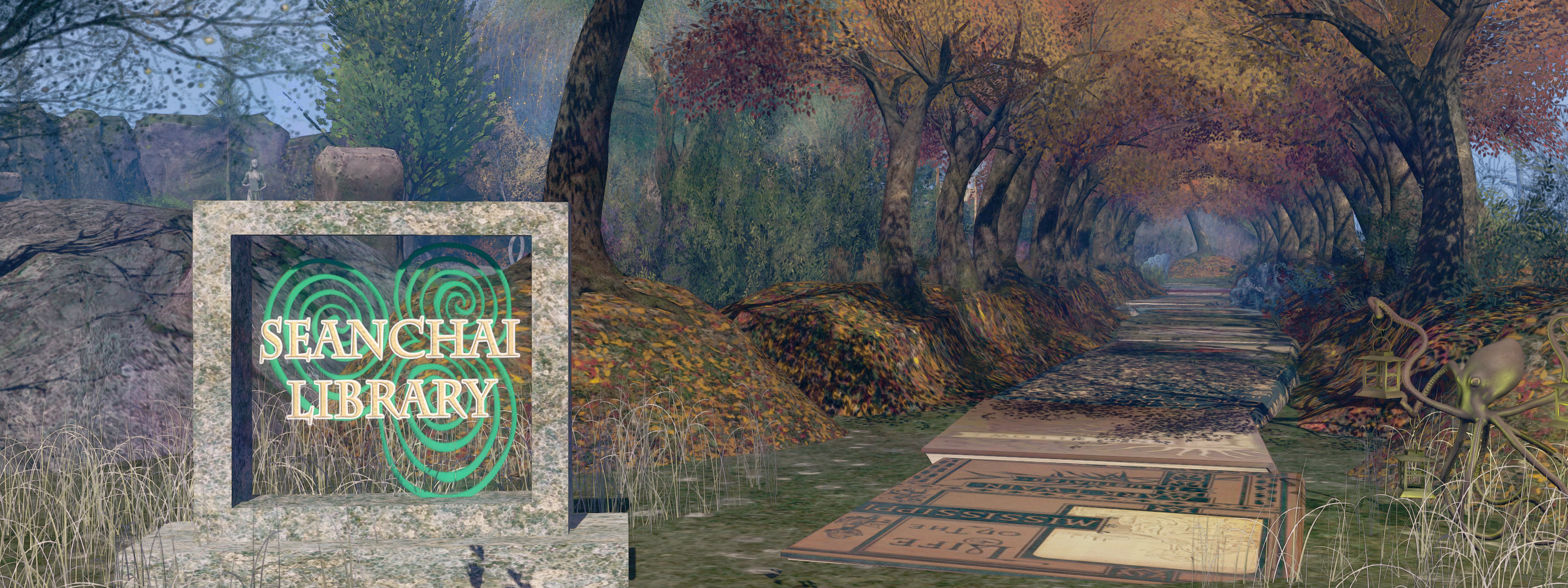
The week with Seanchai Library – May 30th -June 3rd

Seanchai Library

It’s time to highlight another week of storytelling in Voice by the staff and volunteers at the Seanchai Library. As always, all times SLT, and events are held at the Library’s home in Nowhereville, unless otherwise indicated. Note that the schedule below may be subject to change during the week, please refer to the Seanchai Library website for the latest information through the week.

Monday, May 30th, 19:00

A US Memorial Day Special.

The inventor who almost took the pleasure out of life by building a Happiness Machine; the young reporter who fell in love with an alluring lady of ninety; the old gentleman whose last act was listening to the clang of a green trolley car going round a corner, two thousand miles away.

These are just a few of strange and vivid people who entered the secret world of a twelve-year-old boy during one enchanted summer when he discovered the fact that he really was alive…


Tuesday, May 31st

12:00 Noon: Russell Eponym

With music, and poetry in Ceiluradh Glen.

Wednesday, May 25th: Seanchai Flicks

A special for Star Wars month as the Seanchai cinema space plays host to videos from the galaxy far, far away.

Thursday, June 1st, 19:00: Beggar’s Day: The Beggar Prince

The Kingdom of Galaway has a law – The Test of Kings –  that every heir to the throne must work a year and a day as a commoner in order to prove they are worthy of being ruler. Not a great law when you are as lazy and indulgent as Prince Larry.

He find that on his day, he must become servant to a former slave, Brishee, as she is conscripted to find the lost artefact, The Shield of Many Uses. However, the evil Percy has other ideas. Via murder and conspiracy, he intends to usurp the throne of King Willy.

Will Larry survive in his role as servant to Brishee? Will she succeed in her quest – and Larry, by extension, succeed in The Test of Kings, or will he be the first to fail, and Percy thus succeed?

The King, meanwhile, has problems of his own: why does Cruith the Crone keep stealing his chickens? Why is she always the first in line to bend his ear on Beggar’s Day?

Caledonia Skytower reads M.J. McGalliard’s first volume in the Beggar’s Day series.

2022 viewer release summaries week #21

Logos representative only and should not be seen as an endorsement / preference / recommendation

Updates from the week ending Sunday, May 30th, 2022

This summary is generally published every Monday, and is a list of SL viewer / client releases (official and TPV) made during the previous week. When reading it, please note:

  • It is based on my Current Viewer Releases Page, a list of all Second Life viewers and clients that are in popular use (and of which I am aware), and which are recognised as adhering to the TPV Policy. This page includes comprehensive links to download pages, blog notes, release notes, etc., as well as links to any / all reviews of specific viewers / clients made within this blog.
  • By its nature, this summary presented here will always be in arrears, please refer to the Current Viewer Release Page for more up-to-date information.
  • Note that for purposes of length, TPV test viewers, preview / beta viewers / nightly builds are generally not recorded in these summaries.

Official LL Viewers

  • Release viewer: version 6.6.0.571939 – formerly the Performance Improvements viewer, dated May 25th – NEW.
  • Release channel cohorts:
    • No updates.
  • Project viewers:
    • No updates.

LL Viewer Resources

Third-party Viewers

V6-style

V1-style

Mobile / Other Clients

Additional TPV Resources

Related Links

Space Sunday: NASA and Mars and some updates

NASA Moon-Mars concept. Credit: NASA

As NASA moves forward with plans to return to the Moon under the umbrella of Project Artemis, it is now stirring the pot on ideas for sending humans to Mars once more.

There have been many proposals for crewed missions to Mars since the 1950s, and in the last thirty years we’ve had a fair plethora, from the utterly unworkable ideas put forward in the Space Exploration Initiative SEI) of the early 1990s through Mars Direct, NASA’s Sprint and Mars Semi-Direct outlines through to what amount to pipe dreams expressed by Elon Musk / SpaceX.

On May 17th, NASA published a video and documentation outlining a set of high-level objectives identifying four overarching categories for developing a Moon-to-Mars exploration strategy, including transportation and habitation, together with ideas for initial missions which, for those who have followed all the various plans for exploring Mars, come across as a fresh pulling together of some very old concepts.

NAS’s latest conceptual strategy for using technologies for Moon and Mars exploration. Credit: NASA

Managed by the Exploration Systems Development Mission Directorate at NASA Headquarters in Washington DC, the purpose of the publications is to generate feedback from both interested parties within the space industry and from the general public (closing date, June 3rd, 2022). However, the process will not result in NASA issuing any RFIs or undertaking any procurement activity as a result of industry feedback received.

These objectives will move us toward our first analogue Mars mission with crew in space and prepare us for the first human mission to the surface of the Red Planet. After reviewing feedback on the objectives, we will work with our partners to discuss input and finalise our framework this fall.

– Jim Free, associate administrator, Exploration Systems Development Mission Directorate.

In particular, the outline seeks to leverage capabilities that can be utilised / tested on the Moon and then extended to Mars, such as in-situ resource utilisation (ISRU) – although arguably, scaled ISRU for water, oxygen and propellant production is somewhat simplified on Mars, thanks to its atmosphere); and combining robotic and human systems.

The outline also provides insight into how NASA’s initial thinking on how to undertake initial missions and this is where echoes of past proposals comes in. In brief, these ideas include:

  • A “Transit Hab” capable of carrying crews of 4 between lunar orbit and Mars, using a mix of chemical and electric propulsion. Delivered to the Lunar Gateway station in the early 2030s, this vehicle would be capable of both conjunction and opposition trips to Mars.
  • The use of precursor cargo flights to deliver equipment and supplies to Mars ahead of any crewed landing.
  • Precursor crew ascent vehicle missions to provide the means for crews to return to Mars orbit at the end of their time on the surface and return to the transit vehicle.
  • An initial conjunction mission (previously referred to as a “Sprint” mission) with two astronauts spending just 30 days on the surface of Mars utilising a pressurised rover.
  • The first opposition mission with a 4-person crew spending 540 days on Mars utilising large lander-habitats.
NASA 2022 first crewed mission concept. Credit: NASA

To explain the difference between “conjunction” (/”Sprint”) and “opposition” missions to Mars:

  • Opposition missions refer to Earth and Mars being on the “same side” of the Sun in their orbits around the Sun (so the Sun and Mars are on “opposite sides” of Earth), allowing for the fastest transit time between the two planets – 180 to 270 days -, but which require crews to spend up to 540 days on Mars, for a mission duration of 900 days.
  • Conjunction mission refer to Earth and Mars being (more-or-less) on opposite sides of the Sun relative to one another, requiring a mission to “sprint” to catch Mars (usually by making a gravity-assist around Venus). These missions are of a shorter duration (600-650 days total), but restrict crews to just 30 days on Mars but with highly-variable transit times (200-400 days).

There are arguments on both sides of the coin for opposition / conjunction missions, but overall, the choice of a conjunction approach to the first mission is a little odd: it maximises transits times (620 days in space), minimises Mars surface time and requires a Venus sling-shot.

Mars transit options: conjunction (left) and Opposition (right). Credit: NASA

However, the most interesting aspect of the NASA outline is that for this initial landing, the two crew making the descent to the surface of Mars will do so within a pressurised rover. The reasoning behind this is to deal with the crew potentially being “deconditioned” as a result of the transit to Mars, and so will use the rover to reduce the amount of time they will need to take adjusting to conditions on Mars, limiting the amount of actual science they can perform in 30 days.

In actual fact, the idea of making a rover the lander for a crew isn’t new. The first complete Design Reference Mission proposal that suggested this approach was put forward in 2004 – by none other than film director James Cameron!

The lander-rover from the 2004 Cameron DRM, note the landing motors and fuel tanks and fore-and-aft cabins. Unlike the proposed NASA rover, this vehicle required a separate habitat module.

Cameron’s rover was admittedly far more massive that the vehicle NASA is suggesting in their outline, but it was part of an overall strategy involving transfer vehicles, deployable habitation modules, and the use of biconic vehicles to descend through the Martian atmosphere (SpaceX have copied the biconic approach with the shape of starship, although the overall landing is very different).

Similarly, the ideas of sending equipment / supplies and the vehicle that will get the crew off the surface of Mars and back to orbit are not particularly new. Zubrin, Baker, Wagner et al, developed the first modern plan for doing these in the Mars Direct mission plan – although in that, the crew would make the entire trip back to Earth within the very cramped confines of their ascent / return vehicle.

This proposal also laid out who the propellants for the craft could be manufactured on Mars, with the general idea being modified by NASA as a part of their Design Reference Mission proposals, such that the ascent vehicle would only carry the crew up to orbit and a waiting transit vehicle – albeit one much larger than its outline suggests.

As noted, the ideas presented in the NASA document and video are for discussion and feedback, rather than for presenting actual plans. As such, they will be something I’ll return to in the future; once more definition has been given to actual mission outlines, the use of ISRU, etc.

Continue reading “Space Sunday: NASA and Mars and some updates”

Regi’s “Limitations” in Second Life

Regi Yifu: Limitations are Self-Imposed

Currently open in the skies above GlastonBelli on the mainland continent of Corsica sits Limitations are Self-Imposed a 3D installation by Regi Yifu.

The essential idea appears simple enough: a rainbow-hued series of walls interspersed with the shadowy forms of trees around and between which shade-like birds fly, forms a maze visitors are invited to walk. However, appearances are deceptive. Finding your way around the maze to its heart isn’t simply a matter of trying to pick the correct route between the high walls.

Regi Yifu: Limitations are Self-Imposed

This becomes apparent as soon as one enters the maze: the walls are actually phantom, allowing people to pass through them. So why the maze? The clue is in the title of the piece: all too often the limitations we place in life are self-imposed, either personally or by the strictures of our environment.

We make ourselves follow lines of thinking / belief / the demands of society when trying to grow or learn or achieve, and as a result, we frustratingly come across walls that seem to block our way, causing us to stop, turn back and try again using a different approach – one that may succeed or may lead to further frustration. But what if we didn’t? Rather than turning aside, what if we just kept pushing forward and pushing through the apparent barriers we face?

Regi Yifu: Limitations are Self-Imposed

Many of the world’s ideas and innovations have been achieved in this manner: by pushing against limits, by turning aside and moving outside of “traditional thinking / approaches.

True, doing so may not always yield the immediate result we hope for – there might be further barriers to work through / around; by pushing through one barrier might lead to initial confusion as much as trying to follow traditional thinking, and so on.  This, too, is reflected by Regi’s maze: pushing through a wall here and another there can lead you to a point where progress has been made, but you’re not at the heart of the maze – and it’s no longer clear where that centre is; you need to pause, reorient – and then push onwards.

A simple but layered installation that is also fun to visit.

SLurl Details

Hera’s touch of India in Second Life

Hera’s India, May 2022 – click any image for full size

Hera (Zee9) recently opened her latest region design to visitors, this one taking up the ground level at Island of Jahesa, held by Valéria Celestino (Kara Pendleton), and where Hera’s designs sometimes guest.

Entitled India, the setting is easiest described by using Hera’s own words:

I have been wanting to do something evocative of India for a long while. Recently I was looking at pictures of the red fort in Delhi and thought that the unique colour of the pinkish red stone might make for a very unique looking place.
All the textures are derived from photos of the red fort and there are a load of new meshes. I have used the basic layout of the jungle island I have done a few times before because the layout has some nice varying levels. It has turned out far better than I thought it was going to. I keep painting.

Hera (Zee9)

Hera’s India, May 2022

The “jungle island” in question is the one Hera has used in the likes of her Shangri-La build (see: Losing myself in Hera’s Shangri-La in Second Life), and in truth, there are other elements within this build that offer echoes of that 2021 build. These include the beachside seating places and the bar / club area to one side of the build. However, rather than detracting from India, these elements – to me, at least, offer a sense of, if not continuance, then perhaps sisterhood between the two designs.

The Red Fort Hera refers to is Lal Qila, Delhi, the former residence of the Mughal Emperors, as established by Emperor Shah Jahan in 1638, when he decided to make Delhi his new capital.

Hera’s India, May 2022

The important thing to note here is that Hera is not seeking to represent Lal Qila, but rather utilises architecture seen within it as parts of her India design – and she has done so in an effective, subtle manner, such as the capstones along the walls. In addition, Hera has included new meshes of murals along the walls that are mindful of Hindu designs, as well as including reliefs of Ganesh courtesy of RiderX Spitteler.

The bar area – which appeared with Shangri-La (as noted) and also, with a redress, in Giger City (see: Hera’s Drune Giger City in Second Life) – offers a particular attraction for those looking for a place to hide away, but looking up at the towers of the builds and among the tress around it, and you’ll likely find more.

Hera’s India, May 2022

To the front of the build, elephants (admittedly African, but as I’ve noted in the past, the Asian variety is in short supply in SL) and tigers wait to greet visitors as they pass from the landing zone and climb the stairs into the build, while Shiva keeps an eye on all that goes on. Further inside are open-air passages and walks winding around the main structures, offering a route out to where the bar sits on its own island, and to where a temple-like building points an individual tower into the sky on the opposite side of the main building group to the landing zone.

Compact, easy to explore and with plenty of places to relax, India is again a photogenic build from Hera.

Hera’s India, May 2022

SLurl Detail

  • India (Island of Jahesa, rated Adult)

A Monochrome May at The Edge in Second Life

Kultivate Magazine – The Edge Gallery

Now open at Kultivate Magazine’s The Edge Gallery is a new ensemble exhibition of art to take us through the end of May and into June 2022.

The Edge is the home of black-and-white art displays at Kultivate’s home of Water Haven, making it a particular attraction for me, as I very much appreciate monochrome and black-and-white art, and have been endeavouring to develop my own technique with it, which I may get around to showing at some point.

This exhibition at The Edge opened on May 22nd, and is without a given theme, allowing the artists free rein over the pieces they’ve selected to display. The participating artists are: Dawnbeam Dreamscape, Sophia Galewind, Lena Kiopak, Maaddi, Hannah Starlight, Tacca Exotic, Vita Theas and Myra Wildmist.

The Edge Gallery: Dawnbeam Dreamscape, Tacca Exotic and Sophia Galewind

As might be expected from such a gathering, the pieces on offer leans very much towards being avatar-focused, with three of the artists – Lena Kiopak, Hannah Starlight and Tacca Exotic opting to display a single piece each, all in a large format.

Lena is one of only two artists in the gathering to completely avoid avatars in her image(s), leaving The Passage as an powerfully eye-catching piece which calls to the observer, beckoning them to walk its length and into the waiting story. Similarly, Hannah’s His Song is highly sensual and artistically given whilst Tacca’s Emergence-1 matches the power of The Passage, but in a wholly different way.

The other artists to avoid avatar is Vita Theas, who once again present six superbly processed and presented landscape pieces rich in life, whilst Sophia and and Maadi offer a mix of avatar studies and landscapes – with Sophia’s b r e a t h e again particularly capturing my eye. Myra, meanwhile offers a set of five images that together form Myra Dances, something of a life and motion study.

The Edge Gallery: Myra Wildmist and Lena Kiopak

SLuel Details