The Grauland Cluster, September 2025 – click any image for full size
In the year 2097 an unmanned deep space probe sends startling new photos back to NASA. In them a giant inscribed monolith amidst an asteroid cluster is recorded. Years later a base is established to study this discovery. And learn what it means.
– The Grauland Cluster About Land description
For anyone with a love of good science fiction, the above description is likely going to spark thoughts of Stanley Kubrick’s “perennial good science fiction movie”, 2001: A Space Odyssey, simply because of the reference to a mysterious monolith found in space. Certainly, it was enough to pique my interest on arriving to see JimGarand’s latest Grauland build, The Grauland Cluster.
The Grauland Cluster, September 2025
A further 2001 bell might be rung when looking outside the Landing Point: the setting is that of a large crater, one which might bring to mind thoughts of the Moon’s Tycho crater and Dr. Heywood Floyd’s visit. However, this crater appears to be on an asteroid, and the monolith in question is anything but black and featureless (or buried on the Moon / in orbit around Jupiter (or Saturn, if you prefer Arthur C. Clarke’s equally excellent novel of the story)).
Nor should anyone consider from the above that Jim’s latest build is purely a riff on Kubrick’s film (or Clarke’s novel) – it’s not. What we do have is an engaging future setting into which much has been woven, with a focus on a massive facility within the asteroid base – as per the description above.
The Grauland Cluster, September 2025
Reached via the teleport disk within the crater facility, this asteroid station is impressive. Built using elements from the excellent sci-fi range of kits and build elements by Beth Delaunay (Isilmeriel) – and which are doubtless familiar to many with an interest in science fiction in SL – together with elements from ‘frit (Ifrit Skytower) and scratch-built / kitbashed sections.
Attached to a number of small asteroids (which themselves have been hollowed out, making them interesting points for exploration), the base is extensive with multiple docking facilities, including one for large freighters.
The Grauland Cluster, September 2025
The base is obviously intended for long-term occupancy by a potentially large crew (at least going on the cafeteria / canteen / mess hall), with a large gym and multiple recreation facilities available. The layout suggests that it incorporates artificial gravity and is equipped for self-defence – although from what is up to the imagination.
The monolith is free-floating outside of the station, a roadway / walkway running out to it from two of the station’s airlocks. Glowing symbols and geometric forms hover just above its hewn surface, although what they mean is again up to the imagination. Again, as a totally random thought, I looked at it as perhaps some form of Voyager-style interstellar message – or perhaps a Rosetta Stone in waiting, if you will.
The Grauland Cluster, September 2025
Other little touches I liked within the setting include the current time frame NASA-esque EVA and the novel (given the distance between the Sun and the asteroid belt) use of solar panels. Both of these give the setting a little bit of an anachronistic twist when compared to things like the futuristic space vehicles, the apparent presence of artificial gravity of some form and the advanced hydroponics facilities.
These juxtapositions cleverly avoid pinning the setting down to any particular time frame outside of the About Land description, but the presence of current technology (including in the gym and recreation areas) helps cement the station in the imagination as a human construct. I particularly liked the images being cycled on the large screens of the command centre, one of which appears to be a take on a vessel using the (in)famous Alcubierre drive. I don’t know if this was intentionally selected – but for me, it added another little cause to smile.
The Grauland Cluster, September 2025
Because so much is left open within the setting, it naturally lends itself to casual RP for those so-minded; perhaps even something on the sinister side, given the aforementioned external gun mounts and the “big Brother” array of screens within the command centre which appears to be keeping an eye on everything within the station…
But even without any notions of RP, The Grauland Cluster is – as with all of Jim’s builds – visually impressive and very photogenic. In all a delightfully crafted and presented build.
The following notes were taken from my audio recording and chat log of the Content Creation User Group (CCUG) meeting of Thursday, September 18th, 2025. Please note that this is not a full transcript, but a summary of key topics.
The CCUG meeting is for discussion of work related to content creation in Second Life, including current and upcoming LL projects, and encompasses requests or comments from the community, together with related viewer development work.
This meeting is generally held on alternate Thursdays at Hippotropolis.
Dates and times of meetings are recorded in the SL Public Calendar, and they are conducted in a mix of Voice and text chat.
Inventory Favourites System, plus assorted new features.
Improvements to avatar system; camera and movement; chat; voice; content creation tools.
Mesh uploader updates.
Text & UI polish.
Fixes for Environment and Rendering; stability and crashes; UI.
System improvements.
Second Life Project Lua Editor Alpha (Aditi only), version 7.1.12.14888088240, May 13.
Viewer 2025.07
This is now in QA and making its way towards release candidate status (or “beta” as RC viewers seem to now be referenced).
The added native Apple Silicon support is said to deliver “pretty impressive” performance improvements for those running on that OS.
A caveat here is that for this release only, it may not be possible to upload meshes on Apple Silicon. This is due to some Havok issues and “some licensing limitations”.
These issues will likely be resolved when the open source replacement for Havok for convex hull decomposition is integrated into the viewer. This update is anticipated as being available in the upcoming 2025.08 viewer.
The above limitation is only for Apple Silicon, it should not apply to Windows or Mac systems running x86 chipsets.
For other updates likely to be included in this release, please refer to my summary of the previous CCUG meeting.
Viewers 2025.08 and 2025.09
These are liable to be the last two viewer updates from the Lab for 2025, and both are in the planning stage.
Updates under consideration for either of them include potential updates to screen space reflections (SSR), building on work carried out earlier in 2025 but which have yet to reach the viewer.
However, precise details as to what will be in either / both viewers is still subject to internal discussions and decisions within the Lab.
General Discussion – In Brief
Mesh import support – general direction:
COLLADA.DAE support will always remain and be available, even if only for legacy content that may never be updated to glTF.
.gltf /.glb is now an officially supported mesh format or both static and rigged mesh, but with some limitations (e.g. no blend shapes) – with a request that an bugs that may be discovered are reported.
It is acknowledged that currently, importing .gltf meshes is a two step process ( .gltf materials and the .gltf mesh) which have to be imported separately to one another.
There have been discussion on supporting other mesh formats – but these are only discussions at this point in time, with absolutely no guarantee or time frame that/when other formats will be supported, as the work would require further and extensive modification to the mesh import workflow and internal SL mesh support.
A request was made for Inventory Thumbnails to support aspect ratios other than just 1:1, or to include a means for images to be cropped within the viewer post-upload.
Making changes to the the image aspect ratio for Inventory thumbnails was seen as “unlikely” in the near-term, but it was suggested the idea be raised at the next Open Source User Group meeting to see if a code contribution might be made.
A general discussion on the new Inventory Favourites capability in the official viewer, including comparisons with using the Favourite Wearables option seen in some TPVs.
Whilst the latter is not necessarily as flexible in its use as the Lab’s implementation, it was seen as scoring over the latter due to a) having a dedicated floater; and b) having that floater accessible from a toolbar button.
A request was made for some form of Inventory “cold storage”, where items can be archived without having to be boxed, and which is excluded from Inventory searches.
It was suggested that the easiest way to solve for this would be to a system folder to Inventory which is pre-set so that anything placed within it does not show up during searches.
Another suggestion was to strengthen Inventory filters to allow certain exclusions or to allow filtering by new inventory capabilities (e.g. to directly filter for all folders / items tagged as a Favourite).
The above could be combined with some UX redesign to better surface filters and make their functionality clearer, and potentially allowing filters to be set as easy-to-access inventory presets to quickly allow different views of a person’s Inventory to be accessed.
This broader discussion on inventory wound through a good portion of the meeting in terms of comments from users.
The subject of allowing region-wide reflection probes was raised – and was responded to as unlikely to happen, with a not that regions already have a “void probe” which – whilst primitive in nature – already does much of what a region-wide probe would do, using some of the data from the region. This can be visualised by going to Preferences → Graphics, locating Max Reflection Probes and setting it to None.
A question was asked as to whether LL staff and contractor work full-time on their specific areas, or if some work shorter hours / get moved around projects, thus limiting the amount of time they can spend working on certain things, leading to a lengthening of time frames, etc.
The broad response was that the (approx. 30-strong) dev staff work a standard working week, and some do get moved between projects, depending on priorities.
Further, planning, complexity and prioritisation do play a role in determining what gets worked on and how resources are used, all in accordance with management, etc., focus on platform direction and development.
Also, given the overall complexity and age of SL, the need for backward compatibility, etc., a large amount of effort has to go into simply “keeping the lights on” (to use Philip Rosedale’s term), and this also impacts available resources and determining what projects and taken up and worked on at any given time.
A general discussion on versioned sky assets, weather, the old 768-metre system clouds, etc. In terms of versioning EEP assets, this is something still under discussion at the Lab, but is not something currently being targeted for implementation.
Bryggen, Second Norway, September 2025 – click any image for full size
It’s no secret that I have an island home within Second Norway; I’ve written about the estate on numerous occasions in these pages, both pre- and post my move to it. Some of these posts covered the estate’s near-closure and subsequent recovery while others have highlighted some of the public spaces to be found within Second Norway. It is in reference to the second category of Second Norway that this little piece belongs.
At the end of August 2025, I received a message from Gian (GiaArt Clip), a region designer whose work I’ve also covered on multiple occasions in these pages, informing me about their latest project – the overhauling of what might be regarded as the “gateway” to Second Norway when approaching it along the water corridor from Blake Sea: Bryggen.
Bryggen, Second Norway, September 2025
The region is named for the eastern side of Vågen harbour in Bergen, Norway, once part of the centre for Hanseatic League commercial activities in that country (Bryggen meaning “the dock”, and also being known as Tyskebryggen – “the German dock”). It is particularly famous for its Hanseatic heritage commercial buildings, marking it as a natural tourist attraction as well as being a listed UNESCO World Heritage Site since 1979. In respect of this, Bryggen in Second Life has long offered a reproduction of those famous houses on its waterfront.
Under Gian’s reworking of the region, reproductions of these famous building have been retained. They straddle a waterway running west-to-east through the region, those on the north side of this waterway forming a double row of properties, most (all?) of which appear available for rent, the gay colours of the front row lining a pedestrian waterfront much like those so often photographed in the real Bryggen also do so).
Bryggen, Second Norway, September 2025
The units on the southern side of the waterway are a little more constrained in terms of space, being partnered with a part of Second Norway’s road system – notably the local bus station / terminus, which sits behind the local working docks and Get the Freight Out hub and fish market. Movement between these two waterfront areas is facilitated by the broad pedestrian / road/rail bridge spanning the waterway. All of the brightly-painted Hanseatic style units are occupied by local businesses, adding more colour and life to the setting.
As well as the Hanseatic buildings, Bryggen in Second Norway was also home to a distinctive stave church. At one time in Bryggen’s history, this stood on a rugged headland overlooking the main channel leading into the estate from Blake Sea. With Gian’s remodelling, the church has been retained, but it has been relocated into an expanded recreation of a Viking settlement.
Bryggen, Second Norway, September 2025
The village is located on a rocky plateau in the south-east quadrant of the region. Here it overlooks the southern precinct of Hanseatic commercial buildings. Cut through by a road tunnel, the plateau for the village sits at the same elevation as a large neighbouring commercial / business district in the north-east side of the region. However, the two are separated by a narrow gorge – home to the Bryggen central rail station – which appears to leave the village isolated on its plateau.
Solving the mystery of accessing the village is a matter of taking the footbridge over the rail station from the bus terminus (itself alongside the landing point), then following the cobbled footpath along the edge of the gorge towards the local courthouse. Here visitors will find a sign directing them down to a grassy path leading to the main entrance to the village.
Bryggen, Second Norway, September 2025
The business district itself is home to a range of properties, including the courthouse mentioned above, the local hotel and pub and the local nightclub – Club 25, which will be (at the time of writing) hosting DJ Noir from 00:00 SLT on September 19th, 2025.
It should be noted that there are a couple of private residences within the setting – notably in the north-west corner, on the far side of the bridge relative to the double rows of Hanseatic units on that side of the waterway, and also on the raised headland sitting above the Viking village. Other than these, I think the rest of Bryggen is open to exploration, and has plenty of detail and touches in order to make it an interesting and attractive backdrop for photography.
Bryggen, Second Norway, September 2025
Overall, this reworking of Bryggen brings a real sense of life to the region and offers an engaging visit. My thanks to Gian for the invitation to drop in and explore, and my apologies for taking a little time to get to the point of writing it up.
The following notes were taken from the Tuesday, September 16th, 2025 Simulator User Group (SUG) meeting. These notes form a summary of the items discussed, and are not intended to be a full transcript. They were taken from my chat log of the meeting and the video recording by Pantera, embedded at the end of this summary – my thanks to Pantera for providing it.
Meeting Overview
The Simulator User Group (also referred to by its older name of Server User Group) exists to provide an opportunity for discussion about simulator technology, bugs, and feature ideas is held every other Tuesday at 12:00 noon, SLT (holidays, etc., allowing), per the Second Life Public Calendar.
The “SUG Leviathan Hour” meetings are held on the Tuesdays which do not have a formal SUG meeting, and are chaired by Leviathan Linden. They are more brainstorming / general discussion sessions.
Meetings are held in text in-world, at this location.
Simulator Deployments
On Tuesday, 16th, September, 2025, the SLS Main channel was restarted without any updates
On Wednesday, September 17th:
The majority of simulators on the RC channels will be restarted.
There may be a deployment to the BlueSteel RC channel (2025.08 Huckleberry – which subsumes 2025.07 – Grape Juice). This includes some land sale functionality and llSetParcelForSale(). However, this is disabled at the moment, as there is no way to grant the required permission without a viewer update.
However, the Huckleberry deployment is subject to a couple of last minute bugs, the fixes for which will have to clear QA in order for it to go ahead.
SLua Updates
Harold Linden is currently focused on:
Fixing the SLua memory limit accounting logic (not increasing / decreasing limits, just making it more accurate). Essentially only memory that’s currently reachable by your script is counted against your limit so the garbage collector isn’t really a factor at all. The garbage collector can actually release the memory whenever it wants because stuff it hasn’t gotten around to yet isn’t counted against you.
Implementing the event API (see [RFC] SLua event handling proposal #3 for details). He noted he’d to get that and the 1-indexed API changes for the `ll.` functions as well as the Boolean conversion stuff all done at the same time so “we only break APIs once :)”.
He further noted that he’d like to have the ability to embed LSL functions in SLua, “but that’s a bit far out”.
The SLua project is close to a public beta – possibly opening in mid-October, although this is still tentative at this point, and that LL will “figure out opt-ins for the beta once we have things relatively stable on the first few regions”.
SLua have native switch cases, since there’s no support for it in Luau.
Rider Linden continues to work on an official native VSCode plugin for LSL and SLua.
He “has the basics in” and he plans on supporting most of the FS preprocessor commands.
The initial release will be Lua only but that’s only so it can be released in a reasonable amount of time.
He is “up in the air about” `switch` for LSL, but indicates that when he opens the repo, he’ll be happy to take that as a contribution.
He further noted he will have to do some juggling for `require` though, describing it as “basically #include but wrapped in an anonymous function call”.
Leviathan Linden is “mostly done” with making sure the webRTC voice router automatically submits crash reports should it fall over. He’s currently working on the simulator bugs noted above.
Monty Linden has had a side project investigating viewer disconnects (e.g. goes to black and white on disconnect). He describes this as “finding known and new things”, with one of the “new things” (specific to the EventQueueGet capability) is here: https://github.com/secondlife/viewer/issues/4685 .
He also noted that his current “main” project is some work for the mobile group around chat.
A further discussion on memory accounting and garbage collection, both in general and WRT SLua, broadening into a discussion on scripting and coding – please refer to the video for details.
Date of Next Meetings
Leviathan Linden: Tuesday, September 23rd, 2025.
Formal SUG meeting: Tuesday, September 30th, 2025.
† The header images included in these summaries are not intended to represent anything discussed at the meetings; they are simply here to avoid a repeated image of a rooftop of people every week. They are taken from my list of region visits, with a link to the post for those interested.
Cold Moon, September 2025 – click any image for full size
Back in July, I visited Lost Place of Norbu, a marvellous sub-tropical Homestead region design by Miri (SilentChloe). It was a place I found more than lived up to its the English version of its name (“jewel”), as I noted in Lost Place of Norbu: a sub-tropical jewel in Second Life.
More recently, I came across Cold Moon in the Destination Guide and saw it carried a Japanese theme – something which immediately caught my attention and causing me to add it to my list of places to visit. When hopped over to grab a landmark and saw the designer was Miri, I knew I’d be in for something special, as would anyone else paying the setting a visit, and decided to go ahead and write about it immediately.
Cold Moon, September 2025
As with Lost Place of Norbu, this is setting with an Adult rating, and which does include items which can be used for adult and BDSM activities. However, and again like Lost Place, these items are cleverly placed and designed to blend in with the overall design of the setting, and when not in use appear to be part of the overall décor, blending with the rest of the setting.
Cold Moon is a small island surrounded by the ocean. Discover the wild nature and enjoy the sound of the sea and the whistling wind. Enjoy your stay in this beautiful and mysterious place. This place is dedicated to Japanese pearl divers.
– from the Destination Guide entry for Cold Moon
Cold Moon, September 2025
The Landing Point is located on the southern and largest of the five islands making up the setting. Low-lying, somewhat rugged in nature, a fair portion of this island is itself flat, rain-swept rock, the water suggesting it has been subject to a recent downpour. An open-sided pavilion overlooks the Landing Point and provides one of several places to be found throughout the region where visitors might sit and pass the time.
Facing the pavilion from across the puddle rock is dedication to Japanese pearl divers in the form of the story of Lady Tamatori (Tamatori hime), the “jewel-taking princess” and legendary Ama (pearl diver). Just touch the dedication to receive a notecard to read her story.
Cold Moon, September 2025
Close to this dedication board, a path winds down to a long bridge spanning the waters to the second largest island. This is marked by high cliffs over which water tumbles and large statues. The low-lying part of this island offers a further place to sit and a shrine to a fallen warrior. Stepping stones also reach out over the shallow waters to one of the smaller islands in the group, this one dominated by another structure offering a further retreat in which to pass the time.
The remaining two islands lie between to two large islands and tucked into the south-west corner of the region respectively. The former is home to statues of a samurai and a geisha, whilst the latter is a rocky sentinel watching over a nearby floating bar and boat dock.
Cold Moon, September 2025
All of the above is little more than a physical description of the setting; what is harder to convey with words is the overall beauty waiting to be found in Cold Moon.
As with Lost Place of Norbu, this is a setting brought to life be the level of detail Miri has brought to it, from the birds and waterfowl, through the plants and trees to the décor and furnishings found within the various buildings and across the islands. On the water are little boats and a raft carrying with it the suggestion someone might be pearl diving), together with floating lanterns, the latter offer a sense of romance as they sit on the water around the statues of the geisha and samurai on their little isle.
Cold Moon, September 2025
All of this is captured under an ideal environment setting which brings both an edge of fantasy / mystery to the setting and a hint of autumnal days. Combine this with the sense of tranquillity within the setting, and Cold Moon makes for a genuinely engaging visit.
NASA’s Perseverance Mars rover took this selfie on July 23rd, 2024 (sol 1,218 of the mission). The “arrowhead” rock dubbed “Cheyava Falls” is centred in the image. The white spot on surface of “Cheyava Falls” is one of two points “cleaned” of surface dust so the rover could examine the composition of the rock’s surface directly. The second spot was created by the rover’s drilling mechanism in obtaining a core sample of the rock, the hole for which as be seen just below the abrasion patch. Credit: NASA/JPL / MSSS
A little over a year ago, NASA released a statement on a find made by the Mars 2020 rover Perseverance as it continued to explore an ancient river outflow delta within Jezero Crater on Mars. It related to an unusual arrowhead-like rock NASA dubbed “Cheyava Falls”, and which showed both white veins of calcium sulphate – minerals that precipitate out of water – running across it, and tiny mineral “leopard spots”, whitish splotches ringed by black material.
These spots, together with black marks referred to as ”poppy seeds”, are common on Earth rocks when organic molecules react with hematite, or rusted iron, creating compounds that can power microbial life. “Cheyava Falls” was the first time such formations had been located and imaged on Mars, and marked the rock, roughly a metre in length and half a metre wide to become the target for more detailed study before the rover eventually moved on.
This study resulted in more discoveries hinting at the potential for organic processes to have perhaps once been at work within the rock, as I noted in Space Sunday: Mars Rocks and Space Taxis. However, the matter was complicated both because “leopard spots” can also be the result of an abiotic chemical reaction rather than the result of any organic interaction, and the further examination of the rock revealed the presence of olivine mineral.
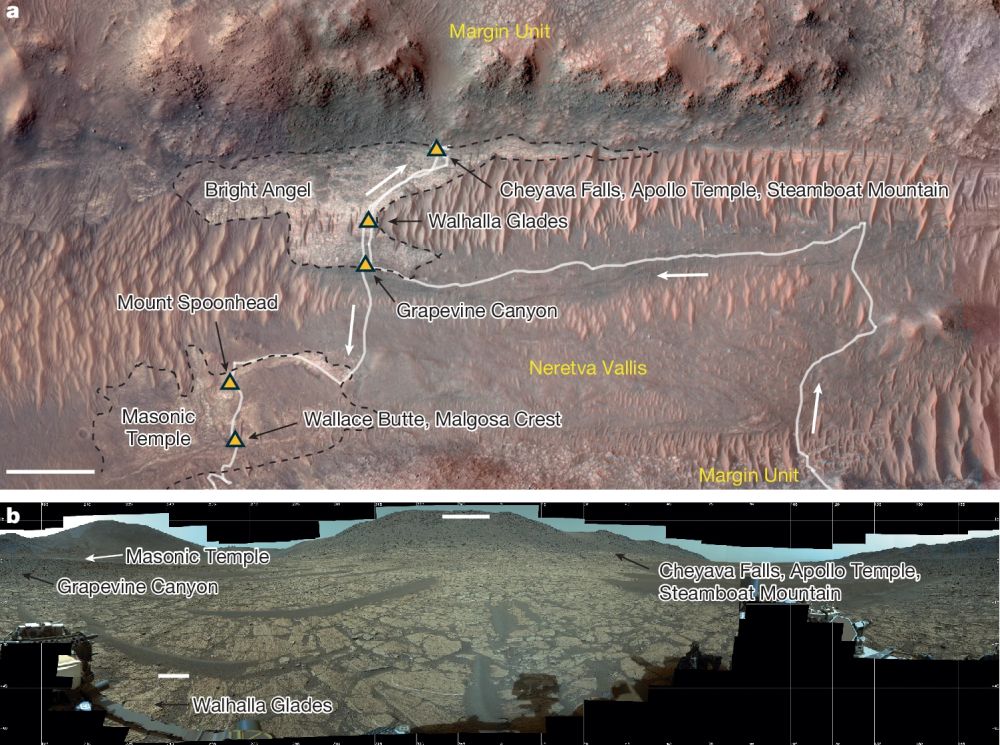
These images provide details on the route taken by Perseverance as it investigated the outflow plain in Jezero Crater in mid-2024 and highlighting the location of “Cheyava Falls” within “Bright Angel”, together with other locations investigated by the rover. Credit: NASA/JPL / ASU / MSSS
The latter is no friend to organics, as it generally forms within magma at temperatures deadly to organic material. This suggest it and the phosphates and other organic-friendly minerals within the rock may have been deposited at temperatures which would have killed off any organics present long before they could have resulted in the “leopard spots” forming, leaving the latter’s formation purely a matter of inorganic reactions.
But the matter is complicated, and for all of its capabilities, the science laboratory aboard Perseverance is limited in how much it can do. What is really required is for the samples gathered from “Cheyava Falls” to be returned to Earth and subject to far more extensive study – something which in the current political climate in the United States, isn’t going to happen in the near-term.
Considerable caution needs to be taken when discussing matters of microbial life on Mars. The planet is a highly complex environment, and while there are many indicators that it may have once been a far warmer, wetter and cosier environment which may have formed a cradle for the basics of life, that period might also have been extremely brief in terms of the Mars’ very early history. And therein lies another twist with “Cheyava Falls”; the rock appears to have formed some time after that period in the planet’s history.
Captured on July 18th, 2024 (sol 1212 of the mission) using the WATSON imager aboard the NASA rover Perseverance, this image of the rock dubbed “Cheyava Falls” show to of the large white calcium sulphate veins running across the rock, and between them bands of material whose reddish colour indicates the presence of hematite, covered in millimetre-sized light patches surrounded by a thin ring of dark material, and referred to as “leopard spots”. Similar spots can form on sedimentary terrestrial rocks and are frequently an energy source for microbes. Also annotated is one of a number of nodules of pale green olivine. Credit: NASA/JPL / MSSS
If nothing else, the likes of ALH84001 – the meteorite fragment discovered in the Allen Hills of Antarctica in 1984 and shown to have originated on Mars – encourage a lot of caution is required when it comes to trying to determine whether or not something is indicative of organic interactions having once been present on Mars.
In that particular case, the team studying the fragment in 1996 reported they may have found trace evidence of past microscopic life from Mars. Unfortunately, their findings were over-amplified by an excited press to the point where even in the face of increasingly strong evidence that what they had discovered – what appeared to be tiny fossilised microbes embedded in the rock – was actually the result of entirely inorganic processes, members of the science team involved in the ALH84001 study became increasingly adamant they had for evidence of long-dead Martian microbes. It wasn’t until around 2022 that the debate over this piece of rock was apparently settled (see: Space Sunday: pebbles, ALH84001 and a supernova).
With this in mind, an international team set out to subject the data and images gathered from “Cheyava Falls” and its immediate surroundings, referred to as “Bright Angel”, and where other samples were taken for analysis by the rover, in an attempt to try to identify the processes at work which may have resulted in the formation of the “leopard spots” and “poppy seeds”. They published their findings on September 10th, 2025 – and those findings are potentially eyebrow-raising.
An artist’s rendering of the Mars 2020 rover Perseverance exploring and studying Jerzero Crater. Credit: NASA/JPL
On Earth, all living organisms obtain energy through oxidation-reduction (redox) reactions, the transfer of electron particles from chemicals known as reductants to compounds named oxidants. An example of this is mitochondria found in animal cells which transfer electrons from glucose (a reductant) to oxygen (an oxidant). Some rock dwelling bacteria use other kinds of organic compound instead of glucose, and ferric iron instead of oxygen.
Ferric iron can be similarly reduced, resulting in water-soluble ferrous iron, which can be leached away or reacts to form new, lighter-coloured minerals, resulting in the “leopard spot” deposits very similar to those found on “Cheyava Falls”. In particular, these latter reactions can result in two iron-rich minerals, vivianite (hydrated iron phosphate) and greigite (iron sulphide). Again, on Earth the formation both of these minerals can involve organic interactions with microbes – and both vivianite and greigite appear to be present within the “Cheyava Falls” samples analysed by Perseverance.
However, as noted, above “leopard spots” – and by extension vivianite and greigite – can be formed through purely aboitic reactions. The most common means for this occurs when rock containing them is formed, due to the transfer of electrons from any organic matter (which is not necessarily living organisms) trapped in the rock to ferric iron and sulphate. But this process requires very high temperatures in order to occur – and given the age of “Cheyava Falls”, the required temperatures were unlikely to have played a role in its formation. However, the presence of living microbes in the rock could result in the spots and the phosphate and sulphide minerals found within them.
Given this, the research team focused on trying to find non-biological interactions which might produce the minerals in question – and they were unable to do so.
The combination of these minerals, which appear to have formed by electron-transfer reactions between the sediment and organic matter, is a potential fingerprint for microbial life, which would use these reactions to produce energy for growth.
– NASA statement of the mineral composition found within samples of the “Cheyava Falls” rock
So, does this mean evidence of ancient microbes having once existed on Mars? Well – not necessarily; nor do the research team suggest it is. As they note in their paper, while no entirely satisfying non-biological explanation accounts for the full suite of observations made by Perseverance, it doesn’t mean that there isn’t one; it’s just that while the rover’s on-board analysis capabilities are extensive, they are also limited. In this case, those limits prevent the kind of in-depth examination and analysis of the “Cheyava Falls” rock sample which might definitively determine whether or not microbial interaction or some currently unidentified inorganic process is responsible for the deposits.
The only way either of these options might be identified is for the samples to be returned to Earth so they can be subjected to in-depth investigation. But again, as noted, that’s unlikely to happen any time soon. A major flaw with the Mars 2020 mission has always been that the samples it gathers can only be returned by a separate Mars Sample Return (MSR) mission. This has proven hard to put together thanks to the complexities of the mission being such that its design has cycled through several iterations and suffered spiralling costs, reaching US $11 billion by 2024 – with the timescales constantly being pushed back to the period 2035-40.
The Rocket Lab Mars Sample Return mission concept would utilise three craft and require the Mars 2020 rover to deliver the samples directly to the lander / return vehicle – although the rover has already cached numerous sample tubes on the surface of Mars, possibly complicating sample selections. Credit: Rocket Lab
More recently, there have been more modest proposals put forward for the MSR mission, such as that from Peter Beck’s Rocket Lab, which offered a simplified approach to collecting the Perseverance samples in 2030/31 at a cost capped at US $4 billion. However, that is currently off the table as the entire idea of any MSR project is currently facing cancellation under the Trump Administration’s proposed cuts to NASA’s 2026 budget. Whether it remains so has yet to be seen.
Following the publication of the new “Cheyava Falls” study, NASA acting Administrator, Sean Duffy, has voiced a belief MSR could be carried out “better” and “faster” than current proposals – but failed to offer examples of how. Further, it’s not clear if his comment was a genuine desire to retrieve the Perseverance samples or bluster in response to China’s Tianwen 3 mission. Slated for launch in 2028, this is intended to obtain its own samples from Mars and return them to Earth by 2031.
New Study Complicates Search for Life on Enceladus
Enceladus, may be a small icy moon orbiting Saturn and just 500 km in diameter, but it has been the subject of intense speculation over the years as a potential location for life beyond Earth. Like Jupiter’s larger moon Europa, Enceladus has been imaged by space probes giving off plumes of water vapour through geysers, suggesting that under its icy surface it might have a liquid or semi-liquid ocean, warmed by tidal forces created by Saturn and its other moons.
These geysers have been shown to contain organic molecules, suggesting that the moon’s ocean might be habitable. However, new research presented during a planetary science conference hosted by Finland provides strong evidence for many of the organic molecules detected in the geysers are actually formed by interactions between radiation from Saturn’s magnetic field and the moon’s surface icy surface.
Specifically, a team based at Italy’s National Institute for Astrophysics recreated conditions on the surface of Enceladus in miniature using an ice chamber and freezing samples of water, carbon dioxide, methane and ammonia – all constituents found within the ice covering Enceladus – down to -253ºC. Each sample was then bombarded with high-energy “water-group ions,” the same charged particles trapped around Saturn that constantly irradiate Enceladus, with the interaction monitored using infra-red spectroscopy.
A dramatic chain of plumes sprays water ice and vapour from the south polar region of Saturn’s moon Enceladus. Credit: NASA/JPL / Space Science Institute
In all five cases, the samples outgassed carbon monoxide, cyanate, and ammonium in varying amounts. These are the exactly the same core compounds as detected within the water plumes of Enceladus as detected by NASA’s Cassini spacecraft in the early 2000s. Further, the five experiments all additionally produced more complex organics – carbamic acid, ammonium carbamate and potential amino acid precursors including methanol and ethanol, as well as molecules like acetylene, acetaldehyde and formamide – all of which were also detected in small quantities within the plumes escaping Enceladus, but which have never been recorded on the moon’s surface.
That all five samples produced broadly similar results in both basic and complex compounds can be taken as a strong indicator that the presence of those compounds within the Enceladus geysers could be as much due to the interaction of radiation from Saturn with the surface of the moon as much as anything organic that might be occurring in any ocean under the moon’s ice.
Although this doesn’t rule out the possibility that Enceladus’ ocean may be habitable, it does mean we need to be cautious in making that assumption just because of the composition of the plumes. [While] many of these products have not previously been detected on Enceladus’ surface, some have been detected in Enceladus’ plumes. This leads to questions about whether plume material is formed within the radiation-rich space environment or whether it originates in the subsurface ocean.
– Grace Richards, Enceladus study lead for EPSC-DPS2025.
The study also notes a further complication: the timescales necessary for radiation to drive these chemical reactions are comparable to how long ice remains exposed on Enceladus’ surface or in its plumes. This further blurs any ability to differentiate between any actual ocean-sourced organics with Enceladus’ plumes (if present) from those produced by the demonstrated surface-born interactions.
As with the “Cheyava Falls” rock samples, potentially the only way of really determining whether or not some of the organics in the geysers on Enceladus have a sub-surface / oceanic source is to go and collect samples. Again, this is not going to happen any time soon.
Currently, NASA has no current plans for a robotic surface mission to Enceladus; while the European Space Agency has outlined a complex mission to explore several of Saturn’s moons – Titan, Rhea, Dione, Tethys, Enceladus and Mimas, and which will release a lander vehicle to the south polar region of Enceladus in order to study the geysers and collect samples for in-situ analysis. However, if approved, this mission will not take place until the 2050s. The same goes for a three-part mission outlined by China’s Deep Space Exploration Laboratory (DSEL) to specifically map the surface of Enceladus and use a lander / robot drilling system in an attempt to drill down 5 km through the moon’s ice and directly sample the moon’s ocean at the ice-ocean boundary and seek out potential biosignatures. As such, any answers on the potential habitability (or otherwise) of any potential ocean within Enceladus are going to be a long time coming.







 Inara Pey: Living in a Modemworld