Space Sunday: a helicopter that could; a lander on its head

A NASA promotional image showing Ingenuity flying as the Mars 2020 rover Perseverance looks on. Credit: NASA

Ingenuity, the remarkable helicopter drone which forms a part of NASA’s Mars 2020 mission, has made its last flight and is now officially “retired” – and with full honours. Whilst very much an experimental vehicle, the craft achieved far more than the teams responsible for developing and building it and for operating it could ever have hoped for – and in doing to, the helicopter caught the imaginations of people around the world.

The vehicle’s remarkable history started in 2012 when the then director of NASA’s Jet Propulsion Laboratory (JPL) , Charles Elachi, met with members of the Autonomous Systems Division (ASD). They persuaded him that a concept study for aerial rover vehicles in support of surface missions on Mars had merit to the point where although NASA senior management had no interest in such a project, he used his influence to get the team sufficient funding for an initial design to be produced.

This demonstrator proved so impressive to NASA management that it was agreed the project should receive further funding to allow several engineering models to be built – even though there was still no mission on which any developed aircraft could join. It was not until March 2018, with the engineering models showing genuine promise for real flight capabilities on Mars that it was agreed that the helicopter project should go ahead – and should be flown as a part of the up-coming Mars 2020 rover mission, which was itself already at an advanced stage of development.

The imaging system mounted on Perseverance’s robot arm observes a partially-deployed Ingenuity as it sits under the rover. Two of the helicopter’s legs can be seen deployed, with the remaining tow still folded in their stow position until the helicopter is swung down from the rover’s belly. Above Ingenuity’s boxy fuselage can be seen the two sets of contra-rotating blades, with the helicopter’s solar array above them. Credit: NASA/JPL

This resulted in a crash course of design and development – from engineering demonstrator to full-blown, mission-ready vehicle in just two years, including a deployment system which would allow the helicopter to be stowed against the rover’s belly and deployed from there once on the surface of Mars.

Originally called the Mars Helicopter Scout, the inclusion of the helicopter in the Mars 2020 mission angered some in the NASA hierarchy – and within the rover team itself. Jennifer Trosper, Perseverance’s mission systems development manager and project manager stated her belief that such were the capabilities of the rover’s autonomous driving system, it would simply outpace the helicopter, rendering any idea of the latter being a useful scout moot.

To help counter such opposition, the scope of the helicopter’s mission was intentionally limited. Named Ingenuity, as suggested by (then) schoolgirl Vaneeza Rupani as a name for the rover, it was related to the role of technology demonstrator and its mission initially limited to a 30-day period at the start of Perseverance’s time on Mars in order to limit any impact on the rover’s mission in having to sit by and observe what was expected to be a maximum of five flights. Even so, opponents of the helicopter’s inclusion in the mission remained vocal in their objections.

I have personally been opposed to it because we are working very hard for efficiencies and spending 30 days working on a technology demonstration does not further those goals directly from the science point of view [this] helicopter is a distraction from the priority scientific tasks, unacceptable even for a short time.

– Mars 2020 chief scientist Kenneth Farley voicing misplaced antagonism toward Ingenuity

Ingenuity on the surface of Jezero Crater, post-deployment by Perseverance. This image was taken using the Hazcam (HAZard avoidance CAMera) system on Perseverance on Sol 43 of the mission (April 4th, 2021), at a local mean solar time of 15:14:28. It has not been white balanced for typical Earth lighting conditions. Credit: NASA/JPL

This opposition is why Ingenuity’s project lead, MiMi Aung and her little team – who initially were not even awarded space in the Mars 2020 mission control room, but had to operate out of a meeting room they converted into their own operations centre – were so determined to see Ingenuity not only fulfil its initial primary mission but to exceed all expectations, even if it meant aggressively pursuing goals and extending flight parameters to a point of putting their little craft at risk.

The first opportunity for the team to prove their vehicle came on April 19th, 2021, almost two months after the mission had arrived within Jezero Crater, and almost two weeks after Ingenuity had successfully deployed onto the planet’s surface. In the intervening period, the helicopter’s electrical system had been charged and tested, the twin sets of contra-rotating blades unlocked for their stowed position and run through a series of ground tests – some of which didn’t quite go to plan –, with a finally high-speed test of the rotors being carried out 2 days prior to the first flight, confirming the motors could safely power the blades to their required 2400 rpm.

The first flight was brief: a simple lift-off to 3 metres above ground, then an axial rotation of around 90º prior to a descent and landing – simple, that is, until you consider that Ingenuity was attempting to take flight at within an atmosphere with a density equivalent to that of Earth’s at 34,000 metres (112,000 ft) – well above the capabilities of any Earth-based rotary craft.

The remaining four test flights came rapidly thereafter, initially testing the craft’s ability to transition from a hover to horizontal flight (covering 4 metres in its second flight, then just 3 cm shy of 100 metres in its third, before smashing its planned maximum horizontal flight capability (160 m) by covering 270 metres in its fourth flight prior to a more modest 130m in the final test flight). By this time, opposition to the helicopter’s presence on the mission was rapidly thawing, and continued operations were given the green light – providing they did not impeded on Perseverance starting into it primary mission of investigation and exploration.

This mission extension period saw the helicopter move from being a technology demonstrator to being more of a general testbed aircraft which could also gradually take up the mantle of its intended role as a scout for the rover. In this capacity it gradually flew flights of both longer duration (the longest being 169.5 seconds in August 201), and greater distance (peaking at 709 metres in a single flight on April 8th, 2022). But the end of 2022, Ingenuity was largely operating in support of Perseverance, not only keeping up with the rover in defiance of Trosper’s prediction, but also actually increasing the effectiveness of the rover’s autonomous driving capabilities by providing the mission team with data which allowed them to more efficiency plan routes wherein the rover could more easily navigate for itself, reducing the punctuation of drive, stop, survey and allow the drive team to plan and upload new instructions then drive, stop, survey and allow the drive team to plan and upload new instructions, common to a lot of the rover’s initial explorations.

Whilst there were some problems encountered with flight software and concerns over motor and rotor performance in the face of slowly decline electrical power generation, overall, Ingenuity proved remarkably robust and capable of exceeding many of the parameters originally set to safeguard it. On October 2023, for example, it achieved an altitude of 24 metres (79 ft) above the ground – over double the 10-metre maximum originally envisioned as its operational ceiling – and this during a time when several flights exceeded that limit. It also withstood the ravages of Martian winter with its harsh cold weather, as well as the challenge of seasonal dust storms.

Map of the total flight path of Ingenuity (yellow), together with the ground track of the Perseverance rover (grey), between landing on Mars in 2021 (the right end of the tracks) and the helicopter’s final flight on 18 January 2024, as the pair explored the ancient river delta within Jezero Crater, Mars. Credit: NASA/JPL

Nevertheless, it was acknowledged that the longer the mission went on, the greater the risk of something happening that could unexpectedly curtail flights. And at the start of 2024, these risks were made manifest.

By this time Ingenuity was operating over what the flight team called “difficult” terrain. To explain: Ingenuity’s flights are entirely autonomous. They are planned on Earth in terms of timings, direction, altitudes, etc., together with waypoints – static ground features and rocks the helicopter can be told to identify using its navigation cameras, and use to make changes in direction or its orientation and as reference points for landing.

However, since its 68th flight, Ingenuity has been flying over terrain where such definable waypoints are few and far between. On the helicopter’s 71st flight – which took place on January 6th, 2024 – this sparseness of waypoints resulted in Ingenuity becoming confused as to where it was and where it was going, triggering automatic a landing. Unfortunately, it seems one of the rotors suffered a very slight deformation on touch-down, as revealed in post-flight images the helicopter took of its own shadow – a trick the flight team had long used to help assess Ingenuity’s status after each flight when Perseverance was too far away to provide suitable images.

As a result, it was decided that prior to continuing in its scouting mission, Ingenuity should complete a straight up-and-down hop to test the rotor systems. This took place on January 18th, 2024 and initially looked to be successful: the rotors spun up to speed, and the helicopter rose to 10 metres and then descended for a landing. However, as I reported in my previous Space Sunday update, communications abruptly cut-off when it was still around a metre off the ground, and took a little while to restore.

Once communications had been recovered, the helicopter was ordered to again image its own shadow to help in the assessment of its overall condition as the flight team went back through the flight data to try to determine what caused the communications drop-out. In one of the the returned photos, the shadow of a rotor blades clearly shows its end has suffered damage, appearing broken and buckled.

An image returned by Ingenuity after its 72nd flight included a shadow of one of its rotors, showing damage to the blade sustained on the flight. Credit: NASA/JPL

This image suggests that at some point Ingenuity ended up at an angle as it descended at the end of flight 72. Whether this was the result of the deformation in a blade seen at the end of flight 71 or has some other cause, is unknown. However, it is clear than whatever happened, it was sufficient to bring at least one blade tip in contact with the ground, even if for a fraction of a second, causing it noticeable damage.

Whether it was the sudden jolt which likely accompanied the impact which caused the drop in communications or whether there may have been a general electrical glitch which caused both the communications drop and the blade impact is currently the subject of JPL assessments of the flight data. But whatever the cause, and even if the damage is to the one blade-tip, it has put paid to Ingenuity’s ability to fly: the damaged blade will simply cause too much turbulence and vibration for the little helicopter to remain stable. Thus, the mission has been declared over and Ingenuity retired from active duty, an event marked with the release of a short video by NASA, celebrating the mission and its achievements.

And celebration is the right word. During its 32-month operational period, Ingenuity conclusively proved the viability and value of rotary drones on Mars operating in support of other missions. In doing so, it not only itself covered a horizontal distance of 17.242 km (reaching a maximum speed of 36 km/h during some flights) and clocking up a total of 2 hours 8 minutes and 55 seconds in the Martian air, it has successfully laid for foundation for future generations of automated and – come human missions to Mars – teleoperated drones on the Red Planet.

In additional to the “official” video, NASA JPL release a more personal video from some of the members of the Ingenuity team, allowing them to say some final words about the Little Helicopter That Could – And Did.

SLIM Landed… On Its “Head”

In my previous Space Sunday, as well as commenting on Ingenuity’s 72nd flight (which at the time had not been identified as terminating its flying career) I reported on Japan’s SLIM mission to the surface of the Moon, which had met with some mixed results.

As I noted in that report, SLIM – Smart Lander for Investigating Moon – had apparently successfully landed right on target to make Japan the fifth nation to have successfully landed on the Moon, but potentially incorrectly oriented for its solar array to capture sunlight and convert it into usable energy.

At the time of that article, it was unclear precisely what had happened to the lander. The telemetry received and broadcast during the livestream seemed to suggest it was upside down – which many saw as unlikely, particularly as the lander’s systems and science instruments did appear to be working. However, in the hours between touchdown and the lander being placed in a dormant mode as battery levels dropped to a critical level, some of the images returned by the lander seemed to back-up the livestream graphics portrayal that the lander was inverted.

Even so, it was not until the two tiny rovers  – LEV-1 (for “lunar excursion vehicle”) and LEV-2, released by the lander shortly before touch down – reported in that the status of the lander could be confirmed. After establishing contact with Earth with LEV-1 acting as a relay for LEV-2  (also called “Sora-Q”), the rovers returned images of their immediate surroundings before being tasked with making their way over to the lander and imaging it; and both return some remarkable shots of the lander sitting on its head, one of its descent engine nozzles pointing up into the lunar sky.
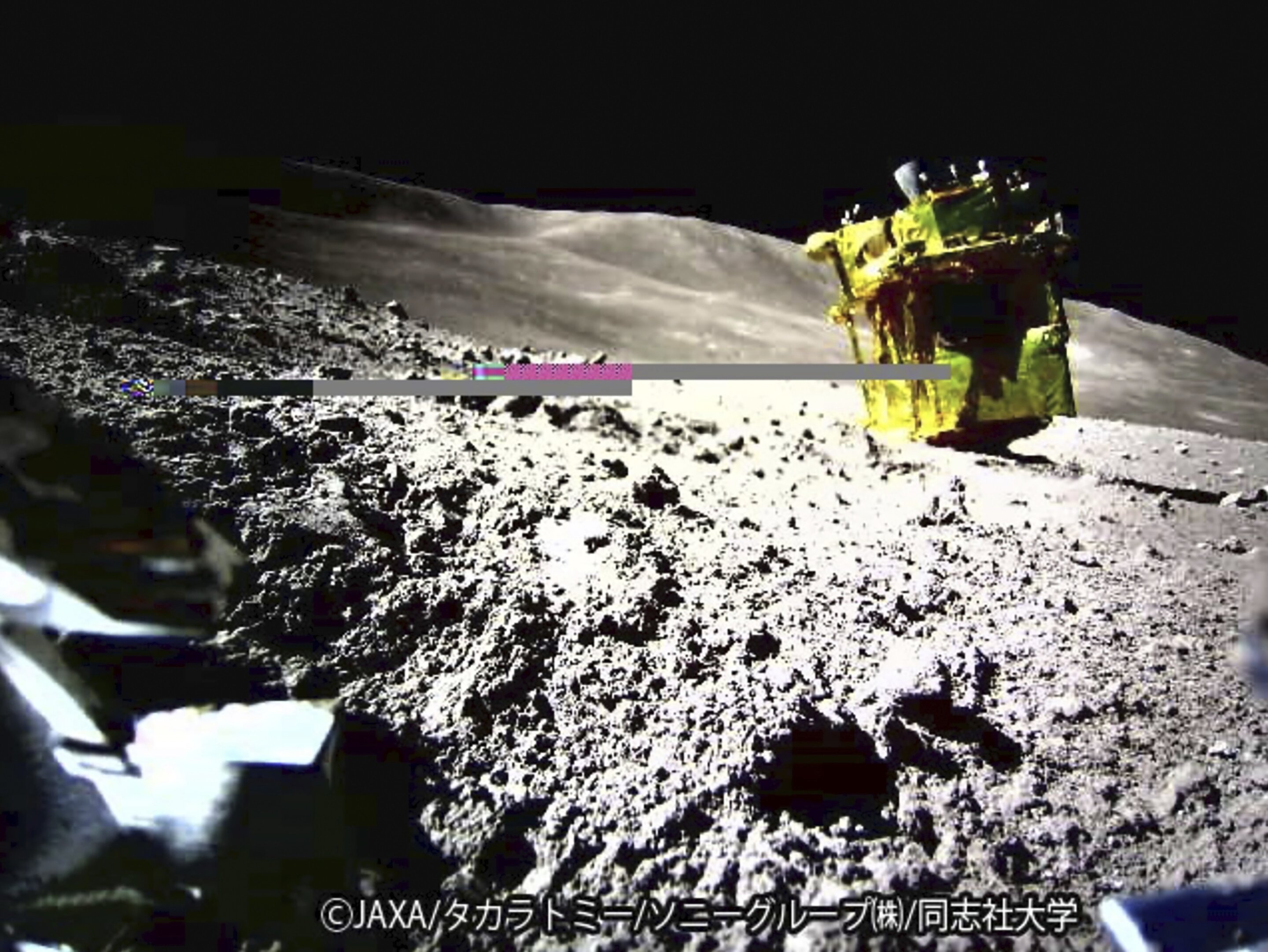
Japan Aerospace Exploration Agency (JAXA) released this image, captured by the LEV-2 mini-rover, of their SLIM lander upside down on the Moon. Credit: JAXA

It’s not clear exactly what occurred, but JAXA – the Japan Aerospace Exploration Agency – believes one of the lander’s decent engines failed during landing, causing it to touch-down harder than intended and then toppling over as a result of landing on a slope, or possibly the off-axis thrust from the remaining descent engine cause it to flip over following initial ground contact.

As I previously noted, mission operators had hoped that as the lunar day progressed, the Sun would move into a position where light would strike SLIM’s solar array and perhaps furnish it with power. The images from the LEV rovers have confirmed this is indeed possible – the array is facing west, and so will encounter sunlight the the Sun moves towards the local horizon. However, given that nightfall commences of February 1st/2nd, and the lander is not equipped to withstand the harsh night-time lunar temperatures, SLIM may only have a couple of days in which to resume gathering data, even if it can be revived. Even so, the fact that the lander has gathered and returned images and data post-landing, and its two little rovers are operational means this mission can still be counted a success.

A Bloom of Flowers of Evil in Second Life

SLEA6: Bloom: Flowers of Evil, January 2024

Lalie Sorbet invited me to visit her latest collaborative piece – working with Chrix (chrixbed) – entitled Bloom: Flowers of Evil, and which is currently open to visitors at the Second Life Endowment for the Arts. A dynamic installation built around what I understand to be a scripted particle system of their own design (and called, appropriately, Bloom), mixed with 2-dimensional elements also under scripted management.

The result is a hard-to-define but infinitely beautiful series of collages-in-motion, centred on a 3D element of standing stones and a “starfish” which looks to be an elegant star-like piece of lava. Close by is an upright piano atop which a female form reclines and with an arc of benches with singles and couples poses ranged before it, allowing people to sit and appreciate the particle display.

SLEA6: Bloom: Flowers of Evil, January 2024

The artists state that the installation is inspired by the works of French art critic, poet and essayist, Charles Baudelaire – the title being the English translation of what is regarded as his most famous volume of work, Fleur du Mal, first published in 1857. The original volume, with its focus on decadence, eroticism, sexuality, original sin and death, caused a considerable stir when it first appeared, with six of its poems leading to Baudelaire and his publisher being prosecuted for “creating an offense against public morals”, resulting in both being fined and the six “offending” poems being suppressed for several years, only appearing in volumes of their own published outside of France (as with Épaves  – The Wrecks – published in 1866 in Belgium).

However, both despite and because of the outrage it caused, Fleur de Mal not only remained in publication – less “offensive” works by Baudelaire were substituted in place of those which caused some to try and suppress the volume entirely – it became synonymous with all his works, with the title being used for successive collections which both incorporated the original poems and other works, including an edition printed in 1868 following the poet’s death at just 48 and which includes 14 of his previously unpublished poems.

SLEA6: Bloom: Flowers of Evil, January 2024

It is in this wider guise, and as a source of inspiration / reflection that Lalie and Chrix appear to utilise the title, rather than offering a more direct visual interpretation of poems from the volume (although there are what appear to be small nods towards some of the themes, here and there, for those familiar with the various sections of the volume). Baudelaire is regarded as a master of rhyme and rhythm within his prose-poetry – demonstrated by the fact that his style and work not only influenced poets down the years, but also artists and musicians, with some of the latter utilising Flowers of Evil or Fleur du Mal – and it is this aspect of his work which appears to be celebrated most directly through the ebb and flow of the piece, where particle patterns and images might be seen as poems and the stanzas therein, caught in a delicate dance of imagery.

Within Bloom: Flowers of Evil, the artists capture the essence of Baudelaire’s rhythm through the particles and images offered, whilst also reflecting the romanticism which also lay at the heart of his work. It also (possibly in part coincidentally) offers echoes of other ways in which Baudelaire’s influence has been felt; within the audio stream accompanying the installation is Sahalé’s Fleur du Mal, a piece with takes the iconic title and mixes it with the rhyme-like rhythm of Eastern and African music, whilst the presence of the piano put me in mind of Susanna Wallumrød’s Baudelaire and Piano (2019), which set several of Baudelaire’s works to music.

SLEA6: Bloom: Flowers of Evil, January 2024

Whether or not you are a follower of Baudelaire or feel compelled to seek out his works (I admit to finding some of his work “florid” (for want of a better term), although Tableaux Parisians is a captivating read, presenting both a contemporary walk through Georges-Eugène Haussmann’s renovation of Paris at the behest of Napoleon III and a critical response to its modernity, thus combining Baudelaire’s gift as a poet with his work as a critic), Bloom: Flowers of Evil stands in its own right as a visually engaging installation; just be sure to try sitting and viewing it in Mouselook, rather than purely through a 3rd-person view!

SLurl Details

Grauland’s derelict appeal in Second Life

Grauland, January 2024 – click any image for full size

It was off to Grauland for me for my first of 2024 trips to Jim Garand’s always photogenic region, which also serves at the home for his M1 Poses store (tucked neatly out of the way in the sky). The last time I visited, the region was home to a setting featuring ancient stone ruins awaiting exploration, set with a somewhat tropical environment; it’s a theme which-sort of continues with the iterated I visited in January – albeit featuring ruins of a very different kind.

For this setting Grauland presents an almost flat island; whether temperate, tropical or sub-tropical is hard to say at first glance, although there are clues to suggest the former is likely the case, rather than the latter two, and on which stand the remnants of what may have been a sizeable industrial operation.

Grauland, January 2024

Quite what that endeavour might have been is open to to imaginative interpretation; to one side of the island, old pumpjacks stand in a field of wild grass, the “nodding donkey” head of one still rising and falling as the little group comes close to resembling a drove of their four-legged namesakes grazing quietly. They suggest that oil might have been a focus of efforts here; however, two of the surviving structures suggest something else to have been the mainstay of work here.

To the west of the island, and partially build on blocky concrete stilts over the water, stands a massive elevator / silo building with eight massive silos forming two column- like rows supporting the high roof built over the great hall between them – a hall now oddly home to a grove of trees which reach from main doors to the iron stairways climbing the far wall to provide access to the upper levels of the building as they stand out over the watery shallows. An outer wall of these levels, complete with their glassless windows staring across the island and out to sea, proclaims the building to belong to Black Stripe Grain, Inc., although it is a little hard to imagine the eight massive silos being home to mere grain – so might the building’s labelling by a cunning disguise? As I said, this is a place open to imaginative interpretation!

Grauland, January 2024

A short distance from this huge elevator with its silos stands a hopper for loading bulk goods onto railcars. Again, its looks suggest it was used for something other than grain, but such has been the passage of time here, who can really tell? And it is clear that a fair amount of time has passed here.

The rail line that once proceeded out from the hopper and – one assumes – over a low-lying trellis across the waters to – well, somewhere – now lies rusting and broken. With rails no longer carried over the water but instead sloping down into it, the line is blocked by derailed boxcars and a rusting carriage which might once have carried a workforce to and from this place.

Grauland, January 2024

Contrasting the sense of human desertion present across most the island, the east side of the complex remains relatively intact, with concrete wharves still in good working order and offering berths to a large boat – perhaps a trawler pressed into other duties – which appears to be in good working order, and a smaller cabin cruiser to which time has been less kind.

But again, while the wharves remain relatively pristine compared to the rest of the island thus far described, the same cannot be said of the warehouse / factory built alongside them. With one side either collapsed or ripped open, it is in a sorry state, now apparently the haunt of graffiti artists visiting the island, whilst the intact section its upper floor reveal it to have once been a literal body shop or sorts, the sad remains of its produce scattered on decaying pallets, sitting in aging crates or hanging from rusting irons.

Grauland, January 2024

Elsewhere there is yet more evidence of past use and hints that further buildings once stood here whilst the workers at least enjoyed some amenities. For example a single, lonely bus sits out on the dirt, its paintwork slowly fading in the sunlight or being slowly corroded by rust. It’s presence suggests it once spared workers the drudgery of walking too and from the rail carriage(s) which may have once brought them here.

But civilisation has not entirely deserted this place. As noted above, the old factory has obviously has the attention of street artists, whilst between the towering “granary” and the factory sits a concrete-side tank. although it might be surrounded by iron railings which may have once suggested it to be a place of potential harm and has machinery alongside it which dips the snout of a pipe into it, the waters within it are clear and blue enough to encourage whoever visits to turn it into an outdoor swimming pool, regardless of its former use. Several places to sit have also been established around the island, further suggesting it receives frequent visitors, something backed-up by the RHIB drawn on up one shore, a picnic basket and blanket close by.

Grauland, January 2024

Desolate yet remaining strong hints of life, carrying a sense of mystery among its deserted buildings, this iteration of Grauland has much to say about itself whilst at the same time holding back enough of its history to set the imagination wandering as much as feet might wander through its structures and open spaces.

SLurl Details

2024 SL SUG meetings week #4 summary

Aurelias, December 2023 – blog post †

The following notes were taken from the Tuesday, January 23rd, 2024 Simulator User Group (SUG) meeting. They form a summary of the items discussed, and are not intended to be a full transcript. A video of the meeting is embedded at the end of this summary, my thanks as always to Pantera for recording the meeting and providing it.

Meeting Overview

  • The Simulator User Group (also referred to by its older name of Server User Group) exists to provide an opportunity for discussion about simulator technology, bugs, and feature ideas.
  • These meetings are conducted (as a rule):
  • They are open to anyone with a concern / interest in the above topics, and form one of a series of regular / semi-regular User Group meetings conducted by Linden Lab.
  • Dates and times of all current meetings can be found on the Second Life Public Calendar, and descriptions of meetings are defined on the SL wiki.

Simulator Deployments

  • No SLS Main channel deployment on Tuesday, January 23rd, 2024; the simhosts were all just restarted.
  • Wednesday, January 24th should see a further attempt to deploy the Falls Colours simulator update (which includes a fix for collision sounds reverberating; llRezObjectWithParams, llListFindListNext and llGetNotecardLineSync.
    • The week #3 attempt to deploy the Fall Colours RC simulator had to be rolled back after it was discovered Debian had accidentally included a bug with the version of the OS used to package the simulator release. It is hoped this will be corrected in order for the simulator update to be deployed on January 24th.
  • Assuming Fall Colours is successfully deployed, week #5 (commencing Monday, January 29th, 2024) should see it promoted to the Main SLS channel and the Gingerbread RC release reach at least some of the RC channels.

Viewer Updates

No changes at the start of the week, leaving the list of official viewers as:

  • Release viewer: version 7.1.2.7215179142, formerly the glTF PBR Materials Maintenance RC, issued December 15, promoted January 8, 2024 – numerous bug fixes and improvements – No Change.
  • Release channel cohorts (please see my notes on manually installing RC viewer versions if you wish to install any release candidate(s) yourself).
    • Emoji RC viewer, version 7.1.3.7453691714, January 22, 2024.
    • glTF PBR Materials Maintenance-2 RC viewer, version 7.1.3.7467259489, issued January 12, 2024.
    • Maintenance-W RC viewer, version 7.1.3.7453541295, January 9, 2024 – bug and crash fixes.
    • Maintenance X RC, version 7.1.1.7088410646, December 7 – usability improvements.
    • Maintenance Y RC, version 6.6.17.6935642049, issued November 21 – My Outfits folder improvements; ability to remove entries from landmark history.
  • Project viewers:

Jira End-of-Road – Reminder

Combat Committee User Group

  • Rider Linden has received the green light to establish this meeting to discuss combat simulation in Second Life, and ways / means to improve what is currently available.
  • The venue / time / frequency of meetings will be announced at the next SUG meeting.

Game Control Update

  • A reminder that the game_control event for using game controllers has been removed from the Gingerbread maintenance RC to become its own branch / channel (currently on Aditi (the Beta grid), where it can be found on the regions LeviathanLove and LeviathanLost.

In Brief

  • In is hoped that work on improving vehicle interactions with parcel ban lines (e.g. stopping them hitting ban lines and getting stuck by having them bounce back) will hopefully be implemented later in 2024. Several Lindens are interested in poking at this.
  • The above led to an extended conversation on security systems in general – notably those which are intentionally aggressive / used to override ban line limitations (e.g. by preventing overflight of parcels on the Mainland well above the upper limit of ban lines). This conversation touched on:
    • The tension between people’s right to privacy vs. the natural expectations that when flying over a contiguous world, a freedom of passage should be allowed.
    • Requests that some form of minimum delay (e.g. 15 secs) be enforced on security systems to prevent unnecessary 0 sec ejection / teleporting those who are innocently passing by a protected parcel.
    • Providing some means for information on orbs / ban lines / private(/restricted) parcel being passed to the viewer (e.g. to be display on the Mini-Map for the former, and / or UI icon to be displayed when passing over restricted  / private parcels with an active security.
    • Please refer to the video below for more on this.

† The header images included in these summaries are not intended to represent anything discussed at the meetings; they are simply here to avoid a repeated image of a rooftop of people every week. They are taken from my list of region visits, with a link to the post for those interested.

Susann’s Impressions of Second Life

NovaOwl Community Centre & Gallery, January 2024: Susann DeCuir

Open through until late February 2024 within the ground-level main gallery at NovaOwl Community Centre & Gallery operated by ULi Jansma, Ceakay Ballyhoo & Owl Dragonash, is a small but engaging exhibition of images by fellow blogger and Second Life traveller, Susann DeCuir.

Entitled Nature and Animal Impressions from Second Life, this is a modest display of pieces with – as the name suggests – a focus on animals (particularly our feathered friends!) and landscapes. Taken at various locations around Second Life, they images serve to both illustrate Susann’s enthusiasm for the many faces of this digital realm and her richly engaging style of photography.

NovaOwl Community Centre & Gallery, January 2024: Susann DeCuir

It also, if I might say so, provides insight into Susann’s humour and philosophy on life. The former might be found in the captions provided for some of the works, with Attention, this morning… carrying a hint of a Jets and Sharks confrontation to the point where you can almost hear Bernstein’s music in the background, and Owls Tribunal with its quintet of owls sitting atop fence posts like judges at the bench considering Issues Of Import.

The latter – Susann’s outline on life, might be most clearly glimpsed within Don’t Cry Because It’s Over, Smile Because It Happened; a valid philosophy for looking on life, loss and love.

NovaOwl Community Centre & Gallery, January 2024: Susann DeCuir

What I particularly appreciate about Susann’s work is her approach and style. Not only does she have an eye for capturing a scene and an theme or idea, she has a deft approach to processing her images, as she notes herself.

I only use one program for the Second Life photos, the free version of Fotojet. I use it to put the motif in the right light by using some minor effects. Apart from that, everything is shown in its original form as created by the sim designer. I pay particular attention to the fact that I use the region’s own EEP.

– Susann DeCuir

This results in images which are both personal in the message they may carry whilst also giving a richness of depth to her impressions of the places she has visited without betraying the creator’s original intent. All of which makes this a genuinely treat of an exhibition; my only regret with it is that there are not more pieces on display to enjoy!

NovaOwl Community Centre & Gallery, January 2024: Susann DeCuir

SLurl Details

  • NovaOwl (Novatron, rated General)

2024 SL viewer release summaries week #3

Logos representative only and should not be seen as an endorsement / preference / recommendation

Updates from the week through to Sunday, January 21st, 2024

This summary is generally published every Monday, and is a list of SL viewer / client releases (official and TPV) made during the previous week. When reading it, please note:

  • It is based on my Current Viewer Releases Page, a list of all Second Life viewers and clients that are in popular use (and of which I am aware), and which are recognised as adhering to the TPV Policy. This page includes comprehensive links to download pages, blog notes, release notes, etc., as well as links to any / all reviews of specific viewers / clients made within this blog.
  • By its nature, this summary presented here will always be in arrears, please refer to the Current Viewer Release Page for more up-to-date information.
  • Note that for purposes of length, TPV test viewers, preview / beta viewers / nightly builds are generally not recorded in these summaries.

Official LL Viewers

  • Release viewer: version 7.1.2.7215179142, formerly the glTF PBR Materials Maintenance RC, issued December 15, promoted January 8th, 2024 – numerous bug fixes and improvements – NEW.
  • Release channel cohorts (please see my notes on manually installing RC viewer versions if you wish to install any release candidate(s) yourself).
  • Project viewers:
    • No updates.

LL Viewer Resources

Third-party Viewers

V6-style

  • Black Dragon for Windows updated to version 5.0.4 (PBR) on January 16th, 2024 – release notes.

V1-style

  • Cool VL viewer updated to 1.32.0.6 (PBR), January 20th, 2024 – release notes.

Mobile / Other Clients

  • No updates.

Additional TPV Resources

Related Links
