The following notes were taken from the Tuesday, June 20th Simulator User Group (SUG) meeting. They form a summary of the items discussed and is not intended to be a full transcript. A video of the entire meeting is embedded at the end of the article for those wishing to review the meeting in full – my thanks to Pantera for recording it.
Meeting Overview
The Simulator User Group (also referred to by its older name of Server User Group) exists to provide an opportunity for discussion about simulator technology, bugs, and feature ideas.
They are open to anyone with a concern / interest in the above topics, and form one of a series of regular / semi-regular User Group meetings conducted by Linden Lab.
Dates and times of all current meetings can be found on the Second Life Public Calendar, and descriptions of meetings are defined on the SL wiki.
Server Deployments
There was no deployment on the SLS Main channel on Tuesday, June 20th. However, the simhosts were restarted.
On Wednesday, June 21st, the RC release deployed to the BlueSteel channel will be deployed to the rest of the RC simhosts. This release includes:
The “bot detection” update (i.e. AGENT_AUTOMATED constant for llGetAgentInfo() – so only detects if that flag is set, not if an agent is a bot or not.
The second part of the LSD rezzing fix + lLinksetDataDeleteFound and llLinksetDataCountFound, among other things.
Viewer Updates
No changes to the crop of official viewers for the start of the week, leaving the available list as:
Release viewer: Maintenance S RC viewer, version 6.6.12.579987, dated May 11, promoted May 16.
Maintenance T RC viewer, version 6.6.13.580419, June 7.
glTF / PBR Materials viewer, version 7.0.0.580330, May 25.
Project viewers:
Emoji project viewer, version 6.6.13.580279, May 30.
Puppetry project viewer, version 6.6.12.579958, May 11.
In Brief
This was a solstice party week, so not a lot of technical discussion.
Depending on who was speaking, vehicle-based region crossings either appear to have improved for some reason, or at exactly the same.
There is a bug with the automated Map refresh / clearing which can result in regions removed from the grid being removed from the Map. Anyone noticing this is asked to raised a support ticket requesting the Map be updated.
The Lab is playing with an experimental capability for adding labelling to the Map – some of this was shown by Alexa Linden some time ago, but the experiments at the Lab are continuing, although it is not clear if any of this work will result in anything user-facing, as currently the overlay is effectively a replacement for the actual Map tile, hence why the examples below are on “empty” parts of the the Map.
The latest in LL’s experiments with Map overlays
llLinksetDataDeleteFound and llLinksetDataCountFound are awaiting documentation, but are now integrated into the next maintenance simulator.
A semi-entertaining discussion on Babylon 5 and Star Trek – who would’ve said Rider Linden is a B5 fan?! All I’ll say is not Zathras – because no-one ever listens to Zathras. Zathras, however, probably did say so. Even if only to Zathras.‡.
† The header images included in these summaries are not intended to represent anything discussed at the meetings; they are simply here to avoid a repeated image of a rooftop of people every week. They are taken from my list of region visits, with a link to the post for those interested.
‡ No, I’m not going to explain that further. Watch Babylon 5 and find out. You won’t regret it 🙂 .
Of course, such partnership between the Lab and external entities are not new; nor, it is not unfair to say, have they perhaps been the most successful of ventures, as might be said to be the case with Film Threat and Zenescope Entertainment Inc (see: The Zenescope Metaverse in Second Life), and it is more than likely that this announcement will cause some rolling of eyes / raising of eyebrows in an “oh no, not again” style of reaction. However, this time, it is actually different, for a reason I’d like to focus on here and which I’ll get to in a moment.
At first glance, the Motown Experience might appear to be along the same lines of the likes of Zenescope – it is offered as a themed region, in this case intended to evoke Detroit and the home of Motown music, and is designed with music events in mind, hosted by a pair of venues, one indoor and the other out on the streets. Within this setting and through the involvement of STYNGR, Second Life residents and visitors to the platform can explore Motown’s rich music and roster of alumni, the music being provided through STYNGER’s unique expertise in licensing and right management and their ability to generate and provide curated playlists of music for stream into platforms and games.
STYNGR is the gaming arm of the recorded music industry, collaborating across all major labels and publishers to give you access to music and artists. With the largest catalogue of music in the gaming ecosystem, STYNGR partners with you to increase engagement, LTV, and visibility for your platform.
– from the STYNGR website
The Motown Experience HUD includes (l) small and hard-to-read instructions on enabling media for both the official viewer and firestorm; (c) the current track on the current playlist; (r) a list of available tracks, accesses by a small button sitting alongside the play/pause and skip buttons at the bottom of the HUD. Speaking personally, I found the HUD slow to respond (before the region even got busy), with the buttons frequently require 2-3 clicks
This is done via a dedicated Motown Records radio station, curated by Motown and STYNGR, and which can be accessed through an auto-attaching HUD (above), which provides access to the various streams the station provides (at the time of my visit, 5 were on offer, per the above images). These tracks can be accessed via a dialogue box triggered by clicking on a HUD button, with buttons also being provided to start / stop / skip tracks during media playback. In addition, visitors can obtain “Styngs”, which might be described as a “digital badge” that can be attached to an avatar and plays snippets of their favourite Motown songs, and the region will be host to various events and activities.
All of which, admittedly, sounds like standard “partnership” fare; so what’s so special here? The clue is in taking a look at the map and / or camming around when in the region.
The Motown Experience sits within a nine-region estate built out as a comprehensive Welcome Hub that will in the new future be opened as a Community Gateway to receive incoming new users signing-up to Second Life. As such, it is designed to address what many people have felt has been missing from SL: a fairly engaging environment where incoming users can not only learn about the platform, the viewer and find out how to do the basics – they can actually get involved in activities and (allowing for the popularity of the Motown Experience as a music venue) actually get to meet other users and have some pleasant fun with them.
The Second Life Welcome Centre sitting adjacent to the Motown Experience
The heart of this hub – which is staffed by people signing-up to the recently announced new Second Life Mentors programme – is the Welcome Centre, where incoming new users will arrive, once the gateway aspect of the Hub is officially opened. This follows lines similar to the Welcome Island I first looked at in 2021 (see: Poking at the new Welcome Islands) and more recently, the BelliHub (see: A look at the new Belli Rub – I mean BelliHub – in Second Life), albeit with its own unique look and feel, which might be defined as semi-sci-fi. Here, as well as as taking lessons either directly or through Second Life Academy videos (isn’t that Second Life University elsewhere?), it s possible to try a game of bumper boats, or try taking to the air in little “robot-driven” flying cars.
Bridges from the Welcome Centre connect variously with the Motown Experience, a sandbox region (allowing visitors to discover the magic of prim-rezzing and banging them together), a sampling of Linden Homes (with open rezzers so the different styles of the available themes can be seen) a shopping district presenting something of a cross-section of content for sale from various creators (no idea how they were selected), and three games areas.
The Welcome Hub includes a Linden Homes region where many of the Linden Home themes currently available can be viewed, with the rezzers open to allowing visitors view the styles of home within a theme
The first of these is innocent enough, presenting an opportunity for people to dip a toe into combat-style gaming via a game of laser tag. This can be reached on foot directly from the Motown Experience region, or via the Shopping region. The remaining two games settings take the form of a Skill Gaming region tucked into one corner of the hub, and a copy of the (still) controversial Lab-developed “social casino” (which I still have yet to actually blog about, as my original piece lapsed into the realm of “meh-dom”). The latter met with (not entirely unjustified) negativity in the forums when the first one opened, and I admit I still cannot get my head around why it ever came to be seen as a good idea.
The Skill Gaming region – reached via either the Linden Homes region or the shopping region – I can understand; it may not everyone’s cup of tea (including me), but Skill Gaming is popular in Second Life. True, I’d rather see the space used as a broader show of what can take place in SL, but that’s a personal opinion. And that said, one thing that is showcased within the hub and via the cinema occupying its ninth region, is the potential for Second Life for producing quality machinima. For the opening, the cinema appears to be showing Waarheid, but I assume other films by residents will also be shown; although that said, I’d certainly not be averse to sitting down and watching “the truly fictious story of the battle of Dirty Hill” – We Were Moles!
The Welcome Hub cinema
Taken as a whole, this approach to providing a comprehensive hub environment with an active experience does represent a new take on a gateway experience for Second Life, and something that is going to be iterated upon and broadened through a rather of partnerships, as Brett Linden, the Lab’s VP of Marketing noted to me.
What you see now is our first test version [of] a new welcome hub we are testing. It hasn’t fully been turned on yet to newcomers (and [it] will be tested along with other community gateways), and but we expect to iterate and partner more with the community (and occasionally outside partners) for future iterations. We’ll be tracking things here closely and play-testing with newcomers to see what works and/or needs improvement for version 2.
Brett Linden, June 20th, in conversation
Given this launch, it is likely the new Hub and experience will be subject on comments and feedback during the upcoming SL20B Lab Gab sessions (of which more in an upcoming post), particularly given new user acquisition is a focus for the Marketing Team under Brett, and he and StyFy Linden from the team are featured in one of the upcoming shows sessions.
More broadly, this expanded tyle of Gateway / welcome facility for incoming new users does seek to address many of the critiques directed towards the on-boarding process: it is staffed by mentors who can provide a personal level of assistance; it covers the “first five (or fifteen) minutes” of in-world experience whilst offering a good opportunity to get to grips with the viewer and discover more about what Second Life is about; there is the opportunity to explore more broadly via the teleport portals (or should than be canons?!); there are local shopping and gaming opportunities; and – most importantly, and assuming the Motown Experience succeeds as a music venue / attraction for existing users as a well as new users – it presents the opportunity to meet people. In this, it might be suggested that how well it succeeds in helping incoming users to “stick”, once the gateway is open to incoming new users, is going to be down to how open, friendly and welcoming the established users visiting the Experience and its surrounding Hub are towards those newbies.
Certainly, I enjoyed my afternoon exploring the Hub regions – and my thanks, as ever, to Brett for his time in talking through aspects of the hub with me , and I will endeavour to keep tabs on what is happening with it over the next month or two; if not directly in relation to the Motown Experience, then certainly with the Welcome Hub as a whole.
Ice particles, with just a trace of phosphates, venting from near Enceladus’s south pole, as imaged by Cassini in 2010. Credit: NASA/JPL-Caltech/Space Science Institute
Even as Europe’s Jupiter Icy Moons Explorer (Juice) is commencing its long trek to the Jovian system in order to study Ganymede, Callisto, and Europa, three of Jupiter’s Galilean moons, more is being learned about Europa and its far more distant “cousin”, Enceladus, as the latter orbits Saturn.
In the case of Europa, the findings of a new study suggest that it may have formed somewhat differently than has long been thought, and that it may actually be less subject to deep heating and volcanism that has been thought – potentially decreasing the chances for it to harbour subsurface oceans and possible life.
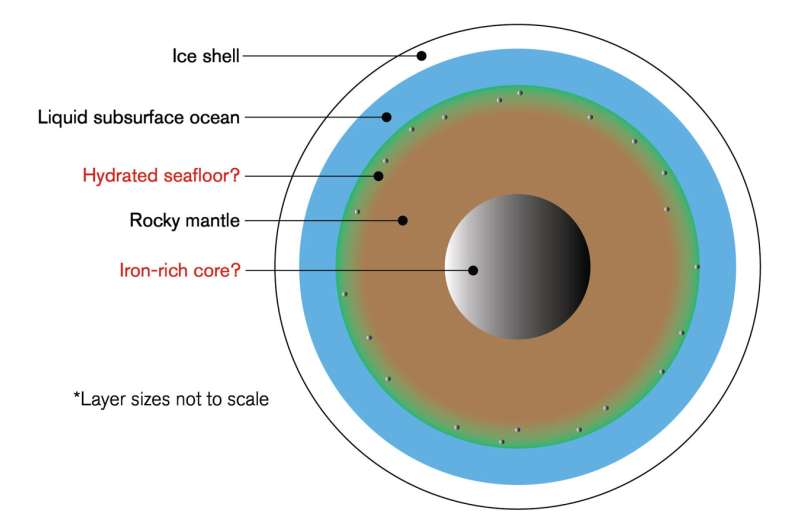
As has been mentioned numerous times in this column, Europa is of fascination because it is covered in an icy shell which appears to cover a liquid water ocean, churning over a rocky mantle and kept liquid due to a combination of internal heat radiating out from the Moon’s molten core and the gravitational “push/pull” inflicted on it by both Jupiter and other three Galilean moons, which give rise to heating through subsea volcanism and hydrothermal vents (which might also pump the ocean full of biologically useful molecules).
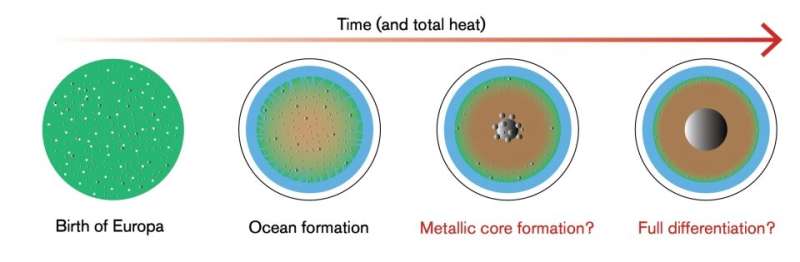
However, Kevin Trinh, a planetary scientist at Arizona State University (ASU), and his follow researchers suggest that Europa may have formed a lot slower than previously assumed, and somewhat differently to how it is generally assumed planets and small moons form, and that even now, it may not have a fully-formed core – possibly a result of its distance from the Sun.
Internal evolution of Europa. Credit: Kevin Trinh/ASU
The accepted theory for the formation of solid planets and moons is that as they coalesced out of ice, dirty, rocks, etc., and were compressed under increasing gravity – assisted by the Sun’s heat – underwent melting, the heavier filling into the centre of the planet / moon to form the core, with the “middleweight” rocks forming a semi-liquid, hot mantle, and the outermost becoming the brittle crust.
But given its size and distance from the Sun, Europa may never have reached the stage of the heaviest elements separating out of its mantle to for the core – or that it is still going through the process, but at a much slower rate and assisted by the gravitational flexing imposed on it by the other large Jovian moons and Jupiter itself.
This doesn’t mean the moon doesn’t have an ocean – Trinh and his colleagues believe the evidence for the ocean is too great to deny –, but rather its formation was different to previously thought, and may have been the result of a metamorphic process, which continues to power it today. In short, the rocks of the mantle were naturally hydrated (that is, contain water and oxygen), as the interior heat increased, it caused the water and oxygen to be released, forming the ocean and its icy shell.
For most worlds in the solar system we tend to think of their internal structure as being set shortly after they finish forming. This work is very exciting because it reframes Europa as a world whose interior has been slowly evolving over its whole lifetime. This opens doors for future research to understand how these changes might be observed in the Europa we see today.
– Carver Bierson, ASU’s School Of Earth and Space Exploration.
Just how far along the formation of a core might be, assuming this ASU study is correct, is an unknown. The study suggests that the core started to form billions of years after Europa’s formation, and that full differentiation has yet to occur.
Credit: Arizona State University
If the theory is correct, it has some significant implications for Europa as a possible abode of life. As noted above, the traditional view is that the moon has had a hot, molten core which could, thanks to the gravitational flexing by Jupiter and the other large Jovian moons, power subsea volcanism and venting sufficient to create hotspots of life in the ocean depths. Without such a fully-formed core, however, it is unlikely that such is the case. But this does not mean that Europa is necessarily lifeless.
It could be that the heat within the rocky mantle – again driven by gravitational flexing – could lead to a more uniform heating of the sea floor, allowing for life to be more widespread around Europa and feeding on the minerals and chemicals released by the hydration process. However, the flipside to this is that such heating could equally leave much – if not all – of the ocean little more than an icy slush, either limiting any life to a very narrow band of heated water very close to the sea floor, or frozen out in the slush.
In the meantime, while Enceladus is even further from the Sun and a lot smaller than Europa – but the evidence for it having a subsurface ocean is more compelling. The southern polar area has long been subject to out gassing material into space – material which is known to be contributing to the growth of Saturn’s E-ring.
The out gassing was first imaged by NASA’s Voyager 2 vehicle in the 1980s and again by the joint European-NASA Cassini mission, which saw the Cassini spacecraft actually pass through some of the plume of material several times, confirming the presence of water vapour and other minerals, all of which are almost contributing to the tiny moon having a very tenuous atmosphere.
A sequence of images of Saturn’s moon Enceladus taken by the Cassini mission. Image credit: NASA/JPL-Caltech/Space Science Institute
Data on the plumes gathered by Cassini have been the subject of extensive studies since they were gathered, revealing that do contain very simple organic molecules and even molecular hydrogen and silica. All of this indicates that chemical reactions between water and warm rock are occurring on the seafloor under Enceladus’ ocean, most likely around hydrothermal vents.
For the last 5 years, a team of scientists at Freie Universität Berlin, have been studying data from a number of sources – Cassini and Earth-based observations – relating to the materials found within Saturn’s E-ring, which, as noted, is at least in part made up of material ejected from Enceladus in an attempt to both better understand the composition of the ring and its relationship with material coming from the moon. What they’ve found has come as a surprise to many planetary scientists: phosphorus.
The importance here is that phosphorus is the rarest of six elements which life here on Earth utilises in various forms – such as combining it with sugars to form a skeleton to DNA molecules and also helps repair and maintain cell membranes. What’s more, the concentrations of the mineral within the plumes are about 500 times greater than the highest known concentrations in Earth’s oceans. While the phosphorus has been detected within Saturn’s E-ring rather than within the plumes rising from Enceladus, its discovery nevertheless is seen as offering “the strictest requirement of habitability” within the moon’s ocean, given that Enceladus is blasting material into the E-ring at the rate of 360 litres per second.
An image of Saturn’s moon Enceladus taken by NASA’s Cassini spacecraft. Image credit: NASA/JPL-Caltech
A 2018 study involving Enceladus’s ocean and the likely minerals in might contain had drawn the conclusion that any phosphorus concentrations on the moon would have been depleted in the moon’s oceans a long time ago, and thus unavailable for potential life. However, in reviewing the new findings, the team behind the 2018 study have stated their findings have now been overturned.
In particular, the Freie team also identified the presence of orthophosphate within the phosphates of the E-ring. This is the only form of phosphorus that living organisms can absorb and use as a source of growth. This suggests that not only are phosphates “readily available” in Enceladus’ oceans, it is in forms simple life can make use off to help in its development. Coupled with the fact that the oceans of Enceladus are likely warm and rich in a broad range of minerals and chemical elements, further raises the potential for the moon to harbour microbial life. This had already led to renewed calls for a dedicated mission to the little moon for a more direct investigation.
Briarwood Wildlife Refuge, June 2023 – click any image for full size
Briarwood Estates is an all inclusive, family role-play community and luxury residential estate. The work of Frankie Jade LaFoxx (Frankie Foxpaws) and her team, the estate covers multiple regions and offers a wide range of amenities and facilities for local residents and for visitors. These include a equestrian hub with horseback riding trails, a hotel and spa, farming, games, a marina and boating, shopping, live music, and more.
One of the more public elements within the estate is the Briarwood Wildlife Refuge which has recently been featured in the Destination Guide. Located on a homestead region, the refuge is linking to several of the surrounding regions via footbridges. Perhaps most notable among these for incoming visitors is the main information (and event?) centre, sitting to the east of the refuge. This presents a model of the estate in which available rentals are highlighted, as well as showing the public routes through all of the regions, with the walls presenting event schedule boards and general information for both visitors and residents, and which does much to present a picture of a well-run estate.
Briarwood Wildlife Refuge, June 2023
The refuge proper starts across the bridge from the information centre, and carries the following description:
Briarwood Wildlife Refuge is a wildlife refuge within SL. It is one of the first wildlife refuges operated by Briarwood Estates. The refuge protects more than 14 acres of marshes, grasslands, and woodlands.
Bounded by a sandy-shingle beach and open waters, the refuge is also cut through with watery channels that have the feel of being both human-made and more natural inlets, steams and a large pond. Together, this break up the landscape in such a way to suggest a natural location curated by human hands and eyes in order to offer the best environment for the wildlife and animals within the refuge.
Briarwood Wildlife Refuge, June 2023
The majority of the landscape is low-lying, suggestive of the wetlands of the description, with cart tracks offering various routes through and around the grasses and up into the few hills which also help to break-up the landscape. Most of the refuge is fairly open, the trees numerous enough to line the trails and tracks and provide shade, but not so numerous they overwhelm the park.
Most of this landscape is given over to the local wildlife, although there is also a meadow bounded by dry stone walls to one side, it and the barn within it home to sheep and goats. A second meadow, this one bounded by a fence and water, can be found across the grasslands, the home of a mare and her foal, the stables here suggesting more horses might also call it home – or they might equally be home to the donkeys wandering a little further away, but still within the boundary marked by the white fencing.
Briarwood Wildlife Refuge, June 2023
The local wildlife includes bears, deer, foxes and waterfowl, and is spread fairly broadly across the refuge as one might expect, offering opportunities for photography and discovery. The trails offer an excellent means to explore the setting, but if you have a wearable horse, they also offer the means to enjoy a little riding whilst exploring.
Considerable care has gone into presenting Briarwood Wildlife Refuge as a wholly natural environment, perhaps most notably in the time spent blending the mesh forms of the rutted tracks into the terrain. This is something which if not done properly, can lead to jarring results when gaps or holes are spotted or the texturing of the mesh does not match that of its surrounds. Here, however, the blending is a tour de force in how to do things properly to the point of near-perfection (aided by the inclusion of terrain textures in Alex Bader’s landscaping kits, allowing them to be applied to terrain), and does much to add to the expressive gentleness of the refuge.
Briarwood Wildlife Refuge, June 2023
The main exits from the refuge link to Briarwood Village to the west, which appears to have public access, allowing visitors to extend their explorations, and Briarwood Oaks to the south. The latter link takes the form of a cut stone, paved bridge spanning the water channel between the two regions. However, as this bridge is gated at either end and the gates are apparently locked against public access, I assume Briarwood Oaks is for local residents only, and their privacy should be respected, rather than attempts made to cross the bridge and go a-wandering among the houses.
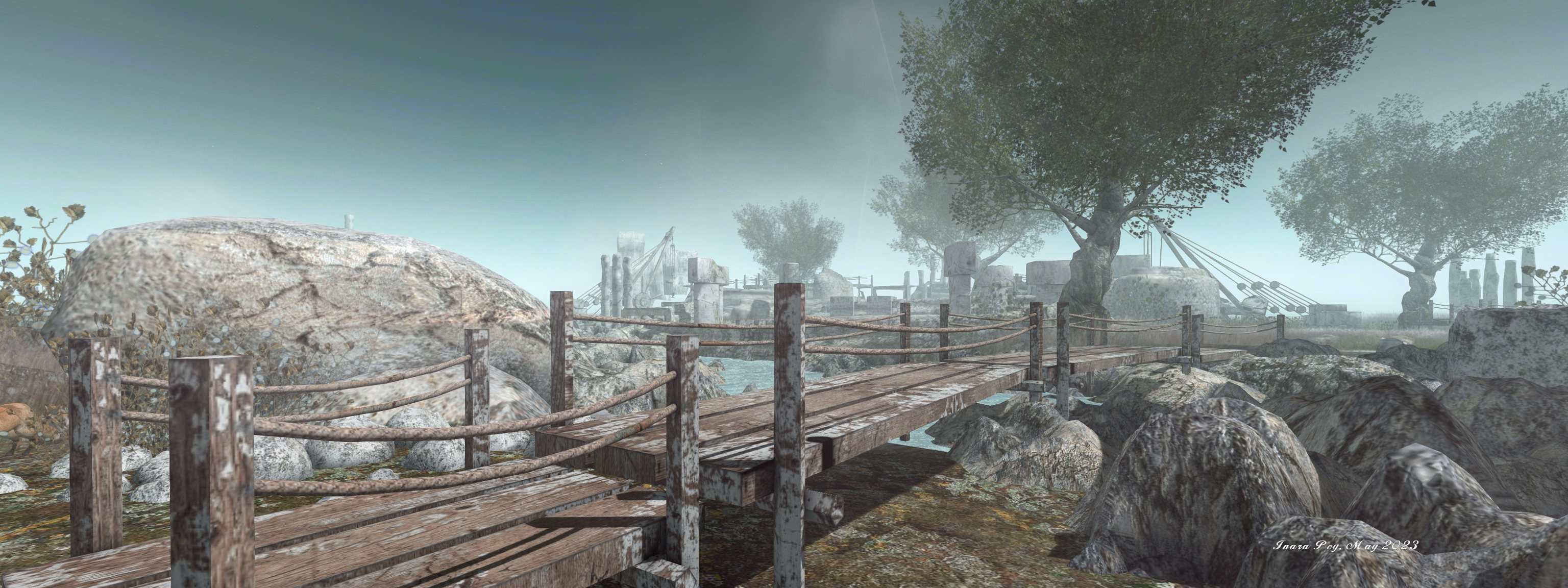
True, the weather within the refuge is a little rainy – but again, this is in keeping with the overall tone of the setting, and it offers its own opportunities for photography whilst also working across a range of EEP settings for those who would like to de-emphasise the rain – as I hope the images in this article show.
Briarwood Wildlife Refuge, June 2023
Overall, a very engaging and photogenic setting in which to explore and take photos.
The 2023 Second Life Hair Fair is currently open, and runs through until Sunday, July 2nd, 2023. As with previous years, is being run to raise money for Wigs for Kids, with every purchase seeing a percentage donated to the cause, with the Bandana booths and Donation kiosks donating 100% of all proceeds received.
As with recent years, the event takes place across six regions, appropriately called Foils, Brunette, Streaks, Noirette, Redhead and Blonde, laid out in a block of six, with Foils, Brunette and Streaks to the north and Noirette, Redhead and Blonde to the south, separated by an intervening stream. The landing zones for the regions form decks spaced along both banks of the stream, both helping to lighten the load of arriving avatars and providing vantage points from which those (such as myself) who prefer to do so, can cam-shop without necessarily having to wander the stores.
As is usual for Hair Fair, the shopping regions are wisely lightly decorated in order to minimise viewer-side lag that might otherwise be created by having a significant amount of extra object and texture rendering. For those who enjoy perusing stores directly, the broad boardwalks ensure there is little chance of bumping into others, whilst those who might tire of walking can use one of the rezzers located along both boardwalks to rez a sittable “bus” and ride the length of the walkways.
The list of participating merchants can be found on the Hair Fair website, while for those who may not find something they wish to purchase, donation kiosks are available to help support Wigs for Kids, or there are the Bandana Booths, one located in Foils and the other in Blonde. within them, visitors can purchase a bandana or a Hair Fair Hare companion (all proceeds on both to Hair Fair), and learn about the history of the Hair Fair Bandana Day & booths.
Hair Fair 2023
About Wigs for Kids
For more than forty years Wigs for Kids has been providing hair replacement systems and support for children who have lost their hair due to chemotherapy, radiation therapy, Alopecia, Trichotillomania, burns and other medical issues at no cost to children or their families. The effects of hair loss go deeper than just a change in a child’s outward appearance. Hair loss can erode a child’s self-confidence and limit them from experiencing life the way children should. With an injured self-image, a child’s attitude toward treatment and their physical response to it can be negatively affected also.
Wigs for Kids helps children suffering with hair loss look themselves and live their lives. Families are never charged for the hair replacements provided for their children; Wigs for Kids rely completely on both the donation of hair and / or money to help meet their goals.
Cica carries us to the magic of summertime night skies and coastal retreats with her installation Summer Night, which opened on June 16th, 2023. It’s another happy setting, rich in content and details that is light-hearted and intended to lift the spirit. utilising Cica’s custom textures to paint the terrain, the installation is set out on five landmasses of varying heights, between which, like an inlet or bay, a body of water flows.
The first of these landmasses sits as the landing point and presents itself as a broad deck or boardwalk, trees growing in the corners, and a huge fish spelunking down one hole in the boards and rising from a second, head and tail visible, but body lost to sight. a ladder spans the water horizontally to reach the local lighthouse, whilst a second ladder further to one side rises up to the decking covering the top of a flat-topped mesa and the bridge reaching across the deep chasm below to a little fishing town.
Cica Ghost: Summer Night, June 2023
Perched high above the waters, with nets hanging from walls and draped over red-tiled roofs, this is a place where dancing might enjoyed, where cats roam rooftops or await visitors at the local café and where walls have been used as canvases for painting little vignettes here and there. Down below in the bay proper, 2D waves rise and fall and fish and whales frolic even as a fishing boat sails by, whilst star fish climb the net cast up the side of the remaining headland, perhaps to dance under the beaming Moon floating just overhead.
The magic of this setting is that it it appears to have been drawn, literally and figuratively, from a childhood memory or a remembrance of childhood drawings. It doesn’t matter that fish appear to be floating above the waves alongside octopi, whilst crabs scuttle from side to side with claws raised in a cheer or the landscape appears the creation of pencil and paper rather than Mother Nature. What matters is the way the setting lifts the heart and encourages a smile, drawing visitors into it with a childlike joy, particularly when the more unusual sit points are discovered!
What’s more, all of this is caught under the most fantastic night sky, filled with stars, fish, the smiling faces of cats, starfish and more. It’s a sky guaranteed to capture the eye and heart as much as the rest.
Cica Ghost: Summer Night, June 2023
As is usual for Cica, Summer Night draws its name from a quote. In this case, a Haiku by Japanese poet and lay Buddhist priest, Kobayashi Issa (June 15, 1763 – January 5, 1828). Known simply as “Issa”, a pen name meaning Cup-of-tea, he is referenced as one of the Great Four haiku masters in Japan (along with Bashō, Buson and Shiki). The Haiku Cica has chosen is one of Issa’s most well-known and – for many – most perplexing (how can stars whisper, and to whom are they whispering?).
Summer night— even the stars are whispering¹
Kobayashi Issa
Cica Ghost: Summer Night, June 2023
However, there is no need to plumb the depths of Issa’s possible meaning here; it is enough to visit Cica’s Summer Night and enjoy it for all it is beneath its blanket of whispering, playful “stars”.
Yes, this doesn’t appear to follow the “5-7-5 rule” for a total of 17 phonetic units. However, that’s because it is a translation; the original Japanese version does follow the 17 phonetic “rule”. More particularly, it includes both a kireji (cutting word) and a kigo (seasonal reference), clearly marking it as a haiku, rather than something like a senryū.







 Inara Pey: Living in a Modemworld