St Elizabeth’s University Original Campus Gallery: Theresa Hermit
Saturday, July 29th, 2023 saw the opening of an exhibition of photography and art from the physical world by Theresa Hermit at the Original Campus Gallery within St. Elizabeth’s University.
I believe this is the first time I’ve witnessed Theresa’s work, but am unsure as to whether this is her first complete exhibition, or the first to be widely advertised. The term “introducing” is used in the advertising, but I gather from chatting with Pat Wheelwright, Director of Residential Living at St. Elizabeth’s, that Theresa has displayed her work there in the past (she is also both the university’s Art History teacher and current president), but these may have been limited in terms of audience, being only advertised within the university’s membership. Either way, I’m glad to have had the opportunity to witness this exhibition, which offers quite the showcase for Theresa’s multi-faceted artistic talents.
St Elizabeth’s University Original Campus Gallery: Theresa Hermit
In the physical world, Theresa holds a Bachelor of Fines Arts (BFA) degree and has recently completed her Master of Fine Arts (MFA). For those not clear on the difference between these and the Bachelor of Arts (BA) and Master of Arts (MA), the latter two usually centre on the scholarly, academic and critical study, whilst the BFA and MFA centre on professional artistic practice within the chosen field of study. Her work encompasses multiple mediums including watercolour (including gouache), oil, and printmaking, whilst also enjoying drawing and – as demonstrated in this exhibition – photography, where she also develops her own images as well as taking them.
The latter is located on the ground level of the gallery space – the exhibition covering a total of three floors within the gallery – presenting a fascinating series of black and white photographs, mostly taken at a farm in Connecticut. These show a keen eye for composition whilst the use of black and white film brings a sense of time and age to the buildings, furniture and hardware which is sublime in giving a deeper sense of narrative and history that might otherwise have not been apparent.
St Elizabeth’s University Original Campus Gallery: Theresa Hermit
Within this selection are also images quite fittingly captured at a property once owned by Edward Steichen. He was both a pioneer in the craft of fashion photography and, more particularly in this case, often credited with elevating photography into a recognised art form – and I have little doubt that were he to view the images here, he would embrace them as such.
The middle and upper levels of the gallery – and the stairways linking them – are host to a selection of Theresa’s paintings covering a range of subjects. In this, and as Theresa herself notes, she is not so much led by the artistic opportunity of something she sees, but by the emotional response she feels towards what she sees. This is perhaps most clearly seen within Darkness Falls, a painting of sunflowers set against a backdrop of smoke / dust, painted as a personal response to the events of September 11th, 2001.
St Elizabeth’s University Original Campus Gallery: Theresa Hermit
Theresa also notes that she eschews “realism” in many of her paintings in favour of her emotions (what she refers to as her work being “representational”), and this further adds a personal depth to her paintings. Again, take GGP Wedding; this is a reflection of the wedding of Theresa’s great-grandparents, taken from a photograph of that event. Within it, the newly weds are shown almost ghostlike; figures and details blurred – a perfect reflection of an event that might be recalled from a time when the eye and mind were too young to capture and imprint all that was seen firmly into memory, allowing the details to become misty over time.
What is also striking about this exhibition are the notes Theresa provides (click the small, wall-mounted signs offered close to the entrances of all three levels of the gallery space). These offer a richness of information, examining the origins of the photographs and paintings, the influences that helped inform their creation, and insights into the approaches she takes to her work. These notes help carry us into Theresa’s creative processes in a very personal way.
St Elizabeth’s University Original Campus Gallery: Theresa Hermit
A genuinely personal, engaging exhibition, and my thanks to Cayla (YumiYukimura) for the invite to visit!
‘Twas off to explore a quarter full region build recently, after SunShine Kukulcan passed a tip suggesting a multi-level setting I’d enjoy exploring – and she was right!
Designed and built by Katie (Katie Luckstone), The Waterfall Café is an engaging setting which, whilst predominantly occupying the sky, captures the richness and beauty of undersea realms, combining them with a sense of fantasy (and a twist of sci-fi in places) to present a location alive with colour and with an engaging sense of life and wonder, all intended to offer a retreat-come-hangout for all those wishing to escape from the “norm” and relax with friends.
At the time of my visit, The Waterfall Café offered five locations open to the public: The Kraken (which is a very good place to start explorations), Waterfall Café itself, Mystic Café, a a ground level coastal setting, and the Night Train. These are all connected via a teleport system (which also provides access to a non-public – I presume – work area), although it is possible to move between The Kraken and the Waterfall Café on foot, which I’d suggest is worthwhile.
The Waterfall Café, August 2023
As you step into this café, you will be transported to a world of whimsy and wonder. The aquatic theme infuses every aspect of the space, creating a visually stunning and immersive experience. Whether you prefer to sit in the main dining area or explore our secret underwater dining area, you will be surrounded by a mystical atmosphere that is both calming and captivating. As the sun sets, the mood shifts to a more intimate and romantic vibe, perfect for a cosy dinner for two on the night train which adds an extra touch of mystery and adventure.
– The Waterfall Café About Land description
The Kraken is a small lounge area offered in vibrant greens and with turquoise walls suggestive of a cavern below the waves. In keeping with its name, the lounge has a distinct octopi theme – although one not in any way menacing -, although the leaf-like seats set out before the bar offer an interesting elven-like counterpoint. The bar itself is a novel affair: those serving drinks are able to do so whilst relaxing on pool loungers floating on the water flowing outwards from where it falls from the rocks behind the bar (doubtless helping to keep the bottled beverages on the shelves there nicely cool), the bar itself holding said water in check, preventing it from soaking the feet of those occupying the leaf chairs.
Just through the doors of this curiously inviting lounge is a teleport disk connecting with the rest of the location, and a tunnel with water flowing outwards over its stone floor directing feet down to where The Waterfall Café awaits.
The Waterfall Café, August 2023
The end of his tunnel takes the form of a L-shaped passageway, the waters descending from above spreading to form a pool over the paved floor to a depth of a few centimetres, allowing vines and plants to form a floating carpet. Windows line the passageway’s walls, mixing views out to a coral reef with wall-mounted tanks to one side, whilst windows and doorways look inwards toward the rest of Café on the other as tables and chairs – some suspended from the ceiling – long both arms of the passageway present places to sit pass the time.
At the far end of the longer arm of this passageway is a huge watertight door. Swung back against its big hinge, it suggests a secret lying beyond, thus beckoning visitors to step through. But while it does indeed hide a secret, it should not be the immediate focus for explorers. Rather, that lies around halfway along the passage’s length, and the open rectangle of a stone doorway as it provides access to what had at one time been a large vaulted hall.
Lit by the phosphoresce of sea plants and the light of aquariums, the chamber has been split into two levels through the addition of a wooden floor. This leaves the lower level as something of a large entrance hall serving four small rooms and passages leading deeper into the Café. Each of the smaller rooms offers an intimate, private space, lit by water from tanks (or possibly windows to the world outside – you decide!), whilst one of the passages leading the way deeper into the Café passes over a glass panel through which the ocean floor can be seen, together with dolphins swimming by, unconcerned by whatever might be going on above their heads.
The Waterfall Café, August 2023Aged wooden stairs climb to the added floor above where, under the vaulted ceiling a more open and decidedly sci-fi looking seating area awaits, comfortable armchairs floating serenely under their own power. Aquariums and animated digital murals set into the archways around the room’s side give the impression of it being exposed within the oceans depths, while alongside the stairs climbing up to it, a further doorway provides access to a large viewing area, modelled to look like a cave with one wall again apparently open to the sea – or at least separated from it by an near invisible transparent wall.
Beyond this first hall with its two floors, the Waterfall Café offers more visual delights in the form of multiple chambers of varying sizes and styles. I could potentially wibble on at length about these, but I’ll save you the pain because, frankly, the entire complex really should be witnessed first-hand. Just be sure to take your time in exploring, as these are spaces where careful camming is required in the larger space in order to appreciate the amount of detail they contain, and where there is a wealth of artistic expression on Katie’s part deserving of discovery.
The Waterfall Café, August 2023
One of these inner halls of the Café forms the “official” landing point for the location, providing another of the teleport disks. There are the only (in the case of the Night Train and Mystic Café) or most obvious (in the case of the ground level locations) for getting to see the rest of the location’s public offerings.
Both the Night Train and Mystic Café are much smaller that The Waterfall Café. The former offers an intimate ride through a night-time setting aboard a train carriage comprising its own private dining area and lounge / bedroom, whilst the latter presents a pavilion-like café-bar sitting within an otherworldly garden. It’s a dreamy setting, perhaps only lacking a dance system for those so inclined but which does offer an interesting selection of music (local sounds, not the audio stream), featuring extracts from the soundtrack of Beetlejuice.
Finally – almost – there is the ground-level coastal area. Sitting under a turquoise night sky, it is home to a number of tiki-style cabins with solid walls, all open to the public and the largest of which sits out over the waters, proudly raised on stilts which anchor it to a small rocky outcrop. It’s a romantically-inclined setting suggestive of tropic island paradises – and one that hides a secret. It find it through discovery, you’ll need to backtrack to the big watertight door at The Waterfall Café; but I’ll leave you to discover it in piece.
The Waterfall Café, August 2023
All told, a deeply satisfying visit – and my thanks to SunShine for the pointer!
Logos representative only and should not be seen as an endorsement / preference / recommendation
Updates from the week through to Sunday, August 6th, 2023
This summary is generally published every Monday, and is a list of SL viewer / client releases (official and TPV) made during the previous week. When reading it, please note:
It is based on my Current Viewer Releases Page, a list of all Second Life viewers and clients that are in popular use (and of which I am aware), and which are recognised as adhering to the TPV Policy. This page includes comprehensive links to download pages, blog notes, release notes, etc., as well as links to any / all reviews of specific viewers / clients made within this blog.
By its nature, this summary presented here will always be in arrears, please refer to the Current Viewer Release Page for more up-to-date information.
Note that for purposes of length, TPV test viewers, preview / beta viewers / nightly builds are generally not recorded in these summaries.
Official LL Viewers
Release viewer, version 6.6.13.580918, formerly the Maintenance T RC viewer, promoted July 14th – No Change.
Note: The Alternative Viewers page appears to have suffered a hiccup, listing version 6.6.12.579987 as the “Win32+MacOS<10.13” RC viewer. However:
The Win 32 + Pre-MAC OS 10.3 viewer was version 6.6.13.580794, promoted to release status on July 5th, and no subject to further update.
6.6.12.579987 was the version number assigned to the Maintenance S RC viewer (primarily translation updates), originally issued on May 11th, and promoted to de facto release status on May 16th.
This entry on the Alternate Viewers page is therefore ignored on my main Viewer Releases Page.
Today I’m shining a spotlight on the art of Raven Arcana, a Second life photographer-artist whose work I’ve seen featured a some ensemble exhibitions, but until June 2023, hadn’t really had the opportunity to focus on her work in these pages. That was when her themed exhibition Destination Unknown opened at Artsville Galleries – although again, time being what it is, I also didn’t actually get the opportunity to write-up that exhibit at the time of its opening. However, at the time of writing this piece it remains available to visitors for a while longer, and so is touched upon here as well.
Raven’s primary gallery space is located with her own region of Clandestine, which is also dedicated to the Digital Arts Gallery, a collective of SL artists and bloggers. Thus, Raven’s gallery can either be reached directly or via the teleport area available at the DAG event space, which also provides access to other galleries and locations within the region (which are outside the scope of this article). For ease of reference, all SLurls to places specifically mentioned here can be found at the end of this article, rather than also being embedded in the text, per my usual approach.
Raven’s eye Gallery: Raven Arcana
Occupying a 2-storey space set within its own skybox, Raven’s Eye Gallery offers a rich introduction to Raven’s photography for those who might not be familiar with it. At the time of my visit, the lower floor presented a diverse selection of Raven’s landscape work, with all of the images beautifully evocative whilst demonstrating an eye for framing that within some rightly eschews so-called “golden rules” of composition in favour of a broader and more fitting artistic balance.
These are images which also demonstrate Raven’s talent for post-processing and effect, with some finished with photograph-like clarity and others treated to resemble watercolours or oils. A particular attractiveness in some of the latter lay in the way Raven has captured the spirit of the Impressionist and Romance landscape painters, the style and finish selected by Raven for each piece is perfectly matched to its focus and subject.
Raven’s eye Gallery: Raven Arcana
The landscapes continue on the upper floor – which at the time of my visit was only partially laid out – but are mixed with pieces that are more thematically inclined. Future Sunset, for example, would appear to offer a direct link to Destination Unknown, itself a powerful selection of pieces focused on climate change / global warming and the inherent threat they contain to life and civilisation. Meanwhile, When Fiction Becomes Reality presents a powerful commentary on the (predominantly patriarchal) suppression of women’s rights, whilst Biker’s Paradise offers an unapologetic celebration of the freedom and joy to be found travelling the open road.
I’m not sure how much longer Destination Unknown will remain open to the public – my apologies to Raven for not previously covering it in these pages; as such I’d recommend a visit alongside a trip to Raven’s Eye Gallery during August 2023, in the hope you get to see it before the next exhibition replaces it at Artsville. That said, make no mistake, a visit to Raven’s Eye is well worth the time for anyone with an appreciation for art.
An artist’s impression of the Psyche spacecraft en route to 16 Psyche. Credit: NASA
Due to launch in just under 2 months, on or shortly after October 5th, 2023, NASA’s Pysche mission is intended to explore the origin of planetary cores by studying the metallic asteroid of the same name.
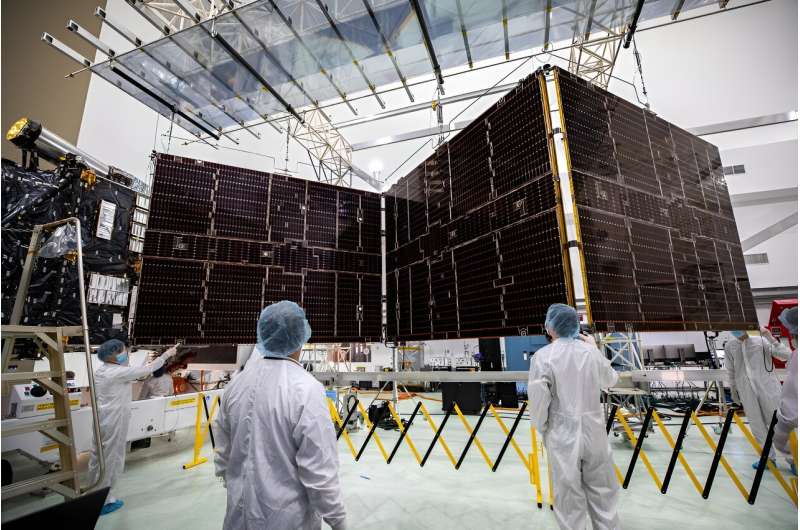
The 14th mission in NASA’s Discovery programme, the spacecraft is currently going through the last of its pre-launch preparations, the latest being the installation and folding of its massive solar arrays.
With a total span of almost 25 metres and covering a total area of 75 square metres, these are among the largest arrays used on a NASA deep-space mission. They will be capable of generating 20 kilowatts of power during the early phases of the mission as the spacecraft departs Earth, where they will be primarily used for the purposes of vehicle thrust. However, Psyche is so far from the Sun that by the time the craft arrives, they will only be able to generate around 2 kilowatts – enough to boil two kettles side-by-side.
Technicians begin to retract one of the two solar arrays following its installation on NASA’s Psyche spacecraft. Credit: NASA/Kim Shiflett
For propulsion, the spacecraft will use four Hall-effect thrusters (HETs). Based on the discovery by Edwin Hall after whom they are named, these are a form of ion propulsion in which the propellant – most often xenon or krypton gas – is accelerated by an electric field. They provide an efficient thrust-to-propellant load ratio, allowing the spacecraft utilise a minimum propellant load – around a tonne – for the 5 year 10 months transit to asteroid 16 Psyche and the 21-month primary science mission.
The overall thrust produced by the HETs is equivalent to holding a single AA battery in the hand. However, as they can run for extended periods, they will be able to gently accelerate the spacecraft to 200,000 km/h during the 4 billion kilometre cruise out to the asteroid belt. They will also provide sufficient thrust to allow the spacecraft to slow itself and enter orbit around the asteroid in readiness to start its science mission.
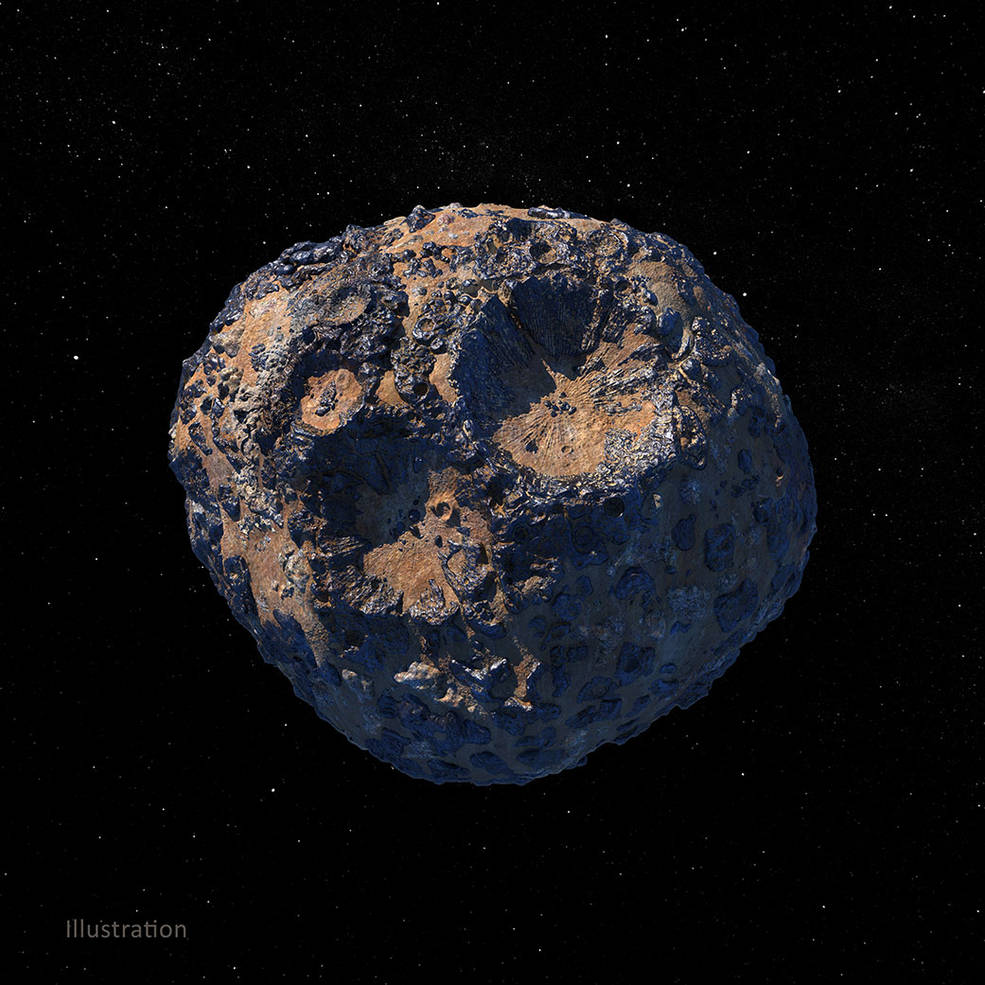
16 Psyche is the heaviest known M-type asteroid – those with higher concentrations of metal phases (e.g. iron-nickel) than other asteroids – in the solar system. It was in 1852 by Italian astronomer Annibale de Gasparis, who named it for the Greek goddess Psyche, with the “16” prefix indicating it was the sixteenth minor planet to be discovered.
An artist’s rendering of 16 Psyche based on radar studies of the asteroid and albedo-based features witnessed through imaging. Credit: Peter Rubin/NASA
Initially, it was thought that asteroid was the exposed iron core of a protoplanet, exposed after a violent collision with another object that stripped off its mantle and crust. However, more recent studies lean heavily towards ruling this out – but it still might be a fragment of a planetesimal smashed part in the very earliest days of the solar system’s creation. As such, studying the asteroid might answer questions about planetary cores and the formation of our own planet.With the solar arrays installed and stowed, the next significant milestone for the mission will be the loading of the xenon propellant, which will occur over a two-week period starting in mid-August. This will be followed by the spacecraft being mated with its payload mount and then integrated into the upper stage of the SpaceX Falcon Heavy which will launch the mission from Kennedy Space Centre’s Pad 39B.
Euclid Arrives at L2 and Starts Commissioning Tests
The European Space Agency’s (ESA’s) Euclid space telescope has arrived in orbit around the Earth-Sun L2 Lagrange point, and commissioning of its science instruments has commenced.
As I noted in Space Sunday: a “dark” mission, recycling water and a round-up, Euclid is a mission intended to aid understanding of both dark matter and dark energy – neither of which should be confused with the other. Euclid will do this by creating a “3D” map of the cosmos around us, plotting the position of some two billion galaxies in terms of their position relative to the telescope and the redshift evident in their motion.
Animation of Euclid (purple) in a halo orbit around the the Earth-Sun L2 position (light blue), as seen from “above” and following launch from Earth (dark blue). Credit: Phoenix777 utilising data from ESA / NASA
From this, astronomers will be able to study the clustering effects of dark matter, the cosmic expansion of dark energy, and how cosmic structure has changed over time. It will be the largest and most detailed survey of the deep and dark cosmos ever done.
Following a 30-day transit from Earth, Euclid entered into orbit around the Earth-Sun L2 Lagrange point, 1.5 million km from Earth, at the end of July, and commissioning of its instruments – which had undergone power tests whilst en-route – commenced almost at once, with early result being released.
Over the next 6 years, Euclid will observe the extragalactic sky (the sky facing away from the bulk of our own galaxy) in what is called a “step and stare” method: identifying a section of sky and training both of its camera systems, one of which images in visible wavelengths and the other in infrared, before moving on to the next, generating “strips” on imaged squares.
The grid-like “step and stare” observation method Euclid will use to survey the extragalactic sky. Credit: NASA
In doing so, Euclid will capture light from galaxies that has taken up to 10 billion of the universe’s estimated 13.8 billion-year lifespan to reach us. In doing so, it will measure their shape and the degree of red shift evident, whilst also using the effects of gravitational lensing on some to reveal more data about them.
The data gathered is intended to help astrophysicists construct a model to explain how the universe is expanding which might both explain the nature and force of dark energy and potentially offer clues as to the actual nature of dark matter – the mass of which must be having some impact on dark energy as it pushes a the galaxies.
Commissioning images for Euclid’s near-infrared camera. Credit: ESA
In all, it is anticipated that Euclid will produce more than 170 petabytes of raw images and data during its primary 6-year mission, representing billions of stars within the galaxies observed. This data will form a huge database that will be made available globally to astronomers and researchers to help increase our understanding of the cosmos and in support for current and future missions studying the universe.
Curiosity Celebrates 11 Years on Mars by Completing Tough Challenge
Since arriving on Mars in February 2021, the Mars 2020 mission with Perseverance and Ingenuity has tended to overshadow NASA’s other operational rover mission on Mars, that of the Mars Science Laboratory Curiosity, which arrived within Gale Crater on August 6th, 2011.
In that time, the mission has scored success after success, doing much to reveal the water-rich history of the crafter – and the history of Mars as a whole. For the last several years the rover has been slowly climbing “Mount Sharp” – the 5 km tall mound at the centre of the crater – and officially called Aeolis Mons – revealing how it is the result of the crater being the home of several lakes during Mars’ ancient history.
With lower slopes at the top and upper sloped at the bottom, this image of Aeolis Mons (from NASA’s Mars Reconnaissance Orbiter) charts Curiosity’s climb to the ridge which caused it so much trouble (white lines, the dots showing individual Sols), with the multiple attempts to drive over it (the collection of dots in the middle of the image) and the eventually diversion around it which allowed the rover to enter the “Jau” crater field. Credit: NASA/JPL
Most recently, the rover has faced its toughest challenge yet: attempting to ascend a ridgeline setting between it and an area of geological interest dubbed “Jau”. From orbit, the ridge appeared to be difficult, but not impossible for the rover. However, it combined three obstacles which proved troublesome: a steep slope averaging 23o and which comprises a mix of sand dunes and boulders large enough to pose a threat to the rover’s already battered wheels.
Initial attempts to get over this ridge in April and June resulted in the rover hitting “faults”: stoppages triggered automatically as the wheels start slipping, either as a result of the ground beneath them being too soft to offer traction meeting a resistance such as a too-large boulder they could not overcome. These forced the mission team to take a chance on a 300 metre diversion to try a point on the ridge which appeared to be less challenging.
The diversion proved worthwhile; despite taking several weeks to plan and execute, Curiosity managed to reach “Jau” – an area of multiple impact craters in close proximity to one another – in early July, and has been studying it at length.
Overcoming the ridge is a significant achievement for the rover, and clearly it means Curiosity should have something of a smoother passage to its next destination.
The following notes were taken from my audio recording and chat log transcript of the Content Creation User Group (CCUG) meeting held on Thursday, August 3rd, and the Third Party Viewer Developer (TPVD) meeting held on Friday, August 4th, 2023.
Meetings Overview
The CCUG meeting is for discussion of work related to content creation in Second Life, including current work, upcoming work, and requests or comments from the community, together with viewer development work.
The TPV Developer meeting provides an opportunity for discussion about the development of, and features for, the Second Life viewer, and for Linden Lab viewer developers and third-party viewer (TPV) / open-source code contributors developers to discuss general viewer development.
As a rule, both meetings are:
Held in-world and chaired by Vir Linden.
Conducted in a mix of voice and text.
Held at 13:00 SLT on their respective days.
Are subject to the schedule set within the SL Public Calendar, which includes locations for both meetings (also included at the end of these reports).
Open to all with an interest in content creation / viewer development.
As these meetings occasionally fall “back-to-back” on certain weeks, and often cover some of the same ground, their summaries are sometime combined into a single report (as is the case here). They are drawn from a mix of my own audio recordings of the meeting + chat log (CCUG), and from the video of the TPVD meeting produced by Pantera Północy (which is embedded at the end of the summaries for reference) + chat log. Not that they are summaries, and not intended to be transcripts of everything said during either meeting.
Viewer News
No changes through the week, leaving the current official viewer in the pipeline as:
Release viewer version 6.6.13.580918, formerly the Maintenance T RC viewer, July 14.
glTF / PBR Materials viewer, version 7.0.0.581126, June 26.
Maintenance U(pbeat) RC viewer, version, 6.6.14.581101 July 21.
Inventory Extensions RC viewer, version 6.6.14.581058, July 20.
Project viewers:
Emoji project viewer, version 6.6.13.580279, May 30.
Puppetry project viewer, version 6.6.12.579958, May 11.
Note that the alternate viewer page also lists “Win32+MacOS<10.13 – 6.6.12.579987” as an RC viewer. However, the Win 32 + pre-Mac OS 10.13 was promoted to release status on July 5th, and viewer version 6.6.12.579987 points to the Maintenance S viewer, promoted to release status on May 16th.
General Viewer Notes:
The Inventory Extensions viewer has a couple of bugs which are preventing it progressing but are being worked on. There are also some simulator-side issues (inventory thumbnail images being dropped) which are also being addressed. However, this remains the next potential viewer for promotion to de facto release, alongside of the Maintenance U RC viewer.
The Maintenance U RC includes an extension to actions available when clicking on in-world objects. CLICK_ACTION_INVISIBLE effectively makes an object “invisible” to mouse clicks, allowing it to be clecked through to whatever might be lying behind it. This functionality will be supported within the next simulator deployment, due in week #32.
The Emoji project viewer may see some font changes prior to progressing further (which may additionally require UI work in general) & is still adding further UI additions.
glTF Materials and Reflection Probes
Project Summary
To provide support for PBR materials using the core glTF 2.0 specification Section 3.9 and using mikkTSpace tangents, including the ability to have PBR Materials assets which can be applied to surfaces and also traded / sold.
The overall goal is to provide as much support for the glTF 2.0 specification as possible.
Up to four texture maps are supported for PBR Materials: the base colour (which includes the alpha); normal; metallic / roughness; and emissive, each with independent scaling.
In the near-term, glTF materials assets are materials scenes that don’t have any nodes / geometry, they only have the materials array, and there is only one material in that array.
As a part of this work, PBR Materials will see the introduction of reflection probes which can be used to generate reflections (via cubemaps) on in-world surfaces. These will be a mix of automatically-place and manually place probes (with the ability to move either).
List of tools and libraries supporting glTF: https://github.khronos.org/glTF-Project-Explorer/ – note that Substance Painter is also used as a guiding principal for how PBR materials should look in Second Life.
LL is seeking feedback on how best to handle sky rendering. In short, ambient lighting is handled differently within “non-PBR” viewers and “PBR viewers” (notably, the latter uses HDR + tone mapping where the former does not).
As the majority of ambient environments have been designed using the “non-PBR” viewer rendering system, they undergo an auto-adjustment process within the PBR viewer so that that match the glTF specification requirements. Unfortunately, this can leave some skies / ambient lighting looking far too dark – and potentially lead to complaints from users on the PBR viewer (at least until more “PBR compliant” EEP assets make themselves available).
To compensate for this, LL included the option to disable the HDR / tone mapping processes in the viewer by setting Probe Ambience to 0 with Graphics preferences. However, doing this makes content specifically designed for PBR environments look muted and much poorer than they should. This brings with it the concern that to try to make their content look good in both “PBR” and “non-PBR” environments, creators will start to go “off-piste” (so to speak) from the glTF specification when making new content, thus defaulting the entire objective in trying to move SL to match recognise content creation standards.
There have been two main schools of thought within LL as to how to best handle both situations, these being:
Continue to iterate on the auto-adjustment system so it can handle a broader range of sky settings that are in popular use without them going overly dark within the PBR viewer.
Initially make HDR / tone mapping opt-in, rather than opt-out (so probe ambience is set to 0 by default, but can be set above zero by users as required) until such time as all viewers are running with PBR, then switch to making it opt-out (so HDR / tone mapping must be manually disabled).
General feedback at the meeting was for LL to continue to try to iterate and improve the the automatic adjustment to HDR / tone mapping for skies, so as to avoid the need for content creators to have to start producing “PBR” and “non PBR” versions of their content.
Outside of this, it has also been reported that multiple script-driven glTF materials updates (such has those that might be seen with the changing pattens on a disco floor, for example) actually cause multiple network connections, impacting network bandwidth to the viewer, which is hardly ideal. This is currently being addressed, but until fixed on the simulator side, it will see a pause in glTF simulator updates being released.
The work on “hero” reflection probes for planar mirrors is continuing to progress.
Senra Discussions – CCUG and TPVD
Via the Content Creation Meeting:
A lengthy discussion on the Senra SDK and the requirement for Avastar with Blender – seen as a paywall block for creators who may not have previously entered the clothing market, but who want to in order to support Senra. Unfortunately, no-one directly involved in the Senra body development was at the meeting to handle questions.
Avastar is generally required with Blender as the latter uses “none-standard” axes orientation compared to other tools, resulting in issues such as armature rotations being incorrect, plus its Collada export doesn’t (I gather, subject to correction here) support volume bones.
However, it was noted that other mesh bodies available within SL provide SDKs where these uses are fixed for Blender without the need to reference Avastar – so the questions were raised as to why LL haven’t done the same (or at least looked at those solutions).
The discussion broadened into issues with the avatar blend file itself which have long required fixing, with the promise that all comments on the SDK, Blender, and the avatar Blend file will be passed back to the relevant parties at the Lab.
Those at the meeting from LL noted their hope that – down the road – the switch from Collada to glTF-compatible formats will help to eliminate many issues related to avatar content creation, and if nothing else, will look to address specific issues . this, and that if nothing else, they will mark the need to fix the armature rotation issue with that work (“glTF Phase 2”) if it is not addressed beforehand.
Via the TPVD Meeting:
It was noted that there currently isn’t a formal venue for discussion Senra outside of the current forum threads or the Discord channel (for those able to access it.
The suggestion is currently to have a special purpose meeting – possibly under the CCUG banner – where those who developed Senra could respond to questions / concerns. This suggestion is being passed to Patch Linden who is better placed to arrange a meeting, given the Senra project largely falls within his remit.
There is a lot of concern / confusion over the SDK licensing (again, please refer to the forum thread on this for details).
It was indicated that the Senra content will soon have inventory thumbnails included, ready for when the Inventory Extension viewer is promoted to release status.
Concerns about new users getting confused by wearing Senra items directly from the Library a) do not appear to be highlighted to indicate they have been added to the avatar (this is actually because the process of “wearing” the item has actually generated a copy within the user’s inventory, which *is* highlighted as added / worn); b) individual items added to an avatar in this manner go to the matching object class type system folder, *not* to a dedicated Senra folder (e.g. mesh clothing is copied to the Objects folder; skins go to the Body folder, etc.).
In Brief
Via the TPVD meeting
General discussions on:
Scalable fonts (as implemented by Genesis viewer).
How TPVs block older versions (for releases, the viewer requests a list of blocked versions from the TPV server in question (say, Firestorm, for the sake of argument), and if it finds itself on the list, it terminates trying to log-in to SL).
The move to de-dupe some asset types (textures, notecards, scripts & (possibly) gestures by giving multiple CDN versions the same UUID number, including clarification on the difference between the original asset, the UUIDs for multiple versions and also inventory IDs (which handle permissions, etc.).
An extensive discussion on chat bubbles and toasts in the official viewer.
Please refer to the TPVD meeting video below for further details on the above discussions.
† The header images included in these summaries are not intended to represent anything discussed at the meetings; they are simply here to avoid a repeated image of a gathering of people every week. They are taken from my list of region visits, with a link to the post for those interested.







 Inara Pey: Living in a Modemworld