Logos representative only and should not be seen as an endorsement / preference / recommendation
Updates from the week through to Sunday, December 10th, 2023
This summary is generally published every Monday, and is a list of SL viewer / client releases (official and TPV) made during the previous week. When reading it, please note:
It is based on my Current Viewer Releases Page, a list of all Second Life viewers and clients that are in popular use (and of which I am aware), and which are recognised as adhering to the TPV Policy. This page includes comprehensive links to download pages, blog notes, release notes, etc., as well as links to any / all reviews of specific viewers / clients made within this blog.
By its nature, this summary presented here will always be in arrears, please refer to the Current Viewer Release Page for more up-to-date information.
Note that for purposes of length, TPV test viewers, preview / beta viewers / nightly builds are generally not recorded in these summaries.
Official LL Viewers
Release viewer: version 7.0.1.6894459864,the glTF / PBR Materials viewer, issued November 17, promoted November 28 – No Change.
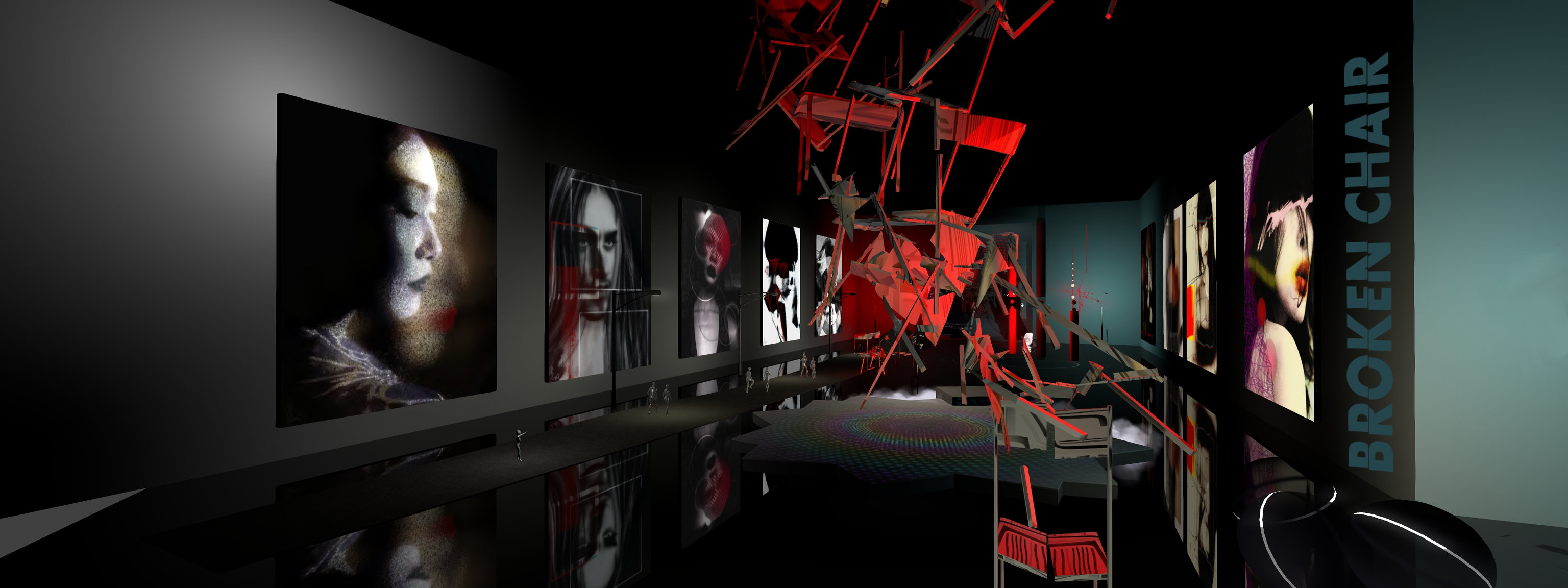
Nitroglobus Roof Gallery, December 2023: Bamboo Barnes – Broken Chair
My idea of art is not the refraction of light, but the expression of what lies behind it. I want to create something that is inside a person, something that has a fragrance like fermented love. Therefore you rarely find anything cheerful or uplifting in most of my work, nor do I want to express such things.
Thus states Bamboo Barnes in discussing her latest exhibition – and her third at Dido Haas’ Nitroglobus Roof Gallery over the years – which opens on December 11th, 2023.
As I’ve frequently noted in these pages, Bamboo is one of the most vibrant, evocative, provocative, and emotive artists in Second Life. Her work is far removed from that of other artists who mix digital techniques with images from the physical world and those from SL, in that it it is both introspective and yet often – through the use of colour and tone – strongly assertive such that individual pieces can both reflect her inner thoughts, personal perceptions and feelings whilst at the same time speaking directly to the person viewing them in an equally personal and also entirely unique way.
Nitroglobus Roof Gallery, December 2023: Bamboo Barnes – Broken Chair
Such is the case with Broken Chair, an exhibition of 19 studies by Bamboo, supported by a series of 3D elements by the artist, some of which reflect the title of the exhibition, others of which might appear more abstract at first glance.
The images are predominantly monochrome in nature, colours – outside of red – sparingly used. Each offers its subject in Bamboo’s trademark style: a face, sometime in full, sometimes in profile, often in sharp focus, just as often not; each one looking outwards at or beyond the observer, expression and pose – even when the eyes are unseen – giving voice to the tumult of thought and feelings tumbling through the mind within the head. What these thoughts and feeling might be is up to observers to interpret for themselves, but there is more than enough within each one to resonate with each of us, and cause a sense of understanding and familiarity.
Where colour is used, it is done so in emphasis of a mood, emotion or feeling, whilst the title of the exhibition speaks to what so often lies within us all: the introspections that are so personal we cannot give voice to them; thoughts that can – whatever their origin or cause – leave us spiralling in silence, trapped without ourselves – but which also demand expression, be it through physical or mental reflection. These are thoughts which can leave us feeling less-than-whole – or broken, if you will. Yet even whilst bringing forth this sense of brokenness, such thoughts and feelings can so often also impart an inner strength or drive to overcome, to mend; a determination to learn, to overcome, to become more whole and move forward in life.
Nitroglobus Roof Gallery, December 2023: Bamboo Barnes – Broken Chair
So yes, we might so often feel broken inside, but as with a broken chair, we have the ability within ourselves to mend and heal. Perhaps not fully – even a repaired chair can so signs of the work applied to make it so – but enough to carry us forward in life. And within Broken Chair, Bamboo perhaps reminds us of that such feelings – and the drive they encourage – are both common to us all.
Image of the ISS taken by SpaceX Crew-2 mission on November 8th, 2021 after it successfully undocked from the ISS Harmony module. Credit: NASA
The International Space Station celebrated its 25th anniversary on December 6th, 2023 – the date marking the orbital mating of the first two modules forming the station in 1998.
This operation was undertaken by the US space shuttle Endeavour, commanded by astronaut Robert Cabana. Launched on December 4th, 1998 from Launch Complex 39A at Kennedy Space Centre on STS-88, Endeavour carried the US- built Unity module in its cargo bay. Once in orbit, it started a series of manoeuvres to rendezvous with the 19.3 tonne Zarya Functional Cargo Block (referred to as the FGB, this being the Russian funktsionalno-gruzovoy blok), which had been launched out of Baikonur Cosmodrome Site 81 in Kazakhstan on November 20th, 1998.
As Endeavour approached the Russian module, the shuttle’s robot arm lifted the 11.6 tonne Unity node from its cavernous cargo bay and rotating it so that one of the module’s two Pressurized Mating Adapters (PMA) could be attached to the Orbiter Docking System also located in the shuttle’s cargo bay and connected to the shuttle’s airlock.
On reaching Zarya, Cabana then slowly eased Endeavour so it was paralleling Zarya’s orbital track whilst “below” the Russian module. He then gently manoeuvred the shuttle to within 10 metres of Zarya – close enough for Mission specialist Nancy J. Currie, who had mated Unity to the shuttle’s Docking System, to use the shuttle’s robot arm to “grab” the Russian module and gently mate it with the second PMA on the far end of Unity.
December 6th, 1998. Operated by NASA astronaut Nancy Currie uses the robot arm on the space shuttle Endeavour to gently position the Russian Zarya module over the USS Unity module, anchored against the Shuttle Docking System, in readiness to mate the two. Credit: NASA
EVAs were then conducted by Mission Specialists Jerry Ross and James Newman to connect power and data services between the two modules, and on December 10th, 1998 Cabana and Russian Cosmonaut Sergei Krikalev opened the hatch between the shuttle and the Unity module and entered the latter together as a symbol of US-Russian cooperation, after which members of the shuttle’s crew completed bringing the station’s power and communications systems on-line.
Whilst this marked the first time humans entered the nascent space station, it would not be until November 2001 that the first official crew – Expedition 1 – arrived at the ISS that the station’s “operational” phase would begin, the period between STS-88 and Expedition 1 being regarded as a “construction” period. However, given the latter actually continued well beyond the arrival of Expedition 1, the mating of Unity and Zarya has come to be regarded as the official anniversary of the ISS.
Excluding the astronauts who visited the ISS as a part of STS-88 and those missions ahead of Expedition 1, the space station ISS has hosted 273 individuals from 21 countries around the world. Together they have conducted over 2,500 short- and long-term science experiments and studies involving researchers from 108 countries and multiple disciplines including Earth and space science, educational activities, human research and healthcare, physical science, and technology.
To mark the 25th anniversary, NASA held a special event with the current ISS crew of Expedition 70 – who themselves represent the international nature of the project, as shown below – and special guest Robert Cabana, commander of STS-88.
The official Expedition 70 crew portrait with (top row from left) Roscosmos cosmonauts Nikolai Chub, Konstantin Borisov, and Oleg Kononenko; JAXA (Japan Aerospace Exploration Agency) astronaut Satoshi Furukawa; and NASA astronaut Loral O’Hara. In the front row are, ESA (European Space Agency) astronaut and Expedition 70 Commander Andreas Mogensen and NASA astronaut Jasmin Moghbeli. Credit: NASA
For Cabana, the event was something of a triple celebration. Not only did it mark space station’s anniversary, but also the 25th anniversary of his 4th and final space mission with STS-88, and the fact that at the age of 74, he is now retiring from NASA. Throughout his later career at the agency, he remained close to the ISS project, joining the Operations team in 1999 to head-up its international aspect, working with other national space agencies. From here he went to work in Russia, heading up NASA’s ISS team there, before becoming the deputy head of the entire ISS project in the US for a two-year period through to 2004. After this he served as the Director of Flight Crew Operations, all the while maintaining his “active” flight status as an astronaut. In May 2021, after stints managing various NASA facilities – including Kennedy Space Centre -, Cabana was promoted to NASA Deputy Administrator, one of 16 former US astronauts holding senior management roles in the agency, the post from which he will now be retiring.
The event itself was a little dry, but also fascinating in the way to shone a light on the astronauts themselves in terms of their thoughts on living and working in space and what captivates them.
The celebration of the space station’s 25th anniversary came alongside the news that NASA is revising contract options and timings for the station’s “retirement”. This is due to come in late 2030 or early 2031, when the ISS will be de-orbited in a controlled manner so that it will break-up on entering the upper atmosphere, with any large elements falling into the South Pacific.
Originally, it had been planned to announce the contract for building the de-orbit vehicle at the end of 2023. However, this has now been pushed back until February 2024, the additional time to allow prospective bidders for the contract to review its updated options, which have been altered from a fixed-price basis to something a little more flexible.
This new contract calls for the de-orbit vehicle to be ready for launch no later than mid-2029, so that it can be launched to dock with the ISS where it will remain until called upon to de-orbit the station. Whilst planned for the end of 2030 / start of 2031, the new contract requires the vehicle must have “dwell in place” capability, allowing it to remain docked at the station but capable of performing its task for a period beyond 2031 so as to provide increased flexibility in the time frame for the decommissioning and de-orbit of the station.
Blue Origin to Purchase ULA?
United Launch Alliance (ULA) is something of the “granddaddy” of US government launch system providers. A joint venture between Lockheed Martin Space and Boeing Defense, Space & Security, it was formed in 2006 with its primary customers being the US Department of Defense (DoD) and NASA, proving them with the expendable Delta IV Heavy and Atlas V boosters and which will soon be replaced by ULA’s new Vulcan Centaur rocket.
However, at the end of October 2023, ULA’s current CEO Tory Bruno indicated the entire company could available for purchase by anyone willing to obtain it as a going concern, rather than breaking it up, stating the overall structure of the company – answerable in equal portions to the two parent companies – has prevented the company from flourishing as well as it could if under single ownership.
Prior to Bruno’s announcement it had been rumoured that either Boeing or Lockheed would buy the other out, but neither appeared willing to do so, each pursuing its own space contracts. As a result, and at the end of November 29th, 2023, it appeared that three bidders had expressed an interest in taking over ULA – although one has yet to be confirmed.
Th “possible” bidder has been referred to as a “well-capitalized aerospace firm that is interested in increasing its space portfolio” but which “does not have a large amount of space business presently”. Meanwhile the two “known” organisations interested in ULA are said to be a private equity fund – and Blue Origin, the privately-owned company founded (and largely funded) by billionaire Jeff Bezos.
The idea of Blue Origin gobbling up ULA might seem inconceivable, but there is actually a lot of synergy between the two already: Blue Origin has worked closely with ULA in the development of the company’s BE-4 engine which will be used to power ULA’s Vulcan Centaur and upgraded Atlas V (as well as Blue Origin’s own New Glenn).
An artist’s impression of the Vulcan Centaur rocket – designed by ULA and with a core stage powered by the Blue Origin BE-4 engine. Credit: ULA
Further, Vulcan Centaur’s capabilities overlap nicely with those of New Glenn, offering Blue Origin with a broad range of launch capabilities. ULA has also sought to eventually make Vulcan Centaur semi-reusable, the engine module being detached from the rocket’s first stage and recovered after splashdown, allowing it to be refurbished and re-used. Such a capability would both dramatically reduce operating costs with Vulcan Centaur – and also match Blue Origin’s desire to develop semi-reusable launch systems, as with its New Glenn. So again, there is a synergy here.
Perhaps most beneficial to Blue Origin is that an acquisition of ULA is the fact that the latter is already an establish provider of launch vehicles to the lucrative US defence market, which Blue Origin could then capitalise upon. In addition, ULA’s Atlas V and the Vulcan Centaur launches are designed to carry humans into space via the Boeing CST-100 Starliner capsule. Thus, Blue Origin gain the means to fly crews into space in partnership with Boeing – potentially vital to its space station plans.
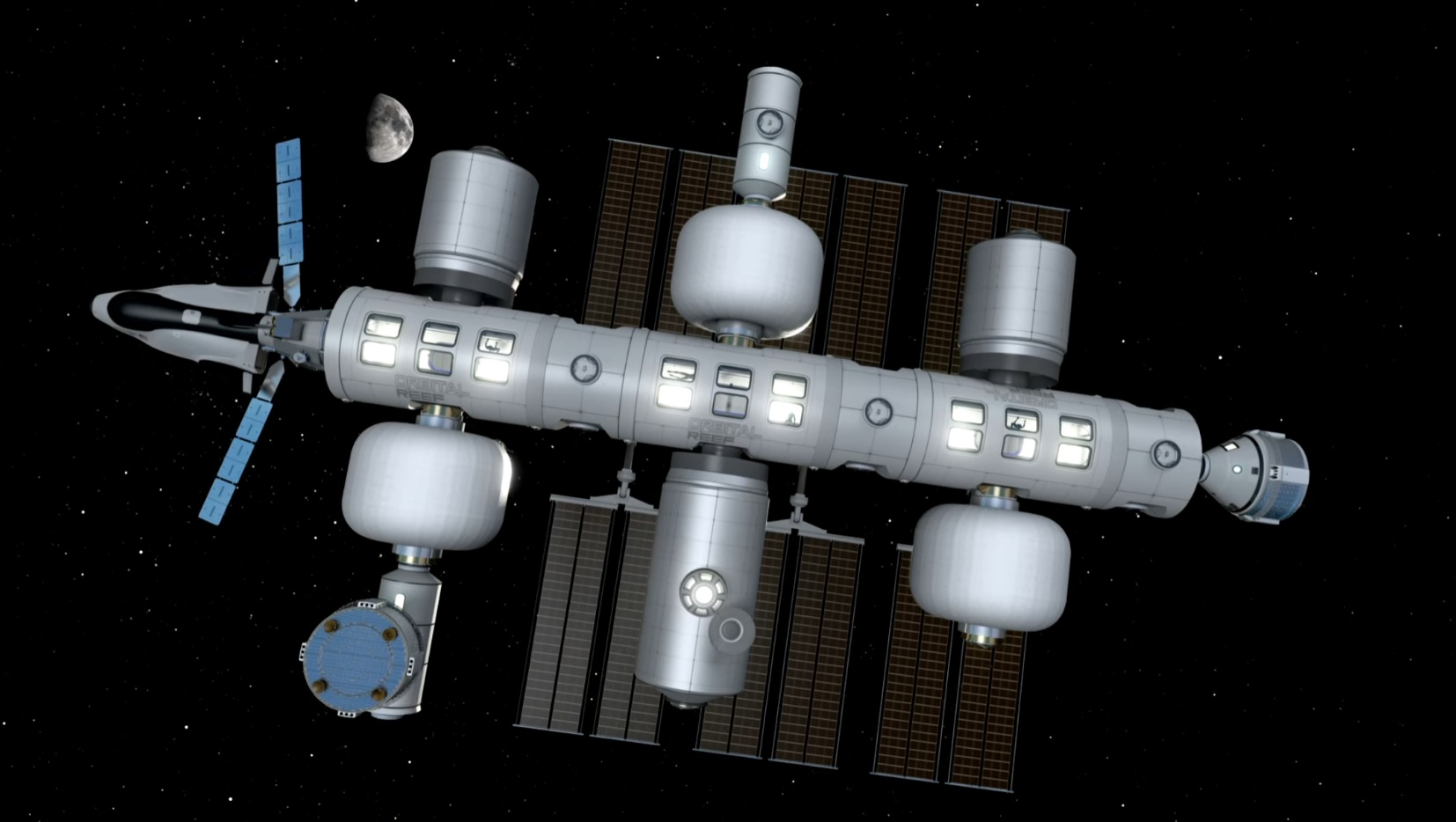
An artist’s concept of the Orbital Reef facility proposed by Blue Origin and Sierra Space, showing the core modules (to be built by Blue Origin) with a Sierra Space Dream Chaser (l) and Boeing CST-100 (r) docked against them, with smaller inflatable and rigid modules mated to either side, with another CST-100 approaching. Credit: Blue Origin / Sierra Space
In 2021, Blue Origin and Sierra Space announced plans for an orbital facility called Orbital Reef, designed to provide facilities for up to 10 people at a time. Under current plans, Blue Origin would provide the station’s large-diameter modules and the launch vehicle (New Glenn), Sierra Space the smaller modules and cargo support via their Dream Chaser vehicle, and Boeing / ULA crew launch capabilities via Starliner / ULA launchers. If Blue Origin obtained ULA, it would further streamline Orbital Reef development / operations. Plus, being able to fly the CST-100 via the Atlas and Vulcan Centaur allows Blue Origin to access a share of NASA’s crewed launch requirements to service the ISS, again through Boeing.
Thus far, neither Boeing nor Lockheed have either confirmed or denied whether ULA is in fact up for sale – but industry insiders believe an announcement on the state of play with ULA – including any winning bid – will be made in early 2024. However, exactly how long any acquisition might take to complete is also unclear, requiring as it would the approval via the US Federal Trade Commission.
Premium Plus Mediterranean Theme Linden Homes, as revealed at the SL Xmas Expo 2023
Update, December 19th, 2023: the Mediterranean Theme homes for Premium Plus are now available via the Linden Homes Store.
The newest Linden Homes theme – this one again for Premium Plus subscribers – was open for preview during the RFL Xmas Expo (December 1st-10th, 2023). Once again offering a range of homes occupying 2048 sq metre parcels, the overall theme for this upcoming release is “Mediterranean”, bringing with it a Tuscan theme – perhaps one of the most popular styles of house used within SL, which may be reflected in how popular the theme might prove, once available through the Linden Homes store.
As with more recent releases of Linden Homes, the theme comprises a total of four designs, each available in “normal” (with a fixed set of rooms) and “open” (with a more open-plan design allowing holders to define the spaces within with additional walls, etc., as they prefer), for a total of eight styles. Not all variants of the new theme were displayed at the Expo reveal, but those which were are described below.
Bella Vista: the open-plan version of a single-storey house, with a central terrace to one aspect, flanked on two sides by the house wings, and the third by the rest of the house, which also opens onto a second terrace. This version of the house presents a large L-shaped room to one side of the entrance hall, two smaller rooms on the other.
Premium Plus Mediterranean Theme Linden Homes: Bella Rosa / Bella Vista styles
Bella Rosa: “normal” version of the Bella Vista, no preview available at the Expo reveal.
Favola: a two-storey house with central stone turret enclosing the entranceway, in which a curved staircase rises to a galleried landing overlooking the entrance. An archway provides access to two lower-floor rooms, also linked by an archway. The largest of the latter further accesses a terrace which is shared with one of the side rooms, which are accessed from the main room via a doorway. The galleried landing provides access to three upper-floor rooms.
Felicita: the open-plan version of the Favola, presenting two large ground floor rooms linked by a doorway and two linked upper floor rooms, the staircase rising directly into the larger of the two.
Premium Plus Mediterranean Theme Linden Homes: Favola / Felicita styles
Grande Vista: a large, two-storey house with turreted front entrance complete with external stairs circling around it to reach the upper floor and provide access to both balcony there and the upper floor hallway, also reached via the internal stairs from the front entrance. A small room opens off of the entrance, and a central hall parallels that of the upper floor, providing access to (respectively) four rooms on the ground floor, the largest of which has a small terrace area opening off of it to one side of the house, and (upstairs) three rooms, two of which have their own balconies.
Gran Palma: the open-plan version of Grande Vista, with the entirely lower floor opened-out into a large single room space, archways linking it to the entrance hall, with the upper floor rooms as described above.
Premium Plus Mediterranean Theme Linden Homes: Grande Vista / Gran Palma styles
Primavera: a central 2-storey area with entranceway to front and large main room, flanked on either side with two single-level wings, one with two individual rooms, the other with two linked rooms (ideal for a kitchen space and dining room), both of which are linked to the main room via archways. Doors from the rearmost room on either side provide access to a roomy terrace overlooked from the main room by large windows. Reached via a dog-leg staircase to the front of the house, the upper floor provides large landing area which might be used as an open room / study, and two rooms suitable for use as a bedroom / bathroom combination or perhaps two bedrooms.
Precioso: an open plan version of the Primavera, not displayed as a part of the Expo reveal.
Some of the versions of the houses at the reveal were furnished, offering some idea of how they might look in use – a good twist on these reveals by the Lab, and perhaps a little overdue. As is usual for the modern range of Linden Homes, all of the styles / versions can be accessed by an off-parcel rezzing system, allowing the full capacity of the parcel on which a house sits to be used for furnishings, garden landscaping, etc.
Premium Plus Mediterranean Theme Linden Homes: Favola style with décor suggestion
When the first selection of Premium Plus Linden Homes – the Ranch theme – was released, I noted that I felt it lacking character, and not something sufficiently appealing to give me pause to consider upgrading from Premium to Premium Plus. I still do not feel the need to make the jump, but in terms of character I do find this theme to have far more in the way of character. Set within a sub-tropical environment, they would clearly have their own unique attractiveness; hence another reason to feel they could well prove popular on release.
Availability
According to Patch Linden, at the time of the reveal there is no release date for the Mediterranean theme, and the advice to Premium Plus subscribers with Ranch Theme homes was not to abandon them to await a pre-end of the 2023 release of this theme, as it may not come until 2024. At the time of writing, a new area of Bellisseria, north and east of the current Ranch Theme homes, appears to be in preparation – possibly for this new theme.
The Middle of Nowhere, November 2023 – blog post †
The following notes were taken from my audio recording and chat log transcript of the Content Creators User Group (CCUG) meeting held on Thursday, December 7th, 2023.
The CCUG meeting is for discussion of work related to content creation in Second Life, including current and upcoming LL projects, and encompasses requests or comments from the community, together with viewer development work.
As a rule, these meetings are:
Held in-world and chaired by Vir Linden, in accordance with the dates and times given in the the SL Public Calendar, which also includes the location for the meetings.
Conducted in a mix of voice and text.
Open to all with an interest in content creation.
The notes herein are a summary of topics discussed and are not intended to be a full transcript.
Official Viewers Status
The Maintenance X RC viewer (usability improvements) updated to version 7.1.1.7088410646, on December 7.The rest of the official viewer stand as:
Release viewer: version 7.0.1.6894459864, the glTF / PBR Materials viewer, issued November 17, promoted November 28.
Release channel cohorts:
Maintenance-W RC viewer, version 7.1.1.7088402585, December 5 – bug and crash fixes.
Maintenance V(ersatility) RC viewer, version 7.1.1.7039128750, December 1 – displaying user-customized keybindings in chat.
Maintenance Y, version 6.6.17.6935642049, issued November 21 – My Outfits folder improvements; ability to remove entries from landmark history.
Puppetry project viewer, version 6.6.12.579958, May 11.
General Notes
It is unclear which viewer is liable to be promoted (if any) to end-of-year de facto release status. Currently both the Maintenance V RC and the Emoji viewer are seen as possible candidates – although the latter has yet to be updated to Github Actions / merged with the PBR release viewer code base.
PBR Materials
Maintenance work on the initial release is well in progress.
This work includes updates to environmental haze, per my previous CCUG summary (e.g. making local lights and glow be subject to haze / fog such that those further away appear dimmer / are blotted by the haze / fog, rather than poking through it; fixing BUG-234235 “[PBR] alpha blend on water is acting a bit like invisiprim” + correcting the fact that Linden Water is currently drawn twice in a rendered scene, when visible).
There have been some reported permissions issues with PBR / glTF, and these are being worked on.
A fix (courtesy of Ansariel Hiller) for BUG-234706 “[GLTF] [PBR] Performance unstable / massive performance loss compared to default release” has also been pulled into the maintenance update.
BUG-234728 “[PBR] Masked alpha gradient textures change with viewing angle” has been accepted by the Lab, but is proving difficult to consistently reproduce, slowing the investigation.
PBR Terrain Work
Materials applied to Second Life terrains. Credit: Linden Lab
Per past meeting notes, Cosmic Linden is prototyping the application of PBR materials on terrain (see this blog post for more).
Important notes with this work:
It is not terrain painting. It is the application of PBR materials – terrain painting is described as “something that’s on the radar” at LL.
The work does not include support for displacement maps.
The work is currently only viewer-side, with no corresponding server-side support, the idea here being to prototype what might be achieved and testing approaches / results.
Current Status
With PBR Materials now having shipped, cosmic Linden is turning her attention back to this work.
The first order of business she sees is to get a project viewer supporting PBR terrain made available for users to try.
Cosmic is also working on refining the PBR swatch / picker in the viewer’s UI.
There is an issue with how PBR normal appear when used within terrain which needed to be corrected.
Game Controller Support
Project Summary
The work is being led by Leviathan Linden, to provide game controller support at the scripting level (e.g. for handling things like vehicle movement, scripted objects etc.).
It is not currently related to matters of avatar locomotion / camera movement, which is covered by the Preferences → Move and View → Other Devices (/Joystick) options, and considered out-of-scope for the work at present.
Official documentation on the server-side support can be found on the Game Control page of the SL Wiki. Note this is based on the Simple Direct Media Layer (SDL) library for the button naming conventions, with some additional buttons added by the Lab to provide support for up to 32 buttons, rather than the 21 offered by SDL.
At the time of writing, the Gingerbread maintenance branch with the prototype Game_Control feature is available on Aditi (the Beta grid) on the following regions: Aegis Island, Blake Sea – Turnbuckle, Cloud Sandbox 1, Cloud Sandbox 2, Firestorm Aerodrome, Gothlauth, Hona Lee Puff, Jigglypuff, Laefeon, LR151, LR 152, Mauve, Moonberry, Morris, SG2, and Smithereens.
The current methodology for the Game_Control event is for whatever button is pressed on a games controller, an overall state is sent to the viewer, comprising:
The number of buttons available, presented in bitmask form to any controlling script.
A range of six axes in the range -1 to 1, given as floats), which the event then presents to an LSL script, which can then parse them.
The Game_Event function then passes this information to a controlling LSL script for parsing.
Notes:
The above points should not be considered tablets-of-stone, Leviathan is open to taking feedback from vehicle builders, etc., – such as including things like mouse input within the axes data.
Event_Control does not include a means for handling force feedback in its current form, but something like this might be added in a future iteration.
Note that discussions on the project are also held within the Simulator User Group meetings (summaries here).
Current Status
Consideration is being given to the fact that when the data on a games controller is sent to a script, it will have to be sent in sequence – so does this mean the inputs received by the Game_Control event should be given more meaningful names prior to being parsed by an LSL script?
Also, what does the LSL script need to know? Is it what button is being pressed or what action is being performed? Three lines of thought emerged in discussions:
One for keeping button options as “standardised” as possible, rather than allowing actions to be arbitrarily mapping to buttons (with the result that every creator using the capability will do so differently), possibly backed-up with a “best practices guide”. A concern with this approach was that it would require a degree of proscription (“button x can do this, this or this” – which do you require?”), which might not meet all use-cases.
Allowing for a more arbitrary button / action assignment, sending the button names as bindable options to the viewer, and providing users with a UI element (accessed via an on-screen button) so they can freely map buttons to vehicle / object actions based on personal preference.
Something of a half-way house: providing a “standard” set of buttons that can be used by a controller, then providing a scripted means / UI option to map vehicle / object actions to that set of buttons.
A further suggestion was made to have a core “glossary” of typical game controller inputs / actions (e.g. up, down, strafe left, strafe right, etc), but have the ability for script to identify the actions they require in controlling a vehicle / object, and allow the creator (/user, if a UI options for re-binding is provided), to map additional options to buttons /re-map preferences.
Discussions around these ideas set to continue.
In Brief
Not purely Content Creation related, but a Jira (BUG-234653 – “Feature Request: Invisible / Utility Login”) has been submitted requesting the ability for users to be able to completely hide their on-line status prior to logging-in. This is being considered for implementation.
The question of the status of the Puppetry Project was again raised. In short:
The overall project remains on “hold” for a variety of reasons (including both complexities and also limitations within SL which require separate addressing).
Some of the work originally sitting within the Puppetry banner – such as animation import – is either being considered as a separate project, or being folded into other work – such as glTF scene import (which encompasses items such a node hierarchies which are required for IK systems etc.).
This lead to a broader discussion of the potential with glTF (perhaps best left until the project relating to scene import becomes more public) and a history of the Puppetry Project, mush of which is summarised in my Puppetry Project meeting summaries).
Next Meeting
13:00 SLT, Thursday, December 21st, 2023, at the Hippotropolis Campsite (but check the public calendar).
† The header images included in these summaries are not intended to represent anything discussed at the meetings; they are simply here to avoid a repeated image of a gathering of people every week. They are taken from my list of region visits, with a link to the post for those interested.
TheDickens Project, a seasonal celebration of the life, times and work of Charles Dickens with a focus on what is perhaps his most famous story, A Christmas Carol, officially opens to the public on Thursday, December 7th 2023.
Now a tradition within Second Life – the first edition of the event was held in 2012 (and which itself grew out of a special presentation originally made in 2008), the Dickens Project offers a mix of reading, storytelling, music, events and activities. It is organised and presented by Seanchai Library and offers visitors an immersive environment across two regions evocative of Victorian England in Dickens’ time. This two-region environment serves as both home to settings from A Christmas Carol and the stage upon which the Project’s multiple events and activities take place throughout it run, which concludes in early January 2024. However, this year’s event brings with it some changes.
“This project has a lot of history and long time fans have a lot of ownership over elements that are favourites … We try to balance retaining things that are familiar with exploring new ideas and new ways to improve the experience for our guests
– Caledonia Skytower, Seanchai Library
For 2023, and following the success of Where’s Mr. Lurky?, a search-and-count style hunt during Seanchai Library’s 2023 Bradbury Project (read more here), the 2023 Edition of The Dickens Project will see visitors invited to Help Tiny Tim! who has left his crutch somewhere, everywhere across the two Dickens regions and which visitors are invited to find in all of its various hiding places. Information on the hunt can be found at the event’s Welcome Area.
Another new feature this year is a celebration of the myth of mermaids. Depicted in many ways throughout history, from lithe beautiful maidens to grotesque fish hybrids, mermaids were also a source of fascination in the Victorian era. For 2023, the Dickens Project offers a fascinating display of some of the art and stories surrounding these mythical creatures. Curated by Dagmar Kohime, the display can be found at the lighthouse within Dickens Harbour.
The Dickens Project 2023 Edition
As with the 2022 Edition, The Dickens Project is this year assisted by a local SL Experiences to help with navigation and general enjoyment. All three are explained at the Project’s Welcome Area. They will be triggered automatically for anyone visiting the Project for the very first time, when approaching one of the teleport portals around the walls of the Welcome Area – so if you are new the the Project, expect the pop-up invite to join the Experiences and accept it when it appears. To also assist visitors with the layout of the regions, the floor of the Welcome Area also includes a map of both regions which highlight locations of interest.
Throughout its history, The Dickens Project has promoted communities through events and activities held throughout its annual run, and 2023 is no exception. Participating this year are: Virtual Community Radio, Innsmouth in SL, Evolution Dance, Idle Rogue Productions, Misfit Dance and Performance Art SL, and Virtuoso Dance, eClipse Club & Resort, and the SL Hawks Aerobatic Team. Some of these communities have dedicated spaces within the Project’s regions which can be reached via the teleport portals at the Welcome Areas, others- such as the Hawks Aerobatic Team. will be visiting to provide special shows.
The Dickens Project 2023 Edition
Also returning for 2023 is the Community Virtual Library, once again providing research and information on Victorian life in the time of Dickens’ works, whilst making a first and special appearance of December 30th is the Angelicus Boy Choir. Finally, the Project will see a broad range of entertainment and parties featuring DJs and live musicians from across Second Life.
Readings
Of course, no edition of the Project would be complete without the readings from Dickens’ a Christmas Carol.
The first such reading for 2023 will take place at 17:00 SLT on Thursday, December 7th, when the Community Virtual Library will host the Virtual Pioneers reading A Christmas Carol: Christmas Present. Then at noon SLT on Sunday, December 17th, 2023, there will be The Big Read, a relay-style reading of A Christmas Carol in its entirety.
The latter will mark the start of Carol Week, with daily readings for parts of the novella throughout the week of December 18th through 21st, each reading taking place at a location within the Project inspired by the story. In addition, a listening room is available 24/7 where guests can listen to different recordings of A Christmas Carol on the media stream, and a HUD can be obtained by visitors who would like to explore listening to the story stream, rather than the music stream.
The full calendar of events for the Project is provided below – note all times are SLT.
To keep up-to-date on daily events and updates, be sure to keep an eye on the Seanchai Library website.
Dickens Project Art Show
Returning for 2023 is the Dickens Project Art Show, which is currently open (until December 17th, 2023) to submissions from artists.
This is a non-juried show which will formally open on December 23rd, 2023 with a special opening party at 15:30 SLT on that day. Artists are invited to submit 2D art (some 3D art can be accommodated by arrangement), with the organisers given priority to art with the following themes:
Elements of The Dickens Project.
Victorian Christmas.
Winter beauty.
Multiple submissions are allowed, but the number of works shown per artist may be limited in order to allow as many artists to be represented as possible.
Submissions should be made via notecard to Stevie Basevi. These notecards should include: the artist’s full SL Name (that is, Display Name and account name); the artist’s physical world time zone or best SL times when they can be contacted; a brief description of the piece + an artist biography; a *preview* image of the art to be submitted (i.e. a lower-resolution, thumbnail copy in order to provide the organisers with an idea of the work – not the art itself); and optional links to a related website, Flickr page, etc., for the artist.
General enquiries – including those concerning 3D art submissions – should also be forwarded to Stevie Basevi.
The Dickens Project 2023 Edition
About Seanchai Library
Seanchai Library (pronounced Shawn-a-kee, which means “Storyteller” in Irish Gaelic.) was founded in March of 2008 in Second Life. The program remains dedicated to promoting the power of stories to transform and inspire through live voice presentations: “We bring stories of all kinds to life, in Second Life and other virtual worlds.”
The Dickens Project was created for Seanchai Library by Da5id Abbot, Dagmar Kohime, Gloriana Maertens, Stevie Basevi-Morane, Iniry Vaher, and Caledonia Skytower, in presenting it, Seanchai Library acknowledges the support and sponsorship of Linden Lab.






 Inara Pey: Living in a Modemworld