Second Life History at the Primitive Museum campus
When it comes to the history of Second Life, there are many who may claim to hold some of the facts and figures and legends and tales. However, were the truth to be told, there is really only one person who has spent years carefully building what is perhaps the most complete history of Second Life’s long and growing history, and then synthesising it down in a manner that can be easily digested and appreciated: Sniper Siemens.
For the last decade (or more!) Sniper has been gathering, compiling and curating information representing as much of Second Life’s history as possible. Since 2014, this information has been displayed by Sniper in a series of installation at events and venues across the grid. I personally first encountered it that year, when it was hosted by the Linden Endowment for the Arts (LEA), and have also covered several iterations of the History since then over the years. So when Sniper IM’d me to tell me the History has a new (and hopefully permanent!) home, I knew I’d have to make sure it went to the top of my list of places to visit!
Second Life History, ground floor
This new home is on land graciously provided to Sniper by Xerses Goff , creator and curator of the Primitive Museum, of which the History now forms a part, sitting as it does within the campus alongside the Learning Lighthouse (itself part of SL’s history although currently being refurbished by Xerses) and just across the water from the original Primitive Museum (with the two connected by shuttle pod). In fact, the campus is an ideal location for the History, being located in Sansara’s historic Old World regions, and the hub of a developing educational project Xerses is bringing together.
For those unfamiliar with the Old World, it is the name given to what are many of SL’s earliest / original regions, including Da Boom. Also to be found within it are Rosedale, Kapor (for Mitch Kapor, the founding investor in Linden Lab), Omidyar with its eye-in-hand craved onto the seabed, and more besides. Similarly, a number of historic and important centres are also awaiting discovery / visit here – such as the Ivory Tower of Primitives, where many first learned (and continue to learn) the magical pleasure of shaping and trimming prims and then gluing them together.
Second Life History: the Beta Test monument
The History actually starts outside its main building, where a small garden acts as the landing point. Here can be found a number of artefacts, together with introductory boards easing visitors through the doors of the main building. It is flanked on one side by the dock where shuttles across the water can be obtained, and on the other by a large plaza presenting images, information and landmark givers for some of the historic locations around SL which remain available to this day for visits by the interested / curious.
Within the garden, Sniper offers a dip into a little of SL lore, providing the story behind the platform’s association with hippos. More lore (some of it perhaps known by many, perhaps new to others) can be found just inside the main building’s entrance, where boards provide short histories behind terms such as Land Baron, Prim Hogging and more, whilst revealing the history of Linden Bears and why those who have been in Second Life a very long time might still be awaiting receipt of their mule (does a pony really compensate?), the origins on Linden Bears and more.
Second Life History: the platform’s foray into streaming via OnLive’s SL Go
From the entrance, the history unfolds year-by-year as visitors travel around the building’s halls, with information imparted via written boards supported by images and interactive elements (be sure to mouse-over the different displays to see which might be clickable!). And in case you’re a veteran of past iterations of the History and so are tempted to hurry through the “early years” because you’ve seen it before – don’t! There are elements and information which are new to the History, and again the result of Sniper’s tireless investigations and research.
In all, the ground level of the History takes you from 1999 and The Rig, through LindenWorld to Second Life as it was in mid-2009. A teleport at the end of the level’s walk carry visitors up to the next floor, where 2009 continues before passing on to 2010 and the years through to 2021. Above this, 2022 and 2023 await, with the rest of the floor ready to be populated as 2024 unfolds.
Second Life History: the Burning Life / Burn 2 rooftop terrace
Throughout all of it, Sniper presents a rich and engaging mix of SL’s history, covering technical developments and innovations (server updates, viewer changes, capabilities from mesh to PBR, etc.,), through to many more of the legends and general history of the platform, together with looks at the (sometimes confrontational) relationship between residents and Lab; recalls some of those most notable for their impact on Second Life – Linden Lab personnel and residents alike; and remembers various notable communities and events. Each display area is carefully separated from its neighbours, allowing each to be focused upon without distraction, while the use of visual media is exceptionally well-considered and balanced throughout.
As well as the history of Second Life, the History building also presents a celebration of the Burning Life / Burn 2 celebrations held in-world in reflection of the annual Burning Man event held in the western United States – just take the teleport from the upper level of the History to the rooftop terrace to tour it. Plus, for those seeking more Second Life history, there is the Primitive Museum Teleport Trail, a trip through 25+ historical places across Second Life. Just look for the historic landmark sign to the front right of the History building, between it and the Learning Lighthouse.
Second Life History: marking the introduction of Senra in 2023
For history enthusiasts and / or those curious about the platform in which we spend so much of our time and how it got to be what it is, Second Life History is an invaluable visit / resource. Kudos to Sniper for the many years spent gathering and curating the information it contains, and thanks to Xerses for providing the land on which it can be hosted.
As I noted in my January 9th Simulator User Group notes, Linden Lab is in the process of moving Second Life away from using Atlassian’s Jira for bug reporting / tracking and filing feature requests, and on January 12th, this was confirmed in the first of a series of official blog posts on the transition.
The decision to move away from Jira is due to Atlassian changing their licensing model; traditionally, Linden Lab has been able to offer Jira on an unlimited basis to all SL users, leveraging the Atlassian Jira Server licence. That licence is being discontinued by Atlassian, making it fiscally impossible for Linden Lab to pay the licence fees associated with its many thousands of individual users who regularly access Jira. Therefore, a move to an alternate platform or platforms is required.
This being the case, going forward Jira will be replaced by what has been called a two-pronged approach to issue reporting and feature requests:
Github will form the new back-end for tracking and managing issues and requests (and is already being used for this purpose by LL), with all current Jira issues being migrated to it. In addition, technical users (such as TPV viewer developers, open-source contributors, etc.) who have accounts with Github, will be able to file ticket through it as well.
More generally, a new front-end feedback portal has been created for filing bug reports and feature requests by users at large.
Second Life Feedback Portal – current bug report form (l) and list of current bugs with search filters (top)
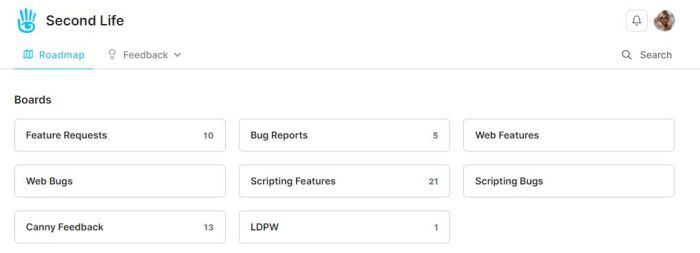
The latter is powered by Canny customer feedback software and tools. It was selected for a number of reasons, as the Lab note in their official blog post, not the least of which is the fact that Canny offers integration with Github, allowing requests and issues raised within it to be imported into the Github repositories (removing the need for cloning issues as is currently the case with Jira), combined with an improved set of triage tools. Other advantages with Canny are given as:
The ability to log-into the Canny tracking system via a user’s Second Life log-in credentials (as is the case with Jira now), thus maintaining its convenience of access / use.
Simpler forms for bug reports and feature requests, which may encourage more users to file issues / ideas.
Clearer navigation for non-technical users, making finding issues, etc., easier.
The use of multiple Boards to help categorise submissions and information.
Canny boards make navigation to specific subject areas – bug reports, feature requests, et. – easier
The ability to view a roadmap of activities and priorities.
Other advantages as noted by the Lab can be found in the official blog post.
The system has been undergoing testing, which has involved selected users, and feedback on it has been provided – although not all of it is particularly favourable. Some of the issued raised (such as the lack of file format options for attachments with only jpg, png, gif and webp supported) are understandable, particularly given these are unlikely to change in the near-future (if at all); others might simply be the result of a natural reluctance to enforced change. In this respect, the Lab is at pains to note that Canny is not a one-to-one replacement for Jira, and will require changes to established behaviours; how people adapt to this in practice is only something time will demonstrate.
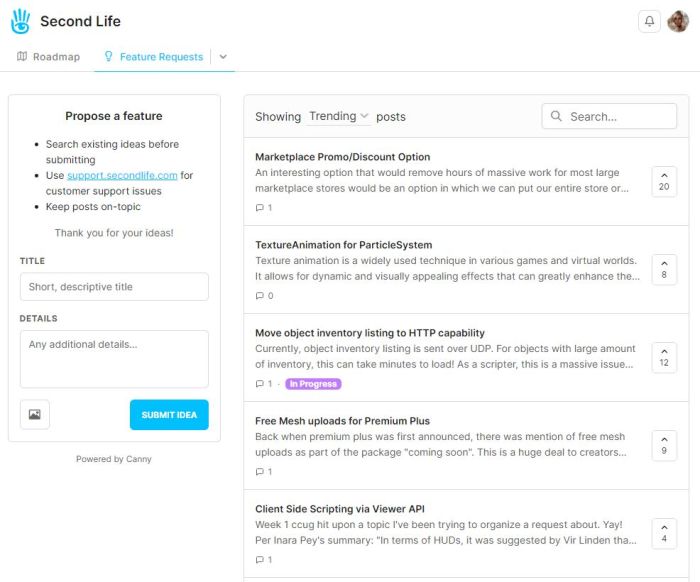
Second Life Feedback Portal – current feature request form (l) and list of open requests with search filters (top)
The switch-over to Canny / Github will now be rapid (by SL standards). The new Jira licensing is due to come into force in March 2024, and so the Lab has published the following timeframe for the transition away from it:
December 2023: generate a full archive of Jira and maintain until shutdown.
December 2023 / January 2024: migrate Jira reports to Github repositories. Soft launch of Canny and accept tickets via both Canny and Jira.
February 2024: provide information on accessing the Jira archive; shutdown Jira access and complete switch to Canny / Github.
Finally, as noted in the official blog post – these changes do not impact general Support / personal issues. These should still be reported to support.secondlife.com.
For my part, I have previously – with the Lab’s help – provided tutorials on filing both bug reports and feature requests. The not As the Canny front-end for filing either is considerably more straight-froward to use (and / or may be further enhanced based on user feedback), I will a) be disabling access to the Jira tutorials on this blog from mid-February; b) may provide a tutorial on using Canny, if this is found to be worthwhile.
Elvion, January 2024 – click any image for full size
January 2024 once more brings with it a further return of the ever-popular work of Bo Zano (BoZanoNL) and his SL/RL partner, Una Zano (UnaMayLi), with the latest iteration of their series of builds produced under their Elvion title. Once more ensconced within a Homestead region, the setting for early 2024 harkens back to some of the earliest designs Bo and Una put together for the enjoyment of SL explorers and photographers, presenting as it does a low-lying setting rich in Nature’s presence.
Designed around a large central body of water, this new iteration of the setting forms something of a circular route around the water, paths and trails meandering gently away from the landing point to the north and south, at times passing under the shade of trees and other over open grassland, turning gently with the flow of the land to pass over the waters either via broad bridges or narrow boardwalks. For the most part the land is flat, the only real “highlands” being a table of rock where water descends from a another large pool of water and into a wide inlet at the northern end of the setting and separated from the waters around which the land forms a broken ring.
Elvion, January 2024
Stone steps make their way up the west side of this plateau, allowing visitors to climb to the top and admire the view – or wade across the shallow water to where a bench might be used to observe the local heron and egrets as they await the passing of an unwary fish or two. However, I’d suggest that viewing this area is best done from close to the edge of the waterfalls; that way, when looking back over the water flowing towards you, it is possible to see how it appears to flow outwards from the off-region slopes and mountain that form a backdrop to the north side of the setting, giving the impression Elvion is part of a much larger landscape.
Nor is this upper pool the only place where waterfowl might be found; both the inlet and the lake within the lowlands are being watched over by heron, pelicans and egrets, as ducks and swans and geese swim on them. Given the presence of the former three, it would appear that the waters here are rich in fishy meals waiting to be caught. A houseboat floating gently among the reeds to one side of the lake might further suggest this; whilst it is now be a cosy little retreat for romantics, its not hard to imagine it once having been a places from which rods may have been cast.
Elvion, January 2024
The houseboat isn’t the only structure waiting to be found; away to the north and east, a refurbished shack sits upon a deck extending over the waters of the inlet; a place where kayaks sit on racks awaiting their owners’ return to take them back out on the peaceful waters. For now, however, it offers a set of places visits can use to sit and pass the time, the walls of the shack neatly separating them around three sides of the deck.
Across the water to the west, is the largest of the setting’s buildings. Its outward face suggests it may once have been a barn; but if that were the case, the large front door openings have long since been altered to form picture windows standing either side of a front door, whilst the inside of the building has been refurbished as little games room, complete with a billiards table, Greedy Greedy game and a corner couch and armchair for quiet chats.
Elvion, January 2024This barn-come-cabin guards the way to the steps leading up to the top of the waterfalls, but it is not the only guardian here; just offshore a lighthouse sits as a sentinel atop a thumb-tip of rock rising from the sea, the carcass of a wreck boat in the waters between it and the shore indicating the purpose it serve is warning vessels away from the shallows.
The last of the structures within the landscape is to be found a stone’s throw from the boardwalk linked the old houseboat with the eastern shore of the lake.
Elvion, January 2024
Nestled with its back to one of the two large, mixed copses of trees occupying the land, and faced on three sides by an aging wood fence with old stone cobbles Nature is slowly reclaiming lying between them and its front entrance, it is another building which has been refurbished. Once a wrought-iron and glass greenhouse, it now forms a bath-house complete with a cast iron tub over which a shower rises, its piping solid enough to support a ring from which curtains might be drawn around the tub to prevent the water from the showerhead spreading too far across the floor.
Whichever way you opt to wander from the west side landing point, it is clear that this iteration of Elvion is intended to calm and relax. There is an easy-going, unhurried look and feel to it, aided by the gentle flow of water and the wheeling of geese on the wing overhead which simply encourages gentle meandering, whichever path one opts to follow. This is further enhanced by the many places tucked away on either side of the trails to encourage folk to just sit and let the time pass unhindered, while the local horses do their part in offering further opportunities for photographers to frame their shots – or for the more artistically inclined, an easel and tricycle-cart laden with paints await.
Elvion, January 2024
Rounded-out with touches here and there which might remind those who have previously visited Elvion of those past designs, this is genuinely a natural and evocative setting, clearly designed with love for nature and open spaces. As always with Una and Bo’s builds, it offers a warm welcome and offers multiple opportunities for photography under both the default environment and many others – I use a number within the pictures offered here as evidence.
As always, Elvion is a highly recommended place to visit.
The following notes were taken from the Tuesday, January 9th, 2024 Simulator User Group (SUG) meeting. They form a summary of the items discussed, and is not intended to be a full transcript. A video of the meeting is embedded at the end of this summary, my thanks as always to Pantera for recording the meeting and providing it.
Meeting Overview
The Simulator User Group (also referred to by its older name of Server User Group) exists to provide an opportunity for discussion about simulator technology, bugs, and feature ideas.
They are open to anyone with a concern / interest in the above topics, and form one of a series of regular / semi-regular User Group meetings conducted by Linden Lab.
Dates and times of all current meetings can be found on the Second Life Public Calendar, and descriptions of meetings are defined on the SL wiki.
Simulator Deployments
No scheduled deployments, just region restarts.
It is hoped the issues with the Fall Colours simulator update (e.g. collision sounds reverberating) have now been addressed, and that these fixes will be deployed across all simulator RCs during week #3.
A further simulator update – Gingerbread – will be following thereafter.
Viewer Updates
The glTF PBR Materials Maintenance RC, version 7.1.2.7215179142 issued December 15th, 2023 and featuring numerous bug fixes and improvements (including haze / fog affecting point lights), was promoted to de facto release status on Monday, January 8th, 2024.
The Maintenance-W RC viewer comprising bug and crash fixes was updated to version 7.1.3.7453541295 on January 9th, 2024.
The rest of the official viewers currently in the pipeline remain as follows
Release channel cohorts:
Maintenance X RC, version 7.1.1.7088410646, December 7 – usability improvements.
Maintenance Y, version 6.6.17.6935642049, issued November 21 – My Outfits folder improvements; ability to remove entries from landmark history.
Puppetry project viewer, version 6.6.12.579958, May 11.
Jira End-of-Road
While yet to be formally announced, as a result of Atlassian changing their licensing model and making it prohibitively expensive for Linden Lab to continue using Jira as reporting tool open to all users, the decision has been taken to replace Jira as a the bug reporting / featuring request filing toll for Second Life.
In the very near future, Jira will be replaced by a two-pronged approach:
Bug reports will be taken directly though Github.
General feedback and feature requests will be made via Canny, from where they will be imported by the Lab as GitHub issues for the purposes of internal tracking.
Work is already underway internally to move existing open and incoming Jira tickets to Github, and it is anticipated that the switch-over to using Canny as well as Github will be made very soon. An official blog post on the switch-over is expected to be made either later this week or early in week #3.
The use of Canny has already drawn some strong negative feedback from technical users due to several limitation within the service as it has been developed. These concerns have been noted by LL, who are also providing feedback to the Canny developers.
However, it was noted that an advantage with Canny is that the Second Life environment there allows users to log-in to it using their SL credentials (just as is currently the case with Jira). However, Github doe not allow this, but requires uses to have dedicated accounts – with the concern this would like be seen as a objectionable requirement by many SL users.
Scripted Camera Control Updates
Leviathan Linden has been working on some LSL updates for camera control, which are expected to be deployed with the Gingerbread update in the next few weeks. These are:
float llGetCameraAspect(): returns aspect ratio as known to the camera on the server. Basically width/height of SL window.
float llGetCameraFOV(): returns “field of view” of the camera as known to the server, in radians. Is a measure of angle of view of the vertical span of the window.
vector llWorldPosToHUD(vector world_pos): returns HUD position that maps to the world-pos as seen by current camera as known by server. HUD attachment point doesn’t matter: the server figures it out.
string llComputeHash(string message, string algorithm): returns hash digest of message using the algorithm, without any “nonce salt” as in llMD5String(). Supported algorithms are: md5, md5_sha1, sha1, sha224, sha256, sha384, and sha512.
Concerns were raised over the float llGetCameraAspect() being used to “fingerprint” users (e.g. whether two accounts are being used by the same user) through returned information on window size & resolution. In response, it was pointed out the return is only the window aspect ration, which is regarded as more secure against such fingerprinting.
Game Control Update
Leviathan also encountered a bug in the game controller code he is developing which meant that sometimes bits could be lost in the button_edges argument supplied to the game_control event.
The fix for this has been a change to the game_control event signatures from game_control(key id, integer button_levels, integer button_edges, list axes) to game_control(key id, integer button_levels, list axes).
Thus, it will be the responsibility of scripters to compute button_levels as necessary. Scripters who want the edges will have to track a global variable previous_button_levels.
In Brief
Questions were asked about LL developing a “scripted UI”. These likely arose out people hearing second-hand some comments made at the first Content Creation User Group meeting. For fuller context, please see my notes from that meeting.
For all other topics, please refer to the video below.
† The header images included in these summaries are not intended to represent anything discussed at the meetings; they are simply here to avoid a repeated image of a rooftop of people every week. They are taken from my list of region visits, with a link to the post for those interested.
The Forgotten, January 2024 – click any image for full size
Back in April 2022, I came across The Forgotten, an engaging, highly-photogenic Full region designed by Elfie (then Elfing Shenanigans, now WeeWangle Wumpkins – such is the magic of Second Life Name Changes!). I thoroughly enjoyed my explorations at the time, as I noted in Finding The Forgotten in Second Life, and in sitting and contemplating the newly-installed bookcases in my cosily-refurbished home office, a stray thought wandered into my head about the region, leading me to consider hopping over and seeing what has changed – and so I did.
Obviously, 15 months is a very long time in Second Life, and it is likely that The Forgotten has gone through more than one iteration since my last visit. However, I was (genuinely) pleased to see that while the region is very different in looks to when I wandered through it in April 2022, there are still little touches here and there that if not carried over from the earlier design at least offer a sense of familiarity within the current situation, as if one had returned to a familiar country – if not a familiar place within that country.
The Forgotten, January 2024
In writing about my first visit to The forgotten, I noted:
Sitting under a dome of stars – or perhaps star stuff, given the fact the a massive full Moon hangs in the sky beyond – there is a sense of timeless age to the setting, together with a sense that it is a place where the tales of C.S. Lewis and J.R.R. Tolkien mix without being overly swayed by one or the other. Or perhaps mix is the wrong term – it is perhaps a place that combines the imaginations of both men to present a place they would both feel comfortable in walking through.
It’s a statement that holds true with the current setting – although I’d add that George R.R. Martin might also enjoy wandering through it with Lewis and Tolkien, as there is much within the region that offers (to my eyes at least) suggestions of the worlds he created as well (and I’m not simply saying that because of the presence of dragons within the region!).
The Forgotten, January 2024
The domed sky with its massive moon is one of the elements which helped with that sense of connection to the previous iteration of the region I visited, whilst the landscape offered something entirely new to explore, from the swamps mentioned within the About Land description, through the grassy trails and rocky climbs to the islands serenely floating in the sky in defiance of gravity (and they are not alone in demonstrating this skill!).
This is a place that offers itself as a book; the landscape seamlessly flowing from shore to shore, from landing point to tabled plateau, though wetlands and grasslands, leading the visitor through vignettes and elements which stand as chapters to a story, each one unique unto itself but also joined to those which came before and which follow after, their tales combining to draw the explorer onwards as the words flowing across written pages draw the reader deeper into their narrative.
The Forgotten, January 2024
And what might that story be? Well, that is not for me to say; such is the nature of the region’s design, the attention to detail – the considered use of trails to lead one onwards and the placement of rocks, hills and screens of tree to naturally details from the eye so as to increase our surprise on finding them – narratives and tales are bound to weave their way into the explorer’s imagination.
There is a richness of contrasting tones through the setting which further enhances its attractiveness. These take many forms; on the one hand, for example, the grassland is home to otherworldly creatures which might easily inhabit nightmares, yet up on one of the uplands bordering the grasslands a cheeky-looking little round babushka waits to offer you treats and savoury snacks and a place to sit and enjoy them. There are quiet places where romance might be had and others where butterflies weave their dance through the air, yet it is also a place where the tooth fairies are quite literal in form, and where paths marked by translucent tear-drop lamps or beautiful blooms of exotic plants end in places of potential dark or light magic.
The Forgotten, January 2024
It is also a place not without humour and simple delight; the former certainly helps to lead one on and up at the floating islands, whilst the latter can be found in a variety of ways and places, both large and small; who cannot smile on finding the mouse trying its paws at a little parachuting – while its friend looks on from the back of the bird which may well have carried them both to this branch for some daring-do.
Despite containing so much to see, be it out in the open or contained within the various ancient structures also to be found in the region or the caverns awaiting discovery, The Forgotten never feels crowded or overloaded. Indeed, such is the genius of its design that it feels anything but; the landscape allows all the various vignettes room to breathe on their own and be appreciated both apart from those close by and as a part of the region’s unfolding mystery.
The Forgotten, January 2024
Mystical, magical and in some places menacing, the Forgotten has no set path of exploration to follow; from the landing point people are free to wander where they please. Hence why any story that might suggest itself to the imagination it likely to be so personally unique. However, what I would advise is that when visiting you use the local environment settings (World → Environment → Use Shared Environment, if not already checked), and make sure you have local sounds enabled.
But above all, let your imagination take flight, and keep your eyes open for all there is to see and find!
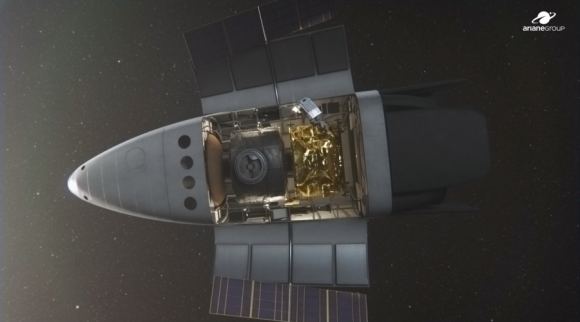
A screen cap of how ESA’s proposed SUSIE cargo / human-capable orbital vehicle might look in orbit. Credit: ArianeSpace
For 40 years, the European Space Agency (ESA) has been at the forefront of space innovation and exploration – although its work and contributions have oft been overshadowed by those of NASA and Russia -, and that drive to innovate is set to continue through the next decade and beyond.
To demonstrate this, on January 3rd, 2024, ESA issued a video showcasing upcoming projects and innovations which will help define the future of crewed and uncrewed voyages into orbit which are being driven from with Europe, either as direct ESA projects, ESA partnerships or ESA-supported private ventures. In particular, the 2:32 minute video (including end credits) showcases the following projects and launch vehicles:
0:26: Space RIDER: (Reusable Integrated Demonstrator for Europe Return) – a small-scale reusable lifting body supported by an expendable service module and capable of delivering 600 kg of payload to low-Earth orbit on missions of up to 2 months at a time. Payloads are intended to be experiments and science instruments, which the vehicle returns to Earth at the end of a mission. Designed to be launched atop ESA’s Vega-C launch vehicle, Space Rider will land horizontally, gliding to a landing under a parafoil, and the vehicle’s qualification flight is expected to take place in 2025.
An artist’s impression of ESA’s Space RIDER in orbit. The black module with solar panels to the rear is the vehicle’s expendable service module. Credit: ESA
0:33: Prime Micro-launcher – a UK-led (by Orbex) private sector launcher designed to leverage the growing cubesat market, and deliver up to 150 kg of payloads to 500 km Sun-synchronous orbit (SSO), primarily from the UK’s SaxaVord Spaceport in the Shetland Isles, and potentially from Portugal’s Azores International Satellite Launch Programme (ISLP) facilities, currently being developed on the island of Santa Maria.
0:44: Skyrora XL – a UK-developed 3-stage vehicle designed to place up to 315 kg into a 500 SSO from the UK’s SaxaVord Spaceport. Skyrora will be powered by its own in-house developed engines, including the Skyforce-2 70 kN motor, which is the focus of the video, and which uses liquid kerosene created from waste plastic as its propellant.
1:06: Isar Spectrum – a German-led project to develop a two-stage launch vehicle designed to deliver up to 1 tonne to LEO orbits out of Europe’s Spaceport at the Guiana Space Centre, Kourou in French Guiana, and up to 500 kg to SSO from the Andøya Spaceport, Norway.
1:26: second launch of Miura-1 – a Spanish-developed sub-orbital, reusable rocket system for flying experiments of up to 200 kg to altitudes between 80 and 110 km. The initial flight of the vehicle occurred in October 2023, but was only a partial success – range safety concerns limited the flight to less than 50 km altitude and the vehicle sank after splashdown, potentially due to its lower than intended altitude resulting in velocity-induced damage on impact with the sea. Once operational, Minura-1 will be Europe’s first fully-reusable launch vehicle and help pave the way for the Miura-5 orbit-capable launcher.
1:32: RFA-1 – a German-led project to build and fly a three-stage multi-role launch vehicle capable of delivering up to 1.6 tonnes to LEO, 1.35 tonnes to polar orbit or 450 kg to geostationary transfer orbit (GTO). The first orbital flight attempt is due to take place from the UK’s SaxaVord Spaceport in the summer of 2024.
1:52: Smart Upper Stage for Innovative Exploration (SUSIE) – potentially Europe’s most ambitious launcher vehicle development programme. A25-tonne lifting body intended to be launched atop the Ariane 64 booster, SUSIE – which is being developed for ESA by ArianeSpace – will be able to deliver either payloads of up to 7 tonnes to orbit when operating autonomously, or crews of up to five astronauts to orbital space facilities. The vehicle is intended to form the upper stage of the launch vehicle, requiring no fairings to protect it during orbital ascent. Following atmospheric re-entry, the vehicle will make a tail-first propulsive descent and landing in a manner akin to the DC-XA demonstrator vehicle, flown in the mid-1990s.
A comparison chart showing the proposed ESA SUSIE and the current crew launch vehicles operated by the United States and Russia. Credit: Ken Kirtland
Propulsion systems featured in the video include:
0:40: M10 liquid methane-liquid oxygen motor currently being developed for use on ESA’s future Vega-E booster by Italy’s Avio aerospace company.
0:50: Parafin-liquid oxygen hybrid propulsion – an in-development rocket motor by Germany’s HyImpulse, and designed to power the first and second stages of the company’s proposed SL1 launcher, designed to lift up to 500 kg to low-Earth orbit (LEO).
1:44: Prometheus – a reusable methane-fuelled rocket motor, currently in development on behalf of ESA and intended to power a reusable test vehicle called Themis, starting in 2025. Both Prometheus and Themis are intended to pave the way for the semi-usable Ariane Next, which will replace Ariane 6 in the 2030s.
Athena: a Space Engine in the Palm of Your Hand
One European innovation not featured in ESA’s video is the Spanish-developed Athena propulsion system. A palm-sized unit specifically designed to manoeuvre small satellites and cubesats once they are in orbit, thus helping them to become more flexible in the range of uses to which they might be put. And it does so in a highly innovative manner – via an electrospray.
An electrospray is an apparatus which uses and electrical current to disperse a liquid through an emitter. The idea itself is not new; its underpinnings were theorised in the 1960s by Sir Geoffrey Ingram Taylor, after whom the most ideal form the liquid is forced into under the influence of the electrical current – the Taylor cone – is named.
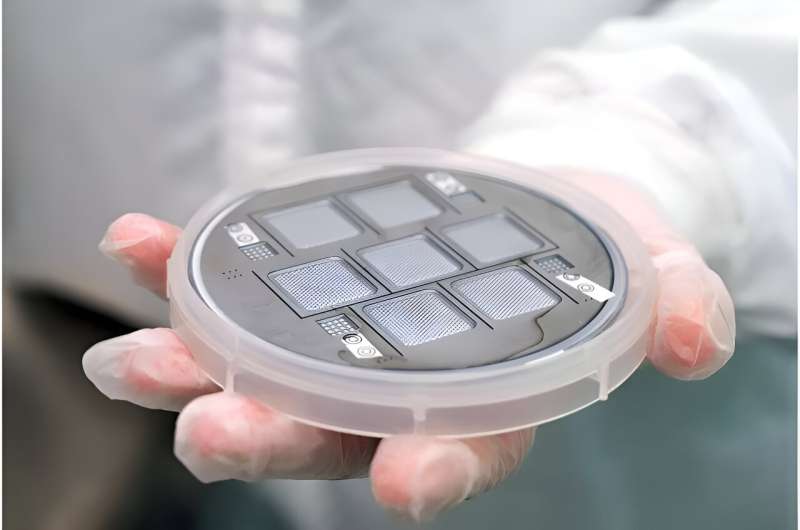
Sitting in a plastic handling tray, an Athena electrospray thruster system for smallsats and cubesats. Credit: IENAI Space
Electrosprays are used in a number of fields of science, and they have spurred the use of electrical currents to direct the thrust of cold gas thrusters on satellites However, what makes Athena (the name standing for Adaptable, THruster based on Electrospray powered Nanotechnology, rather than being drawn from mythology, as is the case with main space-related projects) so unique is a combination of its tiny size coupled with the use of a non-toxic propellant that does not require complex tank storage and pressurisation.
The system comprises a set of seven electrostatically charged thrust emitters, each about two finger tips across and containing an array of 500 pinhole-sized thrust ports each. A conductive salt is passed through these emitters, the electoral charge accelerating the particles and directing them into a cone of unified thrust which can be turned on and off by applying / removing the electrical current. The result is a set of tiny thrusters with practically no moving parts and a propellant which can be stored in a simple, compact container. This means that the overall mass of Athena thrusters and their propellant source is much lower than “traditional” cold-thrust systems, but they are capable of exceptionally fine control.
The current versions of Athena can be used on satellites of up to 50 kg, and can produce a sustained thrust of up to 20 m/s, if required. They are ideal for use on 10-cm-on-a-side cubesats, with the team behind them hoping to scale them up for use with smallsats of up to 300 kg mass.
Vulcan Set to Send Peregrine to the Moon
Monday, January 8th, 2024, is a major date for America’s United Launch Alliance (ULA), as the company seeks to successfully complete the first launch of its new Vulcan Centaur rocket.
Designed to replace ULA’s workhorse Atlas V and Delta IV rockets, Vulcan Centaur has had its share of hiccups and delays in getting to this point. This maiden flight had originally been targeting a 2019 date – although that was admittedly highly ambitious, given ULA only really started developing the vehicle in 2014 and hit some technical issues along the way as a result; other matters outside of ULA’s control – such as the SARS-COVID 19 pandemic and issues with the development of its payload – also contributed to the 4-year delay.
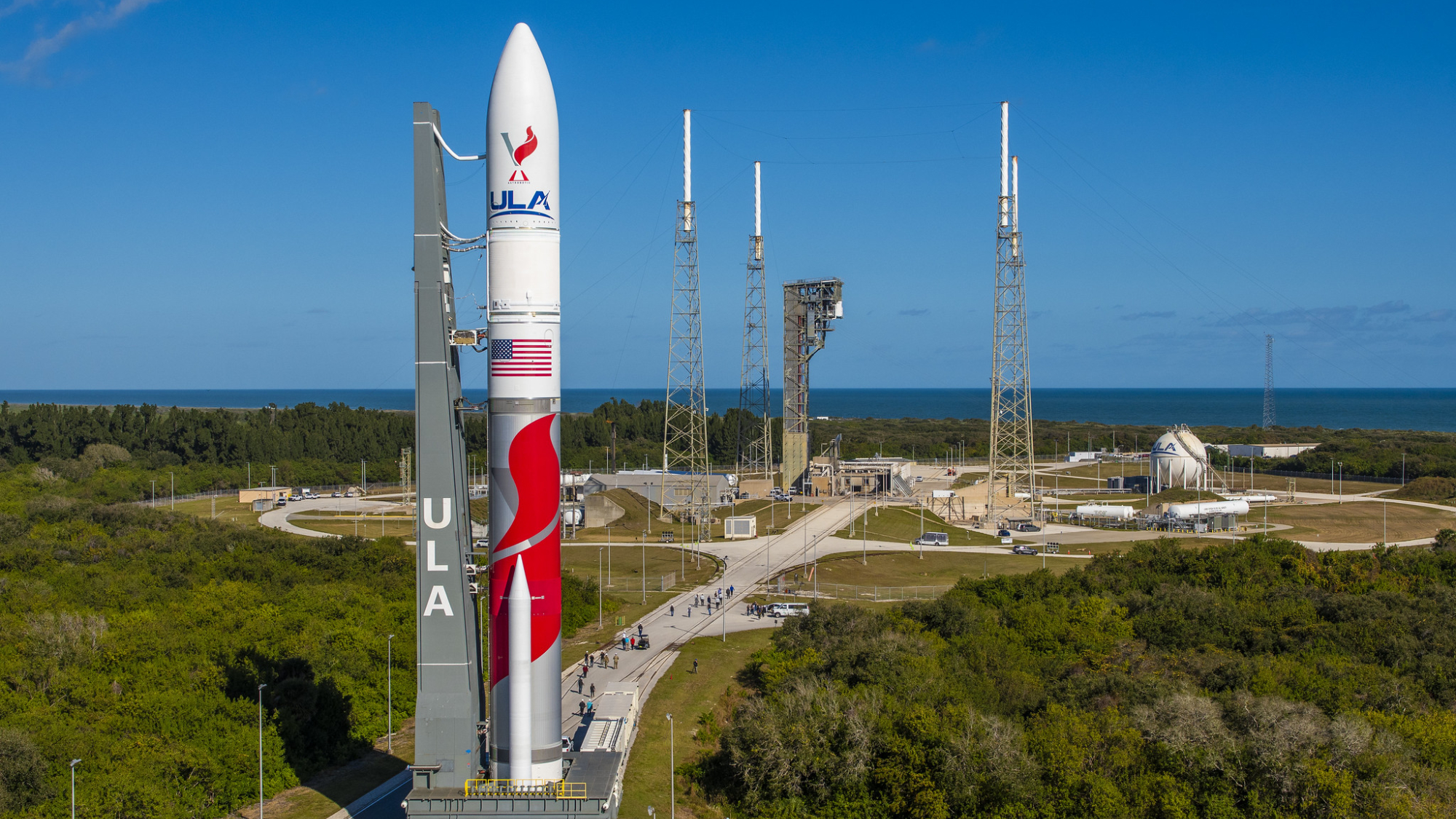
The Vulcan Centaur being transferred to the launch pad at Cape Canaveral Space Force Base, sitting on its mobile launch gantry, January 5th, 2024. Credit: ULA
For the company, a lot is riding on this launch. Technically referred to as a certification flight, rather than an operational launch, the two-stage rocket will nevertheless be carrying a functional payload in the form of Peregrine Mission One (aka Peregrine One). This is a privately-built but NASA-funded lunar lander, developed as a part of the agency’s Commercial Lunar Payload Services (CLPS) programme, designed to help pave the way for the agency’s crewed Artemis Moon landings with various robotic missions and vehicles supplied by the private sector.
The launch is designed to be the first of seven through the year, with the second (in April) serving as the final certification flight, although it will also carry a payload aloft in the form of the first Dream Chaser cargo vehicle to fly into space and delivery supplies and equipment to the International Space Station. After this, Vulcan Centaur will complete a series of US government military launches. Assuming this first flight is a success, and the same is true for the rest planned for 2024, they will vindicate the faith customers have in Vulcan Centaur – despite he delays in its development, the rocket already has 70 customers lined-up and waiting their turn to fly payloads aboard it.
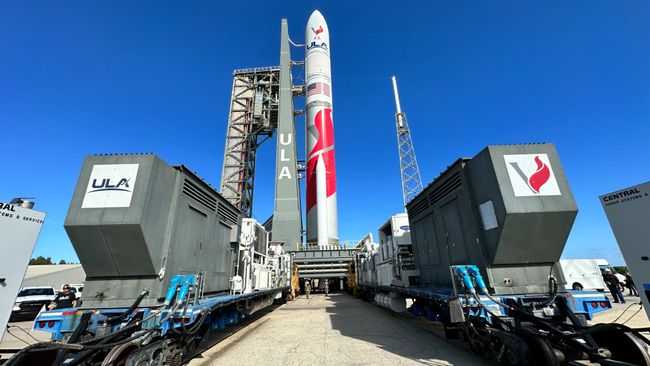
The first Vulcan Centaur to fly, seen on the pad from between the arms of the railcars used to move the rocket and its payload from the integration facilities. Credit: ULA
This maiden flight is important in two other ways as well. It will be the first operational use of the Blue Origin BE-4 engine. This the the engine that will be used to power the first stage of Blue Origin’s upcoming heavy lift launcher, New Glenn. The latter is due to make its maiden flight towards the end of the year, so the data gathered from this flight and those that follow between it and the first flight of New Glenn will provide invaluable data on overall engine performance for Blue Origin as they move ever closer to their own launch.
Finally, and as I’ve recently noted, ULA is apparently up for sale. Ergo, a good maiden flight for the Vulcan Centaur would significantly enhance the company’s attractiveness to its potential buyers – whilst equally, a failure could cause one or more of the trio of potential buyers to either rethink or withdraw their offer.
For Astrobotic Technology, the company behind Peregrine One, the launch is equally important; after proposing and subsequently cancelling two prior lunar missions, it represents the company’s chance to both become the first private venture space vehicle to (hopefully) land on the Moon and confirm their position as a capable supplier of lunar lander services to NASA (in fact, the company is due to fly a second mission to the Moon in November 2024, also funded via NASA’s CLPS and featuring NASA’s VIPER lunar rover).
Peregrine One will deliver 90 kg of mixed payload to Mons Gruithuisen Gamma in the northern hemisphere of the Moon. Comprising experiments from the United States and Germany, the payload also includes time capsules from both of those nations, plus Argentina, Canada, Hungary, Japan, the Seychelles and the UK, as well as small rover vehicles – Iris, built by Astrobotic Technology and Carnegie Mellon University, designed to be a technology demonstrator; and Mexico’s Colmena, a set of 5 tiny little rolling landers, each just 12 cm across and weighing 60 grams, which will be catapulted from the lander and operate wherever they roll / bounce to.
The Peregrine Mission One lander undergoing preparations for integration into its payload fairings at the Astrotech Space Operations Facility near Kennedy Space Centre. Credit: NASA / Isaac Watson
If successful, Peregrine Mission One will likely be followed by two further Peregrine-class landers in additional to the November 2024 Griffin Mission One which will carry NASA’s VIPER rover, as mentioned above. Each of the follow-up Peregrine landers will carry increasingly heavier payloads, thus demonstrating the lander’s overall capabilities.
In the meantime, objections to the Peregrine Mission One landing have been lodged by the Navajo Nation. Their objections have been raised as the lander will carry a sealed container bearing DNA samples from Star Trek creator Gene Roddenberry and his late wife, Majel Barratt-Roddenberry (Christine Chapel from the original series / Lawaxana Troi from The Next Generation / Deep Space Nine and the voice of the computer in both the original series and The Next Generation), and DNA samples together with memory files and some of the cremated remains of Star Trek actors Nichelle “Uhura” Nichols, James “Scotty” Doohan and Deforest “’Bones’ McCoy” Kelley). In particular the Navajo Nation state that placing human DNA on the Moon would desecrate a sacred place. In response, it has been pointed out by some associated with Peregrine Mission One that human DNA is already present on the surface of the Moon in the form of human waste contained within the 100 bags of waste material collectively dumped out of their vehicles by the six Apollo crews who landed on the Moon between 1969 and 1972, whereas the container of DNA as remains will stay within the lander vehicle, and will not be deposited on the lunar surface.
The Vulcan Centaur launch is scheduled for 07:18 UTC, Monday, January 8th, 2024 from Cape Canaveral Space Force Base at the start of a 45-minute window, and will be livestreamed on You Tube. Further launch opportunities are available at 24-hour periods through the 9th to 11th January, with launch windows of between 1 and 9 minutes. Assuming the launch goes ahead as planned, the lander will depart Earth orbit 1 hour and 18 minutes after launch, boosted by the Vulcan Centaur’s upper stage. It is due to land on the Moon on February 23rd, 2024.







 Inara Pey: Living in a Modemworld