Nitroglobus Roof Gallery, January 2025: Kitten – Nude
In modern times, nudity in art – particularly photography – tends all too often conjure images leaning towards the pornographic, or which are at least intended to titillate. Yet the history of the female nude, from art through to photography, is both ich and varied, and has been accepted differently by various cultures and societies down the ages in reflection of the social norms of each.
As well as being associated with the more risqué / erotic, female nudity in art can be linked to subjects as broad as the study of anatomy through depictions and interpretations both religious and mythological to the expression of ideal beauty and aesthetic perfection. But there is another aspect of of female nudity in art: the expression of vulnerability – even of innocence.
Nitroglobus Roof Gallery, January 2025: Kitten – Nude
This is very much the case with Nude, the opening exhibition for 2025 at Dido Haas’ Nitroglobus Roof Gallery. The work of Kitten (Joaannna), this is a stunning selection of pieces which are both highly personal – as Kitten notes – and which again demonstrates her skill in presenting images that are both marvellously artistic and highly emotive.
I’ve long admired Kitten’s work, and covered a number of her exhibitions, and have always been drawn to her use of monochrome / black-and-white, which she marries with a panoramic format which holds the eye. Here she uses both, combining them with a considered use of focus and cropping to present a series of twelve utterly captivating studies, each with a story of its own to tell, and most offered in a perfect, minimalist style.
Nitroglobus Roof Gallery, January 2025: Kitten – Nude
Over the five years seen has been involved in photography – which started in 2020, Kitten’s abilities and style has grown in leaps and bounds to the point where – to me a least – she is one of the foremost visual storytellers in Second Life arts. So much so, that alongside Scylla Rhiadra, she is one of the two Second Life artists I most admire for their ability to inhabit their work with a strength of narrative, meaning and emotion.
In this, Dido herself deserves acknowledgement; she has the ability to challenge artists to move outside of their comfort zones, to experiment, to reach into new areas of expression. Since first being challenged by Dido in 2022, Kitten has grown immeasurably in her ability to express through her art, and Nude perhaps represents her latest pinnacle, revealing not just her avatar as a nude, but her own vulnerability.
Nitroglobus Roof Gallery, January 2025: Kitten – Nude
An altogether exquisite exhibition, one which deserves time to see and consider.
Logos representative only and should not be seen as an endorsement / preference / recommendation
Updates from the week through to Sunday, January 12th, 2025
This summary is generally published every Monday, and is a list of SL viewer / client releases (official and TPV) made during the previous week. When reading it, please note:
It is based on my Current Viewer Releases Page, a list of all Second Life viewers and clients that are in popular use (and of which I am aware), and which are recognised as adhering to the TPV Policy. This page includes comprehensive links to download pages, blog notes, release notes, etc., as well as links to any / all reviews of specific viewers / clients made within this blog.
By its nature, this summary presented here will always be in arrears, please refer to the Current Viewer Release Page for more up-to-date information.
Note that for purposes of length, TPV test viewers, preview / beta viewers / nightly builds are generally not recorded in these summaries.
Official LL Viewers
Release viewer: version 7.1.11.12363455226. formerly the ExtraFPS RC, dated December 17, promoted December 19 – No change.
Malice in Wonderland, January 2025 – click any image for full size
I’ve covered a lot of regions inspired by, or in tribute to, Lewis Carroll’s Alice books. There are several reasons for this; such regions are oft highly imaginative, for example; I also particularly enjoy much of the nonsense and quirkiness with the stories, which helped end a period of literature in which it was believed all children’s stories should be didactic rather than being entertaining, and they are rich in allusions and symbolism. So, when I came across a region with intriguing name Malice in Wonderland, complete with an equally engaging description:
Not quite Wonderland, the place perhaps where Alice gave into her Malice? This destination is a fantasy, sci-fi, post-apocalyptic, wonderland. Swim with mermaids, drink at the Cantina, and avoid the rains of the run-down streets. Secrets abound to explore.
– Malice in Wonderland Destination Guide entry
Malice in Wonderland, January 2025
The work of July Foxglove, Malice in Wonderland more than lives up to the rich and enticing mix of of genres and ideas promised it the description; so much so that while there are clear references to Alice and elements of Carroll’s stories, the region contains so much more, such that a better description for the region might be found in July’s Profile:
Malice’s Wonderland 2.0.
Is it finished? never will be – it’s a work of my madness! Its my second avatar! But with many more attachment slots!
– July Foxglove
Malice in Wonderland, January 2025
What is evident as one starts to explore this world sitting under an astounding night sky is that just as it has been born freely of the imagination, so too does it require an open imagination to fully appreciate all it has to offer. Surrounded by a mountainous region surround into which it blends, Malice in Wonderland is not so much a single setting as it is a series of settings – vignettes and chapters, if you will – containing their own story or stories. Many of these are in plain view and easy to find, others are hidden away and require discovery; all of of it quite marvellous to witness and photograph.
To walk through the region in words would actually be pointless simply because it is genuinely a place that should be experienced first-hand. To help people get around, the region has a Stargate-style system of ring transporters with a list of destinations. Most can be reached on foot and by keeping eyes open for ramps, tunnels, elevators and the like; however, several can only be reached via the teleporter system (such as V’s Apartment, the Tardis, the ballroom, for example), so use of it is recommended during visits (accept the system Experience) if required.
Malice in Wonderland, January 2025
Routes (and, one might say the roots) of exploration commence from the Land Point, as one might expect. Taking the form of a subway station, this offers an obvious exit up to ground level, exiting into the rain-drenched setting of a small town which in turn anchors an interconnected archipelago of island floating overhead. However, check the tunnel mouths either side of of the portrait of Malice at the Landing Zone and you’ll discover why I reference “roots”.
A further way of getting around is using the various zip lines dotted around the settings, so its is worth keeping and eye out for them as well.
Malice in Wonderland, January 2025
Within the ground level space it is possible to find a very steampunk Tea Party, bubbling streams, a winter scene, nightclub, a stunning model of a certain spaceship for which I have a lot of affection (and had me singing about not being able to take the sky from me 🙂 ), an X-Wing whose pilot is liable to see his or her insurance premiums go up, the rain-drenched town, to mention a few of the more obvious points of interest. There’s also a tree house and a deep quarry with another series of secrets awaiting under the surface of the water – possibly best reached via the teleport rings.
Above this, the floating islands offer multiple vignettes (including an actual Stargate), reference to popular fairy tales, a floating bridge leading to a manor house where time can be spent – and where two of the zip lines can be found, one leading down into the quarry while another provides an alternate route to the manor house from the other end of the floating islands.
Malice in Wonderland, January 2025
When exploring, keep an eye out for the smaller vignettes, the use of art (2D and 3D) and the rich mix of genres and ideas. As noted I don’t want to go too much into specifics here, as exploring and encountering really is the best way to fully appreciate all this region has to offer, underground, on the ground and above the ground (can you find Mjölnir, for example? Or Cthulhu? How about Little Red Riding Hood?). However, there is a slight spawn issue with the mini subs, when you find them, which means they may not allow you to sit &require resetting to Guest mode. Keep an eye out as well for the Stargates (upright and laid flat); touching one will offer URL listing regions – enter a destination using local chat as “/d [region name]” – without the quotes – to teleport to the region.
I do recommend using the local environment setting when visit Malice in Wonderland, and also in setting aside as much time as possible to explore – even if you split it over several visits, because it really is the kind of place where just as you think you’ve discovered everything, you find something else.
Artist’s concept of the Rocket Lab Mars Ascent Vehicle lifting-off from its lander vehicle, carrying samples collected by the NASA Perseverance rover. Credit: Rocket Lab
Returning samples from Mars is proving difficult for NASA to get sorted – which, considering plans of various forms have been under consideration since before Apollo 11 landing on the Moon, might sound confusing. However, early proposals for such a mission were hampered by the fact that the density of Mars’ atmosphere was unknown, making the analysis of preferable vehicle masses and trajectory options to achieve a successful atmospheric entry somewhat difficult.
Things became easier in this regard following the successful Viking mission landings in the mid-1970s, but there were still significant technical issues to overcome – such as the number and type of vehicles required to reach Mars, land safely, obtain samples get them safely back to orbit and from there back to Earth.
A 1993 concept for a Mars Sample Return mission using ISU – the use of the Martian atmosphere to produce the propellant the sample capsule (top of the vehicle) required to achieve orbit – in order to try to reduce mission complexity and mass. Credit: NASA
Such were the complications involved that even as relatively recently as 2002, some at NASA felt that skimming a vehicle through the upper reaches of the Martian atmosphere and which used an aerogel to collect samples that would include high-altitude dust would be a easier proposition than trying to gather samples from the planet’s surface.
Also since the early 2000s, efforts have focused on the potential for international / joint efforts to recover samples from Mars, perhaps the most notable being the proposal NASA-ESA sample recovery mission, intended to recover sample tubes deposited on Mars by NASA’s Mars 2020 Perseverance mission.
However, even this has suffered from spiralling costs – in part due to an increasing reliance on complex technologies. By 2022, the mission required no fewer than five vehicles (not including Perseverance): a sample retriever lander + ascent vehicle (NASA); a sample return vehicle (ESA); and a sample collection lander and rover combination (ESA) – later replaced by two Ingenuity-class helicopters to – gather sample tubes deposited by Perseverance. This complexity and cleverness resulted in the cost estimates for the mission surpassing US $11 billion by April 2024, with the return of any samples collected by the Mars 2020 mission unlikely to occur before 2040.
A concept rendering of the original NASA/ESA Mars Sample Return mission showing the ESA Mars return vehicle (top right), the ESA sample recovery rover (centre) and the NASA sample lander / MAV combination (right). The Perseverance rover is show on the left as the collector of the samples. Note that Earth is shown for reference only, and is not to scale. Credit: NASAAs a result, NASA sought alternate architectures to complete such a sample return mission possible, turning to external expertise as well as looking to its own capabilities. The idea here would be to reduce costs and return samples gathered by Perseverance in a more reasonable time frame than 2040.
On January 7th, 2025, NASA announced it intended to spend a further 18 months studying two alternate architectures by which to recover sample caches created on Mars by Perseverance. One leverages technologies developed by NASA, whilst the other involved commercially-developed technologies, with both utilising the existing proposal for the European-built Earth Return Orbiter (ERO) from the mission architecture outlined above to return the gathered samples to Earth.
The principle difference between the two options is that the NASA option proposes using the “skcrane” system sued to which both the Curiosity and Perseverance rovers to deliver the same recovery lander / ascent vehicle onto the surface of Mars, whilst the second would utilise a commercial “heavy lander”. Exactly what form this would take is unclear from the NASA statement – however, both Blue Origin and SpaceX have tried to muscle-in on the mission, suggesting the use of variants of their Blue Moon and Starship lunar landers. In both mission outlines, Perseverance would be used to deliver sample tubes to the sample return craft.
A comparison of the size of the existing design for the MSR lander (right) with a smaller concept proposed by JPL that can use the proven “sky crane” landing system. Credit: NASA/JPL
Exactly how much of an improvement / cost reduction these two methodologies will bring over current plans is very debatable; NASA’s own estimates put the two options at a cost of between US $7 and $8 billion – which is about the same as original estimates for the NASA-ESA proposal at the time when it was already causing concerns, having risen to US $7 billion from an intended cost of US $4 billion. Further, NASA suggests that while either approach might achieve a sample return by 2035 – a more likely timeframe is 2035-2039; hardly any improvement at all over the current 2040 timeframe.
Hence why, perhaps, Peter Beck’s Rocket Lab has placed a formal request with the incoming Trump administration to re-examine sample return mission options rather than green-lighting the updated NASA approach. This is because Rocket Lab – at NASA’s request – has developed a completely alternate sample-return architecture designed to fit NASA’s requested mission cap of US $4 billion, whilst potentially returning the sample to Earth by 2031/32.
The Rocket Lab Mars Sample Return mission concept. Credit: Rocket Lab
Whilst on the surface as complex as NASA’s joint approach with ESA, the Rocket Lab mission is actually far more direct and lightweight, comprising a total of three launches from Earth, and six vehicle elements. These comprise:
The Mars Telecommunications Orbiter (MRO): this would offer an orbital communications relay for the rest of the mission – and other Mars surface missions.
The Mars Entry and Descent System (EDS): an aeroshell vehicle carrying within it the Mars Lander and the Mars Ascent Vehicle (MAV).
The Earth Return Orbiter (ERO), which includes the Earth Entry System (EES).
Rocket Lab’s mission would proceed as follows: a Rocket Lab Neutron launcher is used to send the MRO to Mars. This is followed by to further Neutron launches, one for the EDS and one for the ERO. On arrival at Mars, the MRO arrives first, entering an orbit where it can act as communications relay. The EDS then makes a direct atmosphere entry, protecting the lander / MAV through the heat of atmospheric entry prior to the lander making a parachute descent and propulsive landing.
A photo montage of ten sample tubes set on the surface of Mars by the Mars 2020 rover Perseverance as a cache for possible return to Earth by a sample return mission. Credit: NASA
The latter will be made close to one of the sample caches created by Perseverance, allowing it to collect up to 20 sample tubes (depending on the size of the cache) – although how this will be done is not fully defined in the rocket Lab proposal. The sample tubes are delivered to the MAV on the top of the lander, the MAV using the lander as its launch pad to return to orbit.
Once in orbit, the MAV rendezvous with the ERO, transferring the sample container to the ERO, which sterilises it using onboard systems as it returns the container to Earth and uses the EES to deliver the sample container back to Earth’s surface.
While Rocket Lab might seem an unlikely candidate for a Mars Sample Return mission when compared to the likes of SpaceX, the company arguably has a lot more experience with the technologies required for such a mission. The company has supplied elements used within several Mars missions from the Mars Science Laboratory onwards – including developing solar arrays for power, support systems to maintain vehicles while en-route to Mars, and build the EscaPADE Mars orbiters and their support bus, and re-entry technologies being utilised by other companies.
The six vehicle elements of the Rocket Lab MSR proposal, forming three distinct launch vehicle payloads. Credit: Rocket Lab
It’s not clear how the incoming NASA Administrator (whether it be Jared Isaacman or someone else) will respond to Rocket Lab’s request; a lot, in this regard, might be dependent upon how much influence Elon Musk – whose SpaceX, like it or not, still very much depends upon NASA and government contracts for its survival – welds over NASA’s decision-making in the coming months.
Big Birds Set to Fly
Two significant launches are due to take place in the coming week, one of which could mark the entry of a significant new player in the space launch market.
Blue Origin’s massive New Glenn vehicle, of carrying up to 45 tonnes of payload to orbit – although for the most part it will likely carry far less than that – is due to lift off from Space Launch Complex 36 at Canaveral Space Force Station at 06:00 on Monday, January 13th. It’s a mission I’ve written about extensively already, but there is a lot riding on the broad success of the mission in delivering its upper stage and payload to orbit.
New Glenn on the SLC-36 launch pad at Cape Canaveral Space Force Station in Florida, in December 2024. The flight is now targeting a January 13th launch. Credit: Blue Origin
New Glenn has, from the outset, been designed to fulfil a wide variety of roles, from delivering individual and multiple satellite payloads to orbit and to places like the Moon, through to playing a crucial role in helping Blue Origin and its partners establish their planned Orbital Reef space station, to even carrying out human-rated launches. As a payload launcher, it will – subject to a second qualifying flight after this one – be used for US government launches as well carrying out commercial launch operations.
This first flight will carry a prototype of Blue Origin’s Blue Ring orbital vehicle as the payload – although it will not separate from the vehicle’s upper stage – and will attempt a recovery of the core booster on the landing recovery ship Jacklyn, some 1,000 km off the Florida coast.
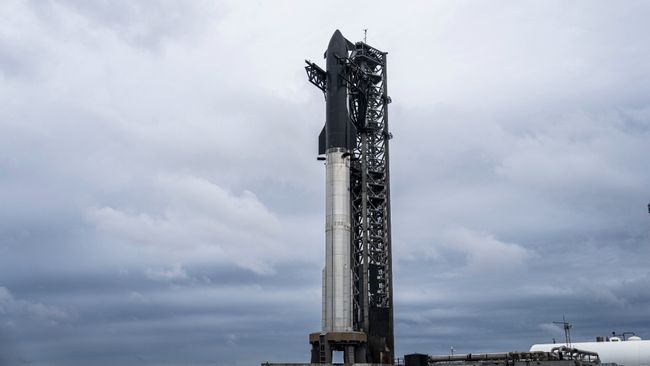
Some will likely point to Wednesday, January 15th as being more important, as it is on that day at 22:00 SpaceX is due to carry out the seventh integrated flight test of their Starship / Super Heavy behemoth, featuring the first flight of their Block 2 version of the Starship vehicle. This features revised forward aerodynamic flaps (used to control the vehicle during its fall through the atmosphere), a 25% increase in propellant load, a 3.1 metres increase in length and an updated thermal protection system.
SpaceX Starship 33 stacked on top of Booster 14, ahead of the seventh orbital flight test, currently targeting a January 15th launch. Credit: SpaceX
Overall, the flight should follow a similar format to Flight 6 – attempting a recovery of the booster at the launch site and the Starship vehicle splashing down in the Indian Ocean. However, a test of the thermal protection system and the deliberate exposure of parts of the vehicle to the heat of re-entry might result in its complete loss. This flight will also see the first attempt to deploy Starlink communication satellite “simulators” from the payload bay.
Starship, with its stated payload capability of up to 100 tonnes far outclasses New Glenn in lifting capabilities – but contrary to SpaceX fans, this actually does not guarantee the vehicle is destined for commercial success once it reaches any form of operational status beyond being a Starlink delivery mechanism. A lot in this regard depends on the price-point for launches with the system, and the continuing downwards trend in the size and mass of many classes of satellite which make smaller, low-cost launchers potentially far more attractive for such launches (I’m deliberately ignoring the claims that Starship is about opening Mars to colonisation, as that had a world of issues in its own right).
I’ve have a report on the flights – assuming they go ahead – in the next Space Sunday.
Like many of us who have become engaged with Second Life, Stevie Basevi has seen her involvement in the platform grow over the years, branching and flowering in numerous directions; from content creator to estate holder (she has been responsible for the 3-region Sanctuary RP Community, for over 16 years), to working extensively with the American Cancer Society (14 years), One Billion Rising, and Seanchai Library’s Special Projects Creative team.
In all of this her appreciation of, an involvement with, the Second Life art scene has often featured in her in-world activities. As a result of this exposure to the broader community of SL artists, Stevie has come to see in-world photography as a means to explore a new avenue of creative expression, and an opportunity to connect with SL on more of an emotional level as she travels the grid.
Stevie Basevi at BOSL, January 2025
A growing confidence in her work, complimented by studying via the Visionaire Institute, encouraged Stevie to start exhibiting in Second Life for herself, joining in with ensemble exhibitions as well as presenting her own solo exhibits (and launching her own gallery in 2022).
Several of the latter have been within the BOSL Innovation Pavilion curated by Jamee Sandalwood, which has featured Steve’s work in exhibitions within the main gallery space, as well as a solo exhibition within the smaller (and cosier) Waterfront Café gallery. And it is at BOSL where Stevie now has a new gallery space.
Stevie Basevi at BOSL, January 2025
Located within the region’s shopping precinct, Stevie’s gallery space sits alongside that of Jamie Sandalwood, allowing visitors to witness works by two very excellent Second Life photographers who have each made a name for themselves in landscape photographer (although both Stevie and Jamie’s portfolios cover much more).
For her first display at the new gallery, Stevie presents a collection of images celebrating both winter and the holiday season. These are engaging pieces, presenting scenes we can all appreciate, often offered with muted tones which reflect the season as much as the settings captured within them. From reindeer grazing in the snow to brooks and streams bubbling through snow-frosted landscapes and avenues white with winter’s delights, and which include Santa enjoying a little off-duty fun, these are all pieces ready to engage the eye and offer unique and beautiful views of familiar places within Second Life.
Stevie Basevi at BOSL, January 2025
And when you’ve visited it, why not hop over to her main gallery?
After the Rain, January 2025 – click any image for full size
Note: After the Rain has been updated to become Sous Les Oliviers – read here for more, and the SLurls here have been updated to the new landing point.
Ely (Elyjia Baxton) recently opened a new Full region design entitled After the Rain, and as always with her work, it is an absolute delight to visit, explore and photograph, being packed with detail. It is also a setting with a couple of related venues about to come on-stream, although at the time of my visit, one had only “soft” opened, and the other was still being finalised.
I’ve covered Ely’s work extensively in this blog – all the way back to some of her earliest co-designs, in fact; and it has been an absolute pleasure to be able to witness and share in her growth as a noted and visual region designer in that time, and After the Rain continues to demonstrate her skill in presenting richly engaging and photogenic locations.
After the Rain, January 2025
This is a place offering everything from a bustling little town through quiet country walks and rural retreats to a coastal fishing harbour, passing by way of livestock farming, natural parkland and cosy homes, all without ever feeling overcrowded or cramped.
Immerse yourself in the enchanting world of After the Rain, a place of tranquillity and beauty. Discover a quaint little town, a charming harbour, and welcoming homes. Stroll along trails that wind past picturesque farms and peaceful rest areas. Whether you’re looking for a place to relax, explore, or simply admire the view, After the Rain is the ideal retreat. Every nook and cranny is designed to offer you an immersive and soothing experience, away from the hustle and bustle of the outside world. Let yourself be swept away by the magic of After the Rain; here every visit is a new adventure.
– After the Rain Destination Guide description
After the Rain, January 2025
The Landing Point sits in the south-east corner of the region, where lies the little town. Small it might be, and with the buildings largely unfurnished, the town still has a feeling of life about it, and (Land Capacity allowing) it might yet see a little décor entering some of the shops. This aside, the streets are certainly decorated and offer nice touches of detail.
Follow the cart track north from the town and you’ll pass by the park offices and the hilltop park with its cosy places to sit. Winding on, the track reaches to a covered bridge passing over one of the many channels and bodies of water breaking up the landscape. It is here that the farmstead might be found. With the house furnished and plenty of little details scattered around the horse meadow and barns, there’s a lot to take in here.
After the Rain, January 2025
Carry on westwards along the track, and a slightly rickety bridge provides access to another farmstead where sheep and chickens are being raised, prior to the track reaching the little fishing harbour.
However, before carrying on the the harbour, take a moment to wander through the garden of the farmhouse; you’ll find stone steps rising to a rugged and wooded headland carrying on it signs of abandoned use: a broken greenhouse, abandoned furniture and a deserted cabin and outhouse crouch among the trees and rocks, largely ignored by the stream tumbling and bubbling through the headland to drop into one of the region’s larger bodies of water, overlooked by a comfortable camp site.
After the Rain, January 2025
A second way out of the town lies under the umbrella-hung archway down the steps from the Landing Point. Here, the cobbled street passes an outdoor market and up to an impressive covered square and its nearby stone bridge standing tall over the same body of water as the covered bridge mentioned above. Beyond this stone bridge one might find a cottage with a charming view over another body of water, the region’s lighthouse (again furnished), and walks among the trees and uplands on this southern side of the region.
All of this barely scratches the surface of After the Rain, given I’ve skipped over many of the little touches – from wildlife to places to sit, indoors and out – some of them on the water or tucked away – to cats and horses and sheep, to a richness of flora throughout. However, two I really should mention are the café and music venue, both of which, at the time of writing, had yet to formally open – although the café is available for visits.
After the Rain, January 2025
The Loulou Café sits on the north side of the region on square of land which, but for the two short causeways reaching out to it, is close to becoming and island in its own right. Presented within a wild garden and offering its own indoor and outdoor seating, the café is available for people to visit, and its terraces and ivy-hung walls, welcome visitors who find it by watch of the parkland or the horse farm. I understand from Ely that it will be used for a music event venue in time.
Located in the sky over the café, Loulou club. Yet to open to the public, this presents a fusion of avant-garde and art deco stylings with a fusion of techno and retro in a manner which both captures the eye and reflects the kind of music it will offer once open: deep house, prog house and electro, and will feature DJs and live performers.
After the Rain, January 2025
I’m not sure when the club is due to open – the best way to find out is perhaps to visit the region and see when the club is accessible (or ask Ely – there is no Group to currently join).
That said, whether or not you’re interested in joining events at the club, After the Rain is a must-see setting for anyone who enjoys exploring Second Life; you’re not going to be disappointed. My thanks to Cube Republic for the pointer!