Logos representative only and should not be seen as an endorsement / preference / recommendation
Updates from the week through to Sunday, June 23rd, 2024
This summary is generally published every Monday, and is a list of SL viewer / client releases (official and TPV) made during the previous week. When reading it, please note:
It is based on my Current Viewer Releases Page, a list of all Second Life viewers and clients that are in popular use (and of which I am aware), and which are recognised as adhering to the TPV Policy. This page includes comprehensive links to download pages, blog notes, release notes, etc., as well as links to any / all reviews of specific viewers / clients made within this blog.
By its nature, this summary presented here will always be in arrears, please refer to the Current Viewer Release Page for more up-to-date information.
Note that for purposes of length, TPV test viewers, preview / beta viewers / nightly builds are generally not recorded in these summaries.
Official LL Viewers
Release viewer: version 7.1.8.9375512768, formerly the Graphics Featurettes RC viewer dated June 5 and promoted June 10th.
It was back to the Kondor Art Centre, operated and curated by Hermes Kondor, for my second visit to the Kondor Art Museum, which saw the opening of its second four-month exhibition of 2D and 3D art; one which features 2D artist-photographers who are, in my opinion, some of the most expressive in the of field presenting work in Second Life.
The exhibition opened on June 23rd, 2024, the exhibition answers a question I cogitated during my first visit in February (see: The Kondor Art Museum in Second Life): would the Museum feature just the one set of exhibitions, or offer a rotating series of exhibits? For this four-month run, the Museum features pieces by Mihailsk, Monique Beebe, Hermes Kondor, Selen Minotaur and Scylla Rhiadra, with a selection of Ilyra Chardin’s charming 3D figures awaiting discovery at the entrance and in the main foyer.
To the left of the museum (as you enter the foyer), Scylla presents La Danse Des Petits Rats. However, this is not a celebration of small rodents jiving (or performing other dances), as the name might suggest; rather it is a celebration of the work of French artist Edgar Degas (July 1834 – September 1717). Often referred to as an impressionist painter, despite the fact he often despised the impressionist movement with its focus on “bright” colours and use of artificial light, Degas is probably best known for a series of paintings he produced from the late 1860 through the 1880s focused on the young dancers studying at the School of Dance at the Paris Opera who were referenced as the Little Rats.
Kondor Art Museum, June 2024: Scylla Rhiadra
No-one knows exactly where the name originated, although the likes of Balzac claim that the romantics saw the rat as a creature to be held dear – small and inquisitive, but able to mature into a “tiger” or “panther”, powerful and lithe – just as the young students at the School of Dance started out urchin-like, maturing into a lithe dancers, their moves fluid and graceful.
Whatever the origins of the term, Degas’ paintings of the Little Rats stand as a history of the students at the School of Dance – from painting the dancers during a performance, he moved to producing “behind the scenes” paintings showing the dancers backstage, in rehearsal or being taught. In doing so, he provided insight into the secrets of ballet training, the paintings becoming extremely popular. At the same time, the series also helps to mark the artist’s own evolving style as a painter. Within her exhibit, Scylla offers A celebration of Degas’ style – his use of colour and light (both of which do stand him aside from his impressionist peers) and, like his original studies of the Little Rats, pay homage to them and their growing mastery of the art of ballet.
Kondor Art Museum, June 2024: Mihailsk
Connecting to Scylla’s exhibition and running around the back of the museum is that of Mihailsk, who is one of the most expressive single-frame storytellers in Second Life. Emotive, often rich in metaphor as well as shooting straight from the hip, Mihailsk’s work spans both colour and monochrome, the stories wrapped within them.
On the upper floor, Monique presents something of a retrospective of her avatar-focused photography, which – as with Mihailsk – is generally centred on her own avatar and marvellously expressive and rich on both narrative and, frequently, a degree of subtext. Her exhibitions tend to be thematically driven and often highly sensual in nature, and the latter is clearly observable in several of the pieces in this collection – and should potentially be regarded as NSFW.
Kondor Art Museum, June 2024: Monique Beebe
At the risk of repeating myself, Selen is also a richly expressive artist, often working to a theme or idea, the pieces she produces richly layered both in terms of their use of colour and elements and in terms of their meaning / interpretation. As with Moni, the items presented in this collect form a retrospective of her work from 2020 through 2024.
Rounding out the exhibition, and located at the front of the museum and to the right of the entrance is Beach Time, a quite marvellous collection of monochrome photographs by Hermes, celebrating summer at the beach.
Kondor Art Museum, June 2024: Selen Minotaur
Engaging, beautifully presented and ideal for appreciating / purchasing, these 2D exhibitions make for a worthy visit, with Ilrya’s characters bringing the charm of their own visit to the museum. Those visiting can also wander the Kondor Art Garden outside of the museum, which is again hosting an exhibition of AI art by Milena Carbone.
The Boeing CST-100 Starliner Calypso docked at the Harmony module of the International Space Station during the Crew Flight Test mission. Two of the thruster “doghouses” which have been the source of issues, can be seen amounted on the service module. Credit: NASA
Boeing’s CST-100 Starliner spacecraft will now not depart from the International Space Station (ISS) until sometime in July at the earliest. The decision was announced by NASA on June 21st, marking the fourth such delay in the vehicle’s return to Earth during its Crew Flight Test, which lifted-off from Cape Canaveral Space Force Station, Florida, on June 5th, for what should have been a test flight of roughly a week’s duration.
Following a flawless launch and arrival in orbit, and as reported in these pages (see: Space Sunday: Bill Anders; Starliner &; Starship), the vehicle started to encounter further issues with its propulsion system, with further helium leaks (the cause of a number of delays ahead of the launch), together with faults with five of the reaction control thrusters as the craft approached the ISS for docking. However, these were largely resolved prior to docking – although problems with the helium purge system associated with the thrusters suffering leaks of decreasing size has continued to be a problem.
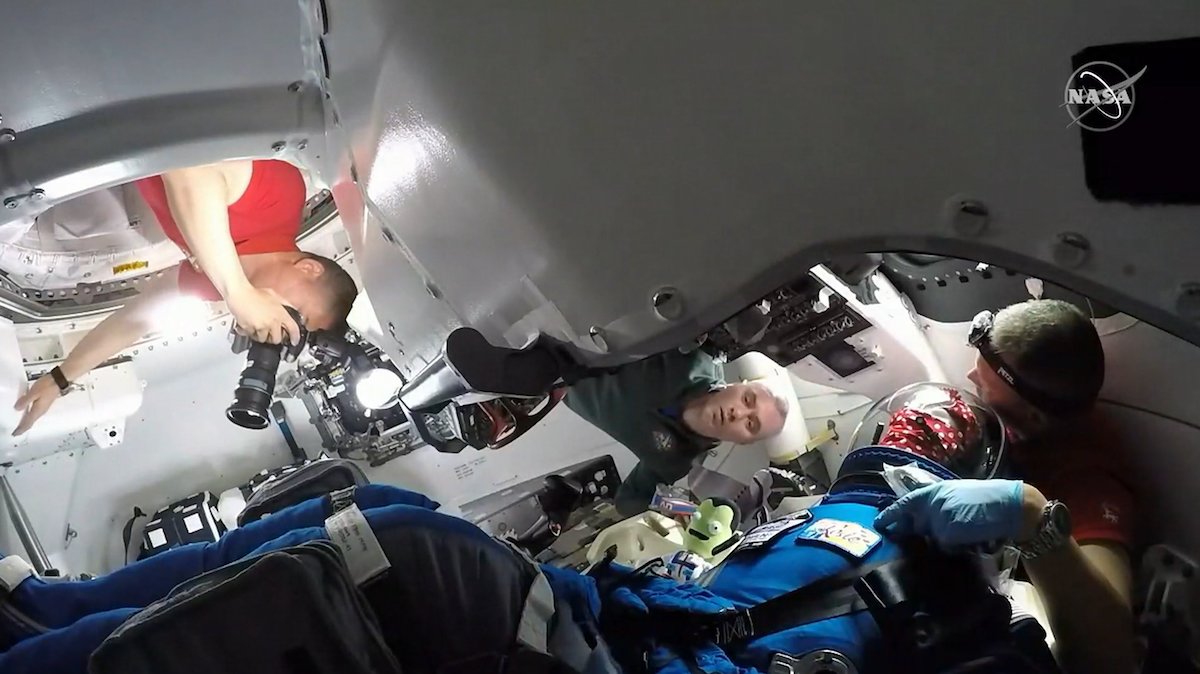
Members of the ISS Expedition 71 crew – NASA astronaut Kjell Lindgren (with the camera), Roscosmos cosmonaut Denis Matveev (centre) and astronaut Bob Hines (behind “Rosie the Rocketeer”, a sensor-laden mannequin which also flew on the uncrewed Orbital Flights Tests with Starliner), explore the CST-100’s cockpit. They were the first people who did not fly on the vehicle to enter it while in orbit. Credit: NASA / Roscosmos
However, despite claims made by some, the delays are not the result of the vehicle being “unsafe” or “broken”; simply put, they are to allow NASA and Boeing to carry out multiple additional tests on the thruster systems – including multiple test firings whilst docked at the ISS – and delve deeper into the issue of the helium leaks.
This is particularly important as the thruster systems will not be making a return to Earth; as a part the vehicle’s service module they will be discarded to burn-up in the upper atmosphere. Ergo, NASA and Boeing want to be sure that as much data has been gathered to facilitate further post-flight investigations. This is particularly important for the problematic systems, as they will not be returning to Earth: as they are mounted on the outside of the vehicle’s service module, they will be detached prior to the capsule’s controlled re-entry into the atmosphere and left to burn-up with the rest of the service module.
No date has been given for any return following the latest postponement, NASA stating they are being data-driven in making decisions, not date-driven. However, as the Expedition 71 crew have had to postpone two EVAs to accommodate Starliner’s continued presence at the ISS, and these need to go ahead at the start of July.
A final consideration for the vehicle’s return lies with the landing sight – the so-called “Space Harbour” at White Sands, New Mexico. NASA and Boeing would rather the landing there takes place under certain lighting conditions, if possible, so that cameras, etc., can gather as much data as possible as well. These opportunities occur every 3 or 4 days, allowing for the ISS being in the correct position in its orbit in order for Starliner to depart it and arrive over its landing site to meet those conditions during its descent.
Virgin Galactic Pauses Sub-orbital Flights; Announces New Astronaut Selection & Seeks to Boost Share Price
It’s a busy old time at Virgin Galactic, the sub-orbital space company offering both private and commercial sub-orbital flights to the edge of space.
On June 8th, 2024, the company’s only operational space plane, VSS Unity, undertook its seventh – and final – passenger-carrying flight, this one was a mix of the company’s commercial research flights and a tourism flight, marking the first time the two have been combined into a single Virgin Galactic flight, research flights having previously been carried out as dedicated flights. The mission also marked Unity’s 12th flight overall to sub-orbital altitudes.
The Virgin Galactic Mothership, VSS Eve, takes to the air from Spaceport America, New Mexico, with the SpaceShipTwo vehicle VSS slung underneath it, June 8th, 2024. Credit: Virgin Galactic
Galactic 07 featured Turkish research astronaut, Tuva Atasever, the second Turk to flight into space via a private mission – the first being Alper Gezeravcı, who flew to the International Space Station (ISS) during the Axiom Space Ax-3 mission in January 2024 – and it was Axiom who arranged for Atasever to fly with Virgin Galactic. He was joined by space tourists Andy Sadhwani, a principal propulsion engineer at SpaceX who previously did research at NASA and Stanford University; Irving Pergament, a New York real estate developer and private pilot; and Giorgio Manenti, an Italian investment manager living in London.
Atasever carried out a total of seven research experiments related to medicine and health, and also oversaw automated payloads from Purdue University to study propellant slosh in microgravity, and a 3D printing experiment from the University of California Berkeley, both of which were flown under the NASA Commercial Flight Opportunities Programme. The flight, which reached an altitude of 87.5 km, was commanded by Virgin Galactic veteran Nicola Pecile, making his fourth flight, with rookie Jameel Janjua, on his first spaceflight, as pilot.
Virgin Galactic founder Richard Branson (left) and company CEO Michael Colglazier (right) with the Galactic 07 astronauts: Andy Sadhwani, Irving Pergament, Giorgio Manenti and Tuva Atasever. Credit: SpaceNews/Jeff Foust
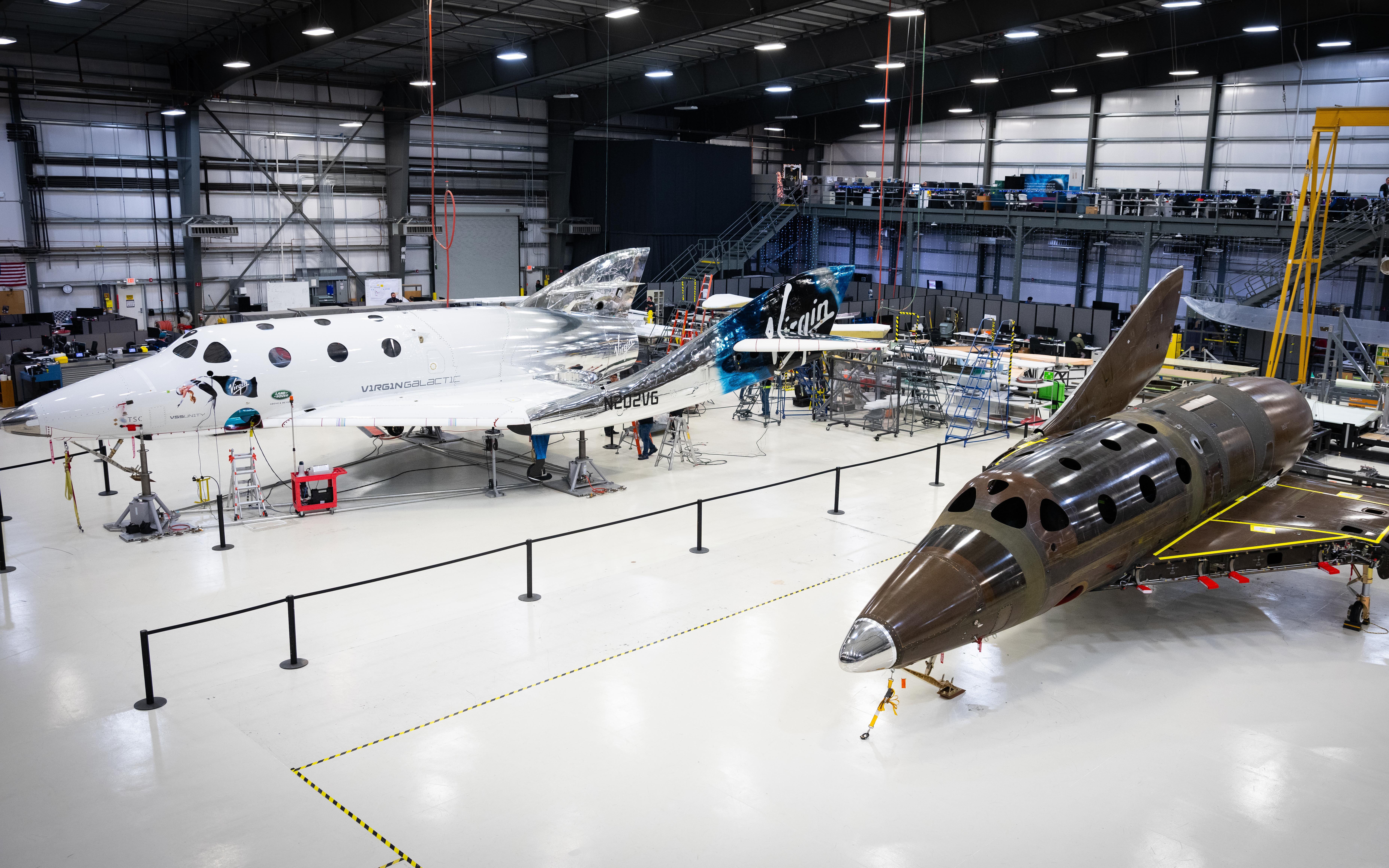
It has been previously announced that Unity would be retired from active service in mid-2024. However, at the time of that announcement – November 2023 – it had been assumed that the company could be switching to use their new SpaceShip III craft. These are visually identical to the SpaceShipTwo vehicle type represented by VSS Unity, but with an evolution of flight systems. In all two vehicles in the SpaceShip III class has been unveiled: VSS Imagine and VSS Inspire. Imagine was rolled-out with great fanfare in 2021, and had been due to commence flight testing in 2022/23, but this never happened.
With the June 8th flight of Unity, the company confirmed that the SpaceShip III project had been cancelled, and neither Imagine or Inspire will fly; instead being relegated to the role of ground test articles. Instead, the company will not focus on their next generation of space plane, the Delta Class.
VSS Unity (background) undergoing servicing, with the fuselage of Spaceship III VSS Imagine in the foreground, June 2020. Credit: Virgin Galactic
The Delta vehicle is said – again – the be visually the same as the SpaceShipTwo and SpaceShip III vehicles; however, the airframe has been completely redesigned to make much greater use of composites, much updated avionics and the ability for vehicle fabrication to be sub0contracted out so that Virgin Galactic only has to focus on final vehicle assembly, operation and maintenance. As such, it is expected that the Delta vehicles will be easier to manufacture and have much lower manufacturing, operational and maintenance costs. The first Delta vehicle(s) are due to be delivered for testing in 2025, with commercial flights using the first of them commencing in 2026.
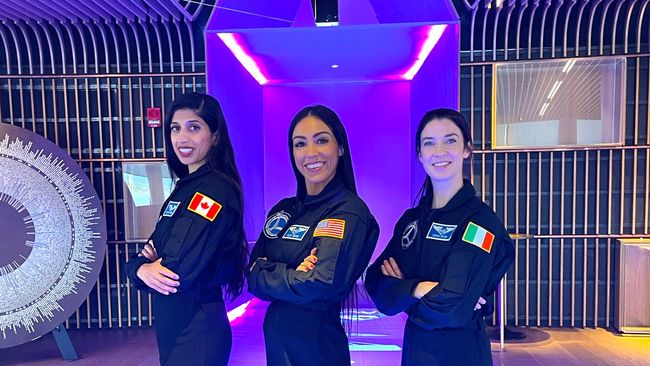
If all goes according to plan, one of the first Delta class flights will feature an all-female research team flying with it, in the form of US national Kellie Gerardi, who flew aboard Galactic 05 in November 2023, along with Canadian Shawna Pandya and Ireland’s Norah Patten. All three are part of the non-profit International Institute for Astronautical Sciences (IIAS), whose mandate includes testing technologies in suborbital aircraft and performing educational activities. Together, they will expand on research that Gerardi (also IIAS director of human spaceflight) performed during Galactic 05, focusing on fluid behaviour with applications to human health.
Three private astronauts assigned to fly one of the first Delta-class missions with Virgin Galactic, representing the International Institute for Astronautical Sciences.(l to R): Shawna Pandya (Canada); Kellie Gerardi (USA); Norah Patten (Ireland). Credit: Virgin Galactic)
Despite a string of successful space tourist and commercial flights, Virgin Galactic has not been without financial issues; one of the reasons for the switch away from the SpaceShip III vehicles to focus solely on Delta is to reduce overall expenditure. More particularly, the company’s share price has tumbled from a peak of US $50 a share (2021) to around US $0.85 a share – meaning the company has been trading at below the New York Stock Exchange’s (NYSE) minimum share price of US $1.00. Because of this, they have been given 6 months to reverse matters or be removed from listed on the exchange.
As a result the company is – with board approval – going ahead with a 1-for-20 share reversal , meaning 20 existing share will become a single share, increasing its value by a factor of 20. It is hoped that this will, combined with the US $870 cash and equivalents the company holds, be sufficient to see it move forward to starting-up flights with the Delta vehicles. Virgin Galactic hope that flights with just two Delta Class vehicles will yield around US $450 million in revenue.
Voyager 1 on 4; Hubble on 1
An illustration of one of the twin Voyager spacecraft now in interstellar space. Credit: NASA/JPL
Two of NASA’s longest-running space missions, the Hubble Space Telescope and Voyager 1 having been facing troubles of late, as reported in these pages, which have proven equally hard to resolve, but for very different reasons.
With Voyager 1, the issue is that of distance: it is the most distant human-made object from Earth so far ever made; so far away, that two-way communications take almost 48 hours. The bad news is that in November 2023, the vehicle started returning gibberish to Earth during routine communications. The good news is that, as I reported in April 2024 (see: Space Sunday: Rocket Lab, Voyager, Hubble and SLIM), the root cause of the issue had been identified and corrected, leaving engineers and scientists to bring the craft’s remaining four science instruments back on-line.
On June 13th, 2024, the space agency announced all four instruments – which measure plasma waves, magnetic fields and particles in interstellar space – are back on-line, gathering data, and that data is being correctly transmitted to Earth without being converted to garbage.
In order to get things running solidly, the final step to returning Voyager 1 to a fully-operational status was a full communications sub-system software update: the first time an interstellar software update has every been carried out.
However, the news that Voyager 1 is once again telling us about the interstellar medium has been a bittersweet moment, coming has it did two days after the announcement that Edward C. “Ed” Stone, the man who oversaw the entire Voyager project from its formal inception in 1972 through until 2022, had passed away.
Ed Stone lead the Voyager programme from its formal inception in 1972 through until 2022. He passed away on June 9th, 2024, just before Voyager 1’s science capabilities were fully restore. Credit: NASA/JPL
Allowing for declining energy from its decaying from their plutonium-238 power supplies (and the degradation of the thermocouples that turn the heat from that decay into electrical energy), both Voyager 1 and Voyager 2 should be able to continue to transmit data through until 2030 – or even the mid-2030s -, although it is possible than one or more of the remaining instruments on either will have to be turned off in the intervening time.
For Hubble, meanwhile, the issue is not distance, but capability; in short, and again as I’ve previously reported, while the telescope might be operating in Earth orbit, we no longer have a vehicle suitable for rendezvousing with it in order for astronauts to swap-out worn-out parts or make other repairs. Again, as I reported in the Space Sunday edition linked-to above, one of the most delicate elements of the telescope is its gyroscopes – vital for pointing the telescope and maintaining its stability.
Normally, Hubble requires three gyros – which is good, because for the just few years, it has had only three of its original 6 in reasonable working order – and one of those has been unwell, as reported in the Space Sunday linked-to above. As that gyro cannot be reliably recovered, NASA made the decision to alter operations so that Hubble only uses a single gyro – the other of the remaining two being held in reserve.
The Hubble Space Telescope captured this image of the galaxy NGC 1546 while in single gyro mode. Credits: NASA, ESA, STScI, David Thilker (JHU)
As a result, a new technique has been developed to ensure the telescope can correct point itself at targets and remain steady during imaging, and the results of initial testing are more than promising. On June 20th, NASA released an image of NGC 1546, a galaxy 50 million light-years away. Capturing such an object at such a distance requires both precise pointing and rock-steady stability: and Hubble managed both, revealing the galaxy in as much detail and clarity as if it had been operating on all three gyros.
This is great news for deep-space operations with Hubble, and means the telescope can once again keep producing good science; but there is a price. Pointing and steady the telescope means that Hubble’s operational has to be cut by 25%, and it cannot track objects moving a reasonable speed – such as comets and asteroids inside the orbit of Mars. Even so, better that, than losing Hubble altogether.
Endless: Antipodes, June 2024 – click any image for full size
I received an invitation to visit a further iteration of Endless: the Full private region featuring designs by Sombre Nyx and Jackson Cruyff – my thanks to Jackson for said invitation.
The last time I visited, Sombre had used a physical world location in New Zealand as an inspiration for her design (see: An Endless: Birdlings Flat in Second Life). This time around, she sticks with the idea of an antipodean location, but where it might be relative to you in the world is a matter of choice; the setting sits equally well in most northern / southern latitudes as thus could also be west or east as well, depending on your place in the world.
Endless: Antipodes, June 2024
An island at the end of the world, where seething seas break against the rocks of the coast. Where craggy and low, rugged hills offer views to forever. Where rural life is quiet, but full, and nothing really matters but the moment.
– Endless: Antipodes About Land
As the About Land description indicates, this is a craggy, rugged location, one island among a small group. The flora on the island – mostly scrub and grasses, interrupted here and there by lonely trees – the one close-knit grouping of trees being mangroves sprouting up from the wetlands on the island’s eastern side. Such is the lie of the land and its blanket of flora, it gives no clue as to its possible latitude or longitude, although it is not unfair to say it is probably outside of tropical and most sub-tropical climes.
Endless: Antipodes, June 2024
The arrival point lies toward the western side of the island, sitting on a shoulder of land separating two shallow bays with sandy beaches, one of which appears suitable for bathing, sheltered as it is from northern winds by a further high-shouldered promontory extending out into the sea. A footpath runs out along this headland, and also forms a track running eastward along the bluffs above the north coastline. As it does so, it crosses what appears to be the former course of a stream that once tumbled to the sea from higher ground, then descends towards the eastern coastal lowlands.
A wall has been build over the rocks of the coastline here, helping to ensure the sea and land remain separated and allowing the former to become a level setting for a homestead farm, complete with an orchard alongside it. The farmhouse has the look of having been long since been converted into more of a cosy retreat than a place of work (although the apples from the orchard are very clearly being cultivated / harvested); the integral barn is now a bedroom and outdoor decks provide additional living space – their presence suggesting the island perhaps does not suffer from too much in the way of really inclement weather.
Endless: Antipodes, June 2024
This house is one of three on the island, the spines of hills separating it from its neighbours one of which lies on island’s far side, the other more directly to the south. A small, rough beach sits to one side of the farm, and the path continues from close bay, this time following the east coast as curves around a bay cutting deeply into the island, home to the wetland and mangroves mentioned above, and its mouth guarded by a small isle. Whether the studio is used by whoever occupies the little farmhouse or not is open to question, as the path continues on to the house on the south side of the bay, putting it within easy reach of the studio isle, whilst its design and décor perhaps suggest the aesthetic of an artist has been at work inside.
The remaining house is very much a place of work – a barn with tractor and feed for livestock, etc., lying just up the hill from it and a chicken coop betwixt the two. Whoever lives here likely owns the sheep found scattered across the island. As well as the sheep, the island is something of a home for birds, including herons and kingfishers as they carefully keep an eye on all the comings and goings across the land.
Endless: Jack’s Canyon, June 2024
Such is the design of the setting, it is easy to arrive and just wander; however, there is also a ground-level teleport system (starting at the arrival point) to help guide people around the major points of interest for those who prefer. Rezzing is open for photography props, with auto-return set to 30 minutes – but do please clean up yourself if you use the option.
Jackson’s location – as with his past joint designs with Sombre – occupies a sky platform overhead. It takes the form of another rugged setting – perhaps part of one of the island seen off the coast of Sombre’s setting. A short walk from the landing point the land is cut through by a deep gorge, clearly formed by the erosion of the water pouring into it from one end, before making its way seaward but not quite entering open waters. Instead, a natural rocky breakwater block overland progress – but given the water simply hasn’t risen to overcome the barrier, one might assume there are submerged routes passing under the rock that allow it to escape.
Endless: Jack’s Canyon, June 2024
This gorge gives the setting its name: Jack’s Canyon, and forms the focal-point for explorations. Invisible from ground level, it is a little like Rivendell, only opening to view when practically on top of it. Unlike Rivendell, the gorge has a man-made path in the form of a wooden board walk and ladder descending into it, the top of this walk forming a deck close to the one building in the setting: a small wooden cabin.
This route down into the gorge is overlooked by a further deck extending out from the west cliffs, whilst the seaward end is watched over by two tall rock formations, one of which also looks down on a small camp site sitting on a broad lip of rock and grass forming a step in the cliffs on the west side of the canyon (another little camp area occupies a further lip close to the bottom of the canyon as well). Wildlife in the form of bears, boars, wolves, foxes, cranes and eagles are to be found throughout the setting, all of which perhaps suggest this is a location more in the northern hemisphere – but wherever you choose to place it (if at all), there is no doubting its natural beauty. So much so, that even a time-traveller appears to have dropped in for a bit of a look around!
Endless: Jack’s Canyon, June 2024
Like Antipodes, Jack’s Canyon includes a local teleport for hoping between the local arrival point and the canyon floor. However, this is not directly connected to Sombre’s Endless: Antipodes; both the ground level setting and the canyon are only linked via the common landing point in the region – hence why no SLurl earlier in this article – which must be pass through when moving between the two.
With both locations offering local sound scape and various opportunities to sit and relax and / or take photographs, they can be enjoyed individually or jointly – and my thanks again to Jackson for the invite!
Second Life marks its 2st anniversary in 2024, with a month of activity kicking-off through until Sunday, July 21st. Celebrations will be taking place across the Birthday regions in Second Life, and and with previous years includes live music, DJ sets, art, shopping (via the dedicated Shop and Hop event), exhibits by Linden Lab and – particularly – exhibits by Second Life residents and communities.
The following is intended to provide a general overview of the celebrations and provide calendars, SLurls and anything else that might be useful to you when visiting the regions.
IMPORTANT NOTE: many of the builds at SL21B, particularly the stages, etc. have been built using PBR materials, and the skies are rendered as HDR. Therefore, to see the regions at their best, you should preferably be running a viewer that is “PBR enabled.”
SL21B Welcome Area
Theme
This theme for Second Life’s 21st birthday (SL21B) has been given as Elements, which the Lab describes thus:
This theme invites us to explore the fundamental components that make up our vast virtual landscape and the diverse communities within it. From the fiery passion of creators and artists to the fluid adaptability of our social environments, from the solid bonds within our communities to the fresh breezes of innovation that propel us forward, “Elements” is a celebration of the core forces that shape our experiences in Second Life.
As per usual, SL21B will feature a series of events featuring various members of the Lab’s Board, management team and advisors. These will be a mix of live and pre-recorded sessions, per the schedule below.
Tuesday June 25th 13:30
Product and Engineering Town Hall
Senior VP of Product & Engineering Grumpity Linden; Director of Engineering Second Life Server & Viewer Signal Linden; Director of Engineering Web & Platform Kali Linden; Senior Product Manager Sntax Linden; Product Manager Kyle Linden.
Wednesday June 26th 13:30
Product Operations Town Hall
Linden Lab Executive Chairman Oberwolf Linden and Senior VP of Product Operations & Marketing Patch Linden.
Entertainment and Performances
Over 500 live performers are lined-up to perform across four stages at SL21B between Friday, June 21st and July 1st. The complete schedule can be seen below.
The Nimbus Stage
The Welcome Area
Never been to an SLB event before – try starting at the Welcome Area where you’ll find lost of help, things like the SL21B Hunt HUD, and more!
The Tapestry of Time and Gift Area.
First presented in 2018, the region-wide Tapestry of Time presents visitor with a walk-through of Second Life’s history from 2003 through to the present day using images, text and videos. True, not everything has been recorded, but there’s enough within the region to be of interest to the historically minded.
within the Tapestry of Time can be found the SL21B Gift Area, offering gifts from the Birthday exhibitors and from merchants participating in the Shop & Hop event.
Exhibitor Regions
via Linden Lab. Click for exhibitor list
As is common for SLB events, the mix of content is varied, and the representation of interests broad. Role-play groups, arts, communities, are represented across the nine regions open to exhibitors; some are static, others are interactive in nature.
Direct links to the exhibitor regions can be found in the SLurls lists at the end of this piece.
Note that teleport boards are available at the centre of all Exhibitor regions for easy of moving between them.
Adult Exhibitor Regions And Adult Shop and Hop
2024 sees the Adult content and groups exhibitor regions combined with the Adult Shop and Hop regions and the Once again, the celebrations include Adult content and groups, with exhibits at the event, with four dedicated regions – separate to the main exhibitor regions – open to visit. These have a dedicated Teleport Hub sitting kitty-corner admits the four regions, and I’ve also included individual region SLurls at the end of this article.
SL21B Last Names and Physical World Merchandise
To mark the event, Linden name available a special series of SL21B themed last names focused on the theme of “elements”. Also launched to mark the event is a range of SL21B merchandise for the physical world, including t-shirts, baseball caps, tote bags, laptop sleeves, pins, mug note books and more.
The following notes were taken from my audio recording and chat log transcript of the Content Creation User Group (CCUG) meeting held on Thursday, June 20th, 2024.
Meeting Purpose
The CCUG meeting is for discussion of work related to content creation in Second Life, including current and upcoming LL projects, and encompasses requests or comments from the community, together with related viewer development work. This meeting is held on alternate Thursdays at Hippotropolis.
Not strictly a Content Creation tool / subject, but of import to SL as a whole.
Summary
A project intended to replace the Vivox Voice system with the WebRTC communications protocol (RTC=”real-time communication”).
Will see the removal of the SLplugin.EXE from the viewer, to be replaced with a library wrapper within the viewer.
Offers much better and more flexible voice support across platforms, with improved capabilities (e.g. automatic echo cancellation, automatic gain control, better noise cancellation) with better audio sampling / quality.
Also opens the door to adding new features and capabilities to SL Voice, some of which have been long-requested.
Care is being taking to address potential security issues (e.g. preventing eavesdropping, exposing users’ IP address (by using an internal proxy server), etc.).
During the transitional period as WebRTC is deployed on the back-end and gradually made available by viewers, support will be provided for both Vivox and WebRTC (i.e. if you are using a viewer using the Vivox plug-in, you will connect to voice via Vivox, and if using a viewer with WebRTC, then that protocol will be used.
Both Vivox and WebRTC work together, but their may be some initial limitations / issues until the project is fully deployed and the switch made.
Feature requests for WebRTC made via the WebRTC board on the SL Feedback Portal are being evaluated and some are being actioned, together with issues being investigated.
Status
There is a Project viewer available on the Alternate Viewers page. Thus is expected to to to Release Candidate status very soon.
The server support is currently available on the region WebRTC on the main grid.
The focus is currently on getting the viewer code up to release status so it can be adopted by TPVs, with a gradual deployment of the server code, however, it is unlikely the latter will be widely deployed until after the viewer code has been more fully adopted.
That said, this is something of a priority project, likely to be fast-tracked as much as possible.
Graphics / glTF
Terrain
Cosmic Linden is working on PBR terrain custom repat controls allowing for improved Texel densities to help reduce the “stretching” of textures of elevation changes) and better support 2K textures.
Most of the viewer work for this is now almost complete, but is awaiting simulator-side support on Aditi in order to be offered in a test viewer.
There is a more general bug where PBR terrain does not render in planar mirrors, and Cosmic is also working on trying to resolve this issue.
PBR Terrain painting: depending on how the above progress, Cosmic hopes to be able to start looking into the potential for PBR terrain painting in the near future. Currently the tentative plan is:
To allow land owners to control the mix of the four PBR materials on terrain, rather than the current situation where it’s determined by some elevation weights plus some noise added on top.
This capability will potentially be allowed for whoever can edit the terrain heights in a given parcel.
glTF Scene Import
Runitai Linden is continuing to work on glTF scene import. The focus remains on the viewer-side code.
As previously noted, this allows glTF scenes to be uploaded, tied to an in-world object and previewed in the viewer.
The support for this is available on the Rumpus Room regions on Aditi (the Beta Grid).
Actual simulator / back-end support for glTF scene will not start to be implemented until after the viewer side of the code is in better shape.
The overall goal is to get scene import working with Blender (and in accordance with the glTF specification), and mee the requirements / guidelines outline in the Blender glTF Imort / Export documentation. The plan is to:
Support all of the animation data defined in the document.
Support “most” of the materials data in additional to the already supported metallic roughness & emissive unlit.
As this work is still in the prototype phase no decisions have been made regarding the potential Land Impact for scenes or how LI will be calculated. This will come later in the project, once LL have more of a handle on things (upload, streaming, download, runtime cost, etc.).
There are also a lot of additional decisions yet to be made regarding this work – the LSL API, avatar limits (which can be attached to an avatar within a scene), all of which mean it will sill be a while before glTF scene imports are ready for any form of testing on the main grid (Agni).
General Notes
Runitai Linden is looking at the render pipe and possible optimisations and the potential to improve things like rendering objects, etc. Some of this work is likely to find its way back into production viewers in time.
This work also includes refinements to mirrors (e.g. so they get occluded, improvements to the update rate, etc).
Geenz Linden continues to work on Transmission and Index of Reflection (IOR), however, as they were out of the office for this meeting, no update was available.
Proper support for HDRI skies is being increasingly requested as a result of the Graphics Featurette viewer, and this work may be accelerated. However, they will require a new asset type.
† The header images included in these summaries are not intended to represent anything discussed at the meetings; they are simply here to avoid a repeated image of a gathering of people every week. They are taken from my list of region visits, with a link to the post for those interested.










 Inara Pey: Living in a Modemworld