Space Sunday: Crew 11 comes home; Artemis 2 rolls out

The Crew-11 astronauts deboarding their NASA flight to Ellington Field, Houston on January 16th, 2026. Left to right: NASA astronauts Mike Fincke and Zena Cardman; Japan’s Kimya Yui and cosmonaut Oleg Platonov. Credit: NASA/Robert Markowitz

NASA’s ISS Expedition 73/74 crew, flying as SpaceX Crew 11, have made a safe and successful return to Earth following their medical evacuation from the space station.

As I reported in my previous Space Sunday piece, the decision to evacuate the entire 4-person crew, comprising NASA astronauts Zena Maria Cardman and Edward Michael “Mike” Fincke, together with Kimiya Yui of the Japan Aerospace Exploration Agency (JAXA) and Russian cosmonaut Oleg Platonov, was made after one of the four suffered an unspecified medical issue. Details as to who has experienced the issue and what form it takes still have not been revealed – although when initially discussing bringing the crew back to Earth roughly a month ahead of their planned end-of-mission return, the agency did make it clear the matter was not the result of an injury.

NASA also made clear the move to bring the crew home was in no way an emergency evacuation – had it been so, there were options available to return the crew a lot sooner. Instead, the evacuation was planned so that the affected crew member could have their situation properly diagnosed on Earth, whilst allowing time for the combined crew on the ISS to wrap-up as much as possible with outstanding work related to their joint time on the station and to allow Fincke, as the current station commander, to hand-over to cosmonauts Sergey Kud-Sverchkov, who together with Sergey Mikayev and  US astronaut Christopher Williams will continue aboard the station, where they will at some point in the next month be joined by the Crew 12 team from NASA.

Crew Dragon Endeavour, with her docking hatch open, backs gently away from the ISS, January 14th, 2026. Credit: NASA

The crew began prepping for their departure in the evening (UTC) of Wednesday, January 14th, when after a round of goodbyes to the three remaining on the ISS and then changing into the SpaceX pressure suits, the four Crew 11 personnel boarded Crew Dragon Endeavour, prior to the hatches between the spacecraft and station being closed-out and final checks run on the vehicle’s status in readiness for departure.

Following this, all four of the crew ran through a series of leak checks on their suits to ensure all connections with the Dragon’s life support systems were working, and Cardman – acting as the Crew 11 Mission commander and the experienced Fincke as the Crew 11 vehicle pilot – completed all pre-flight and power checks.

Captured via a high altitude observation aircraft, Endeavour passed into the denser atmosphere surrounded by a plasma cone of super-heated molecules and trailing a fiery tail behind her. Credit: NASA

Undocking occurred at 22:20 UTC, slightly later than planned, Fincke guiding the spacecraft smoothly and safely away from the station until Endeavour moved through the nominal 400-metre diameter and carefully monitored  “keep out sphere” surrounding the ISS. This “sphere” represents the closest any vehicle can come to the ISS whilst operating entirely independently from the station – vehicles can only move closer whilst engaged in actual docking manoeuvres.

Crossing the sphere’s outer boundary some 20 minutes later, Endeavour entered the “approach / departure ellipsoid” – a zone extending away from the ISS denoting, as the name suggests, the area of space along which vehicles can approach / depart the station and make a safe manoeuvres away should anything happen during an initial docking approach.

By 22:52 UCT, some 30 minutes after initial undocking, Endeavour transitioned away from the ISS and into its own orbit around the Earth, intended to carry to a position where it could commence it re-entry manoeuvres and make a targeted splashdown off the coast of California. The main 13.5-minute de-orbit burn was initiated at 07:53 UTC on January 15th, as Endeavour passed over the Indian Ocean and  Indonesia. From here, it passed over the Pacific reaching re-entry interface with the denser atmosphere at 08:31 UTC. At this point communications were lost – as expected – for around 7 minutes as the vehicle lay surrounded by super-heated plasma generated by the friction of its passage against the denser atmosphere, prior to being re-gained at 08:37 UTC.

A pre-dawn infrared photograph taken from the deck of the recovery vessel MV Shannon, shows Endeavour still glowing from the heat generated by her passage through the atmosphere as she awaits recovery, January 15th, 2026. Credit: SpaceX

Splashdown came at 08:40 UTC, closing-out a 167-day flight for the four crew. Recovery operations then commenced as a SpaceX team arrived at the capsule via launches and set about preparing it to be lifted aboard the recovery ship, which also slowly approached the capsule stern-first. By 09:14 UTC, Endeavour had been hoisted out of the Pacific and onto a special cradle on the stern of the MV Shannon, allowing personnel on the ship to commence the work in fully safing the capsule and getting the hatch open to allow the crew to egress.

On opening the hatch, a photograph of the four crew was taken, revealing them all to be in a happy mood, the smiles and laughter continuing as they were each helped out of Endeavour with none of them giving any clues as to who might have suffered the medical condition. Gurneys were used to transfer all four to the medical facilities on the Shannon, but this should not be taken to signify anything: crews returning from nigh-on 6-months in space are generally treated with caution until their autonomous systems – such as sense of balance – etc, adjust back to working in a gravity environment.

Visors up and thumbs up, the four crew (Platonov, Fincke, Cardman and Yui) aboard Endeavour as the capsule hatch is opened following recovery onto the MV Shannon. Credit: SpaceX

Following their initial check-out, all four members of Crew 11 were flown from the Shannon to shore-based medical facilities for further examinations. The ship, meanwhile, headed back to the port of Long Beach with Endeavour. Following their initial check-outs in California, the four crew were then flown to Johnson Space Centre, Texas on Friday, January 16th for further checks and re-acclimatisation to living in a gravity environment. No further information on the cause of the evacuation or who had been affected by the medical concern had, at the time of writing, been given – and NASA has suggested no details will be given, per a statment issued following the crew’s arrival at Johnson Space Centre.

The four crew members of NASA’s / SpaceX Crew-11 mission have arrived at the agency’s Johnson Space Centre in Houston, where they will continue standard postflight reconditioning and evaluations. All crew members remain stable. To protect the crew’s medical privacy, no specific details regarding the condition or individual will be shared.

– NASA statement following the arrival of the Crew 11 members at JSC, Texas.

Artemis 2 on the Pad

The massive stack of the second flight-ready Space Launch System (SLS) rocket and its Orion MPCV payload, destined to carry four astronauts to cislunar space and back to Earth, rolled out of the Vehicle Assembly Building (VAB) at NASA’s Kennedy Space Centre atop its mobile launch platform, to make its way gently to Launch Complex 39B (LC-39B).

The rocket – comparable in size to the legendary Saturn V – and its launch platform slowly inched out of High Bay 3 at the VAB at 12:07 UTC, carried by one of NASA’s venerable Crawler Transporters at the start of the 6.4 kilometre journey.

Artemis emerges: Sitting atop it mobile Launch Platform and on the back of a Crawler Transporter, the Space Launch System (SLS) vehicle containing Integrity, departs High Bay 3 of the Vehicle Assembly Building, Kennedy Space Centre, on the firs leg of the Artemis 2 flight to cislunar space and back. Credit: AP/John Raoux

The drive to the launch pad took almost 12 hours to complete, the average speed less than 1.6 km/h throughout. Standing 98 metres in height, SLS is powered by a combination of 4 RS-25 motors originally developed for the space shuttle, together with two solid rocket boosters (SRBs) based on those also used for the shuttle – although these boosters, with their tremendous thrust, will only be available to the rocket during the first couple of minutes of its ascent to orbit, helping to push it through the denser atmosphere before being jettisoned, their fuel expended.

The next major milestone for the launch vehicle is a full wet dress rehearsal on February 2nd, 2026. This involves a full countdown and fuelling of the rocket’s two main stages with 987 tonnes of liquid propellants, with the rehearsal terminating just before engine ignition. The wet dress rehearsal is a final opportunity to ensure all systems and launch / flight personnel handling the launch are ready to go.

Artemis 2 on its way to Launch Complex 39B at Kennedy Space Centre, January 17th,2026. Note the large boxy grey structure on the left of the base of the rocket. The is the combined propellants feed and power transfer mechanism, which proved problematic with leaks during preparations for Artemis 1 in 2022. Credit: AP/John Raoux

It was the wet dress rehearsal that caused numerous problems for NASA with Artemis 1, the uncrewed flight of an Orion vehicle around the Moon in 2022, with repeated leaks occurring in the cryogenic propellant feed connections on the launch platform. These issues, together with a range of other niggles and the arrival of rather inclement weather, forced Artemis 1 to have to return to the VAB three times before it was finally able to launch.

Since then, changes have been made in several key areas – including the propellant feed mechanisms. The hope is therefore that the wet dress rehearsal for Artemis 2 will proceed smoothly as the final pre-flight test, and the green light will be given for a crewed launch attempt, possibly just days after the rehearsal. However, Artemis 2 will not be standing idle on the pad until February 2nd; between now and then there will be a whole series of tests and reviews, all intended to confirm the vehicle’s readiness for flight and ground controllers readiness to manage it.

The crew of Artemis 2 – Canadian astronaut Jeremy Hansen, and NASA astronauts Christina Koch, Victor Glover and Reid Wiseman, prepare to address the media as Artemis 2 crawls by on its way to the launch pad. Credit: NASA

Assuming everything does go smoothly, NASA is currently looking at Friday, February 6th, 2026 as the earliest date on which Artemis 2 could launch, with pretty much daily windows thereafter available through until February 11th, with further windows available in March and April.

As I’ve recently written, Artemis 2 will be an extended flight out to cislunar space over a period of 10 days, during which the 4-person crew of NASA astronauts Reid Wiseman, Victor Glover and Christina Koch and Canadian Space Agency astronaut Jeremy Hansen will thoroughly check-out the Orion Multi-Purpose Crew Vehicle and its fitness as a lunar crew transport vehicle.

These tests will initially be carried out in Earth orbit over a 24-hour period following launch, during which the Orion vehicle – called Integrity – will lift both the apogee and perigee of its orbit before performing an engine burn to place itself into a trans-lunar injection flight and a free return course out to cislunar space, around the Moon and then back to Earth. The transit time between Earth and cislunar space will be some 4 days (as will be the return transit time). This is slightly longer than Apollo generally took to get to the Moon, but this (again) is because Artemis 2 is not heading directly for a close orbit of the Moon, but rather out to the vicinity of space that will eventually be occupied by Gateway Station, where crews will transfer from their Orion vehicle to their lunar lander from Artemis 4 onwards. Thus, this flight sees Integrity fly a similar profile the majority of Artemis crewed missions will experience.

As I’ve also previously noted, this flight will use a free return trajectory, one which simply sends the craft around the Moon and then back on a course for Earth without the need to re-use the vehicle’s primary propulsion. Most importantly of all, it will test a new atmospheric re-entry profile intended to reduced the amount of damage done to the Orion’s vital heat shield as it comes back through Earth’ atmosphere ahead of splashdown.
2026 week #3: SL CCUG and Open Source (TPVD) meetings summary

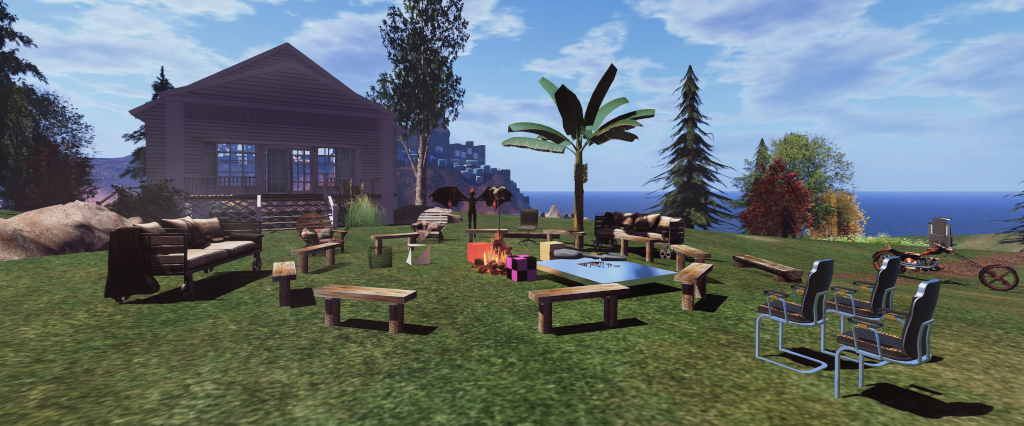
Hippotropolis Campsite: venue for CCUG meetings
The following notes were taken from:

  • My chat log of the Content Creation User Group (CCUG) meeting of Thursday, January 15th, 2026 and my chat log of that meeting
  • Pantera’s video (embedded at the end of this article) and my chat log of the Open-Source Developer meeting held on Friday, January 16th, 2026.
Table of Contents

Please note that this is not a full transcript of either meeting but a summary of key topics.

Meeting Purpose

  • The CCUG meeting is for discussion of work related to content creation in Second Life, including current and upcoming LL projects, and encompasses requests or comments from the community, together with related viewer development work.
    • This meeting is generally held on alternate Thursdays at Hippotropolis and is held in a mix of Voice and text chat.
  • The OSUG meeting is a combining of the former Third Party Viewer Developer meeting and the Open Source Development meetings. It is open discussion of Second Life development, including but not limited to open source contributions, third-party viewer development and policy, and current open source programs.
    • This meeting is generally held twice a month on a Friday, at 13:00 SLT at the Hippotropolis Theatre and is generally text chat only.
  • Dates and times of meetings are recorded in the SL Public Calendar.

Official Viewer Status

  • Default viewer 2025.08 – 7.2.3.19375695301 – maintenance update with bug fixes and quality of life improvements – December 2 – No Change.
    • Notable addition: new VHACD-based convex decomposition library for mesh uploads.
  • Second Life Project Lua Editor Alpha version 7.2.3.19911032641, December 5 –  No Change.
  • Second Life Project Voice Moderation viewer 26.1.0.20139269477, December 12 – No Change.
    • Introduces the ability to moderate spatial voice chat in regions configured to use webRTC voice.

Upcoming Viewers

Viewer 2026.01 – One-click Installer / Updater

Viewer 2026.01 is in progress. This will include:

  • Improved bugsplat support (we want better reporting for freezes, and just generally better crash reporting). This work builds on the successes of 2025 in detailing with viewer crashes and reducing overall causes for crashes.
  • A new one-click installer, which in brief:
    • Will be powered by a new dependency called velopack, and will allow a single-click installation of the viewer (with a brief pop-up message), with the viewer launching once the install process is complete.
    • Will default to installing under Apps/Local on windows; will remain as a drag-and-drop process on Mac OS, while Linux is currently TBD. It will still be possible to install the viewer to a custom location, initially via a command line argument.
    • Will not change the install location of config files, or anything that counts as user data.
  • Development work on this did hit a delay, which has now been cleared, the hope remaining to get an Alpha (previously known as Project) viewer out with the update code in place sooner rather than later.
  • As an added benefit to the switch to velopack for TPVs, LL will be providing a solution to add auto-update functionality to TPV projects, if TPVs wish to leverage it. More information on this is due to be made available in the next week or so.

Viewer 2026.02 – “Flat” UI, Font Changes

  • This viewer is to be part of the Lab’s “first impressions” push to make SL resonate more with incoming new users and hopefully encourage them to keep logging in.
  • This first impression work is on multiple fronts, and for the 2026.02 viewer will be a switch to the “flat” UI seen in the Project Zero (viewer in a browser) version which comprises things like a font change, a colour scheme change,  and generally giving the viewer a more “modern” look and feel.
  • The font update:
      • Should not impact people’s use of unicode.
    • Will require XUI updates which will likely require updates for TPVs using their own custom XUI – TPVs are advised to keep an eye on Discord and Github for more information on these changes as they develop, and to particularly track this github issue.

General Viewer Notes

  • Linux support will likely ship as a part of the in-progress SLua beta viewer.
  • The viewer development roadmap is still being worked on in terms of fixes and updates and actioning feature requests, the focus being to work these into the viewer without disrupting major initiatives the Lab is looking to develop (such as the “first impressions” drive).
  • 2026.02 might include some screen space reflections (SSR) updates to help improve the appearance of Linden Water under PDR/HDR.
  • The avatar appearance fixes contributed by Kitty Barnett and intended to make the current outfit folder more reliable when changing outfits, messing with outfits, etc., may get to see the light of day in viewer 2026.03 – but this had yet to be confirmed.

Grid-Wide WebRTC Deployment – Initial Announcement (OSD Meeting)

  • The Lab is currently looking at a March deployment of WebRTC voice across the grid.
  • The schedule is not firmly set as yet, but will follow the usual server-side deployment routine: first to one (or more) simulator RC channels, then to all simulator RC channels (if not all rolled at once), and then a week after this, deployment to the Main simulator channel.
  • The important point in this is that once grid-wide, WebRTC will completely supplant Vivox Voice, and those who use Voice by who are not running a WebRTC voice capable viewer (which generally means anyone not on a non-PBR supporting viewer) will be unable to use Voice.
    • This does not mean that the Vivox service will be immediately shut-down. It will remain an option for the Lab to re-enable until such time as LL is confident in the WebRTC service and no surprises have come to light.
  • There is one remaining WebRTC critical issue in the viewer that makes the experience not great for a small body of users:
    • People with certain network characteristics may see a dropout because the WebRTC provider is not properly handling renegotiation.
    • LL has a fix which should be deployed with viewer 2026.01. However, TPVs wishing to merge it now can do so via Pull Request 5126.
  • In the meantime, the beta for WebRTC has expanded – see this official blog post for details.
  • Roxie Linden also indicated that LL is experimenting with speech-to-text using WebRTC, but does not as yet have anything available for public demonstrations.
  • The issue of Linux builds not using Pulseaudio but with the WebRTC code crashing on start-up was reiterated at the meeting. Whilst this might not be a widespread issue, the feeling was that it should be looked at; however, if the pool of impacted users is liable to be very small, it will not be seen as a reason to block / delay WebRTC deployment as a whole and any fix is liable to be prioritised in terms of resources / impact of the issue, post-deployment.

General Discussion – Both Meetings

  • Avatar support related:
    • Shape key support and / or custom bone hierarchies – seen as complex area of work, and not being looked at.
    • While the current avatar does technically use shape keys, it is very different to how modern blend shapes are used.
    • SL’s internal format also doesn’t store bones.
  • Questions were raised on the status of game_control. This is more a subject for the Simulator User Group meetings, where Leviathan Linden indicated he was trying to resume work on the code. However, it was also indicated during this meeting that Leviathan had again been “borrowed” to work on other code.
  • Despite rumour to the contrary, Puppetry is not currently set for revival or on the current 2026 roadmap.
  • Geenz noted that while work on things like new tools, updates to the GLTF uploader, etc., are not “done”, the focus for the time being in more on dealing with technical debt together with the aforementioned “first impressions” initiative, etc.
  • Questions were asked on auto / planar-aligning PBR materials  – see: Aligning Faces when using PBR and Planar face alignment with PBR GLTF materials. This is something the Lab has yet to resolve, and has offered a contribution bounty for any developer who is able to provide a solution. Geenz also indicated he would try to get bugs like this better prioritised.
  • A general discussion on ideas for improvements to chat, including: ability to have a “last unread” indicator in chat when logging-on; having the chat rings on the mini-Map on by default, some idea about a special chat tab that would allow region-wide chat (presumably at the region owner’s discretion to enable), ability to correct text in chat / IM after sending(!), etc.
  • The You Tube embedding issues was again raised (see here for more), with a possible (if hacky) workaround. LL are looking to You tube to address the problem, as they created it.
  • There was a general discussion on the complexities of Land Impact, particularly – but not restricted to – mesh objects. In short, LI is a complicated subject, and not easily addressed; hence why the Lab backed away from the subject recently. This also strayed into the equally complicated realm of LOD generation.
    • On the subject of LOD generation, it was suggested that the Lab should look to implement a LOD generator and then inform creators LODs have to be generated  to fit a defined set of criteria – or defaults will be forced.
  • A discussion on the choice of VHACD over HACD as a replacement for Havok in mesh decomposition. The latter is seen as more mature, but LL opted for VHACD is a “middle ground” solution as it is more regularly maintained, it is also apparently more reliable when dealing with the “weirder meshes” some SL creators produce, when compared to something like CoACD. However, Geenz indicated it would be “nice” to have “swappable”  convex decomposition solutions at runtime.
  • A further request for Error creating thumbnail” message on SL wiki, breaking images  to be addressed.

Next Meetings